
Life, 1888-02-02 · page 10 of 16
Life — February 2, 1888 — page 10: what you’re looking at
What you’re looking at
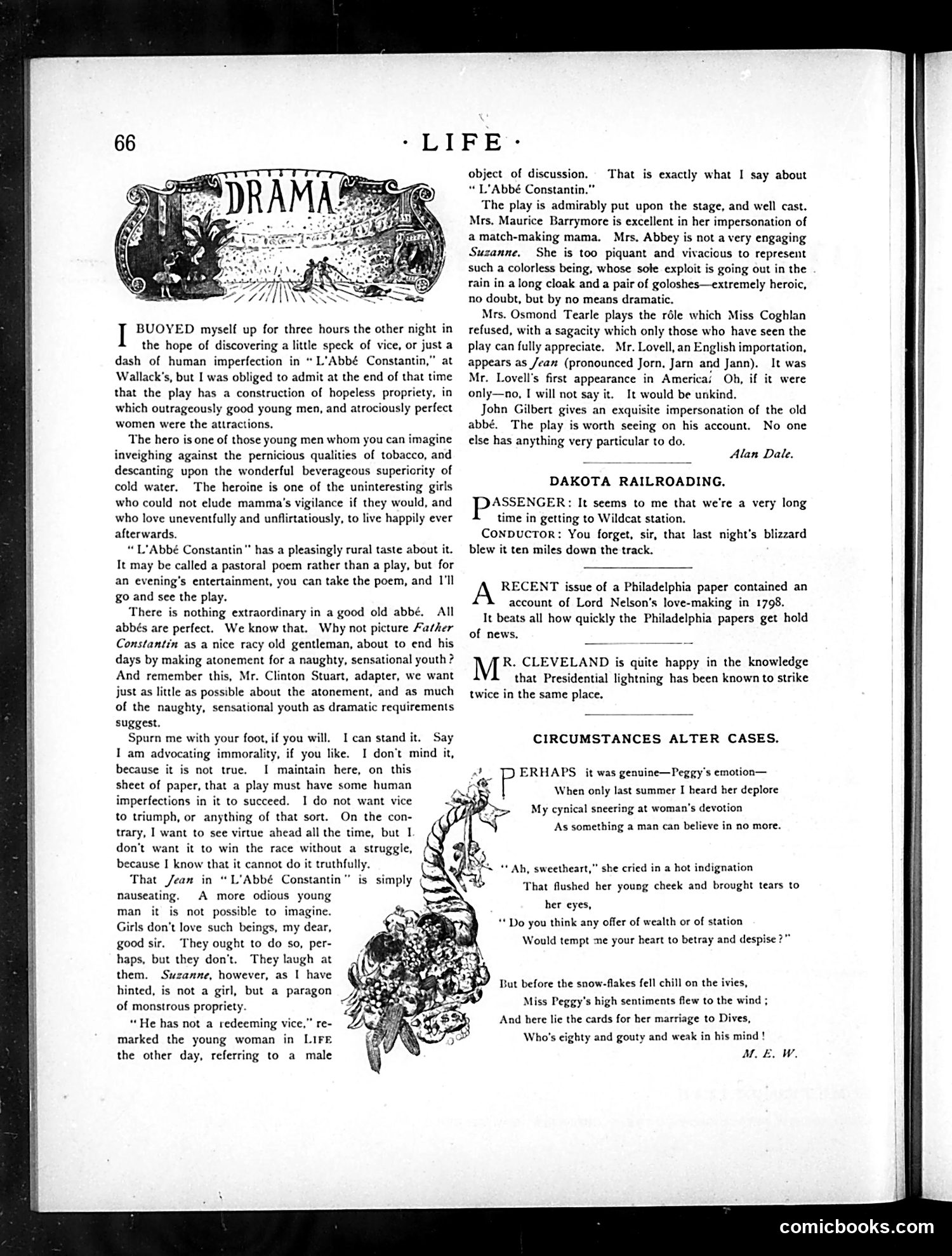
This page contains theatrical and social commentary rather than political cartoons. The main content includes: **"L'Abbé Constantin" review**: A drama critique discussing a stage play about an elderly abbé (Catholic priest). The reviewer critiques the heroine "Suzanne" as too vivacious and the character "Jean" as nauseatingly pious—advocating that plays should portray human imperfection rather than idealized virtue. **Supporting items**: Brief satirical notes about railroad delays and Presidential lightning strikes. **Illustration**: A decorative sketch accompanying "Circumstances Alter Cases," a poem about a woman (Peggy) who rejects a suitor when his fortune declines, marrying a wealthy but feeble man instead—mocking mercenary marriage attitudes. The page primarily offers social satire of theatrical conventions and romantic hypocrisy rather than political commentary.
📄 Transcribed text from this page (OCR, searchable)
Machine-transcribed from the original scan — historical spelling and the odd misread are preserved.
- LIFE’: BUOYED myself up for three hours the other night in the hope of discovering a little speck of vice, or just a dash of human imperfection in “ L’Abbé Constantin,” at Wallack’s, but I was obliged to admit at the end of that time that the play has a construction of hopeless propriety, in which outrageously good young men, and atrociously perfect women were the attractions. The hero is one of those young men whom you can imagine inveighing against the pernicious qualities of tobacco, and descanting upon the wonderful beverageous superiority of cold water. The heroine is one of the uninteresting girls who could not elude mamma's vigilance if they would, and who love uneventfully and unflirtatiously, to live happily ever afterwards. “ L'Abbé Constantin” has a pleasingly rural taste about it. It may be called a pastoral poem rather than a play, but for an evening's entertainment, you can take the poem, and 1'll go and see the play. There is nothing extraordinary in a good old abbé. All abbés are perfect. We know that. Why not picture Father Constantin as a nice racy old gentleman, about to end his days by making atonement for a naughty, sensational youth ? And remember this, Mr. Clinton Stuart, adapter, we want just as little as possible about the atonement, and as much of the naughty, sensational youth as dramatic requirements suggest. Spurn me with your foot, if you will. I can stand it. Say I am advocating immorality, if you like. I don’t mind it, because it is not true. I maintain here, on this sheet of paper, that a play must have some human imperfections in it to succeed. I do not want vice to triumph, or anything of that sort. On the con- trary, 1 want to see virtue ahead all the time, but 1 don’t want it to win the race without a struggle, because I know that it cannot do it truthfully. That Jean in “L'Abbé Constantin” nauseating. A more odious young man it is not possible to imagine. Girls don’t love such beings, my dear, good sir. They ought to do so, per- haps, but they don’t. They laugh at them. Swzanne, however, as | have hinted, is not a girl, but a paragon of monstrous propriety. “He has not a redeeming vice,” re- marked the young woman in LIFE the other day, referring to a male object of discussion. “ L'Abbé Constantin.” The play is admirably put upon the stage, and well cast. Mrs. Maurice Barrymore is excellent in her impersonation of a match-making mama. Mrs, Abbey is not a very engaging Suzanne. She is too piquant and vivacious to represent such a colorless being, whose sole exploit is going out in the rain in a long cloak and a pair of goloshes—extremely heroic, no doubt, but by no means dramatic. Mrs. Osmond Tearle plays the réle which Miss Coghlan refused, with a sagacity which only those who have seen the play can fully appreciate. Mr. Lovell, an English importation, appears as /ean (pronounced Jorn, Jarn and Jann). It was Mr. Lovell’s first appearance in America’ Oh, if it were only—no, I will not say it. It would be unkind. John Gilbert gives an exquisite impersonation of the old abbé. The play is worth seeing on his account. No one else has anything very particular to do. That is exactly what I say about Alan Dale. DAKOTA RAILROADING. PASSENGER: It seems to me that we're a very long time in getting to Wildcat station. Conbuctor: You forget, sir, that last night's blizzard blew it ten miles down the track. RECENT issue of a Philadelphia paper contained an account of Lord Nelson’s love-making in 1798. It beats all how quickly the Philadelphia papers get hold of news. R, CLEVELAND is quite happy in the knowledge that Presidential lightning has been known to strike twice in the same place. CIRCUMSTANCES ALTER CASES. _ DERHAPS it was genuine—Peggy's emotion— « P When only last summer I heard her deplore My cynical sneering at woman's devotion As something a man can believe in no more. “* Ah, sweetheart,” she cried in a hot indignation That flushed her young cheek and brought tears to her eyes, “Do you think any offer of wealth or of station Would tempt me your heart to betray and despise?” But before the snow-flakes fell chill on the ivies, Miss Peggy's high sentiments flew to the wind ; And here lie the cards for her marriage to Dives, Who's eighty and gouty and weak in his mind ! MEL W. comicbooks.com