
Life, 1888-02-02 · page 2 of 16
Life — February 2, 1888 — page 2: what you’re looking at
What you’re looking at
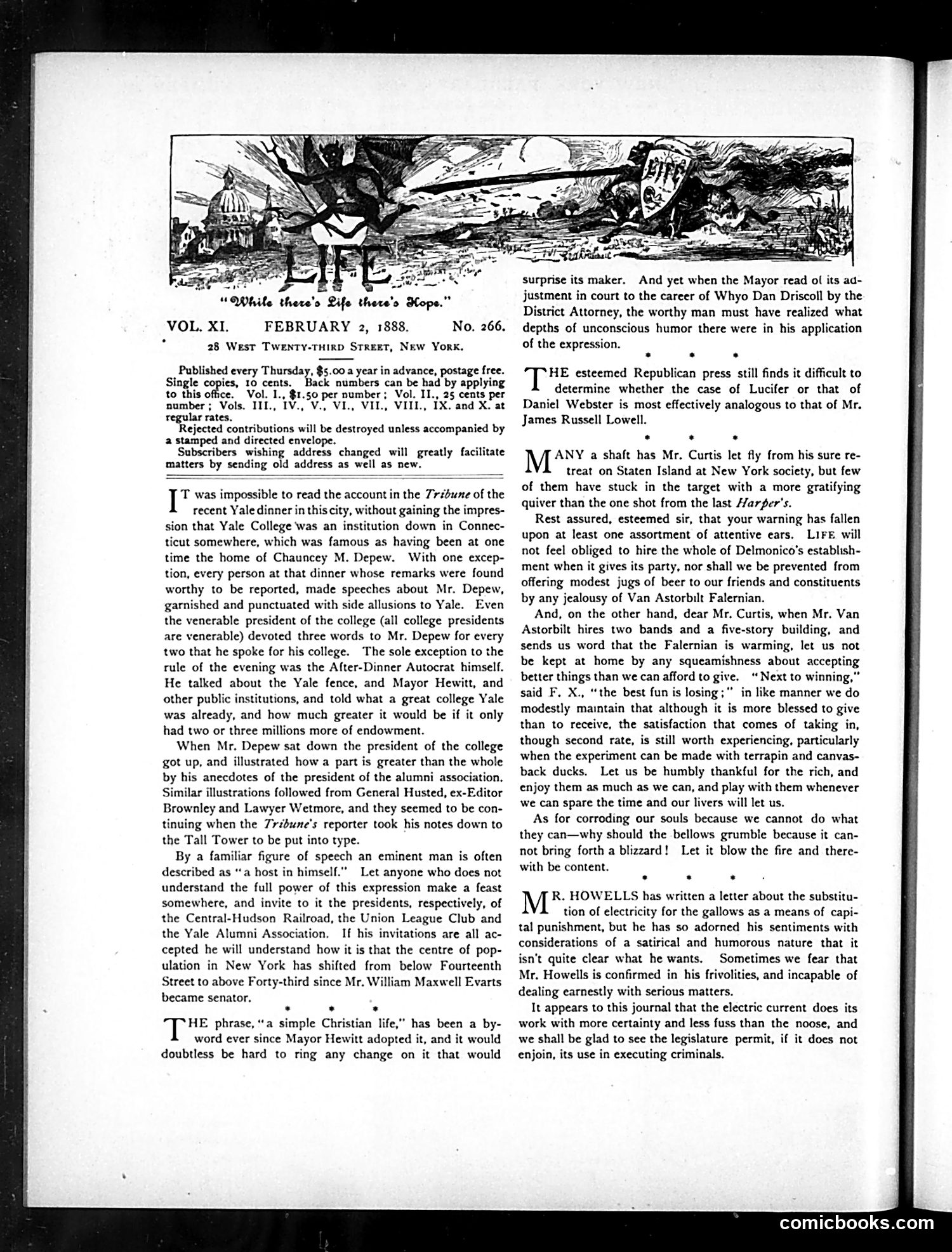
The masthead cartoon depicts a figure in formal dress seated beneath a large tree, with a cityscape and moon in the background. The accompanying text references Yale College, Mayor Hewitt, and a recent Yale dinner in New York, discussing remarks made by college President (whose name appears garbled in OCR). The satire critiques a phrase adopted by Mayor Hewitt: "a simple Christian life." The editors mock how this expression, while noble-sounding, has become so overused that it's lost meaning—likening it to a "host in himself," suggesting anyone claiming to live such a life should prove it through substantive action rather than mere words. The cartoon appears to illustrate this theme of empty rhetoric versus authentic living, though the specific figure remains unclear from the image alone.
📄 Transcribed text from this page (OCR, searchable)
Machine-transcribed from the original scan — historical spelling and the odd misread are preserved.
“Mhile there's Life there's Hope.” VOL. XI. FEBRUARY 2, 1888. No. 266, 28 West Twenty-THIRD STREET, New York. Published every Thursday, $5.00 a year in advance, postage free. Single copies, 10 cents. Back numbers can be had by applying to this office. Vol. 1., $1.50 per number; Vol. II., 25 cents per number; Vols. III., IV., V., VI., VIL, VIII, IX. and X. at regular rates. Rejected contributions will be destroyed unless accompanied by a stamped and directed envelope. Subscribers wishing address changed will greatly facilitate matters by ding old address as well T was impossible to read the account in the 7rséune of the recent Yale dinner in this city, without gaining the impres- sion that Yale College was an institution down in Connec- ticut somewhere, which was famous as having been at one time the home of Chauncey M. Depew. With one excep- tion, every person at that dinner whose remarks were found worthy to be reported, made speeches about Mr. Depew, garnished and punctuated with side allusions to Yale. Even the venerable president of the college (all college presidents are venerable) devoted three words to Mr. Depew for every two that he spoke for his college. The sole exception to the rule of the evening was the After-Dinner Autocrat himself. He talked about the Yale fence, and Mayor Hewitt, and other public institutions, and told what a great college Yale was already, and how much greater it would be if it only had two or three millions more of endowment. When Mr. Depew sat down the president of the college got up, and illustrated how a part is greater than the whole by his anecdotes of the president of the alumni association. Similar illustrations followed from General Husted, ex-Editor Brownley and Lawyer Wetmore, and they seemed to be con- tinuing when the 7rzbune's reporter took his notes down to the Tall Tower to be put into type. By a familiar figure of speech an eminent man is often described as “a host in himself.” Let anyone who does not understand the full power of this expression make a feast somewhere, and invite to it the presidents, respectively, of the Central-Hudson Railroad, the Union League Club and the Yale Alumni Association. If his invitations are all ac- cepted he will understand how it is that the centre of pop- ulation in New York has shifted from below Fourteenth Street to above Forty-third since Mr. William Maxwell Evarts became senator. . . . HE phrase, “a simple Christian life,” has been a by- word ever since Mayor Hewitt adopted it, and it would doubtless be hard to ring any change on it that would Surprise its maker. And yet when the Mayor read ol its ad- justment in court to the career of Whyo Dan Driscoll by the District Attorney, the worthy man must have realized what depths of unconscious humor there were in his application of the expression. . . . HE esteemed Republican press still finds it difficult to determine whether the case of Lucifer or that of Daniel Webster is most effectively analogous to that of Mr. James Russell Lowell. M ANY a shaft has Mr. Curtis let fly from his sure re- treat on Staten Island at New York society, but few of them have stuck in the target with a more gratifying quiver than the one shot from the last Harper's. Rest assured, esteemed sir, that your warning has fallen upon at least one assortment of attentive ears. LIFE will not feel obliged to hire the whole of Delmonico’s establish- ment when it gives its party, nor shall we be prevented from offering modest jugs of beer to our friends and constituents by any jealousy of Van Astorbilt Falernian. And, on the other hand, dear Mr. Curtis, when Mr. Van Astorbilt hires two bands and a five-story building, and sends us word that the Falernian is warming, let us not be kept at home by any squeamishness about accepting better things than we can afford to gi “Next to winning,” said F, X., “the best fun is losin; in like manner we do modestly maintain that although it is more blessed to give than to receive, the satisfaction that comes of taking in, though second rate, is still worth experiencing, particularly when the experiment can be made with terrapin and canvas- back ducks. Let us be humbly thankful for the rich, and enjoy them as much as we can, and play with them whenever we can spare the time and our livers will let us. As for corroding our souls because we cannot do what they can—why should the bellows grumble because it can- not bring forth a blizzard! Let it blow the fire and there- with be content. R. HOWELLS has written a letter about the substitu- tion of electricity for the gallows as a means of capi- tal punishment, but he has so adorned his sentiments with considerations of a satirical and humorous nature that it isn’t quite clear what he wants, Sometimes we fear that Mr. Howells is confirmed in his frivolities, and incapable of dealing earnestly with serious matters. It appears to this journal that the electric current does its work with more certainty and less fuss than the noose, and we shall be glad to see the legislature permit, if it does not enjoin, its use in executing criminals, comicbooks.com