
A complete issue · 16 pages · 1888
Life — January 19, 1888
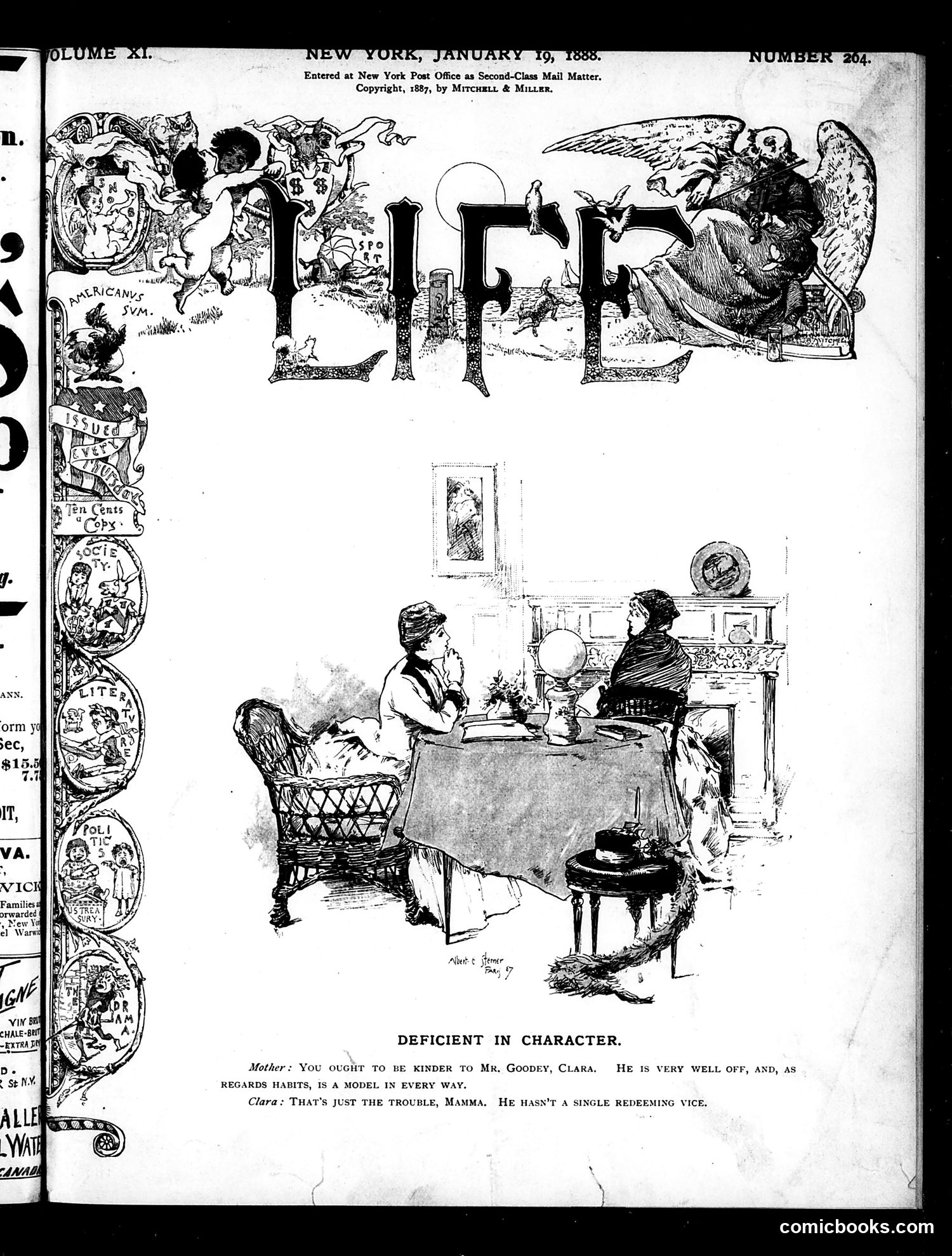
This 1888 *Life* magazine cartoon satirizes a social conflict between a mother and daughter over the daughter Clara's relationship with a man named Mr. Goodey. The mother defends Goodey as "well off" and "a model in every way," emphasizing his financial status and respectability. Clara counters that despite his wealth, he "hasn't a single redeeming vice"—implying he's boring or lacking vitality. The joke targets Victorian-era social expectations: mothers prioritized suitors' economic stability and outward propriety, while younger women desired more personality or excitement. Clara's complaint that moral perfection equals dullness satirizes the rigid respectability culture of the era, suggesting that absolute virtue can be unattractive.
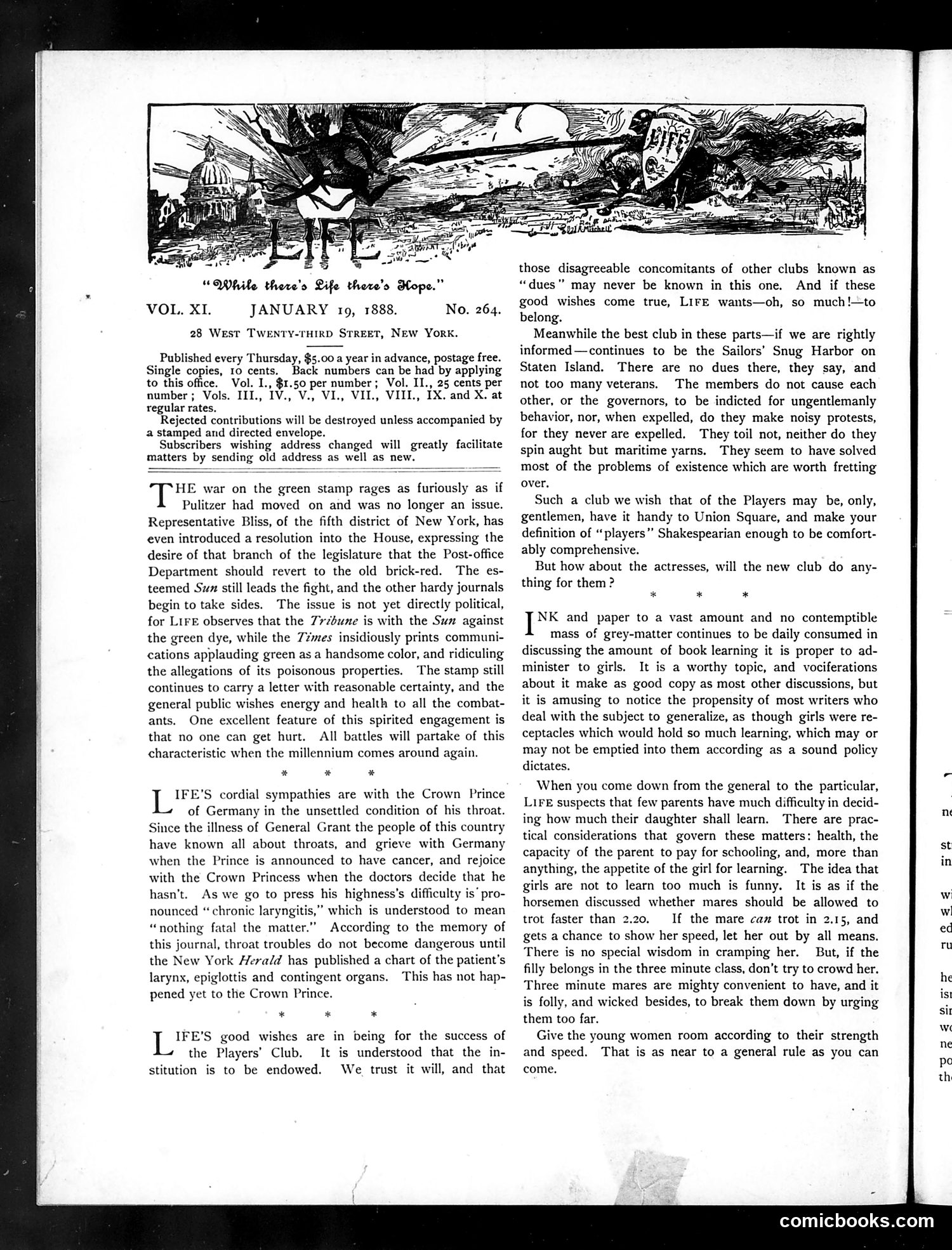
The ornamental header cartoon depicts a chaotic scene with what appears to be a large figure or monument being toppled or destroyed, with classical buildings and landscapes in the background. The caption reads "While there's Life there's Hope." The imagery likely satirizes the "green stamp" controversy mentioned in the text—a political battle over postage stamp design involving the Post-office Department and competing newspapers (the *Sun* and *Tribune*). The toppling structure may represent institutional disruption caused by this bureaucratic dispute. The cartoon's apocalyptic tone reflects the text's observation that this seemingly minor administrative issue has become unexpectedly contentious, with various factions fighting over symbolic control and policy direction—hence the somewhat overwrought visual metaphor of institutional collapse.
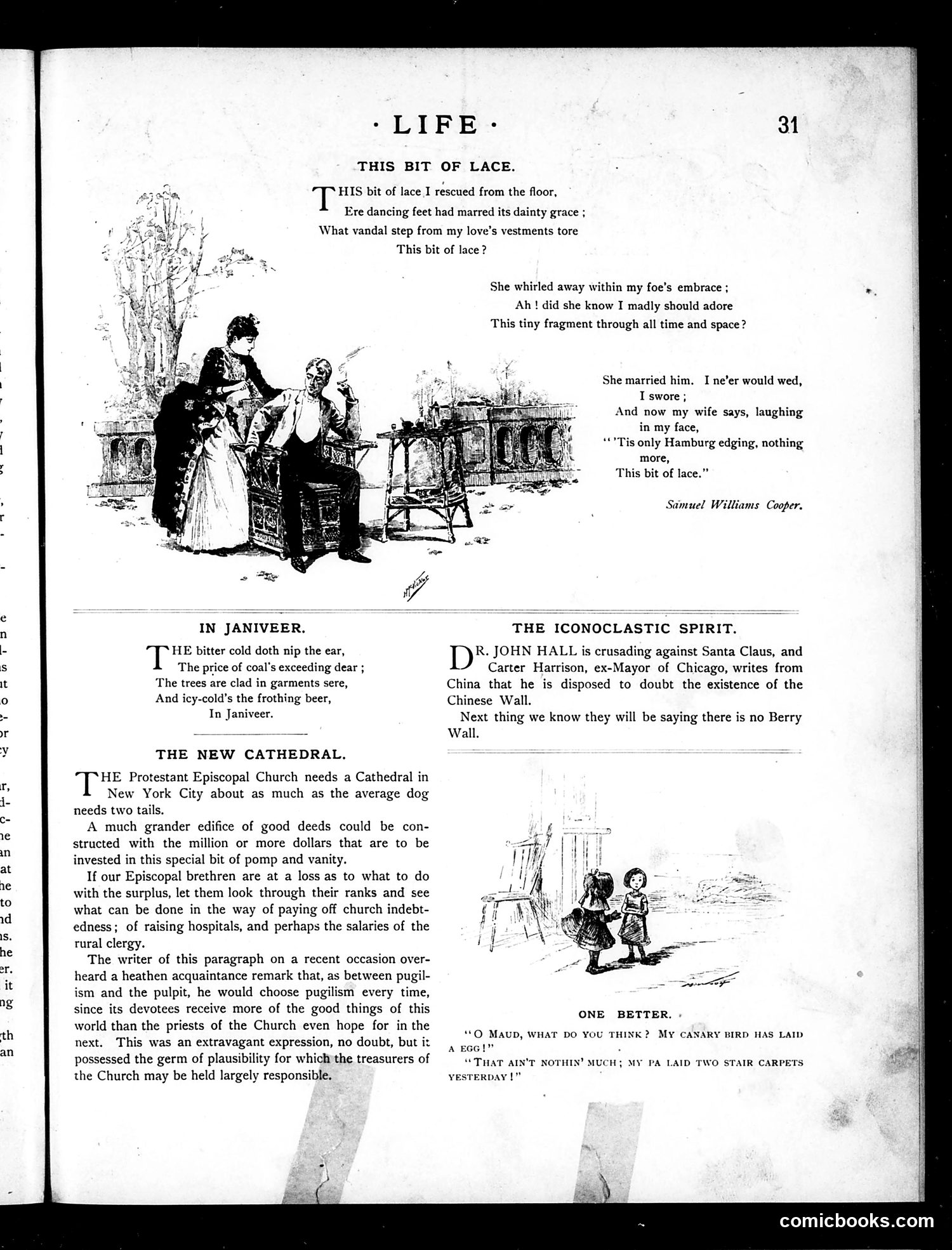
**"This Bit of Lace"** (top): A sentimental poem by Samuel Williams Cooper about a preserved piece of lace from a lover's garment. The accompanying illustration shows a couple and man examining the cherished item. This reflects Victorian-era sentimentality about romantic keepsakes and lost love. **"In Janiveer"**: A brief humorous poem about winter's harsh conditions. **"The Iconoclastic Spirit"**: A short satirical note mocking Dr. John Hall's campaign against Santa Claus, predicting similar attacks on other American icons (the Chinese Wall, Berry Wall). This lampoons excessive reformist zeal. **"The New Cathedral"**: Satirizes Episcopal Church leaders debating how to spend surplus funds on a cathedral, when the money could address poverty and church debt instead. **"One Better"**: A humorous illustration and caption about competing exaggerations regarding household expenses.
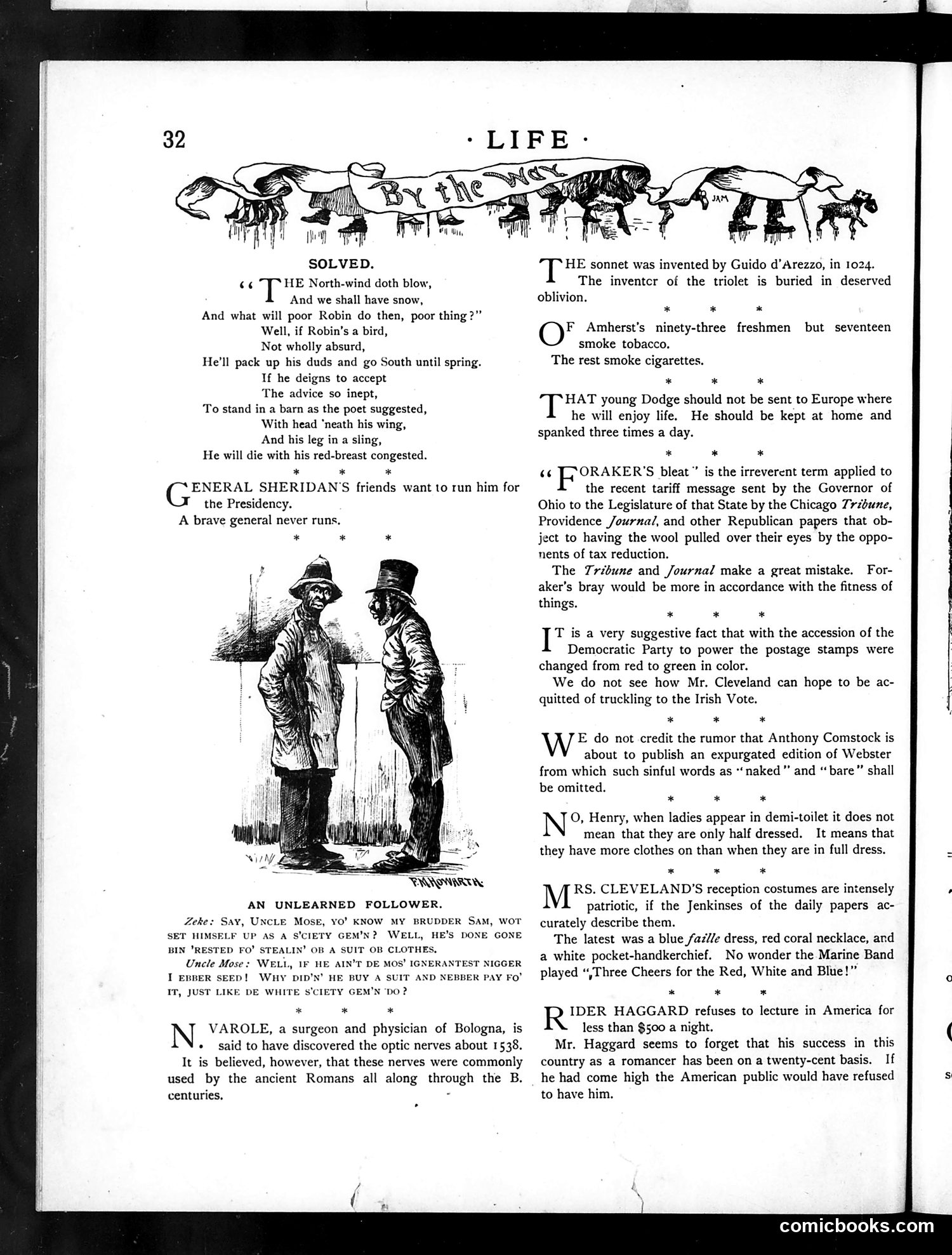
This satirical cartoon depicts two men in conversation, likely from the 1880s-90s based on Life magazine's style. The caption mocks a political follower who uncritically imitates his leader. The humor targets someone ("Sam") who adopted a wealthy man's mannerisms and appearance without understanding them—buying an expensive suit and top hat despite not understanding their purpose. The follower merely apes superficial status markers without grasping why. This reflects common 19th-century satire about class pretension and blind party loyalty. The cartoon ridicules both social climbers who mimic their betters and political supporters who follow leaders without independent thought. The detailed caption emphasizes the absurdity of mimicry divorced from actual understanding.
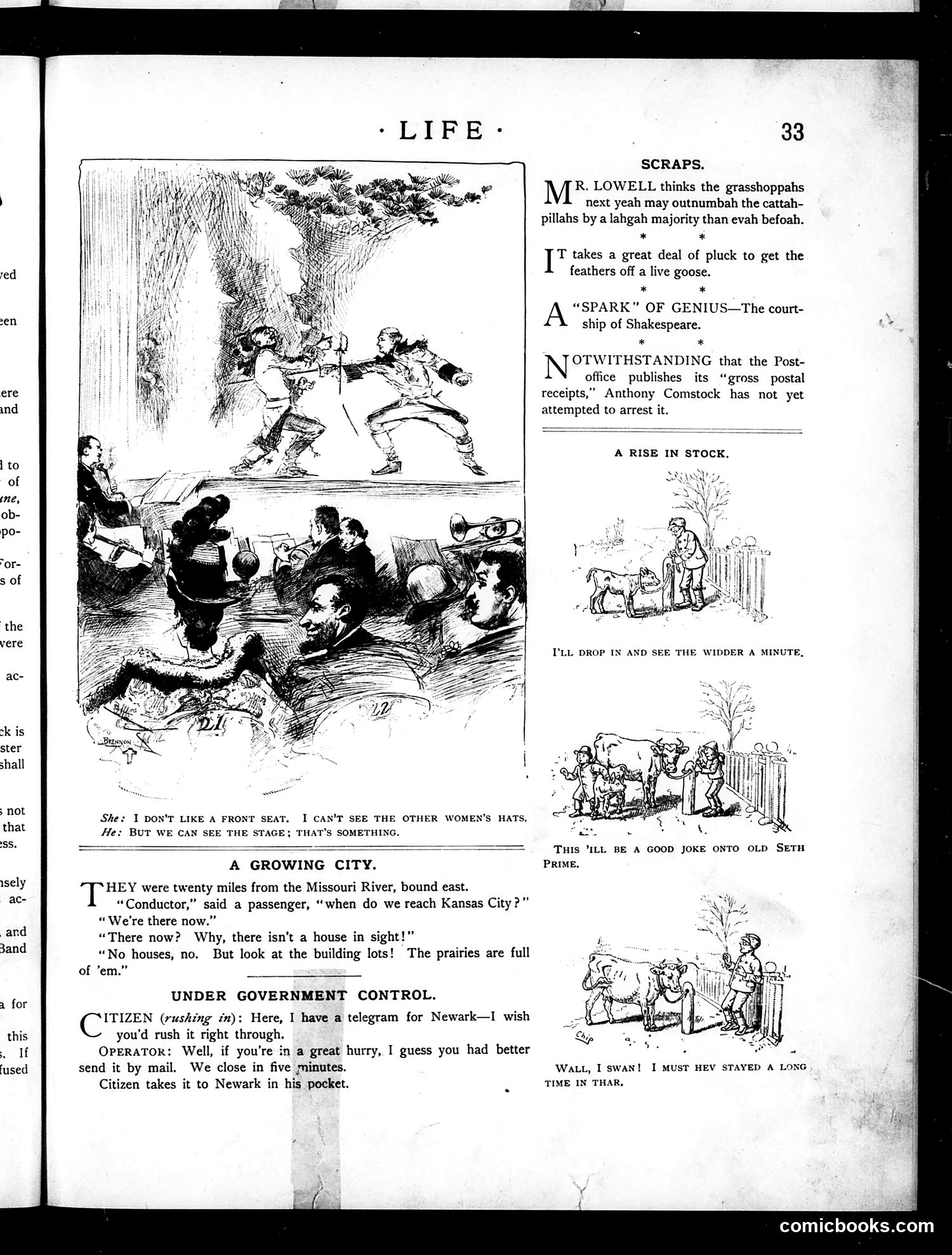
The page contains several unrelated satirical items typical of Life's format: **Top cartoon**: Shows theatrical acrobats performing for an audience. The caption jokes about a woman's frustration at a "frost seat" where she can't see other patrons' hats—suggesting the humor involves theater etiquette and audience obstructions. **"A Growing City"**: A brief dialogue about Kansas City's rapid development, with prairie building lots replacing natural landscape—satirizing frontier expansion and urban growth. **"Under Government Control"**: Depicts a citizen rushing to send a telegram through the Post Office, with an operator suggesting mail would be faster. This likely satirizes postal bureaucratic inefficiency or slow government services. The smaller sketches labeled "A Rise in Stock" appear to show rural or pastoral scenes, though their specific satirical point is unclear from the visible text.
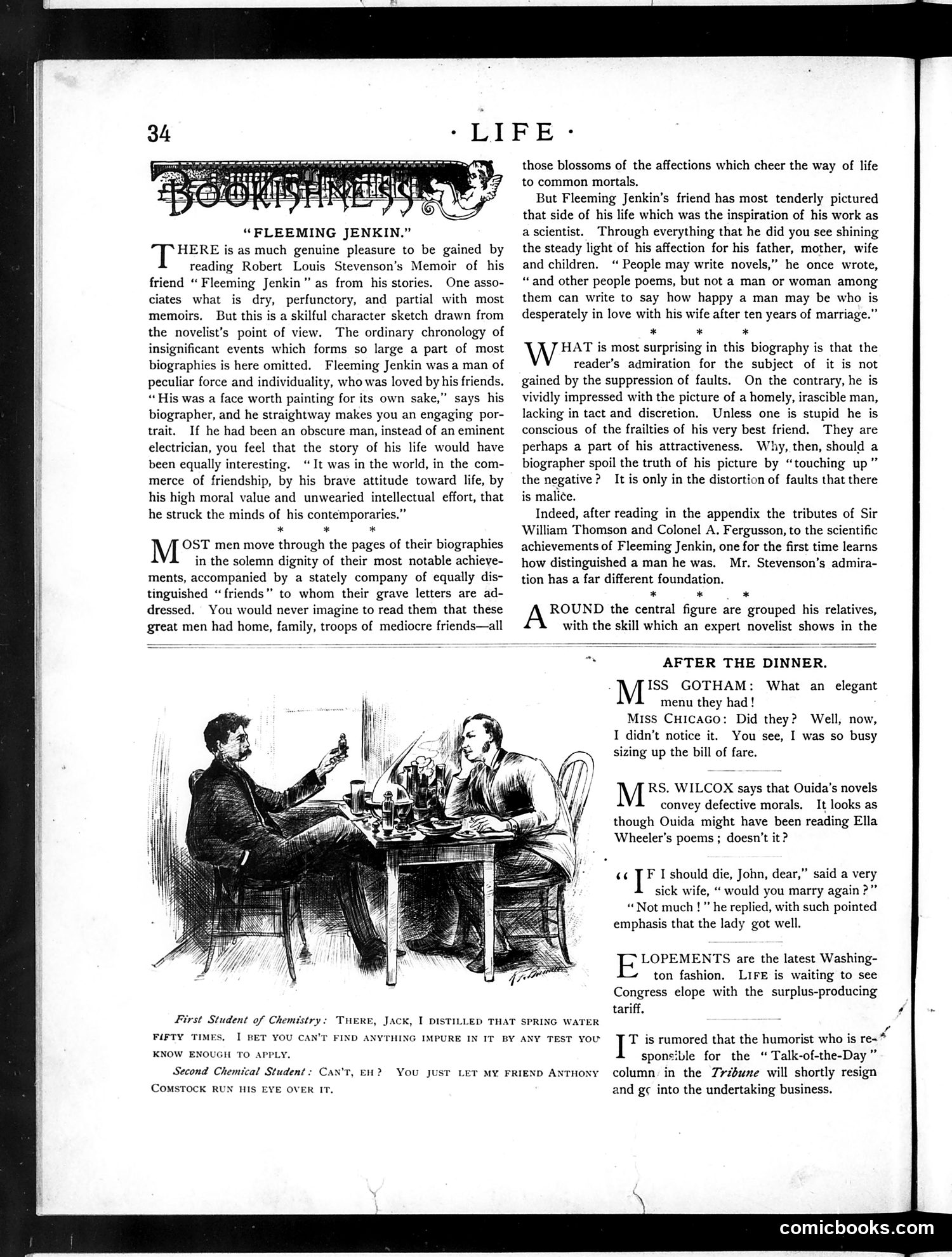
This page contains a literary essay about "Flemming Jenkin," praising Robert Louis Stevenson's biographical sketch of this Scottish engineer and friend. The essay celebrates Jenkin as an unpretentious but morally admirable figure whose life story, though lacking dramatic achievements, demonstrates genuine human value through integrity and affection for family. The cartoon below titled "After the Dinner" depicts two men in conversation at a table. It's a humorous exchange between chemistry students debating whether spring water is chemically pure—a lighthearted academic joke about laboratory standards and pedantic arguing among scholars. The page concludes with brief satirical notes on contemporary topics including Ouida's novels, elopements, and a Tribune humorist's rumored resignation—typical light social commentary of the era.
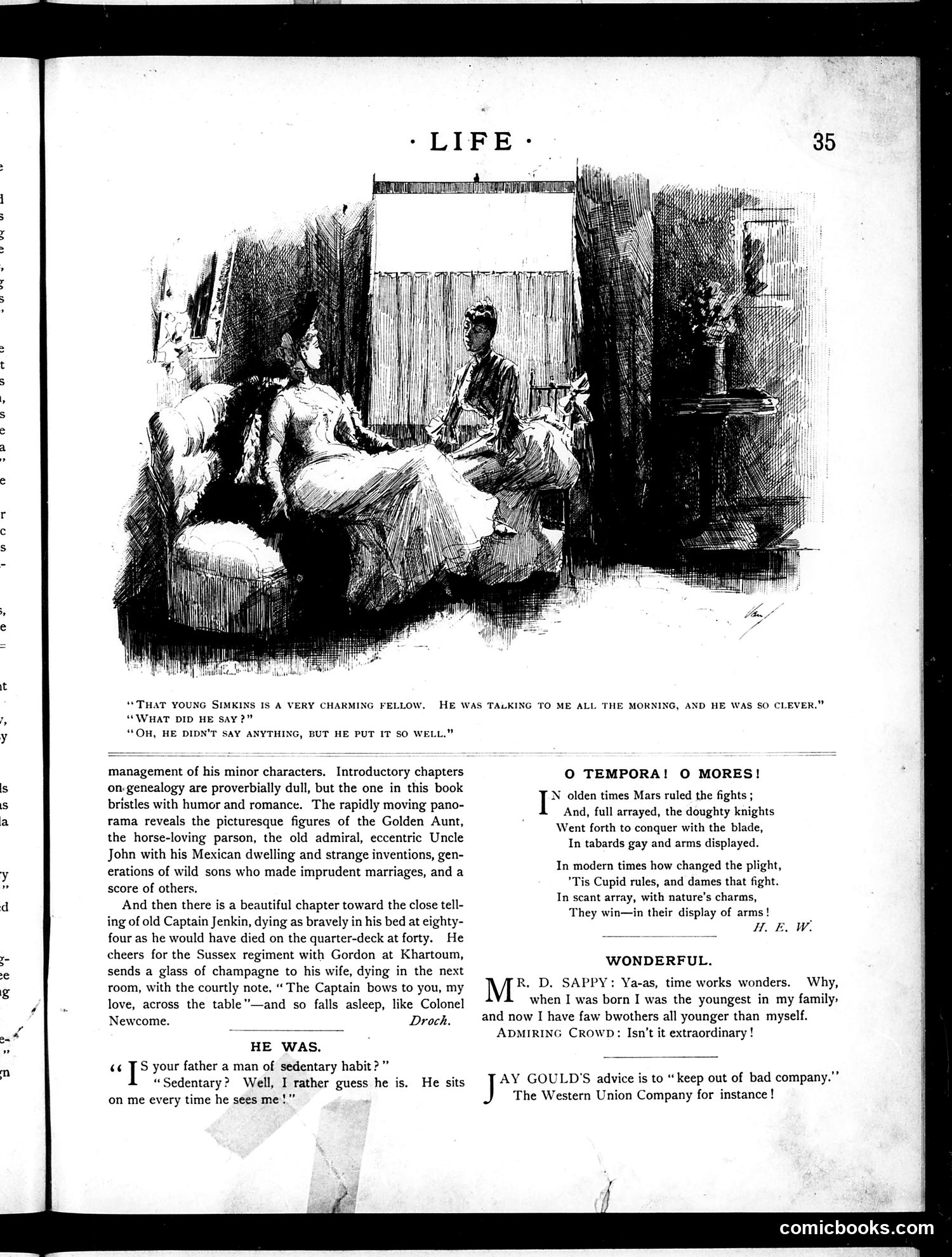
This page contains a sketch depicting a domestic interior scene with multiple figures in conversation. The illustration shows what appears to be social commentary on contemporary manners and conversation. Below the sketch are three short humorous pieces: 1. **"HE WAS"** - A brief joke about a sedentary father figure 2. **"O TEMPORA! O MORES!"** - A poem contrasting martial valor in ancient times with modern Cupid-dominated society 3. **"WONDERFUL"** and **"JAY GOULD'S advice"** - Short satirical quips The page lacks clear political figures or specific historical references. Instead, it appears to offer general social satire about Victorian-era manners, family dynamics, and contemporary society. The content criticizes idleness, excessive romanticism, and modern business practices (the Jay Gould reference) through light humor rather than sharp political commentary.
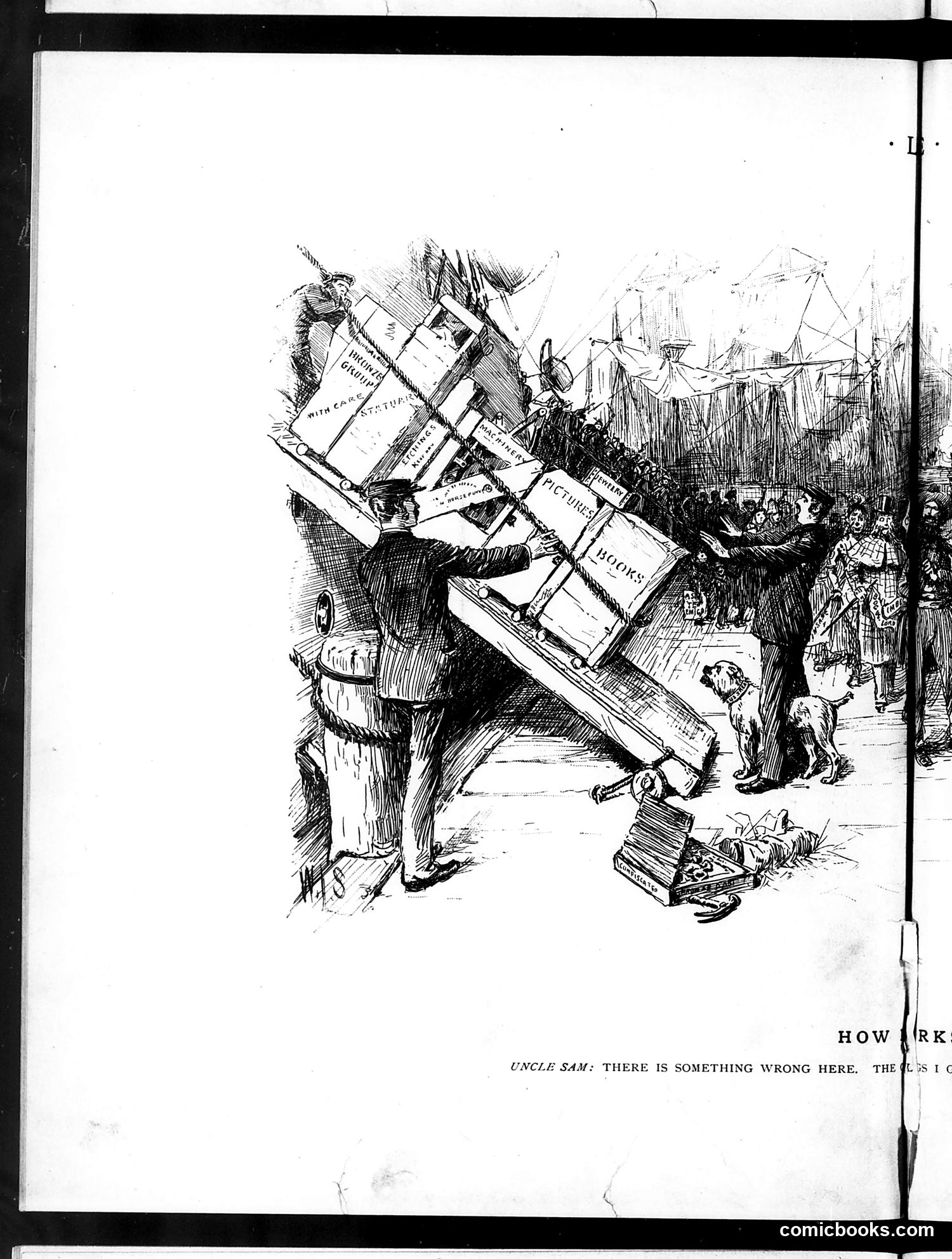
This cartoon depicts Uncle Sam (the bearded figure in formal dress) examining a precarious stack of labeled boxes that appear to represent different economic or political concerns—the text on the boxes is partially legible but unclear in this reproduction. The stack is dangerously unbalanced, suggesting structural instability or mismanagement. Uncle Sam's expression and gesture ("There is something wrong here") indicates alarm at the situation. The crowded harbor scene in the background, with ships and onlookers, suggests this relates to commerce or trade policy. The satire appears to critique economic mismanagement or an unstable political/economic structure built on shaky foundations. Without clearer box labels, the specific policy being targeted—likely tariffs, trade agreements, or financial arrangements—cannot be determined with certainty.
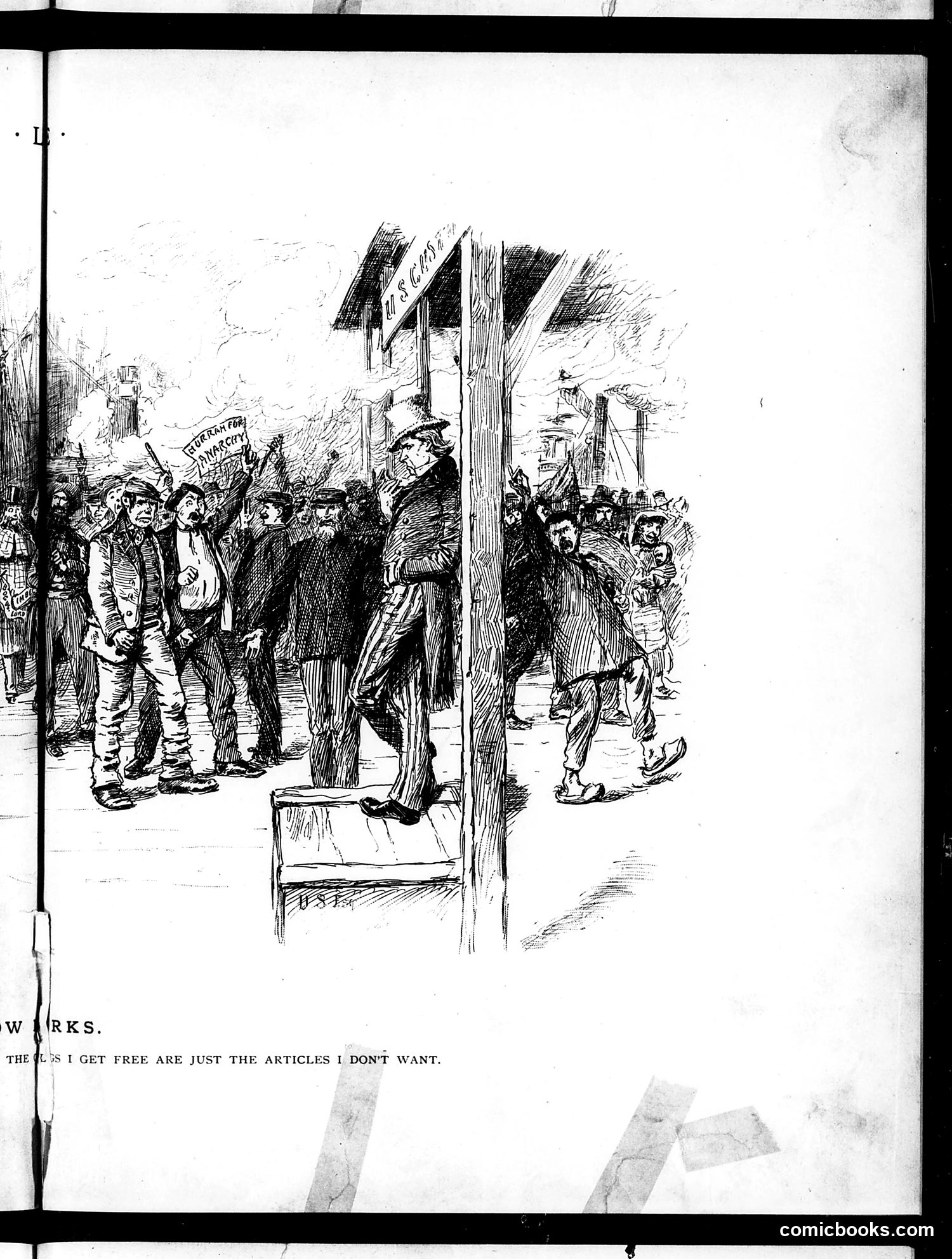
This sketch depicts a public execution by hanging, with a crowd gathered to witness it. The visible caption reads: "THE ONLY I GET FREE ARE JUST THE ARTICLES I DON'T WANT." The cartoon appears to satirize newspaper publishing or media practices, likely from the late 19th or early 20th century. The gallows scene serves as dark visual metaphor for the fate of unwanted or poor-quality newspaper content. The phrase suggests criticism of "free" materials—possibly advertisements, filler articles, or syndicated content—that publications are forced to include while unable to obtain the quality content they actually desire. The satirical point appears to target the contradictions and frustrations of newspaper economics during this era.
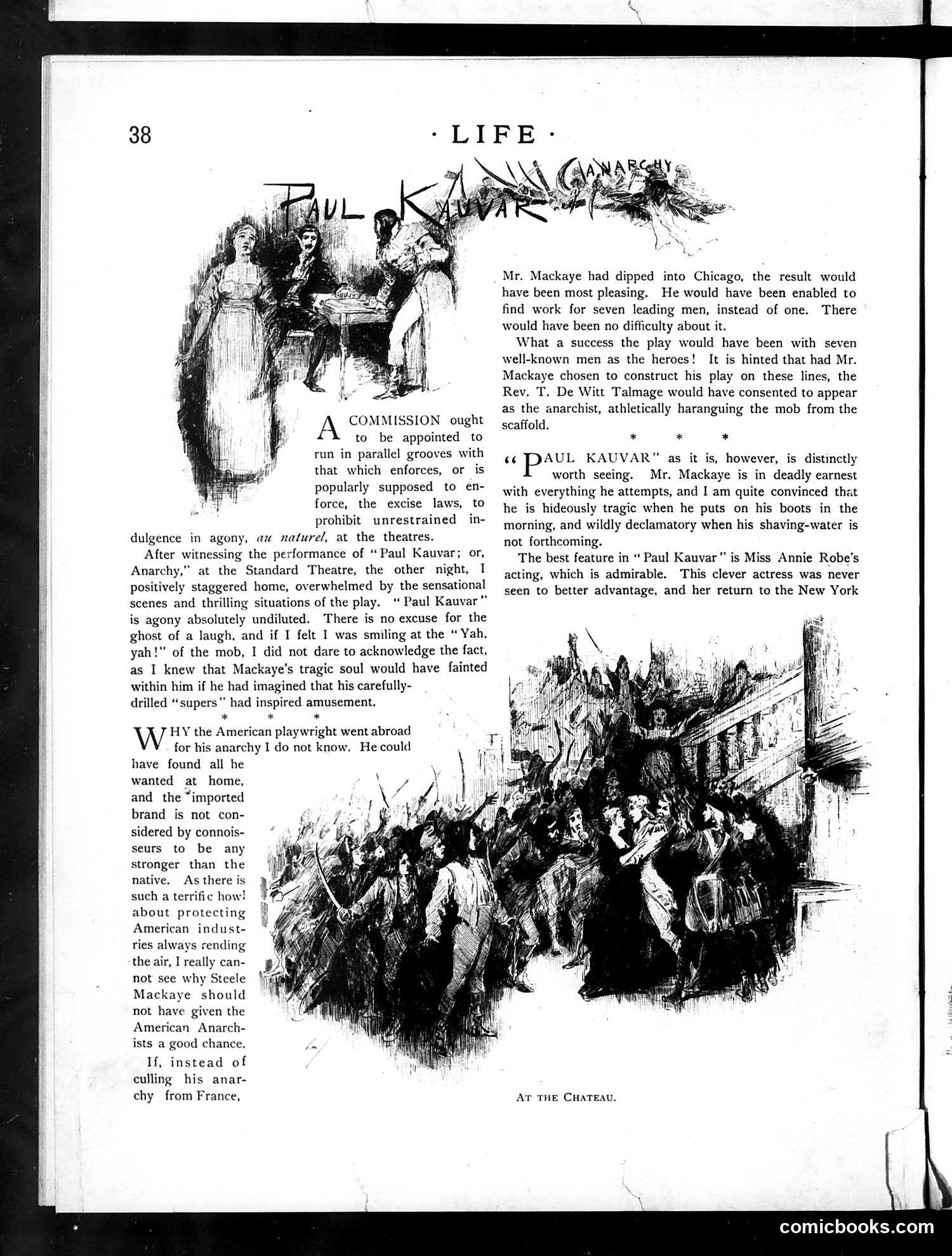
This page reviews "Paul Kauvar," a play by Steele Mackaye. The critic discusses the theatrical production, noting Mackaye's attempt to create a serious drama about anarchism ("Anarchy" at the Standard Theatre). The top illustration shows a scene from the play's drawing room setting. The lower illustration, captioned "At the Chateau," depicts what appears to be a mob or crowd scene—likely representing the anarchist action central to the play's plot. The reviewer criticizes Mackaye for going abroad to find anarchist material rather than developing American themes, sarcastically questioning why imported "anarchists" are considered more valuable than homegrown American industrial issues. The text highlights Annie Robe's acting as the play's strongest element.
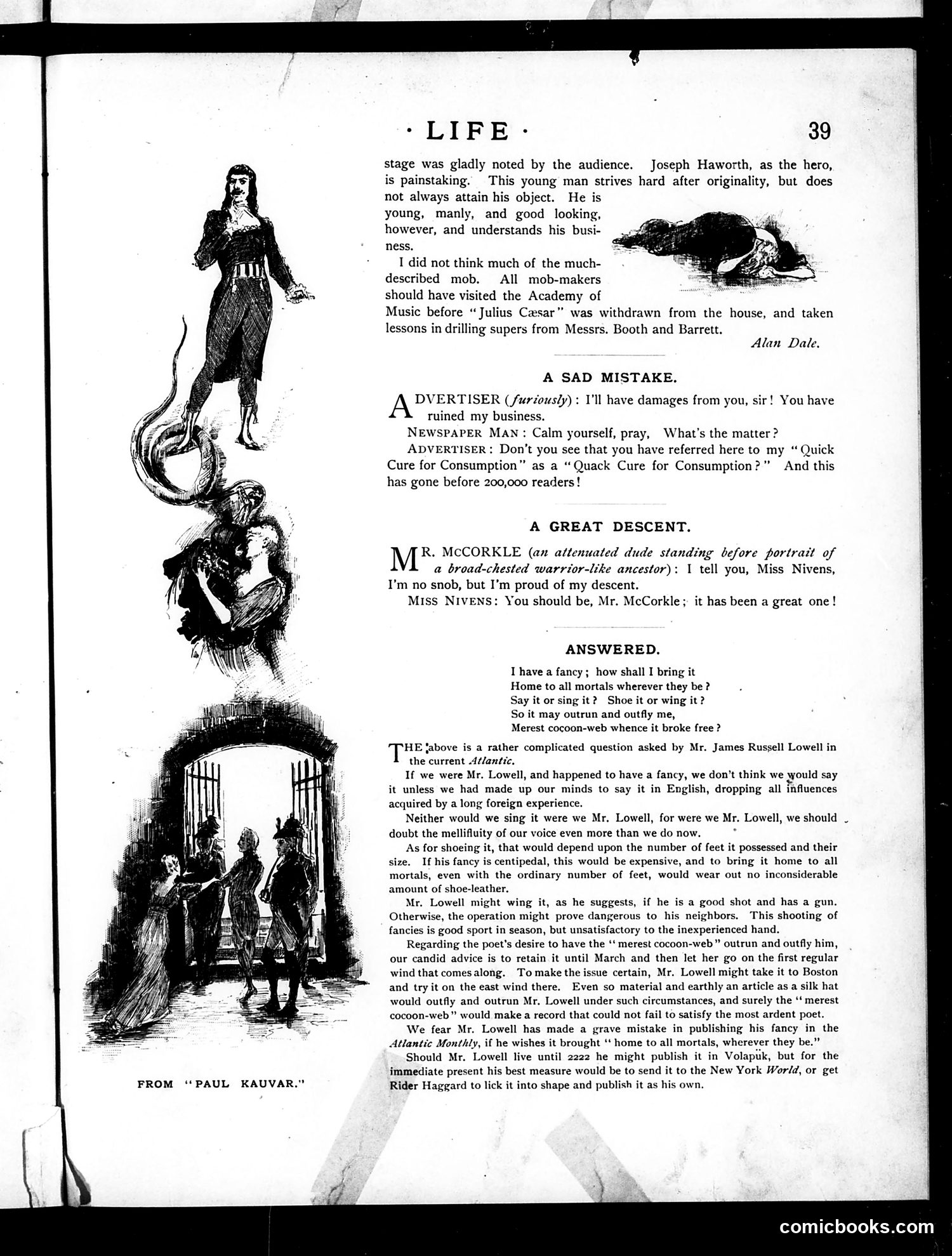
This page contains three separate satirical humor pieces typical of 19th-century American comedy magazines: **"A Sad Mistake"** mocks a newspaper advertiser who sued over a typo—his "Quick Cure for Consumption" was printed as "Quack Cure," potentially reaching 200,000 readers. The joke is the advertiser's outrage over what appears to be an honest mistake that actually undermined his dubious medical product. **"A Great Descent"** plays on class pretension: Mr. McCorkle boasts of his proud ancestry to Miss Nivens, who delivers a cutting reply—his "descent" (lineage) is actually a "descent" (decline), suggesting his family has deteriorated. **"Answered"** responds to a James Russell Lowell poem published in *Atlantic Monthly*. Life mocks Lowell's flowery question about spreading his "fancy" to mortals by literalizing his metaphors: if his fancy is a centipede, shoeing it costs money; if he "wings" it like a gun, that's dangerous. The advice: send it to the *New York World* instead. The illustrations on the left appear to be from "Paul Kauvar," a theatrical production.
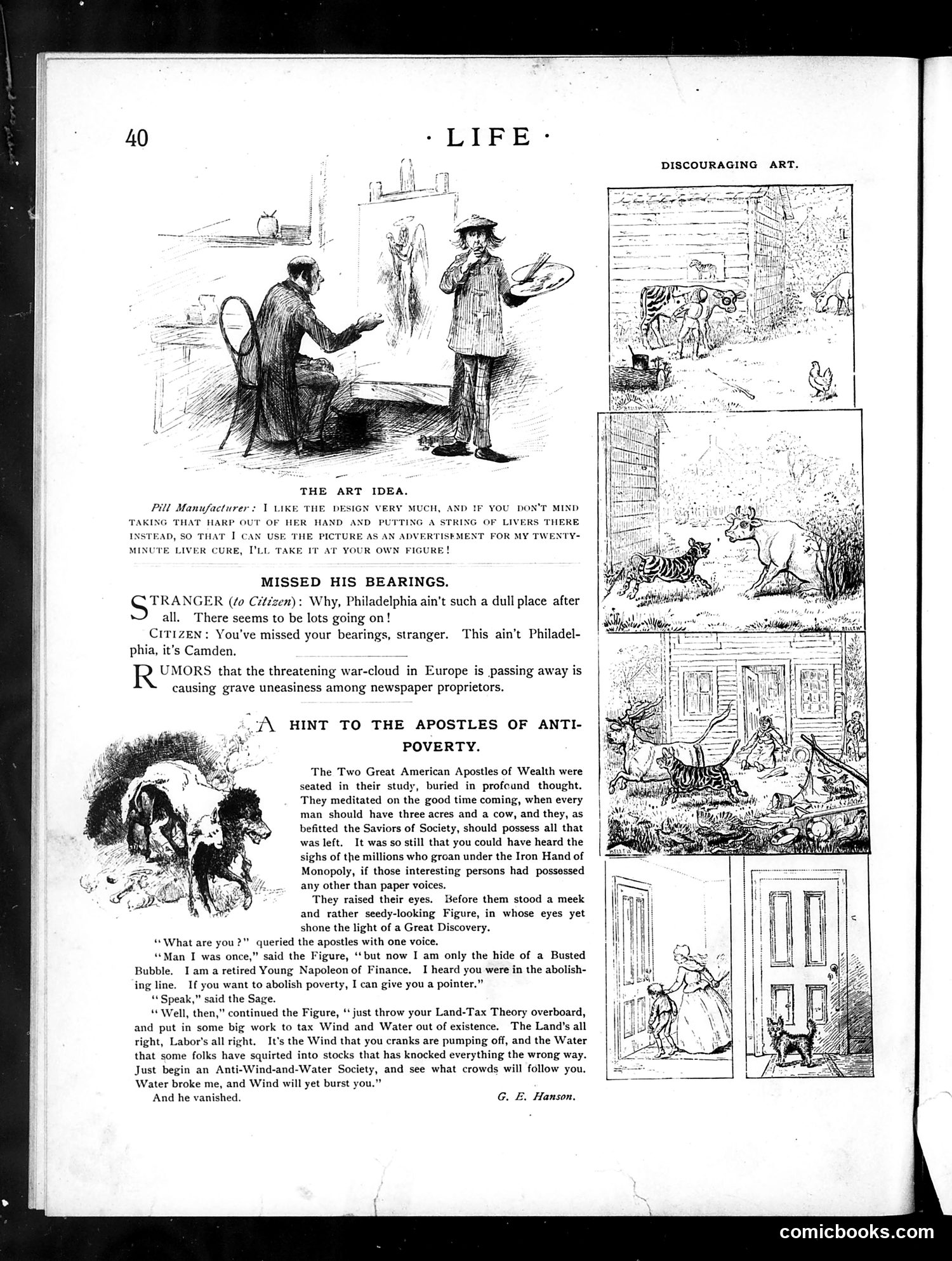
This page contains three satirical pieces from *Life* magazine: **"The Art Idea"** (top left): A pill manufacturer tries to buy an artist's painting, offering to replace the angel harp with an advertisement for his liver cure—mocking both commercial exploitation of art and quack medicine advertising. **"Missed His Bearings"**: A brief joke where a stranger compliments Philadelphia's activity, only to learn he's actually in Camden—likely referencing Camden's lesser significance or reputation at the time. **"A Hint to the Apostles of Anti-Poverty"** (main text): Satirizes wealthy "apostles" promoting land-tax reform while a bankrupt financier appears, blaming "Wind and Water" (speculation and stock market manipulation) rather than land issues. The piece mocks reformers as hypocritical while identifying financial speculation as the real cause of poverty. The right-side illustrations labeled "Discouraging Art" appear to show rural/pastoral scenes, likely contrasting with the commercial exploitation depicted in the main cartoon.
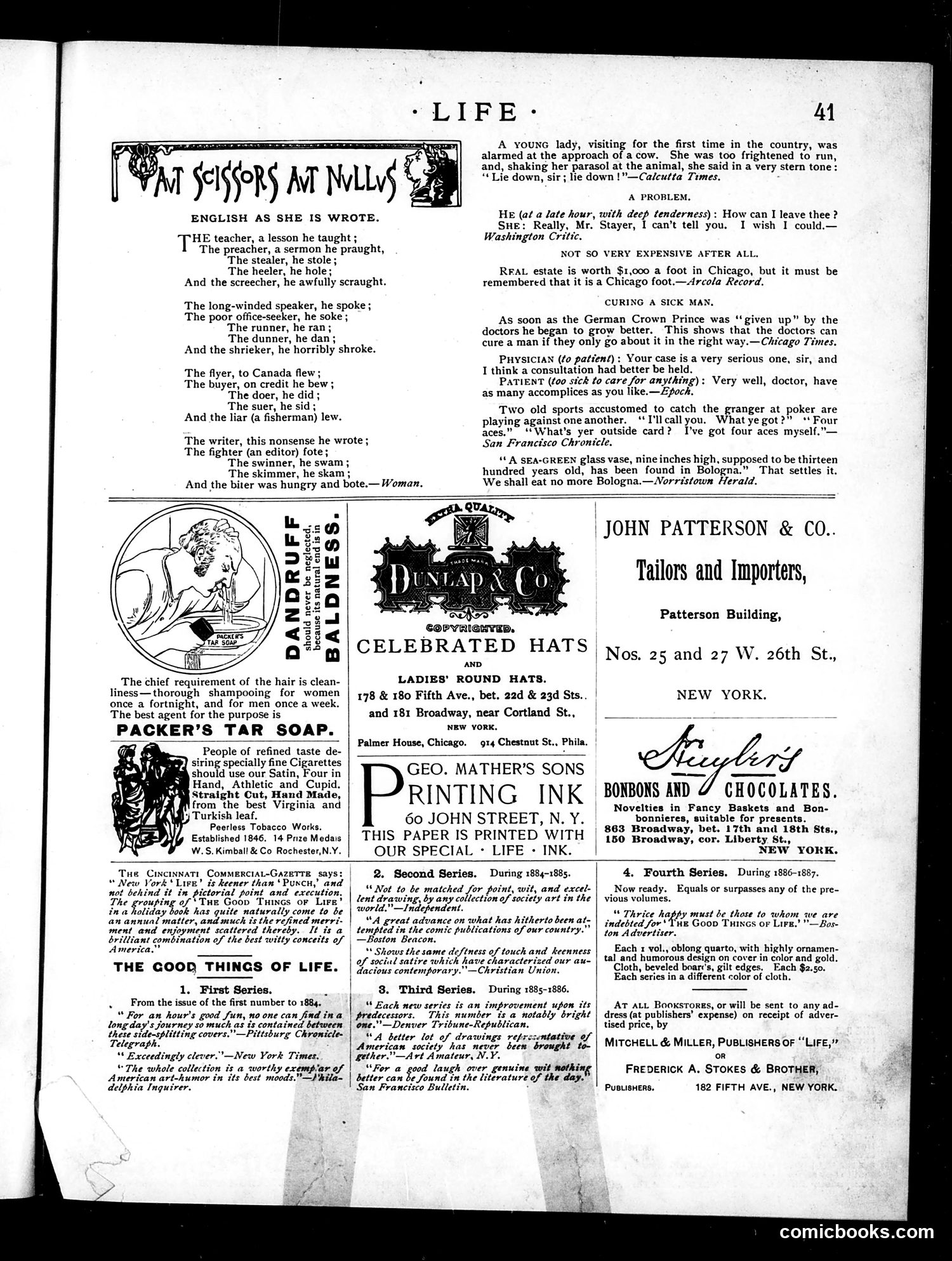
This page primarily contains **humorous short jokes and anecdotes** rather than political cartoons. The satire targets social awkwardness and linguistic absurdities: **"English As She Is Wrote"** mocks non-standard grammar through exaggerated verb conjugations ("scraught," "praught," "shroke"), likely poking fun at poorly educated speakers or immigrants struggling with English. **Other jokes** include: - A frightened English lady parasol-threatening a cow (playing on cultural stereotypes) - A German Crown Prince who recovers once doctors give up (suggesting doctors are ineffective) - A doctor-patient joke where the patient calls doctors "accomplices" (cynicism about medical practice) - Miscellaneous puns about real estate prices and vintage vases The page is **mostly advertisements** for hair soap, cigarettes, printing ink, and clothing—typical of 1880s magazine padding. There are no identifiable political figures or events referenced. The humor is gentle, domestic, and universal rather than topical.
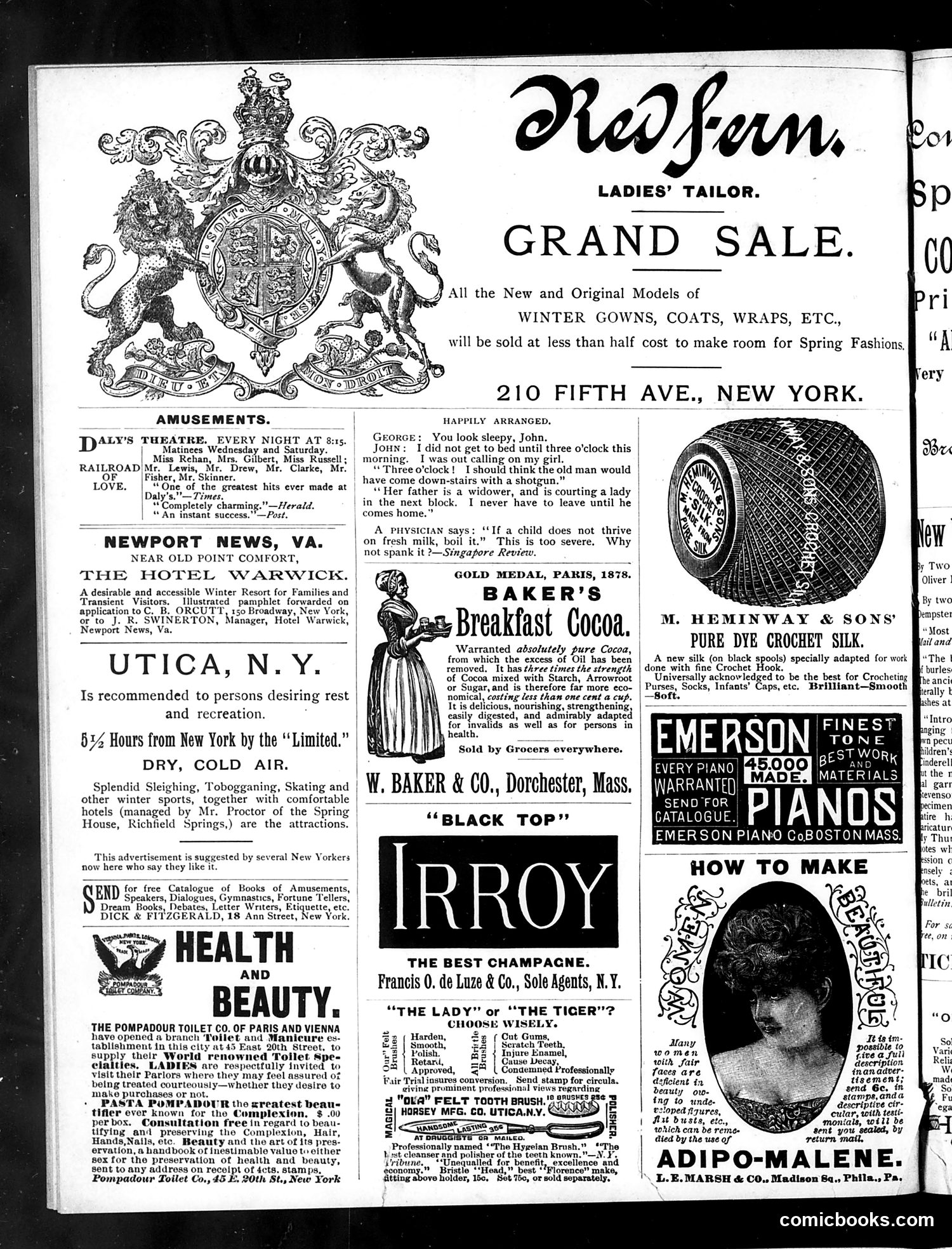
This page is primarily **advertisements and entertainment notices**, not political satire. Key content includes: **"Happily Arranged" Dialog**: A brief comedic sketch about a young man calling on his girlfriend until 3 a.m. The humor relies on the girl's widowed father being occupied courting a neighbor, so he never forces the suitor to leave—a gentle joke about Victorian courtship customs and parental oversight. **Product Advertisements**: The page features typical 1880s-90s ads for: - Winter resort hotels (Newport News, Utica) - Baker's Breakfast Cocoa (emphasizing purity and economy) - Tooth brushes and beauty products (Pompadour Toilet Co.) - Ladies' fashion sales - Theater listings **Theater Notice**: "Daly's Theatre" advertises a play called "Railroad Love" with period actors. The page contains **no political cartoons or satirical commentary**—it's a commercial publication page featuring leisure/consumer content typical of Life magazine's mixed entertainment and advertising format from this era.
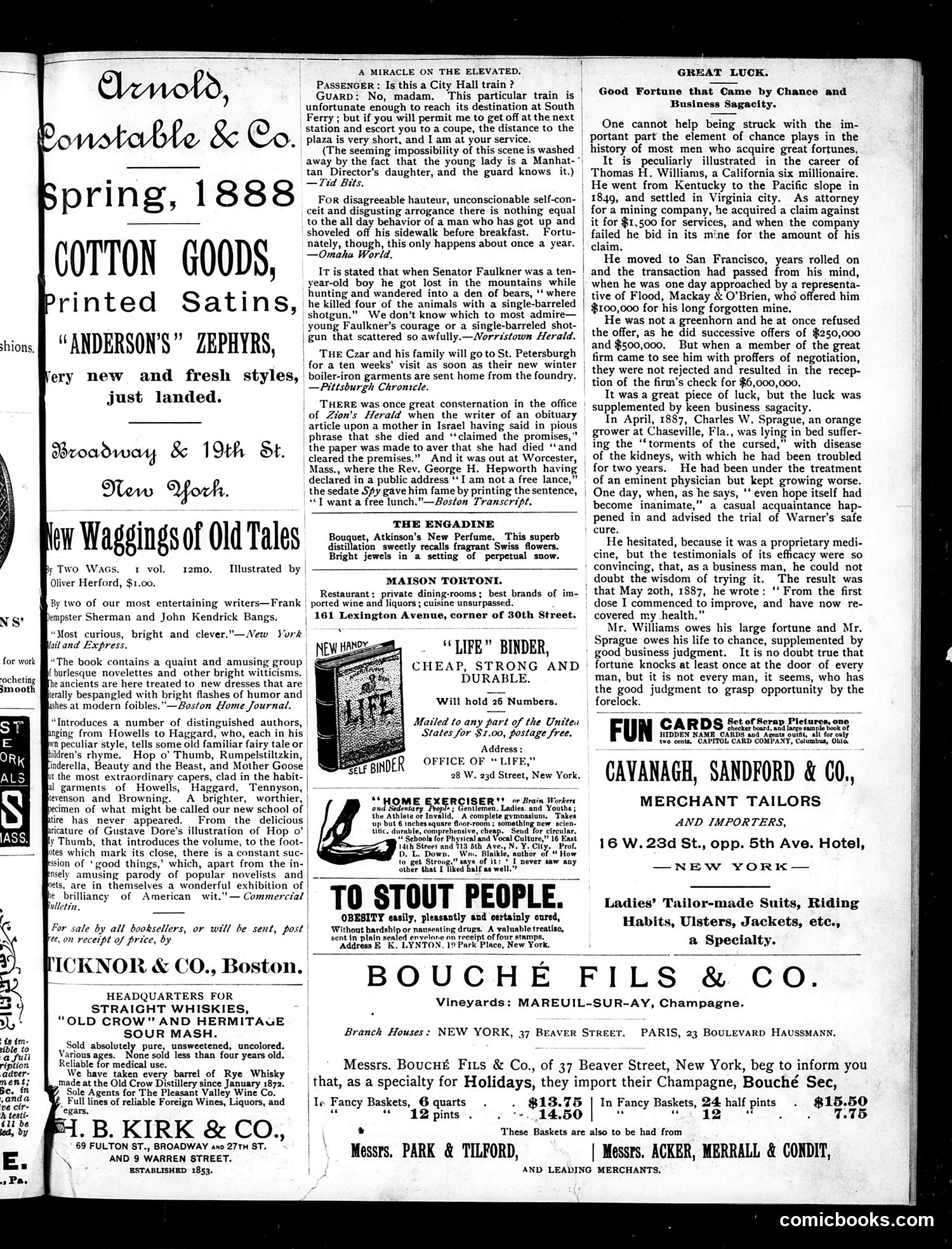
This is primarily a **Spring 1888 advertising page** from *Life* magazine, with brief humorous snippets scattered throughout—not a political cartoon page. The small jokes are social satire typical of the era: - **"A Miracle on the Elevated"**: Mocks New York's class system. A subway guard offers special service to a passenger simply because she's a Manhattan Director's daughter—satirizing how wealth and connections override normal rules. - **Other brief quips** ridicule everyday absurdities: a man's smugness after shoveling snow, and a tall tale about Senator Faulkner killing four bears with one shot as a child. The page is dominated by **advertisements** for cotton goods, books (*New Waggings of Old Tales*, a humorous collection), whiskey, and tailoring services—reflecting what *Life* readers in 1888 purchased. The cartoons here are **mild social commentary** rather than sharp political satire, poking fun at vanity and hypocrisy rather than major political figures or movements.
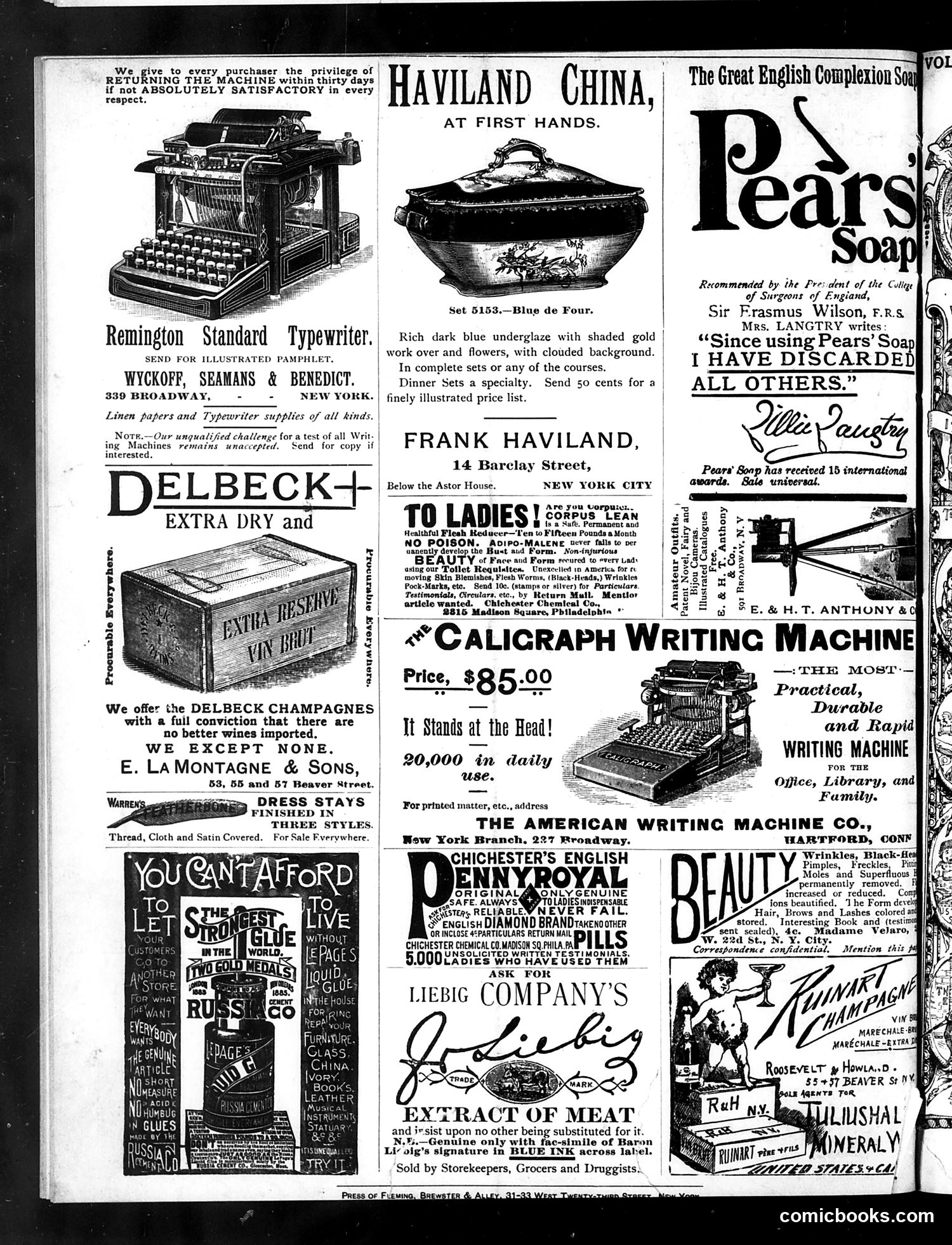
This is primarily an **advertisement page** with no political cartoons or satirical content. It consists entirely of commercial advertisements typical of late 19th-century American magazines. Notable ads include: - **Typewriters and writing machines** (Remington, Caligraph) — reflecting the era's office technology boom - **Haviland china** and champagne — luxury goods marketing - **Pears' Soap** — featuring an endorsement from actress Lillie Langtry and Sir Erasmus Wilson, emphasizing beauty and complexion care - **Patent medicines** — including weight-reduction products ("Apyrolemalene") and beauty treatments, some containing potentially harmful substances now recognized as dangerous - **Liebig's Extract of Meat** — a popular nutrition product The ads reveal period consumer culture: obsession with beauty standards, aggressive patent medicine marketing (often with exaggerated health claims), and the technological modernization of office work. Many products advertised here would be considered fraudulent or unsafe by modern standards.