
Life, 1888-01-19 · page 10 of 16
Life — January 19, 1888 — page 10: what you’re looking at
What you’re looking at
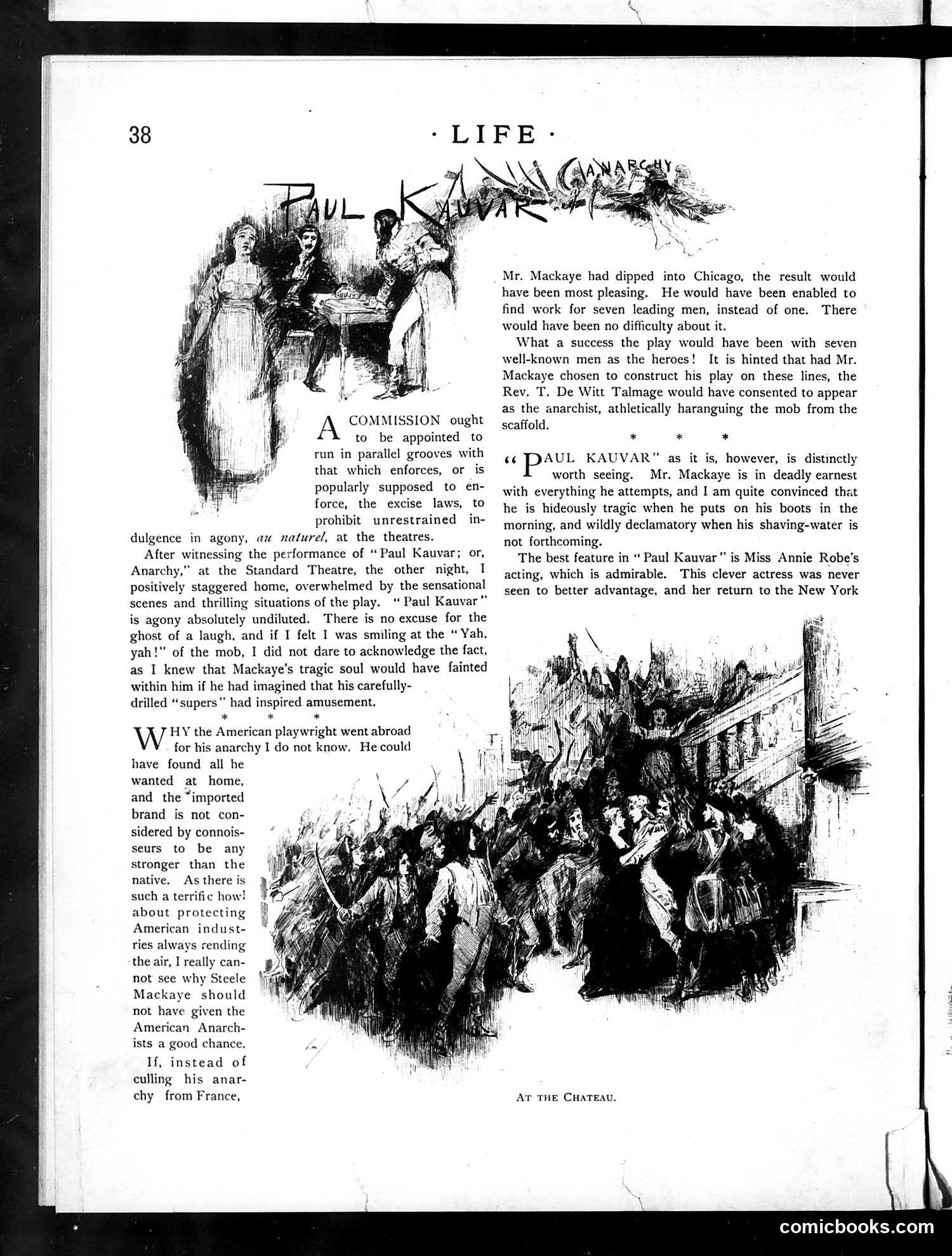
This page reviews "Paul Kauvar," a play by Steele Mackaye. The critic discusses the theatrical production, noting Mackaye's attempt to create a serious drama about anarchism ("Anarchy" at the Standard Theatre). The top illustration shows a scene from the play's drawing room setting. The lower illustration, captioned "At the Chateau," depicts what appears to be a mob or crowd scene—likely representing the anarchist action central to the play's plot. The reviewer criticizes Mackaye for going abroad to find anarchist material rather than developing American themes, sarcastically questioning why imported "anarchists" are considered more valuable than homegrown American industrial issues. The text highlights Annie Robe's acting as the play's strongest element.
📄 Transcribed text from this page (OCR, searchable)
Machine-transcribed from the original scan — historical spelling and the odd misread are preserved.
COMMISSION ought to be appointed to run in parallel grooves with that which enforces, or is popularly supposed to en- force, the excise laws, to prohibit unrestrained in- dulgence in agony, aw naturel, at the theatres. After witnessing the performance of “Paul Kauvar; or, Anarchy,” at the Standard Theatre, the other night, I positively staggered home, overwhelmed by the sensational scenes and thrilling situations of the play. “ Paul Kauvar” is agony absolutely undiluted. There is no excuse for the ghost of a laugh, and if I felt I was smiling at the “ Yah, yah!” of the mob, I did not dare to acknowledge the fact, as I knew that Mackaye’s tragic soul would have fainted within him if he had imagined that his carefully- drilled “supers” had inspired amusement. * * * HY the American playwright went abroad for his anarchy I do not know. He could have found all he wanted at home, and the “imported brand is not con- sidered by connois- seurs to be any stronger than the native. As there is such a terrific how! about protecting American indust- ries always rending the air, I really can- not see why Steele Mackaye should not have given the American Anarch- ists a good chance. If, instead of culling his anar- chy from France, Mr. Mackaye had dipped into Chicago, the result would have been most pleasing. He would have been enabled to find work for seven leading men, instead of one. There would have been no difficulty about it. What a success the play would have been with seven well-known men as the heroes! It is hinted that had Mr. Mackaye chosen to construct his play on these lines, the Rev. T. De Witt Talmage would have consented to appear as the anarchist, athletically haranguing the mob from the scaffold. * * * 6c“ AUL KAUVAR” as it is, however, is distinctly worth seeing. Mr. Mackaye is in deadly earnest with everything he attempts, and I am quite convinced that he is hideously tragic when he puts on his boots in the morning, and wildly declamatory when his shaving-water is not forthcoming. The best feature in “ Paul Kauvar” is Miss Annie Robe's acting, which is admirable. This clever actress was never seen to better advantage, and her return to the New York AT THE CHATEAU. comicbooks.com