
Life, 1888-01-19 · page 6 of 16
Life — January 19, 1888 — page 6: what you’re looking at
What you’re looking at
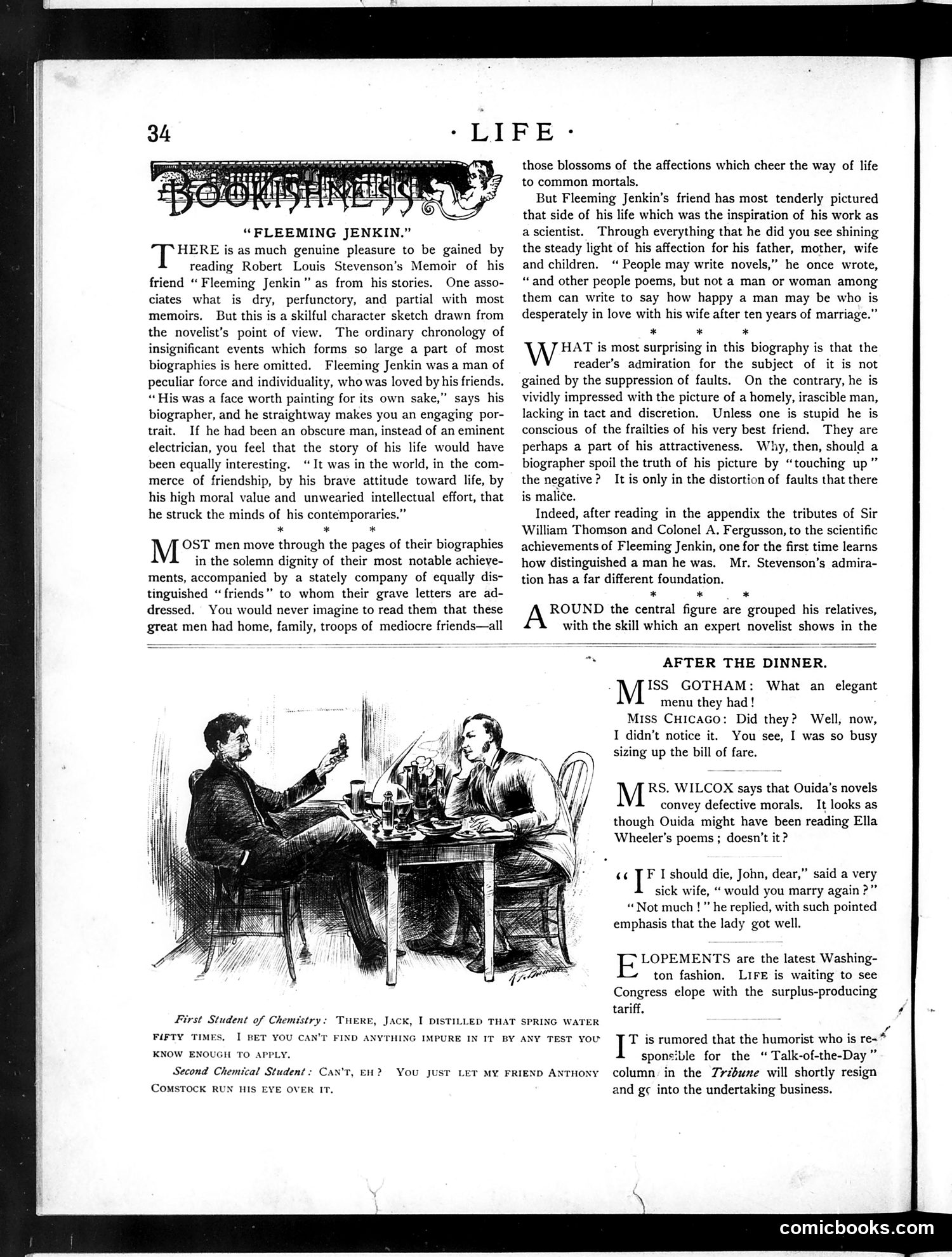
This page contains a literary essay about "Flemming Jenkin," praising Robert Louis Stevenson's biographical sketch of this Scottish engineer and friend. The essay celebrates Jenkin as an unpretentious but morally admirable figure whose life story, though lacking dramatic achievements, demonstrates genuine human value through integrity and affection for family. The cartoon below titled "After the Dinner" depicts two men in conversation at a table. It's a humorous exchange between chemistry students debating whether spring water is chemically pure—a lighthearted academic joke about laboratory standards and pedantic arguing among scholars. The page concludes with brief satirical notes on contemporary topics including Ouida's novels, elopements, and a Tribune humorist's rumored resignation—typical light social commentary of the era.
📄 Transcribed text from this page (OCR, searchable)
Machine-transcribed from the original scan — historical spelling and the odd misread are preserved.
“FLEEMING JENKIN.” “TERE is as much genuine pleasure to be gained by reading Robert Louis Stevenson’s Memoir of his friend “ Fleeming Jenkin” as from his stories. One asso- ciates what is dry, perfunctory, and partial with most memoirs. But this is a skilful character sketch drawn from the novelist’s point of view. The ordinary chronology of insignificant events which forms so large a part of most biographies is here omitted. Fleeming Jenkin was a man of peculiar force and individuality, who was loved by his friends. “His was a face worth painting for its own sake,” says his biographer, and he straightway makes you an engaging por- trait. If he had been an obscure man, instead of an eminent electrician, you feel that the story of his life would have been equally interesting. “It was in the world, in the com- merce of friendship, by his brave attitude toward life, by his high moral value and unwearied intellectual effort, that he struck the minds of his contemporaries.” * * * OST men move through the pages of their biographies in the solemn dignity of their most notable achieve- ments, accompanied by a stately company of equally dis- tinguished “friends” to whom their grave letters are ad- dressed. You would never imagine to read them that these great men had home, family, troops of mediocre friends—all those blossoms of the affections which cheer the way of life to common mortals, But Fleeming Jenkin’s friend has most tenderly pictured that side of his life which was the inspiration of his work as a scientist. Through everything that he did you see shining the steady light of his affection for his father, mother, wife and children. ‘ People may write novels,” he once wrote, “and other people poems, but not a man or woman among them can write to say how happy a man may be who is desperately in love with his wife after ten years of marriage.” * * * HAT is most surprising in this biography is that the reader’s admiration for the subject of it is not gained by the suppression of faults. On the contrary, he is vividly impressed with the picture of a homely, irascible man, lacking in tact and discretion. Unless one is stupid he is conscious of the frailties of his very best friend. They are perhaps a part of his attractiveness. Why, then, should a biographer spoil the truth of his picture by “touching up” the negative? It is only in the distortion of faults that there is malice. Indeed, after reading in the appendix the tributes of Sir William Thomson and Colonel A. Fergusson, to the scientific achievements of Fleeming Jenkin, one for the first time learns how distinguished a man he was. Mr. Stevenson’s admira- tion has a far different foundation. * * * ROUND the central figure are grouped his relatives, with the skill which an expert novelist shows in the AFTER THE DINNER. ISS GOTHAM: What an elegant menu they had! Miss CHICAGO: Did they? Well, now, I didn’t notice it. You see, I was so busy sizing up the bill of fare. RS. WILCOX says that Ouida’s novels convey defective morals. It looks as though Ouida might have been reading Ella Wheeler's poems ; doesn’t it ? «¢ TF I should die, John, dear,” said a very sick wife, “ would you marry again ?” “Not much !” he replied, with such pointed emphasis that the lady got well. LOPEMENTS are the latest Washing- ton fashion. LIFE is waiting to see Congress elope with the surplus-producing tariff. First Student of Chemistry: Tere, Jack, 1 DISTILLED THAT SPRING WATER FIFTY TIMES. I BET YOU CAN'T FIND KNOW ENOUGH TO APPLY. Second Chemical Student; Cax't, EM? COMSTOCK RUN HIS EYE OVER IT, NYTHING IMPURE IN IT BY ANY TEST YOU You JUST LET MY FRIEND ANTHONY T is rumored that the humorist who is re~ sponsible for the ‘“ Talk-of-the-Day” column. in the Zrzbune will shortly resign and g¢ into the undertaking business. comicbooks.com