
A complete issue · 16 pages · 1887
Life — November 10, 1887
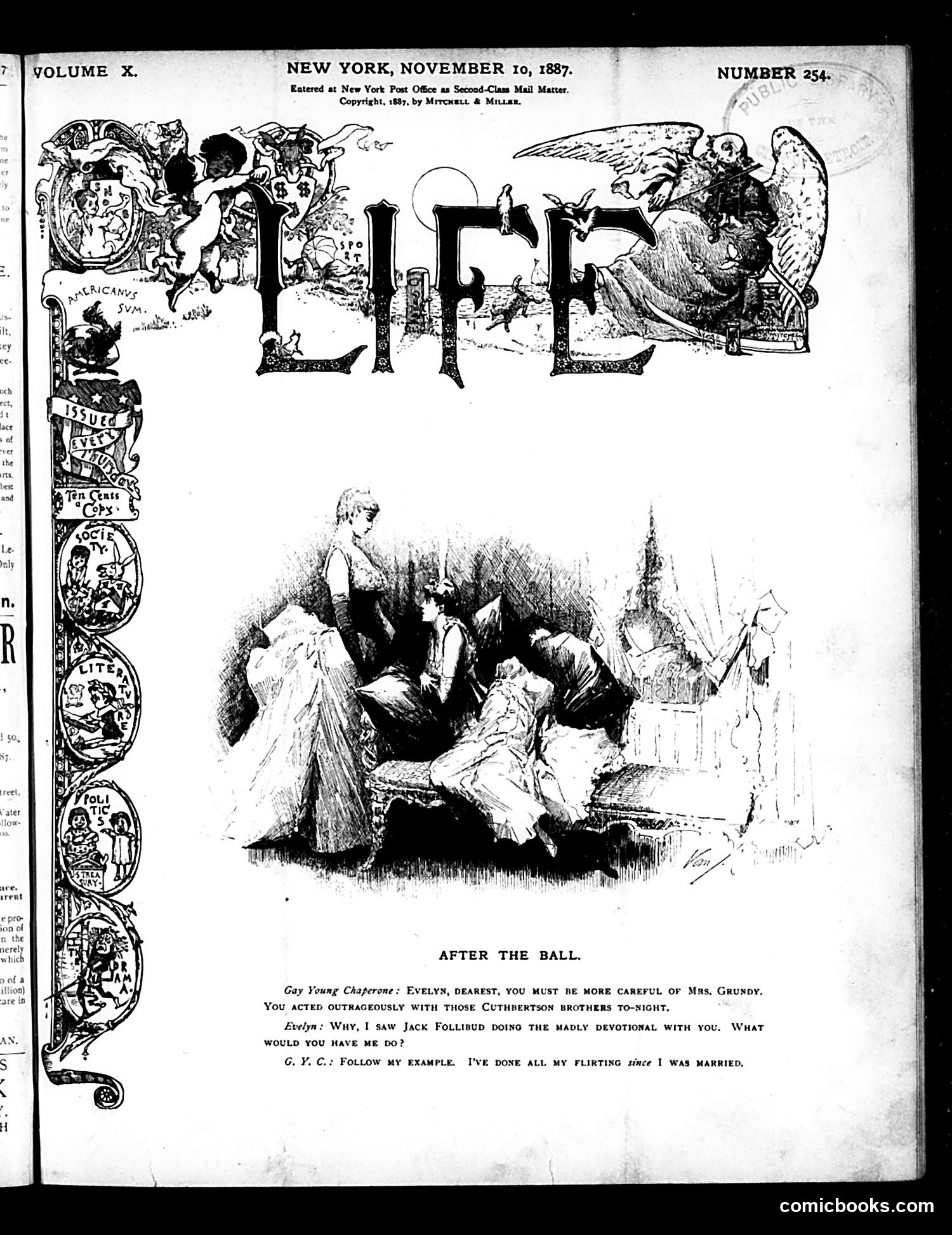
This page depicts a domestic scene titled "After the Ball," showing a conversation between a young couple and an older woman (likely the wife's mother or chaperone, Mrs. Grundy). The satire concerns proper Victorian courtship behavior. The young woman (Evelyn) is being scolded for acting "outrageously" with the Cuthbertson brothers at a ball. The older gentleman (G.Y.C.) responds by defending his own marital conduct, claiming he's "done all [his] flirting since I was married"—implying that respectable men only flirt *after* marriage, not before. The joke targets Victorian gender double-standards: wives were expected to be demure before marriage, yet husbands apparently had license for continued flirtation afterward. The satire mocks this hypocrisy through the older man's casual admission.
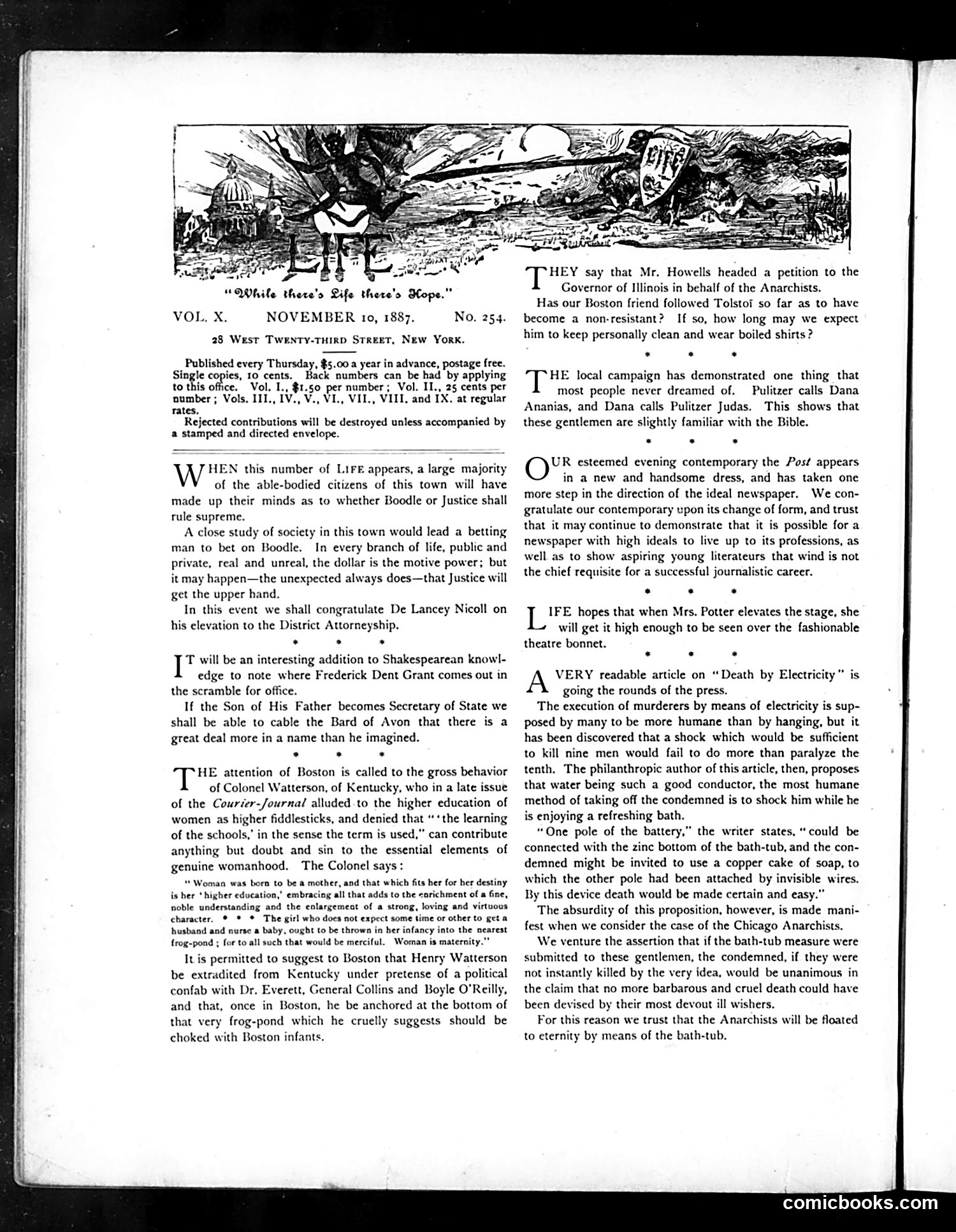
The masthead cartoon depicts a figure saying "While there's Life there's Hope"—a visual pun on the magazine's title. The page contains satirical commentary on contemporary Boston politics and social issues: 1. **Hoodle vs. Justice**: A discussion of whether "Hoodle" (political corruption/bribery) or Justice will rule the city, congratulating De Lancey Nicoll on his District Attorney appointment. 2. **Frederick Dent Grant**: A jab at Grant's son becoming Secretary of State, suggesting nepotism. 3. **Colonel Watterson critique**: Mocking a Kentucky colonel's statements about women's education, suggesting his views are ignorant. 4. **Death by Electricity satire**: Dark humor about executing anarchists (likely referencing the Chicago Anarchists trial) via electric shock in a bathtub—absurdist commentary on proposed execution methods.
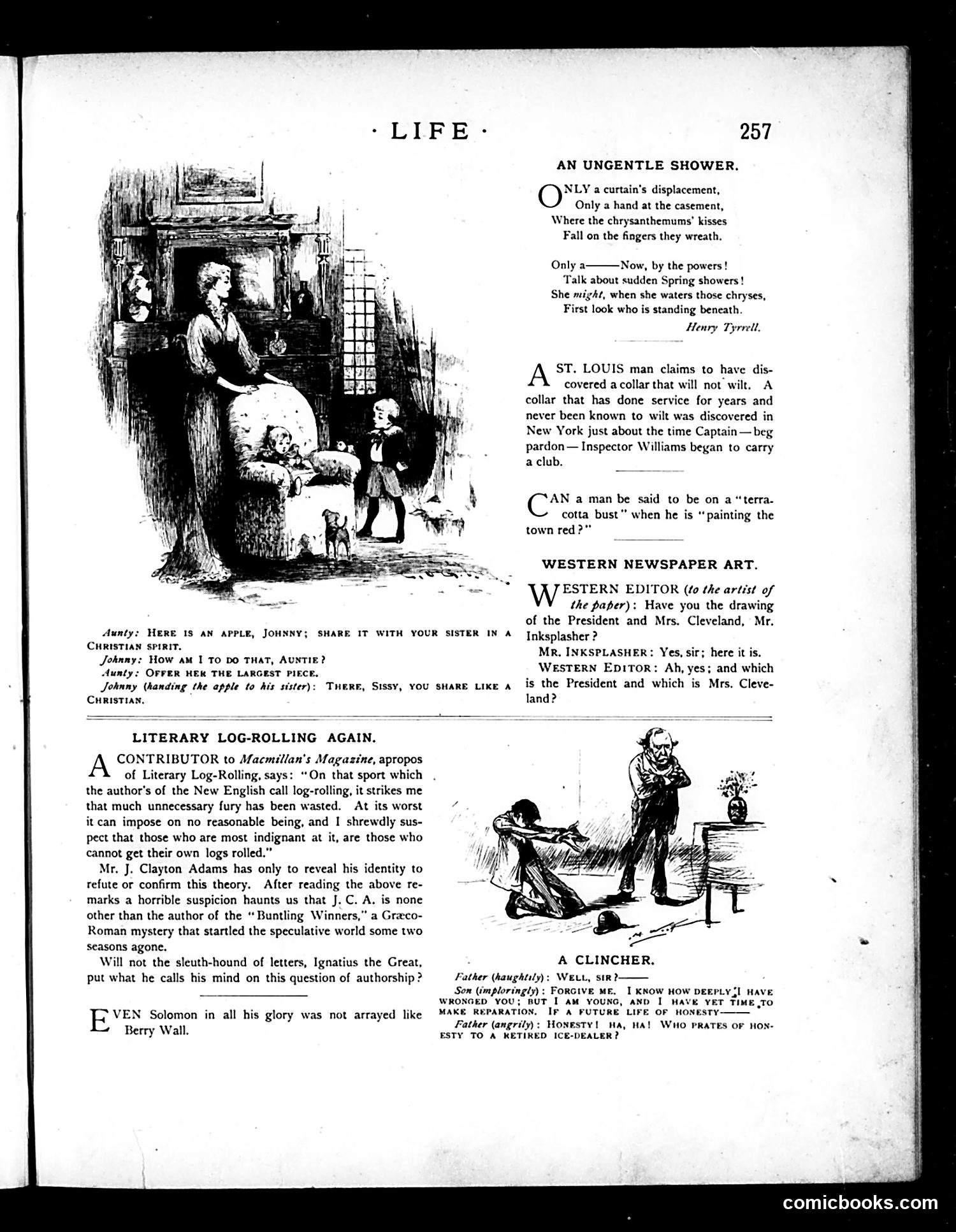
This page contains three separate satirical pieces rather than single unified cartoons: 1. **"An Ungentle Shower"** - A poem by Henry Tyrrell about unexpected spring rain, accompanying a Victorian-era sketch of domestic life. 2. **"Literary Log-Rolling Again"** - Discusses literary criticism and authorship, referencing J.C.A. (appears to reference Clayton Adams) and questioning whether mystery writer J.C.A. is truly the author of "Bungling Winners." The satire mocks mutual praise between writers and the opacity of authorship claims. 3. **"A Clincher"** - A cartoon showing what appears to be a family reconciliation scene, with dialogue about a son's wrongdoing and father's eventual forgiveness, ending with a joke about honesty toward "a retired ice-dealer." The page primarily satirizes literary pretension and social hypocrisy through humor rather than political commentary.
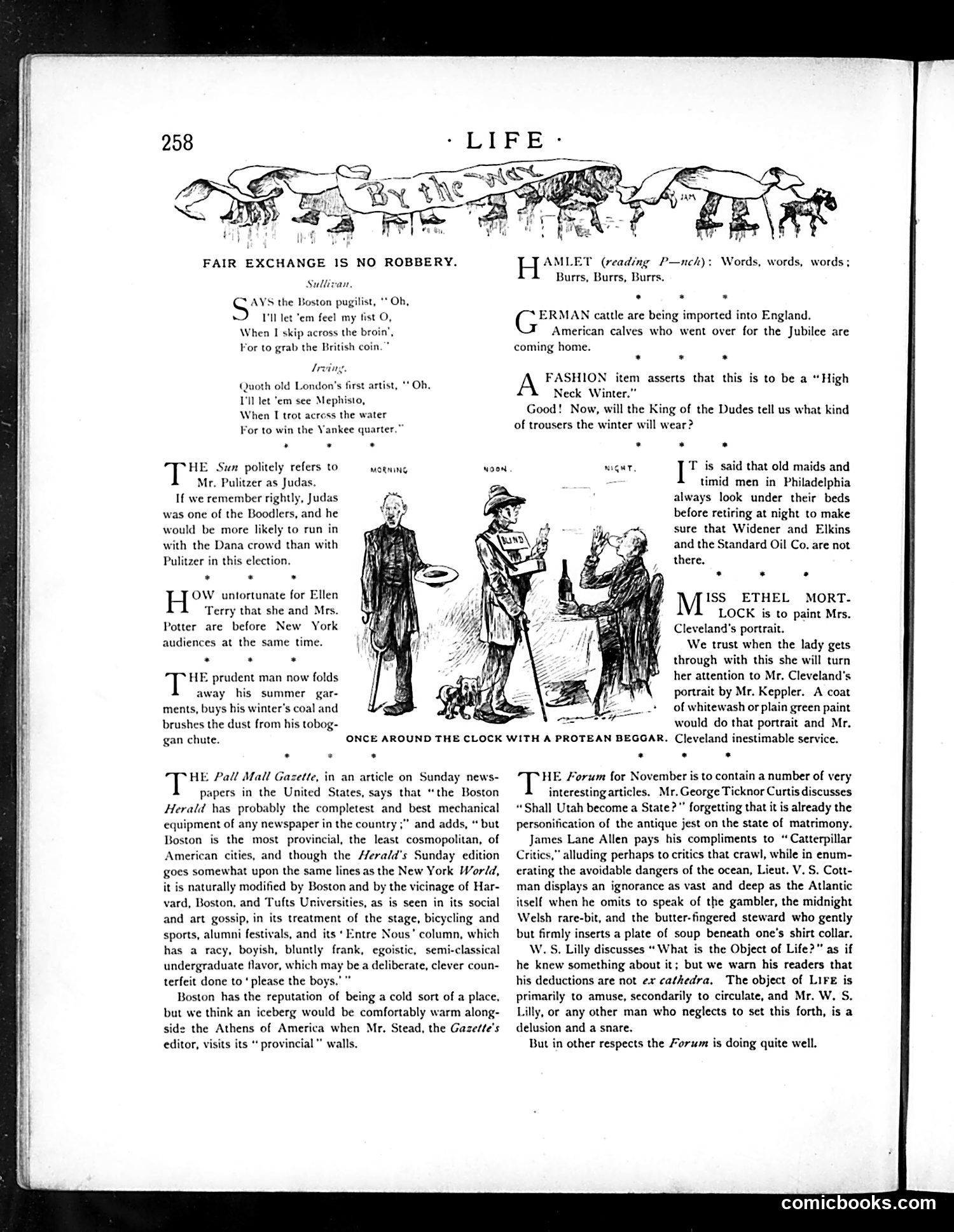
This cartoon depicts a beggar (likely representing a con artist or professional panhandler) in multiple poses throughout a day, changing his appearance and story to manipulate different marks. The three figures shown represent the same person shifting his presentation—appearing as a ragged beggar to one person, then reframing himself differently to another. The satire targets panhandlers who exploit public sympathy through deception, presenting themselves variously to maximize donations. The title "protean" (meaning shape-shifting) emphasizes how beggars adapt their stories and appearance to manipulate different audiences. This reflects Progressive-era concerns about urban poverty and distinguishing "deserving" poor from con artists—a common satirical target in early 1900s Life magazine.
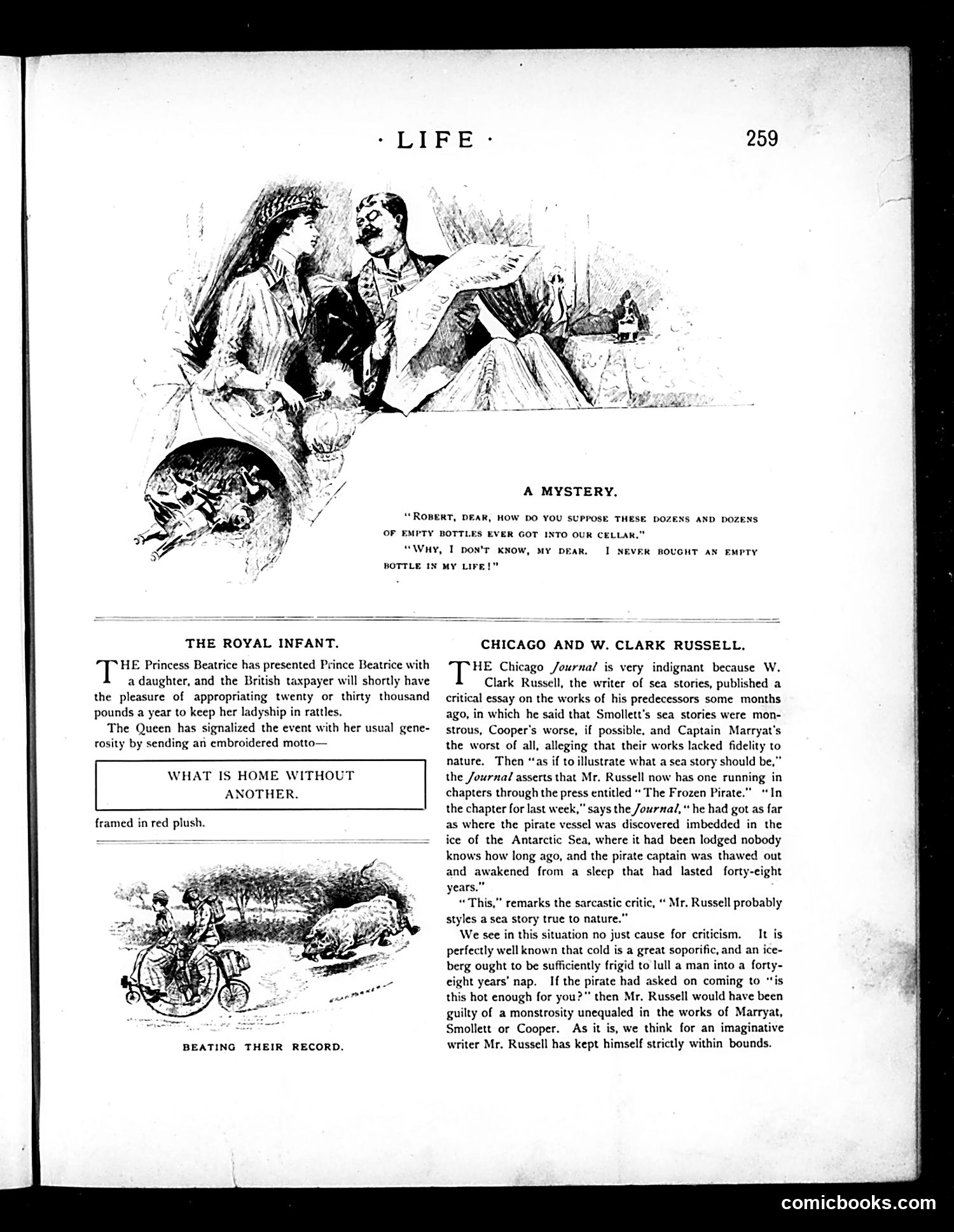
**"A Mystery"** (top cartoon): Shows three figures discovering empty wine bottles in a cellar. The caption presents a humorous domestic dispute—the husband claims he never purchased empty bottles, implying his wife or servants are responsible for the mysteriously empty wine supply. This is genteel Victorian-era satire about household management and alcohol consumption among the wealthy. **"The Royal Infant"**: Brief news item about Princess Beatrice presenting Prince Henry with a daughter; the Queen sends an embroidered note—typical society page coverage of royal births. **"Chicago and W. Clark Russell"**: A critical essay defending sea-story writer W. Clark Russell against a *Chicago Journal* reviewer who had criticized his work as implausible (specifically "The Frozen Pirate"). The satire defends Russell's realistic storytelling against overly harsh literary criticism.
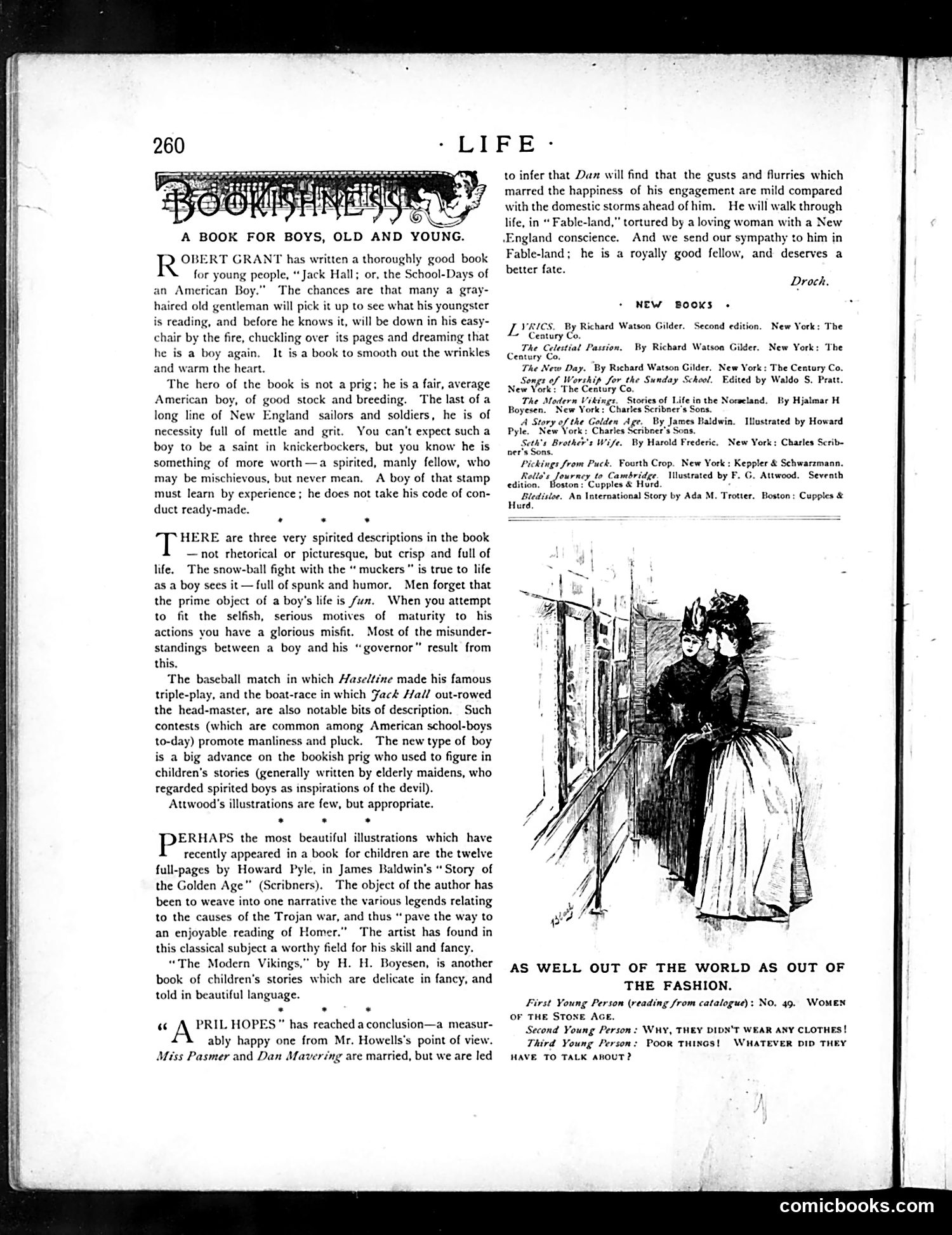
This page is primarily a **book review section**, not a political cartoon. It reviews "Jack Hall; or, the School-Days of an American Boy" by Robert Grant, praising it as a realistic portrayal of American boyhood—depicting both mischief and character-building. The single illustration shows a **domestic scene** of a woman in Victorian dress greeting visitors at a doorway, likely from one of the reviewed books. The page concludes with a humorous dialogue titled "AS WELL OUT OF THE WORLD AS OUT OF THE FASHION," mocking women's fashion obsession through three generational perspectives on ancient women who "didn't wear any clothes." This is **literary criticism and social satire about fashion conventions**, not political commentary. It reflects late 19th/early 20th-century attitudes about gender and propriety.
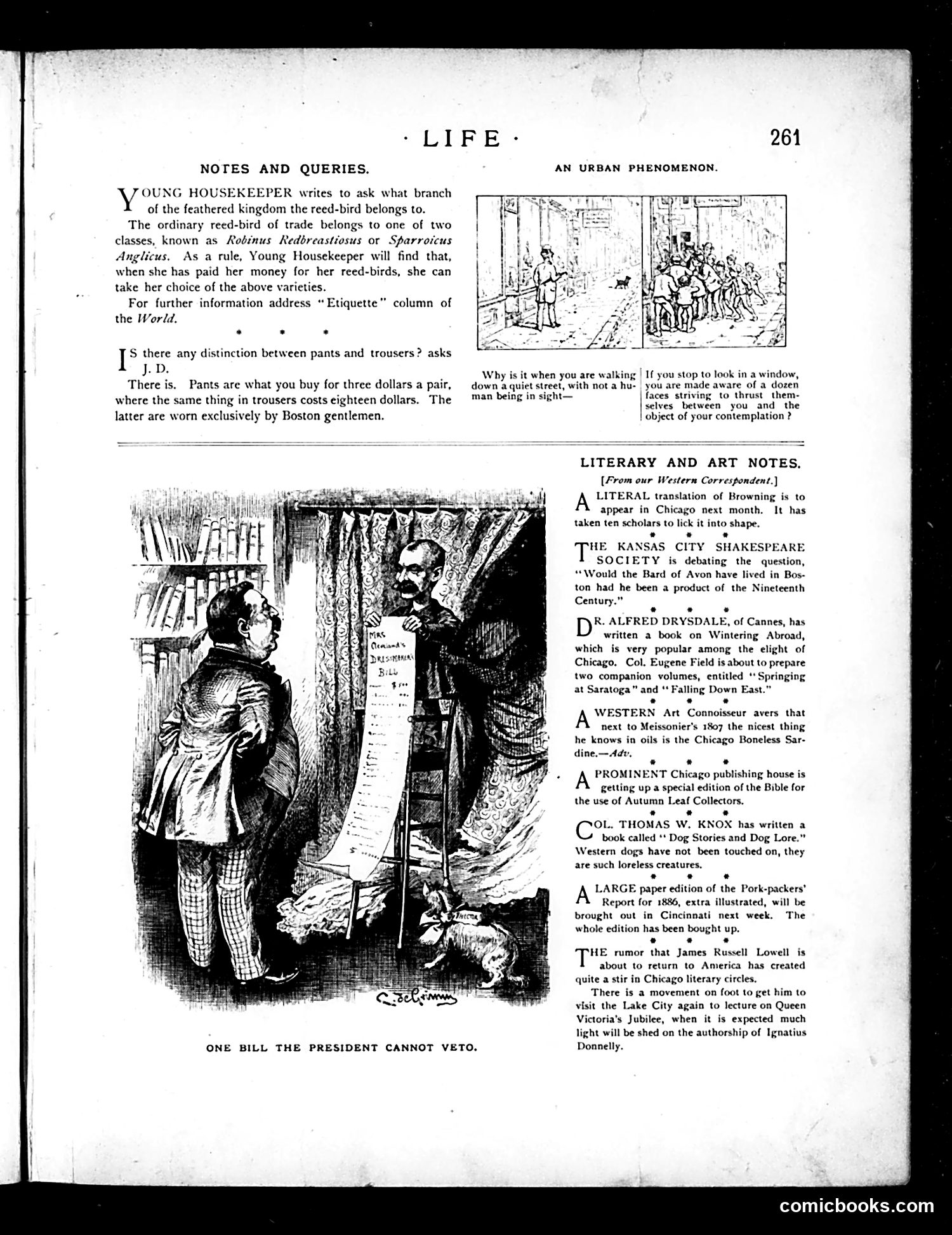
This political cartoon satirizes presidential power by depicting a woman presenting a bill or document to a man (likely representing a President or authority figure). The title's joke is that while a President can veto legislation, he cannot veto certain domestic matters—specifically, this appears to reference a woman's authority within the household or domestic sphere. The woman's assertive posture and the man's apparent submission suggest commentary on gender dynamics and domestic authority. The cartoon likely reflects late 19th or early 20th-century humor about the limitations of male power once men leave the political realm and enter domestic life, where women traditionally held sway. It's a "battle of the sexes" joke common to this era.
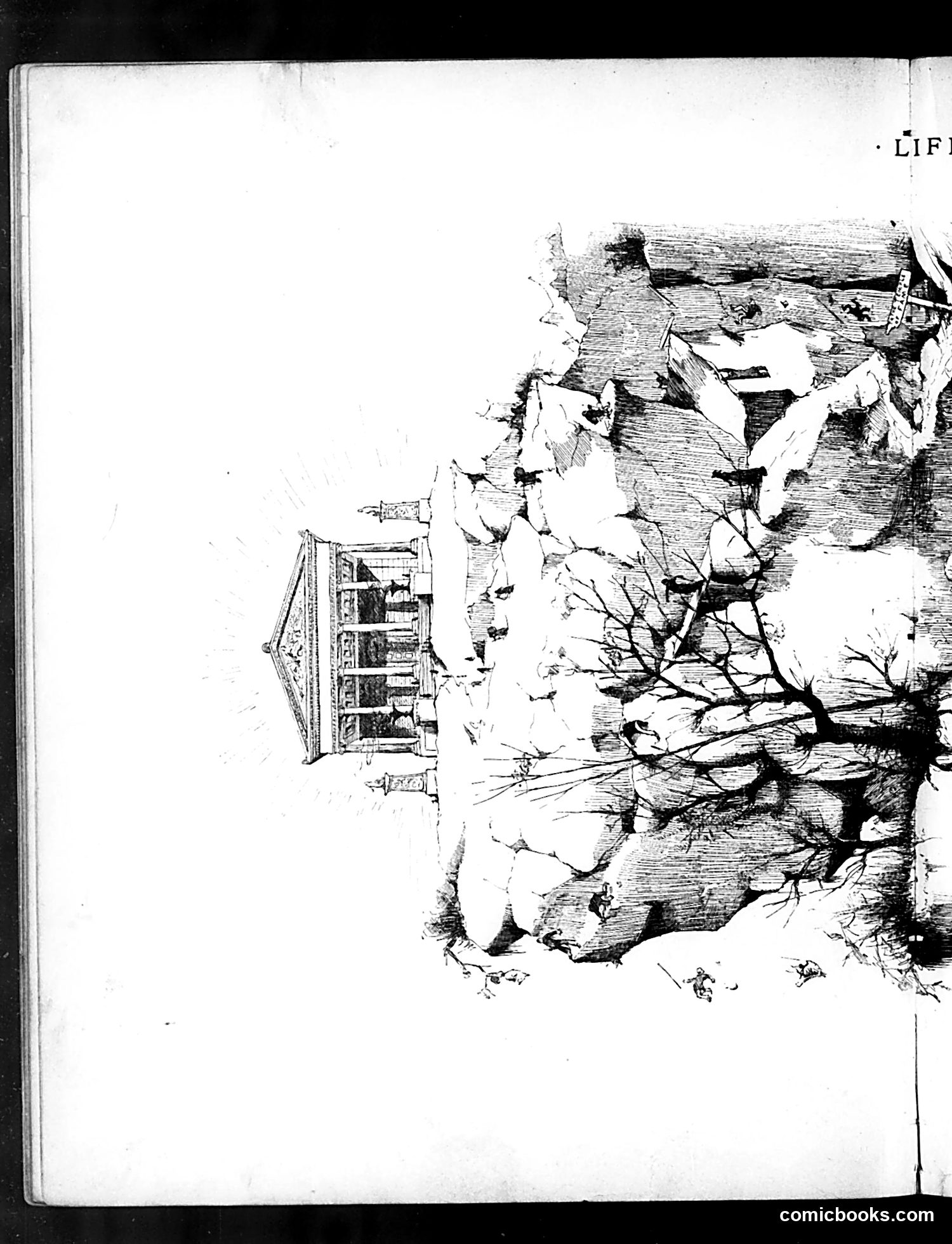
This page appears to contain a single engraved illustration showing a rural landscape with a modest house or cabin on the left side and bare, gnarled trees dominating the right portion of the composition. The image is rendered in detailed cross-hatching typical of 19th-century wood engraving. The OCR text is minimal and unclear, providing no visible caption or context. Without legible text identifying the subject, figures, or satirical intent, I cannot reliably determine what political or social commentary this illustration conveys. The rural setting and sparse vegetation might suggest themes of hardship, poverty, or agricultural decline, but specific interpretation would require additional textual context not clearly visible in this reproduction.
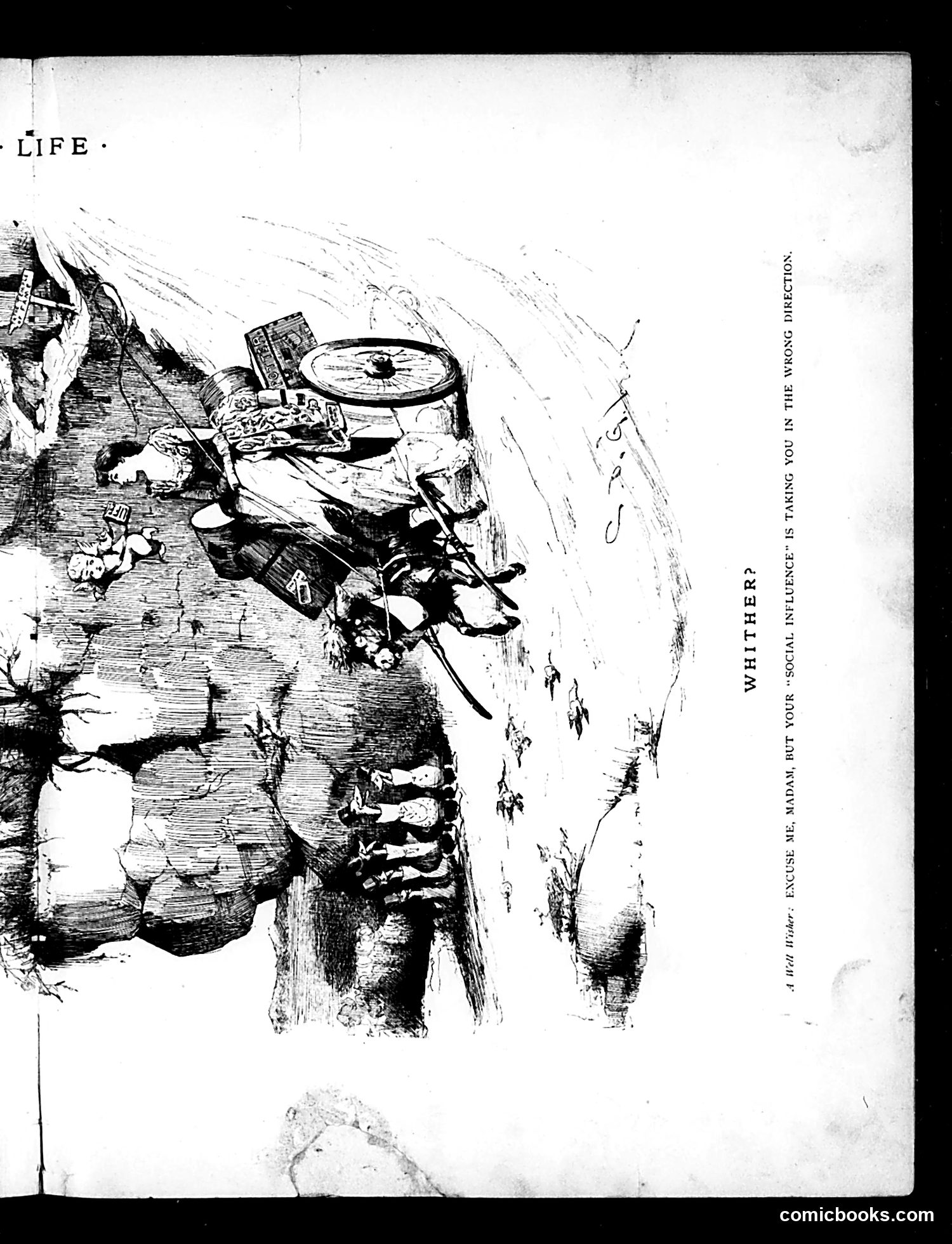
This page from *Life* magazine features a political cartoon titled "WHETHER?" The illustration depicts a figure (appears to be a political or social character) standing amid wreckage and debris, holding what looks like a large wheel or steering mechanism. The scene suggests chaos or disaster. The caption reads: "A POOR FRENCH EXCUSES HE MAMMON BUT YOUR SOCIAL INFLUENCE IS TANKING YOU IN THE WRONG DIRECTION." The cartoon likely satirizes political or social leadership during a period of instability or poor decision-making. The wreckage and the figure's precarious position suggest failed policies or misguided direction. However, without clearer OCR text or identifying features, the specific political figures or events referenced remain uncertain. The "WHETHER?" title suggests questioning the wisdom of current leadership or choices.
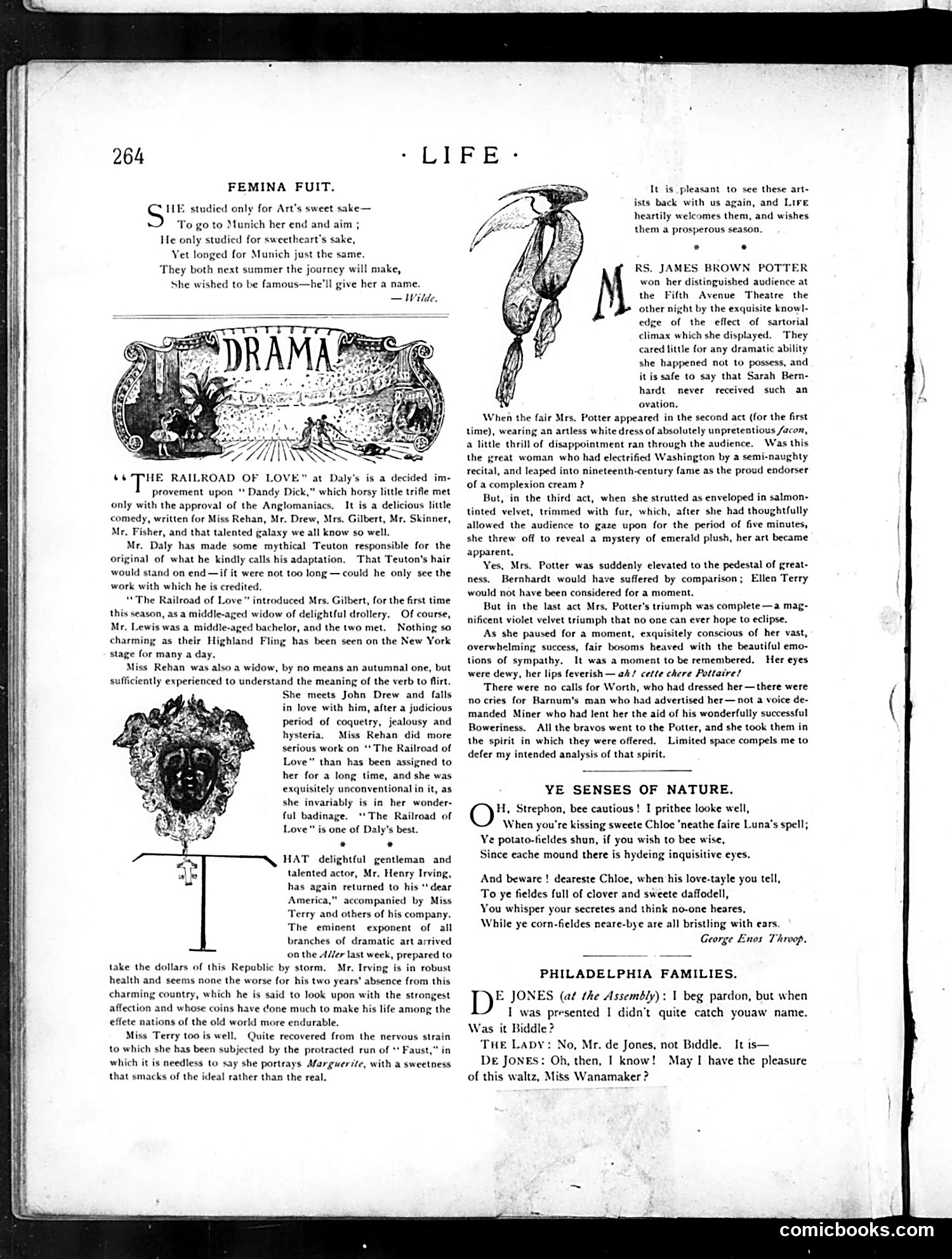
This page contains theater reviews from Life magazine's drama section. The main content discusses "The Railroad of Love" at Daly's Theatre, praising the ensemble cast including Mrs. Gilbert, Mr. Skinner, and Mr. Fisher. The review notes it's an adaptation featuring Mrs. Daly in a leading role. A separate section praises actress Mrs. James Brown Potter's performance at the Fifth Avenue Theatre, specifically highlighting her dramatic portrayal in the third act, where she wore salmon-tinted velvet trimmed with fur—a costume choice the reviewer found particularly effective in conveying her character's emotional transformation. The page also includes a poem called "Ye Senses of Nature" and a brief dialogue labeled "Philadelphia Families," appearing to be social comedy.
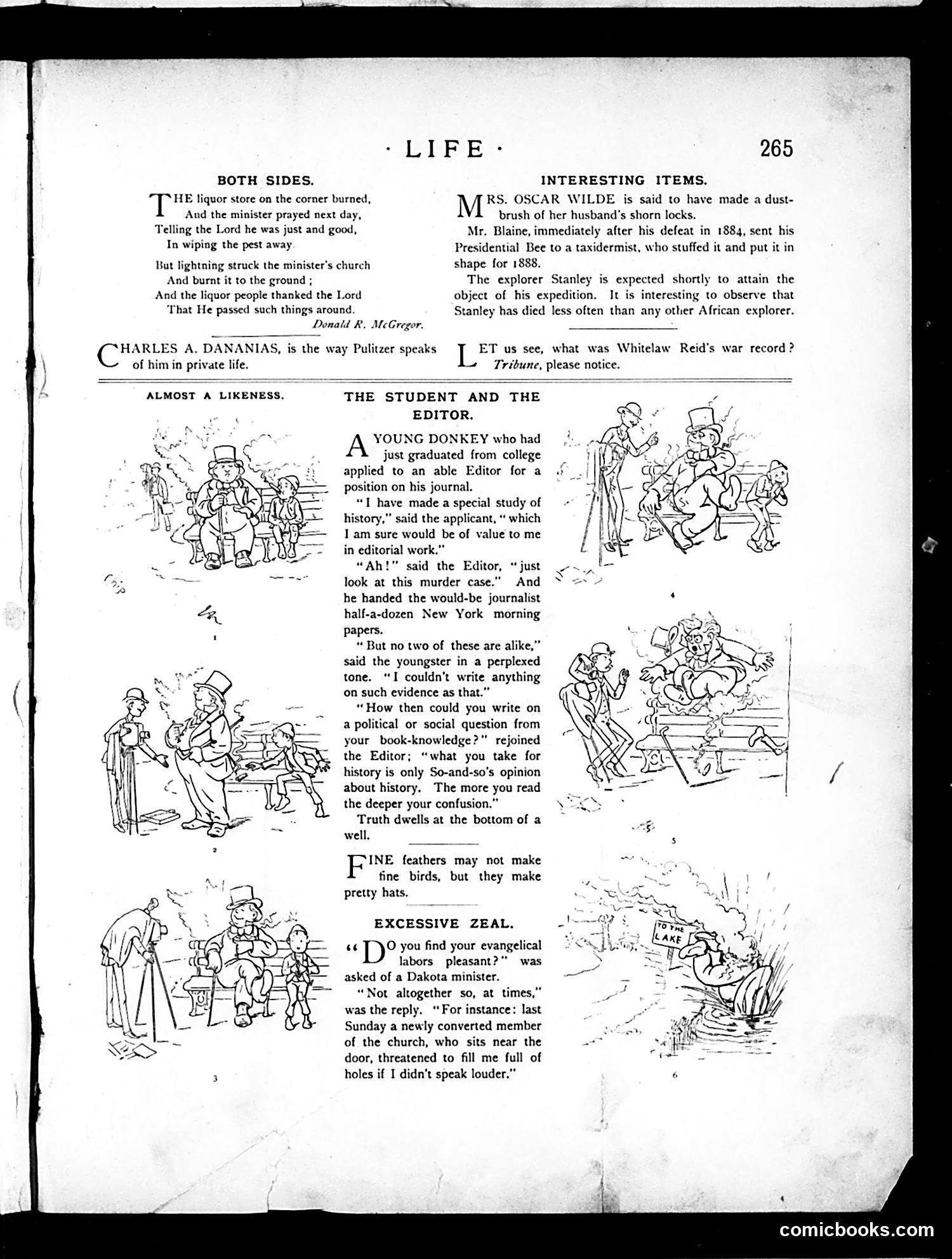
This page contains several satirical pieces typical of late-19th-century American humor: **"Both Sides"** is a poem mocking religious hypocrisy. A minister thanks God for burning down a liquor store as divine judgment, but when lightning strikes *his* church, the liquor dealers thank God equally. The satire: both groups interpret misfortune selectively to confirm their moral worldview. **"The Student and the Editor"** satirizes naive book-learning versus real-world journalism. A college graduate claims historical knowledge would help editorial work, but an editor demonstrates that newspaper accounts of the same event contradict each other—showing that "history" is merely opinion, not fact. The joke critiques both academia's disconnect from practical truth and journalism's unreliability. **"Excessive Zeal"** jokes about frontier Christianity: a Dakota minister's newly converted parishioner threatens violence if he doesn't preach louder, suggesting religious fervor without actual piety. The page also contains brief gossip items about Oscar Wilde and political figures, typical of Life's format mixing cartoons, jokes, and social commentary.
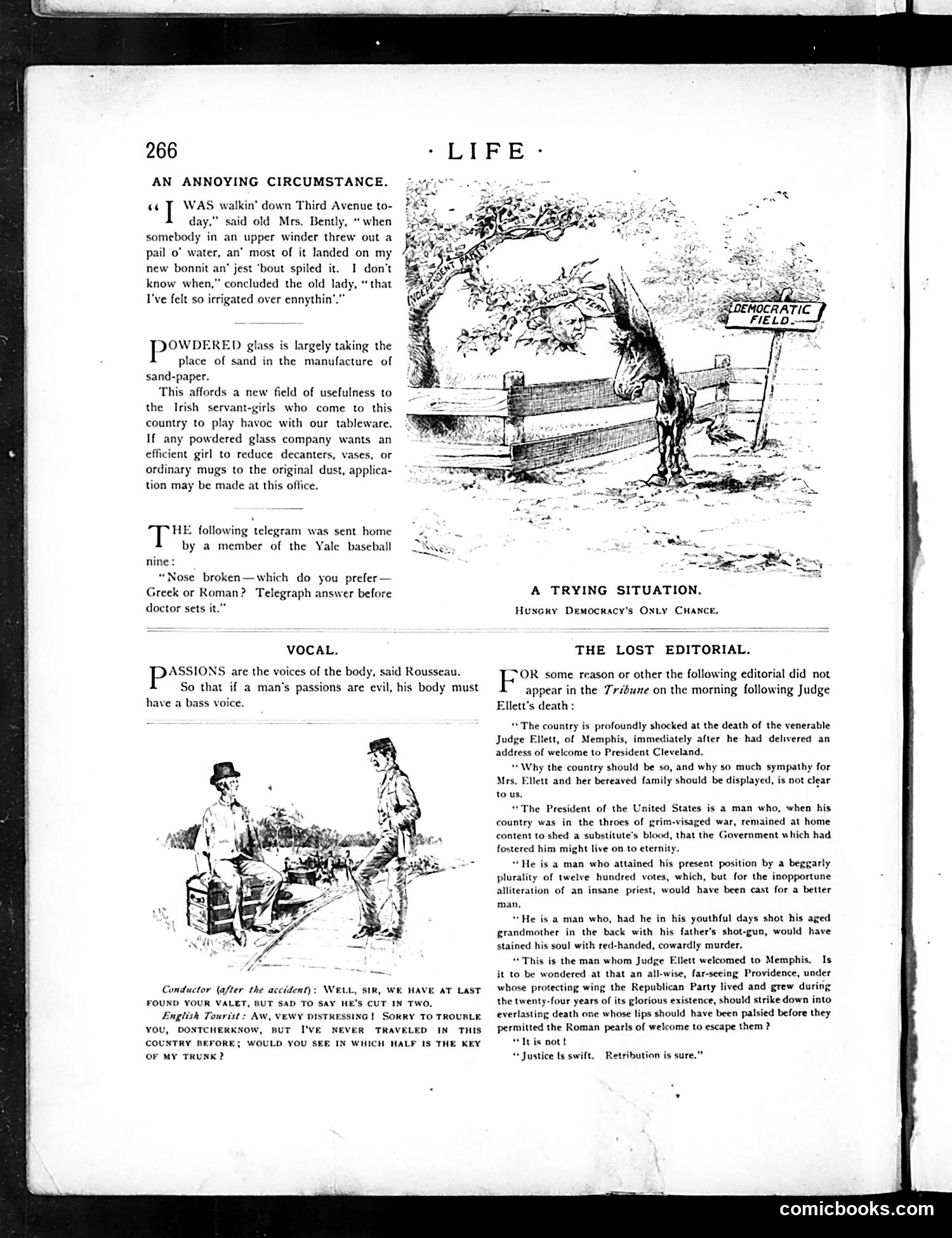
This page contains several separate humor pieces satirizing American society and politics circa the 1880s-90s. **"A Trying Situation"** cartoon depicts a hungry donkey in a "Democratic Field"—political allegory suggesting the Democratic Party's weakened state or limited opportunities. **"The Lost Editorial"** is the page's most pointed satire. It presents a fictional editorial supposedly suppressed from the *Tribune* following Judge Ellett's death at a Cleveland reception. The piece viciously attacks President Cleveland, sarcastically implying his unworthiness to receive a judge's welcome by cataloging his supposed failures: draft-dodging during the Civil War, winning by a narrow plurality, and moral corruption. The editorial's concluding assertion that Providence "struck down" the judge for greeting Cleveland is bitterly ironic—suggesting Cleveland's presence itself is cursed. This reflects sharp partisan divisions of the Gilded Age, when political attacks were ferociously personal. The satire mocks extreme partisan rhetoric by presenting an absurdly venomous editorial as something that *would* circulate. Other pieces on the page are lighter anecdotes about everyday annoyances.
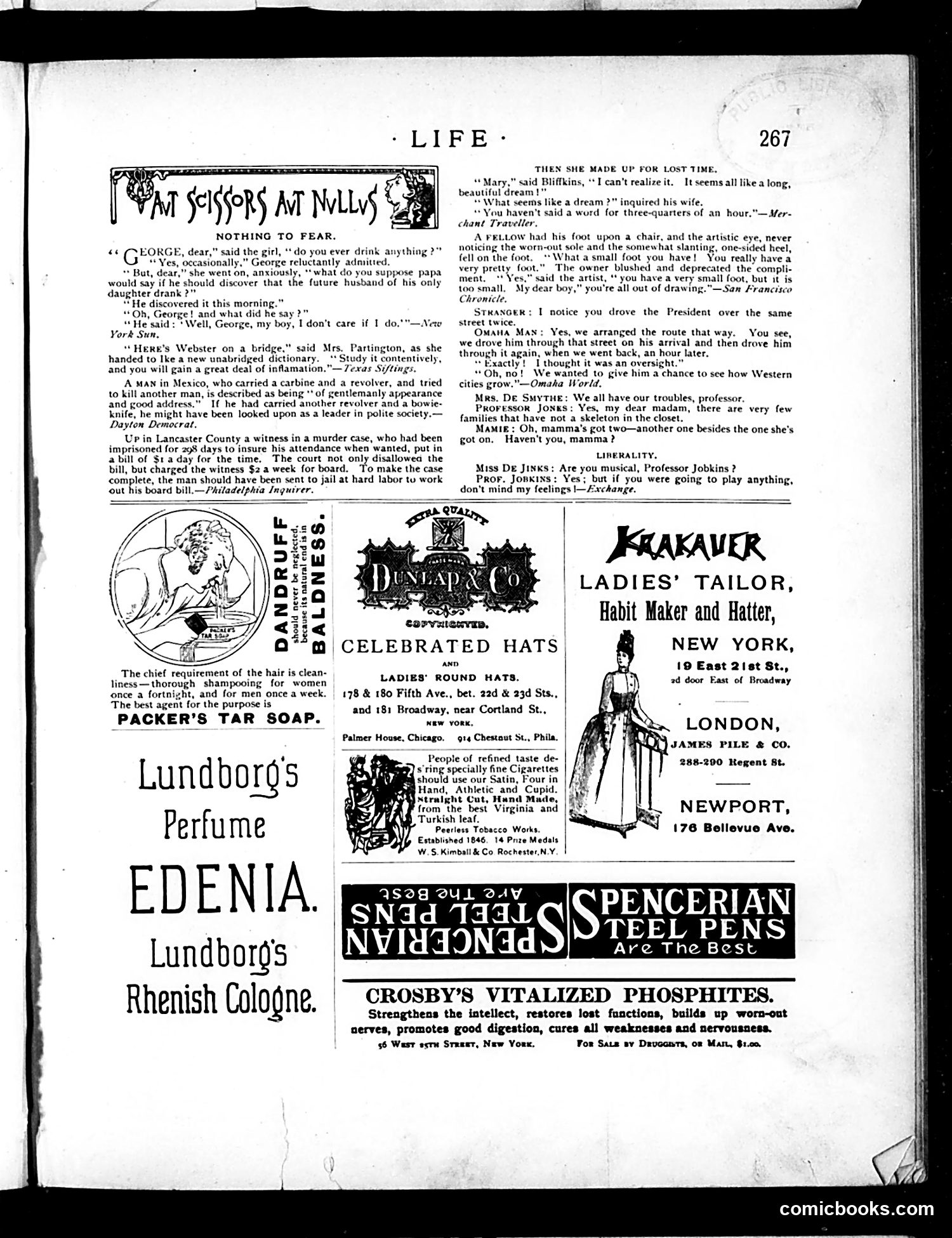
This page is primarily **advertising** interspersed with brief humorous anecdotes typical of early Life magazine's format. The small comic sketches and jokes mock social pretensions and absurdities: - A husband discovers his wife drinks; her father dismissively replies he doesn't care—satirizing male indifference to women's behavior - A witness imprisoned 298 days for a murder trial is charged $1/day board fees, then $2/week afterward—mocking the absurdity of the justice system profiting from detaining witnesses - An artist compliments a woman's small foot while noting it's "all out of drawing"—satirizing affected artistic praise - An Omaha official claims driving the President twice through the same street showcases city growth—mocking hollow civic boosterism The advertisements (Packer's Tar Soap, Lundborg's Perfume, Krakauer tailoring, Spencerian Steel Pens) reflect contemporary consumer goods marketed to affluent readers. The overall tone is genteel satirical humor targeting middle and upper-class hypocrisies and social conventions of the era.
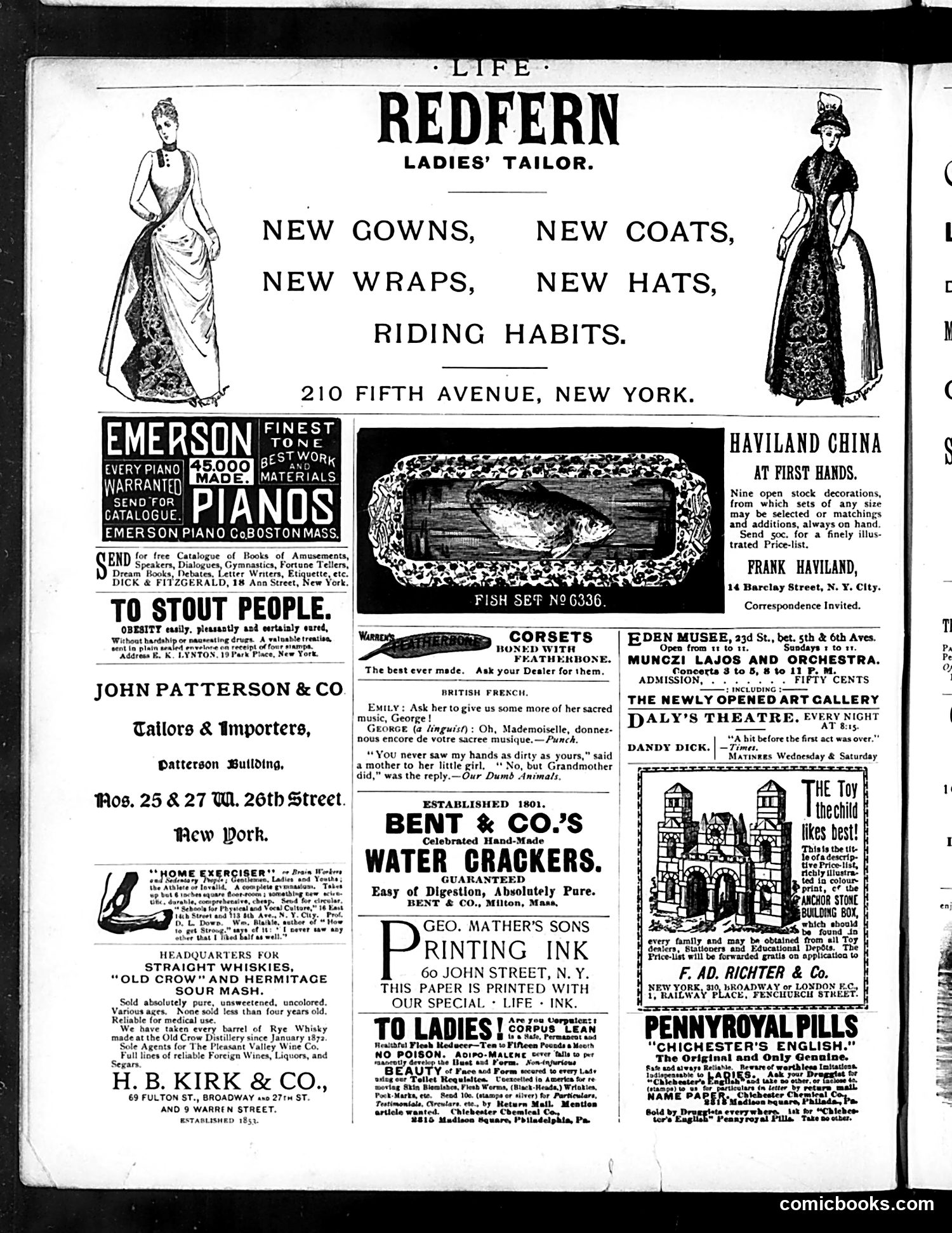
This is primarily an **advertising page** from Life magazine, not a satirical cartoon page. The layout consists of period commercial advertisements for various products and services typical of late 19th-century New York. Notable ads include: - **Redfern** (ladies' tailor) at top - **Emerson Pianos** - **John Patterson & Co.** (tailors) - **H.B. Kirk & Co.** (whiskey distributor) - **Bent & Co.** (water crackers) - Various other merchants and patent medicines The page includes a few brief **humorous anecdotes** (credited to *Punch* and *Our Dumb Animals*) rather than visual satire—small jokes about music and children that served as filler content. The only illustration is a **fish serving set** (#6336), shown as a product image for Haviland China. **For modern readers:** This represents how 19th-century magazines monetized space—advertisements subsidized publication costs, with humor interspersed as editorial content.
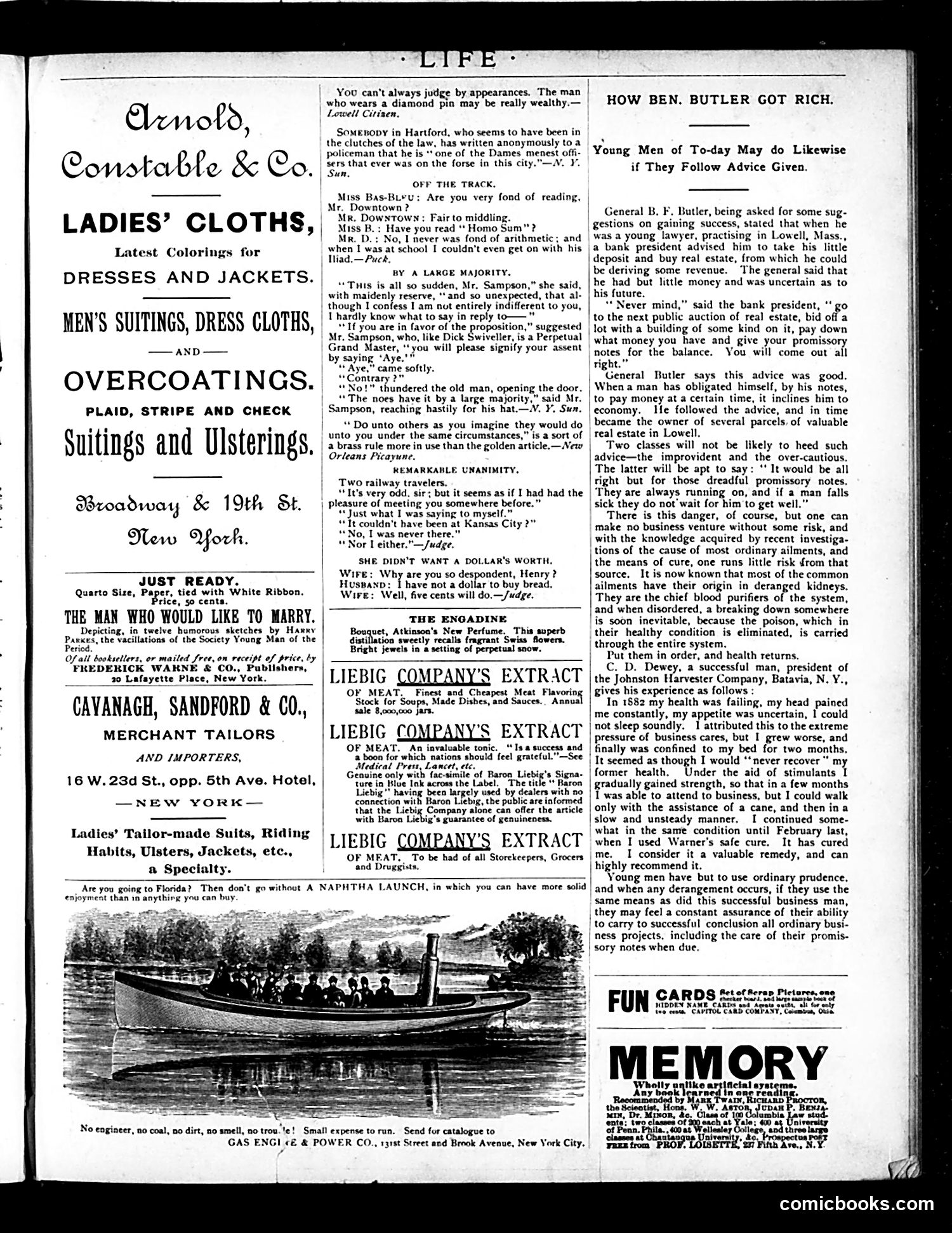
This page is primarily **advertising**, with small satirical pieces typical of Life magazine's humor sections. The main content includes: - **Fashion and tailoring ads** for Arnold, Constable & Co. and Cavanagh, Sandford & Co. - **Several short humorous anecdotes** mocking everyday situations (a woman declining a marriage proposal via parliamentary procedure; travelers coincidentally never meeting in the same places). - **Product advertisements** for Liebig Company's meat extract and other goods. The only substantive political/social reference is the headline **"How Ben. Butler Got Rich,"** which appears to promise content about General Benjamin Butler (a controversial Civil War general and politician known for allegations of corruption). However, the actual article text is cut off or not visible on this page, so the specific satire cannot be determined. The headline alone suggests Life was critiquing Butler's reputation for financial impropriety, a common target of period satire.
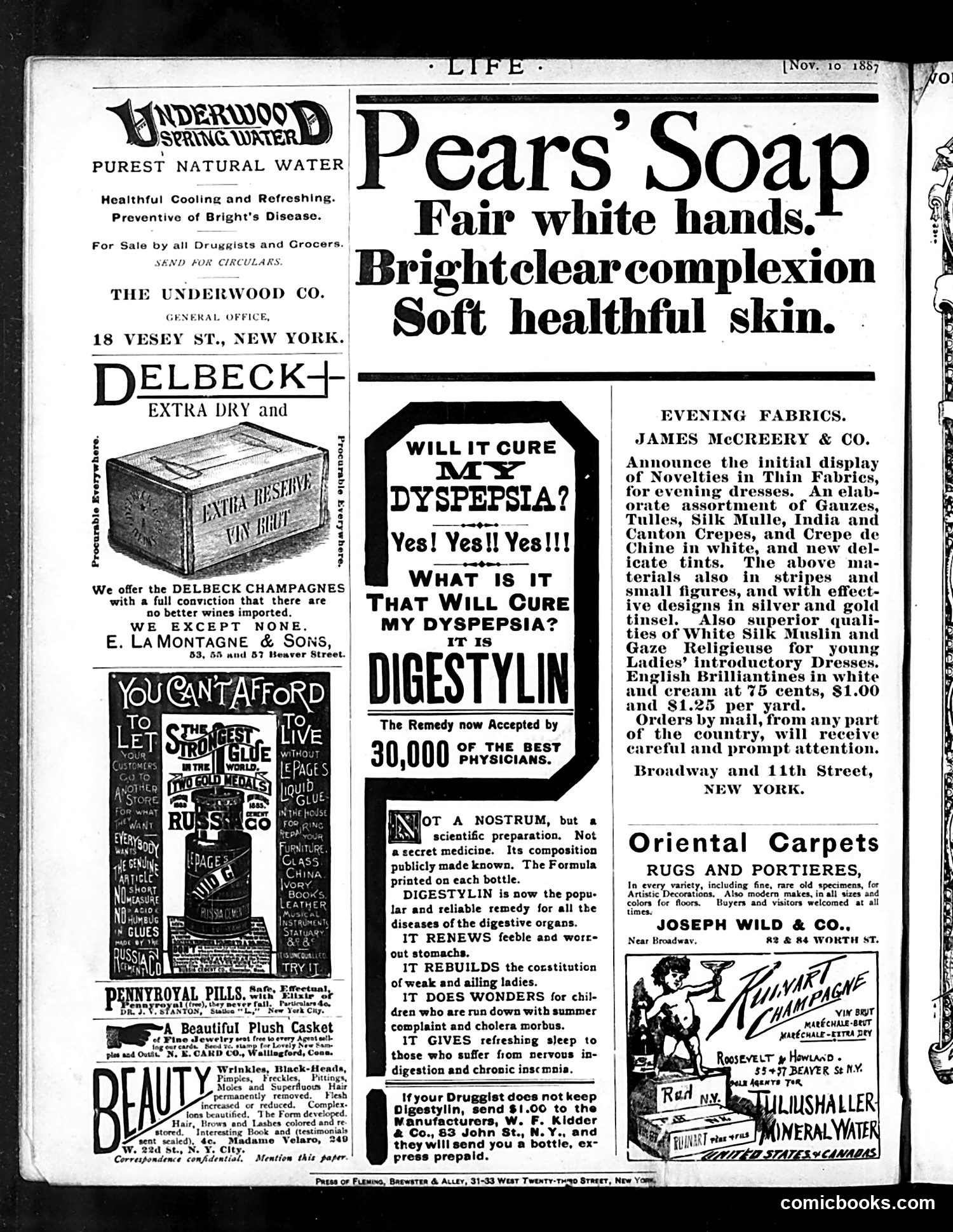
This is primarily a **commercial advertising page** rather than political satire or comics. The page features numerous patent medicines and luxury goods typical of the 1880s. The most prominent content is a large advertisement for **Digestylin**, a patent medicine claiming to cure dyspepsia (indigestion). It boasts endorsement by "30,000 physicians"—a marketing claim characteristic of dubious patent medicines of this era that often made unsubstantiated medical promises. Other notable ads include **Pears' Soap** (emphasizing racial anxieties about skin whiteness common to Victorian advertising) and **Pennyroyal Pills** (likely an abortifacient sold euphemistically). The page also advertises luxury items: champagne, fine jewelry, carpets, and evening fabrics—reflecting affluent readership. **For modern readers**: This page documents both consumer culture and the largely unregulated medical marketplace of the 1880s, before FDA oversight. The ads reveal contemporary beauty standards and medical fraud that was then commonplace and legal.