
Life, 1887-11-10 · page 5 of 16
Life — November 10, 1887 — page 5: what you’re looking at
What you’re looking at
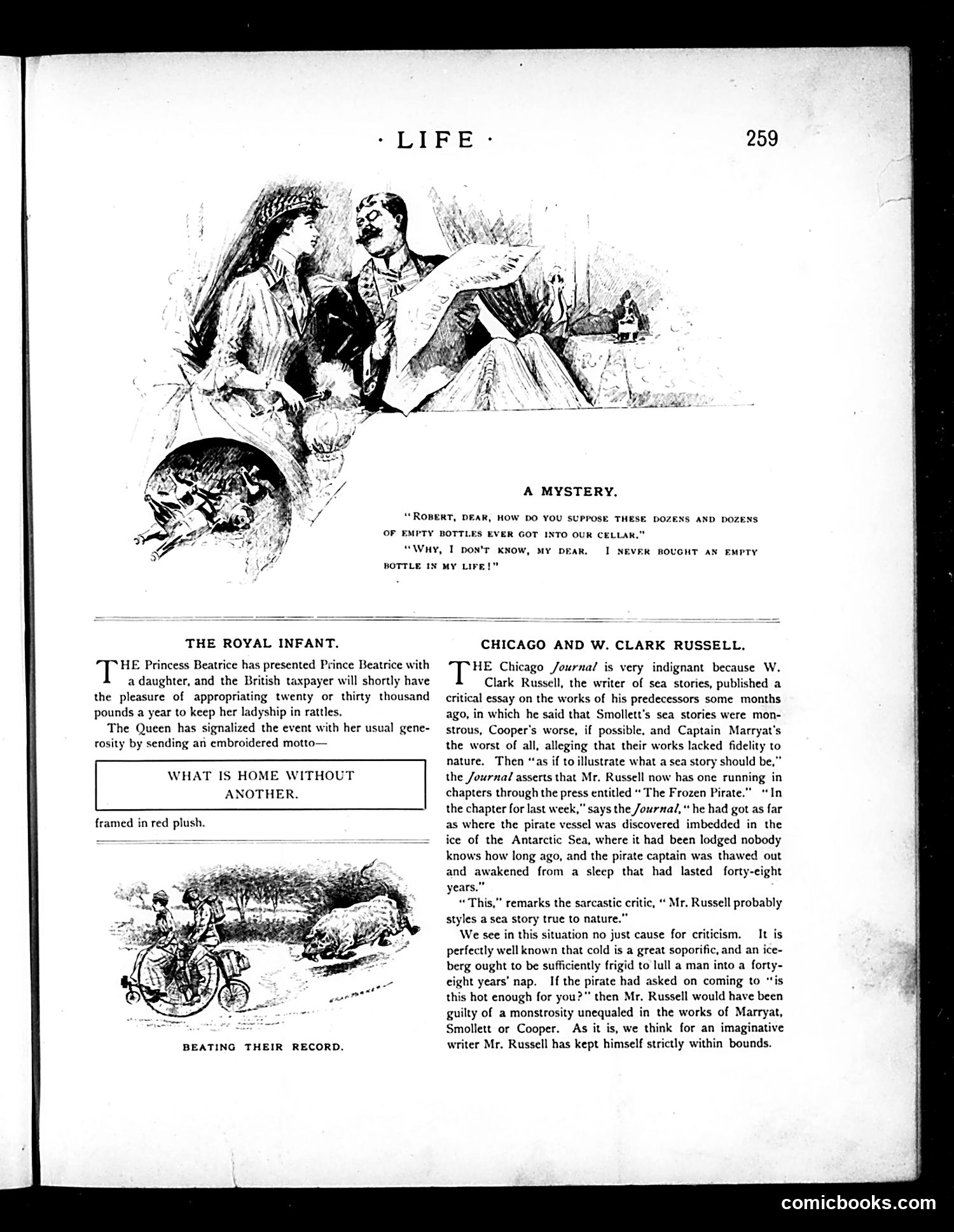
**"A Mystery"** (top cartoon): Shows three figures discovering empty wine bottles in a cellar. The caption presents a humorous domestic dispute—the husband claims he never purchased empty bottles, implying his wife or servants are responsible for the mysteriously empty wine supply. This is genteel Victorian-era satire about household management and alcohol consumption among the wealthy. **"The Royal Infant"**: Brief news item about Princess Beatrice presenting Prince Henry with a daughter; the Queen sends an embroidered note—typical society page coverage of royal births. **"Chicago and W. Clark Russell"**: A critical essay defending sea-story writer W. Clark Russell against a *Chicago Journal* reviewer who had criticized his work as implausible (specifically "The Frozen Pirate"). The satire defends Russell's realistic storytelling against overly harsh literary criticism.
📄 Transcribed text from this page (OCR, searchable)
Machine-transcribed from the original scan — historical spelling and the odd misread are preserved.
A MYSTERY. “ROBERT, DEAR, HOW DO YOU SUPPOSE THESE DOZENS AND DOZENS OF EMPTY BOTT “Wuy, I pon'r KNow, MY DEAR. EVER GOT INTO OUR CELLAR,” I NEVER BOUGHT AN EMPTY BOTTLE IN MY LIFE!" THE ROYAL INFANT. HE Princess Beatrice has presented Prince Beatrice with a daughter, and the British taxpayer will shortly have the pleasure of appropriating twenty or thirty thousand pounds a year to keep her ladyship in rattles. The Queen has signalized the event with her usual gene- rosity by sending an embroidered motto— WHAT IS HOME WITHOUT ANOTHER. framed in red plush. BEATING THEIR RECORD. CHICAGO AND W. CLARK RUSSELL. HE Chicago /ourna/ is very indignant because W. Clark Russell, the writer of sea stories, published a critical essay on the works of his predecessors some months ago, in which he said that Smollett’s sea stories were mon- strous, Cooper's worse, if possible, and Captain Marryat's the worst of all, alleging that their works lacked fidelity to nature. Then “‘as if to illustrate what a sea story should be,” the Journal asserts that Mr. Russell now has one running in chapters through the press entitled “ The Frozen Pirate.” “In the chapter for last week,” says the Journal,“ he had got as far as where the pirate vessel was discovered imbedded in the ice of the Antarctic Sea, where it had been lodged nobody knows how long ago, and the pirate captain was thawed out and awakened from a sleep that had lasted forty-eight years,” “This,” remarks the sarcastic critic, “ Mr. Russell probably styles a sea story true to nature.” We see in this situation no just cause for criticism. It is perfectly well known that cold is a great soporific, and an ice- berg ought to be sufficiently frigid to lull a man into a forty- cight years’ nap. If the pirate had asked on coming to “is this hot enough for you?” then Mr. Russell would have been guilty of a monstrosity unequaled in the works of Marryat, Smollett or Cooper. As it is, we think for an imaginative writer Mr. Russell has kept himself strictly within bounds. comicbooks.com