
A complete issue · 16 pages · 1887
Life — October 13, 1887
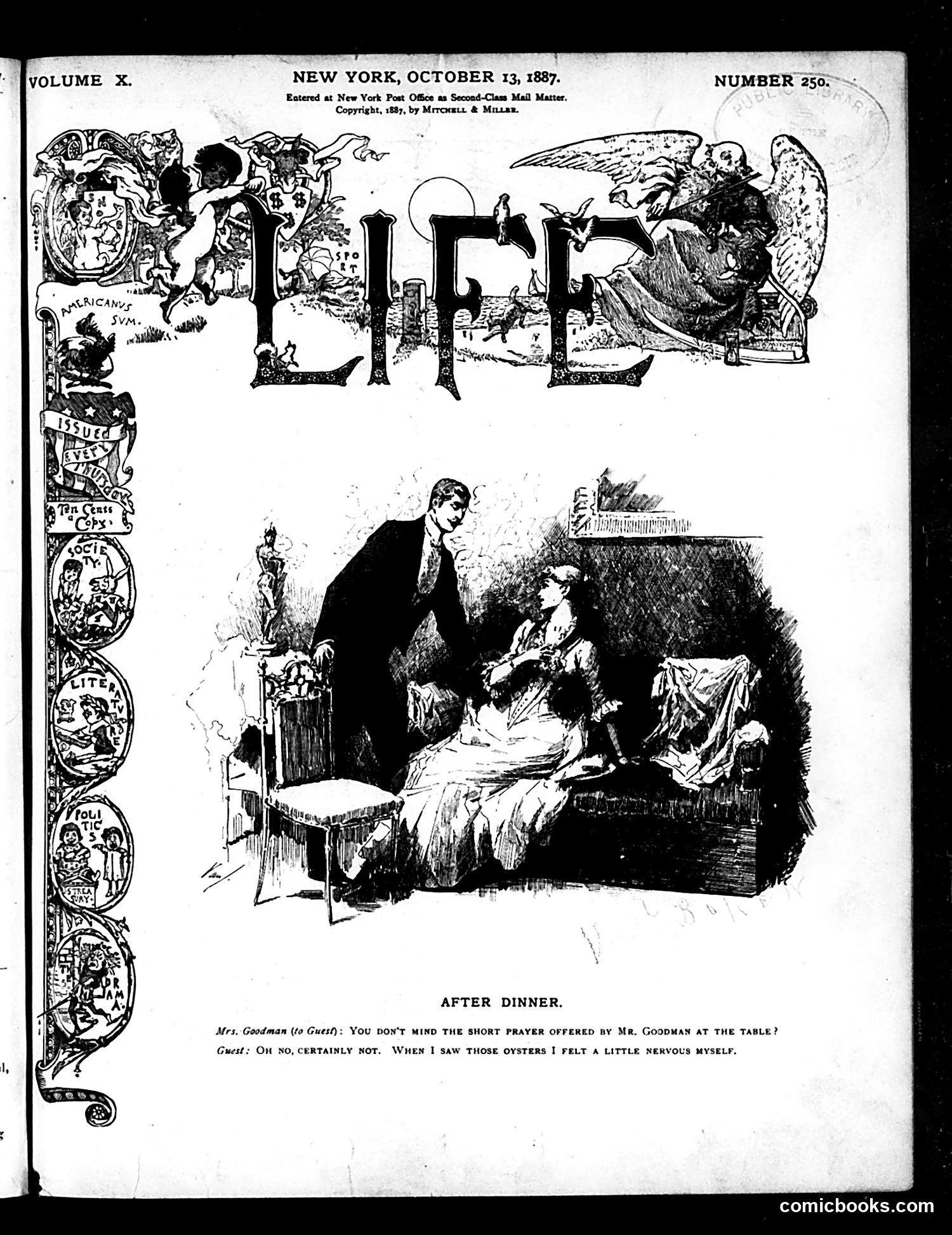
**The Cartoon:** Titled "After Dinner," this depicts a social scene where a guest remarks to Mrs. Goodman that he felt "nervous" upon seeing oysters at dinner. Mrs. Goodman responds that her husband offered a "short prayer" before the meal—suggesting the prayer was meant to protect diners from potentially contaminated seafood. **The Satire:** The humor targets two concerns of the 1880s: the quality and safety of oysters (a popular but sometimes risky food), and the apparent inadequacy of religious blessing as food safety protection. The joke implies both the oysters' questionable quality and the irony of relying on prayer rather than proper food handling to prevent illness.
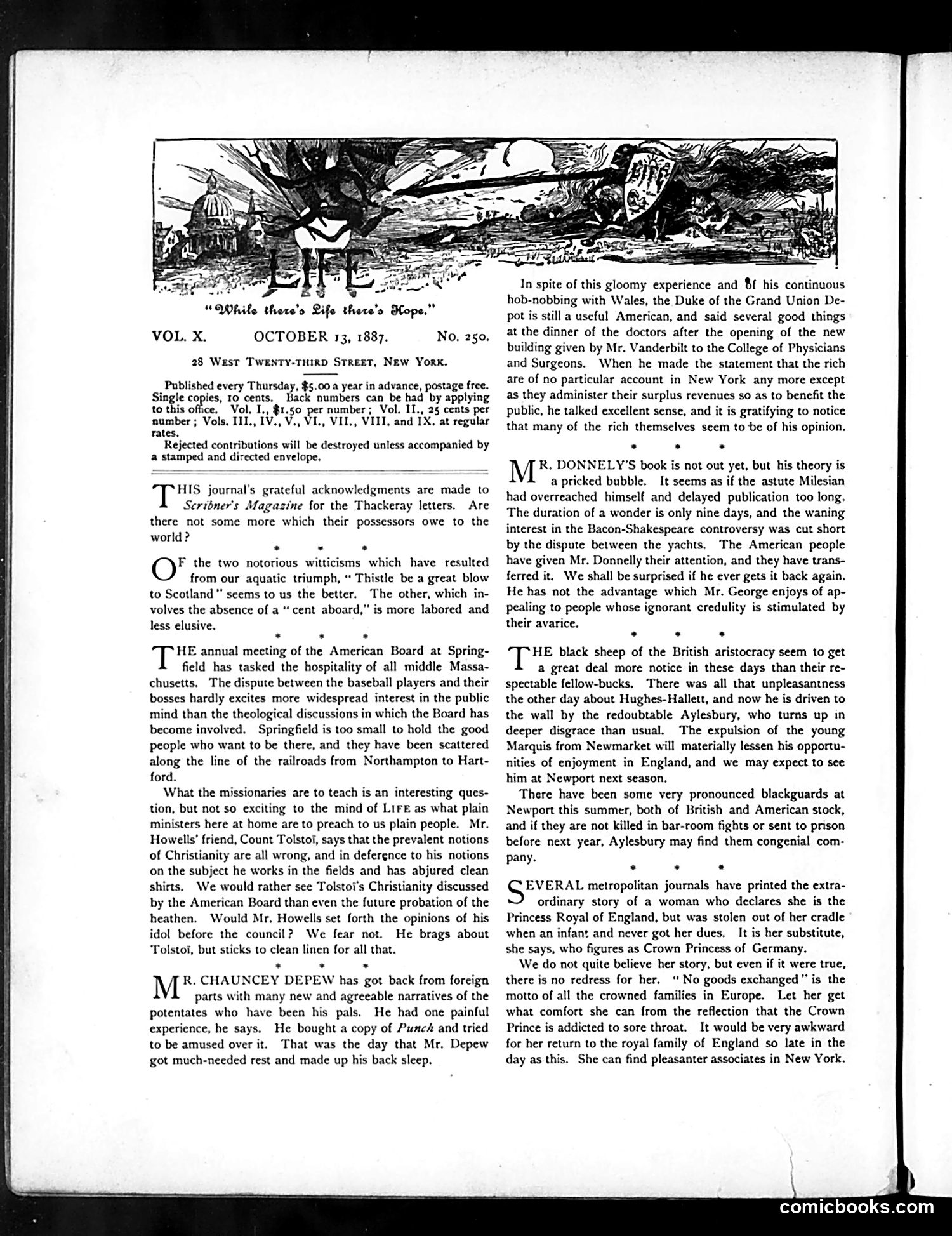
The header cartoon, titled "While there's Life there's Hope," depicts a chaotic nighttime scene with figures in distress near water, possibly shipwreck or disaster. The satirical commentary below discusses American social and political matters of 1887. The text critiques various subjects: Mr. Donnelly's failed theories about the Bacon-Shakespeare controversy; disputes between American yachts and British rivals; the American Board's meeting addressing religious disputes; and Mr. Chauncey Depew's travels abroad. A final piece mocks a woman claiming to be England's "Princess Royal," rejected by the Crown Prince and now seeking sympathy in New York—likely satirizing both European aristocratic pretension and American gullibility toward false nobility claims. The satire targets fraud, religious hypocrisy, and transatlantic class dynamics.
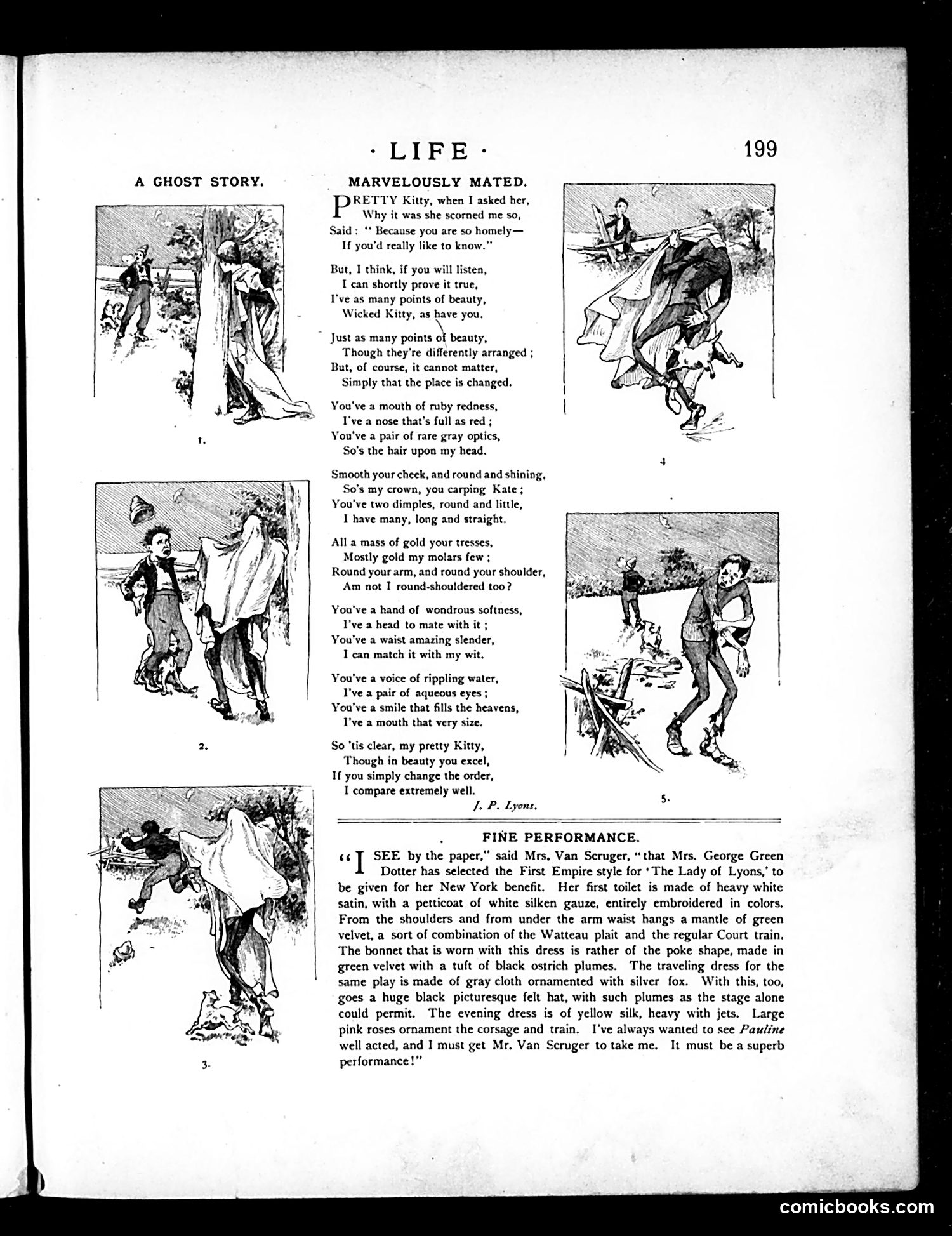
This page contains two separate pieces: **"A Ghost Story"** (left): A comic narrative with five illustrations showing what appears to be a romantic or supernatural encounter between a man and a woman in classical dress. The story's exact meaning is unclear from the images alone. **"Marvelously Mated"** (center): A poem by J. P. Lyons complimenting a woman named "Pretty Kitty" by comparing her physical features favorably to those of another woman ("Wicked Kitty"). It's a lighthearted romantic verse praising her beauty and charm. **"Fine Performance"** (bottom right): A brief note about actress Mrs. George Green Dotter selecting an Empire-style dress for a theatrical performance of "The Lady of Lyons," detailing costume elements including satin, velvet, and accessories. The page reflects early-20th-century Life magazine's mix of humor, romance, and entertainment gossip.
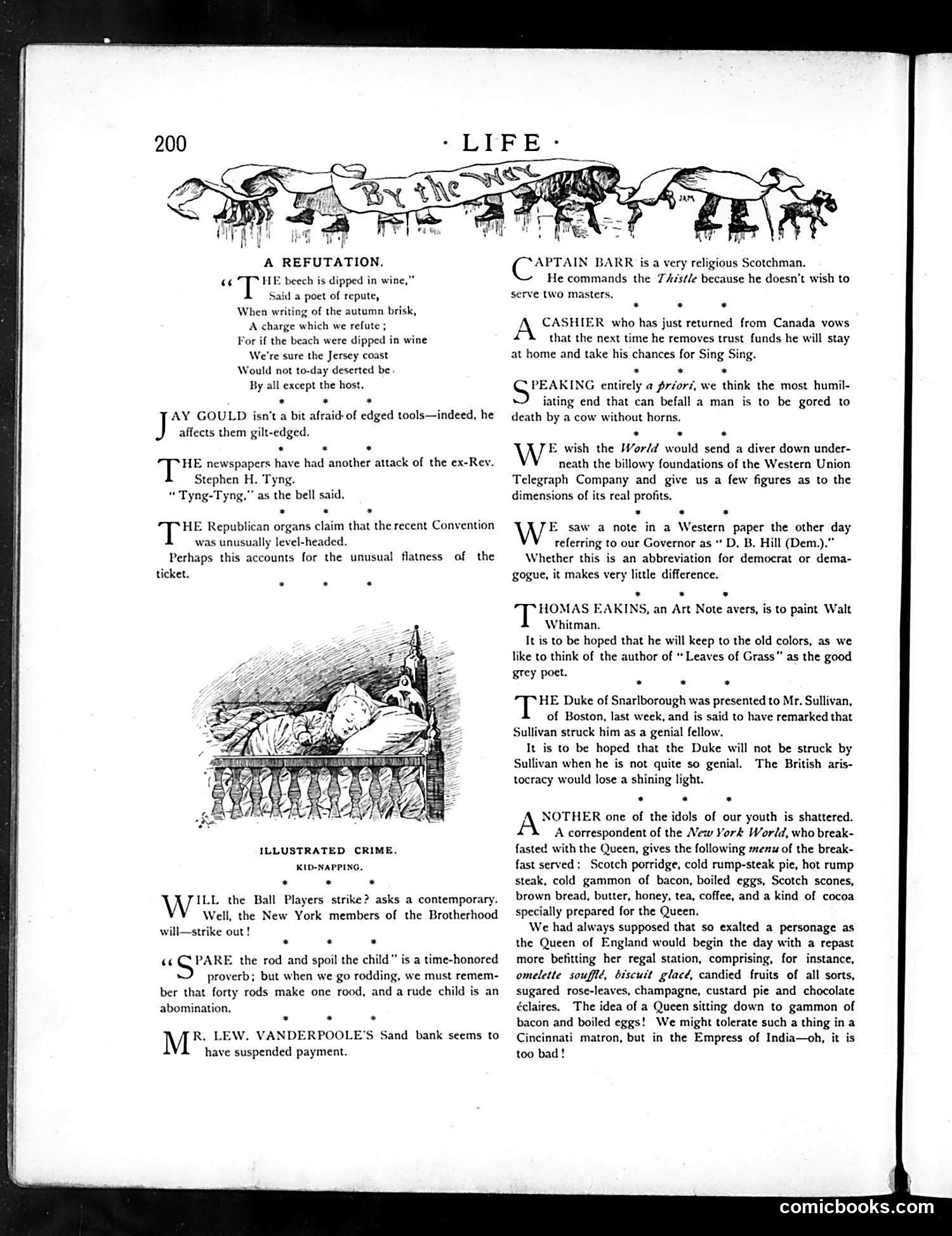
This page contains short satirical commentary and one illustration titled "Illustrated Crime: Kid-Napping." The cartoon depicts a child being kidnapped from a crib while parents sleep below, seemingly unaware. The satire appears to reference the contemporary crime of child abduction. The text section "A Refutation" mocks a poet's claim that beech wood shouldn't be used for wine because it's inferior—arguing the real issue is whether hosts would serve such poor-quality wine. Other brief items satirize: Jay Gould's miserliness, Rev. Stephen Tyng's newspaper attacks, Republican convention "flatness," and various social figures including Captain Barr and Thomas Eakins. The satire targets wealth inequality, religious hypocrisy, political matters, and social pretension typical of Gilded Age *Life* magazine humor.
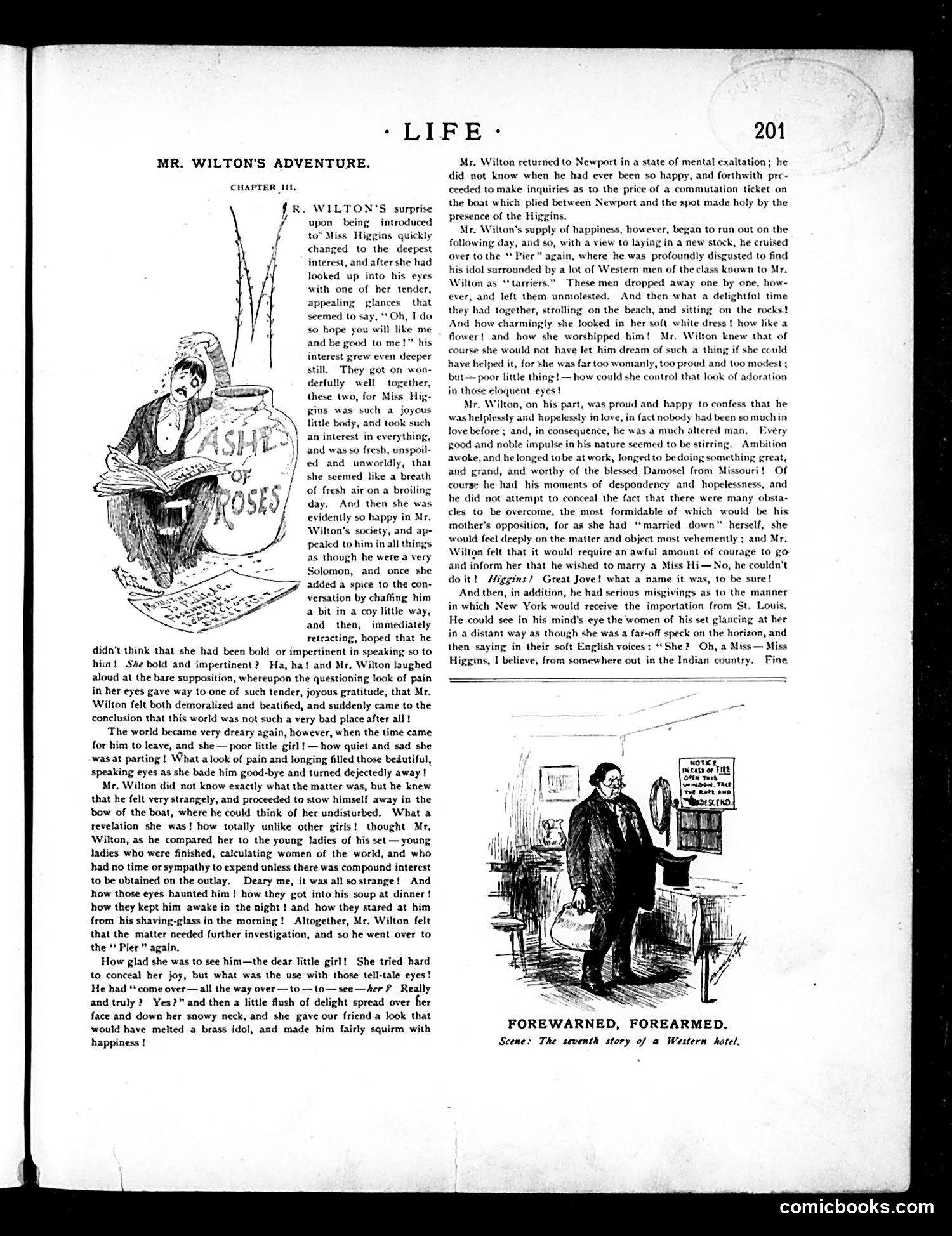
This page continues "Mr. Wilton's Adventure," a serialized story about a man pursuing romance in Newport, Rhode Island's high society. The main illustration shows Wilton conversing with Miss Higgins, a young woman he's attracted to, depicted with exaggerated features typical of period illustration. The bottom illustration titled "Forewarned, Forearmed" appears to be a separate cartoon depicting a Western hotel scene, though the specific satirical target is unclear from the image alone. The page is primarily **literary content**—a fictional narrative with accompanying illustrations—rather than political satire. It reflects early 20th-century American magazine conventions mixing serialized stories with visual humor for middle-class audiences.
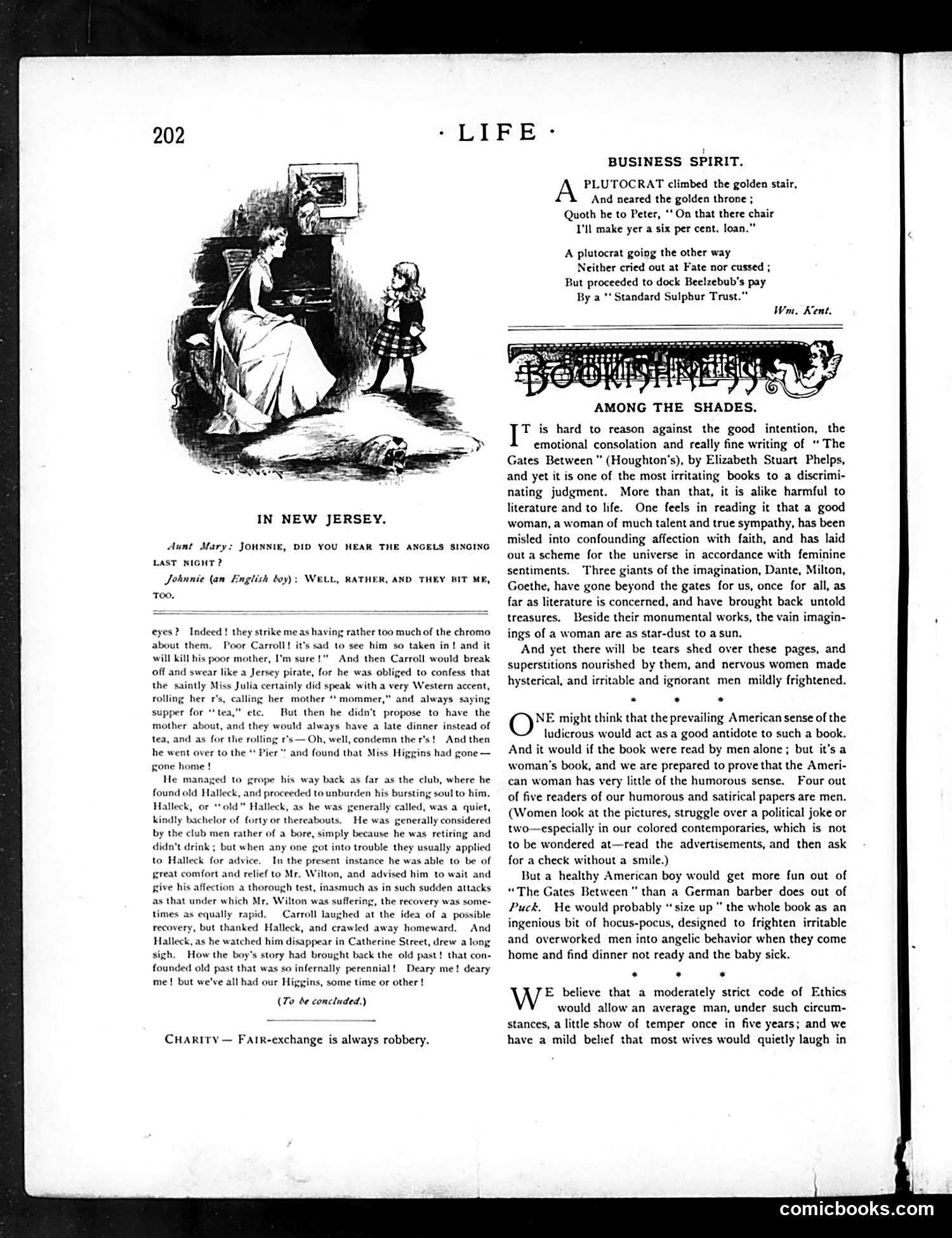
**"In New Jersey" cartoon:** This depicts a domestic scene satirizing working-class life. A woman asks a man ("Johnnie") if he heard angels singing; he responds cynically that angels "bit me" and he's covered in welts. The joke mocks both romantic sentimentality and the harsh reality of poverty or hardship—suggesting that idealism and comfort are luxuries the working poor cannot afford. **"Business Spirit" poem:** Satirizes financial manipulation, describing a plutocrat making predatory loans at six percent interest while another plutocrat "docks" payments to a "Standard Sulphur Trust." The satire targets wealthy businessmen exploiting financial systems for personal gain. **"Among the Shades" essay:** Critiques Elizabeth Stuart Phelps's novel "The Gates Between," arguing it misguides readers with sentimental rather than rational thinking.
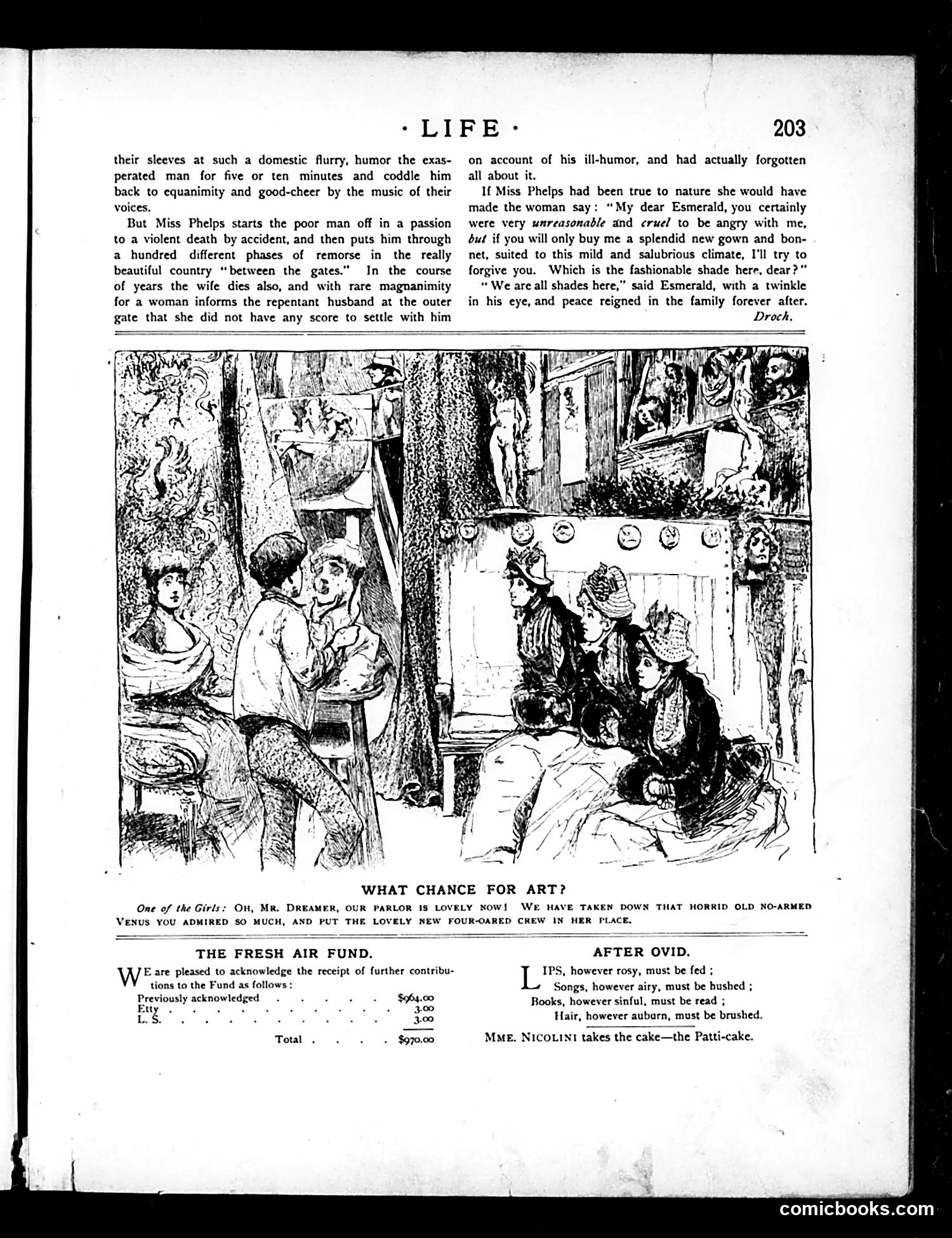
This satirical cartoon mocks the displacement of classical artistic taste by commercial entertainment. The caption references removing "that horrid old no-armed Venus" (the famous armless ancient statue) to make room for a "lovely new four-oared crew" (likely a rowing team). The scene shows fashionable women gathered around what appears to be a parlor or social space, seemingly indifferent to high art. The satire targets the era's growing commercialization of culture and the prioritization of sports/athletics (represented by the rowing crew) over traditional fine art appreciation. This reflects early 20th-century anxieties about modernization eroding classical aesthetic values among the leisure class—a recurring theme in *Life* magazine's social criticism during this period.
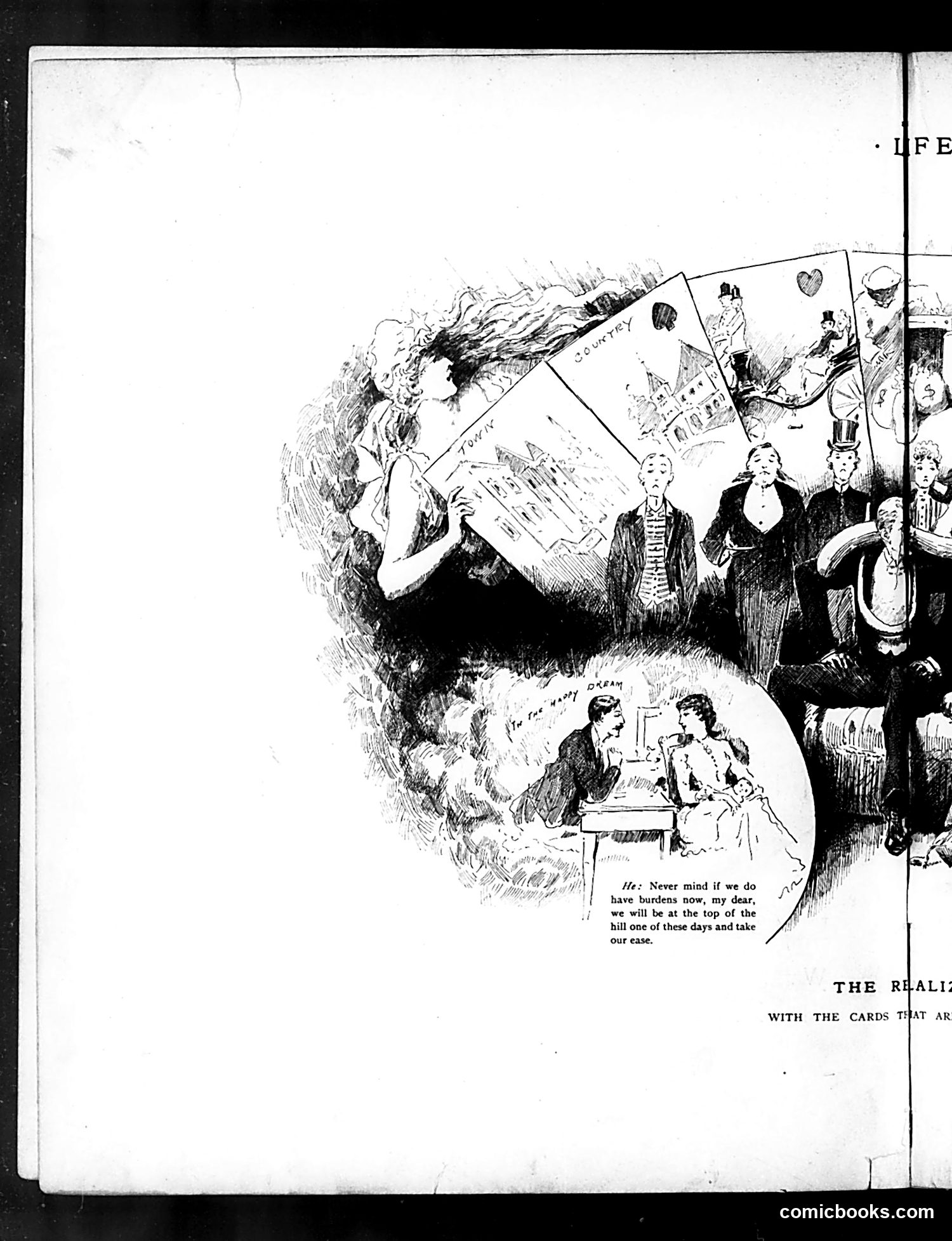
This page from *Life* magazine contains a satirical illustration about social aspiration and class mobility. The central image depicts a large female figure (representing either ambition or a society matron) presiding over a social scene. Below, a couple discusses their financial prospects, with the man reassuring his companion: "Never mind if we do have burdens now, my dear, we will be at the top of the hill one of these days and take our ease." The cartoon satirizes the American dream and middle-class optimism about upward mobility. The heading references "cards that are" (text cuts off), suggesting the satire concerns how people are "dealt with" socially or financially. The elaborate costume and theatrical staging mock both the pretensions of social climbing and the naive faith in future prosperity.
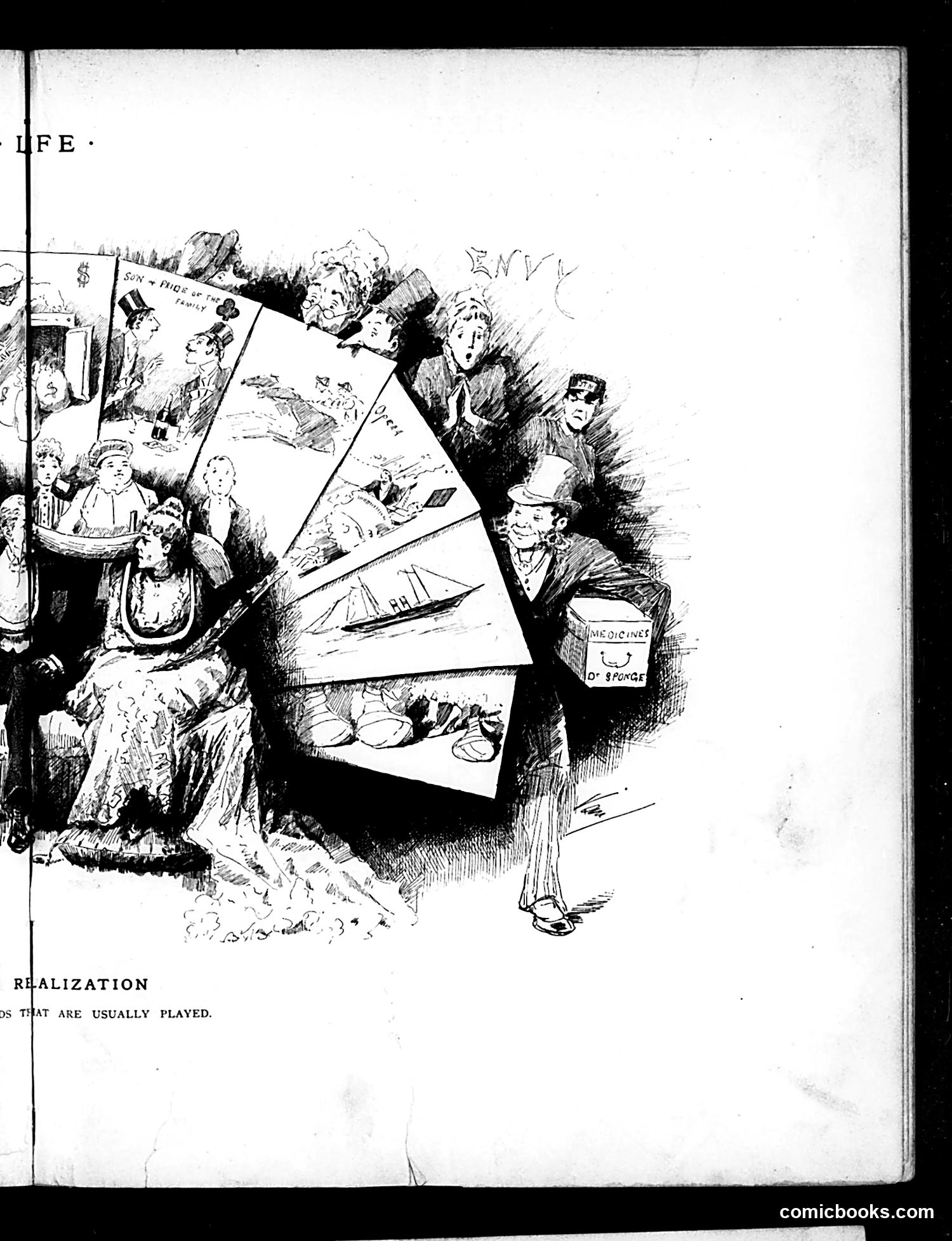
This page from *Life* magazine shows a satirical cartoon titled "REALIZATION" depicting a group of people gathered around large artistic sketches or paintings. The visible text fragment mentions "OS THAT ARE USUALLY PLAYED," suggesting commentary on theatrical or social performance. The cartoon appears to satirize public enthusiasm for art or cultural pretense. A well-dressed man on the right (possibly a dealer or promoter, holding what appears to be a product box labeled "MARGARINE" or similar) presents grand artistic compositions to an assembled crowd of onlookers. The satire likely mocks either: the gap between artistic ambition and commercial reality, the gullibility of art enthusiasts, or the commodification of culture—suggesting that grand artistic visions are reduced to mundane, marketable products or performances when brought before the public.
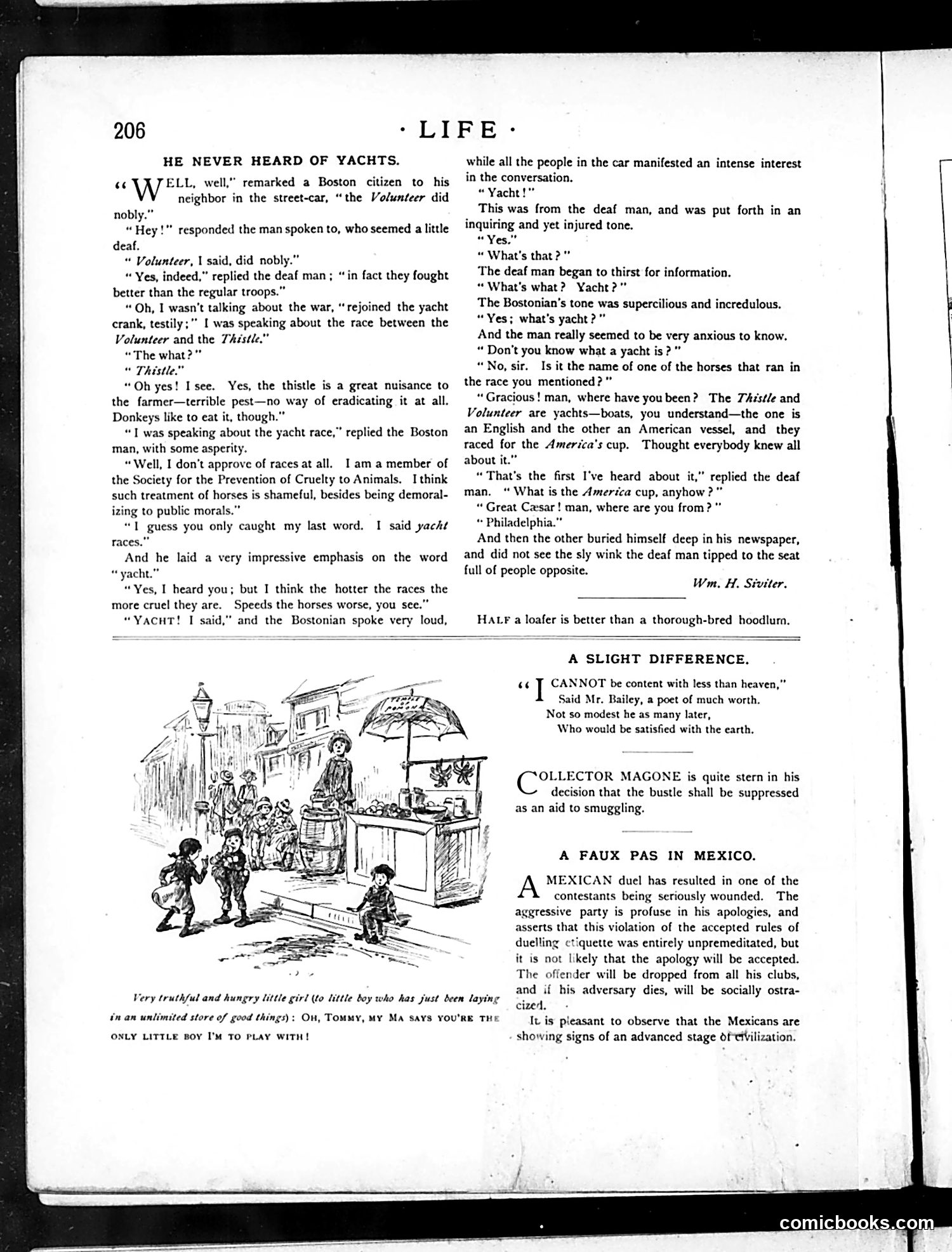
**"He Never Heard of Yachts"** (top story): A Boston Brahmin condescendingly discusses yacht racing with a deaf man who misunderstands "Volunteer" and "Thistle" (famous racing yachts) as a military volunteer and a weed. The satire mocks both the wealthy man's assumption that everyone knows about exclusive yacht culture and the deaf man's innocent misinterpretations. The joke relies on class difference and the assumption that "proper" society interests are universal knowledge. **"A Slight Difference"** (middle cartoon): A street vendor with an umbrella; the caption satirizes Mr. Bailey's poetic aspirations humorously through contrast between heavenly ambition and earthly practicality. **"A Faux Pas in Mexico"** (bottom): References a dueling incident in Mexico, critiquing both Mexican honor culture and the violation of accepted dueling etiquette, while sardonically noting the Mexicans' "advanced civilization."
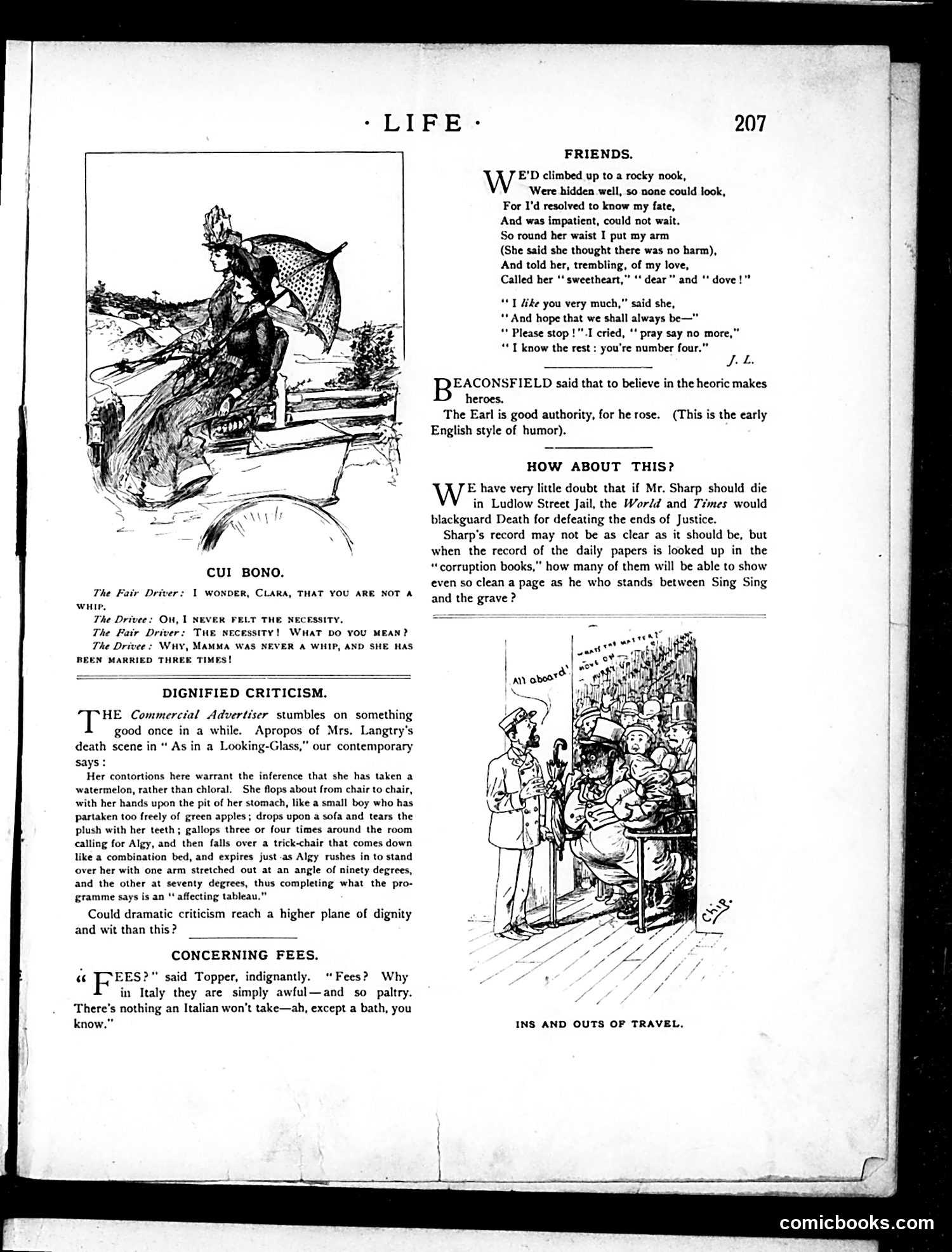
This satirical page contains several distinct humor pieces: **"Cui Bono"**: A flirtatious exchange where a woman asks why her male companion isn't married. He jokes that his mother never needed a whip (wasn't domineering) yet married three times—implying women don't need to be controlling to secure husbands, or sarcastically suggesting serial marriage doesn't require a strong personality. **"Dignified Criticism"**: Mocks overwrought theatrical reviewing by quoting the *Commercial Advertiser's* absurdly graphic description of actress Mrs. Langtry's death scene—she supposedly convulses like someone with watermelon-induced stomach pain, gallops around calling for "Algy," and dies in an exaggerated pose. The satire targets pretentious drama criticism. **"Concerning Fees"**: A character named Topper complains about Italian fees being too low, then stereotypes Italians as willing to accept bribes for anything except bathing—a period ethnic joke. **"Friends"**: A sentimental poem about a proposal, with a punchline: the woman stops him mid-confession, revealing he's her fourth suitor. The page mixes romantic comedy, theatrical satire, and ethnic humor typical of early-20th-century American magazines.
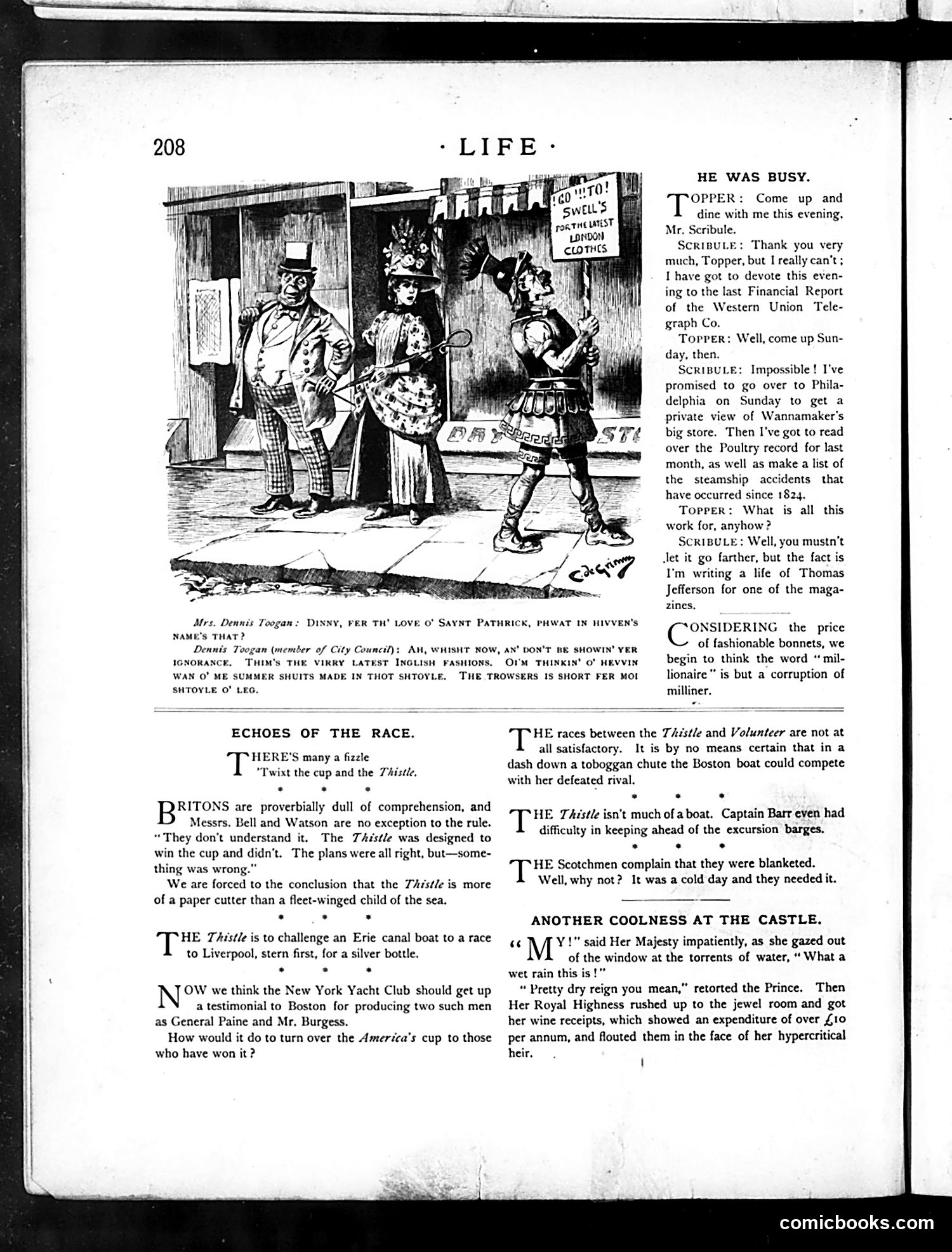
This page contains multiple satirical pieces mocking contemporary concerns: **Top cartoon**: Features Irish immigrants (identifiable by dialect and names like "Dennis Toogan"). Toogan claims his ill-fitting English suit represents "latest fashions"—satirizing working-class pretension and immigrant aspiration to appear fashionable despite obvious absurdity. **"He Was Busy"**: Mocks the overworked businessman obsessed with self-improvement. Scribule is too busy with tedious tasks (financial reports, store visits, historical research) to accept social invitations—satirizing the exhausting, joyless American work ethic and performative productivity. **"Echoes of the Race"**: Ridicules the recent yacht race between the Scottish *Thistle* and American *Volunteer*. The passages mock the *Thistle's* poor performance, suggesting it's useless and sarcastically proposing the Scottish team deserved their "blanket" defeat on a cold day. **"Another Coolness at the Castle"**: A pun-filled joke about British royalty's excessive spending, playing on "wet rain" vs. "reign" and mocking the heir's criticism of royal expenditure.
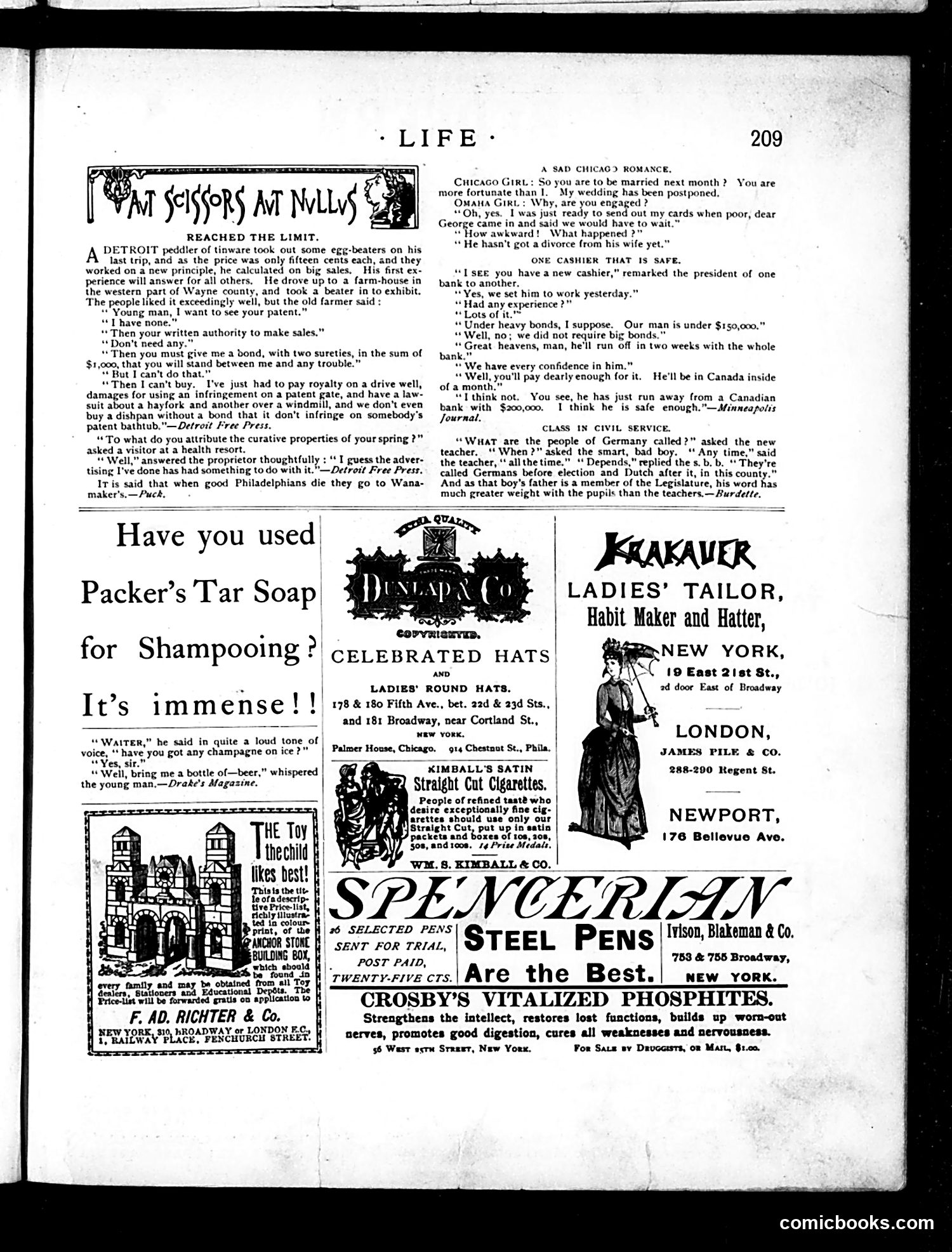
This page contains multiple satirical vignettes typical of Life magazine's humor: **"At Scissors at Nullys" / "Reached the Limit"**: A farmer's absurd demand that a tinware peddler provide a $1,000 bond before purchasing an egg-beater. The satire mocks excessive patent litigation in the Gilded Age—the farmer has already faced multiple patent lawsuits (on wells, gates, hayforks, windmills) and now distrusts any new invention without legal protection. **"A Sad Chicago Romance"**: Dark humor about a woman's postponed wedding because her fiancé cannot divorce his current wife—satirizing both marital complications and loose morality. **"One Cashier That is Safe"**: A bank president boasts confidence in a new cashier who previously embezzled $200,000 from a Canadian bank, reasoning he's "safe enough" because he's already fled. The joke mocks naive hiring practices and criminal predictability. **"Class in Civil Service"**: A student's crude observation that Germans are called "Germans before election and Dutch after it"—satirizing ethnic stereotyping and political manipulation in American local politics. The remainder is period advertising.
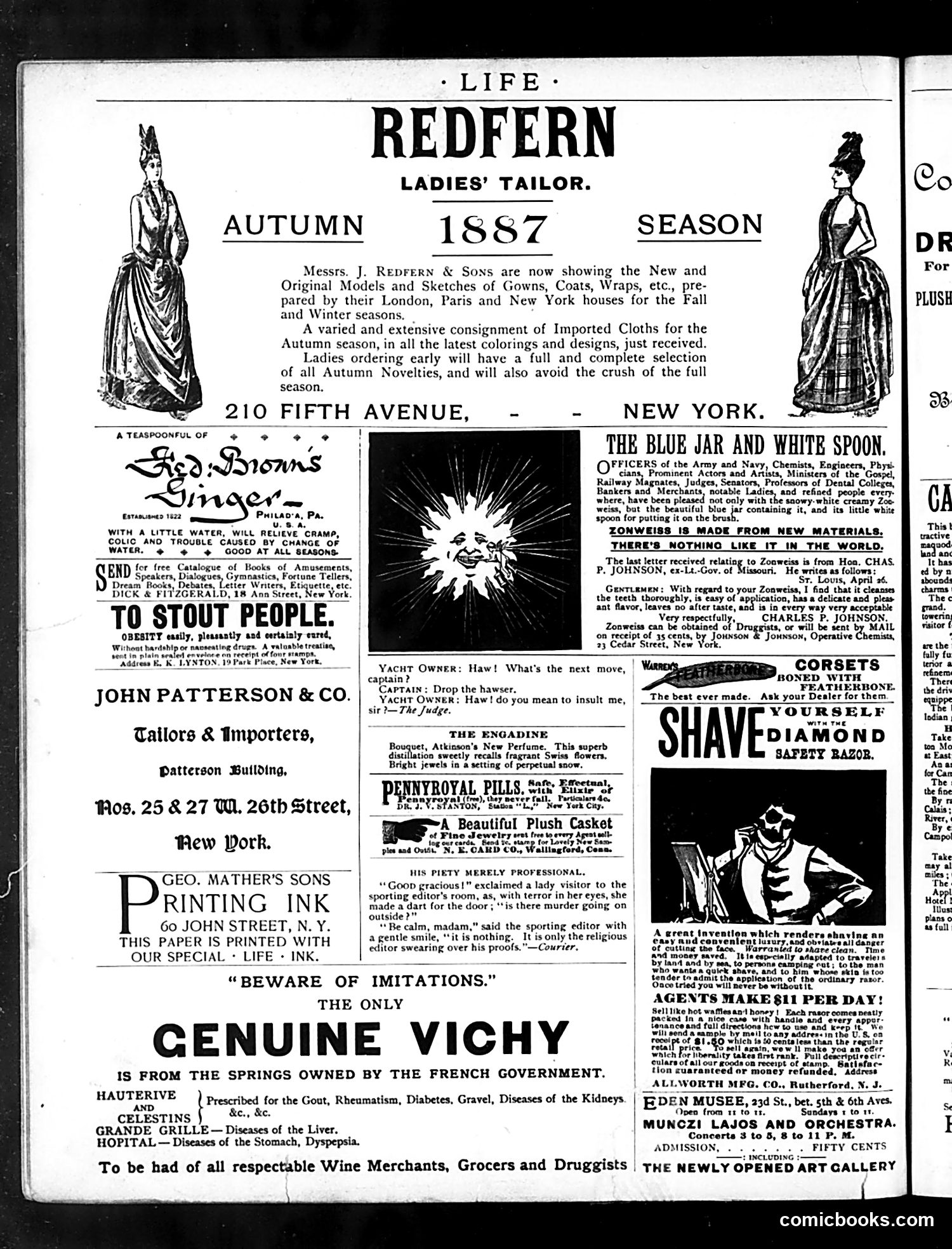
This page is primarily **advertising**, dominated by commercial notices for 1887 products and services: a ladies' tailor (Redfern), patent medicines (Zonweiss tooth preparation, Pennyroyal Pills), razors, corsets, and mineral water. The only satirical content appears to be a small cartoon dialogue labeled "Yacht Owner," depicting a brief exchange between a ship's captain and owner—likely mocking social pretension or nautical incompetence, though the joke's specifics are unclear without more context. The rest consists of business advertisements, including a humor piece titled "His Piety Merely Professional" about a sporting editor's irreverent language—gentle workplace satire rather than political commentary. Overall, this is a **commercial issue** using *Life's* platform primarily for paid advertisements, with minimal political or social satire.
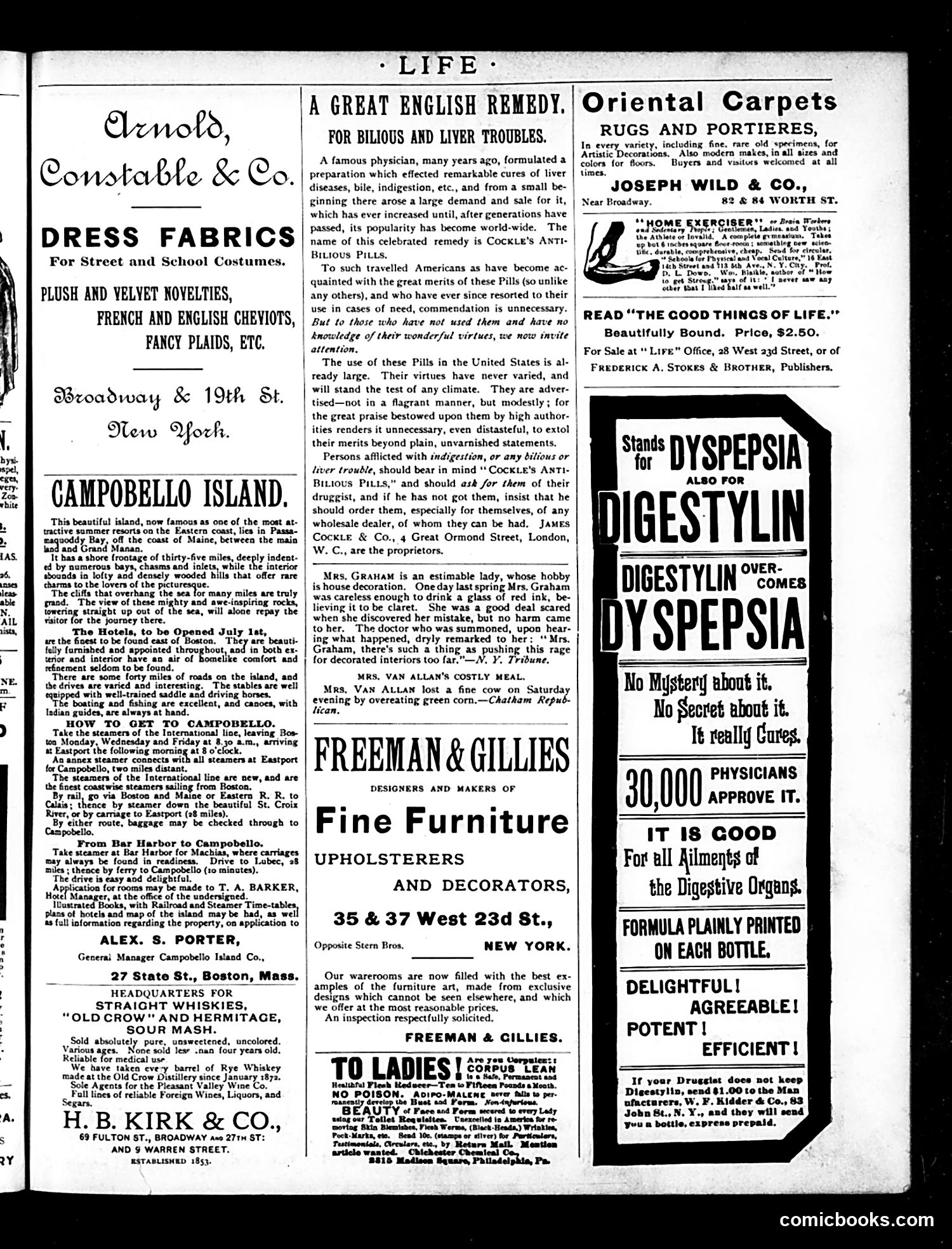
The page consists almost entirely of commercial advertisements from late 19th-century New York businesses: Arnold, Constable & Co. (dress fabrics), Campobello Island resort promotions, H.B. Kirk & Co. (whiskey), Freeman & Gillies (furniture), and various patent medicines including Cockle's Anti-Bilious Pills and Digestylin (a digestive aid claiming approval from "30,000 physicians"). The only content with potential social commentary is the Digestylin ad's prominent claims about curing digestive ailments—typical of the era's often-dubious patent medicine marketing. However, there is no identifiable political satire, caricature, or cartoon on this page. It represents straightforward commercial advertising from *Life* magazine's revenue stream rather than editorial or satirical content.
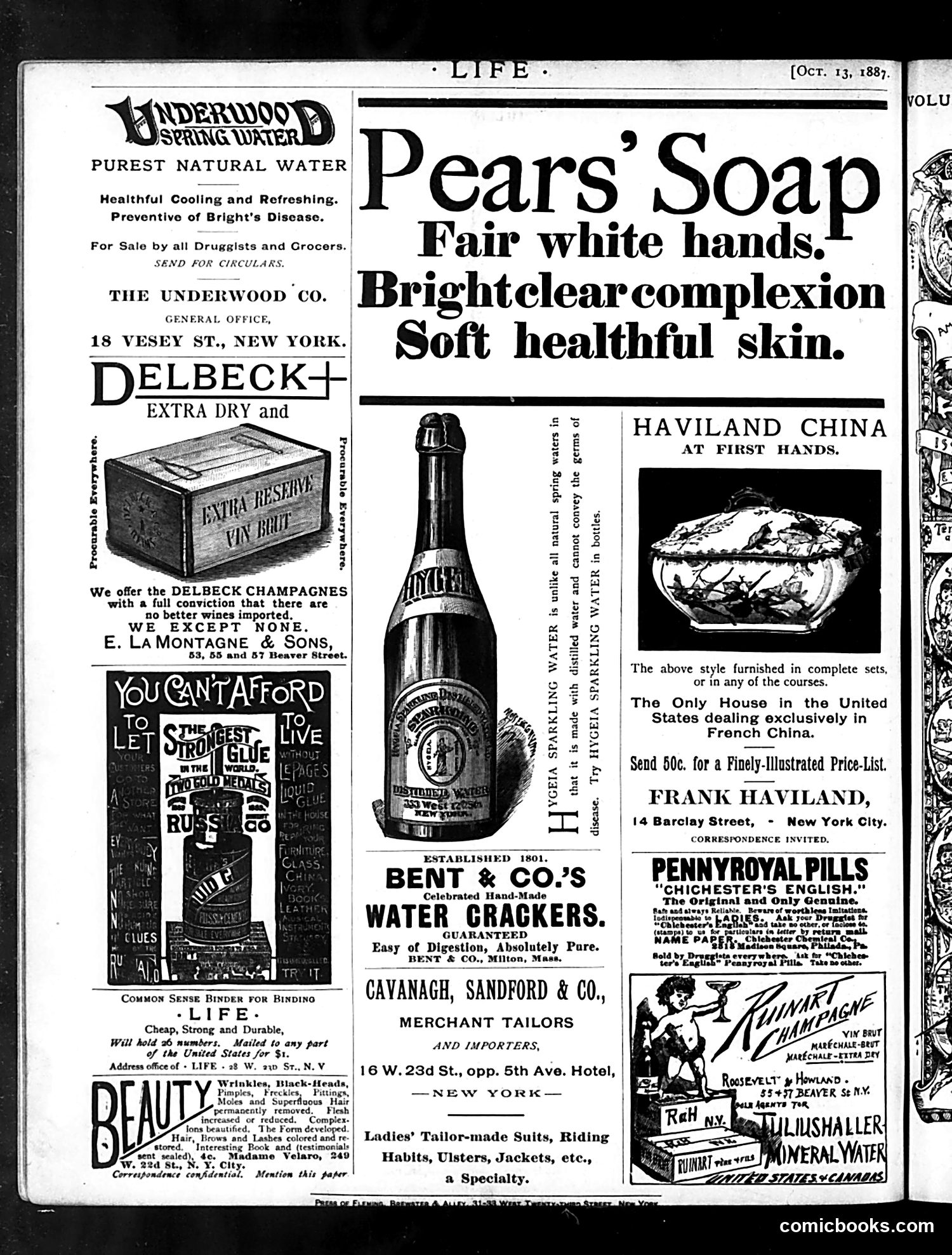
This is primarily an **advertising page** with no political cartoons or satirical content. It consists entirely of commercial advertisements typical of late 19th-century American magazines. The ads promote various products: spring water (Underwood), champagne (Delbeck), soap (Pears'), water crackers, china dishware, tailor-made clothing, and medicinal pills. Notably, **Pennyroyal Pills** are advertised as "Chichester's English"—these were commonly used as abortifacients in this era, though marketed euphemistically as general women's health remedies. Several ads target **beauty and personal appearance**, reflecting Victorian-era concerns: Madame Velaro offers facial treatments and hair removal; Pears' Soap promises "fair white hands" and "bright clear complexion." The **Life magazine binder advertisement** at bottom-left is the only house ad, promoting the magazine's own product for organizing back issues. This page exemplifies how 1880s magazines financed operations through advertising rather than subscription alone.