
Life, 1887-10-13 · page 6 of 16
Life — October 13, 1887 — page 6: what you’re looking at
What you’re looking at
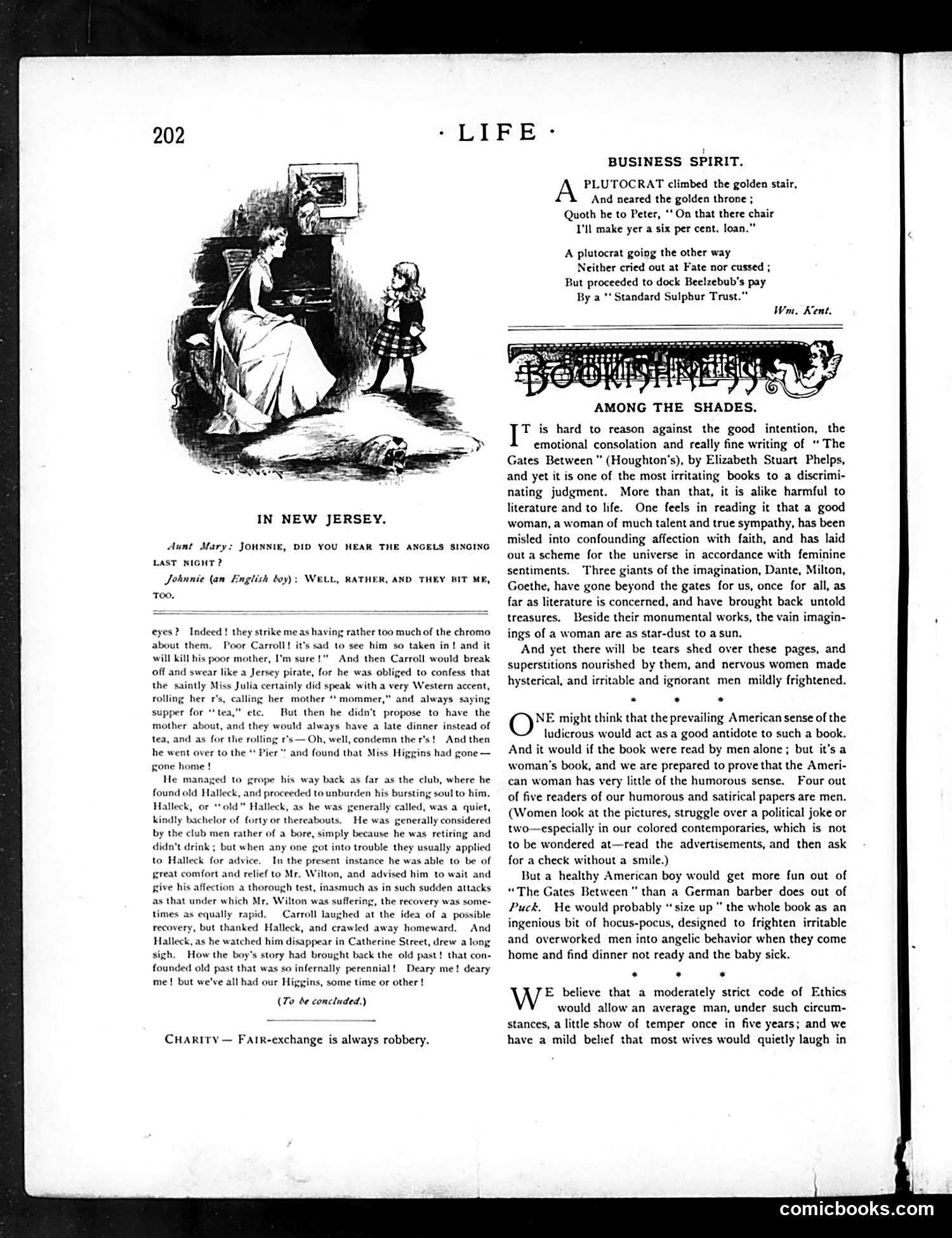
**"In New Jersey" cartoon:** This depicts a domestic scene satirizing working-class life. A woman asks a man ("Johnnie") if he heard angels singing; he responds cynically that angels "bit me" and he's covered in welts. The joke mocks both romantic sentimentality and the harsh reality of poverty or hardship—suggesting that idealism and comfort are luxuries the working poor cannot afford. **"Business Spirit" poem:** Satirizes financial manipulation, describing a plutocrat making predatory loans at six percent interest while another plutocrat "docks" payments to a "Standard Sulphur Trust." The satire targets wealthy businessmen exploiting financial systems for personal gain. **"Among the Shades" essay:** Critiques Elizabeth Stuart Phelps's novel "The Gates Between," arguing it misguides readers with sentimental rather than rational thinking.
📄 Transcribed text from this page (OCR, searchable)
Machine-transcribed from the original scan — historical spelling and the odd misread are preserved.
IN NEW JERSEY. Aunt Mary: JOMNSIE, DID YOU HEAR THE ANGELS SINGING LAST NIGHT ? Johnnie (an English boy): WELL, RATHER, AND THEY BIT ME, Too. eyes? Indeed ! they strike me as having rather too much of the chromo about them, Poor Carroll! it’s sad to see him so taken in! and it will kill his poor mother, I'm sure!" And then Carroll would break off and swear like a Jersey pirate, for he was obliged to confess that the saintly Miss Julia certainly did speak with a very Western accent, rolling her r’s, calling her mother * mommer," and always saying supper for “tea,” etc. But then he didn’t propose to have the mother about, and they would always have a late dinner instead of tea, and as for the rolling t's — Oh, well, condemn the r's! And then he went over to the * Pier” and found that Miss Higgins had gone — gone home ! He managed to grope his way back as far as the club, where he found old Halleck, and proceeded to unburden his bursting soul to him, Halleck, or “told” Halleck, as he was generally called, was a quiet, kindly bachelor of forty or thereabouts. He was generally considered by the club men rather of a bore, simply because he was retiring and didn’t drink ; but when any one got into trouble they usually applied to Halleck for advice. In the present instance he was able to be of great comfort and relief to Mr. Wilton, and advised him to wait and give his affection a thorough test, inasmuch as in such sudden attacks as that under which Mr, Wilton was suffering, the recovery was some- times as equally rapid. Carroll laughed at the idea of a possible recovery, but thanked Halleck, and crawled away homeward. And Halleck, as he watched him disappear in Catherine Street, drew along sigh. How the boy's story had brought back the old past! that con- founded old past that was so infernally perennial! Deary me! deary me! but we've all had our Higgins, some time or other! (To be concluded.) CHaRIty — Fair-exchange is always robbery. BUSINESS SPIRIT. PLUTOCRAT climbed the golden stair, And neared the golden throne ; Quoth he to Peter, ‘‘On that there chair I'll make yer a six per cent. loan. A plutocrat going the other way Neither cried out at Fate nor cussed ; But proceeded to dock Beelzebub’s pay By a“ Standard Sulphur Trust.” Wm, Kent. AMONG THE SHADES. I" is hard to reason against the good intention, the emotional consolation and really fine writing of “ The Gates Between " (Houghton’s), by Elizabeth Stuart Phelps, and yet it is one of the most irritating books to a discrimi- nating judgment. More than that, it is alike harmful to literature and to life. One feels in reading it that a good woman, a woman of much talent and true sympathy, has been misled into confounding affection with faith, and has laid out a scheme for the universe in accordance with feminine sentiments. ‘Three giants of the imagination, Dante, Milton, Goethe, have gone beyond the gates for us, once for all, as far as literature is concerned, and have brought back untold treasures. Beside their monumental works, the vain imagin- ings of a woman are as star-dust to a sun, And yet there will be tears shed over these pages, and superstitions nourished by them, and nervous women made hysterical, and irritable and ignorant men mildly frightened. E might think that the prevailing American sense of the ludicrous would act as a good antidote to such a book. And it would if the book were read by men alone; but it’s a woman's book, and we are prepared to prove that the Ameri- can woman has very little of the humorous sense. Four out of five readers of our humorous and satirical papers are men. (Women look at the pictures, struggle over a political joke or two—especially in our colored contemporaries, which is not to be wondered at—read the advertisements, and then ask for a check without a smile.) But a healthy American boy would get more fun out of “The Gates Between” than a German barber does out of Puck. He would probably “size up " the whole book as an ingenious bit of hocus-pocus, designed to frighten irritable and overworked men into angelic behavior when they come home and find dinner not ready and the baby sick. . . . E believe that a moderately strict code of Ethics would allow an average man, under such circum- stances, a little show of temper once in five years; and we have a mild belief that most wives would quietly laugh in comicbooks.com