
A complete issue · 16 pages · 1887
Life — September 1, 1887
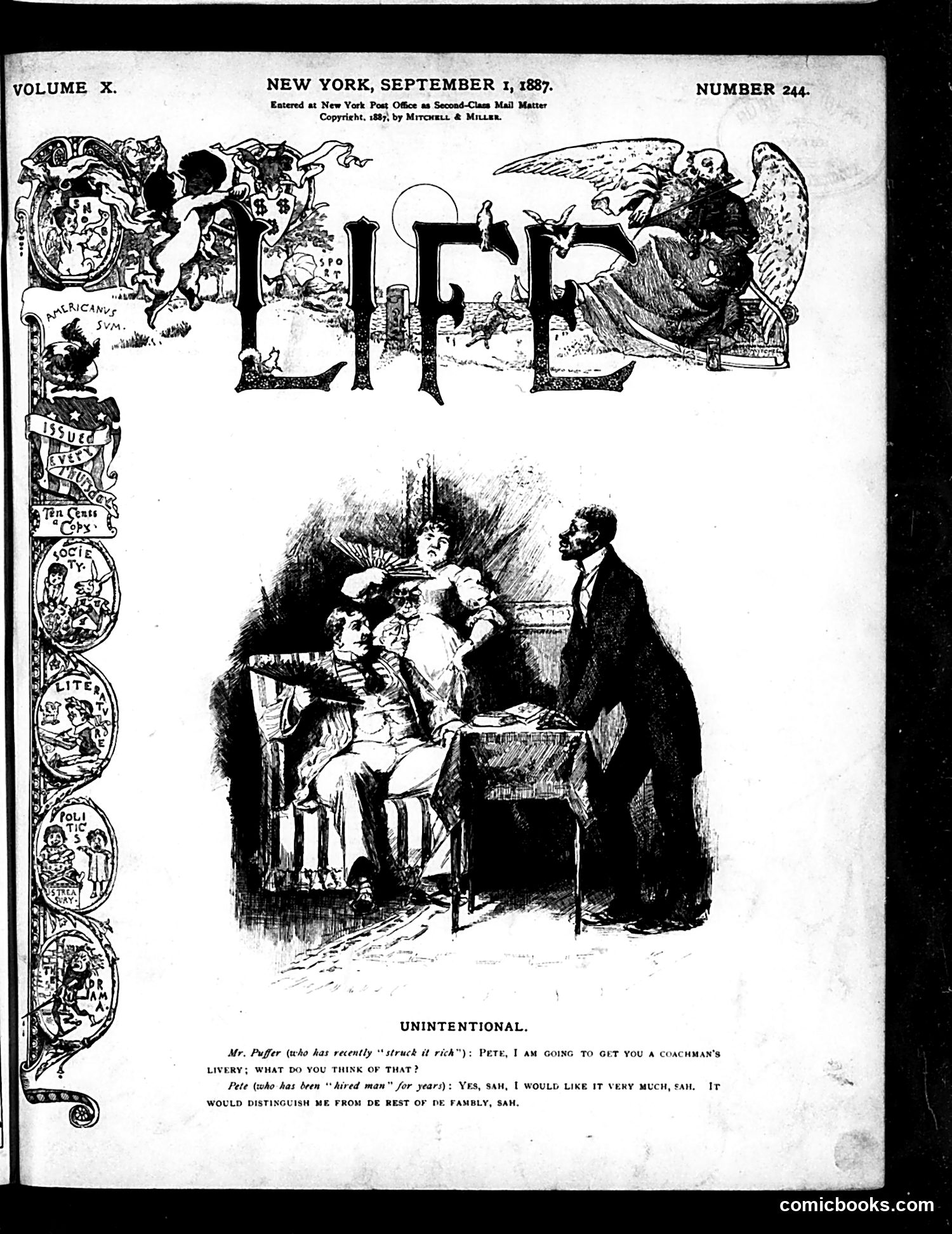
This single-panel cartoon satirizes class pretension and social climbing. The sketch shows a well-dressed man (Mr. Puffer, described as having recently "struck it rich") announcing to his family his plan to purchase a coachman's livery—a servant's uniform. His son responds enthusiastically, saying he'd "like it very much" because it would "distinguish me from de rest of de family." The joke hinges on unintended irony: rather than elevating the family's status, acquiring servants' uniforms would actually mark them as servants, not gentlemen. The son's response is deliberately malapropian (note the dropped 'd's), suggesting the family's pretensions exceed their actual breeding or education. The satire mocks nouveau riche attempts at social respectability through superficial displays of wealth.
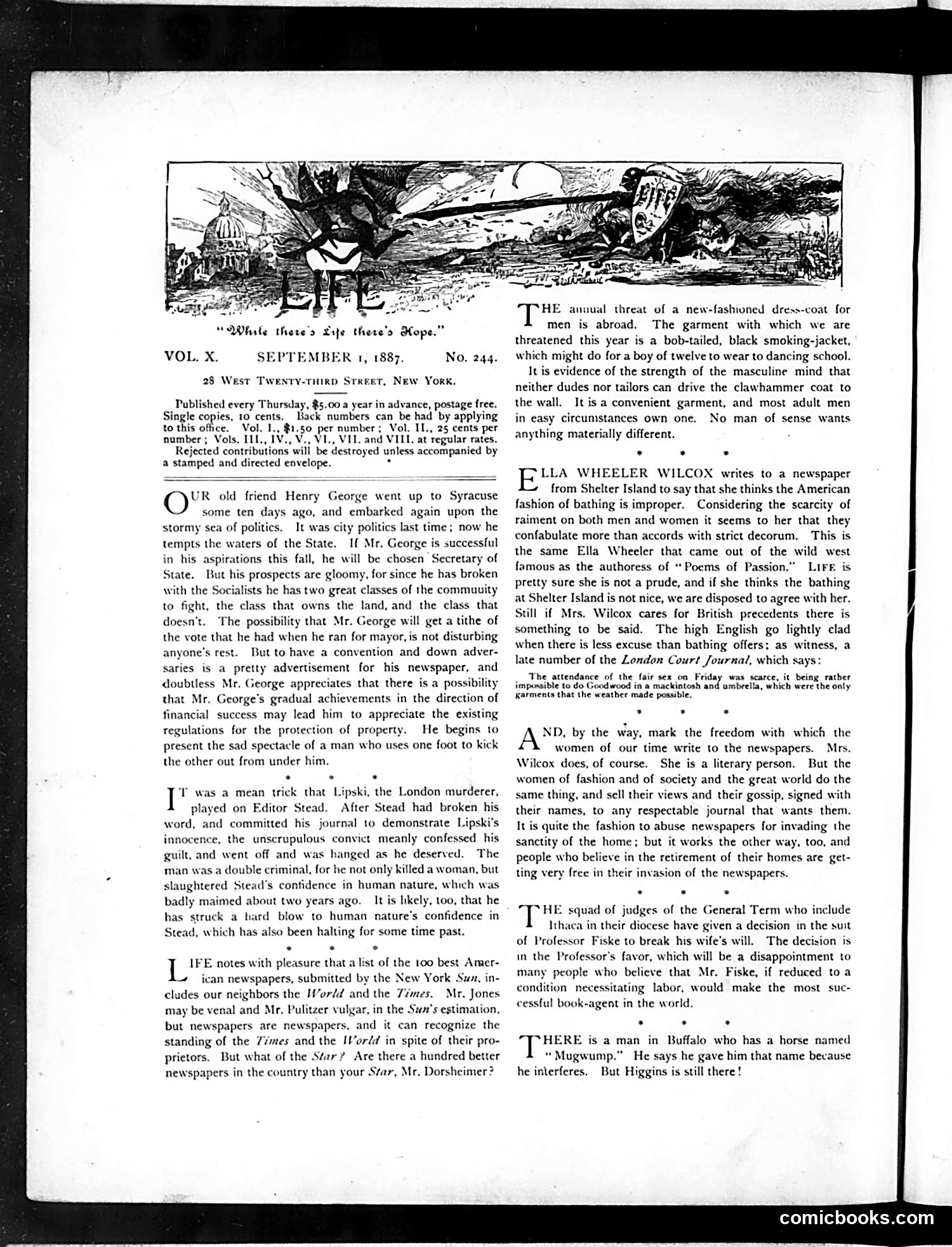
The header cartoon depicts a skeletal figure of **Death** sitting atop a pile of skulls and gravestones, positioned over a cityscape with a dome (likely the U.S. Capitol). This appears to be satirizing concerns about public health threats or mortality in America. The text below discusses various social and political matters, including Henry George's political aspirations, a murderer named Lipski, newspaper rankings, and fashion criticism of women's bathing attire by "Ella Wheeler Wilcox." The cartoon's central point seems to be warning about some contemporary danger to American life—the text references a "new-fashioned dress-coat" threat, but the Death imagery suggests the cartoonist viewed certain conditions or policies as genuinely deadly to the nation.
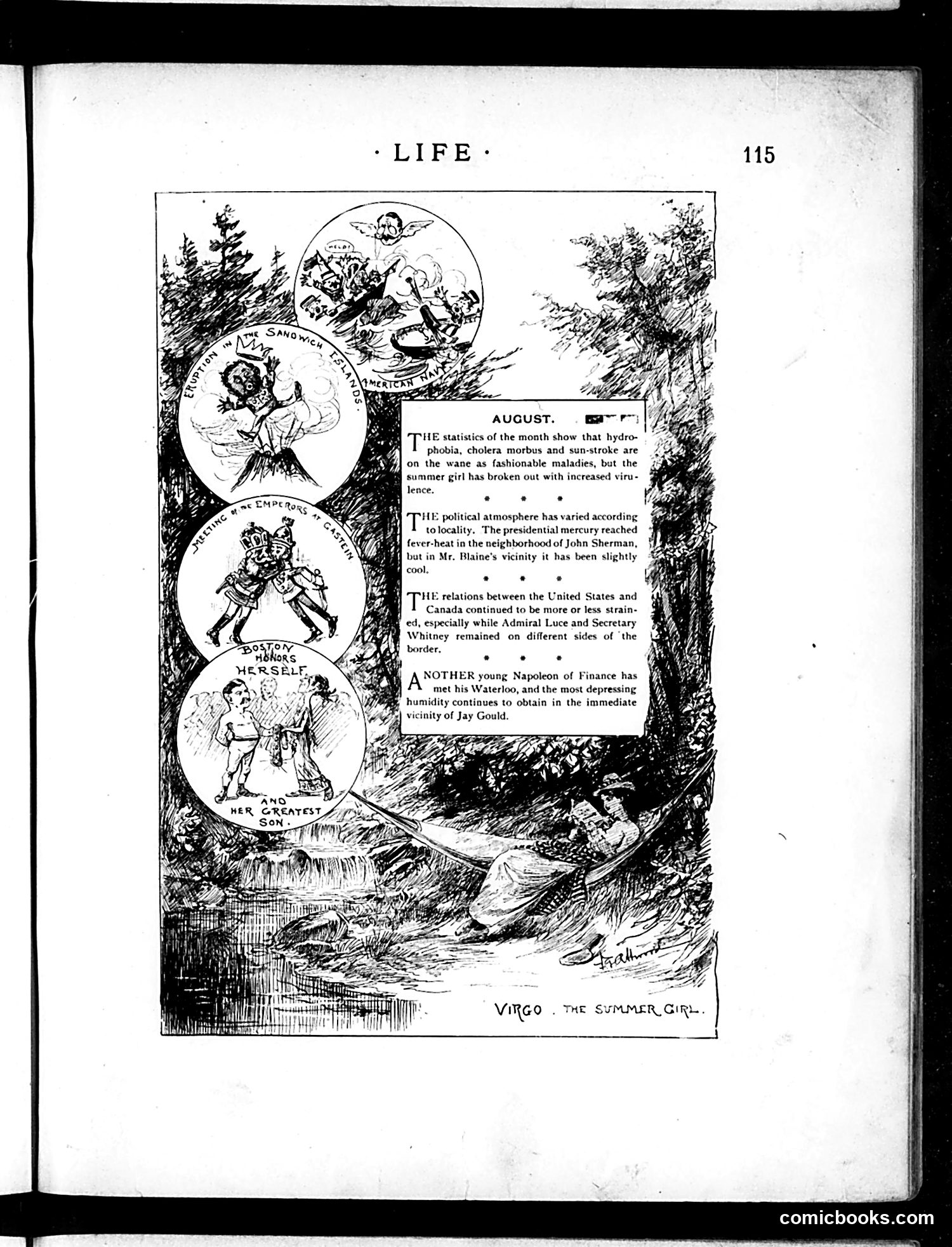
This August page from *Life* magazine uses the zodiac sign Virgo as a framework for satirizing summer social conditions. The circular vignettes show figures labeled with phrases like "Empress of American Fashion" and "Destiny of Herself"—likely mocking pretentious summer society types and their self-importance. The accompanying text references contemporary issues: hydrophobia and cholera as fashionable complaints, political tensions (possibly between the U.S. and Canada regarding "Admiral Luce and Secretary Whitney"), and a "young Napoleon of Finance" who faced financial ruin (possibly referencing Jay Gould). The reclining "summer girl" at bottom represents the leisured ideal being satirized. Overall, *Life* mocks both social pretension and real economic/political anxieties of the era.
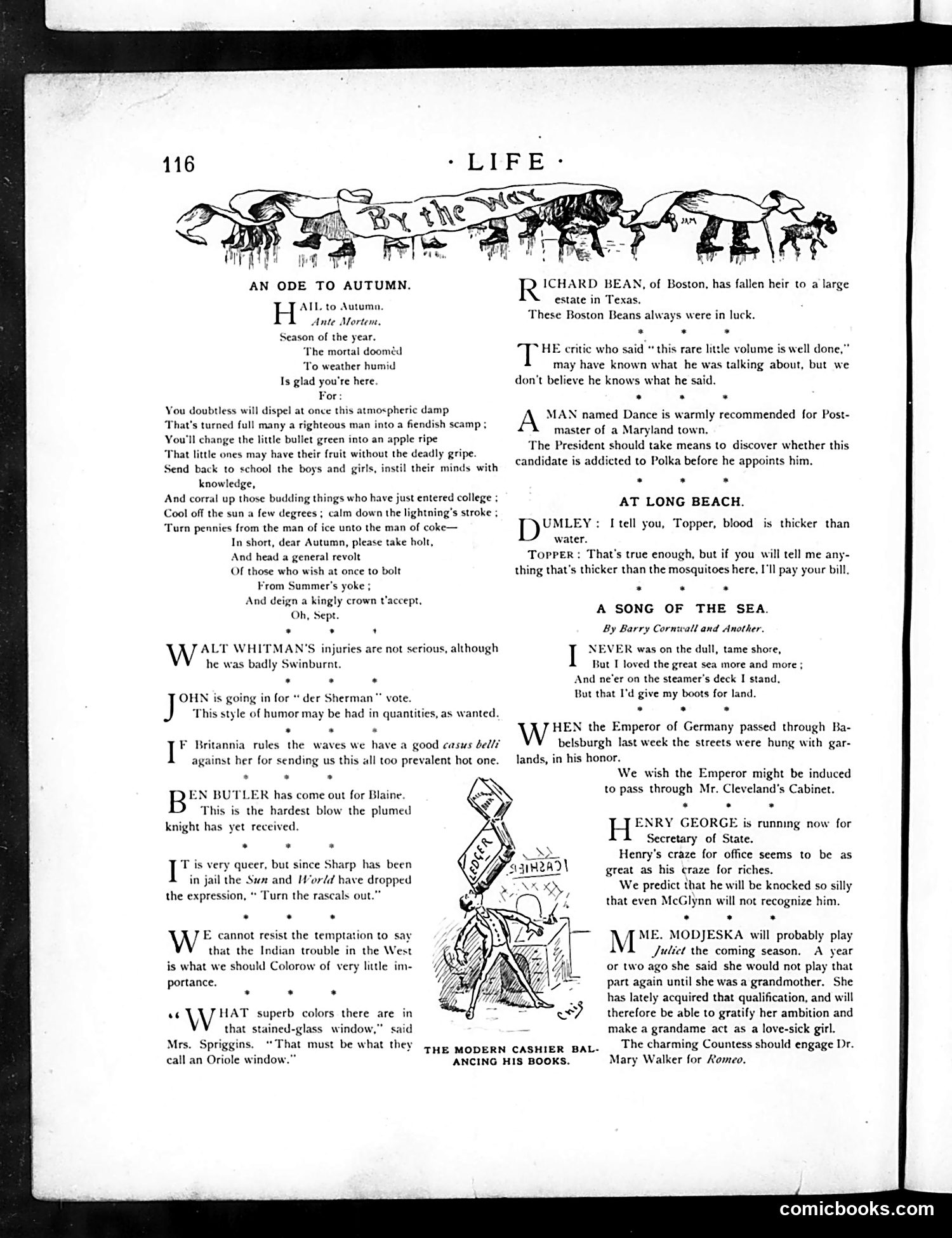
This page contains satirical commentary and a cartoon titled "The Modern Cashier Balancing His Books." The cartoon depicts a cashier precariously stacking ledgers and accounting materials, suggesting incompetence or dishonesty in bookkeeping—likely commentary on financial mismanagement during the Gilded Age. The text items are short political quips about contemporary figures: Richard Bean inheriting a Texas estate, criticism of a published volume, a candidate named Dance for Postmaster, Walt Whitman's injuries, John Sherman's political prospects, and British naval matters. The piece on Henry George concerns his campaign for Secretary of State, mocking both his political ambitions and wealth-related views. Mme. Modjeska's theatrical plans are also noted. The humor relies on readers' familiarity with these specific contemporary political figures and events—context largely lost today.
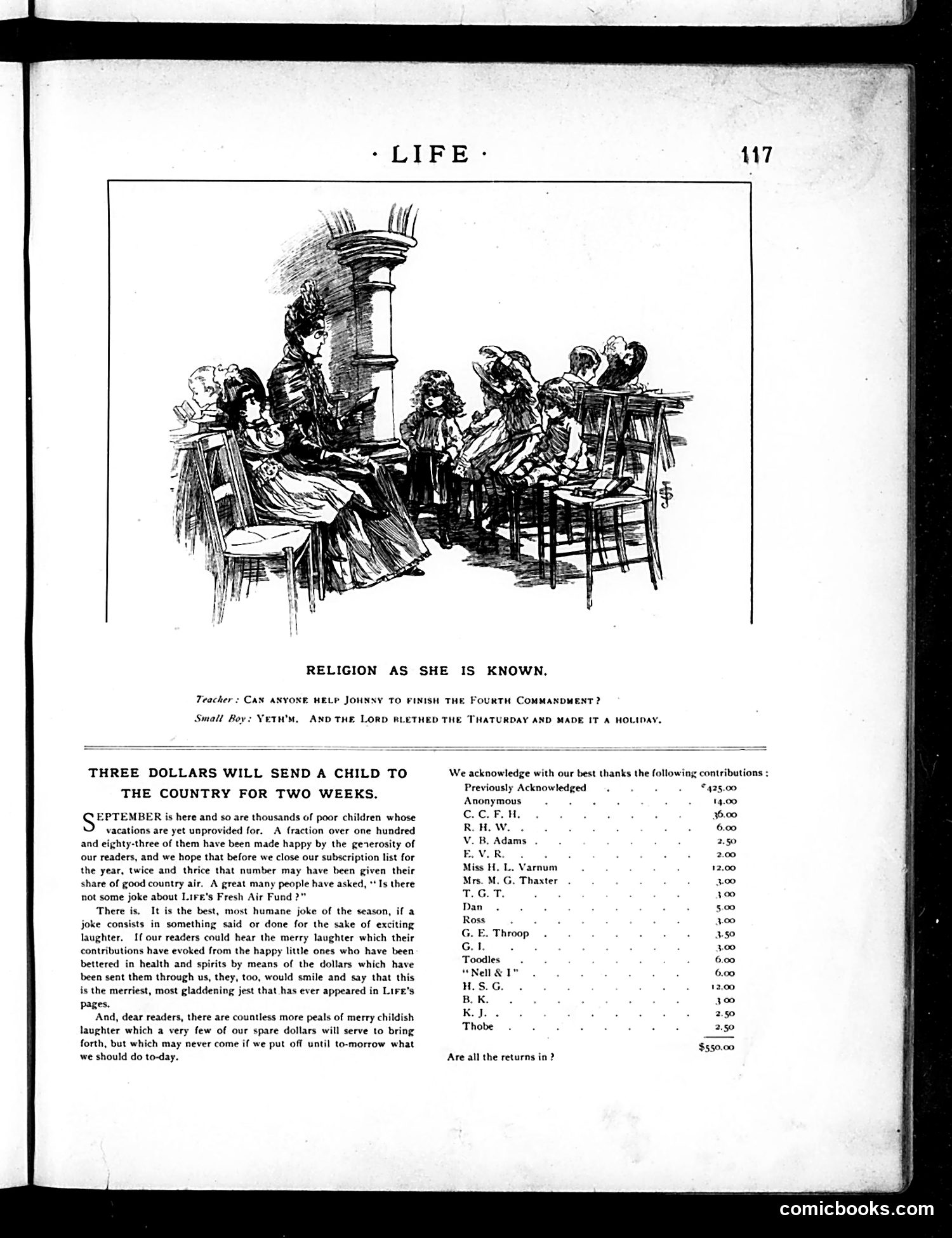
The cartoon titled "Religion As She Is Known" depicts a classroom scene where a teacher instructs children. The caption reads: "Teacher: Can anyone help Johnny to finish the Fourth Commandment? Small Boy: Yeth'm. And the Lord blethed the Thaturday and made it a holiday." **The satire:** The joke mocks the shallow religiosity of the period. Instead of understanding the Fourth Commandment's spiritual meaning (keeping the Sabbath holy), the child interprets it materialistically—as a day off from work/school, a "holiday." This suggests that actual religious instruction has been replaced by secular attitudes about leisure time. The lisp adds childish innocence to highlight the adults' failure to teach genuine faith. The page also contains a fundraising appeal for poor children and contributor acknowledgments—typical Life magazine content mixing humor with social advocacy.
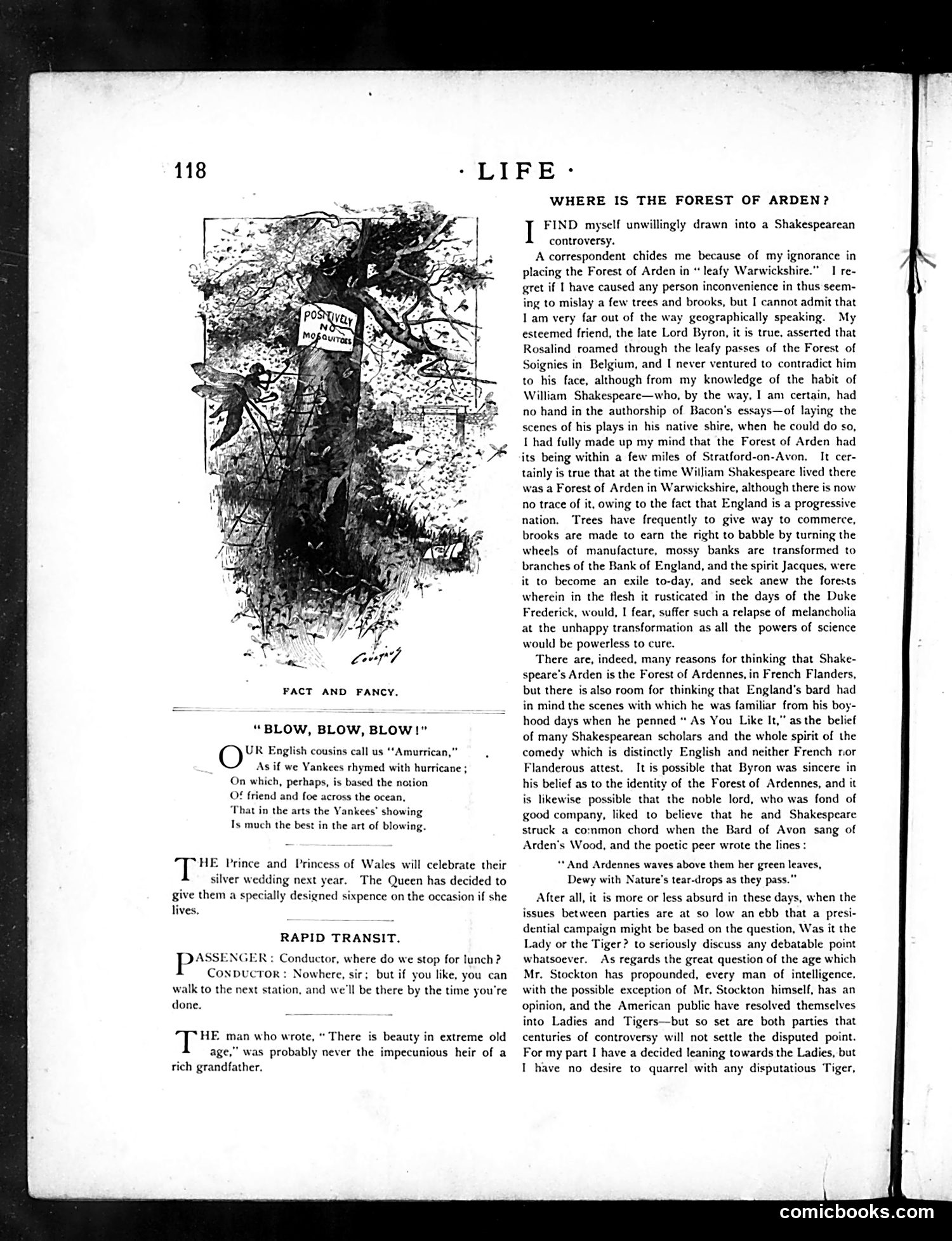
The main article discusses a scholarly dispute about the geographical location of Shakespeare's Forest of Arden from *As You Like It*. The author defends placing it in Warwickshire, England (near Stratford-upon-Avon), against those who argue it's the Forest of Ardennes in French Flanders. The accompanying illustration (signed "Cesare") shows a gnarled, dead tree with a "Positively No Trespassing" sign, appearing to mock the overly serious scholarly debate. The cartoonist satirizes how literary scholars obsess over minor geographical details while the actual forest has been destroyed by England's industrial progress—suggesting the whole controversy is somewhat absurd given the forest's current nonexistence.
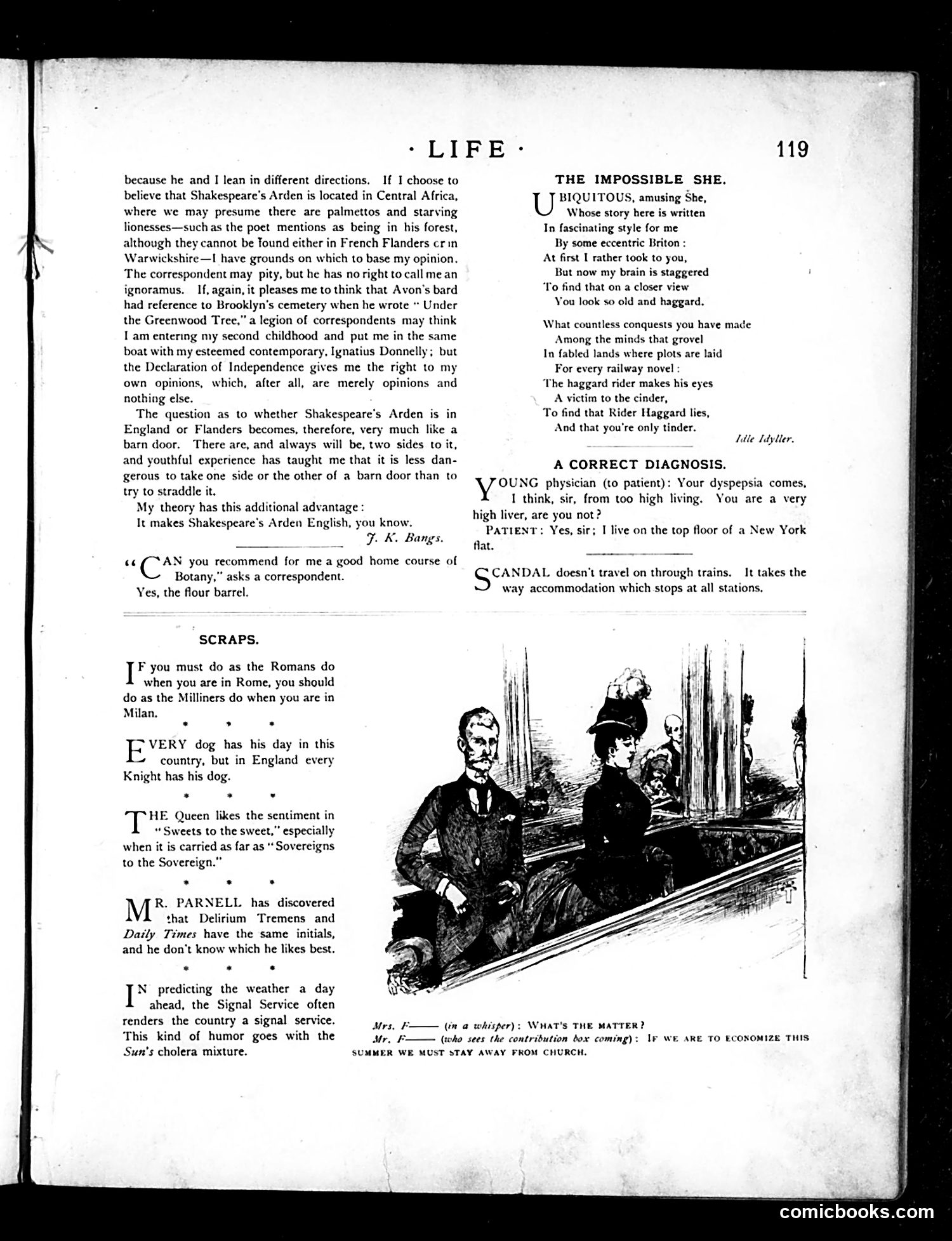
This page contains satirical short pieces and one cartoon rather than political commentary. The main cartoon depicts two well-dressed figures in what appears to be a railway carriage, with a caption about economizing by staying away from church. The humor targets wealthy individuals who claim financial hardship. The joke suggests that avoiding church expenses (collection plates) is their method of saving money—satirizing both the hypocrisy of the wealthy and their stinginess. The surrounding "Scraps" section contains brief witticisms about various topics: Roman customs, English knights, the Queen's preferences, and weather prediction services. These are general social observations rather than political satire, characteristic of Life magazine's lighter humor pieces. The cartoon's targets are the self-deluding wealthy rather than specific political figures.
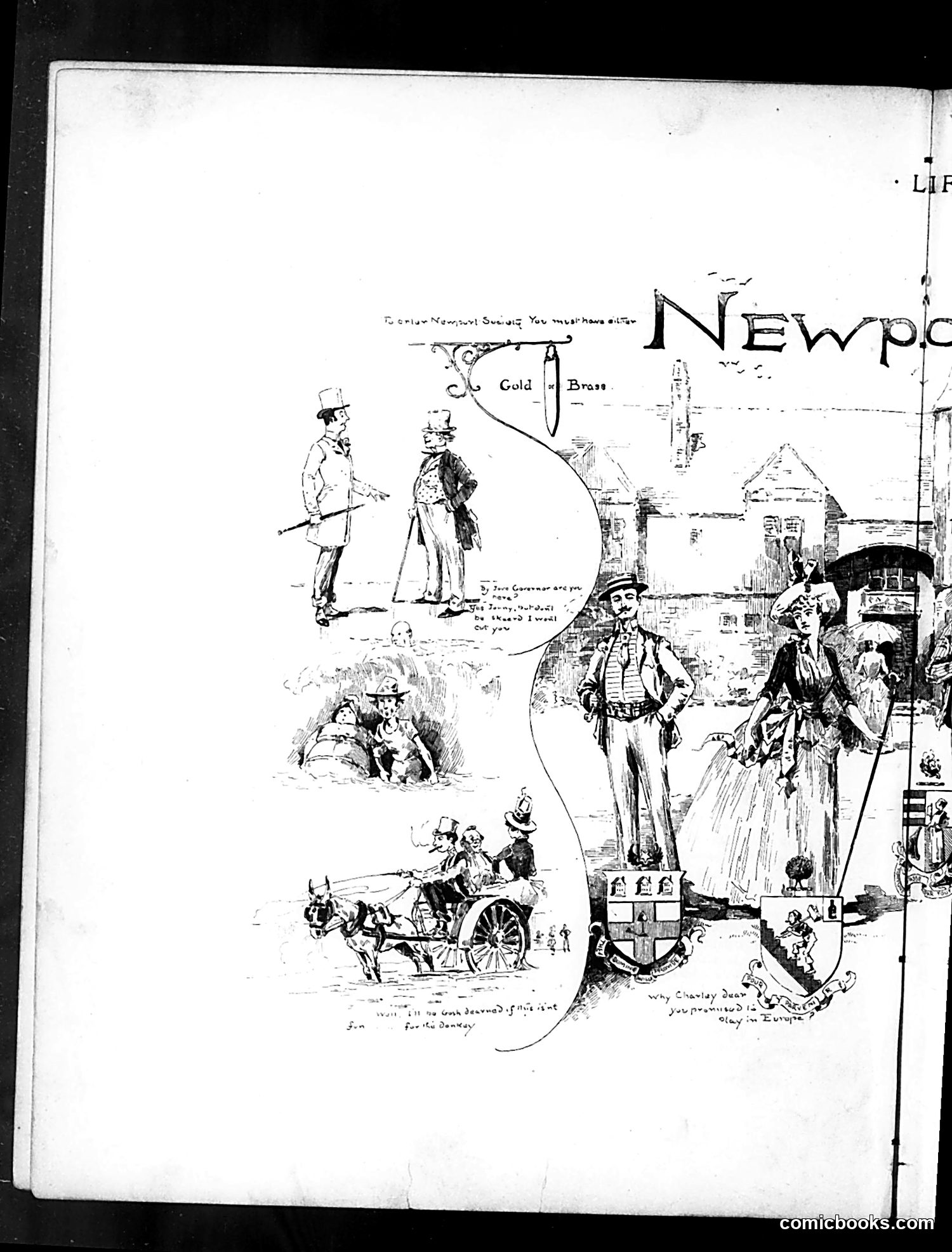
This appears to be a Life magazine page featuring multiple satirical sketches about Newport society life. The central large illustration shows wealthy figures in Victorian-era dress at what appears to be a seaside resort setting—note the architectural elements and formal attire. The sketches include: - Upper left: Two gentlemen in top hats (likely discussing business or social matters) - A horse-drawn carriage scene - A prominent couple in formal dress, with a coat of arms visible The "Gold and Brass" label suggests commentary on the material values of the wealthy elite. The overall tone mocks Newport's upper-class society, their pretensions, fashions, and social hierarchies—typical of Life's satirical approach to Gilded Age affluence and leisure-class behavior. The specific identities of the caricatured figures remain unclear from the image alone.
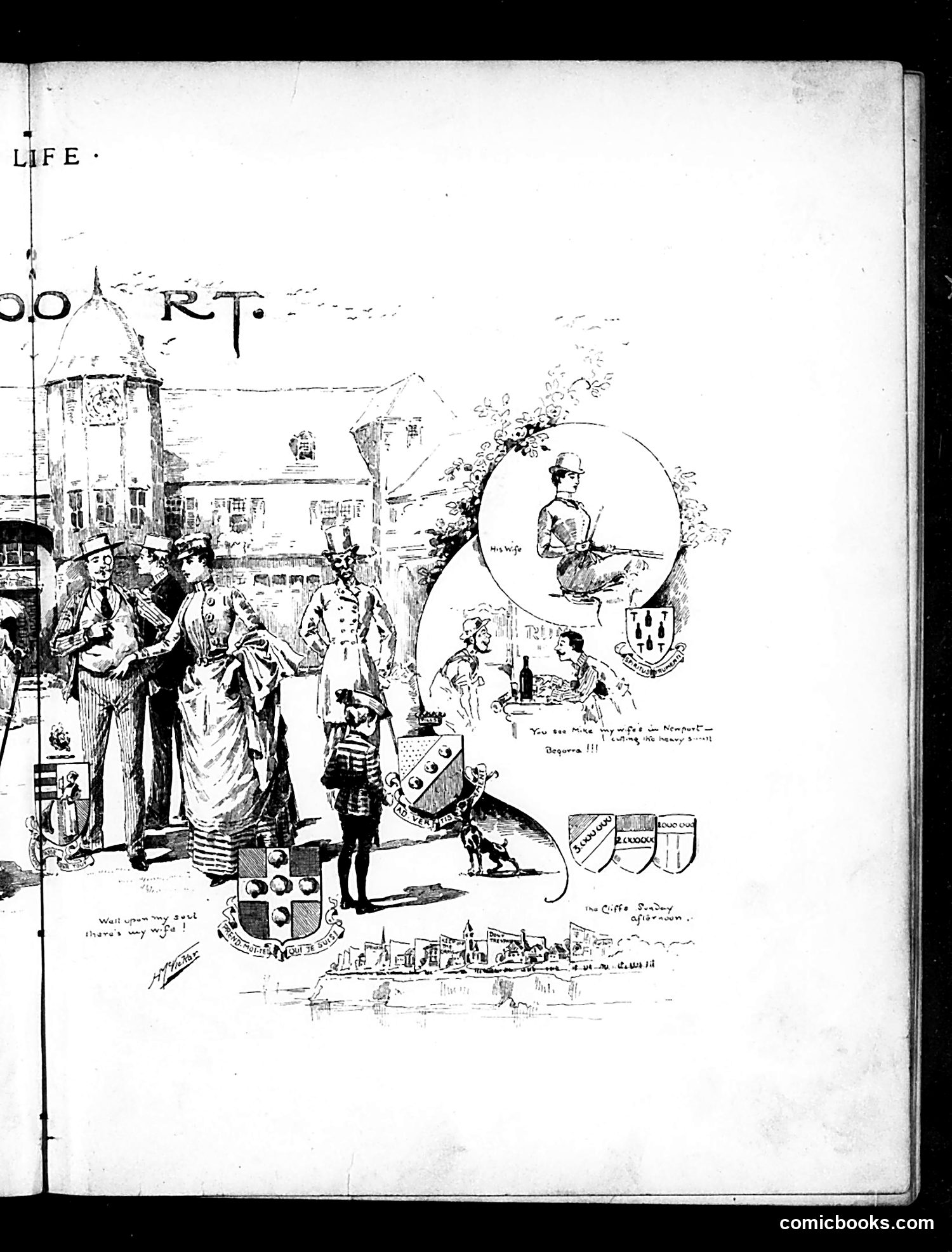
This appears to be a satirical illustration titled "Sport" from Life magazine's "Court" section, depicting European nobility and aristocracy engaged in leisure activities. The sketch shows elegantly dressed figures in period clothing (likely late 19th century) around a castle or estate, with heraldic shields displaying coats of arms scattered throughout. The satire appears to mock the pretensions and idle pursuits of the European upper classes—their focus on ceremonial dress, genealogy (emphasized by the repeated heraldic symbols), and genteel pastimes rather than productive work. The elaborate architectural setting and formal attire underscore the target: mocking aristocratic self-importance and the persistence of class hierarchies in what was likely a period of social change.
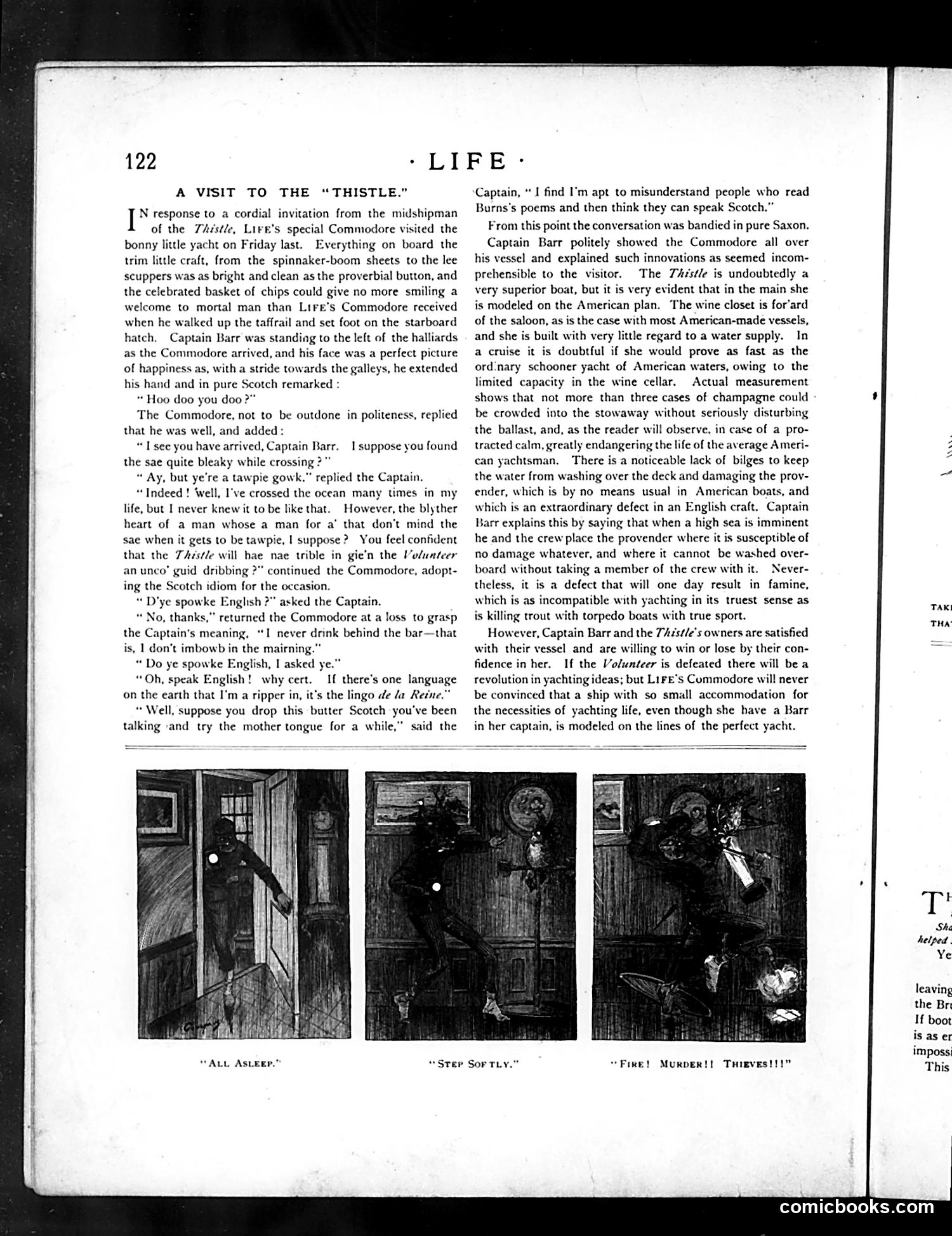
This page satirizes Scottish pretension and dialect through a dialogue between a Commodore and Captain Barr aboard a yacht called the *Thistle*. The humor centers on the Commodore's exaggerated attempts at Scottish speech ("Hoo doo you do?", "guid dribbling") and Captain Barr's patient corrections, mocking both affected Scottishness and those who adopt it after reading Burns's poetry. The three illustrations below depict comedic shipboard chaos: "All Asleep," "Step Softly," and "Fire! Murder! Thieves!!!" These captions suggest escalating mayhem, likely poking fun at naval incompetence or the contrast between the yacht's refined pretensions and its chaotic reality. The satire targets both Scottish affectation and American yacht culture's superficiality.
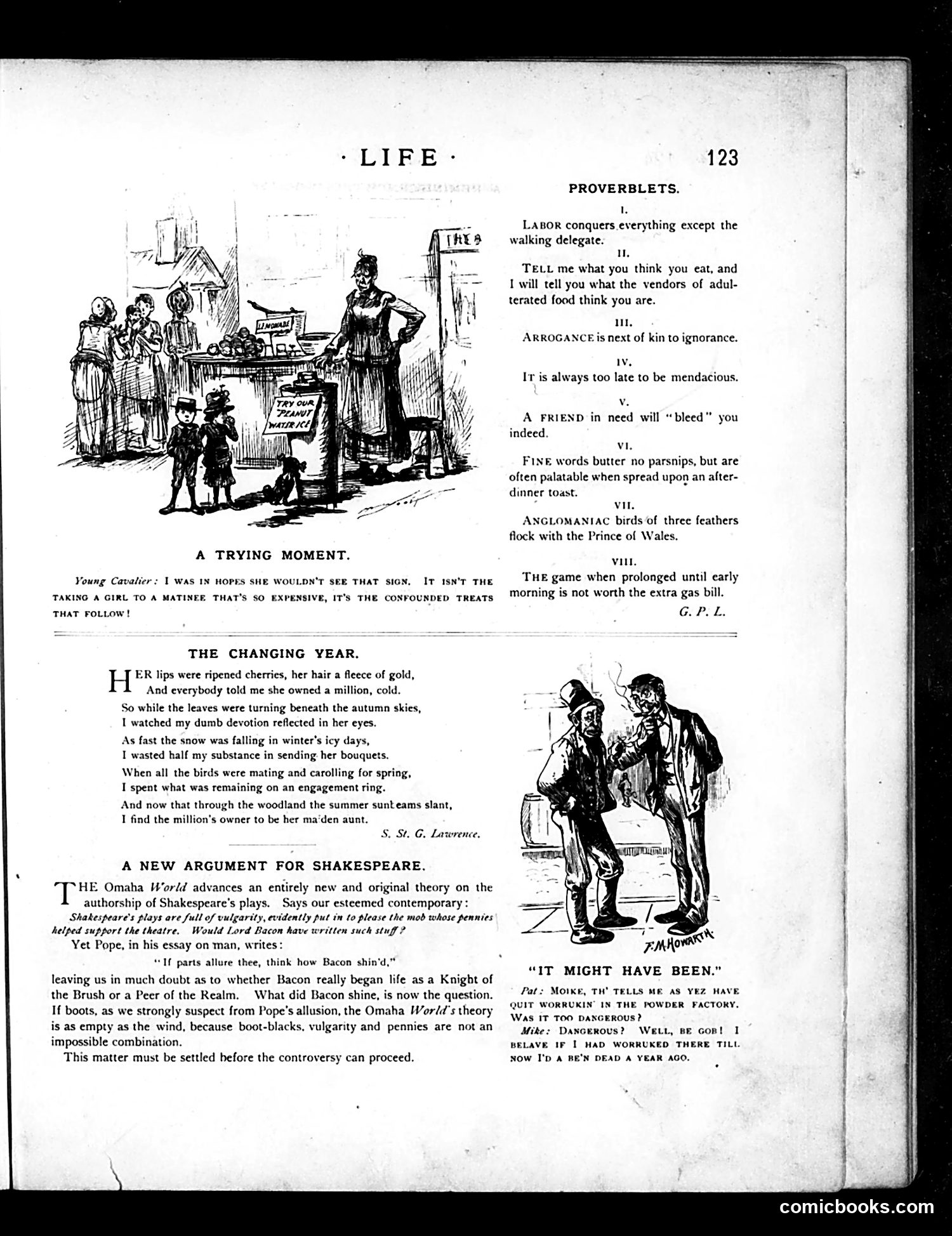
**"A Trying Moment"** depicts a young man frustrated by theater dating costs—not the ticket price, but the expensive treats (candy, refreshments) that follow. The humor targets both male expense and female expectations in courtship. **"The Changing Year"** is a romantic poem with ironic twist: a man wastes his wealth courting a woman he believed wealthy, only to discover she's merely her aunt's poor relation. The satire mocks both masculine romantic foolishness and the social importance placed on female wealth/status. **"A New Argument for Shakespeare"** ridicules the Omaha World's theory attributing Shakespeare's "vulgar" plays to Lord Bacon rather than Shakespeare himself. Life's counterargument: if Bacon were a boot-black (shoe shiner) rather than a nobleman, vulgarity and commerce would be perfectly compatible. The piece satirizes pretentious literary criticism and class snobbery about what constitutes "refined" authorship. **"It Might Have Been"** (dialogue): An Irish immigrant (Mike) quit his powder factory job; Pat asks if it was dangerous. Mike replies he'd be dead by now had he stayed—dark humor about industrial labor hazards and worker mortality.
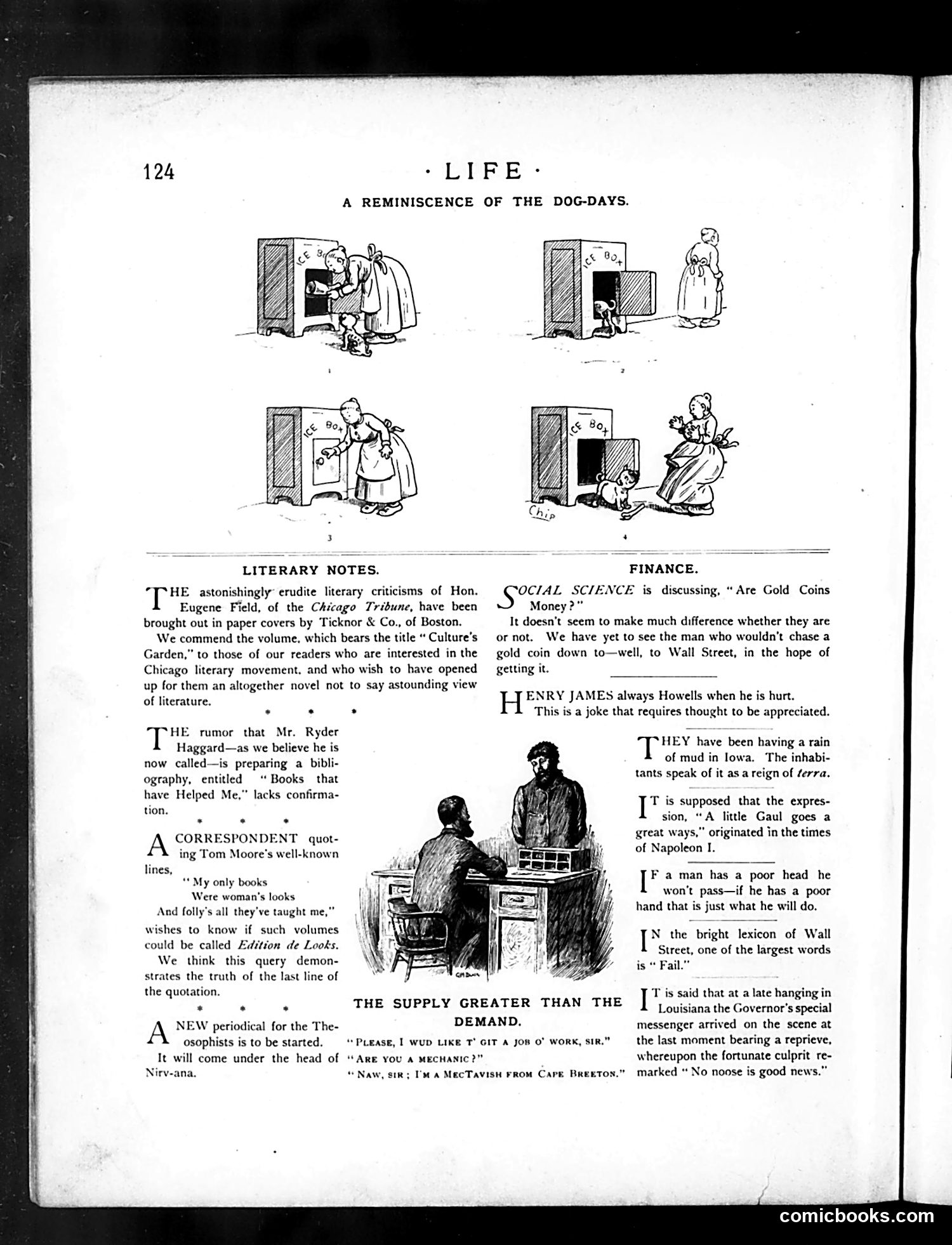
This page features a four-panel cartoon showing a child repeatedly visiting a neighbor's doghouse, apparently trying to play with or retrieve a dog. The humor appears to be a simple domestic scene—the child's persistence and the dog's reluctance or the neighbor's reactions provide the comedic arc, though specific details are difficult to discern in the image quality. The surrounding text consists of literary gossip (Eugene Field's criticism collection, Rider Haggard's rumored bibliography), wordplay puns, and brief satirical economic commentary. A larger cartoon depicts a job-seeker being turned away, with dialogue suggesting employment scarcity. The "Finance" section mocks financial speculation around gold coins and Wall Street failures with light humor. The overall tone is typical of *Life* magazine's genteel satire aimed at educated readers—mixing literary references, clever wordplay, and social observation rather than sharp political commentary.
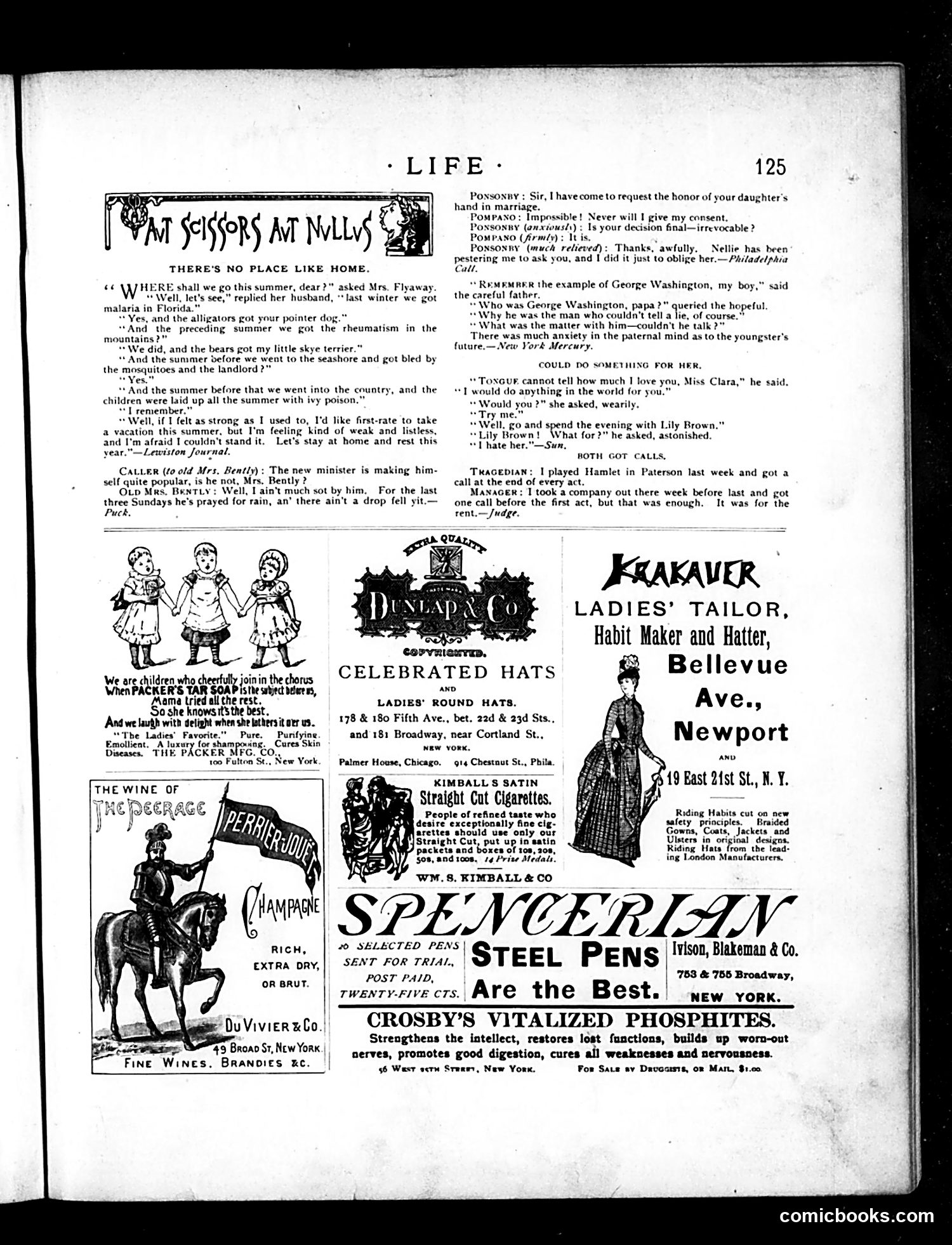
This page is primarily **advertisements with interspersed humorous short pieces** typical of Life's satirical format. The main cartoons/jokes include: 1. **"There's No Place Like Home"** — A domestic humor piece where a couple debates summer vacation destinations, only to recall disasters at each (malaria in Florida, alligators killing their dog, bears, mosquitoes, ivy poisoning). The husband concludes they should stay home to rest, making the title ironic. 2. **Minister joke** — A woman dismisses the new minister because his prayers for rain went unanswered—a dry joke about efficacy. 3. **Marriage proposal reversal** — A suitor proposes to a father for his daughter's hand, but it's revealed the daughter actually wanted the father to propose *to get rid of him*, reversing expectations. 4. **Washington anecdote** — A father teaches his son that George Washington "couldn't tell a lie," but the child asks why he "couldn't talk," mocking the father's knowledge. The remainder is **period advertisements** for hats, wine, tailoring, pens, and patent medicines—standard for this era's magazines.
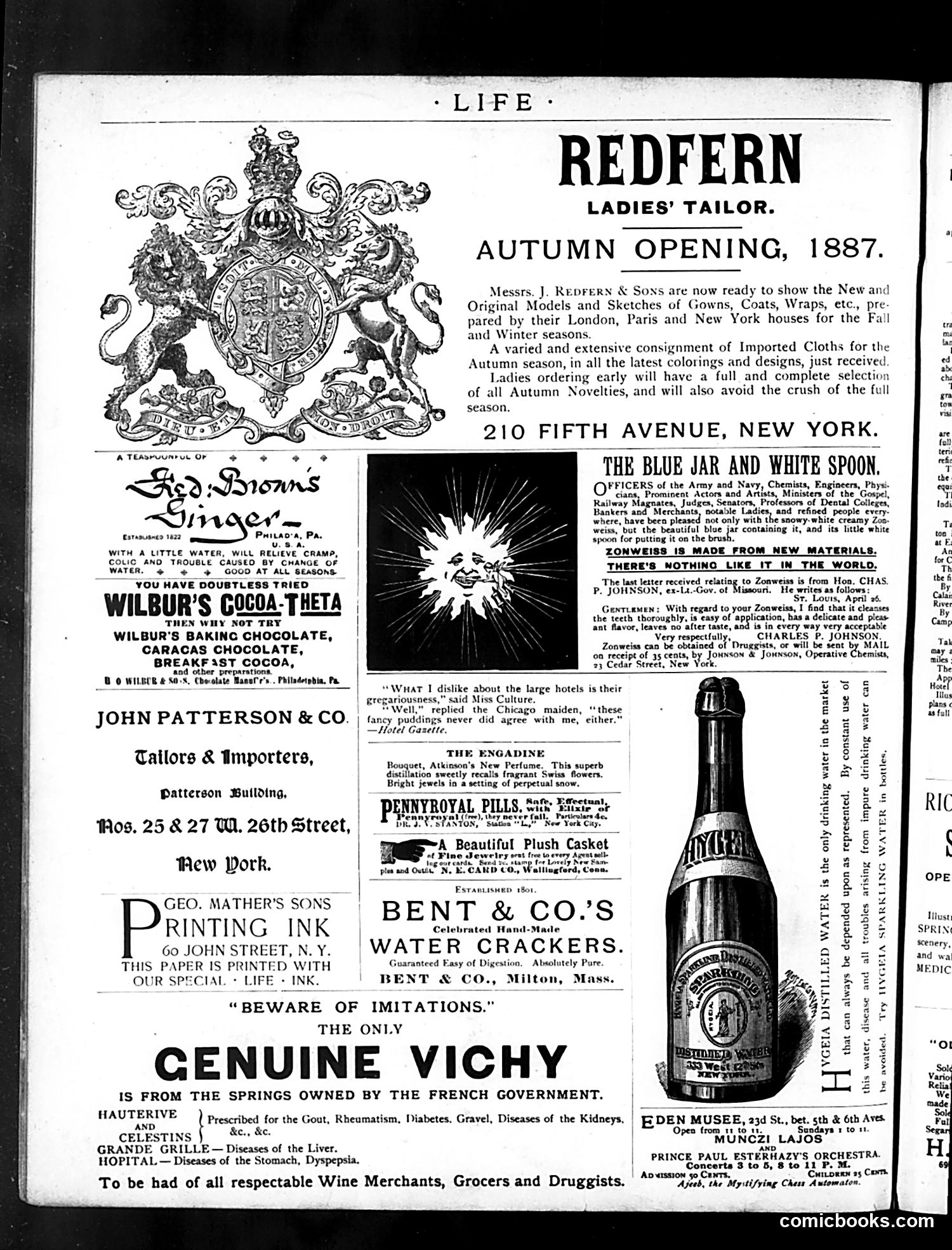
This page is primarily **advertising**, not satire or political cartoons. It features fashion, patent medicines, and consumer goods typical of 1880s American commerce. The notable content includes: **"The Blue Jar and White Spoon"** — an advertisement for Zonweiss, a dental product. The satirical element appears minimal; it simply lists prominent endorsers (judges, senators, professors, bankers) to build credibility, a common advertising tactic of the era. **Patent medicine ads** dominate the page: Vichy water (claimed to treat gout, rheumatism, diabetes), Pennyroyal Pills, and various tonics—products we now recognize as often fraudulent or dangerous. **Fashion/tailoring ads** (Redfern, John Patterson & Co.) reflect the era's focus on imported European styles for wealthy clients. The page reflects **1887 consumer culture**: an age before FDA regulation, when extravagant medical claims were unpoliced, and advertising relied heavily on testimonials from authority figures rather than scientific evidence. There are **no political cartoons or identifiable caricatures** on this page.
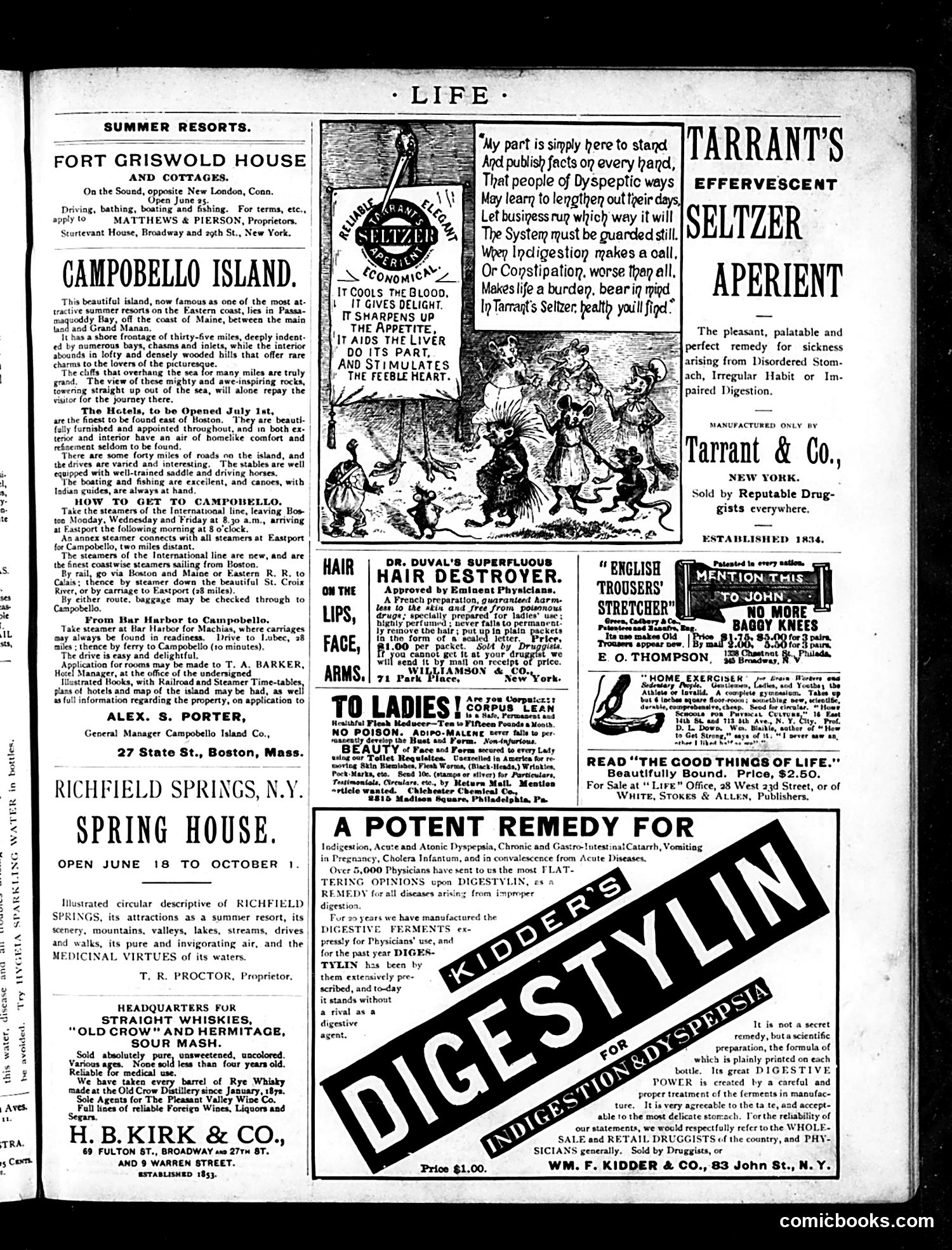
This page is primarily **advertisements and resort listings**, not political satire. The bulk consists of commercial copy for summer resorts (Fort Griswold House, Campobello Island, Richfield Springs) and patent medicines. The **only cartoon** depicts figures labeled as representing digestive complaint—a visual metaphor showing characters troubled by indigestion. The poem accompanying it uses personification: "Dyspeptic ways," "Indigestion," and "Constipation" are characterized as life's burdens. The satire is **entirely commercial**: it's advertising Tarrant's Seltzer Aperient as the solution, using mock-serious moralizing about health to sell the product. Other ads hawk period patent remedies—Dr. Duval's hair destroyer, "English Trousers Stretcher" (for baggy knees)—all making exaggerated medical claims typical of late-19th-century advertising before FDA regulation. There is **no political content** on this page.
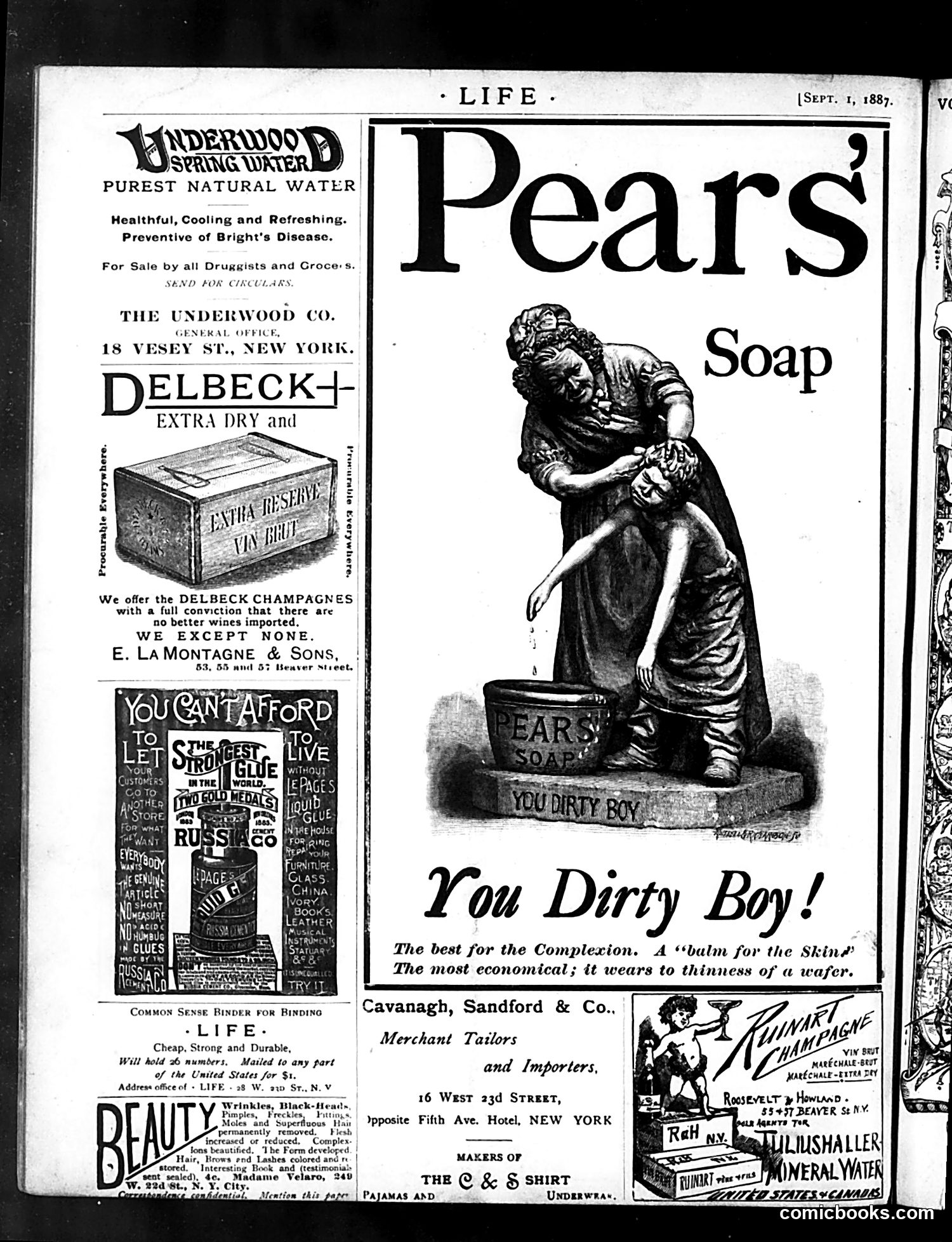
This page is primarily **advertising**, not political satire. The dominant image is a Pears' Soap advertisement featuring a cherubic figure washing a dirty boy, with the caption "You Dirty Boy!" **The Advertisement's Message:** The ad uses sentimental Victorian imagery—a well-dressed child attending to an unkempt street child—to market soap as a moral and practical solution. The tagline promises Pears' Soap is "the best for the Complexion" and "most economical." **Social Context:** This reflects 1887 attitudes about cleanliness as both hygiene and moral virtue. The imagery subtly promotes class distinctions while offering an aspirational message: proper soap could "civilize" even dirty street children. The ad doesn't mock the dirty boy but rather positions soap-use as a path to respectability. The surrounding page contains typical period advertisements for champagne, spring water, beauty treatments, and other products—standard commercial content for *Life* magazine.