
Life, 1887-09-01 · page 6 of 16
Life — September 1, 1887 — page 6: what you’re looking at
What you’re looking at
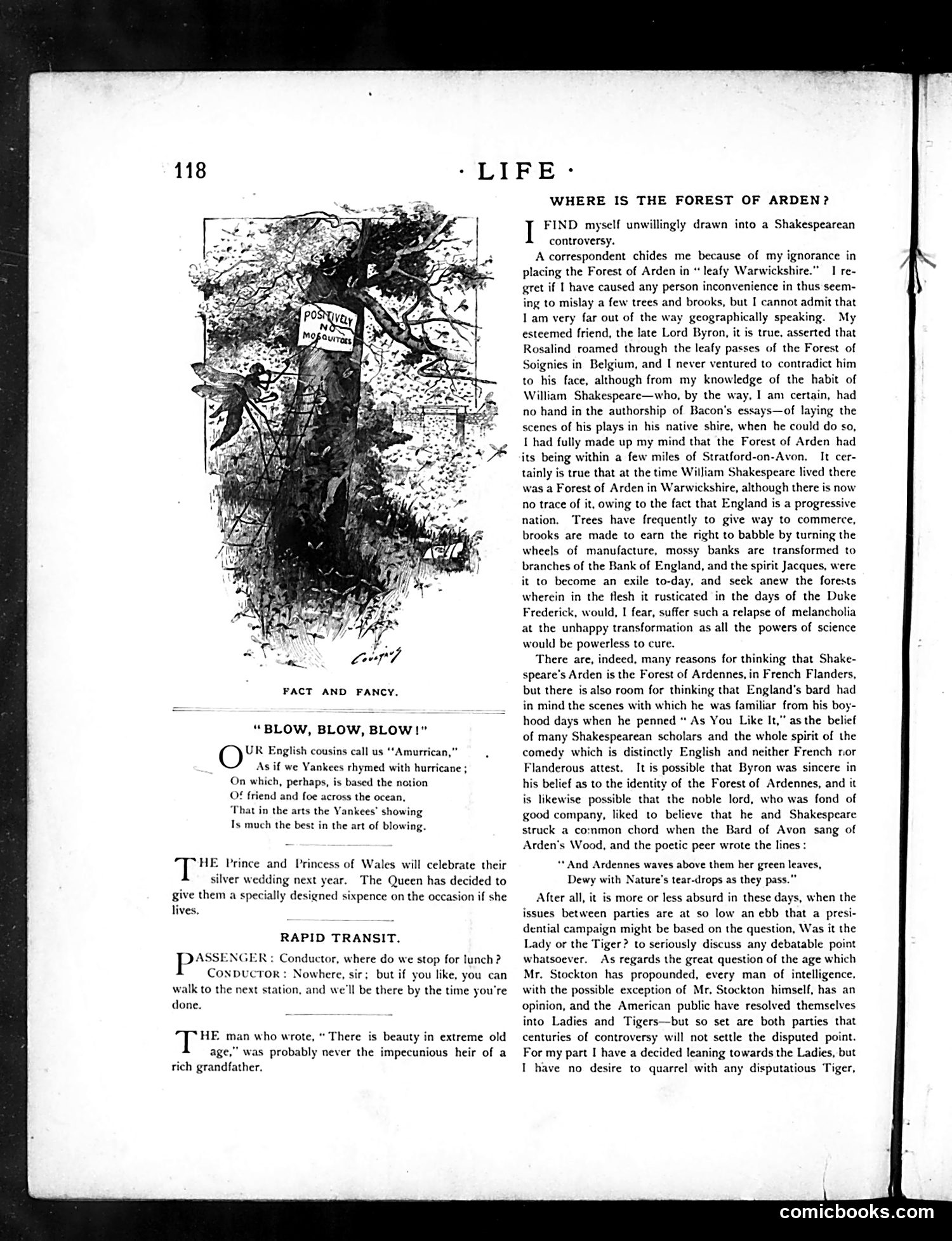
The main article discusses a scholarly dispute about the geographical location of Shakespeare's Forest of Arden from *As You Like It*. The author defends placing it in Warwickshire, England (near Stratford-upon-Avon), against those who argue it's the Forest of Ardennes in French Flanders. The accompanying illustration (signed "Cesare") shows a gnarled, dead tree with a "Positively No Trespassing" sign, appearing to mock the overly serious scholarly debate. The cartoonist satirizes how literary scholars obsess over minor geographical details while the actual forest has been destroyed by England's industrial progress—suggesting the whole controversy is somewhat absurd given the forest's current nonexistence.
📄 Transcribed text from this page (OCR, searchable)
Machine-transcribed from the original scan — historical spelling and the odd misread are preserved.
- LIFE: FACT AND FANCY, “BLOW, BLOW, BLOW!” UR English cousins call us ‘‘Amurrican,” As if we Yankees rhymed with hurricane ; On which, perhaps, is based the notion Of friend and foe across the ocean, ‘That in the arts the Yankees’ showing Is much the best in the art of blowing. i I HE Prince and Princess of Wales will celebrate their silver wedding next y The Queen has decided to give them a specially designed sixpence on the occasion if she lives. RAPID TRANSIT. R: Conductor, where do we stop for lunch ? TOR: Nowhere, sir; but if you like, you can walk to the next station, and we'll be there by the time you're done. HE man who wrote, * There is beauty in extreme old age," was probably never the impecunious heir of a rich grandfather. WHERE IS THE FOREST OF ARDEN? FIND myself unwillingly drawn into a Shakespearean controversy. A correspondent chides me because of my ignorance in placing the Forest of Arden in “leafy Warwickshire.” I re- gret if I have caused any person inconvenience in thus seem- ing to mislay a few trees and brooks, but I cannot admit that lam very far out of the way geographically speaking. My esteemed friend, the late Lord Byron, it is true, asserted that Rosalind roamed through the leafy passes of the Forest of Soignies in Belgium, and I never ventured to contradict him to his face, although from my knowledge of the habit of William Shakespeare—who, by the way, I am certain, had no hand in the authorship of Bacon's essays—of laying the scenes of his plays in his native shire, when he could do so, I had fully made up my mind that the Forest of Arden had its being within a few miles of Stratford-on-Avon. It cer- tainly is true that at the time William Shakespeare lived there was a Forest of Arden in Warwickshire, although there is now no trace of it, owing to the fact that England is a progressive nation. Trees have frequently to give way to commerce, brooks are made to earn the right to babble by turning the wheels of manufacture, mossy banks are transformed to branches of the Bank of England, and the spirit Jacques, were it to become an exile to-day, and seek anew the forests wherein in the flesh it rusticated in the days of the Duke Frederick, would, I fear, suffer such a relapse of melancholia at the unhappy transformation as all the powers of science would be powerless to cure. There are, indeed, many reasons for thinking that Shake- speare’s Arden is the Forest of Ardennes, in French Flanders, but there is also room for thinking that England's bard had in mind the scenes with which he was familiar from his boy- hood days when he penned “ As You Like It,” as the belief of many Shakespearean scholars and the whole spirit of the comedy which is distinctly English and neither French ror Flanderous attest. It is possible that Byron was sincere in his belief as to the identity of the Forest of Ardennes, and it is likewise possible that the noble lord, who was fond of good company, liked to believe that he and Shakespeare struck a co:nmon chord when the Bard of Avon sang of Arden’s Wood, and the poetic peer wrote the lines : “And Ardennes waves above them her green leaves, Dewy with Nature's tear-drops as they pass.” After all, it is more or less absurd in these days, when the issues between parties are at so low an ebb that a presi- dential campaign might be based on the question, Was it the Lady or the Tiger? to seriously discuss any debatable point whatsoever. As regards the great question of the age which Mr. Stockton has propounded, every man of intelligence. with the possible exception of Mr. Stockton himself, has an opinion, and the American public have resolved themselves into Ladies and Tigers—but so set are both parties that centuries of controversy will not settle the disputed point. For my part I have a decided leaning towards the Ladies, but I have no desire to quarrel with any disputatious Tiger, comicbooks.com