
A complete issue · 16 pages · 1887
Life — July 14, 1887
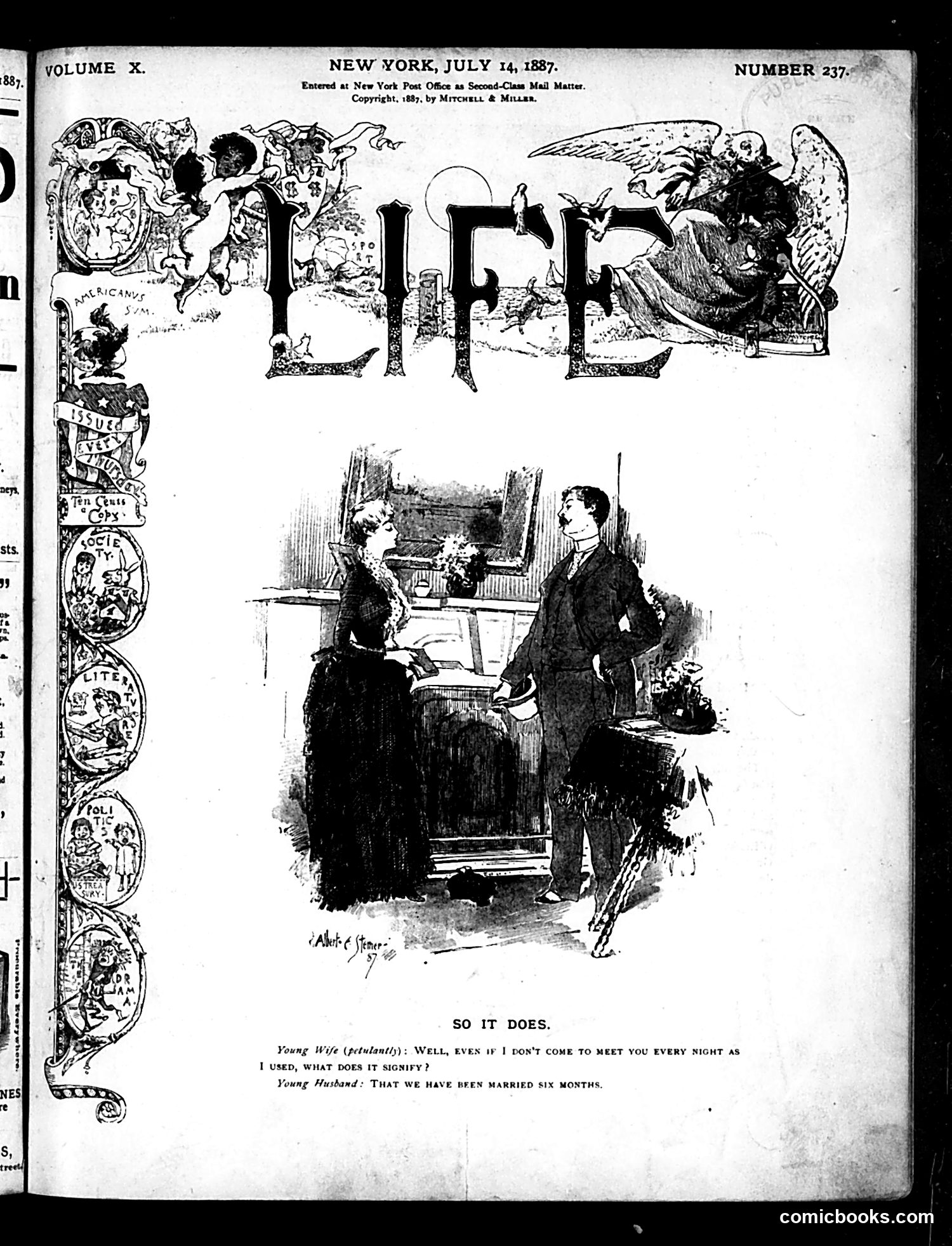
This page features a single cartoon with accompanying caption. A young married couple stands in what appears to be a parlor, with the husband gesturing while speaking to his wife. The joke concerns the wife's complaint about the husband's changed behavior after marriage. She asks what it means that they no longer meet every night as they used to. His response—"That we have been married six months"—suggests that the initial romantic intensity of courtship naturally diminishes after half a year of marriage. The satire mocks the common domestic reality that newlyweds' behavior shifts from passionate courtship to routine married life. The cartoon's title, "So It Does," implies resignation to this inevitable marital pattern—the husband's blunt acknowledgment serving as dry commentary on how quickly romance fades in marriage.
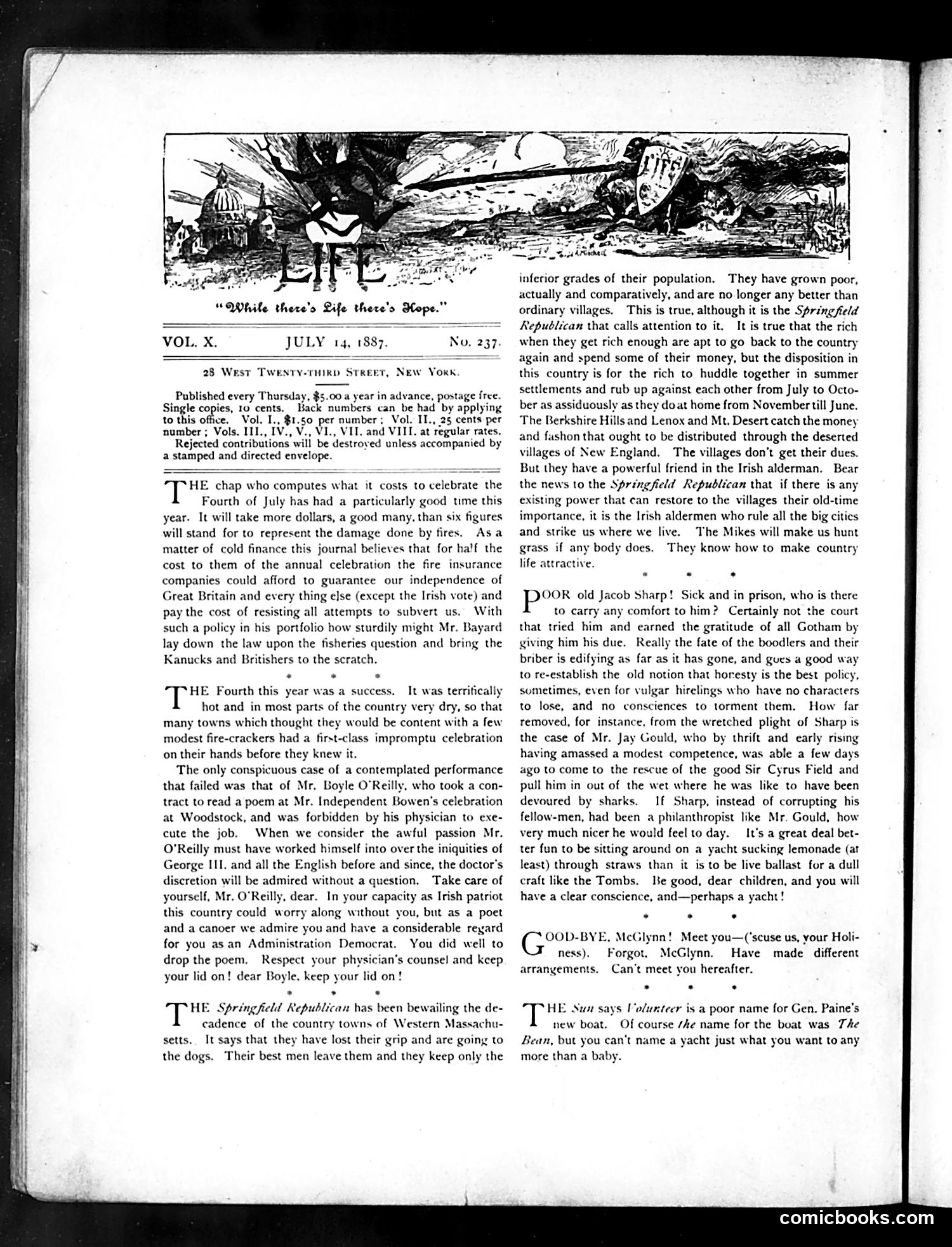
The masthead cartoon shows a figure sitting amid destruction, with the caption "While there's Life there's Hope." This appears to reference Fourth of July celebrations—the text discusses the costs and dangers of fireworks, mentioning fires and injuries from the holiday's festivities. The accompanying articles critique various social and political matters: wealthy Irish Americans' hypocrisy about supporting Irish independence, incompetent military leadership (referencing General O'Reilly), and the Springfield Republican's reporting on rural Massachusetts depopulation. A brief note mocks a boat named "Volunteer" as an inappropriate name for General Paine's yacht, suggesting wordplay on patriotic versus personal pride. The content reflects 1880s American concerns: Irish-American politics, military incompetence, rural decline, and wealthy Americans' pretensions.
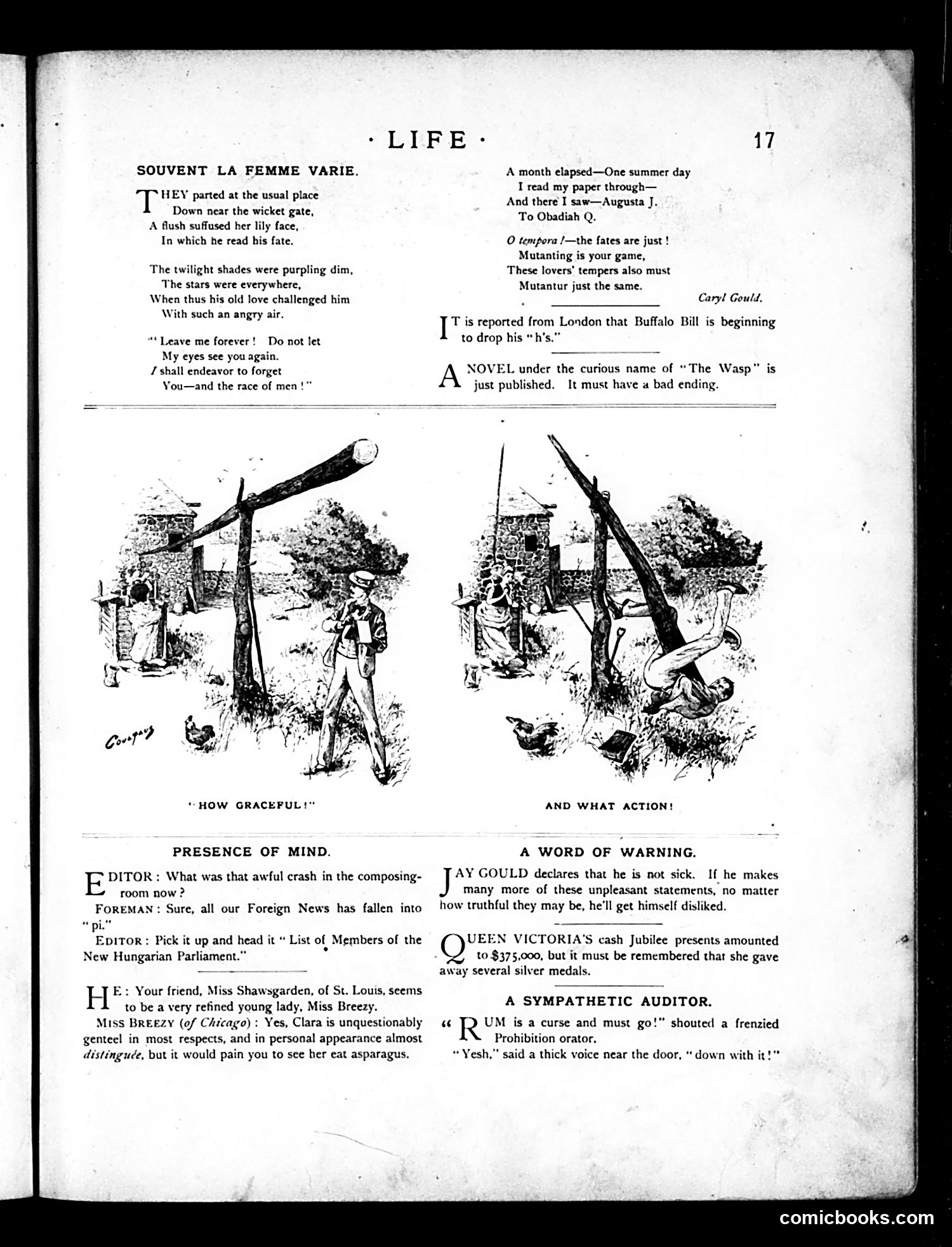
The page contains two cartoon panels titled **"How Graceful!"** and **"And What Action!"** depicting a figure on a gallows or execution structure in two different poses—first standing, then apparently falling or swinging. The cartoons appear to satirize someone's response to an execution or capital punishment, though the specific political figure or event referenced is unclear from the visible text alone. The surrounding text includes literary excerpts and brief satirical items about social topics (Jay Gould's health claims, Queen Victoria's Jubilee, Prohibition). The cartoons likely comment on contemporary politics or a specific scandal, but without additional context about the magazine's date or other identifying details, the precise subject remains indeterminate.
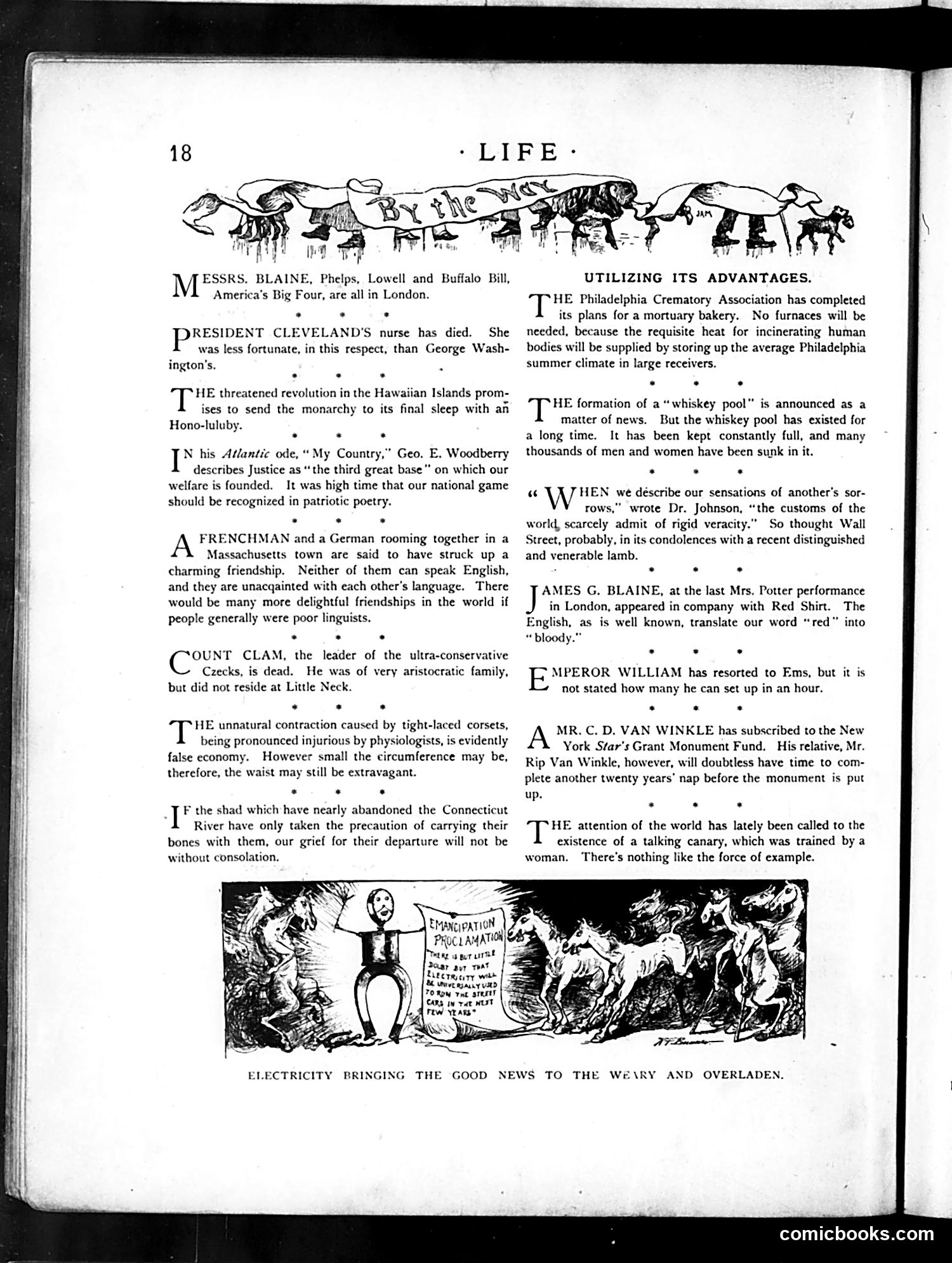
This page contains brief satirical news items and commentary typical of Life magazine's format. The main cartoon at bottom, titled "Electricity Bringing the Good News to the Weary and Overladen," depicts a woman in classical dress (likely representing Liberty or Progress) surrounded by mythological figures, proclaiming electricity as a solution to human hardship. The text items mock contemporary figures and events: President Cleveland's nurse, Buffalo Bill in London, Hawaiian political turmoil, and Count Clam (a conservative politician). One item jokes about a "whiskey pool" and another references tight corsets as false economy. The cartoon celebrates electricity as a modern advancement that will alleviate suffering—a common late-19th-century progressive theme. The mythological imagery suggests electricity represents enlightenment and hope for society's problems.
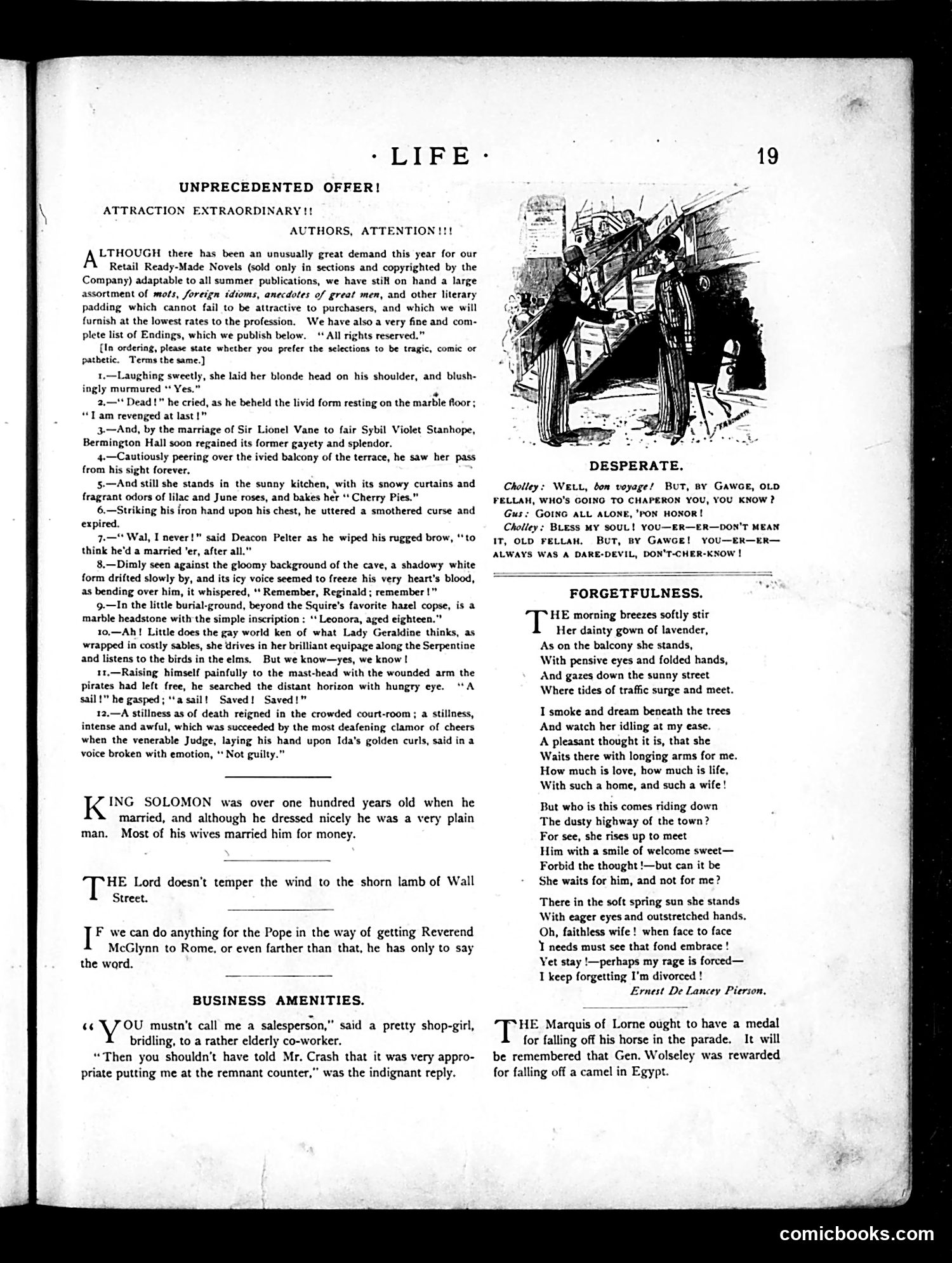
This page contains literary content rather than political cartoons. The main illustration depicts a dramatic scene labeled "DESPERATE," showing figures in what appears to be a gothic or melodramatic setting—consistent with the serialized fiction excerpts printed alongside it. The page includes: 1. **Advertisement section** ("UNPRECEDENTED OFFER!") promoting the magazine's retail novels and literary works available to the publishing industry. 2. **Serialized fiction excerpts** numbered 1-12, appearing to be from adventure or romance stories involving characters like "Deacon Pelter" and "Sir Lionel Vane." 3. **A poem titled "FORGETFULNESS"** by Ernest De Lancey Pierson about longing and infidelity. 4. **Brief satirical items** under "BUSINESS AMENITIES," including commentary on shop-girl terminology and military honors. The content reflects Life magazine's mix of literature, humor, and social commentary from the early 20th century.
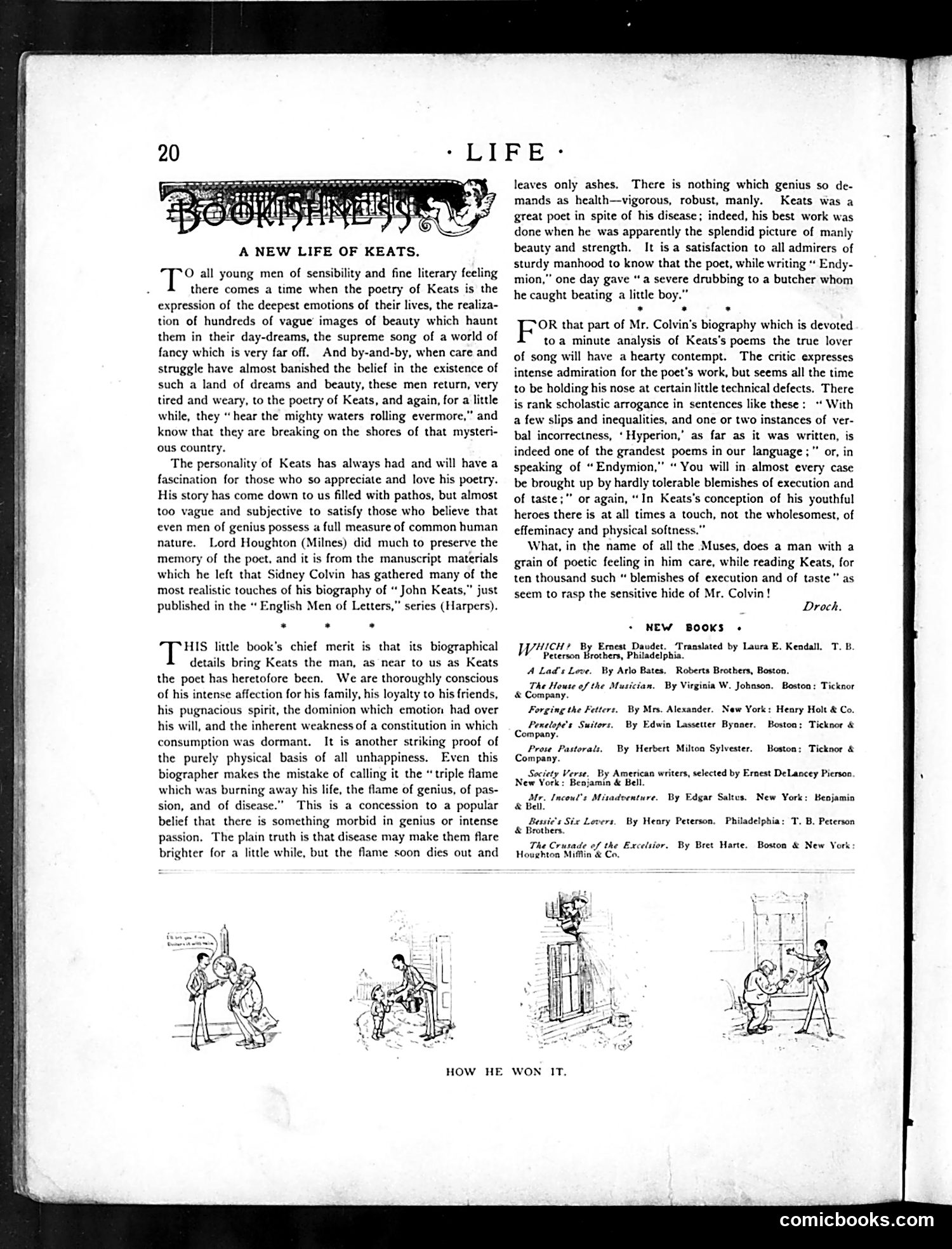
This page contains a literary article about John Keats accompanied by four small cartoon illustrations labeled "HOW HE WON IT." The article discusses Sidney Colvin's biography of the poet Keats, praising its realistic portrayal while critiquing some scholarly pedantry in analyzing Keats's poems. The text emphasizes Keats's genius despite physical weakness and short life, noting his intense passion for poetry. The four cartoons below appear to humorously illustrate the phrase "how he won it"—likely depicting various scenarios of romantic or social conquest, though the small illustrations make specific details difficult to discern. They seem to offer comedic commentary on Keats's personal life rather than his literary achievements, typical of Life's satirical approach to serious subjects.
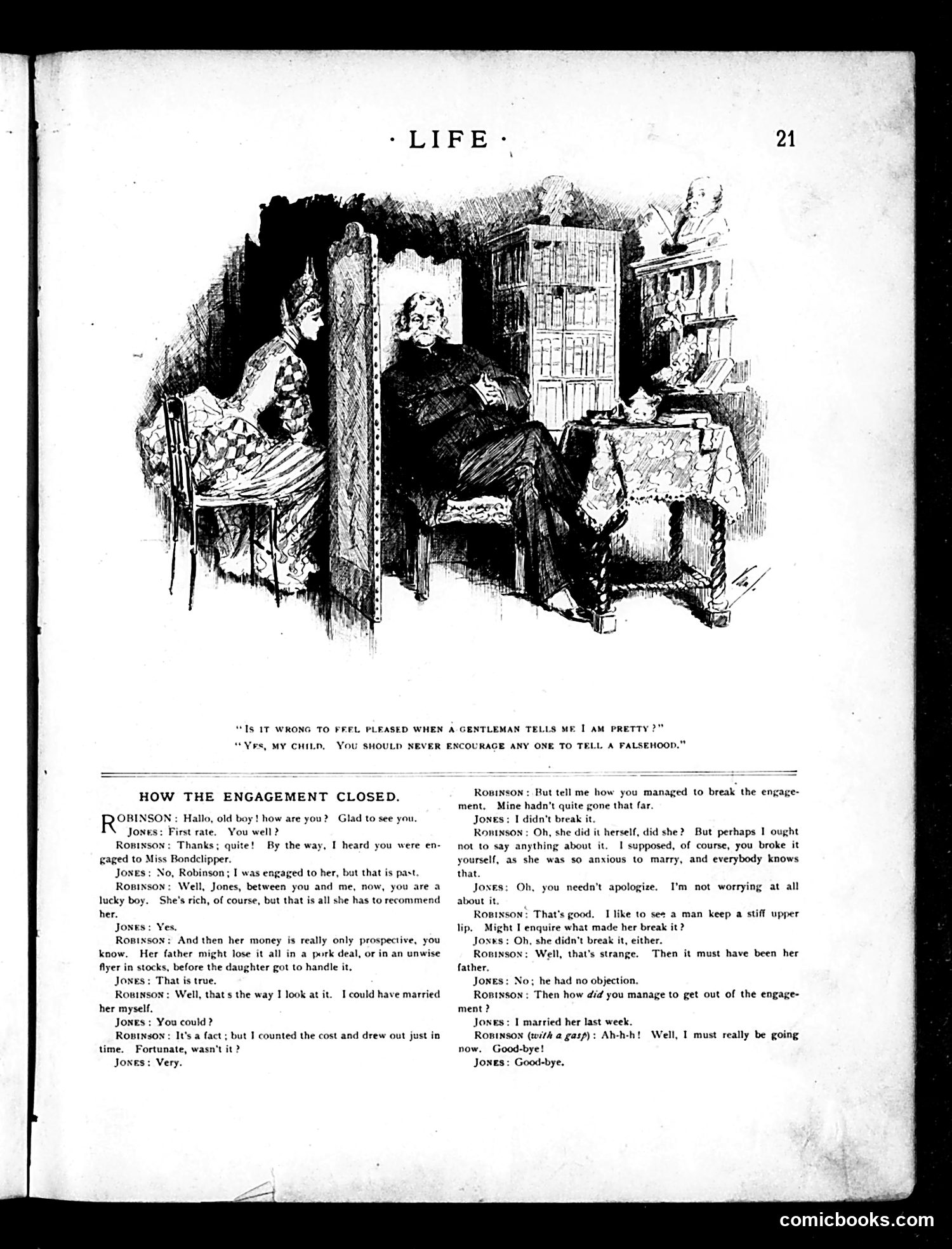
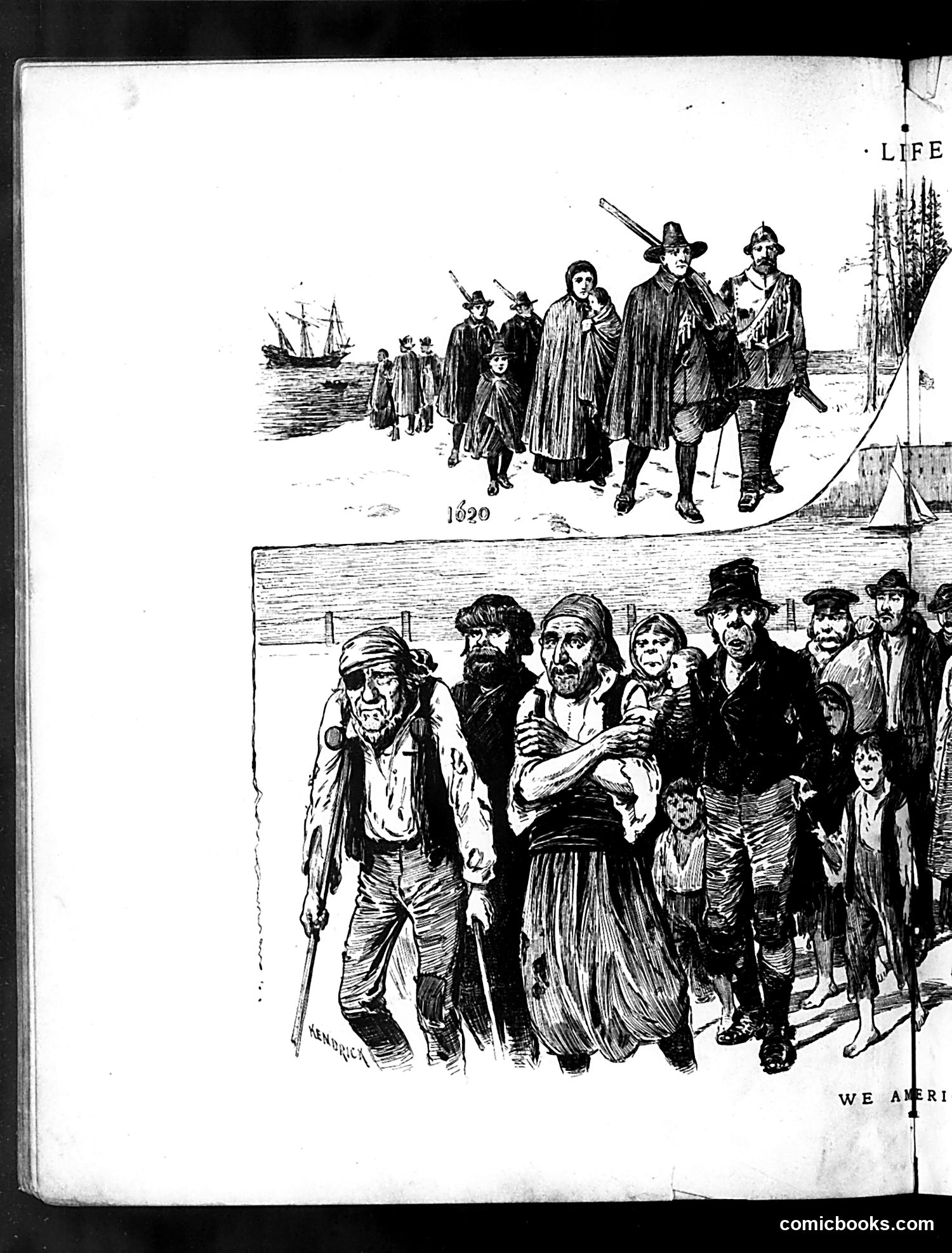
This page depicts the 1620 arrival of the Pilgrims at Plymouth, Massachusetts—a foundational American historical moment. The top panel shows the Mayflower and colonists landing; the bottom panel illustrates the struggling settlers, depicting disease, hardship, and poverty among men, women, and children during their first winter. The satire likely comments on American immigration or settlement by contrasting the romanticized historical narrative (orderly landing) with harsh reality (suffering colonists). By invoking the Pilgrims—revered as America's moral founders—the cartoonist may critique contemporary attitudes toward newcomers or immigrants, suggesting Americans have forgotten the hardship and desperation their own ancestors faced. The exaggerated facial expressions emphasize human suffering rather than heroic mythology.
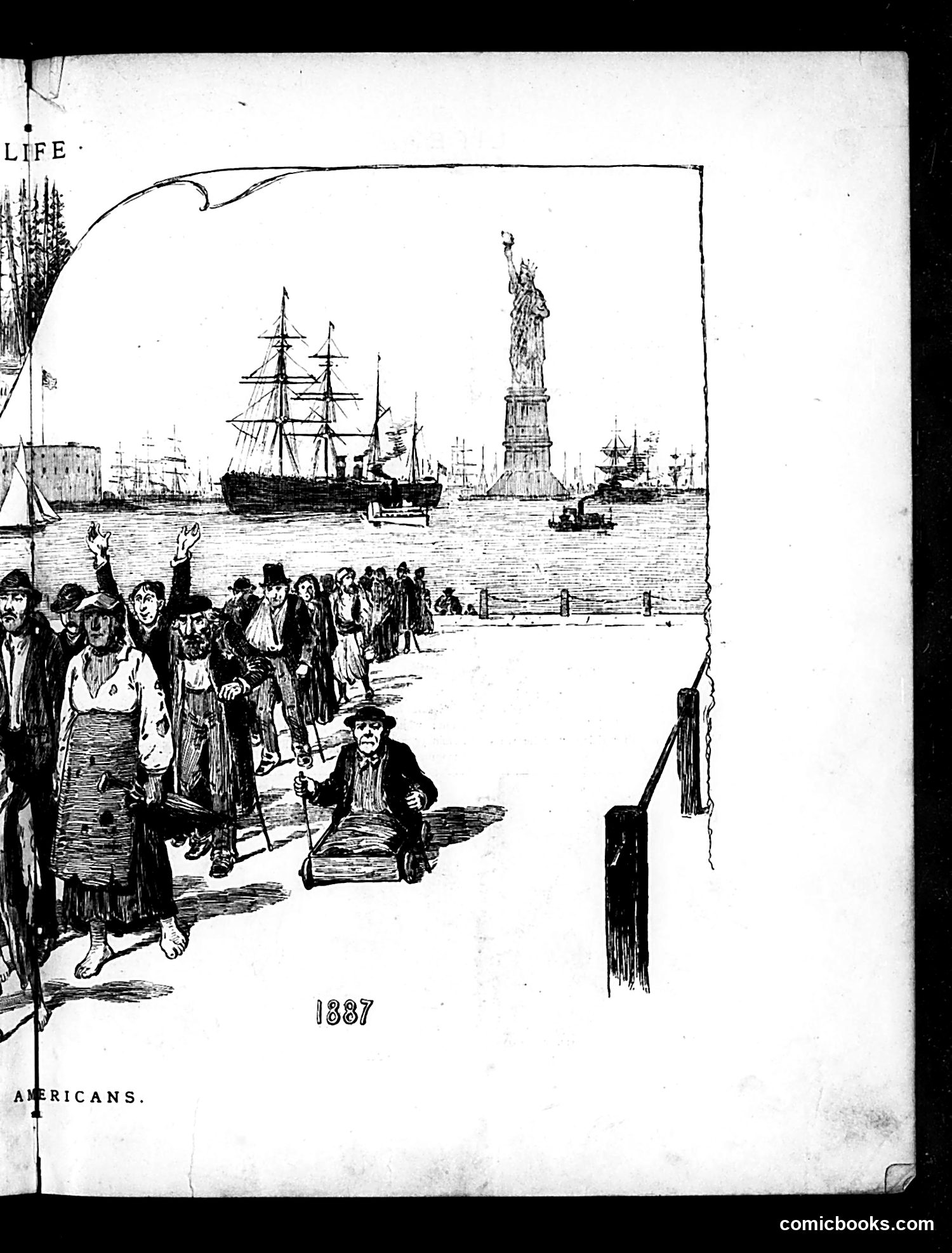
This satirical illustration depicts immigrants arriving at what appears to be New York Harbor, recognizable by the Statue of Liberty visible in the background. The crowded dock scene shows newly arrived people—likely poor European immigrants—alongside sailing vessels characteristic of 1880s transatlantic travel. The cartoon's satire targets American attitudes toward immigration. The year "1887" marks a period of intense immigration restriction debates. The contrast between the idealistic Liberty monument and the humble, struggling immigrants below suggests irony about America's promise versus the reality faced by newcomers. The title "AMERICANS" likely refers sarcastically to these newly arrived foreigners, commenting on anxieties about who truly belonged to the nation during this contentious era of mass immigration and nativist opposition.
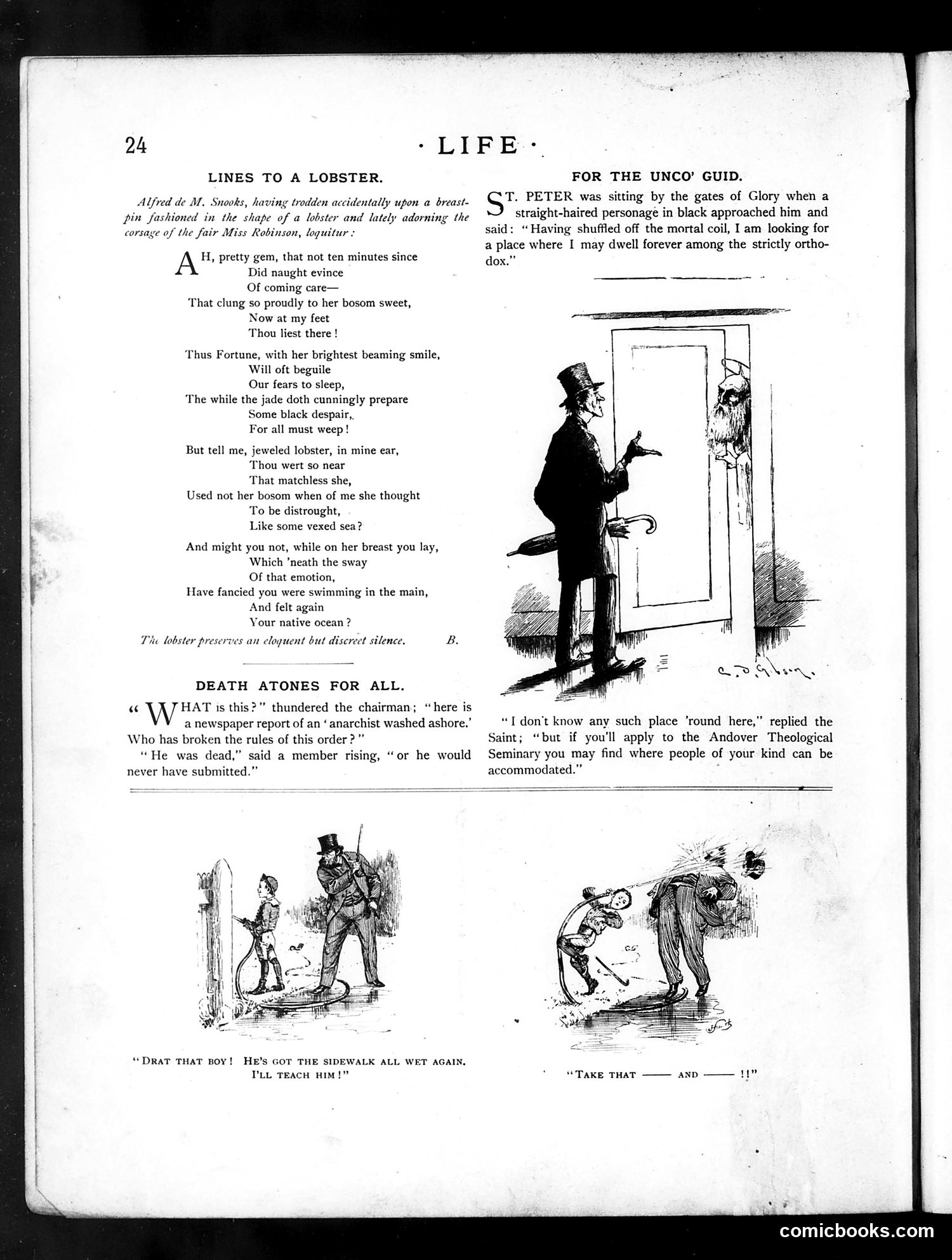
This page contains three distinct pieces of Victorian-era humor: 1. **"Lines to a Lobster"**: A romantic poem mocking sentimental verse, addressing a lobster as a love interest. The satire targets overwrought Romantic poetry conventions. 2. **"For the Unco Guid"**: A cartoon showing a well-dressed man at a doorway speaking to St. Peter. The "unco guid" (Scottish for "supposedly virtuous") depicts a sanctimonious character seeking entry to heaven. The punchline suggests such self-righteous people belong at the "Andover Theological Seminary" instead—satirizing religious hypocrisy. 3. **"Death Atones for All"**: A brief satirical scene about an anarchist's death, followed by two cartoon vignettes depicting domestic punishment and mischief, illustrating consequences for rule-breaking. The overall theme critiques hypocrisy, pretension, and sanctimoniousness across social and religious spheres.
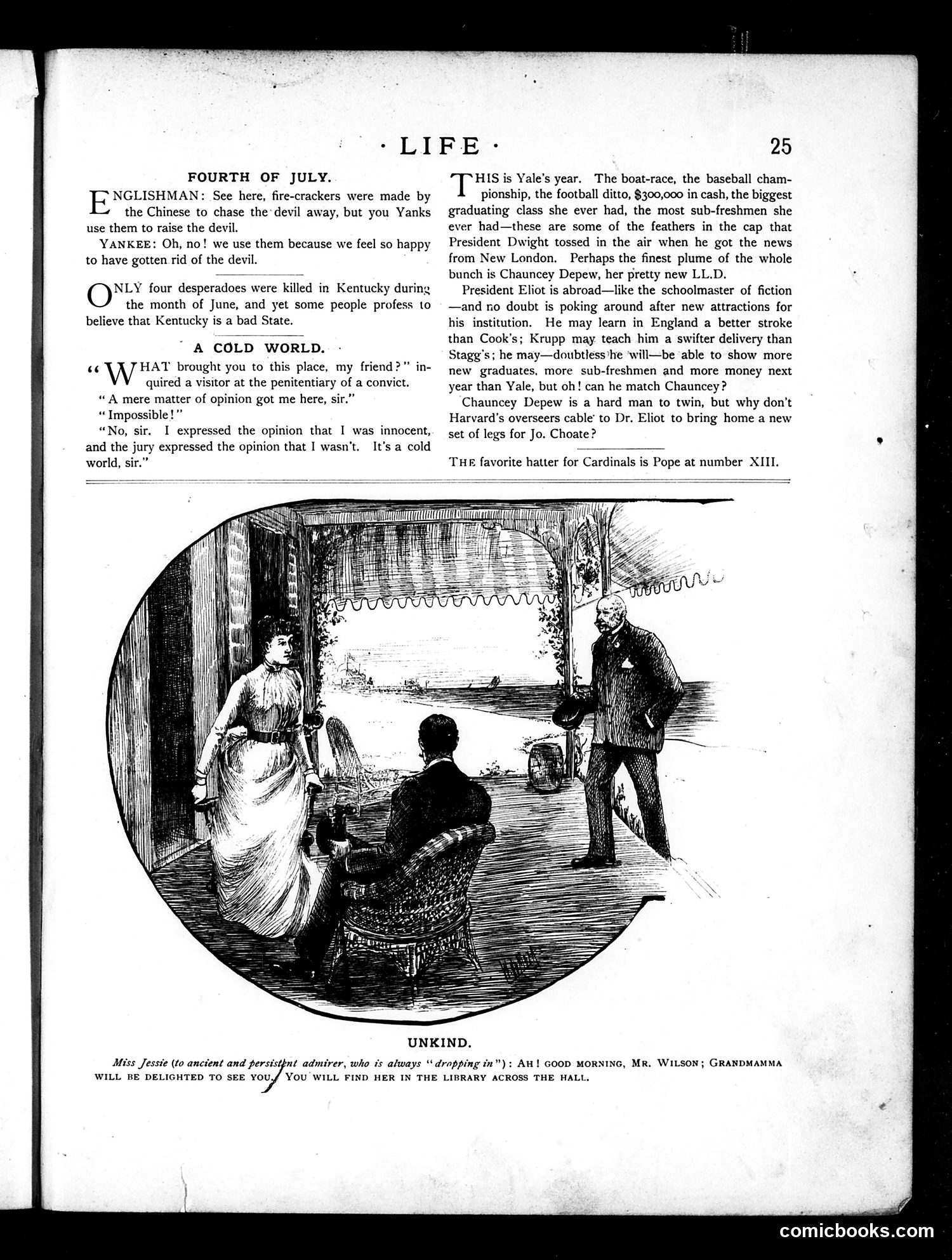
This page contains several satirical pieces typical of 1890s American humor: **"Fourth of July" dialogues** mock national character: an Englishman criticizes Americans for using firecrackers recklessly rather than respectfully (as the Chinese did to ward off evil), while Americans celebrate having "gotten rid of the devil"—a jab at American rowdiness. **"A Cold World"** presents a convict's dark joke about the legal system: he was imprisoned for expressing an "opinion" (his innocence), while the jury expressed the opposite opinion. The satire critiques arbitrary justice. **Yale vs. Harvard rivalry** section celebrates Yale's recent successes (boat races, football, money, graduates) while sarcastically suggesting Harvard President Eliot seek improvements abroad. Chauncey Depew, Yale's new honorary degree recipient, is positioned as an unbeatable asset. **"Unkind"** illustration depicts a young woman (Miss Jessie) greeting an elderly persistent suitor while redirecting him to see her grandmother, implying he's outdated—a gentle age-based humor common to the era.
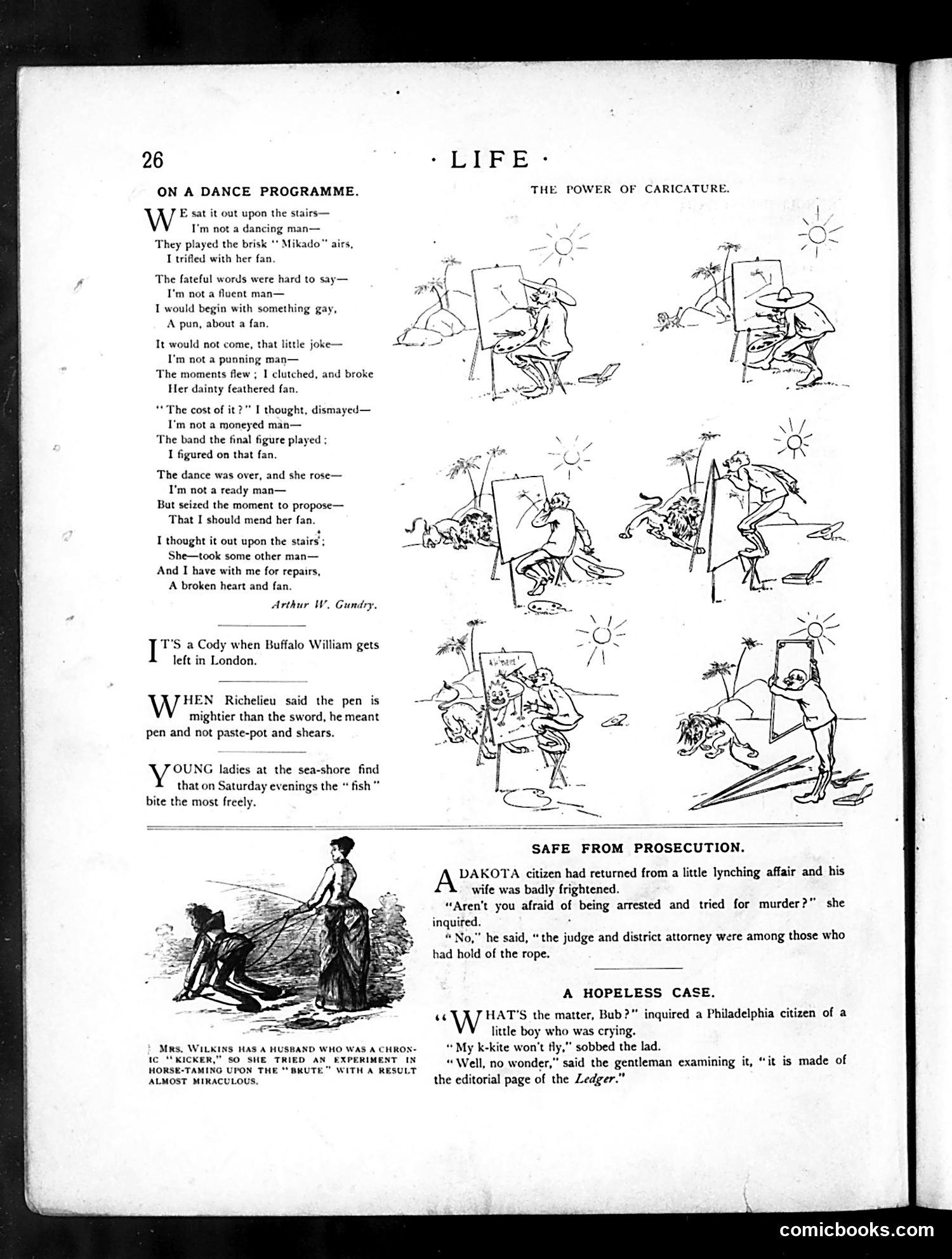
This page combines light humor with darker social commentary typical of early 20th-century American satire. **"On a Dance Programme"** is a romantic poem by Arthur W. Gundry about an awkward suitor who breaks a woman's fan while nervously trying to propose. The humor lies in his repeated self-deprecation ("I'm not a dancing man," "I'm not a fluent man") culminating in rejection—he's left holding only the broken fan as a memento. **"The Power of Caricature"** shows six cartoon panels depicting an artist drawing a portrait in sunlight, with the final image increasingly exaggerated/distorted, illustrating how caricature transforms reality. **"Safe from Prosecution"** is biting political satire: a Dakota man returns from a lynching unafraid of arrest because the judge and district attorney participated in the mob violence—exposing the complete breakdown of law enforcement in lynching contexts. **"A Hopeless Case"** mocks the *Philadelphia Ledger*'s editorial quality by suggesting a child's broken kite is made from it. The page juxtaposes frivolous romance and mild visual humor against serious commentary on American lawlessness and justice system corruption.
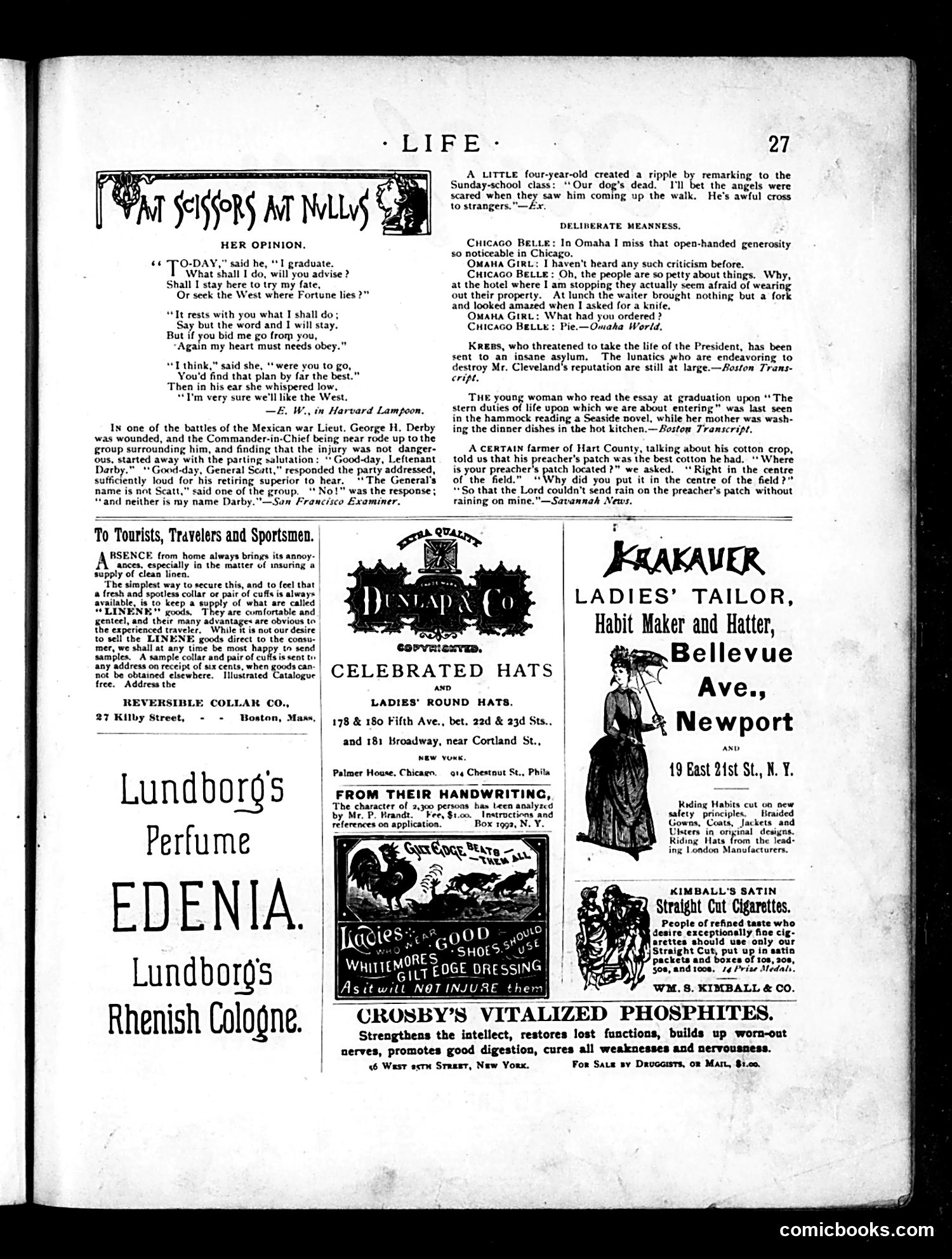
This page mixes humor columns with period advertisements. The cartoons and anecdotes satirize social pretension and hypocrisy: **"Her Opinion"** depicts a young woman from Chicago visiting Omaha, complaining that locals lack "open-handed generosity"—yet she herself refuses to wear out hotel property and demands a knife with pie. The satire targets her obliviousness to her own meanness. **Other anecdotes mock**: a four-year-old's brutally honest comment about a cross dog; a graduate's indecision about life direction; and a farmer's self-interested prayer requesting rain everywhere *except* his preacher's patch. Each satirizes human contradiction between stated values and actual behavior. **Historical context**: References to "Cleveland" (President Grover Cleveland) and Kreps's assassination threat date this roughly to the 1880s-90s. The humor reflects *Life*'s typical approach—exposing class pretension and moral hypocrisy through brief, pointed anecdotes aimed at educated readers. The page is predominantly advertising (corsets, perfume, cigarettes, tailoring services).
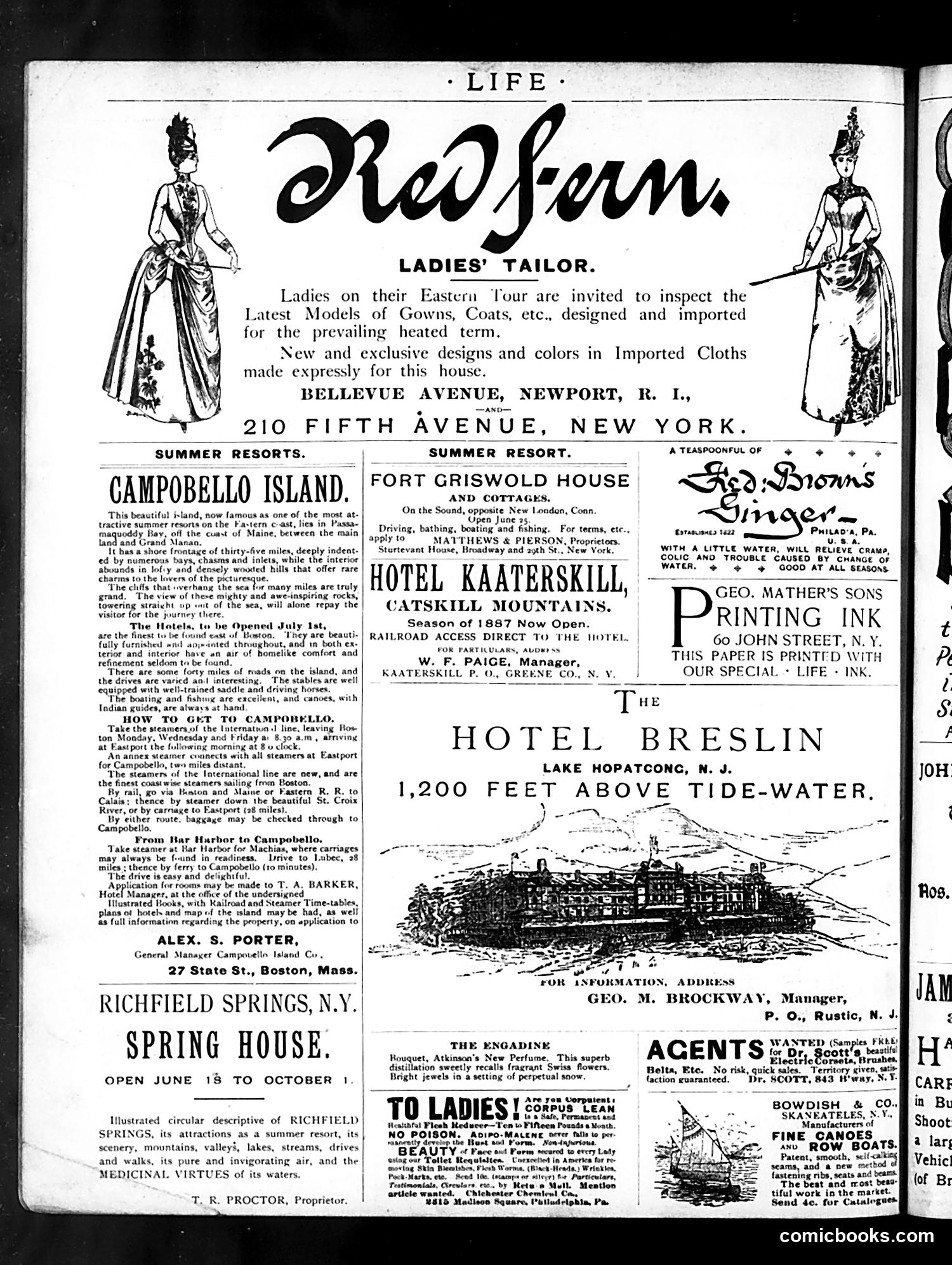
This is **primarily an advertising page**, not a satirical cartoon page. It features advertisements for summer resorts and commercial products popular in the 1880s. The main content includes: **Summer Resort Ads**: Campobello Island (Maine), Fort Griswold House (Connecticut), Hotel Kaaterskill (Catskill Mountains), and Hotel Breslin (Lake Hopatcong, New Jersey)—promoting leisure destinations for wealthy Americans. **Commercial Ads**: A ladies' tailor on Fifth Avenue and Bellevue Avenue (Newport, Rhode Island), printing ink by Geo. Mather's Sons, and patent medicine ("Asa Brown's Ginger") claiming to relieve cramps and digestive issues from travel. **No political satire is evident**. The page reflects Gilded Age leisure culture—wealthy Americans taking "Eastern Tours" and summering at fashionable resorts. The patent medicine ad represents typical 19th-century commercial health claims.
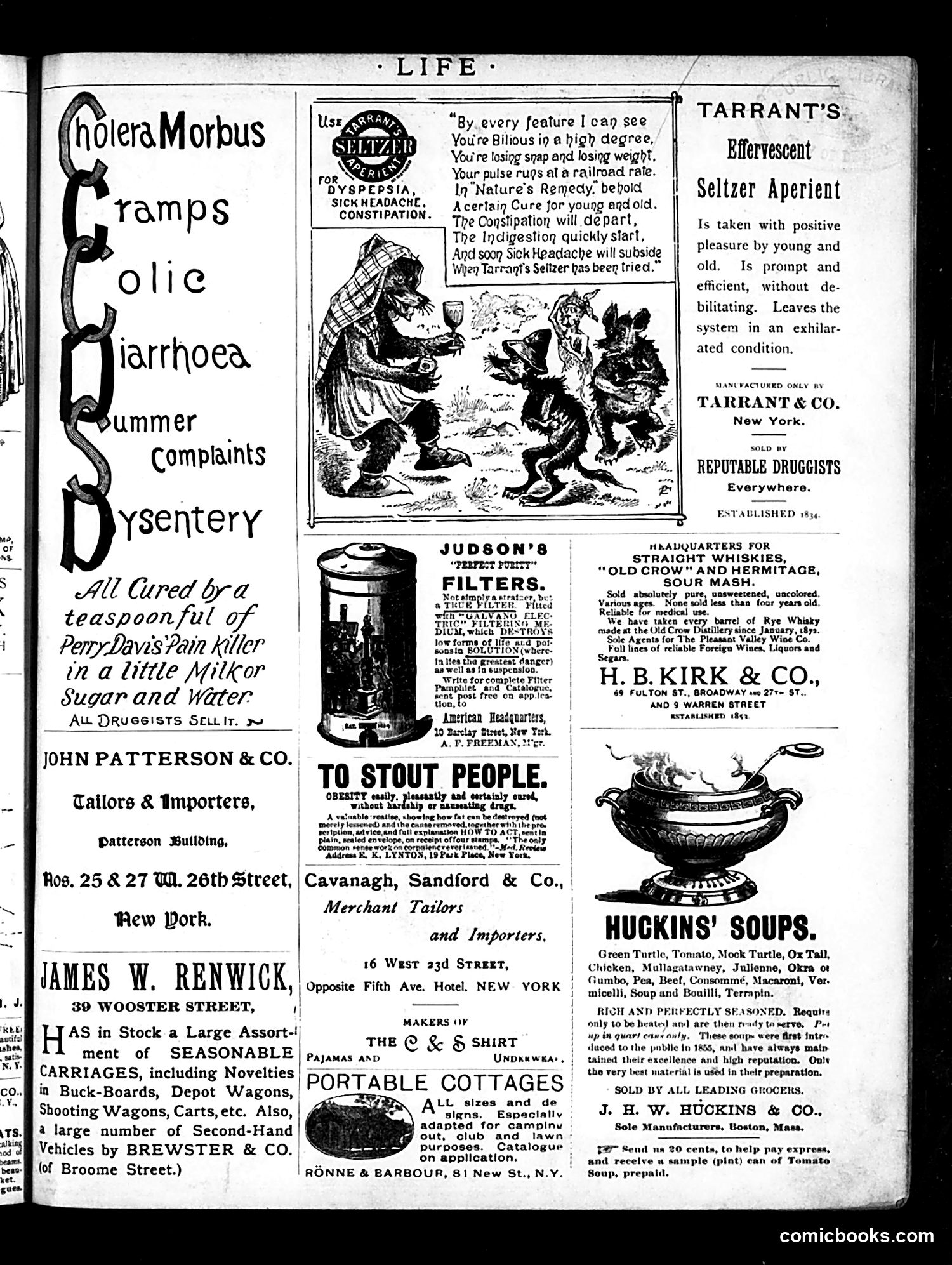
This is primarily a **advertisements page** from Life magazine, not a political cartoon. The dominant content is commercial messaging for patent medicines and consumer goods typical of the late 19th century. The most notable satirical element is the **Tarrant's Seltzer advertisement**, featuring an illustrated dialogue between a doctor-like figure and a patient. The doctor diagnoses the patient as "bilious" (a common Victorian medical complaint) and recommends Tarrant's product as a cure-all for constipation, indigestion, and headaches. The humor lies in the exaggerated medical language and the absurd confidence that one product treats multiple unrelated ailments—reflecting period satire about patent medicine snake oil. Other ads promote remedies for obesity, dysentery, and various lifestyle products. The page reflects early advertising's use of pseudo-medical authority and dubious health claims that were common before modern FDA regulation.
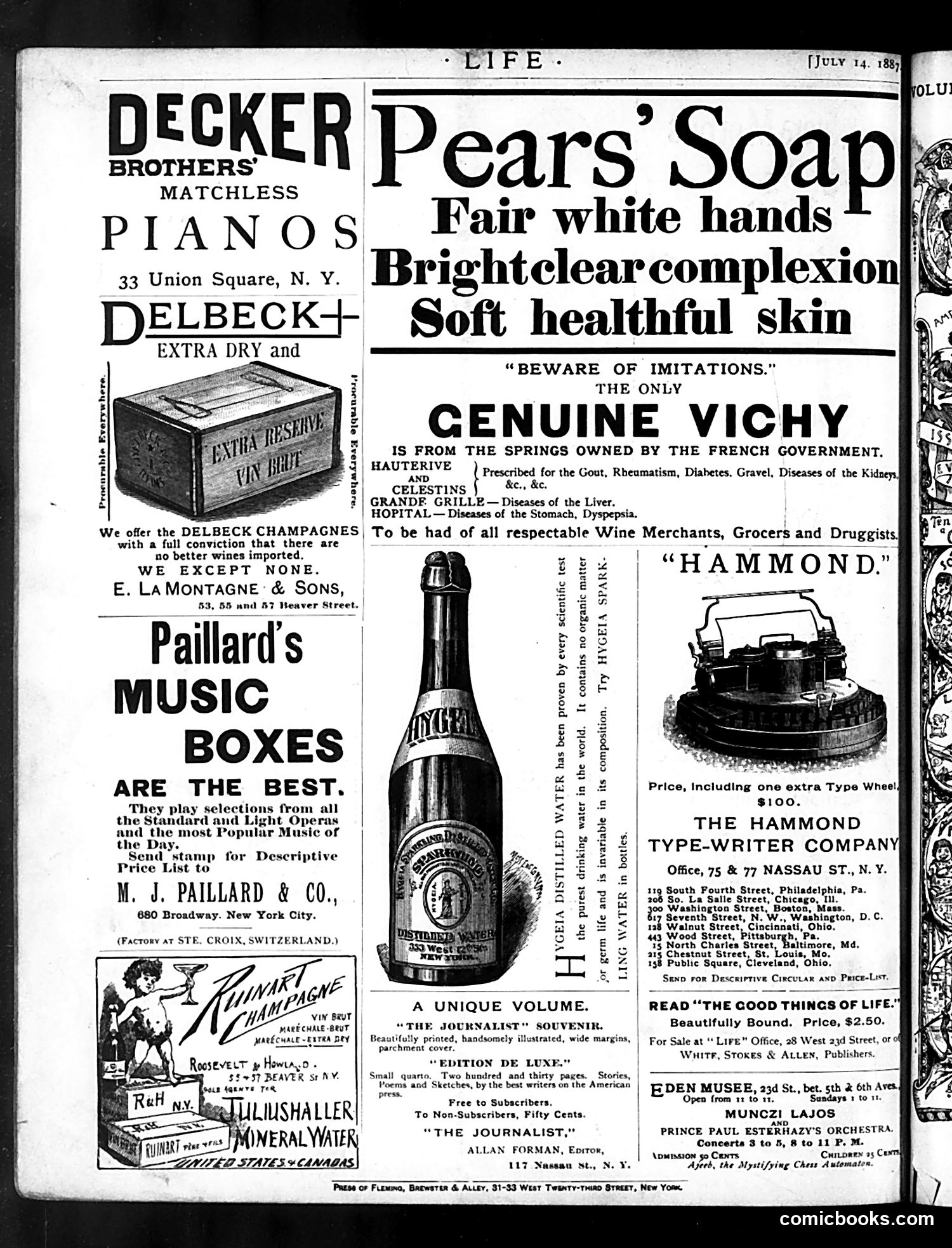
This is primarily an **advertising page** from Life magazine (July 14, 1889), containing no political cartoons or satirical content worth analyzing. The page features **commercial advertisements** for luxury goods popular among wealthy Americans of the era: Decker pianos, Pears' soap (promising "fair white hands" and "bright clear complexion"), champagne, music boxes, mineral water, typewriters, and wine. These ads reflect late-Victorian consumer culture and beauty standards. Notable is **Pears' soap's explicit marketing of whiteness and fair skin**—reflecting period racial attitudes—and the emphasis on "beware of imitations" for Vichy water, suggesting consumer anxiety about product authenticity in an era before strict food/drug regulation. The page also advertises cultural venues like Eden Musee (a wax museum) and concert performances, indicating entertainment options available to New York's affluent readers. There is no discernible satirical commentary or political messaging visible.