
Life, 1887-07-14 · page 6 of 16
Life — July 14, 1887 — page 6: what you’re looking at
What you’re looking at
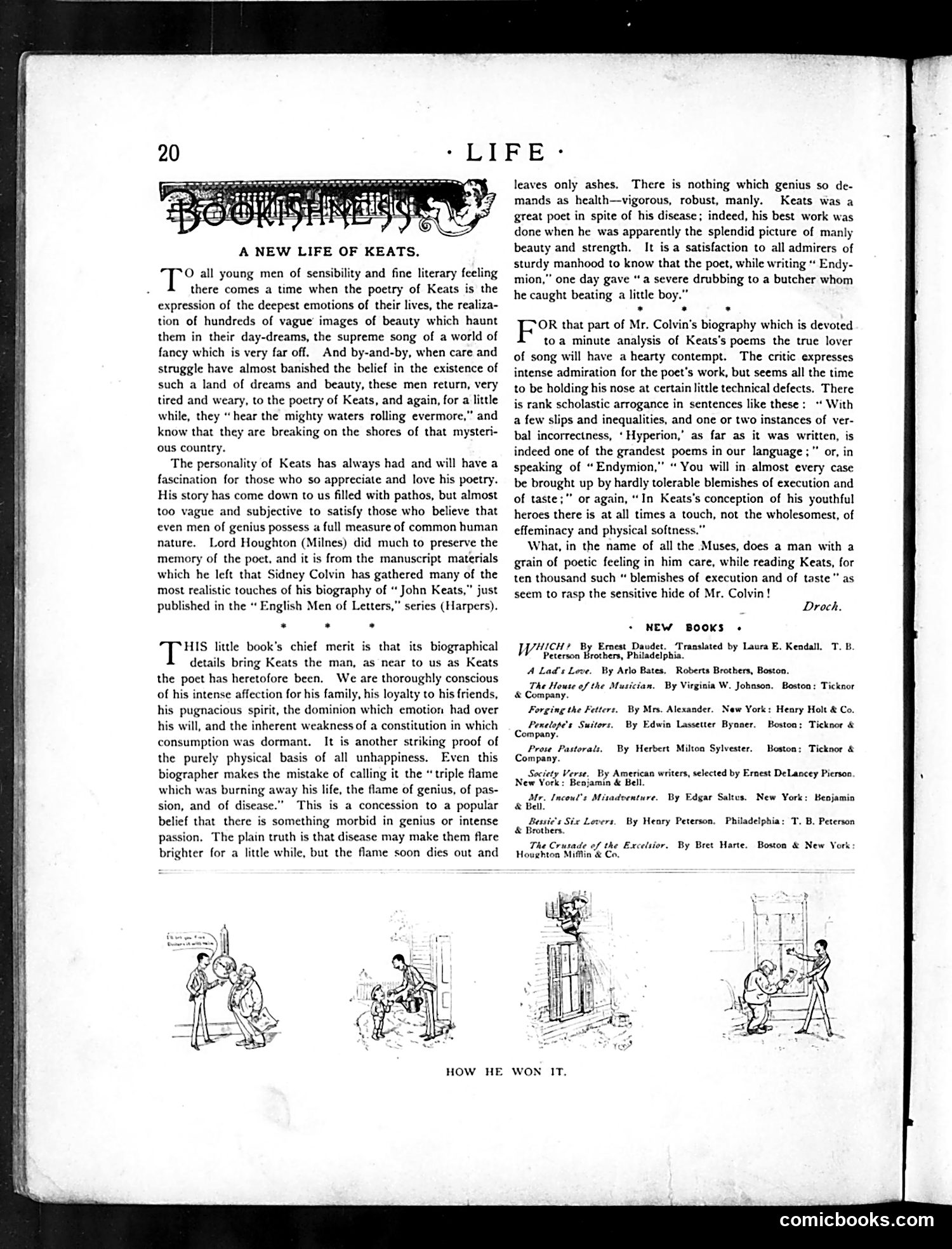
This page contains a literary article about John Keats accompanied by four small cartoon illustrations labeled "HOW HE WON IT." The article discusses Sidney Colvin's biography of the poet Keats, praising its realistic portrayal while critiquing some scholarly pedantry in analyzing Keats's poems. The text emphasizes Keats's genius despite physical weakness and short life, noting his intense passion for poetry. The four cartoons below appear to humorously illustrate the phrase "how he won it"—likely depicting various scenarios of romantic or social conquest, though the small illustrations make specific details difficult to discern. They seem to offer comedic commentary on Keats's personal life rather than his literary achievements, typical of Life's satirical approach to serious subjects.
📄 Transcribed text from this page (OCR, searchable)
Machine-transcribed from the original scan — historical spelling and the odd misread are preserved.
A NEW LIFE OF KEATS. O all young men of sensibility and fine literary feeling there comes a time when the poetry of Keats is the expression of the deepest emotions of their lives, the realiza- tion of hundreds of vague images of beauty which haunt them in their day-dreams, the supreme song of a world of fancy which is very far off. And by-and-by, when care and struggle have almost banished the belief in the existence of such a land of dreams and beauty, these men return, very tired and weary, to the poetry of Keats, and again, for a little while, they “ hear the mighty waters rolling evermore,” and know that they are breaking on the shores of that mysteri- ous country. The personality of Keats has always had and will have a fascination for those who so appreciate and love his poetry. His story has come down to us filled with pathos, but almost too vague and subjective to satisfy those who believe that even men of genius possess a full measure of common human nature. Lord Houghton (Milnes) did much to preserve the memory of the poet, and it is from the manuscript materials which he left that Sidney Colvin has gathered many of the most realistic touches of his biography of “ John Keats,” just published in the “ English Men of Letters,” series (Harpers). * . . HIS little book's chief merit is that its biographical details bring Keats the man, as near to us as Keats the poet has heretofore been. We are thoroughly conscious of his intense affection for his family, his loyalty to his friends, his pugnacious spirit, the dominion which emotion had over his will, and the inherent weakness of a constitution in which consumption was dormant. It is another striking proof of the purely physical basis of all unhappiness. Even this biographer makes the mistake of calling it the “triple flame which was burning away his life, the flame of genius, of pas- sion, and of disease.” This is a concession to a popular belief that there is something morbid in genius or intense passion. The plain truth is that disease may make them flare brighter for a little while, but the flame soon dies out and HOW HE leaves only ashes. There is nothing which genius so de- mands as health—vigorous, robust, manly. Keats was a great poet in spite of his disease; indeed, his best work was done when he was apparently the splendid picture of manly beauty and strength. It is a satisfaction to all admirers of sturdy manhood to know that the poet, while writing “ Endy- mion,” one day gave “a severe drubbing to a butcher whom he caught beating a little boy.” . . . OR that part of Mr. Colvin’s biography which is devoted toa minute analysis of Keats's poems the true lover of song will have a hearty contempt. The critic expresses intense admiration for the poet's work, but seems all the time to be holding his nose at certain little technical defects. There is rank scholastic arrogance in sentences like these: ** With a few slips and inequalities, and one or two instances of ver- bal incorrectness, ‘Hyperion,’ as far as it was written, is indeed one of the grandest poems in our language ;" or, in speaking of “Endymion,” “ You will in almost every case be brought up by hardly tolerable blemishes of execution and of taste;" or again, “In Keats's conception of his youthful heroes there is at all times a touch, not the wholesomest, of effeminacy and physical softness.” What, in the name of all the Muses, does a man with a grain of poetic feeling in him care, while reading Keats, for ten thousand such “ blemishes of execution and of taste” as seem to rasp the sensitive hide of Mr. Colvin! Droch. + NEW BOOKS «+ JVHICH? By Ernest Daudet. ‘Translated by Laura E. Kendall. T.B Peterson Brothers, Philadelphia. A Lad’s Leve. By Arlo Bates, Roberts Brothers, Boston. The House of the Musician. By Virginia W. Johason, Boston: Ticknor & Company. Forging the Fettert, By Mes. Alexander. New York: Henry Holt & Co. Penelope's Suitors, By Edwin Lasseter Bynner. Bostoa: Ticknor & Company. Prose Pastorals. Company. Society Verse. By American writers, selected by Ernest DeLancey Pierson New York: Benjamin & Bell. Mr. Incoul’s Misadventure. By Herbert Milton Sylvester. Boston: Ticknor & By Edgar Saltus. New York: Benjamin 4 Six Lovers. By Henry Peterson, Philadelphia: T. B, Peterson 3. The Crusade of the Excelsior. By Bret Harte. Houghton Mifflin & Co, Boston & New York: WON IT, comicbooks.com