
A complete issue · 18 pages · 1887
Life — June 2, 1887
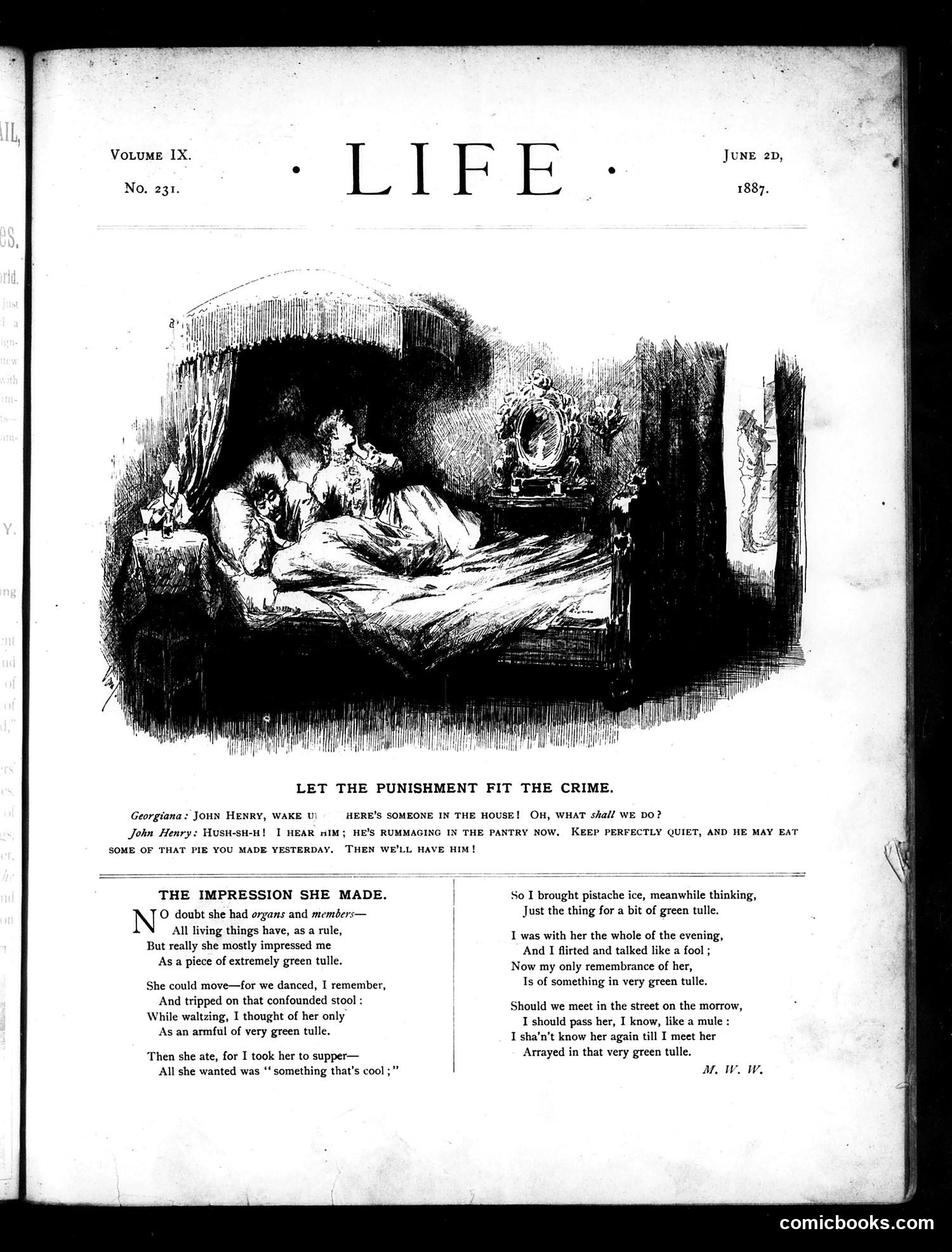
The main cartoon depicts a bedroom scene titled "LET THE PUNISHMENT FIT THE CRIME," showing what appears to be a domestic dispute. A character named John Henry confronts someone in bed, threatening punishment involving pie from "yesterday" and forced confinement—suggesting a humorous domestic punishment scenario rather than anything serious. Below are two poems: "THE IMPRESSION SHE MADE" describes a romantic evening where a man took a young woman to supper, and she only wanted "something that's cool"—likely a joke about her lack of romantic interest or emotional coldness despite his efforts. The humor relies on domestic courtship mishaps and romantic disappointment, typical of late-Victorian-era satirical magazine content. The specific identities of "John Henry" and the woman are unclear from the text alone.
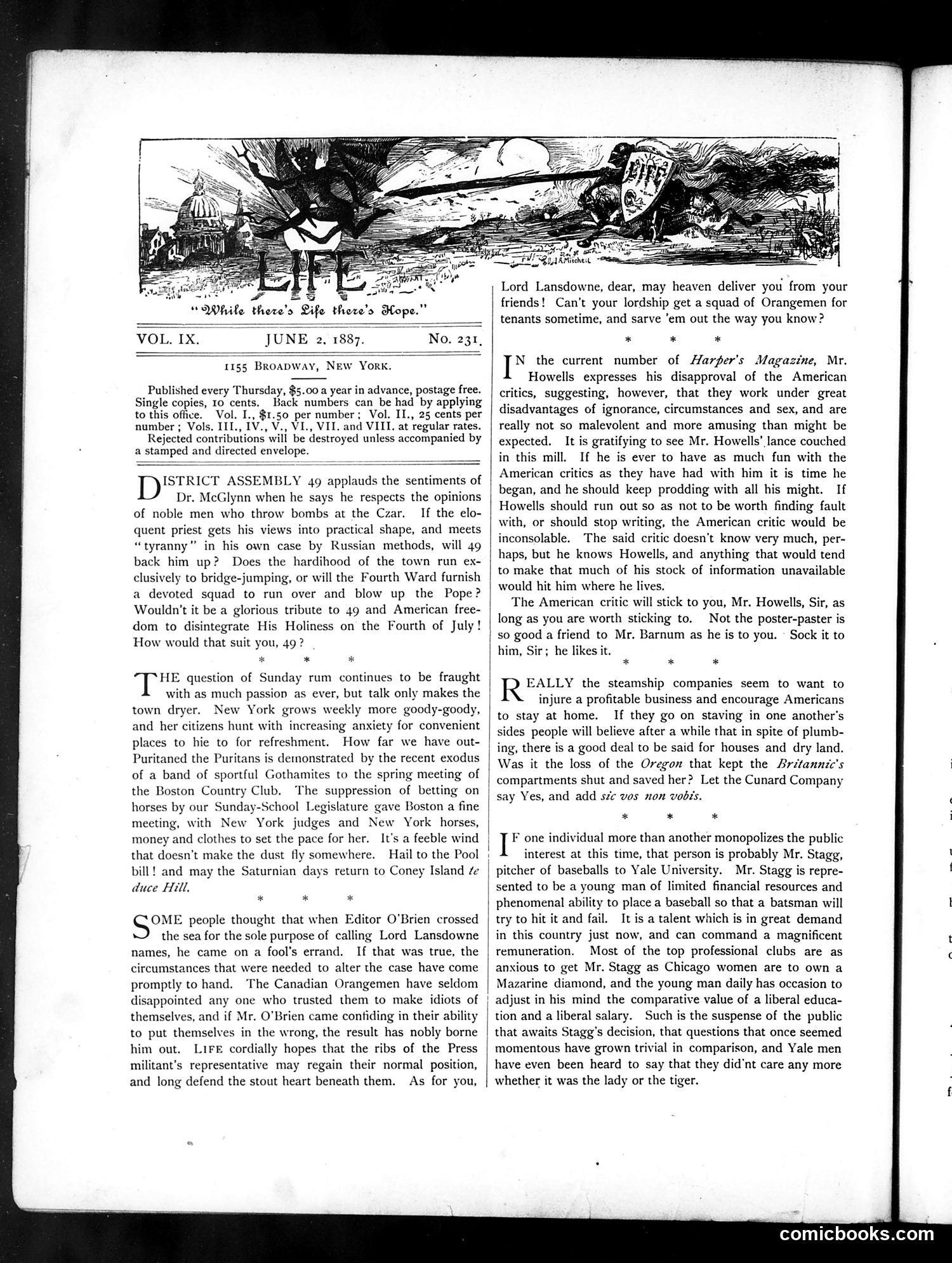
The masthead cartoon "While there's Life there's Hope" depicts a figure wielding a large club or bat against what appears to be a dragon or monster, with a cityscape and moon in the background. This likely represents Life magazine's satirical mission to combat social evils through humor and criticism. The text discusses various topics including criticism of American literary critics, the suppression of Sunday horse racing in New York (a Puritan moral issue), and editorial commentary on Lord Lansdowne's Irish tenant policies. A notable item concerns Mr. Stagg, a baseball pitcher at Yale University, whom the magazine suggests should be hired by a professional club—commentary on the emerging commercialization of college athletics and the growing professional sports industry of the 1880s.
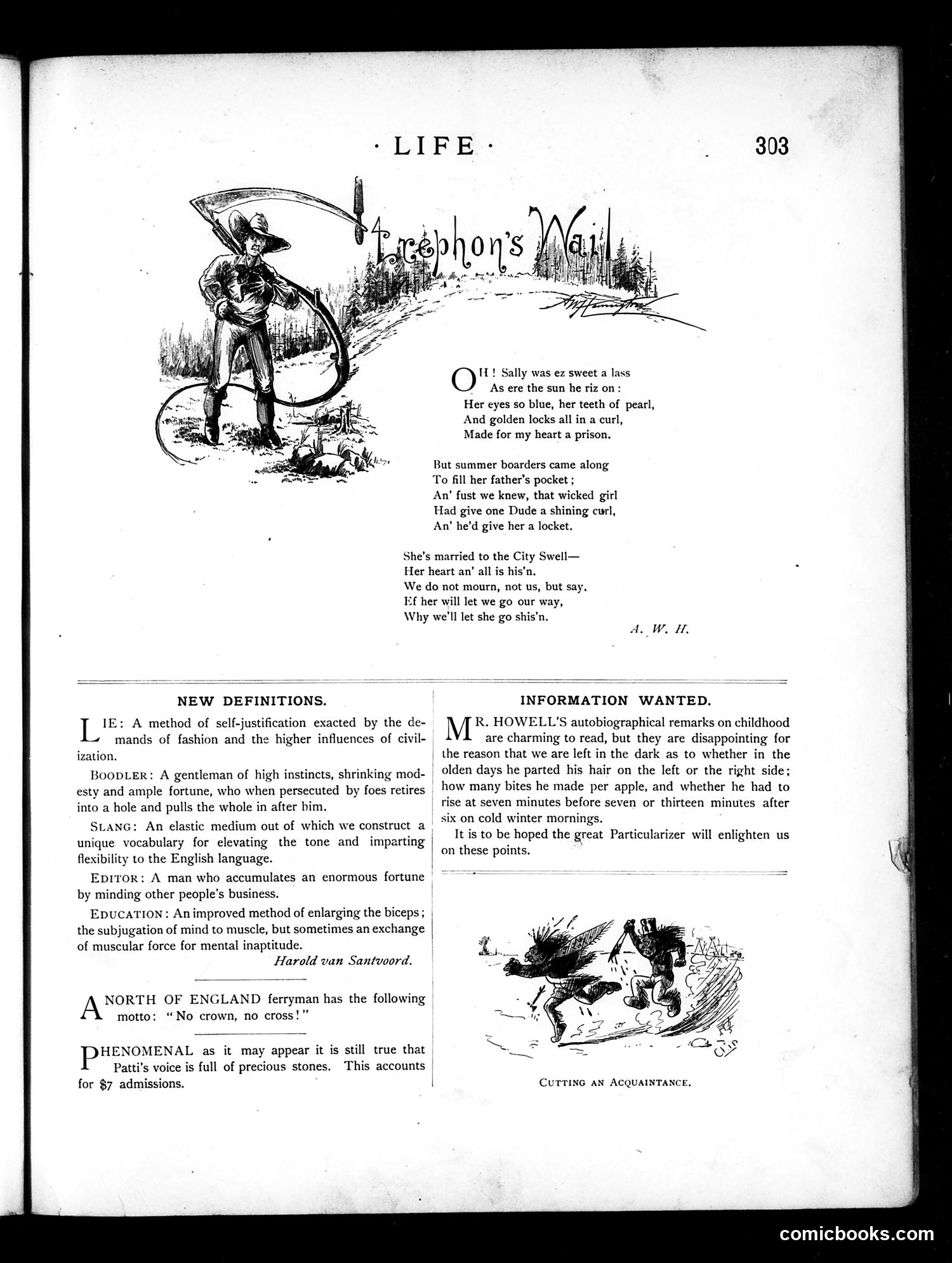
The page contains a poem titled "Traphon's Wail" illustrated with a figure holding a scythe in a rural landscape. The narrative describes a man lamenting that his sweetheart Sally married a wealthy "City Swell" instead of staying with him, a country laborer. The satire targets the social mobility and materialism of the era—the implication that rural working-class men lose romantic prospects to wealthier urban suitors. The Grim Reaper imagery (scythe) suggests Death itself as a metaphor for the man's romantic despair. Below the poem are humorous "New Definitions" mocking contemporary terms like "Lie," "Doodler," and "Slang," plus a separate joke about an Englishman's motto and Patti's expensive voice.
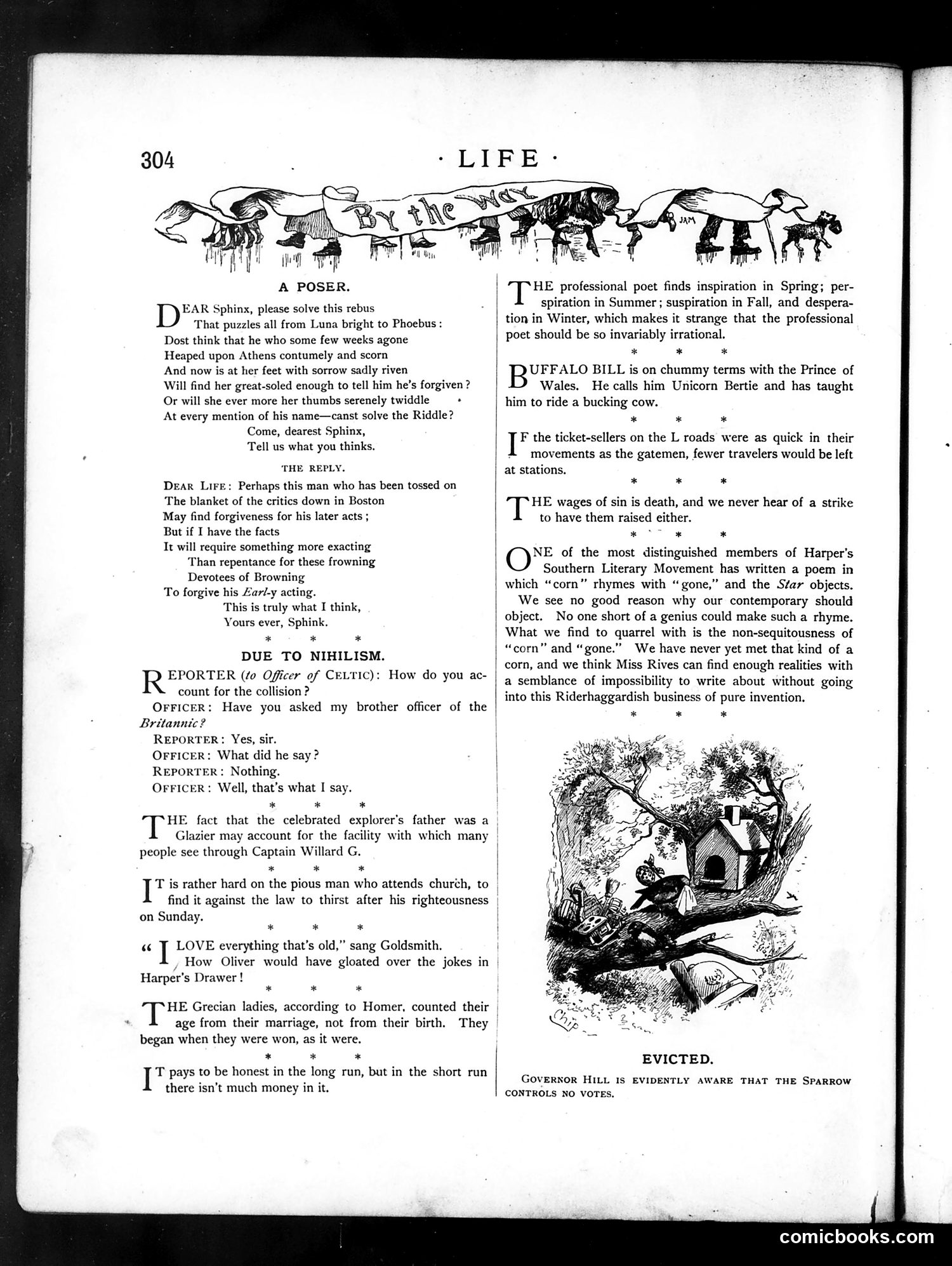
This page contains several brief satirical commentaries typical of Life's humor section: **"A Poser"** presents a mock-serious poem addressing the Sphinx, asking whether a certain woman will forgive past wrongs—treating an everyday romantic dilemma with grandiose classical references. **"Due to Nihilism"** depicts a dialogue where an officer questions a Celtic reporter about a collision, receiving only "nothing" as answers—satirizing either evasiveness or nihilist philosophy's perceived absurdity. **Other brief items** mock professional poets' predictability, Buffalo Bill's relationship with the Prince of Wales, slow railway ticket-sellers, and other contemporary social observations. **"Evicted"** features an illustration of birds being displaced from a tree, with a caption about Governor Hill and sparrows' voting rights—likely political commentary on electoral or governance issues of the era. The page exemplifies Life's signature style: sharp, topical satire mixing literary parody with social criticism.
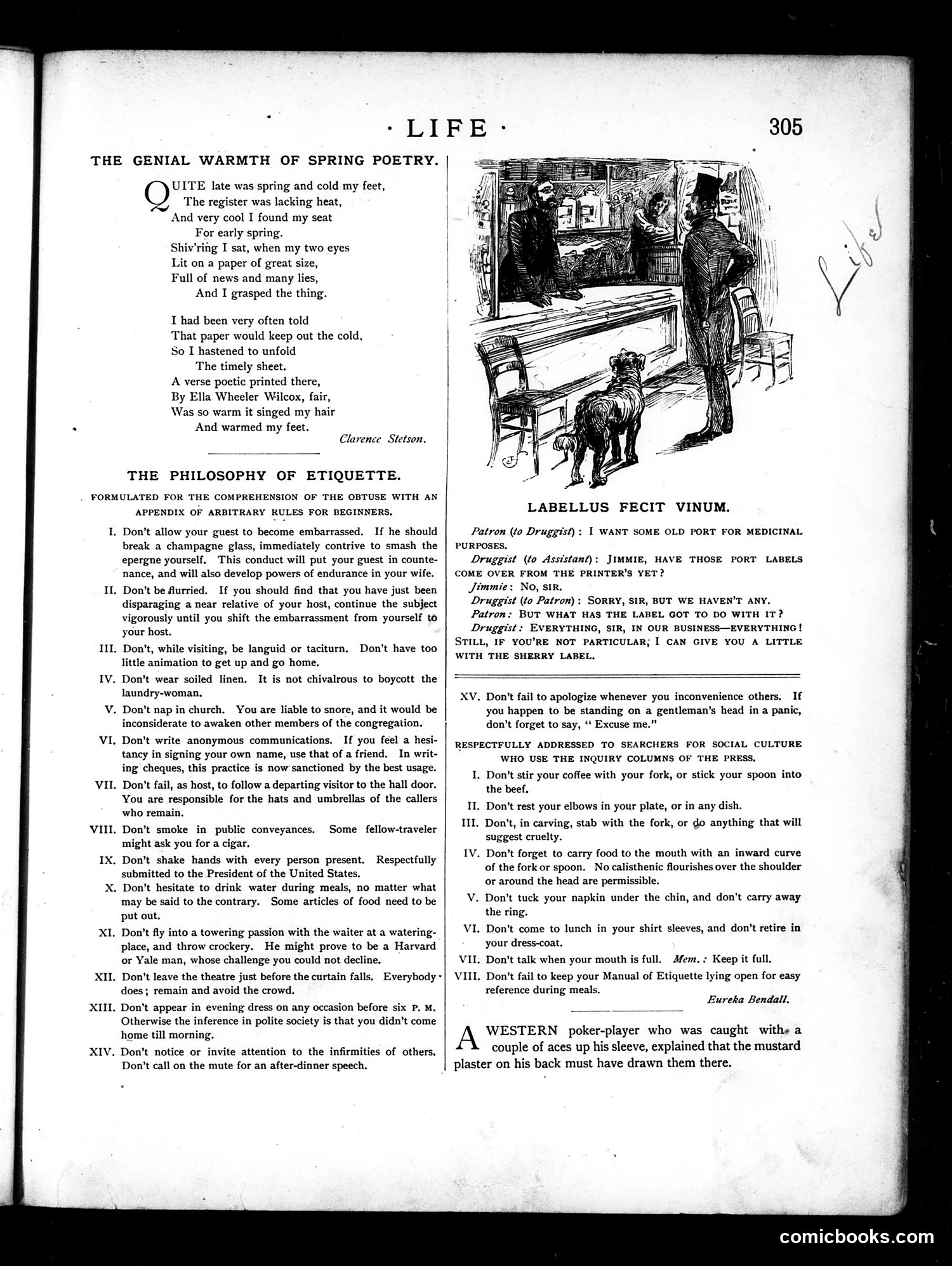
The main illustration depicts a scene in what appears to be a shop or business establishment. A customer (likely a woman, based on the era's clothing) stands at a counter with a dog, while shopkeepers or clerks stand behind it. The accompanying dialogue—"LABELLUS FECIT VINUM" (Latin: "The label made the wine")—suggests satire about commerce and deception. The joke appears to critique how product labels or branding can oversell inferior goods. The customer seems to be complaining about wine quality, with clerks offering alternatives like "sherry" instead of the requested "port." The satire mocks how merchants rely on attractive labeling and marketing rather than actual product quality to make sales—a commentary on consumer fraud and commercial dishonesty common in the period.
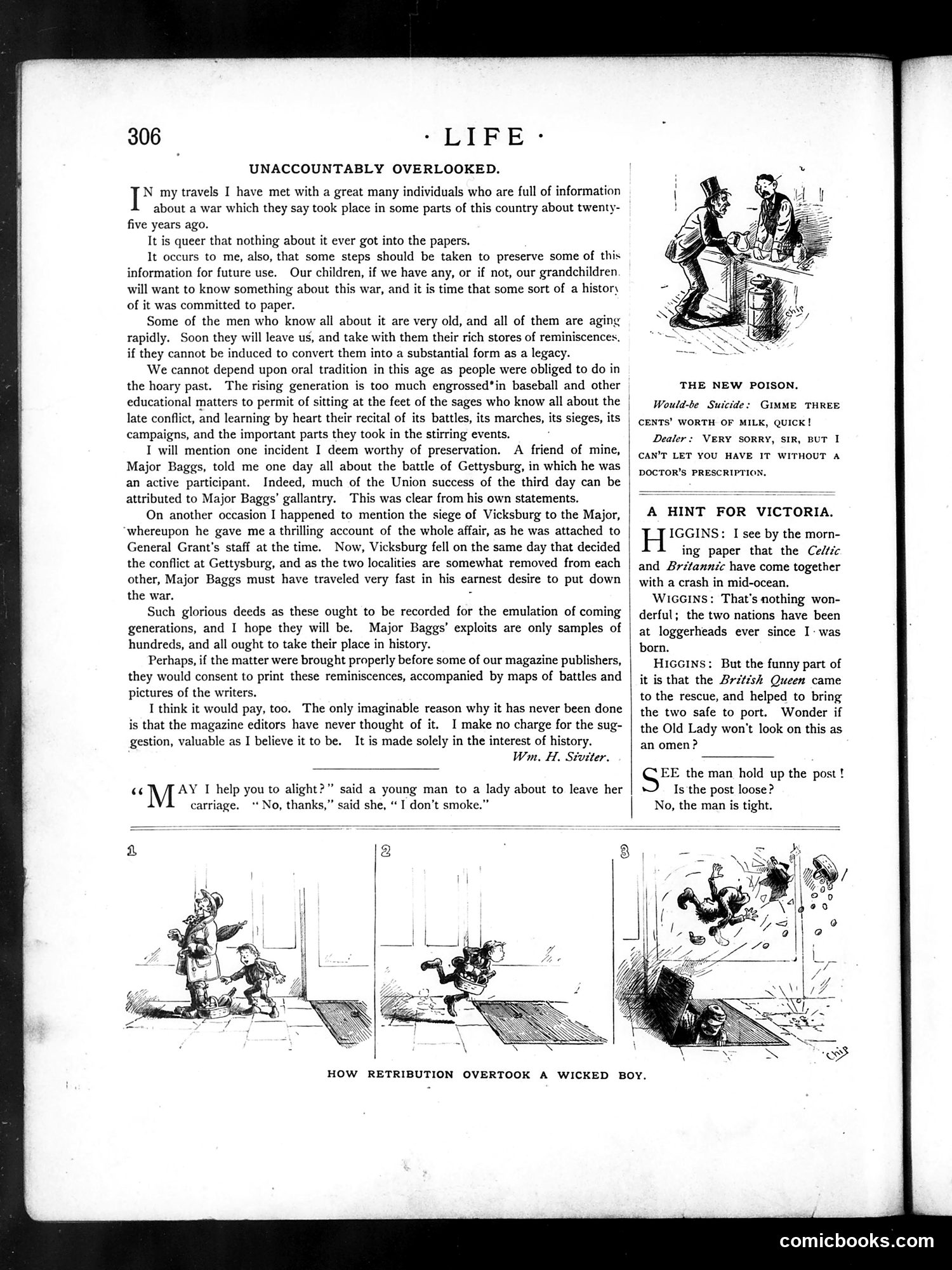
This page contains three distinct pieces: 1. **"Unaccountably Overlooked"** — An essay by Wm. H. Stotler advocating that Civil War incidents (particularly those involving Major Baggs at Gettysburg and the siege of Vicksburg) be recorded for historical preservation and future generations. 2. **"The New Poison"** — A brief satirical dialogue mocking a patent medicine advertisement claiming milk-based remedies require a doctor's prescription. 3. **"A Hint for Victoria"** — A dialogue between Higgins and Wiggins joking that the British Queen and Britannia should together rescue a ship, with ironic commentary on British naval power. 4. **"How Retribution Overtook a Wicked Boy"** — A three-panel comic strip showing slapstick consequences befalling a mischievous child. The page primarily showcases period humor and historical reflection rather than explicit political satire.
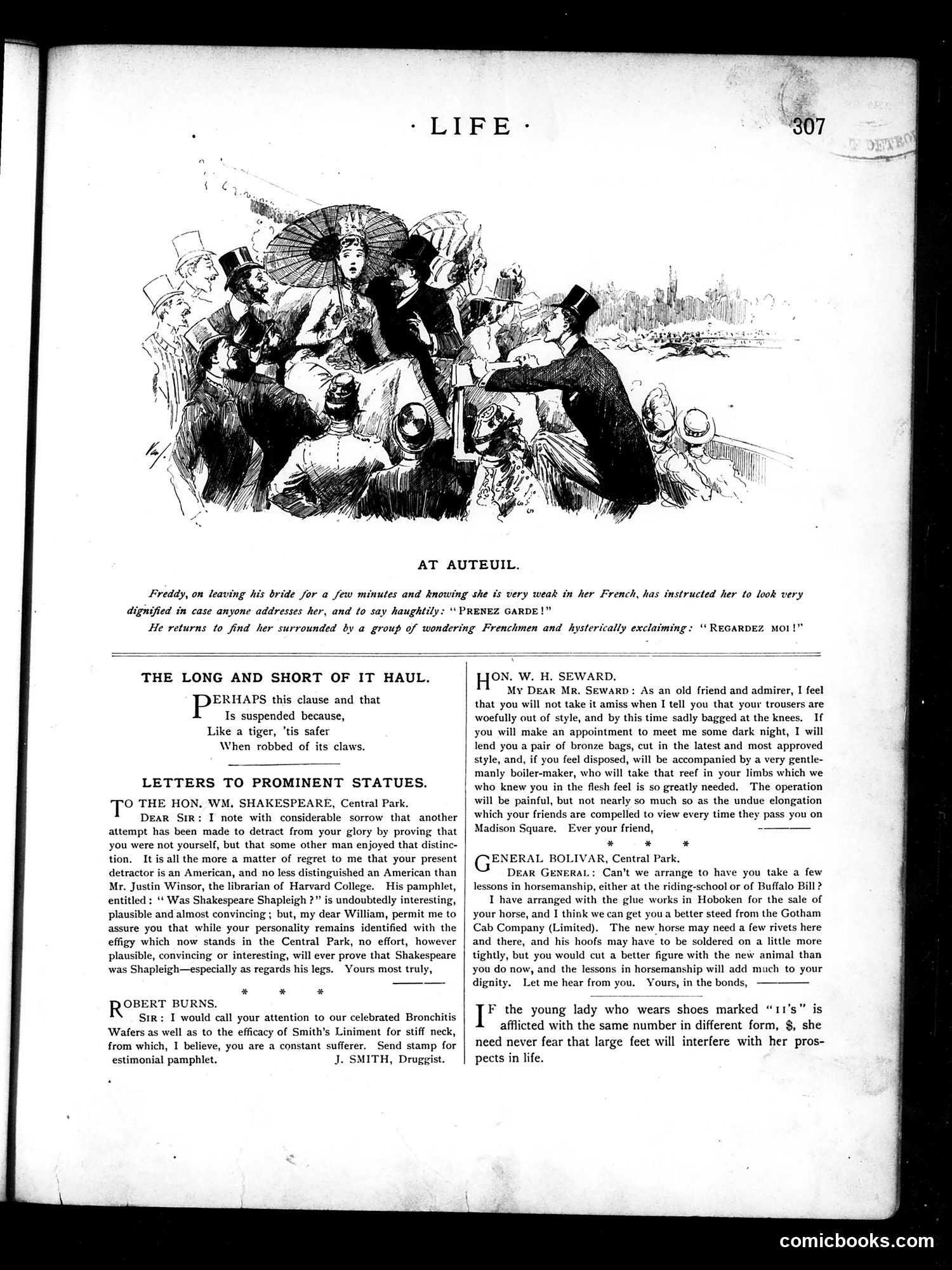
The cartoon depicts a social scene at Auteuil, a fashionable Paris racecourse, showing well-dressed spectators in Victorian-era clothing. The caption indicates the humor centers on a newly married man (Freddy) who has instructed his bride to appear dignified in French society. However, he returns to find her surrounded by Frenchmen exclaiming "Regardez moi!" (Look at me!), suggesting she has abandoned his instructions for propriety and is instead attracting admiring male attention. The satire targets the contrast between Anglo-American social restraint and French flirtatiousness. The joke plays on cultural stereotypes about French romantic behavior versus stuffy British/American marital expectations, presenting the bride's social success as a humorous violation of her husband's conservative wishes.
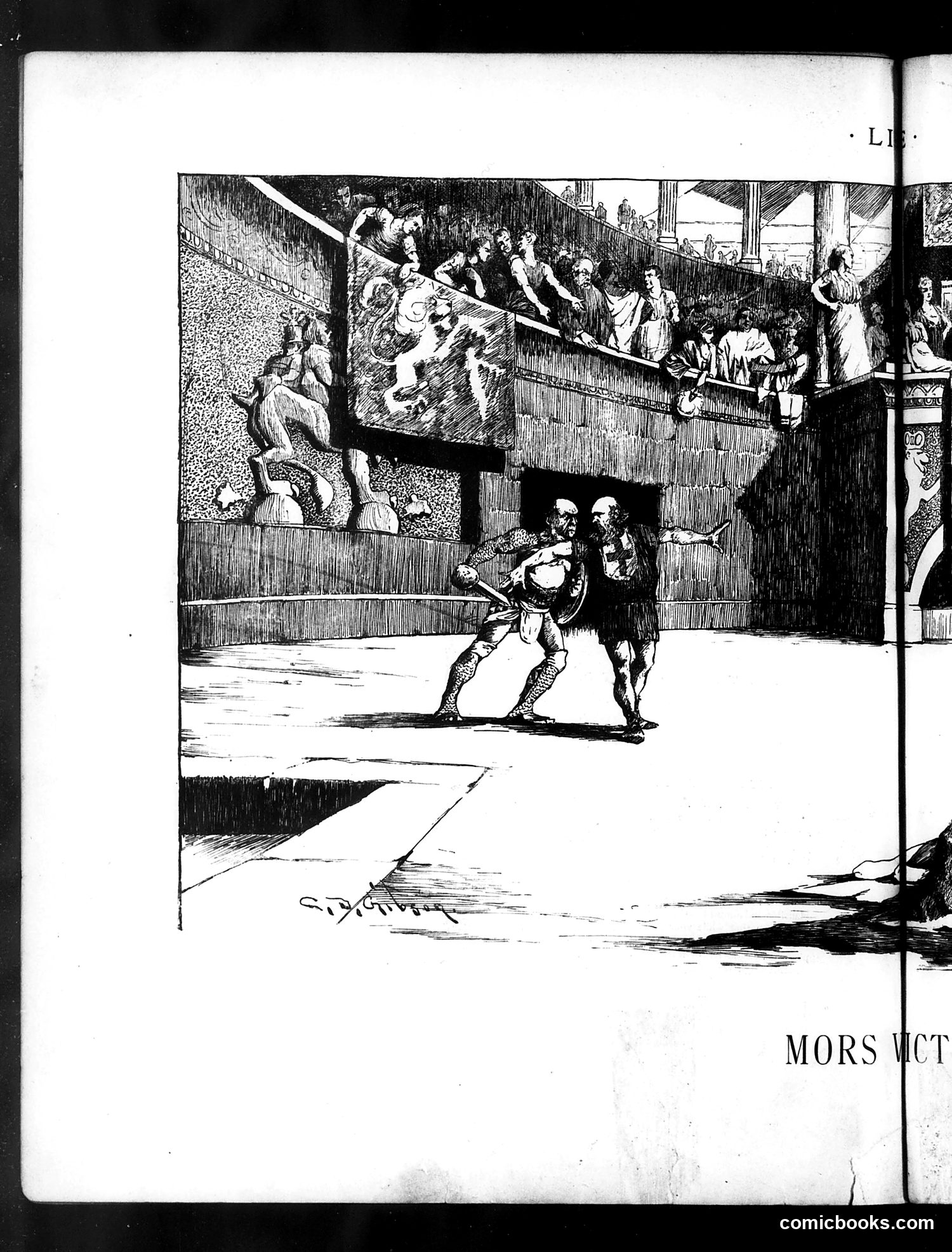
This engraving depicts a Roman gladiatorial scene: armored combatants fight in an arena while crowds watch from tiered seating above. The Latin caption "MORS VICT" suggests death as the victor. The satire likely uses classical Rome as a metaphor for contemporary society—a common 19th-century rhetorical device. By depicting gladiatorial combat, the artist appears to be critiquing either: - The brutality of social competition or industrial labor - Public spectacle and entertainment derived from human suffering - The degradation of human dignity for profit or amusement Without additional context about *Life* magazine's publication date or other articles on this page, the specific political target remains unclear, though the invocation of Roman decadence suggests criticism of modern civilization's moral decline.
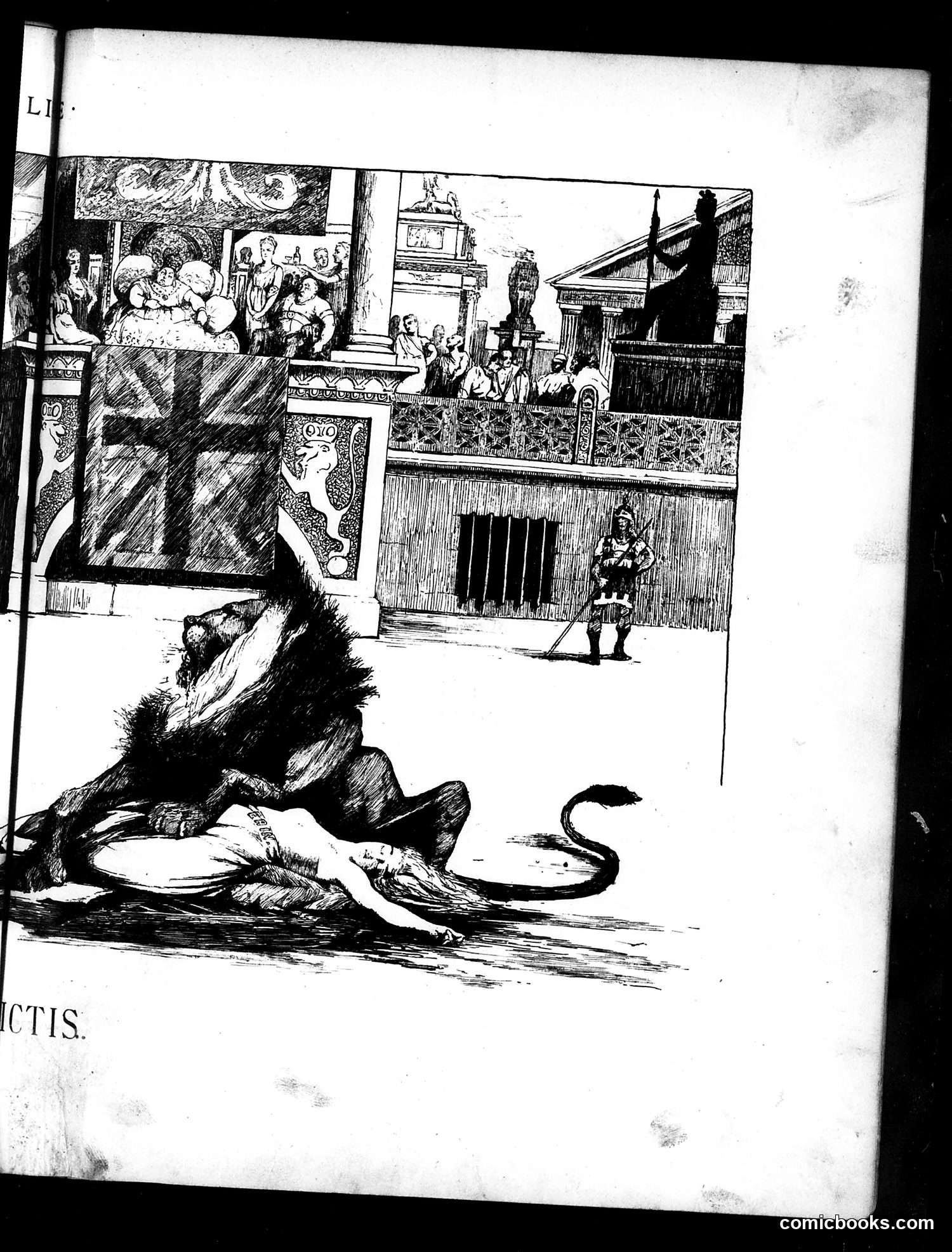
This engraving depicts a dramatic arena scene, likely Roman gladiatorial combat. A fallen gladiator or beast-fighter lies mortally wounded in the foreground, with what appears to be a large cat (lion or similar beast) nearby. A helmeted figure stands ready in the arena while spectators watch from tiered seating above, including what seems to be nobility or officials in decorated boxes. The partial text "ICTIS" (likely "RICTIS" or similar) appears at bottom. This appears to be historical illustration rather than political satire—documenting ancient Roman spectacles. Without visible byline or full caption, the precise satirical intent remains unclear, though Life magazine often used historical scenes to comment on contemporary society and violence.
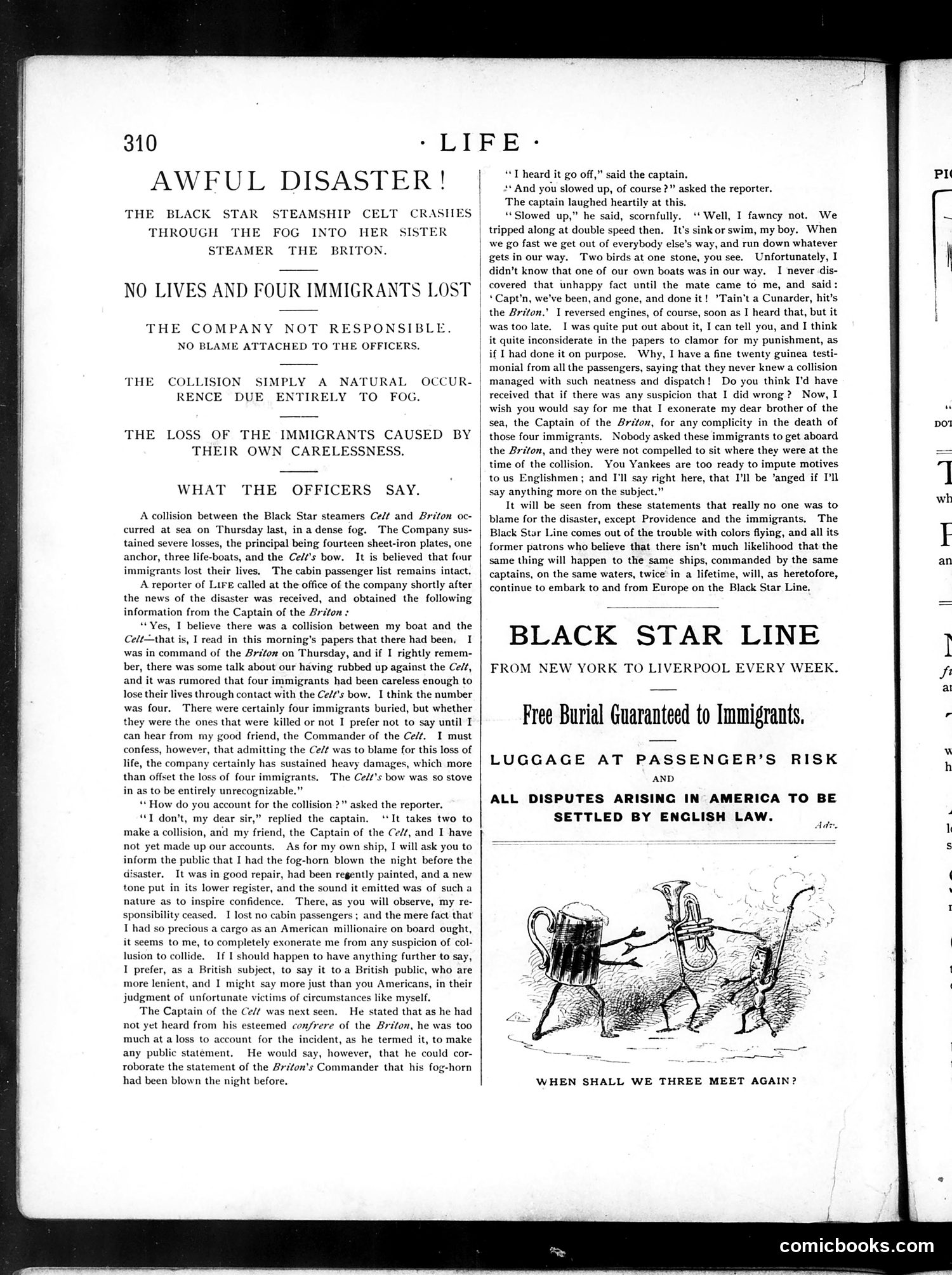
This page reports a maritime disaster where the Black Star steamship *Celt* collided with the *Briton* in fog, resulting in four immigrant deaths. The text consists primarily of official statements from ship captains and company representatives denying responsibility. The satirical point appears clear from the headlines' progression: "No Lives and Four Immigrants Lost," "The Company Not Responsible," and "The Loss of the Immigrants Caused by Their Own Carelessness." Life's satire targets how corporations and officials systematically deflect blame onto victims—here, portraying poor immigrants as responsible for their own deaths through "carelessness," while exonerating the shipping company and captains. The small cartoon below (titled "When Shall We Three Meet Again?") appears to mock this evasion of accountability.
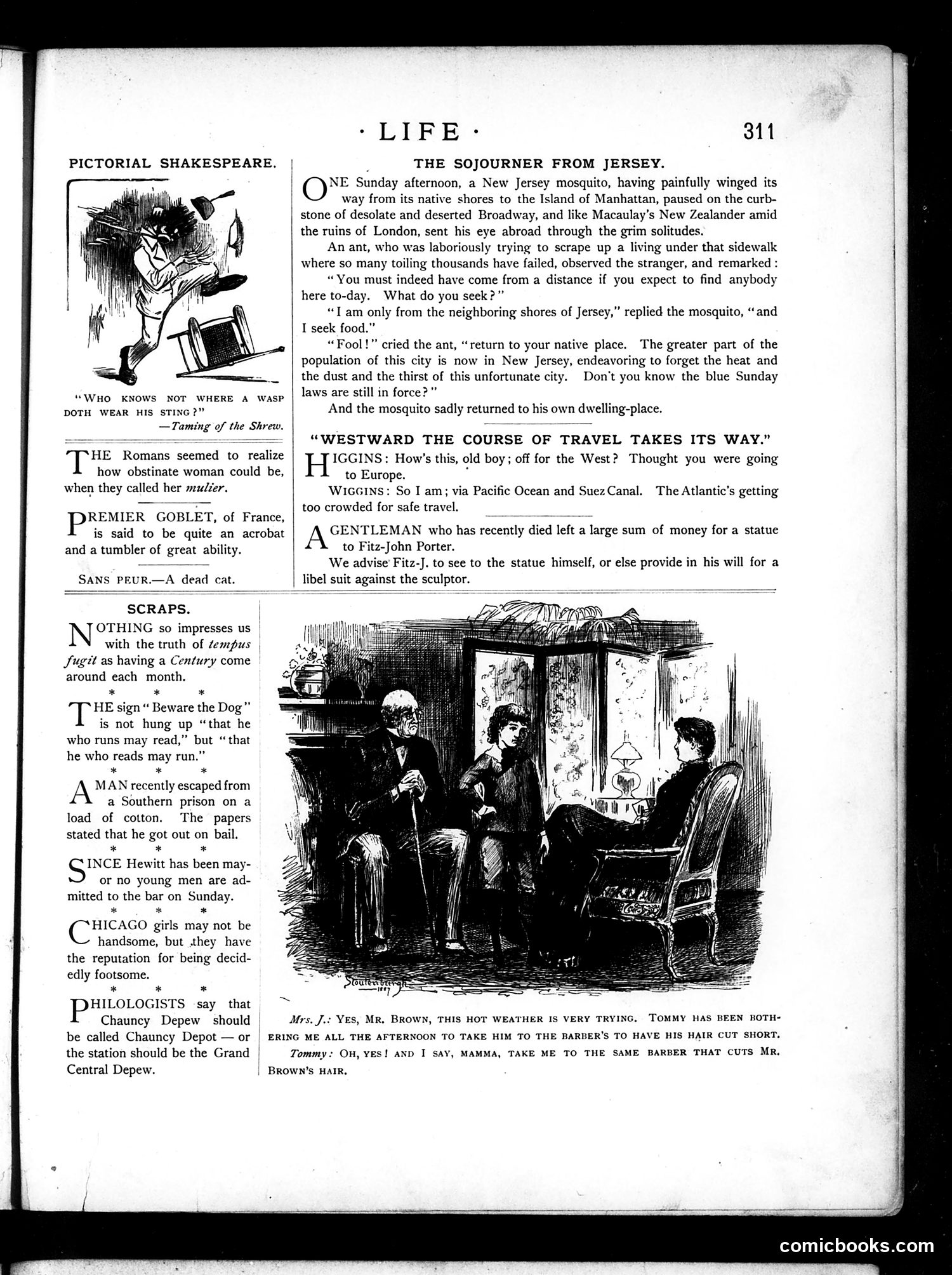
This page collects brief satirical items typical of Life's format. The main story, "The Sojourner from Jersey," uses a mosquito and ant as characters to mock New York City's summer exodus and blue laws (Sunday restrictions). The joke: even a pest finds no sustenance in Manhattan when residents flee to New Jersey. The "Scraps" section contains wordplay and topical jabs: a pun on "tempus fugit"; mockery of Chicago women as physically unattractive but athletic; and a joke about politician Chauncy Depew's name resembling "Depot." A cartoon illustration (lower right) shows a domestic scene where a boy Tommy requests his mother take him to "the same barber that cuts Mr. Brown's hair"—the humor lies in the child's innocence implying Mr. Brown's hair loss or thinness, an unstated insult delivered through a child's naive comment. The references assume readers' familiarity with contemporary figures (Depew) and local conditions (New York's summer climate, blue laws).
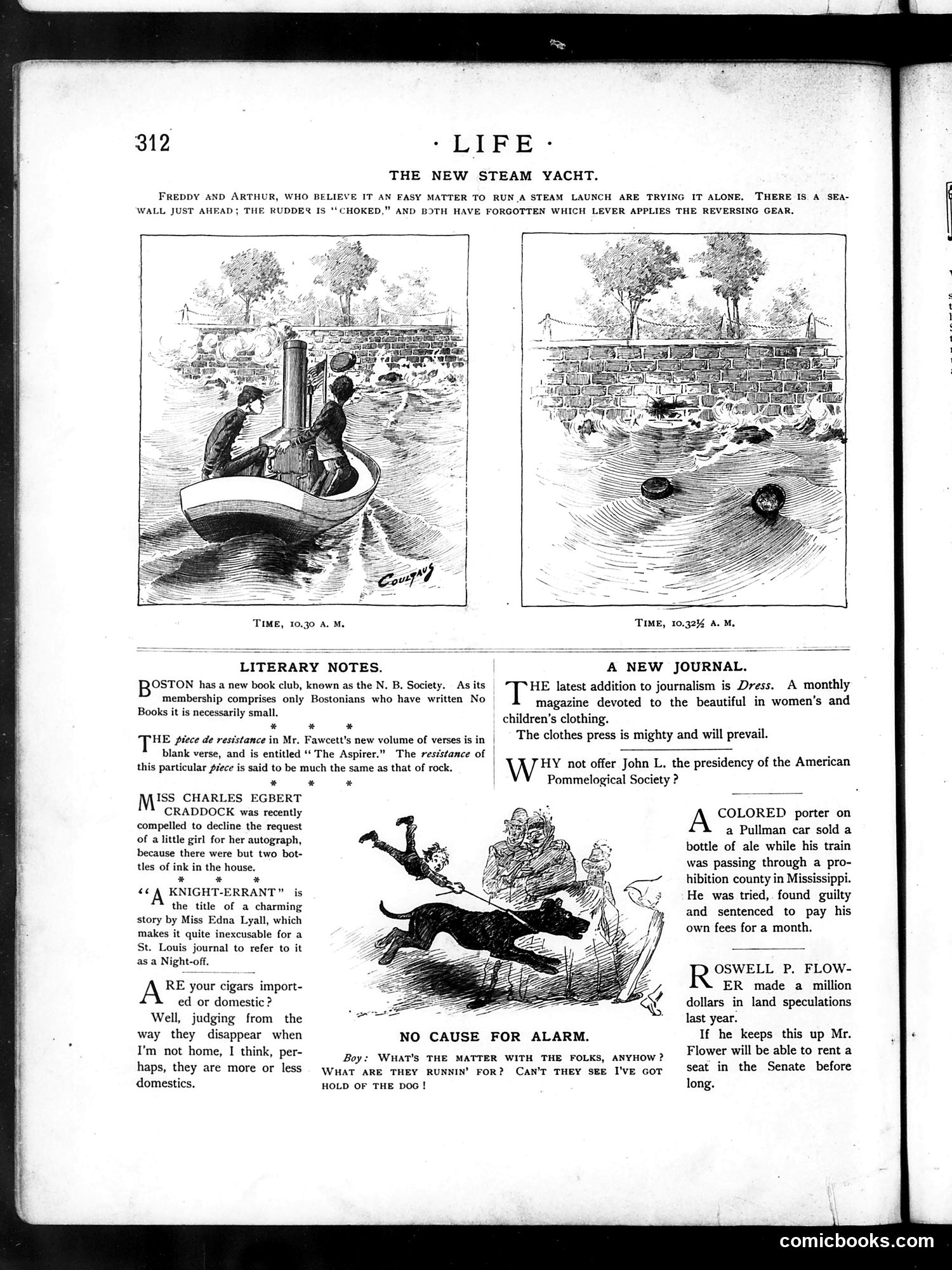
The top cartoon depicts two amateur boatmen (Freddy and Arthur) operating a steam launch they don't understand. They're heading toward a sea wall while the rudder is jammed and both have forgotten which control lever operates the reversing gear. The sequential panels (10:30 A.M. and 10:32½ A.M.) show their imminent disaster. **The satire**: This mocks overconfident amateurs attempting complex machinery beyond their competence—a common turn-of-the-century anxiety about new steam technology. The humor lies in their bumbling incompetence and the inevitable collision approaching. The lower cartoon shows a boy struggling with an uncontrolled dog while adults ignore his distress, with the caption suggesting the dog won't "let go." This appears to be a separate, unrelated visual joke about loss of control. The page also includes literary notes mocking Boston's exclusive book club and various publishing industry quips—typical *Life* magazine content mixing visual and textual satire of contemporary culture.
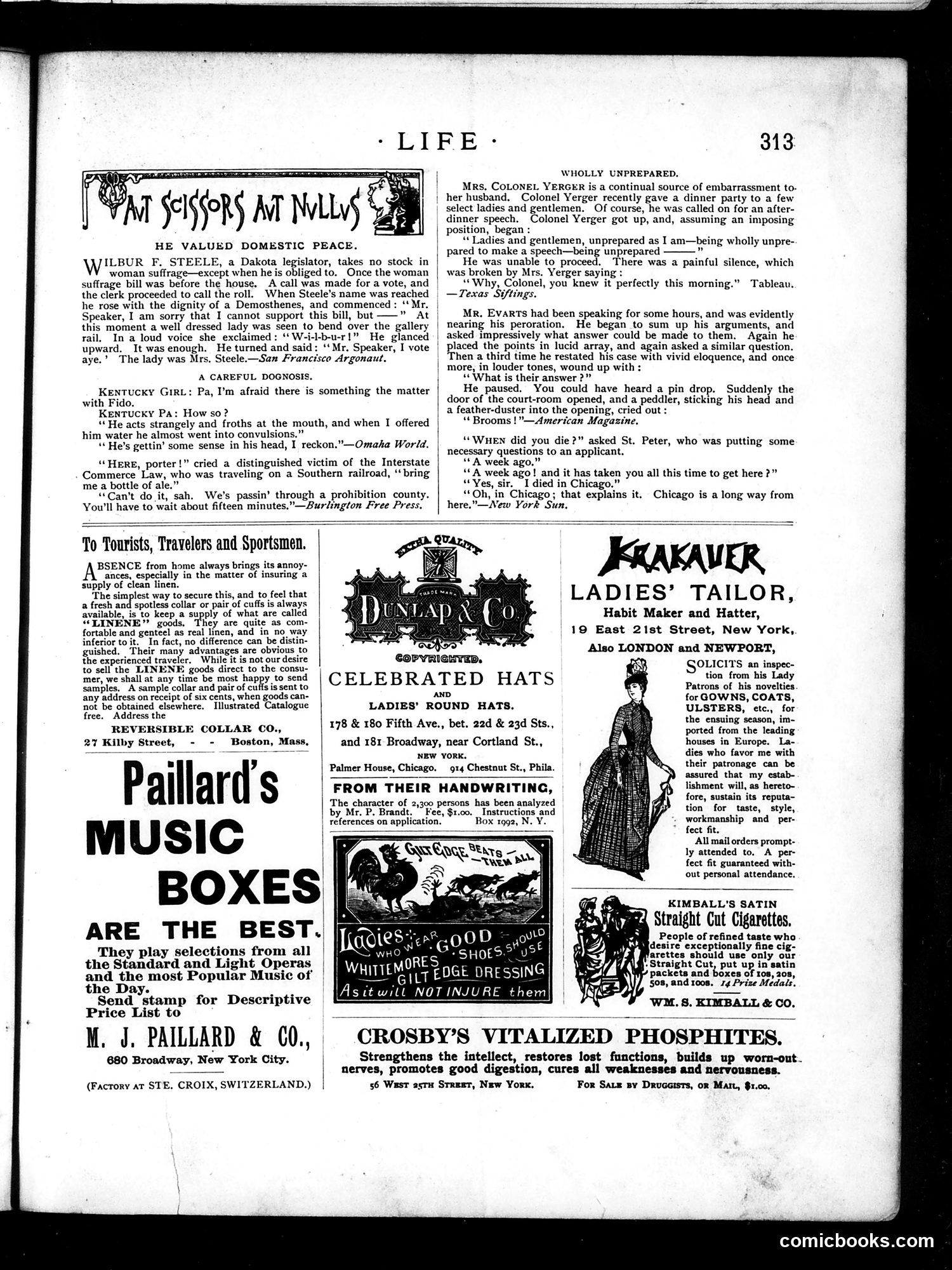
This page contains three brief humorous anecdotes satirizing human behavior and social conventions: 1. **"He Valued Domestic Peace"**: A Dakota legislator opposes women's suffrage until his wife openly calls from the gallery during a vote, shaming him into reversing his position. The satire targets male politicians' inconsistency and their susceptibility to public embarrassment from their wives. 2. **"Wholly Unprepared"**: Colonel Yerger repeatedly claims he's "unprepared" to give an after-dinner speech, only to be interrupted by his wife pointing out he knew this morning he'd have to speak. The joke mocks men who feign spontaneity and false modesty. 3. **Minor anecdotes**: Include a dog displaying common sense, a railroad traveler thwarted by Prohibition, a lawyer repeatedly asking rhetorical questions interrupted by a broom peddler, and a newcomer to the afterlife delayed by Chicago's distance. The recurring theme: **wives outwitting or exposing their husbands' pretensions**—reflecting early 20th-century domestic comedy conventions where women's practical intelligence triumphed over male pomposity.
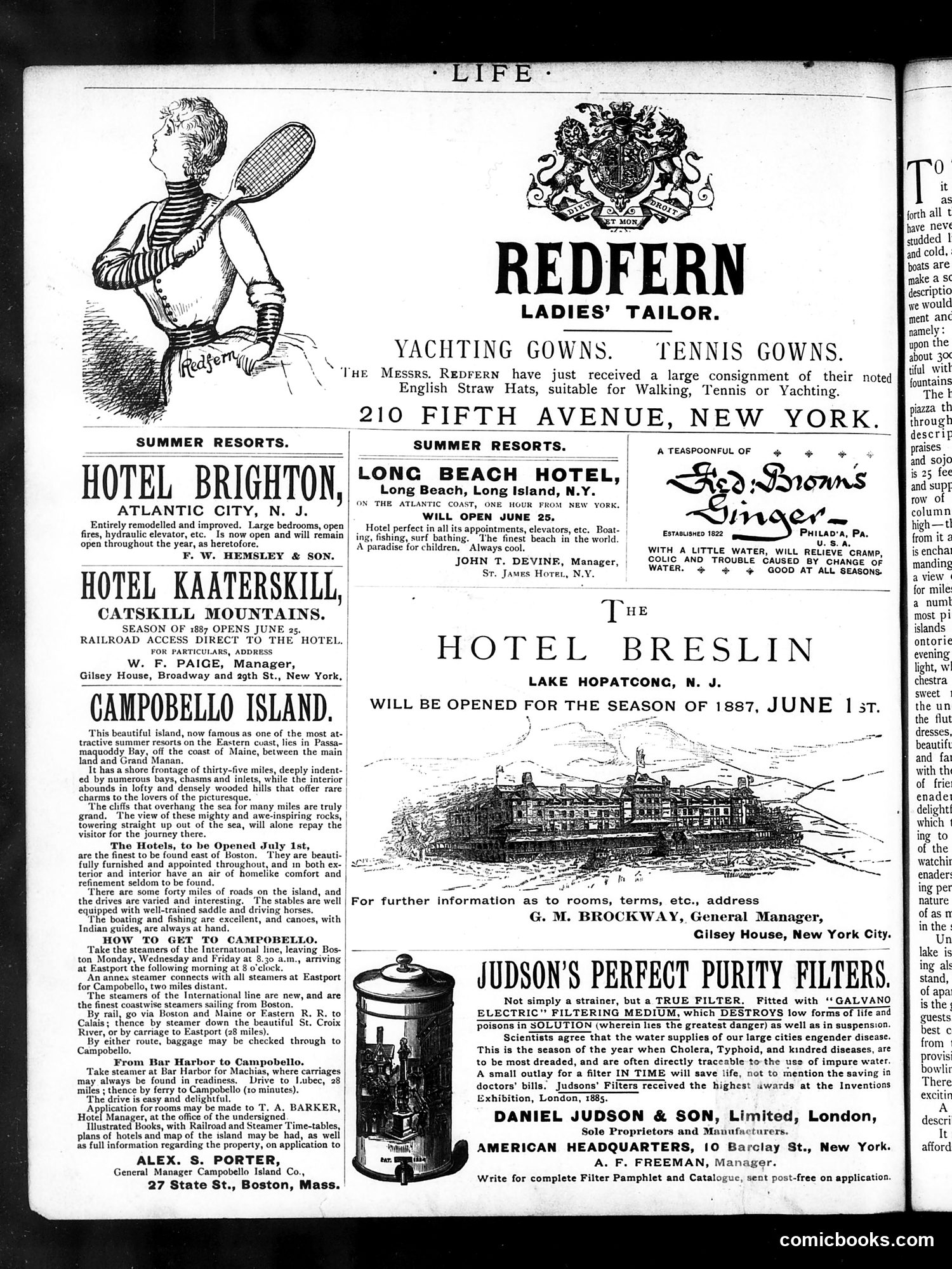
This page is **primarily advertising**, not political satire. The dominant content consists of summer resort hotel advertisements (Hotel Brighton, Long Beach Hotel, Hotel Kaaterskill, Campobello Island, Hotel Breslin) typical of late 19th-century leisure travel promotion. The only illustration with potential satirical intent appears in the upper left: a sketch of a fashionable woman holding a tennis racket, labeled "SUMMER RESORTS." This appears to mock the leisured upper-class lifestyle—depicting the idealized "New Woman" of the 1880s engaged in fashionable athletic pursuits like tennis and yachting. The exaggerated pose and styling suggest gentle satire of contemporary leisure culture and feminine fashion. The remainder includes a Redfern Ladies' Tailor advertisement and Hudson's Perfect Purity Filters advertisement. This reflects *Life* magazine's dual function as both satirical publication and society/fashion periodical catering to affluent readers.
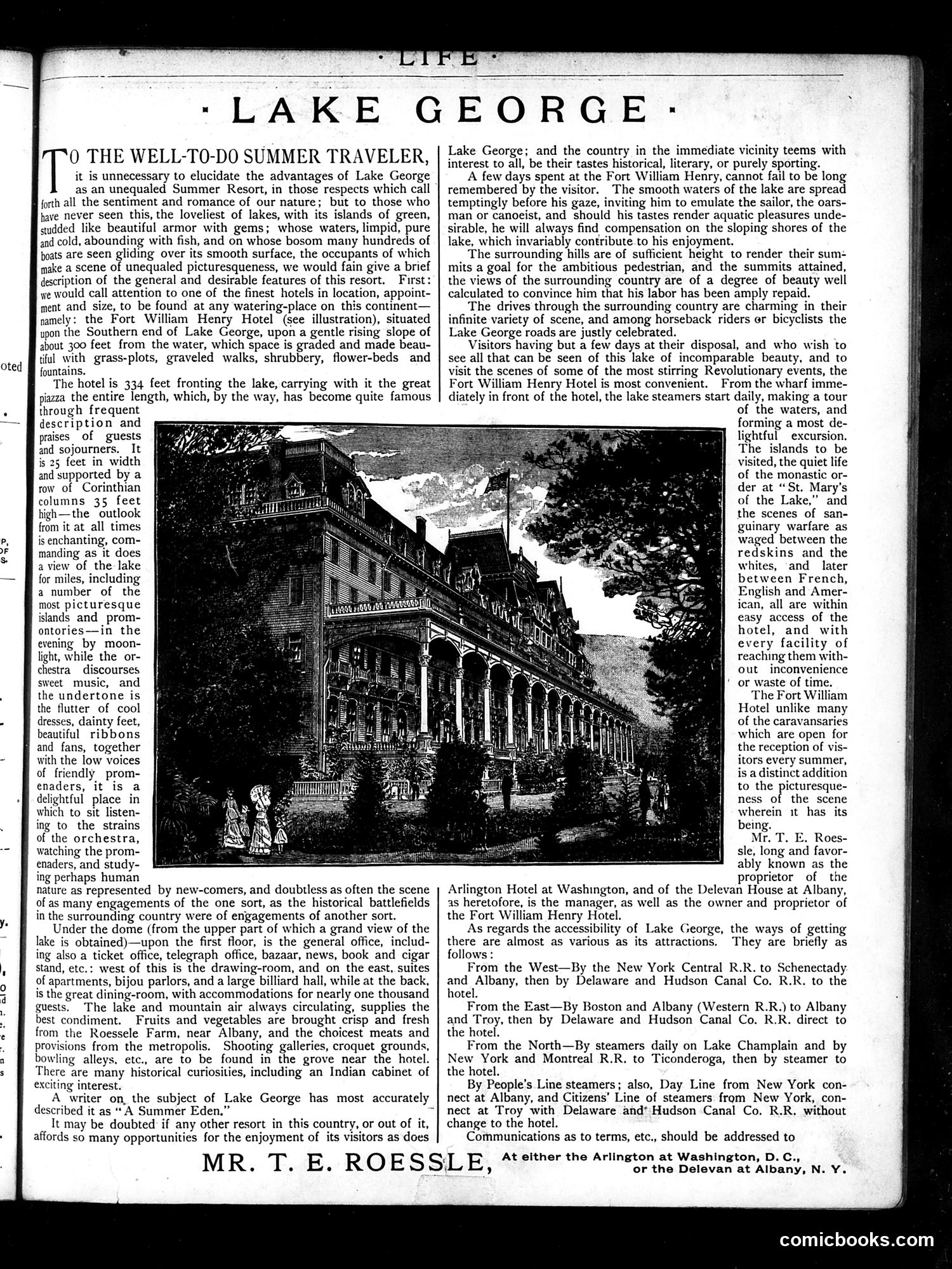
This page is primarily a **promotional advertisement** for the Fort William Henry Hotel at Lake George, New York, presented as travel journalism. There are no political cartoons or satire here. The text enthusiastically describes the resort's amenities for wealthy summer travelers: the grand 334-foot hotel with its famous piazza supported by Corinthian columns, views of picturesque islands, orchestral entertainment, dining facilities for 1,000 guests, and recreational activities (croquet, billiards, shooting galleries). The accompanying engraving shows the hotel's imposing riverside architecture. The piece concludes with contact information for **MR. T. E. ROESSLE**, the proprietor, directing inquiries to either Arlington Hotel in Washington, D.C. or the Delevan Hotel in Albany, N.Y. This is essentially a 19th-century advertorial targeting the leisure class, not satirical content.
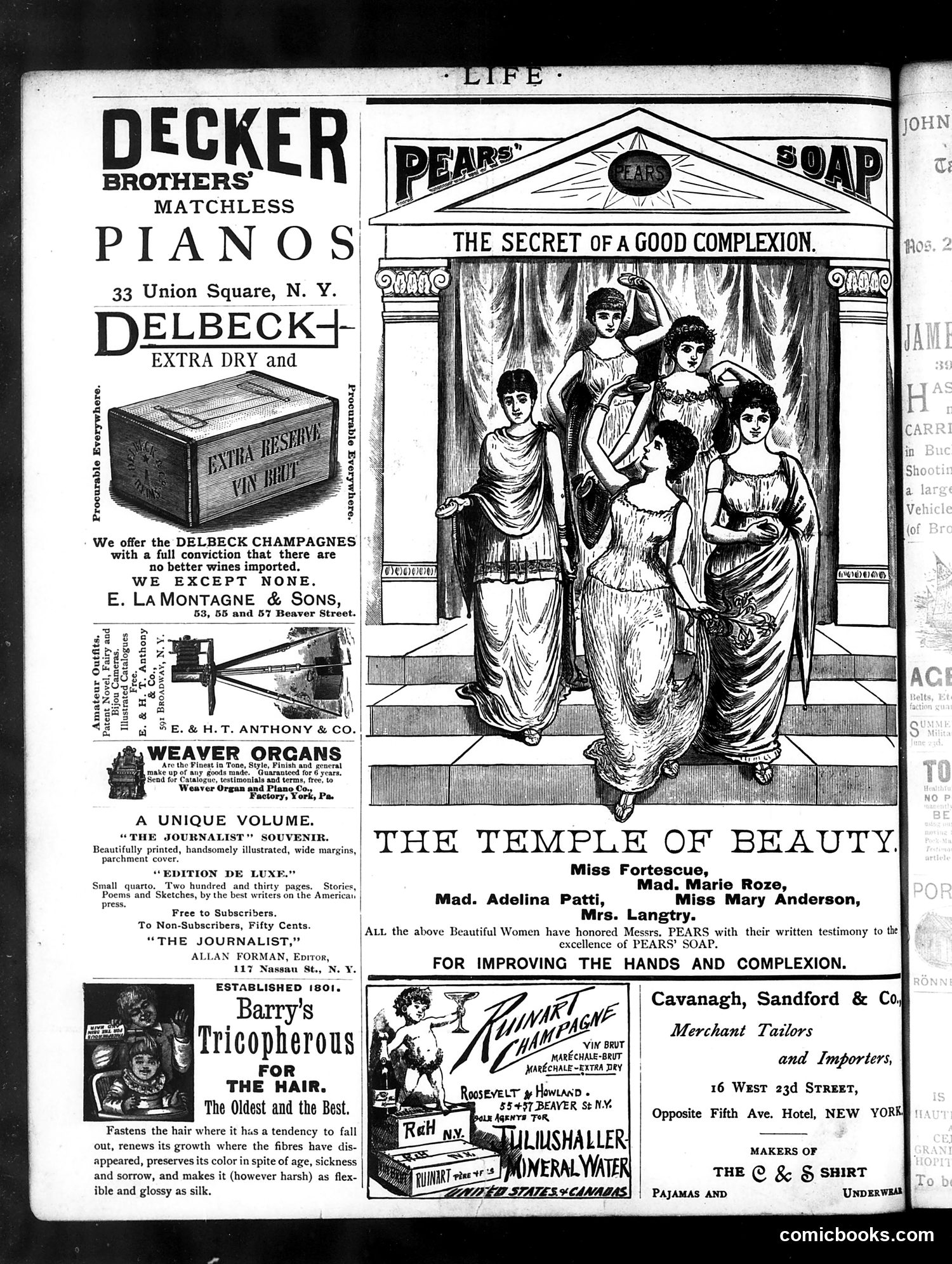
This page is primarily **advertising** rather than editorial content or satire. It features multiple product advertisements targeting late 19th-century consumers. The dominant image, "The Temple of Beauty," advertises **Pears' Soap** by featuring classical female figures and listing endorsements from famous actresses of the era (Adelina Patti, Lillie Langtry, Marie Roze, Mary Anderson). This appeals to aspirational consumerism—associating the product with beauty, refinement, and celebrity status. Other advertisements include Decker Brothers pianos, Delbeck champagne, Barry's Tricopherous hair product, Kunkel's champagne, and merchant tailoring services. The page reflects Gilded Age consumer culture, where quality goods and luxury items signaled social status. The "satire" in *Life* magazine typically appeared in editorial cartoons elsewhere in issues; this particular page focuses on selling products rather than political or social commentary.
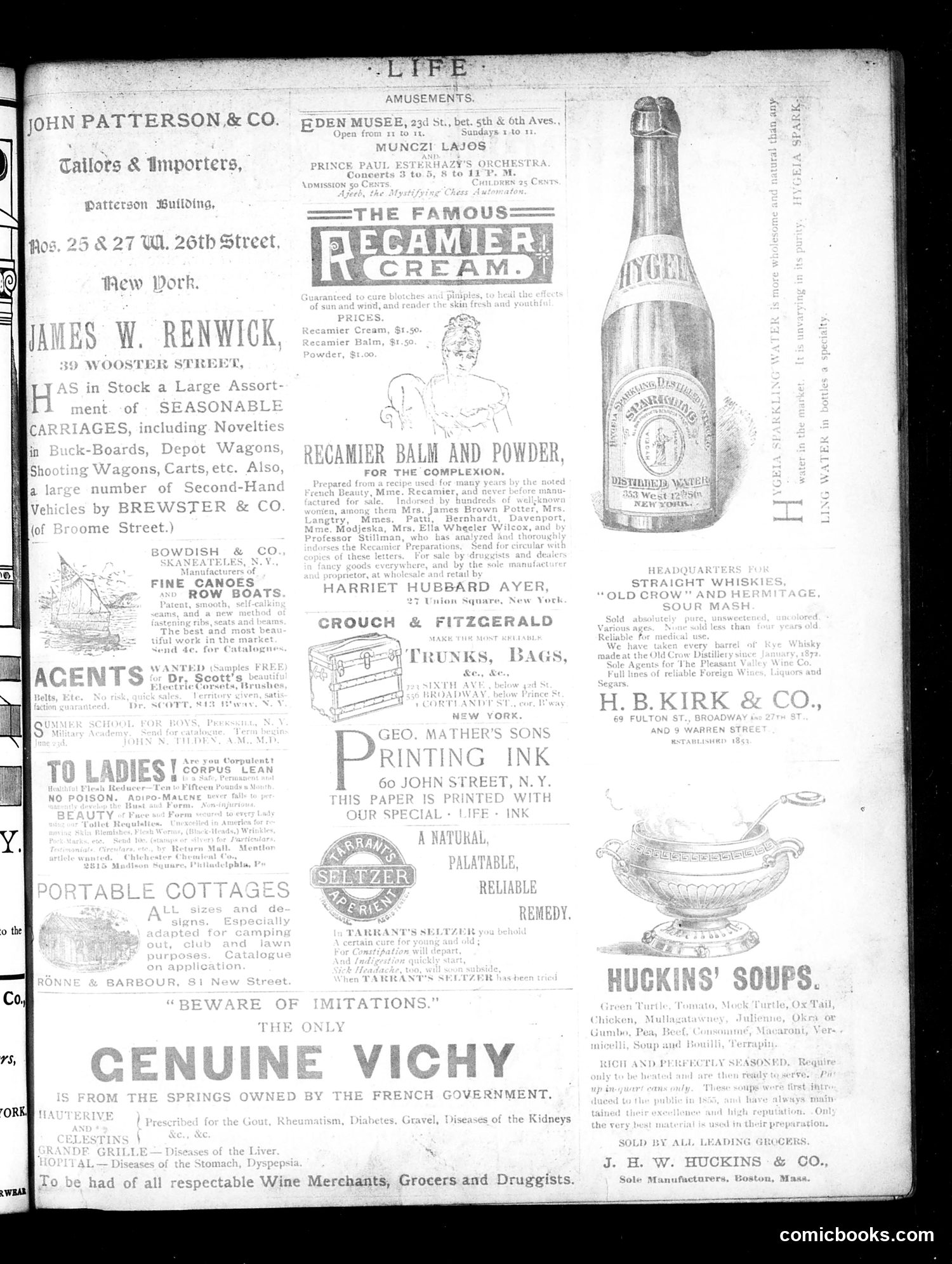
This page is **primarily advertising**, not satirical content. It contains multiple commercial advertisements from late 19th/early 20th-century New York businesses, including: - John Patterson & Co. (tailors/importers) - James W. Renwick (carriages and vehicles) - Bowdish & Co. (row boats) - Recamier Cream (cosmetic product) - Crouch & Fitzgerald (trunks and bags) - Geo. Mather's Sons (printing ink) - Tarrant's Seltzer (medicinal remedy) - Genuine Vichy water (health product) - Huckins' Soups (food product) - H.B. Kirk & Co. (whiskeys) There are **no political cartoons visible** on this page. The illustrations are product advertisements and decorative elements typical of period magazine advertising. This appears to be a standard advertising-heavy page from *Life* magazine's commercial section.
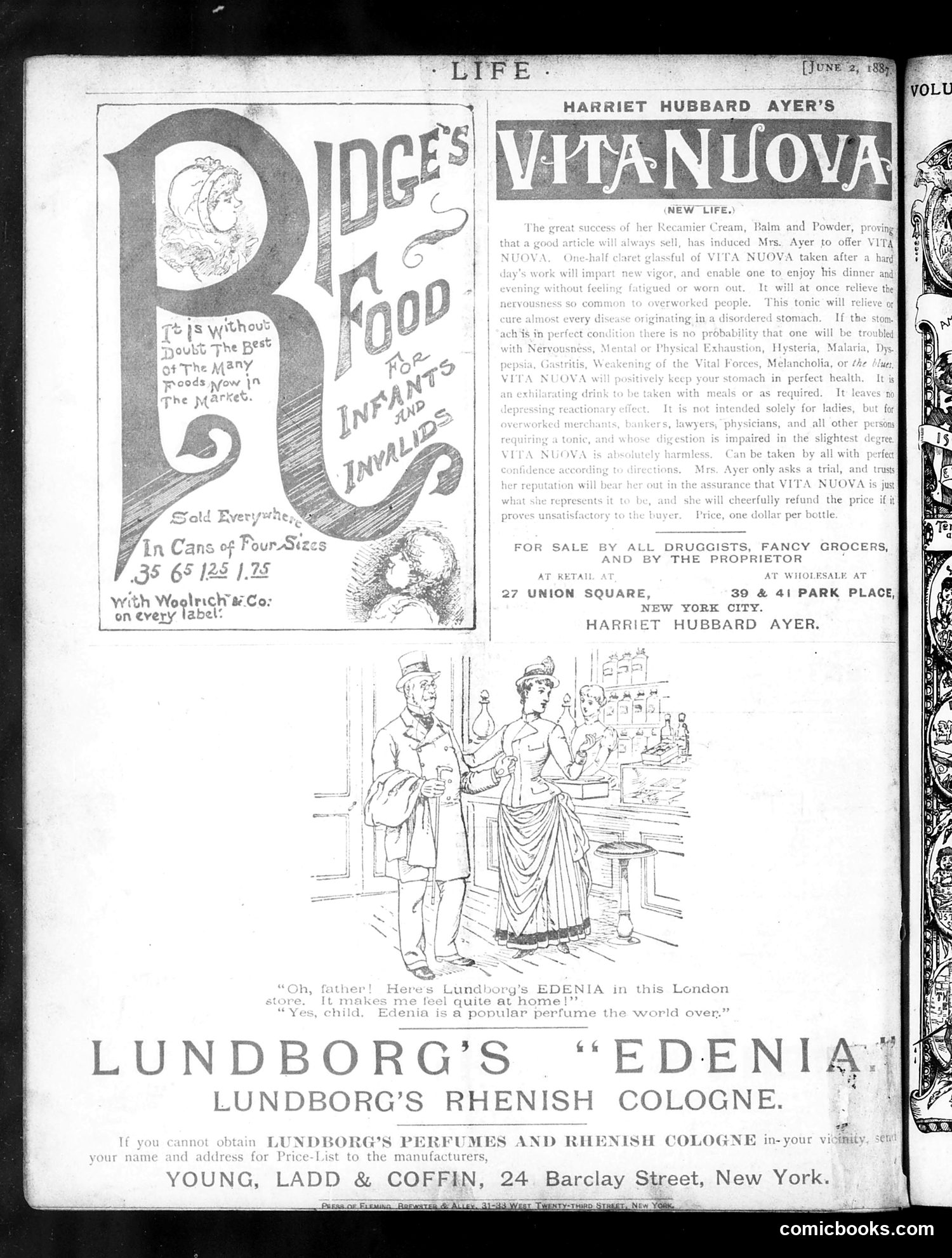
This page is primarily **advertising**, not satire or political commentary. It features three product advertisements: 1. **Pidge's Food** (left): A patent medicine ad claiming superiority for infants and invalids, sold in four sizes. The ornate Victorian design uses a profile illustration typical of health-product marketing of the era. 2. **Vita Nuova** (center-right): Harriet Hubbard Ayer's tonic claimed to cure nervousness, mental disorders, hysteria, malaria, and digestive issues—typical exaggerated health claims of 1880s tonics. It promises to restore vigor for "overworked merchants, bankers, lawyers, physicians." 3. **Lundborg's Edenia Cologne** (bottom): A perfume advertisement featuring a humorous domestic scene where a woman references the product's popularity. These represent the era's unregulated patent medicine market, where manufacturers made sweeping therapeutic claims without scientific evidence—a practice eventually curbed by the 1906 Pure Food and Drug Act.