
A complete issue · 16 pages · 1887
Life — April 21, 1887
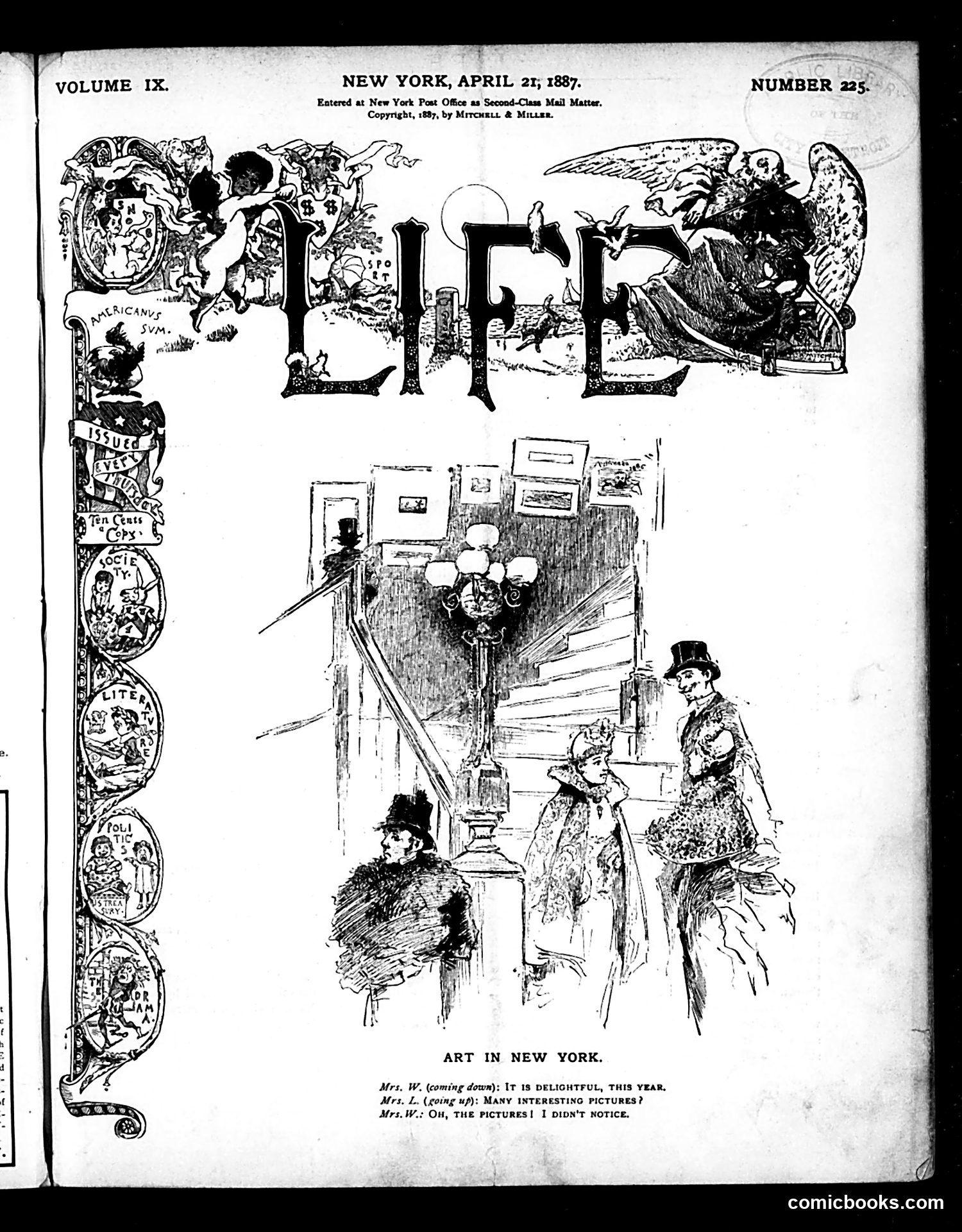
This cartoon satirizes the art exhibition scene in New York. The illustration shows three fashionable women visiting what appears to be an art gallery, examining paintings hung on walls with period lighting fixtures above. The dialogue captures contemporary attitudes toward art appreciation: Mrs. W (coming down) declares the exhibition "delightful, this year"; Mrs. L (going up) asks about "many interesting pictures"; Mrs. W responds dismissively: "Oh, the pictures! I didn't notice." The joke mocks society women who attend cultural events for social status rather than genuine interest in art. The satire suggests that fashionable gallery-goers are more concerned with being seen at prestigious venues than actually engaging with or appreciating the artwork on display—a timeless critique of performative culture.
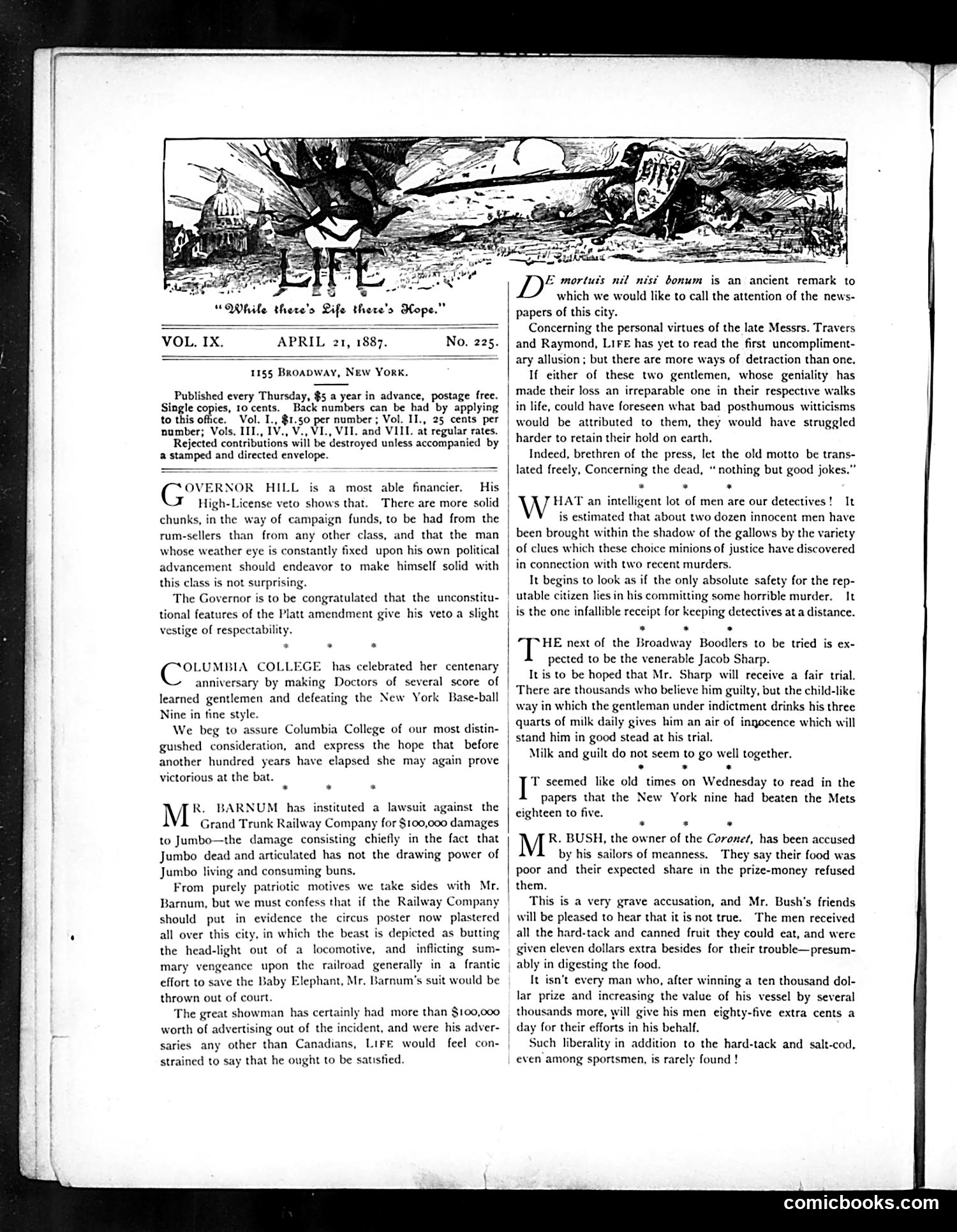
The masthead cartoon depicts a skeletal, demonic figure looming over a landscape with the motto "While there's Life there's Hope." This appears to be Life magazine's standard satirical banner rather than commentary on a specific event. The text discusses several contemporary issues: Governor Hill's financial management, Columbia College's centenary, a lawsuit against the Grand Trunk Railway over damages to "Jumbo" (likely P.T. Barnum's famous elephant), and accusations against Mr. Bush, owner of the yacht *Coronet*, regarding allegedly stingy provisions for his sailors after winning a prize. The satire targets wealthy industrialists and their treatment of workers/employees—mocking their miserliness despite newfound wealth. The magazine champions fair treatment and justice while poking fun at the wealthy's character.
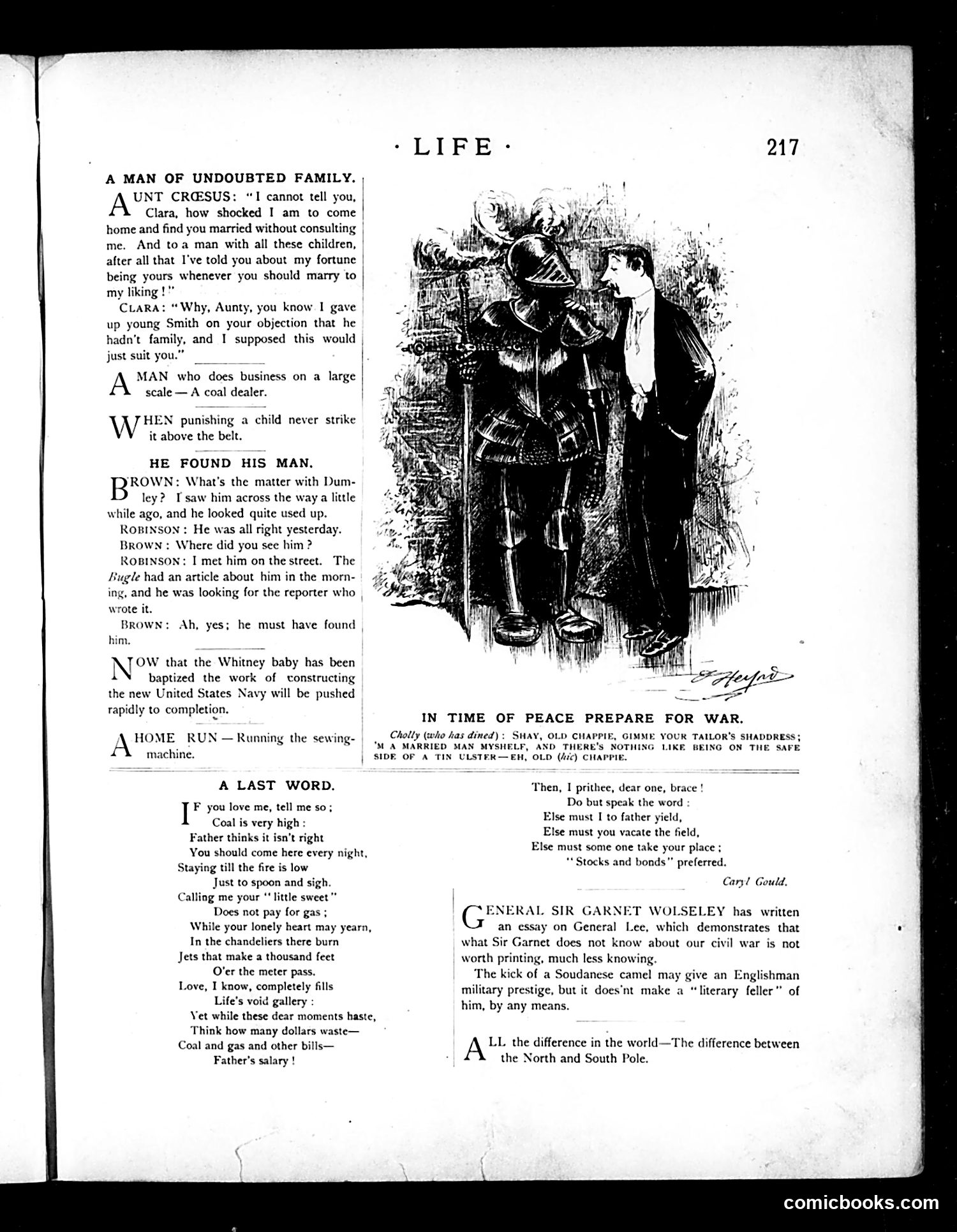
The main illustration depicts two figures in period dress examining or discussing something against a wall, with the caption "IN TIME OF PEACE PREPARE FOR WAR." This appears to reference military preparedness, likely relating to early 20th-century U.S. Navy expansion (the text mentions "Whitney baby has been baptized the work of constructing the new United States Navy"). The page contains various brief humor items ("A Man of Undoubted Family," "A Last Word") typical of Life's satirical format—short jokes about domestic life, business, and social customs. These are gentle observations on contemporary American society rather than pointed political commentary. The naval reference suggests the page dates to a period of active military modernization.
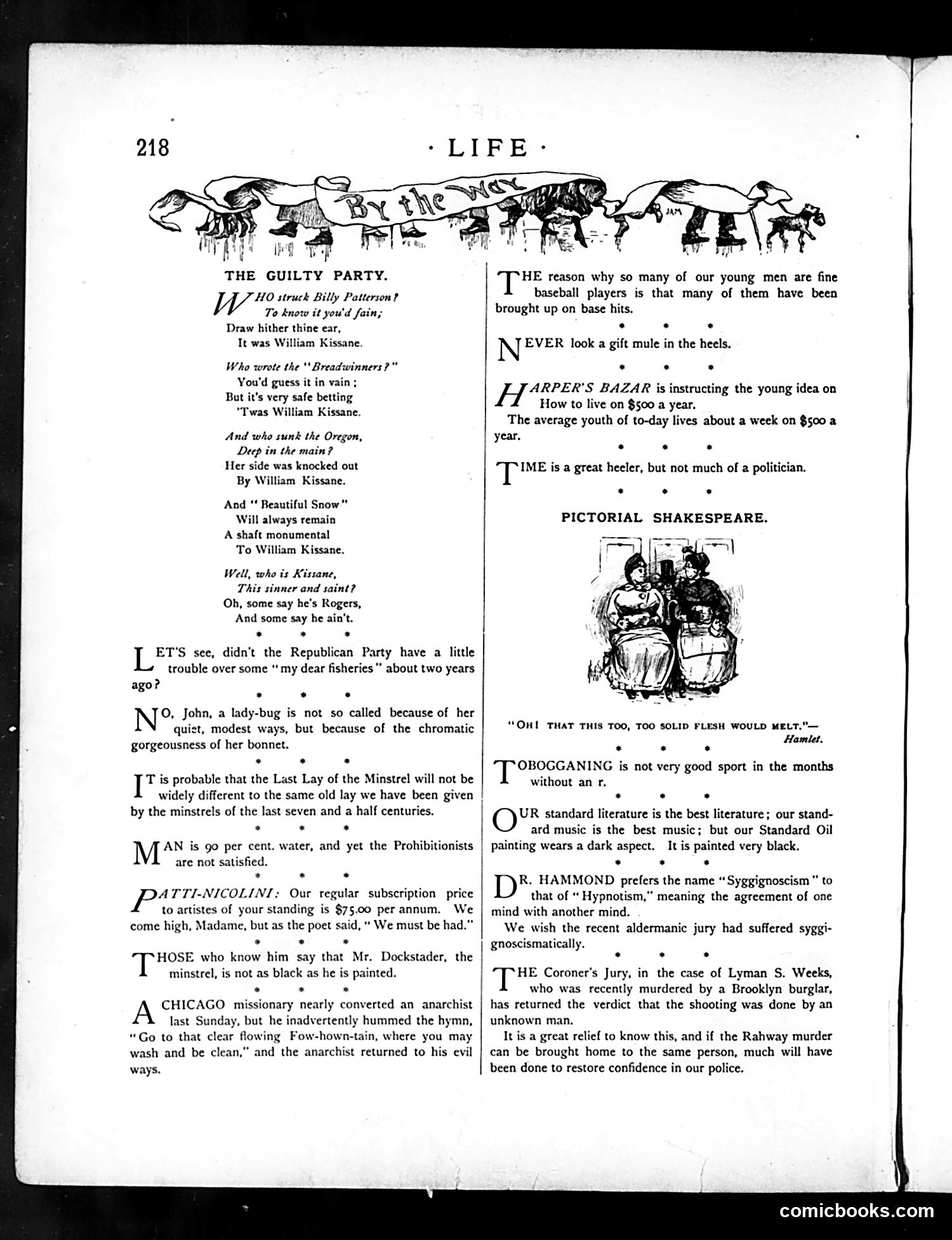
This page contains brief satirical commentary rather than political cartoons. Key items include: **"BY THE WAY" section**: Humorous observations about William Kissane (appears to be a contemporary figure), with jokes about baseball, literature, and politics. **"PICTORIAL SHAKESPEARE"**: A small sketch showing two figures in period dress with the caption "OH! THAT THIS TOO, TOO SOLID FLESH WOULD MELT."—*Hamlet*. This is a visual pun illustrating the famous Shakespeare line. **Other quips**: Commentary on topics including Republican Party politics, literature standards, Prohibitionism, and a Brooklyn murder case (the Lyman S. Weeks case), blending social satire with current events. The page exemplifies Life's style: quick-hit humor mixing high culture references with topical commentary for educated readers.
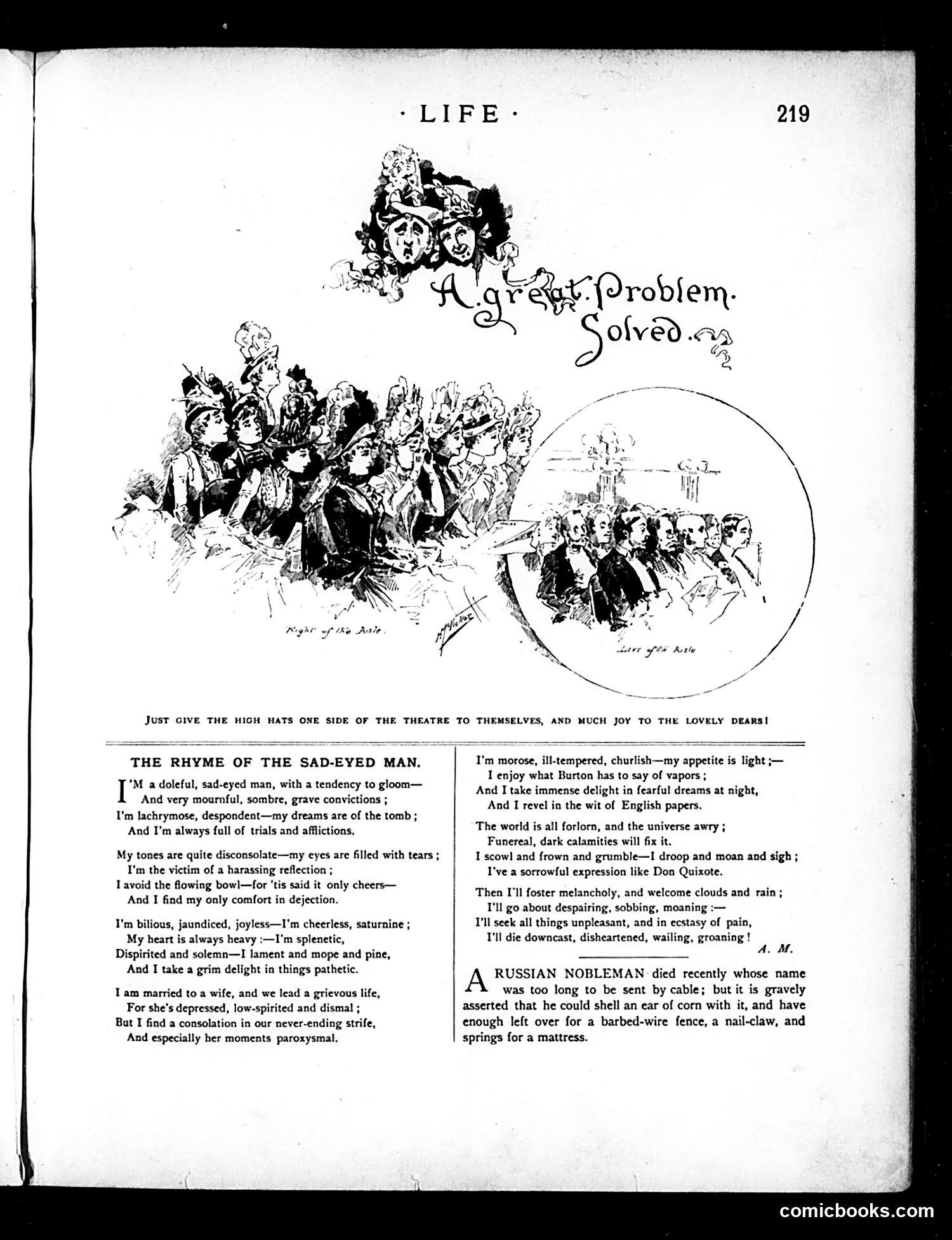
This page from *Life* magazine presents satirical content about theater etiquette. The top cartoon, titled "A Great Problem Solved," depicts two scenes showing crowds of women wearing elaborate high hats blocking theater audiences' views. The caption reads: "Just give the high hats one side of the theatre to themselves, and much joy to the lovely dears!" The satire targets a recurring social complaint: women wearing fashionable, oversized hats to theaters, which obstructed other patrons' sightlines. The "solution" humorously suggests segregating hat-wearers to one section—a mockingly impractical remedy to this persistent period annoyance. This reflects genuine frustration with theater-going etiquette violations among fashionable ladies of the era.
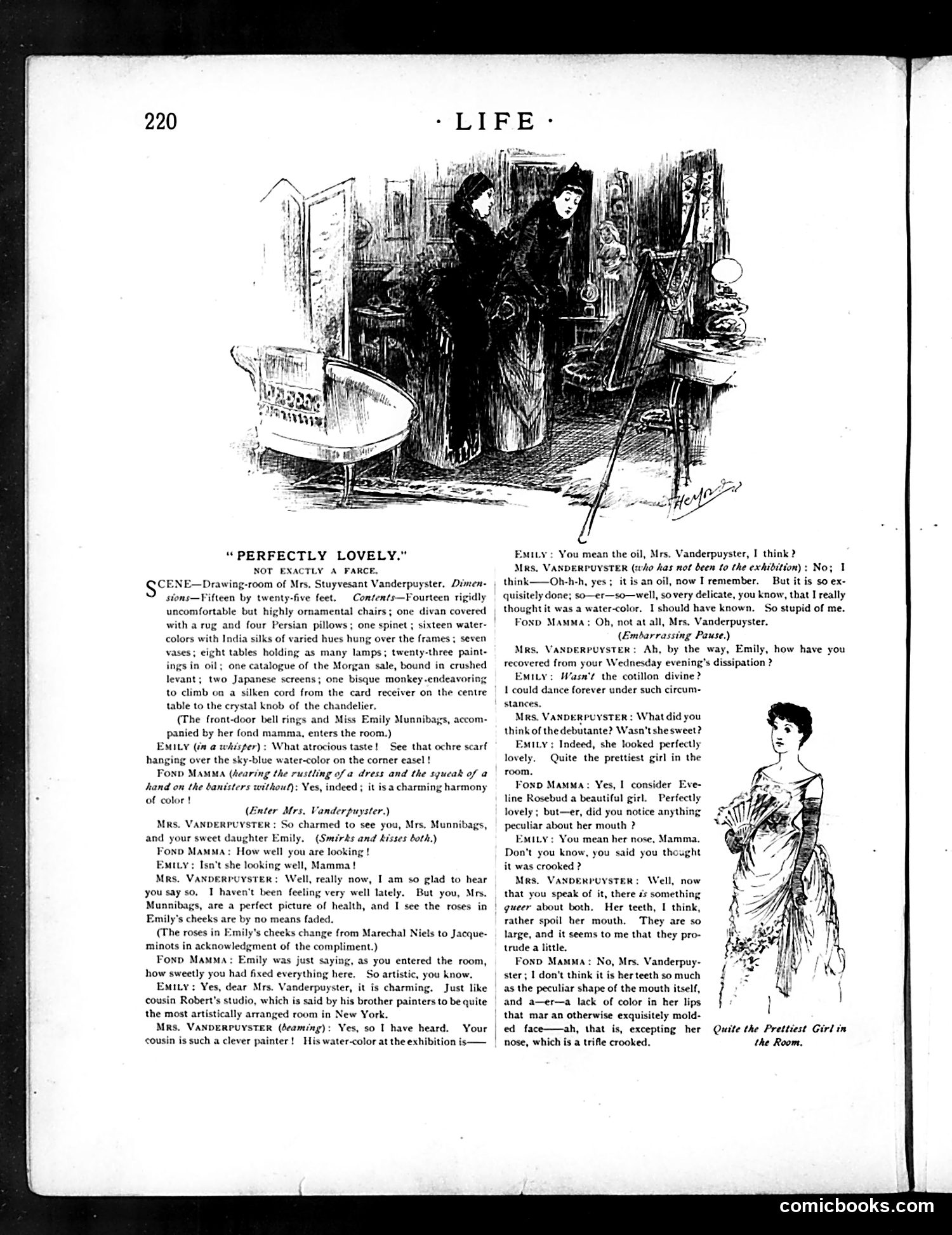
This sketch satirizes upper-class social pretense and art world snobbery. The scene depicts wealthy women (including Mrs. Vanderpuyster) discussing art and social standing in what appears to be an artist's studio. The humor targets several things: superficial compliments about art ("perfectly lovely"), obsession with exhibition attendance and social credentials, and cattiness masked by politeness. The dialogue mocks how these women reduce people to physical critiques (discussing a debutante's nose and teeth), pretend expertise they lack, and use art appreciation as social performance rather than genuine interest. The title's deadpan phrase captures how such circles substitute empty pleasantries for authentic conversation—a common Life magazine critique of Gilded Age society's hollowness.
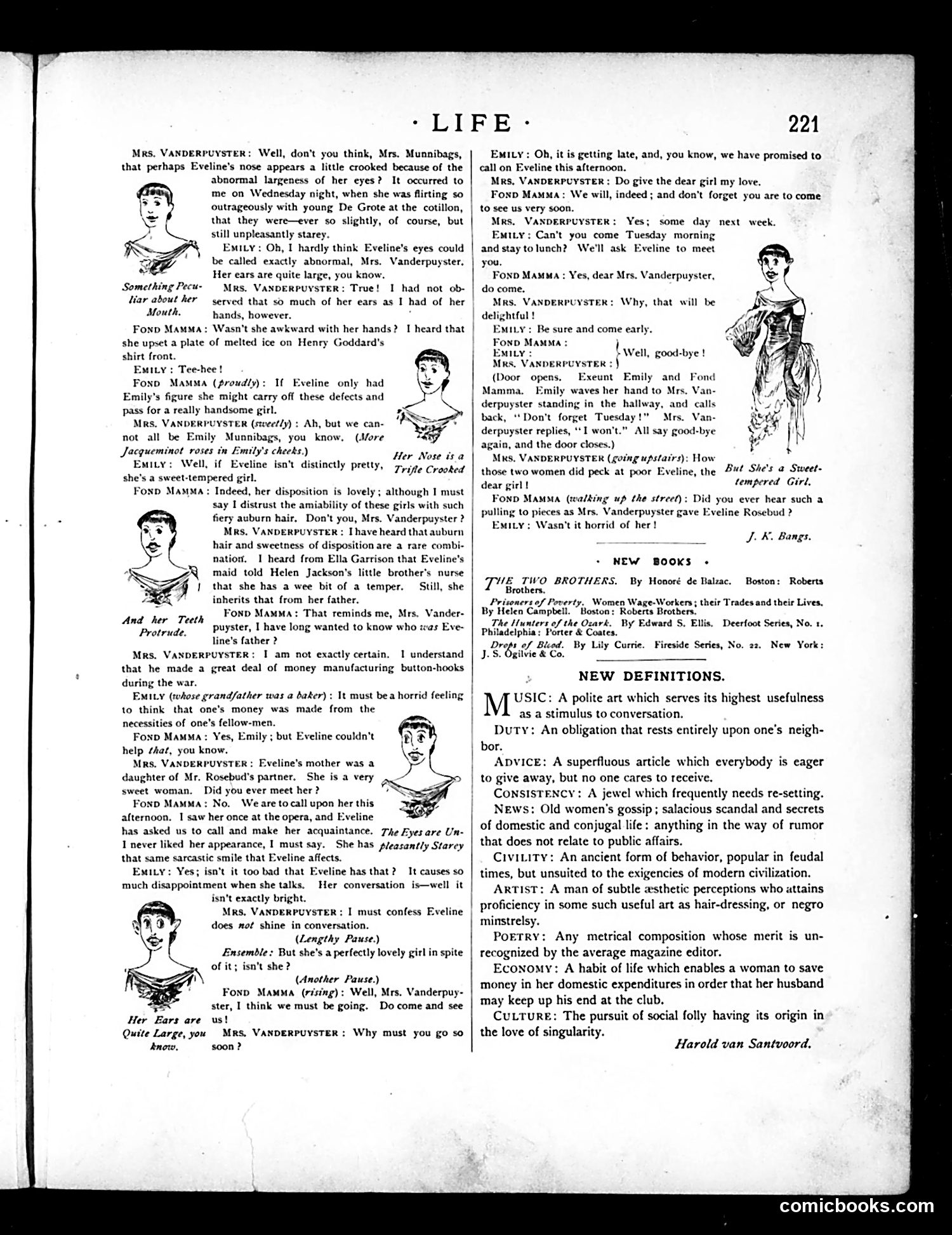
This page contains a humorous domestic dialogue between Mrs. Vanderpuyster and her friend Fond Mamma, discussing Eveline, a young woman with physical peculiarities. The conversation satirizes upper-class social anxieties about appearance and marriageability. The sketches mock Eveline's crooked nose, large ears, and other features while the women debate whether these defects matter. Fond Mamma suggests Eveline possesses charm despite her appearance ("a sweet-tempered girl"), while Mrs. Vanderpuyster worries such girls struggle socially. The satire targets snobbish concern with superficial perfection in marriage markets and social standing. The accompanying "New Definitions" section offers witty redefinitions of terms like "Duty," "Advice," and "Culture"—typical Life magazine humor mocking pretension and hypocrisy in genteel society.
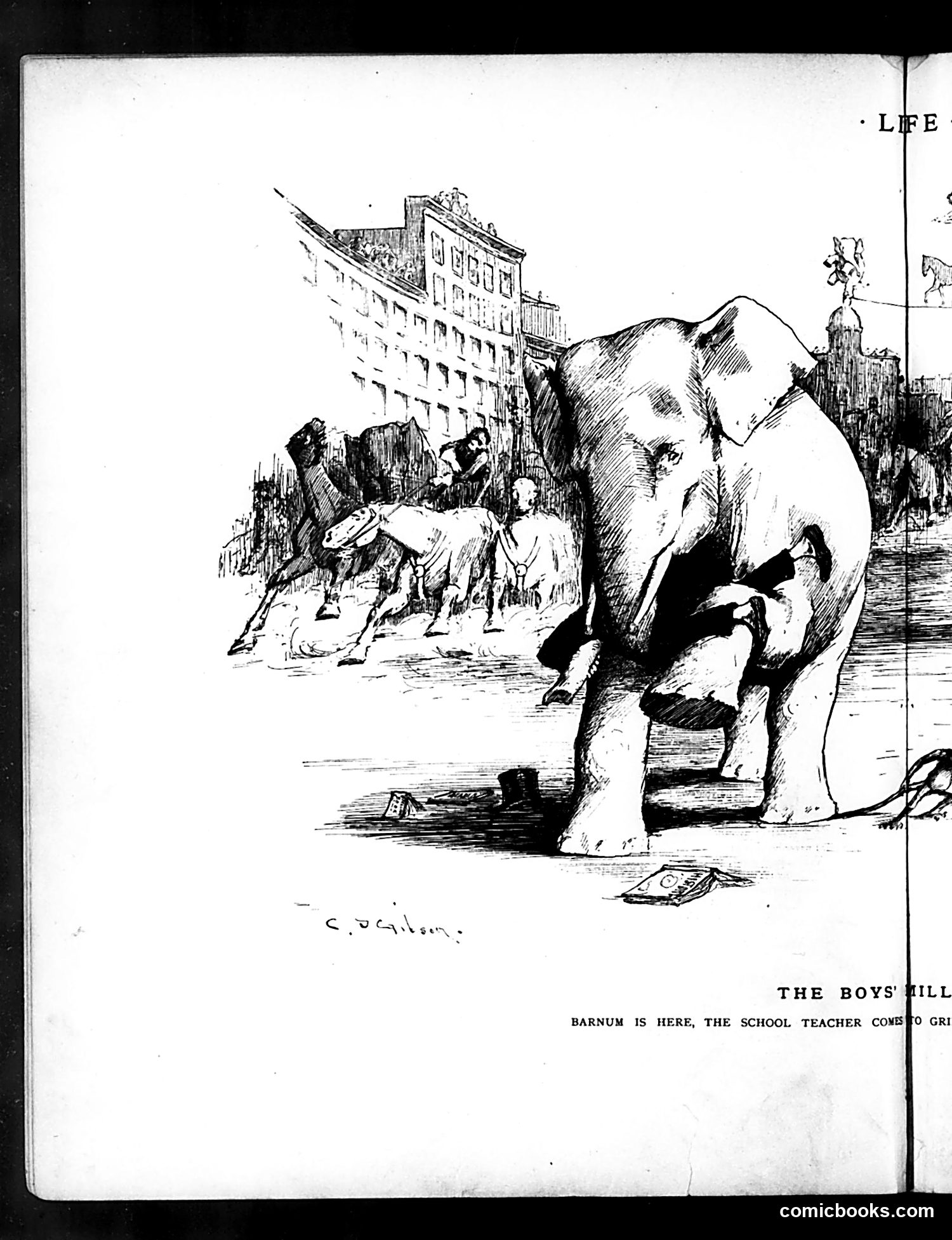
This cartoon depicts an elephant labeled "Barnum" (P.T. Barnum, the famous 19th-century showman) in an urban street, with schoolchildren and their teacher approaching. The caption reads: "Barnum is here, the school teacher comes to gri[p]" (text cut off). The satire plays on Barnum's reputation as a master of spectacle and attraction—his arrival causes such excitement that even the school teacher must "grapple" with the distraction he presents to her students. The joke criticizes how Barnum's sensational showmanship competes with education for children's attention. The elephant itself exemplifies his famous attractions (Barnum famously exhibited Jumbo the elephant). The urban setting emphasizes how thoroughly his entertainment culture penetrates ordinary city life.
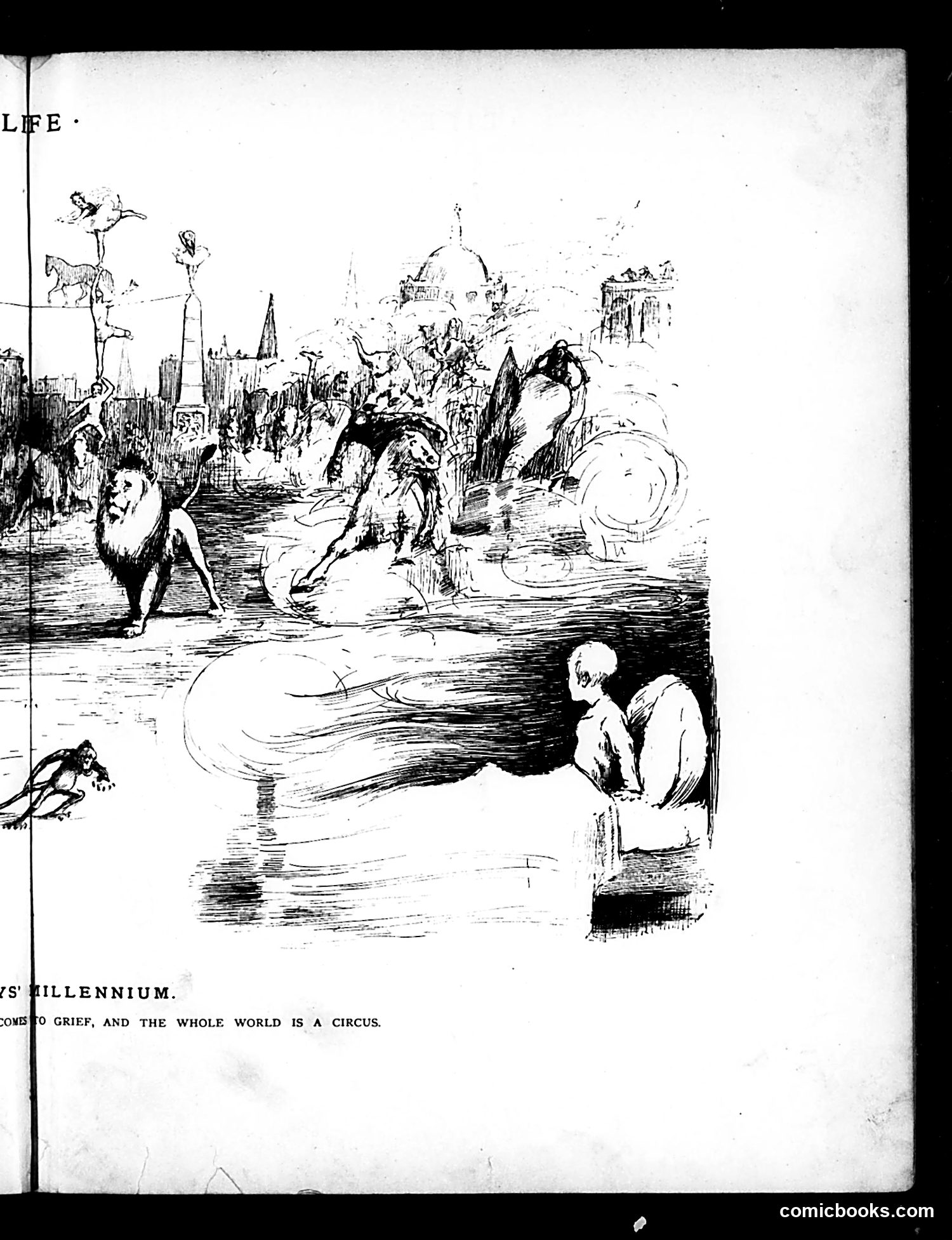
This is a satirical cartoon from Life magazine titled "A COMES TO GRIEF, AND THE WHOLE WORLD IS A CIRCUS." The image depicts a chaotic circus scene with acrobats, performers, and spectators around a cityscape with prominent landmarks (possibly including a cathedral dome). In the foreground, an elderly man observes the pandemonium with apparent resignation or dismay. The caption's reference to "comes to grief" suggests this depicts a specific public figure or leader experiencing downfall or failure, with the "circus" metaphor implying the world has descended into chaos, confusion, or absurdity as a result. The circus setting emphasizes disorder and spectacle over reason. Without a visible date or clearer context identifying the specific figure referenced, I cannot definitively identify who "A" represents, though the artwork's style suggests early-to-mid 20th century publication.
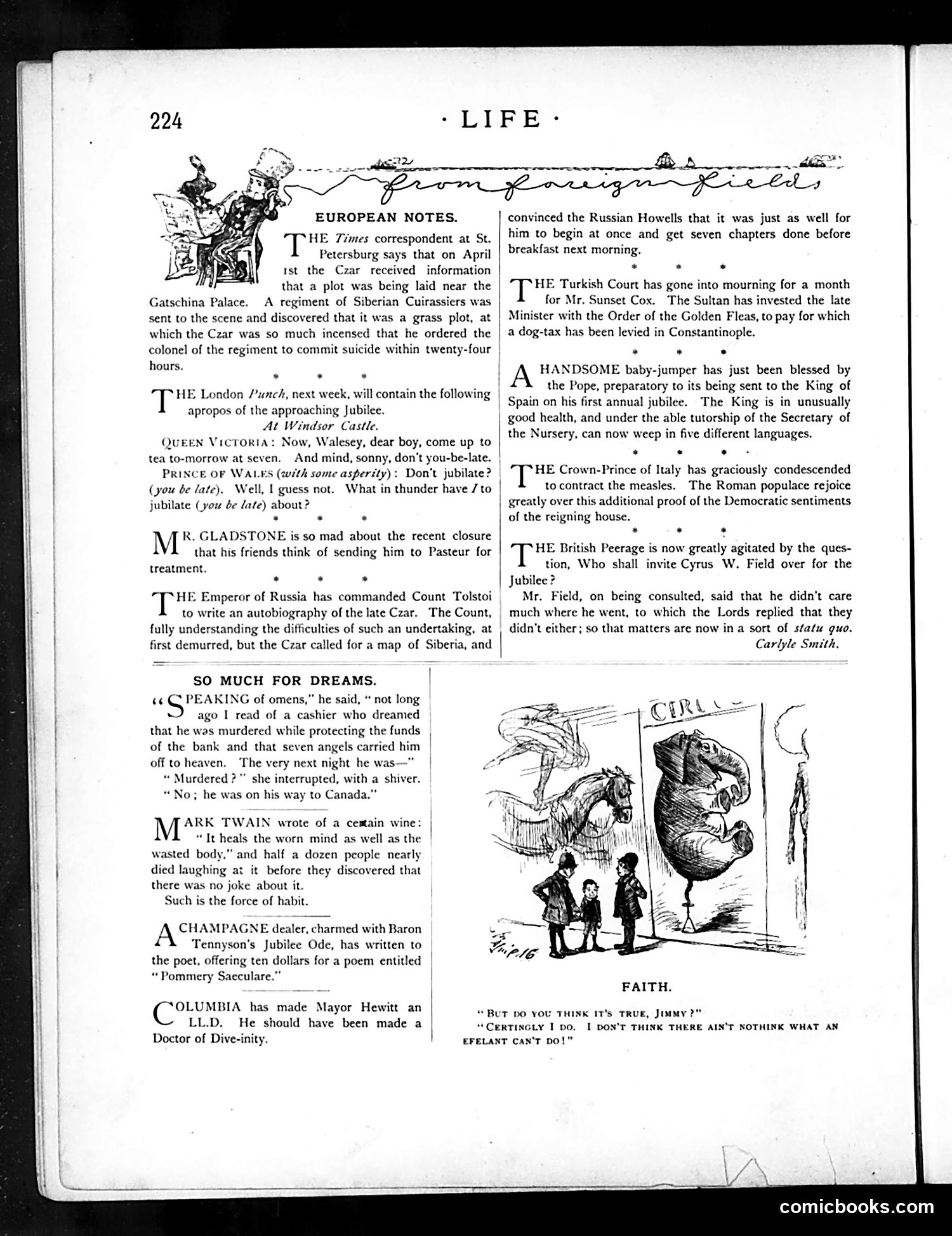
This cartoon depicts a child's literal interpretation of an adult's figurative language. An adult tells a child "it's true, Jimmy" regarding something seemingly impossible—the child responds with skeptical realism: "I don't think there ain't nothing what an elephant can't do!" The humor satirizes how children expose the absurdity in adult exaggeration and wishful thinking. The elephant imagery (labeled "CIRCL" in the sketch) suggests adults were making grandiose claims about what's possible—perhaps referring to contemporary technological or political promises. The cartoon's title "Faith" is ironic: the adult appeals to faith/belief, while the child demands logical consistency, exposing how adults use faith to bypass rational scrutiny. This reflects turn-of-century skepticism about accepting claims without evidence.
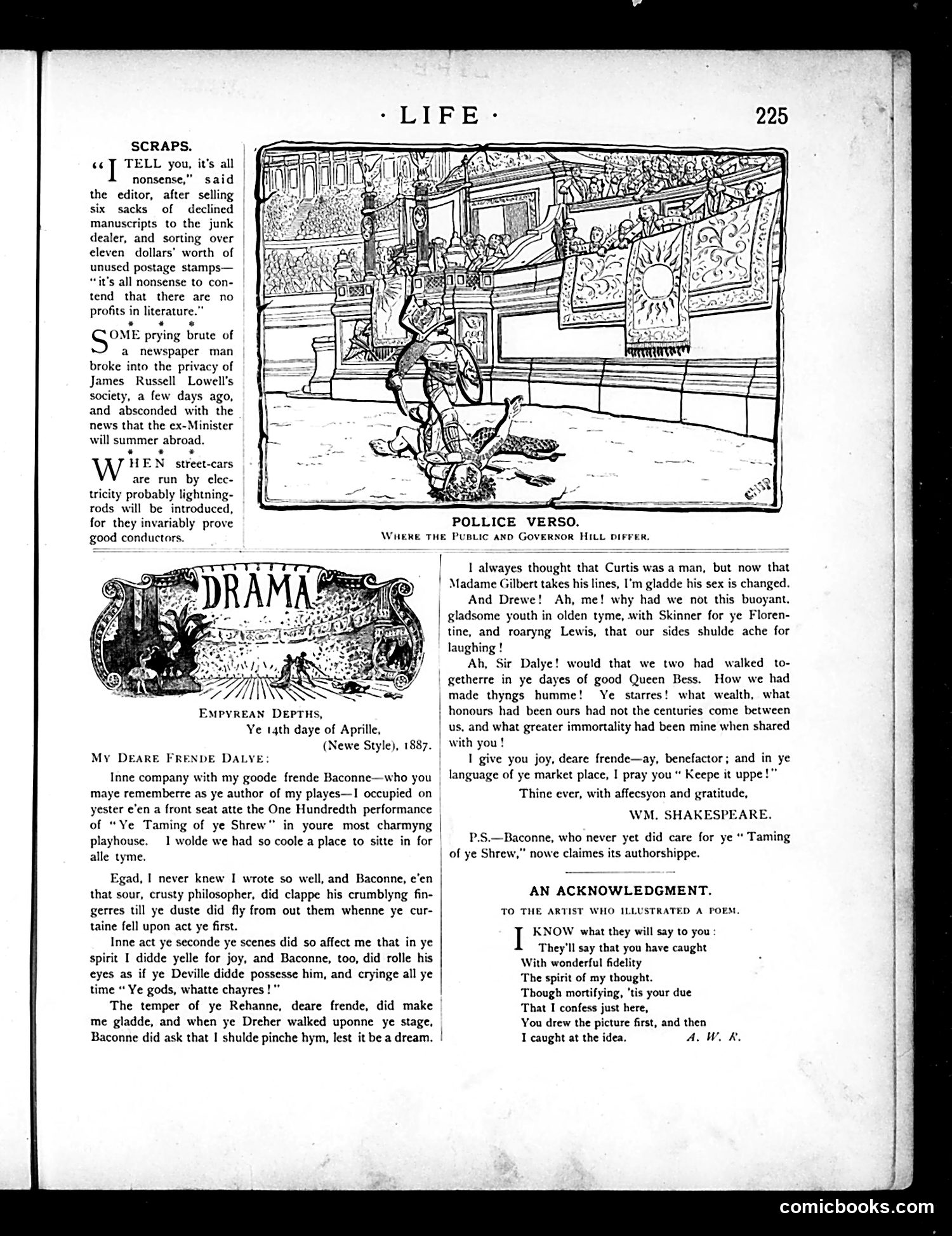
This page contains three satirical sections: **"SCRAPS"** — Brief editorial jokes about literary economics (editors profiting from rejected manuscripts) and a pun about electric streetcars needing lightning rods as "good conductors." **"POLLICE VERSO"** — A cartoon captioned "Where the Public and Governor Hill Differ," depicting what appears to be a gladiatorial execution scene. The image likely satirizes a contemporary disagreement between New York Governor David B. Hill and public opinion on some matter (possibly capital punishment or a specific legal case), using the Roman "thumbs down" reference to suggest Hill's unpopular stance. **The Shakespeare Letter** — A humorous mock-letter from "Shakespeare" praising a performance of *The Taming of the Shrew*, written in pseudo-Elizabethan dialect. It appears to reference contemporary actors (Curtis, Gilbert, Drew, Skinner, Lewis) and includes a PS about Bacon claiming authorship—a running literary joke about the Bacon-Shakespeare authorship controversy. The final poem credits an artist for illustrating work while admitting the artist's contribution deserves acknowledgment.
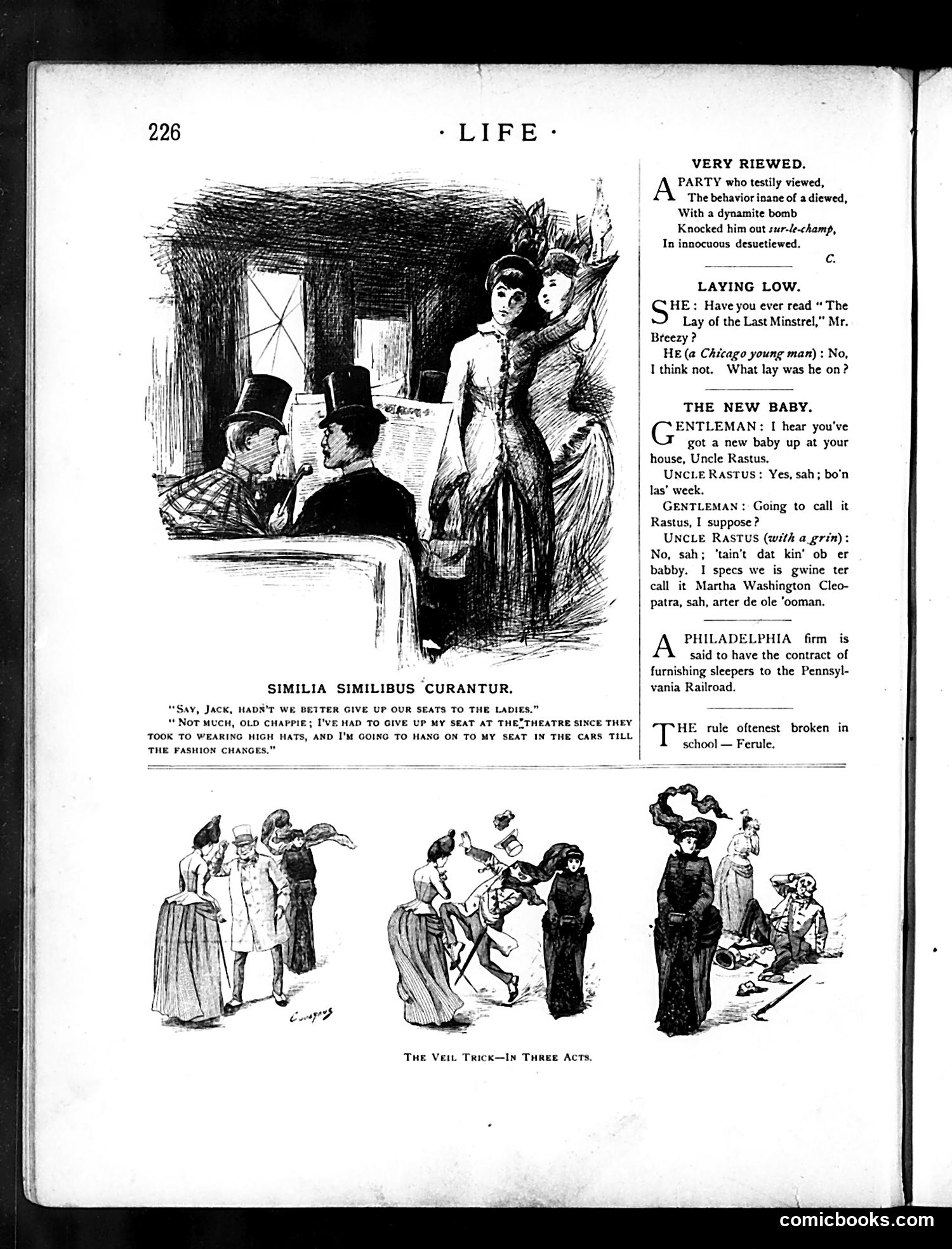
This page collects brief satirical jokes and sketches typical of early Life magazine: **"Very Riewed"**: A crude poem mocking someone's pretentious behavior, using awkward rhymes ("sur-le-champ," "desuetiewed"). **"Laying Low"**: A dialogue joke playing on a misunderstanding—a Chicago man mistakes "The Lay of the Last Minstrel" (a famous poem) for discussion of employment ("what lay"). **"The New Baby"**: Racist humor featuring "Uncle Rastus," a stereotypical Black character. The joke is that he's naming his baby "Martha Washington Cleopatra"—absurdly grandiose names, presented as amusingly pretentious for a poor Black family. **"Similia Similibus Curantur"**: Two men debate theater etiquette—complaining that high hats worn by ladies now block views, so they refuse to give up train seats as gentlemen traditionally should. **"The Veil Trick—In Three Acts"**: A silent comic strip showing a woman using a veil to disguise herself through three sequential scenes. The humor reflects period attitudes toward class, race, and social conventions.
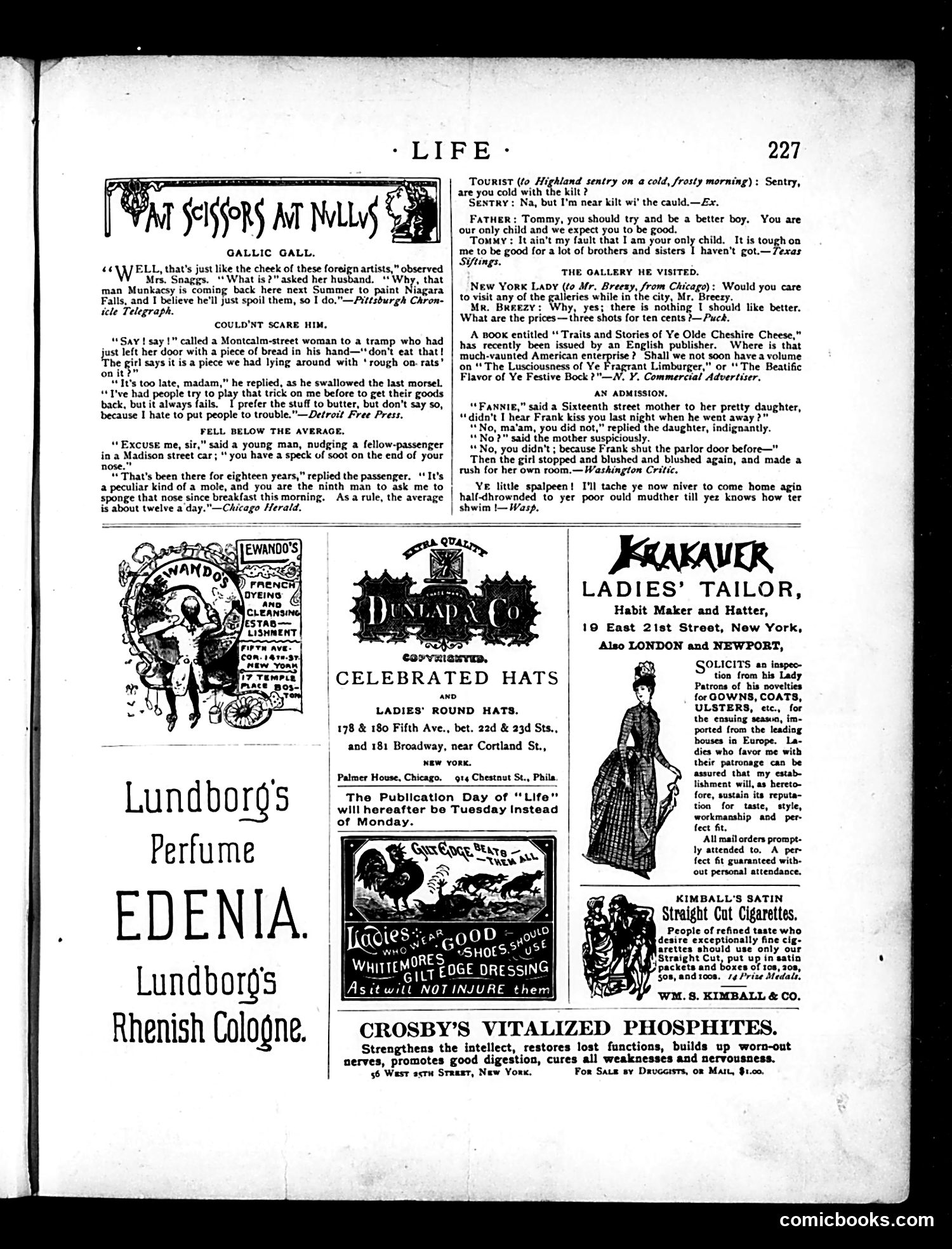
This page contains multiple brief humorous anecdotes rather than political cartoons. The jokes satirize everyday social situations and national stereotypes: **"Gallic Gall"** mocks American cultural insecurity—a woman complains that Hungarian painter Munkacsy will "spoil" Niagara Falls by painting it, revealing anxiety about foreign artists' judgment of American landmarks. **"Couldn't Scare Him"** presents a tramp unfazed by poison warnings, suggesting both the working poor's desperation and their street wisdom. **Other pieces** joke about Scottish Highland soldiers, a naive Chicago visitor expecting low gallery prices, and an Irish mother figure using dialect humor. The page mostly advertises ladies' fashion (tailors, hats, perfume). The humor reflects 1880s-90s attitudes: ethnic stereotyping, class-based comedy, and anxiety about American cultural status versus Europe. The satire is gentle, targeting social pretension and miscommunication rather than serious political targets.
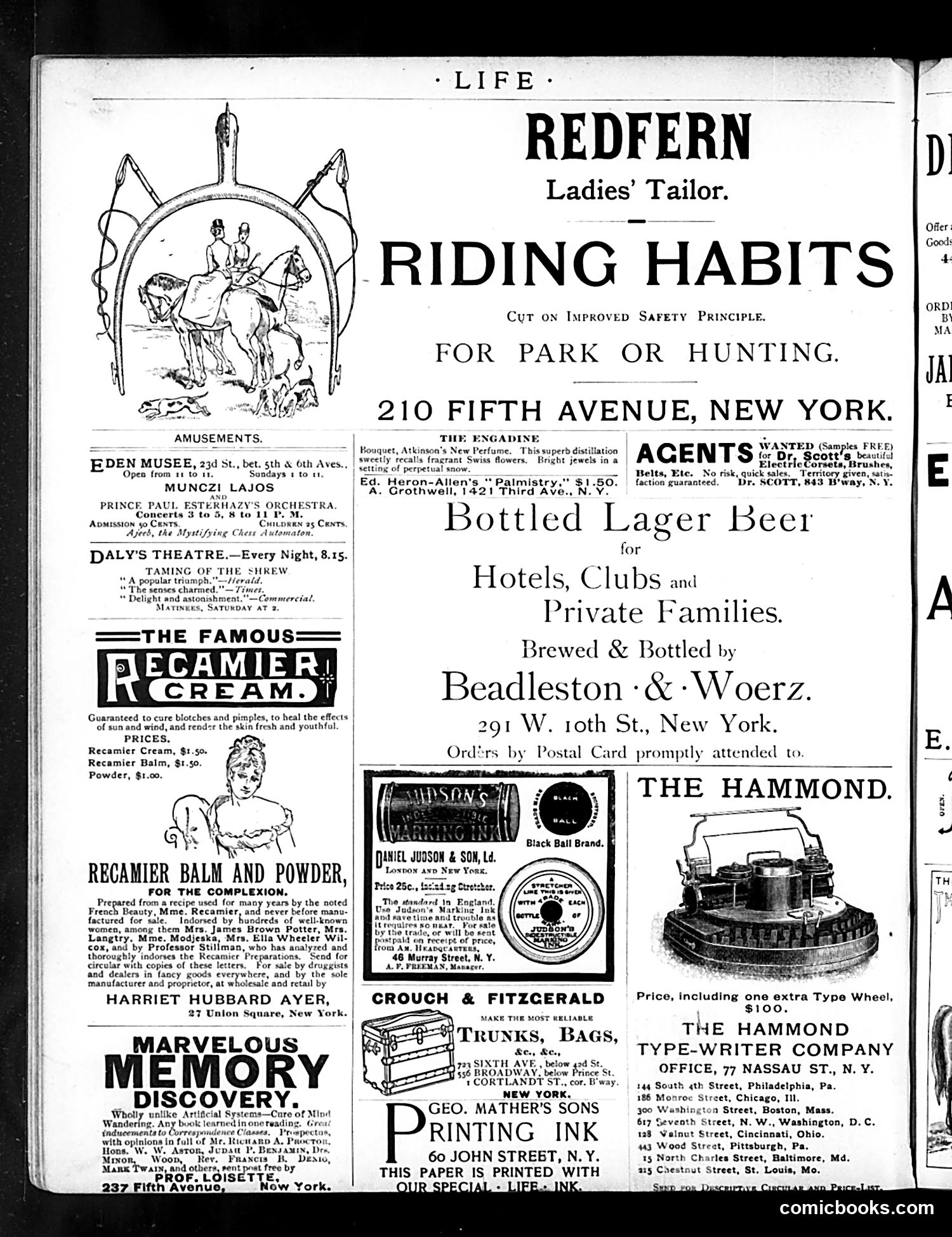
This is primarily an **advertisement page**, not a satirical cartoon. The main content advertises Redfern's ladies' riding habits at the top, featuring a decorative illustration of women on horseback. The page contains typical late-19th/early-20th-century classified advertising for: - **Fashion**: Redfern riding clothes marketed with an "Improved Safety Principle" - **Beauty products**: Recamier balm and powder, endorsed by famous actresses like Lillie Langtry - **Entertainment**: Theater listings and amusement venues - **Business services**: Printing ink, typewriters, trunks, perfume The small illustration showing women riding sidesaddle reflects the era's fashion conventions for ladies' equestrian wear. The "safety principle" likely refers to design modifications making horseback riding safer or more practical for women in long skirts. This is a commercial page typical of Life magazine's revenue model—mixing editorial content with paid advertisements targeting affluent urban readers.
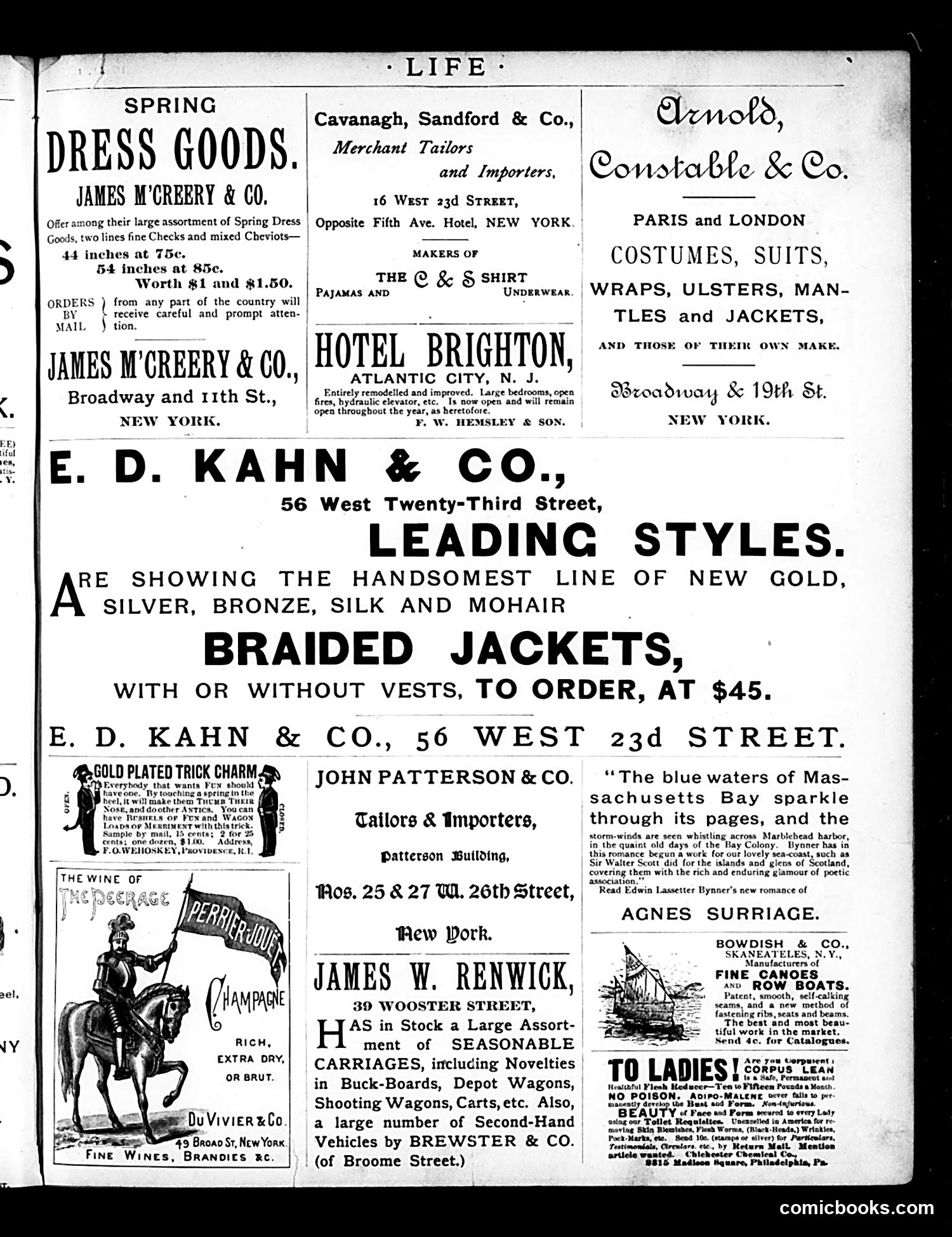
This page is **primarily advertising**, typical of late 19th-century magazines. There are no political cartoons or satirical content requiring historical context. The advertisements showcase period consumer goods: - **Dress goods and tailoring**: Multiple clothiers advertise spring fashions, braided jackets ($45), and custom carriages - **Hotels and transportation**: Atlantic City's Hotel Brighton and carriage maker James W. Renwick advertise seasonal services - **Patent medicines**: "Corpus Lean" and similar products promise weight reduction and skin treatments—standard of the era, when such unregulated remedies were common - **Luxury items**: Fine wines and champagne from DuVivier & Co., canoes from Bowdish & Co. - **Literature**: A brief excerpt promoting Edwin Lasseter Bynner's novel *Agnes Surriage*, romanticizing early Massachusetts colonial history The **"Gold Plated Trick Charm"** appears to be a novelty toy with spring mechanisms. All content reflects Gilded Age consumer culture with no satirical intent visible.
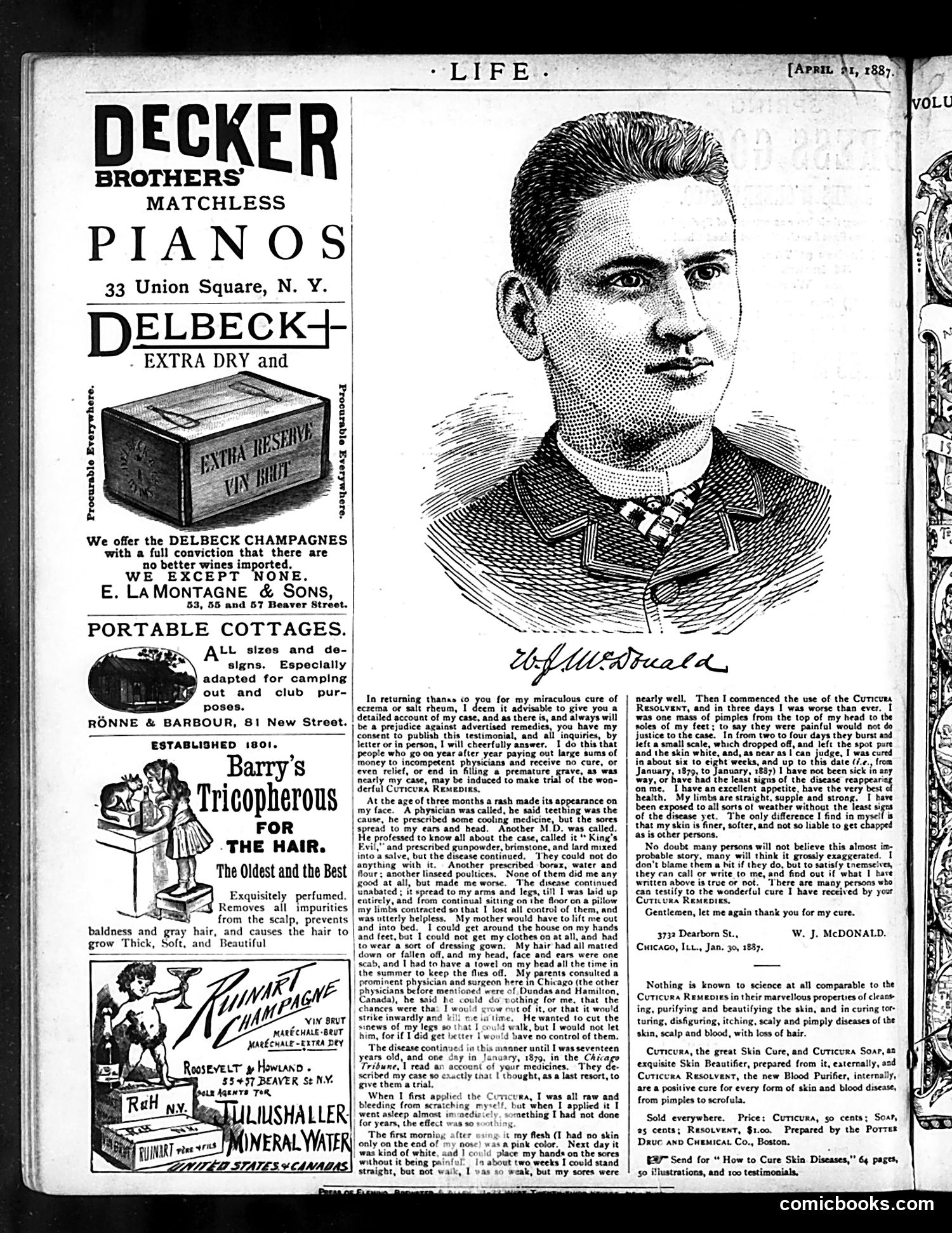
This page is primarily **advertising**, not political satire. The central image is a portrait (signed "W. J. McDonald") accompanying a lengthy testimonial letter about **Cuticura Remedies**—a patent medicine claiming to cure severe skin conditions like eczema and salt rheum. The testimonial describes a man's childhood suffering from a spreading rash that conventional doctors couldn't treat, featuring dramatic details (hair loss, immobility, constant scabbing). After years of failed treatments, he claims Cuticura provided miraculous relief. The surrounding ads promote various products: Decker Brothers pianos, Delbeck champagne, portable cottages, Barry's Tricopherous hair tonic, and mineral water. **Context for modern readers**: This exemplifies 19th-century patent medicine marketing—before FDA regulation, companies made unverified health claims using emotional testimonials. The practice exploited genuine suffering and medical limitations of the era. The page reflects how extensively such ads dominated publications like *Life*.