
Life, 1887-04-21 · page 7 of 16
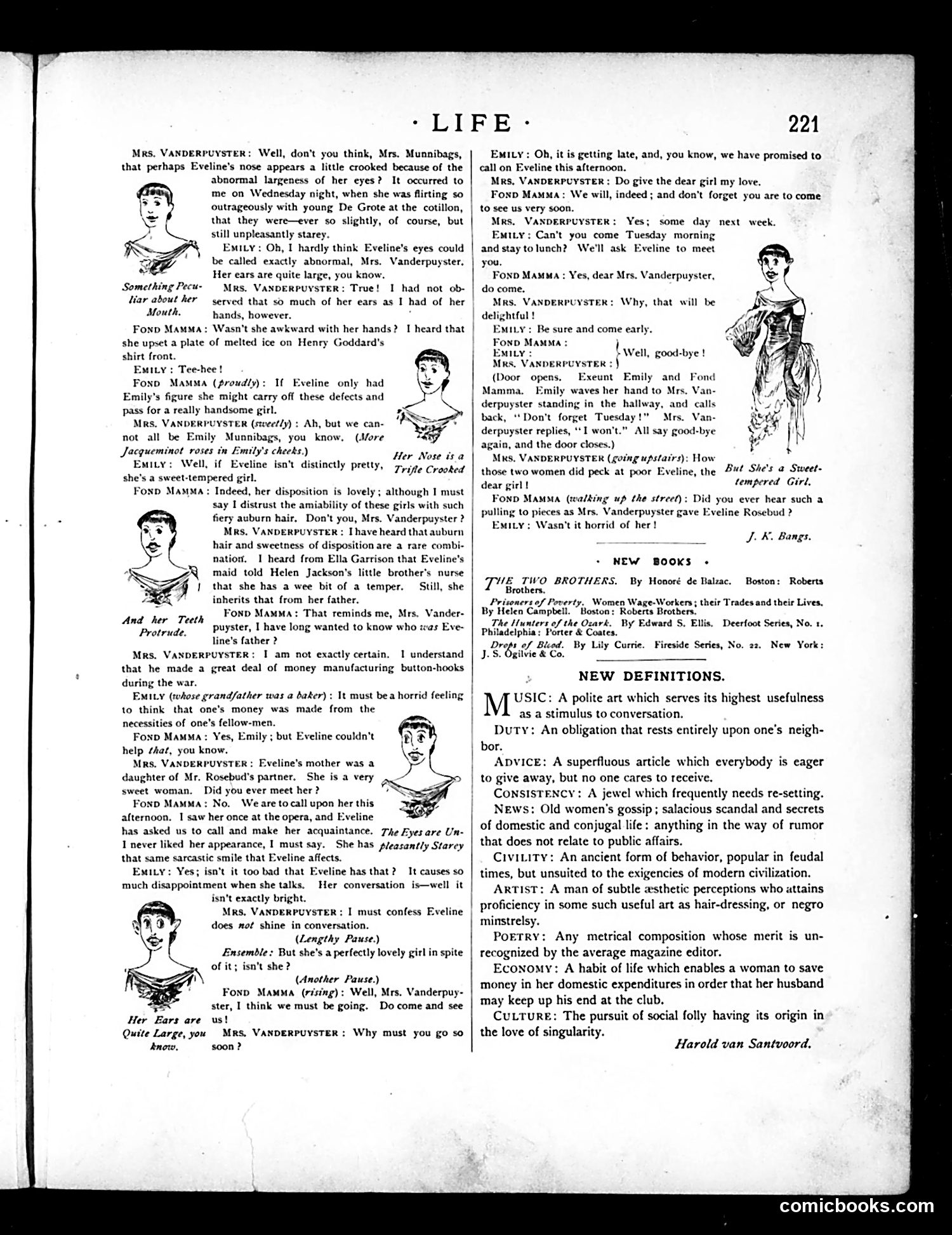
Life — April 21, 1887 — page 7: what you’re looking at
What you’re looking at
This page contains a humorous domestic dialogue between Mrs. Vanderpuyster and her friend Fond Mamma, discussing Eveline, a young woman with physical peculiarities. The conversation satirizes upper-class social anxieties about appearance and marriageability. The sketches mock Eveline's crooked nose, large ears, and other features while the women debate whether these defects matter. Fond Mamma suggests Eveline possesses charm despite her appearance ("a sweet-tempered girl"), while Mrs. Vanderpuyster worries such girls struggle socially. The satire targets snobbish concern with superficial perfection in marriage markets and social standing. The accompanying "New Definitions" section offers witty redefinitions of terms like "Duty," "Advice," and "Culture"—typical Life magazine humor mocking pretension and hypocrisy in genteel society.
📄 Transcribed text from this page (OCR, searchable)
Machine-transcribed from the original scan — historical spelling and the odd misread are preserved.
> LIFE: Mrs. VANDERPUYSTER: Well, don't you think, Mrs. Munnibags, that perhaps Eveline’s nose appears a little crooked because of the abnormal largeness of her eyes? It occurred to me on Wednesday night, when she was flirting so | outrageously with young De Grote at the cotillon, that they were—ever so slightly, of course, but still unpleasantly starey. Emity: Ob, I hardly think Eveline’s eyes could be called exactly abnormal, Mrs. Vanderpuyster, Her ears are quite large, you know, Mrs, VaNDERPUYSTER: True! I had not ob- Hiar about her served that so much of her ears as I had of her Mouth. hands, however. 7 Fonp MaMa: Wasn't she awkward with her hands? I heard that she upset a plate of melted ice on Henry Goddard's shirt front. Emtty : Tee-hee! Foxp Mamata (froudly): If Eveline only had Emily's figure she might carry off these defects and pass for a really handsome girl. Mrs. VANDERPUYSTER (stecef/y) : Ah, but we can- not all be Emily Munnibags, you know. (J/ore Jacqueminot roses in Emily's cheeks.) Emity: Well, if Eveline isn't distinctly pretty, she's a sweet-tempered girl. Foxp MaMMA: Indeed, her disposition is lovely; although I must say I distrust the amiability of these girls with such fiery auburn hair, Don't you, Mrs. Vanderpuyster ? Mrs. VANDERPUYSTER : Ihave heard that auburn hair and sweetness of disposition are a rare combi- nation. I heard from Ella Garrison that Eveline's maid told Helen Jackson's little brother's nurse that she has a wee bit of a temper. Still, she inherits that from her father. Fonb Mamma: That reminds me, Mrs, Vander- puyster, I have long wanted to know who was Eve- line's father ? Mrs. VANDERPUYSTER: I am not exactly certain. 1 understand that he made a great deal of money manufacturing button-hooks during the war. Something Pecu- Her Nose isa Trifle Crooked And her Teeth Protrude. EMILY (twhose grandfather was a baker): It must bea horrid feeling | to think that one’s money was made from the necessities of one's fellow-men. Foxp Mamma: Yes, Emily ; but Eveline couldn't help ¢hat, you know. Mrs. VANDERPUYSTER : Eveline’s mother was a daughter of Mr. Rosebud’s partner, She is a very sweet woman. Did you ever meet her ? Fonp MAMMA: No. Weare tocall upon her this afternoon. I saw her once at the opera, and Eveline has asked us to call and make her acquaintance. The Eyes are Un- I never liked her appearance, I must say. She has p/easantly Starey that same sarcastic smile that Eveline affects. Emity: Yes; isn’t it too bad that Eveline has that? It causes so much disappointment when she talks, Her conversation is—well it isn’t exactly bright. Mrs, VANDERPUYSTER : I must confess Eveline does not shine in conversation. (Lengthy Pause.) Ensemble: But she’s a perfectly lovely girl in spite of it; isn’t she? (Another Pause.) Fonp MAMMA (rising): Well, Mrs. Vanderpuy- ster, I think we must be going. Do come and see us! Mrs, VANDERPUYSTER ; Why must you go so soon ? = Her Ears are Quite Large, you snow. 221 Emity : Oh, it is getting late, and, you know, we have promised to call on Eveline this afternoon. Mrs, VANDERPUYSTER : Do give the dear girl my love. Foxp MAMMA: We will, indeed ; and don't forget you are to come to see us very soon. Mrs. VANDERPUYSTER: Yes; some day next week. Eity: Can't you come Tuesday morning and stay tolunch? We'll ask Eveline to meet you, Fonp Mamma : Yes, dear Mrs. Vanderpuyster, do come. Mrs. VANDERPUYSTER: Why, that will be delightful ! EMILy : Be sure and come early. Fowp Mamata : i Eaty : Well, good-bye ! Mrs. VaNperpuyster : J (Door opens, Exeunt’ Emily and Mamma. Emily waves her hand to Mrs. Van- Fond | derpuyster standing in the hallway, and calls back, “Don't forget Tuesday!" Mrs. Van- derpuyster replies, “I won't.” All say good-bye again, and the door closes.) Mus, VANDERPUYSTER (ving upstairs): How those two women did peck at poor Eveline, the 2a She's @ Sweet. dear girl! tempered Girl. Fon MAMMA (tealting up the street): Did you ever hear such a pulling to pieces as Mrs. Vanderpuyster gave Eveline Rosebud ? Esuty : Waso’t it horrid of her! J. K. Bangs. + NEW BOOKS «+ THE TWO BROTHERS, By Honoré de Balzac, Boston: Roberts Brothers. Prisoners of Poverty. Women Wage-Workers; their Trades and their Lives, By Helen Campbell. “Boston: Roberts Brothers, The Hunters of the Ozark. Philadelphia: Porter & Coates. Drops of Bled. By Lily Currie. 1.8 Spite & Co. By Edward S, Ellis, Deerfoot Series, No. t. Fireside Series, No. 22, New York: NEW DEFINITIONS. M USIC: A polite art which serves its highest usefulness as a stimulus to conversation. Duty: An obligation that rests entirely upon one’s neigh- bor. ADVICE: A superfluous article which everybody is eager | to give away, but no one cares to receive. CONSISTENCY: A jewel which frequently needs re-setting. News: Old women's gossip ; salacious scandal and secrets of domestic and conjugal life: anything in the way of rumor that does not relate to public affairs. Civitity: An ancient form of behavior, popular in feudal times, but unsuited to the exigencies of modern civilization. Artist: A man of subtle asthetic perceptions who attains | proficiency in some such useful art as hair-dressing, or negro minstrelsy. Poetry: Any metrical composition whose merit is un- recognized by the average magazine editor. Economy: A habit of life which enables a woman to save money in her domestic expenditures in order that her husband may keep up his end at the club. CuLTURE: The pursuit of social folly having its origin in the love of singularity. Harold van Santvoord. comicbooks.com