
A complete issue · 16 pages · 1887
Life — January 6, 1887
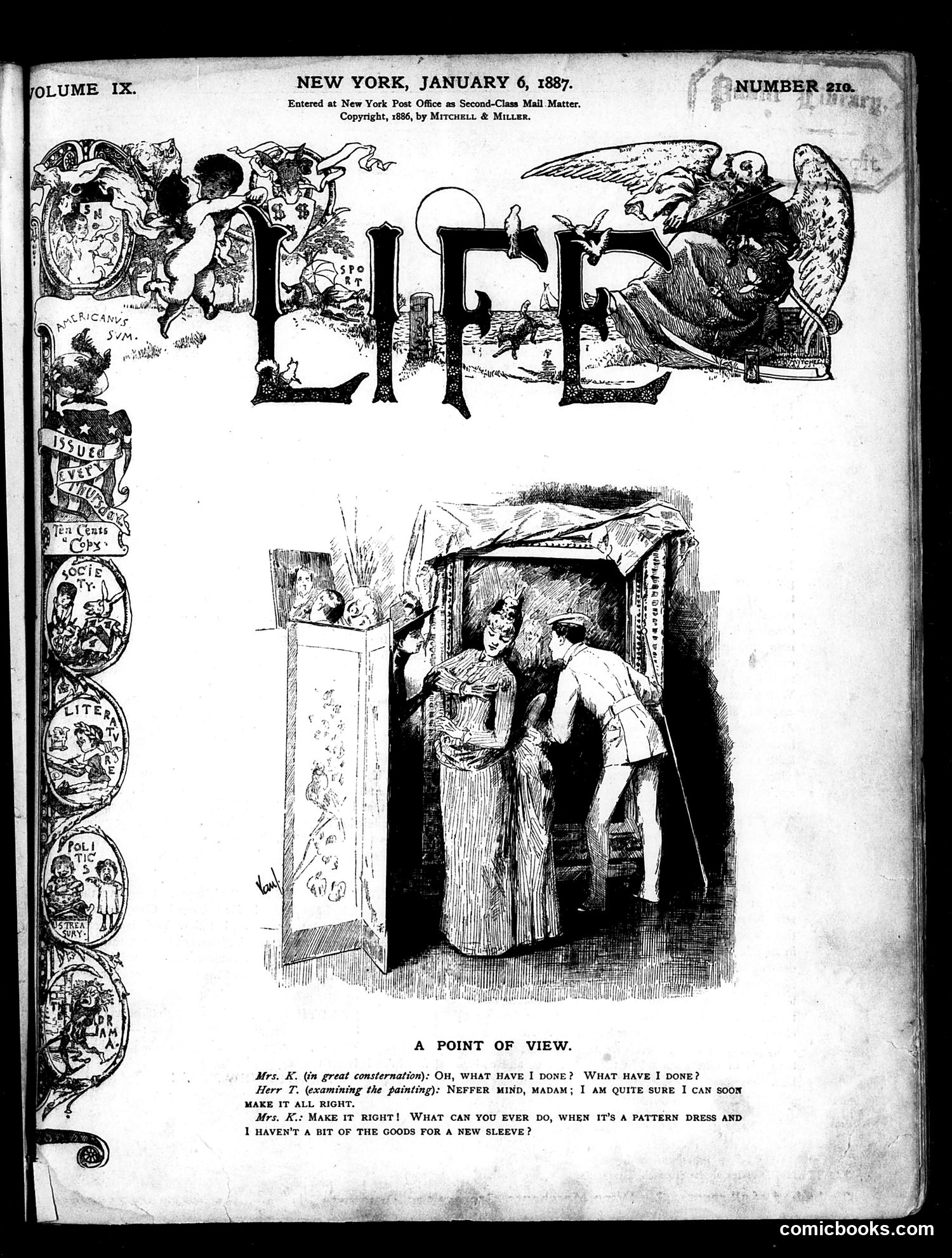
This cartoon satirizes domestic friction over fashion and household economics. Mrs. X (in "great consternation") confronts what appears to be a painter or decorator about damage—likely to wallpaper or furnishings. Her husband (labeled "HERE") responds dismissively while examining a painting, assuring her he can "soon make it all right." Mrs. X retorts with sharp sarcasm: she cannot replace a pattern dress when she lacks fabric scraps for new sleeves—implying her husband wastes money on art while denying her domestic necessities. The satire critiques male indifference to wives' practical concerns and the financial imbalance in Victorian households, where men controlled spending yet prioritized aesthetic pursuits over family provisions. The "point of view" contrasts marital perspectives on value and resource allocation.
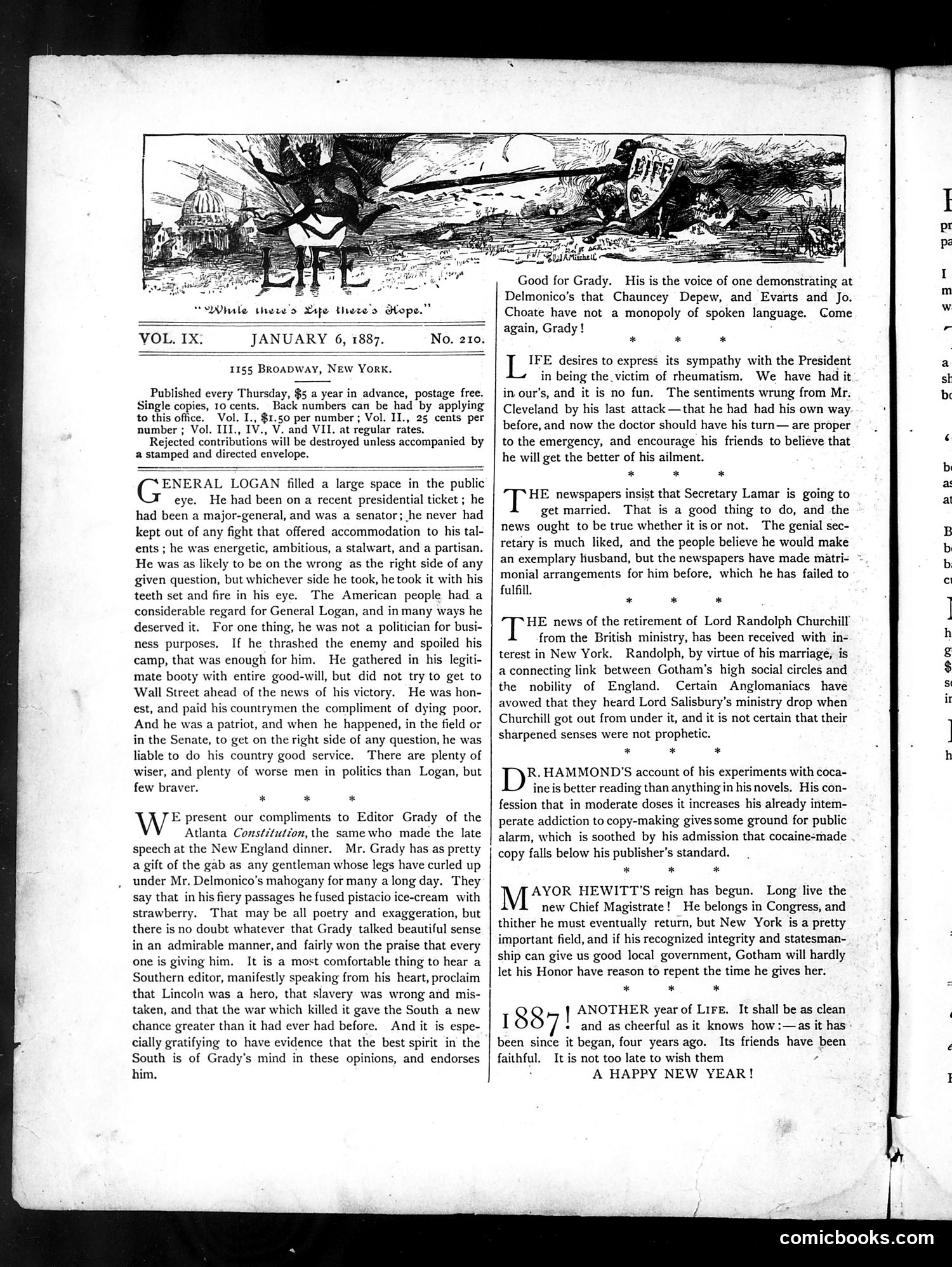
The masthead cartoon depicts a figure labeled "LIFE" sitting among classical ruins and landscape, illustrating the magazine's identity as a satirical publication surveying American society. The text consists of editorial commentary on contemporary figures: - **General Logan**: Praised for his Senate integrity and willingness to challenge both parties fairly, avoiding purely partisan politics. - **Editor Grady** (Atlanta Constitution): Complimented for eloquent Southern rhetoric and Lincoln appreciation, representing reconciliation between North and South post-Civil War. - **Secretary Lamar**: Gossip about potential marriage; editors hope he'll make a good husband. - **Lord Randolph Churchill**: British politician visiting New York's social circles. - **Dr. Hammond**: Noted for cocaine addiction accounts in his novels. - **Mayor Hewitt**: New York's new Chief Magistrate, praised as congressional material.
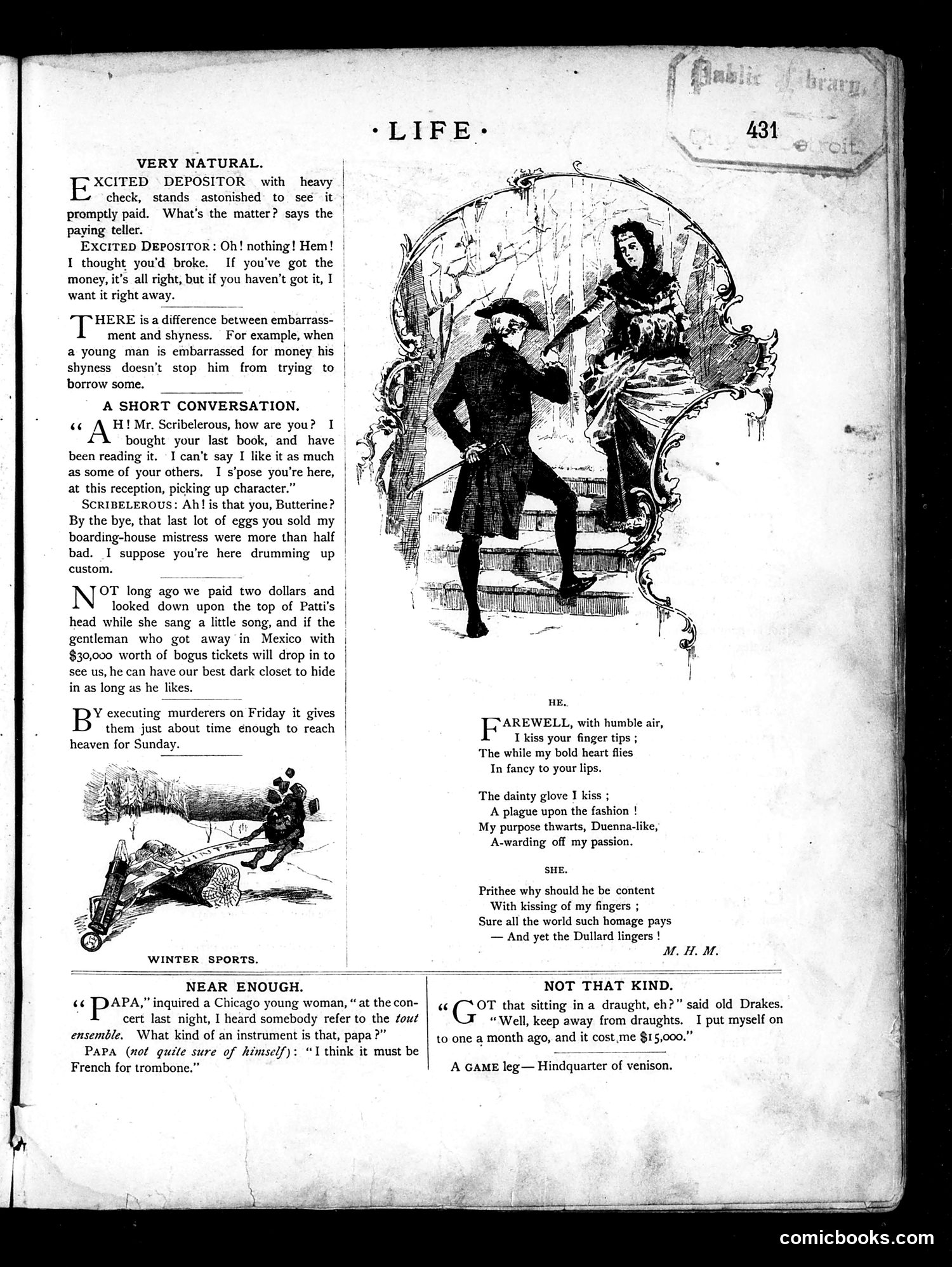
This page contains several brief humorous anecdotes rather than political cartoons. The content includes: **"Very Natural"** — A joke about a bank depositor's relief when told their money is safe, contrasting embarrassment with shyness. **"A Short Conversation"** — A social satire where someone named Scribeelerous discusses attending a reception and critiquing an author's work, with ironic commentary about boarding-house life. **"Winter Sports"** — An illustration depicting people sledding or winter recreation. **Additional items** include brief witticisms about executions, fashion, and social customs (kissing gloves, finger etiquette). The humor relies on wordplay, social observation, and genteel Victorian-era satire rather than political commentary. The "Farewell" and "She" pieces appear to be romantic or flirtation-themed verse. No specific political figures or events are clearly referenced on this page.
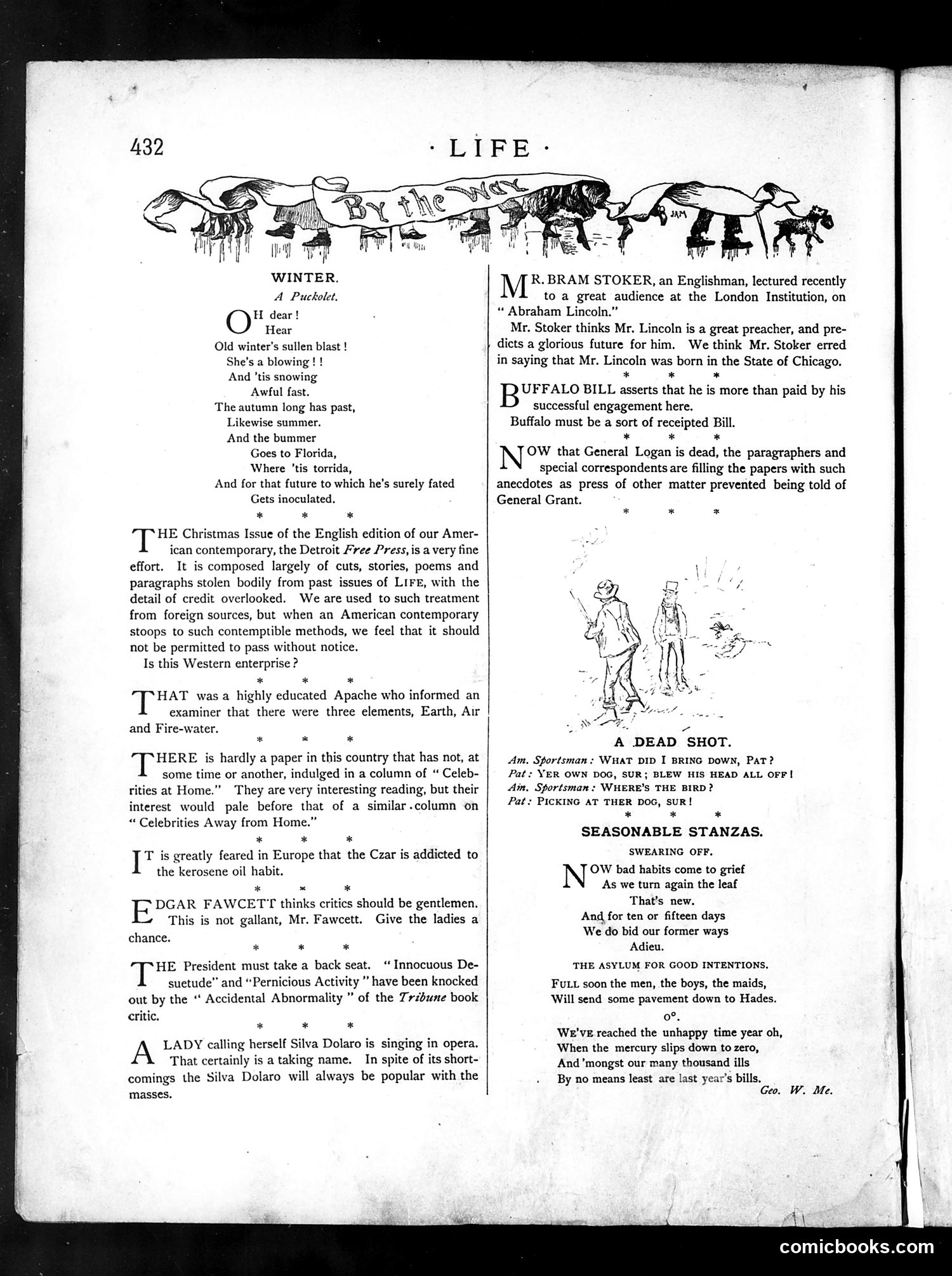
This page contains editorial commentary and poetry rather than political cartoons. The left column includes brief satirical notes on contemporary figures: Bram Stoker (author), Abraham Lincoln's future prospects, and Buffalo Bill's paid engagements. The right side features "A Dead Shot," a small illustration showing two hunters with a dead bird, accompanied by humorous dialogue about a dog bringing down game. Below that are "Seasonable Stanzas"—poems about winter habits and New Year's resolutions, with themes of reforming bad behavior as the year turns. The content reflects Life's format as a weekly humor and satire magazine mixing commentary on public figures with light verse and illustrations. No specific political cartoon is prominently featured on this particular page.
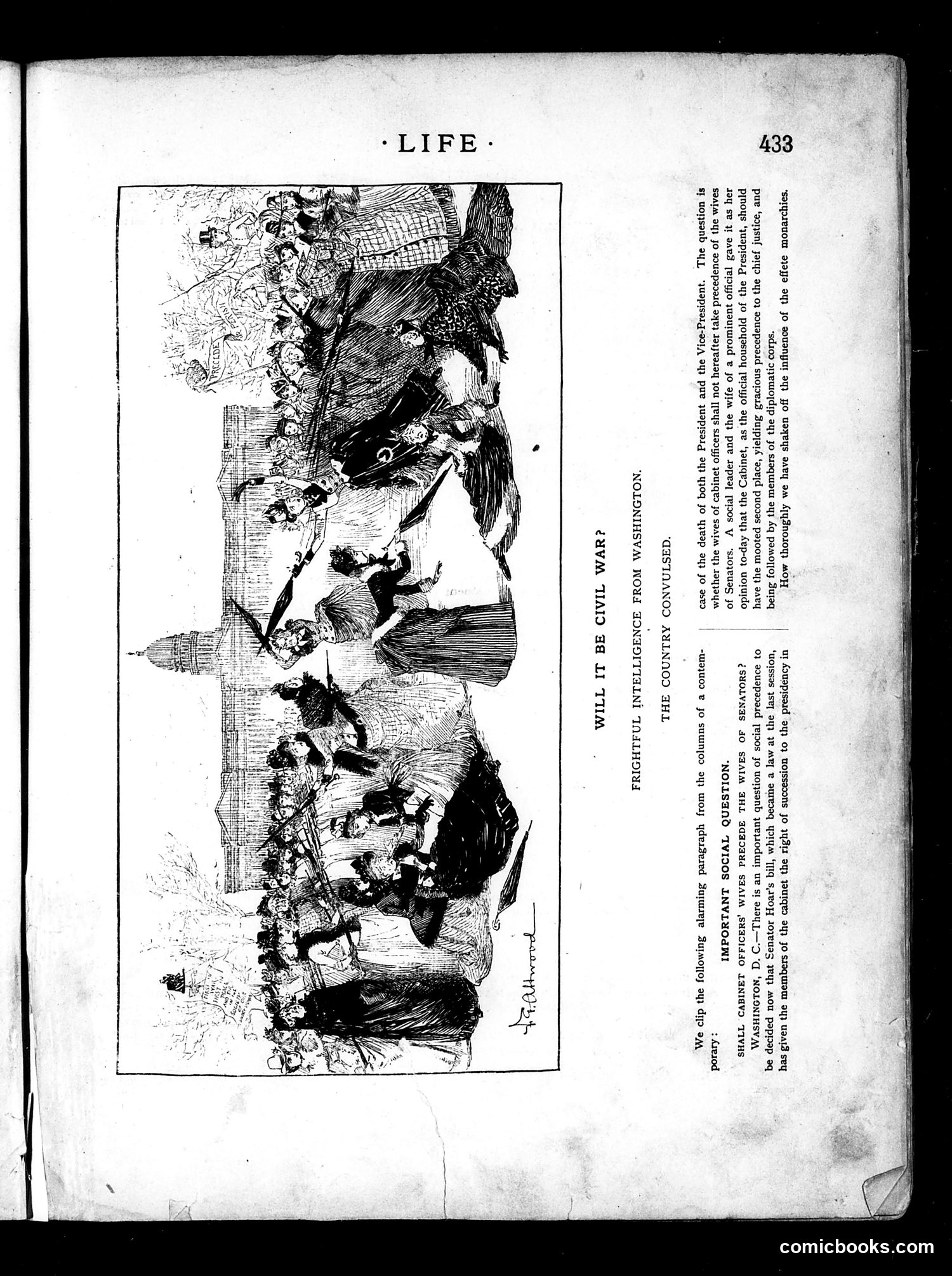
This satirical cartoon from *Life* magazine depicts violent civil unrest, titled "Will It Be Civil War?" with a subtitle referencing "Frightful Intelligence from Washington." The image shows street violence with multiple figures engaged in combat, destruction, and chaos in an urban setting. The accompanying text warns of societal breakdown, mentioning "small causes" spiraling into serious conflict and questioning whether the nation faces potential civil war. Without the specific date visible, this likely comments on a period of significant American political tension—possibly the 1890s labor disputes, Reconstruction era conflicts, or another moment of heightened partisan or class-based violence that threatened national stability. The cartoon uses exaggerated depictions of street violence to satirize contemporary political rhetoric about potential societal collapse.
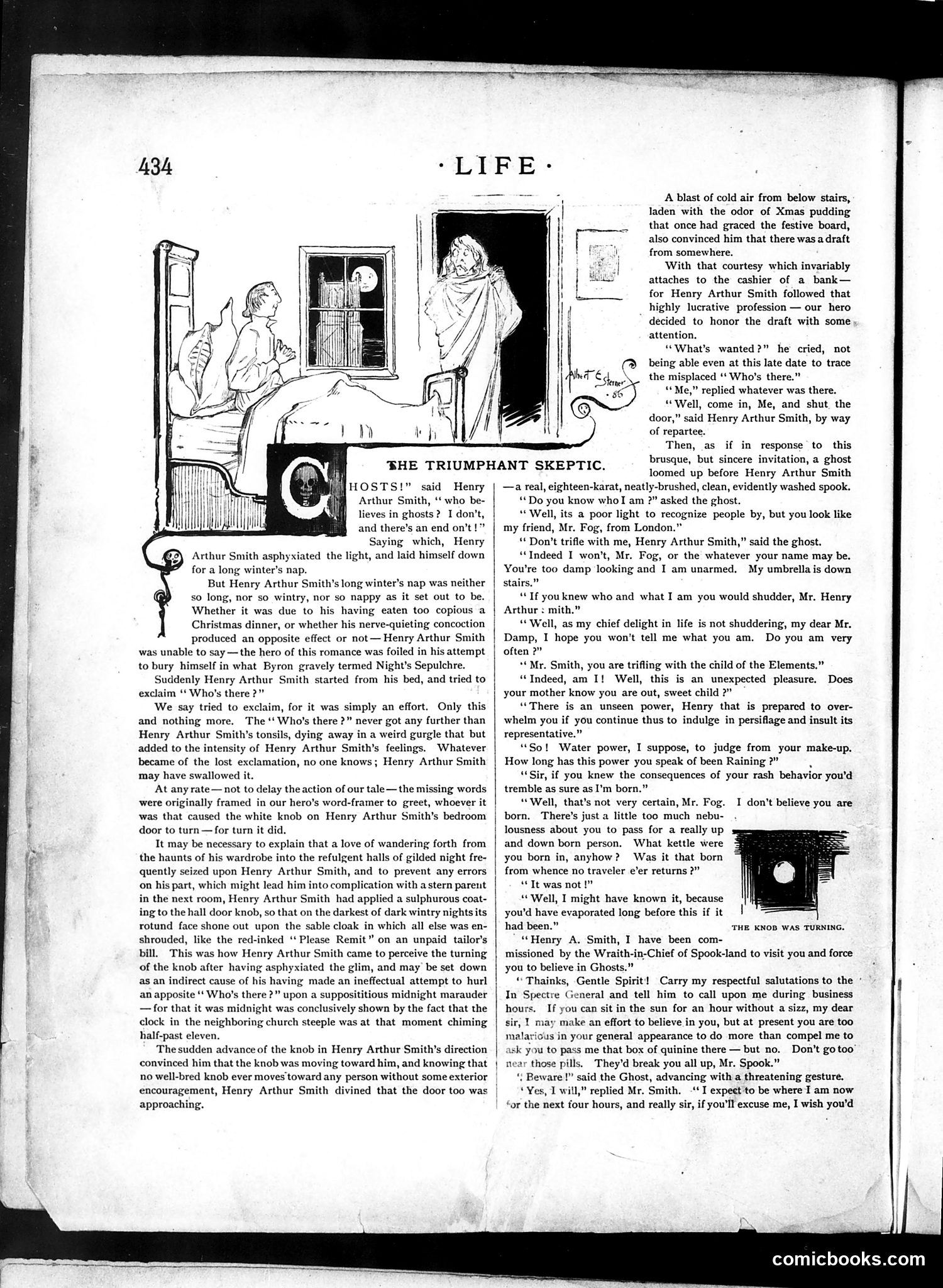
This story satirizes **Henry Arthur Smith**, a skeptic who disbelieves in ghosts. The narrative's humor derives from Smith's rational dismissal of supernatural phenomena, even when confronted with ghostly visitors on Christmas Eve. The cartoon depicts Smith in bed while a ghost appears at his door. Despite the apparition's protestations and increasingly exasperated dialogue, Smith remains unmoved—treating the ghost with bureaucratic indifference, even offering it an umbrella. The satire targets **Victorian-era rationalism and materialism**: Smith represents the modern skeptic so committed to logical explanation that he cannot perceive reality before him. The ghost's frustration mirrors period anxieties about science and reason displacing traditional belief systems. The humor relies on absurdist inversion—the supernatural entity becomes the desperate believer.
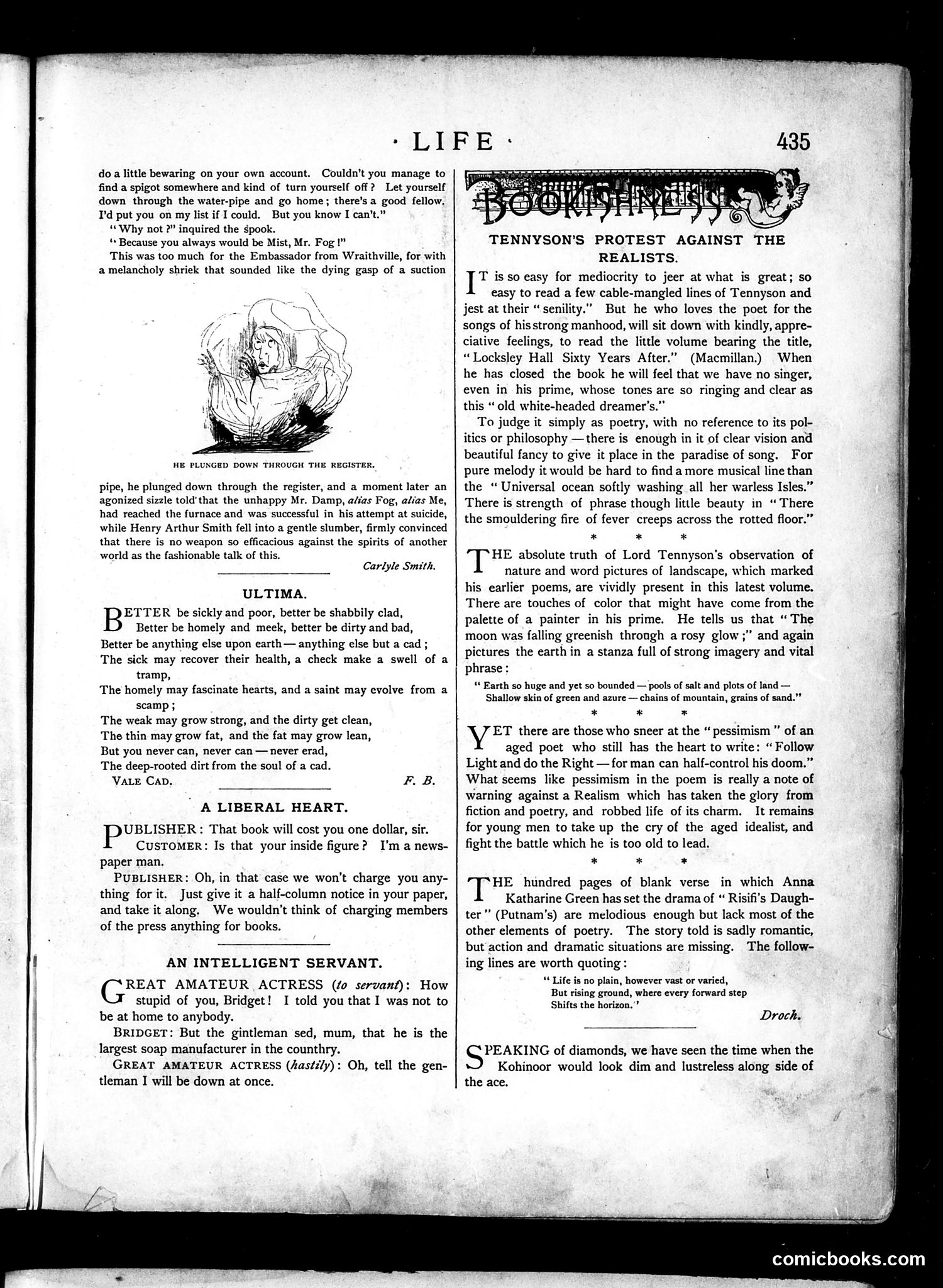
This page contains literary criticism rather than political satire. The main content discusses **Tennyson's "Locksley Hall Sixty Years After,"** defending the aged poet against critics who mock his work as sentimental. The piece argues that readers should appreciate Tennyson's "strong manhood" and poetic skill rather than dismiss him based on subject matter. The cartoons on the page are unrelated comic sketches: 1. **"He Plunged Down Through The Register"** — appears to be a humorous domestic scene about someone falling through a heating register 2. **"A Liberal Heart"** and **"An Intelligent Servant"** — brief comedic dialogues about publishing and employment These are standalone jokes typical of Life magazine's satirical humor, not connected to the Tennyson essay.
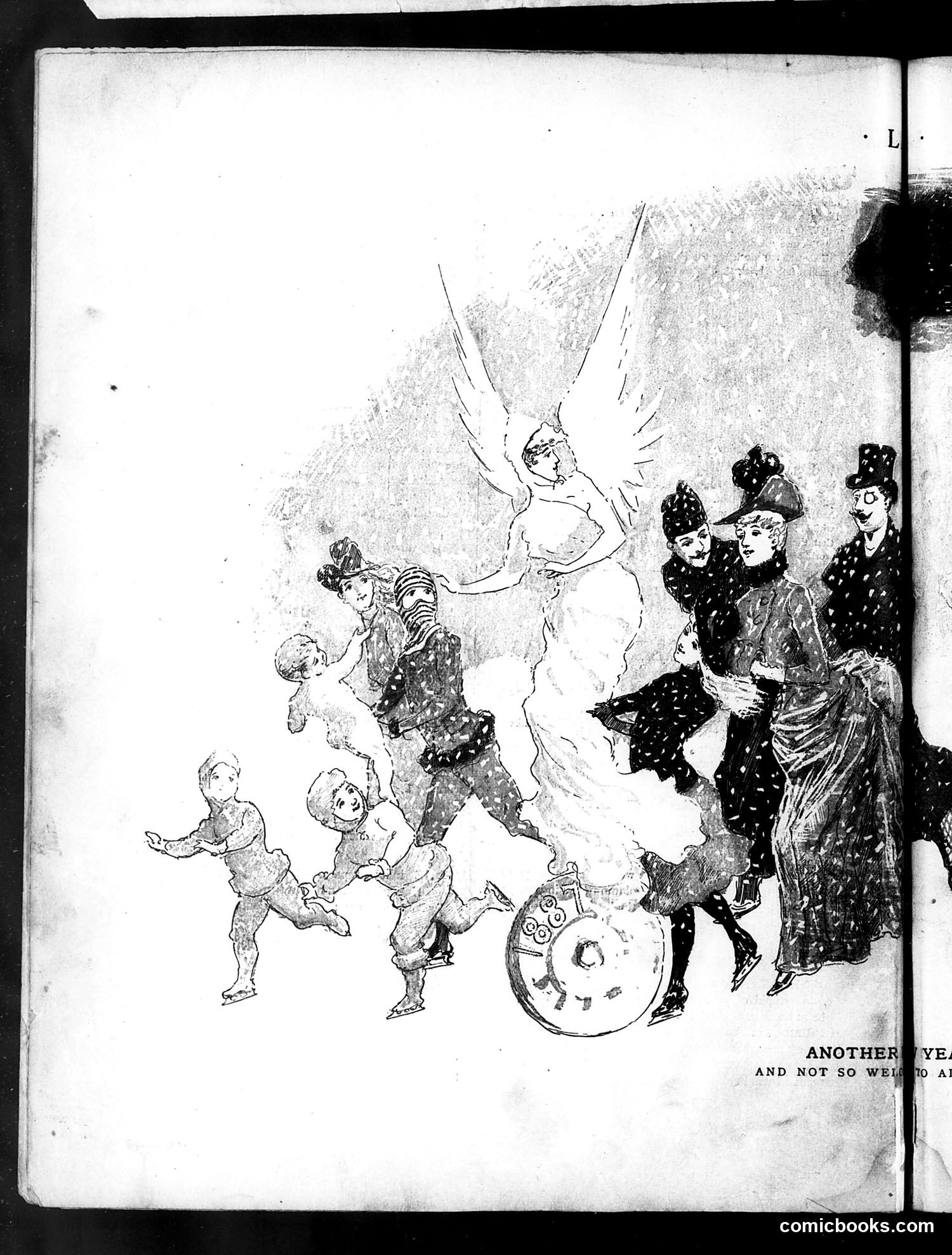
This appears to be a satirical illustration from *Life* magazine depicting a New Year's Eve celebration scene. The image shows elegantly dressed society women on the right observing a chaotic scene on the left featuring cherubs (cupids) playing with what appears to be a large clock or circular mechanical object. The partial caption reads "ANOTHER YE[AR]" and "AND NOT SO WELL TO A[?]," suggesting commentary on how the new year arrived—apparently not as smoothly or pleasantly as hoped. The contrast between the refined spectators and the tumultuous cherub activity likely satirizes the gap between expectations for New Year celebrations and reality. The specific social or political references remain unclear without the complete caption.
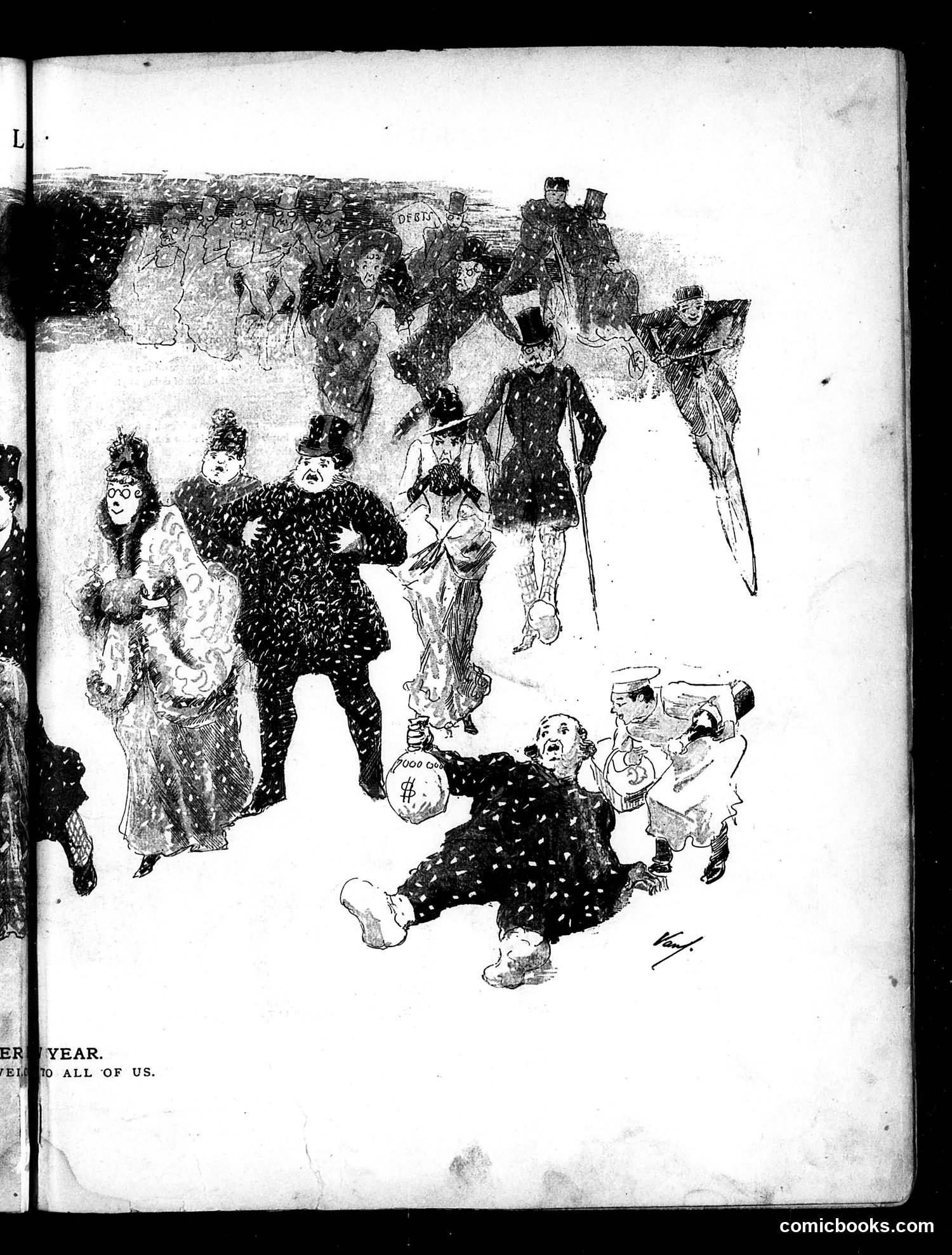
This appears to be a satirical cartoon from Life magazine depicting a New Year's celebration scene. The central figure—a man lying on the ground clutching a money bag marked with a dollar sign—appears to represent financial hardship or economic struggle during what the visible text suggests is commentary on "all of us" facing difficult times. The well-dressed figures surrounding him in formal attire likely represent wealthy or privileged classes. The contrast between the prostrate figure's poverty and the elegant gathering above suggests social commentary on wealth inequality and economic disparity during what was probably a recession or depression era. The cartoon's satirical point: while some celebrate lavishly, ordinary people suffer financially. The "HAPPY NEW YEAR" sentiment is undermined by depicting economic struggle as the actual shared experience.
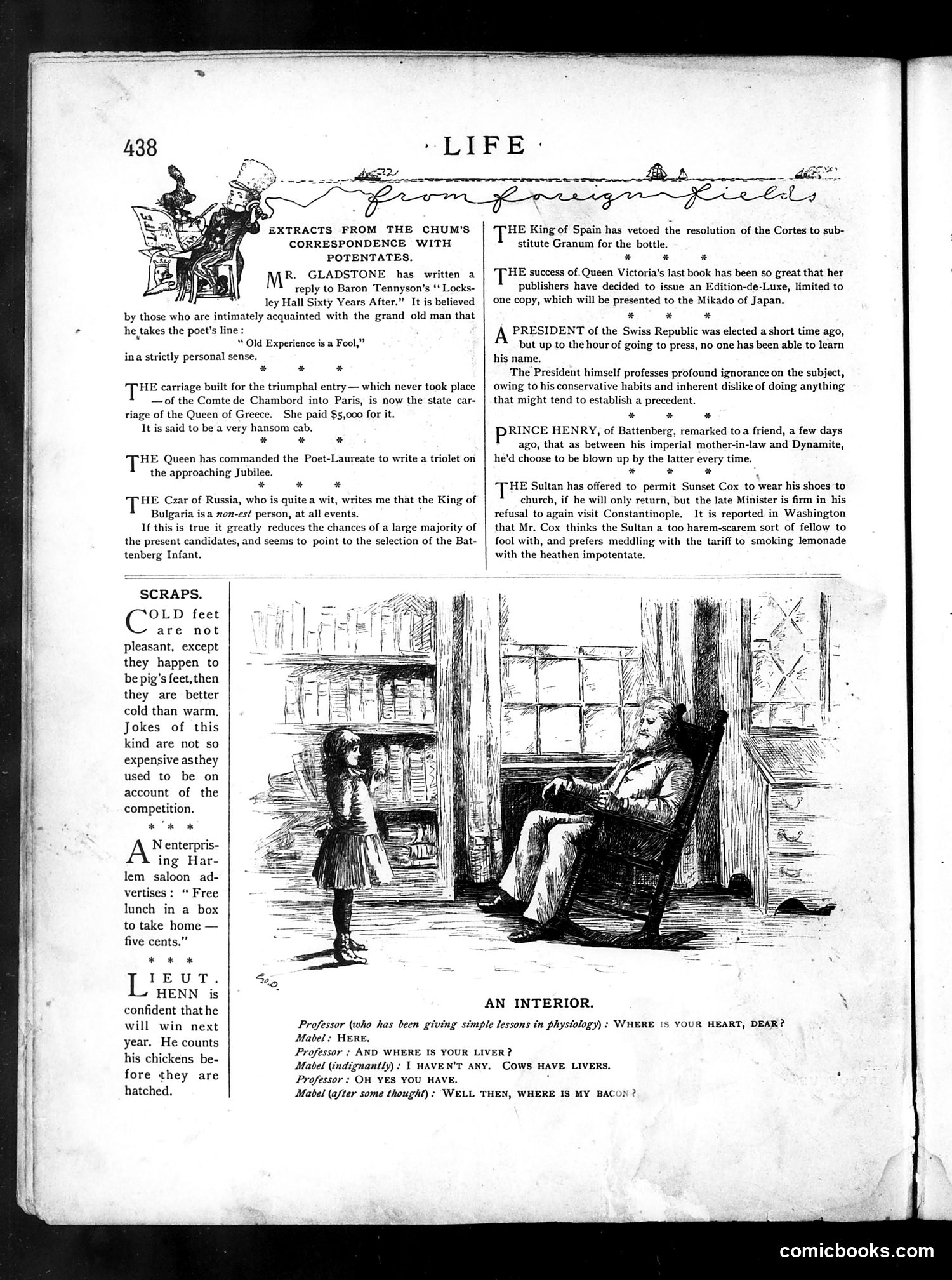
This cartoon depicts a physiology lesson where a **Professor questions a student named Mabel** about human anatomy. The humor relies on Mabel's deliberately obtuse or cheeky answers: - When asked "Where is your heart?" she answers "Here" (pointing somewhere) - Asked about her liver, she claims "I haven't any. Cows have livers" - When asked where her back is, she responds "Well then, where is my bacon?" The satire mocks **Victorian-era education and gender attitudes**—suggesting female students were either genuinely ignorant of basic anatomy or performed ignorance as a form of social propriety. The joke plays on **conflating animal butchery terms with human anatomy**, implying Mabel confuses practical meat-cutting knowledge with biological science. This reflects contemporary anxieties about women's education and intellect.
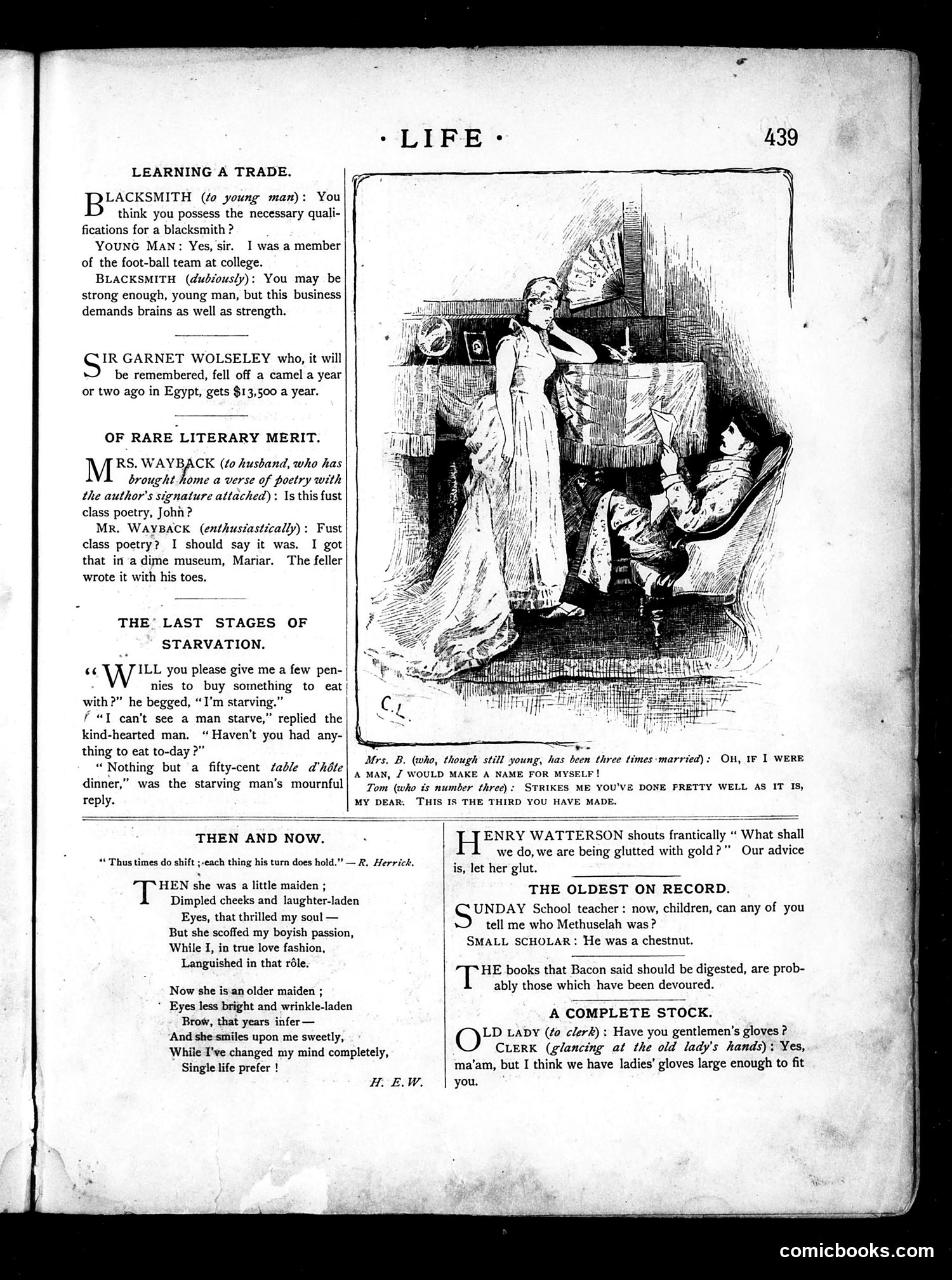
This page contains multiple short satirical jokes typical of *Life* magazine's humor format: **"Learning a Trade"** mocks college football players' intellectual pretensions—a young man claims football experience qualifies him as a blacksmith, prompting the blacksmith to note the job requires "brains as well as strength." **"Of Rare Literary Merit"** ridicules both poetry appreciation and museum culture: a man acquired poetry at a dime museum, supposedly written by someone using their toes. **"The Last Stages of Starvation"** satirizes exaggeration—a beggar claims starvation while having eaten a fifty-cent dinner (a respectable meal), suggesting false poverty claims. **"Then and Now"** uses a poem to joke about aging and romance: a woman who rejected the narrator's youthful advances now courts him, but he's lost interest. **Other brief jokes** include jabs at Mrs. Wayback's multiple marriages, Henry Watterson's complaint about economic surplus, and a clerk's insulting implication about an elderly woman's hand size. The cartoon illustrates the "Tom" domestic scene.
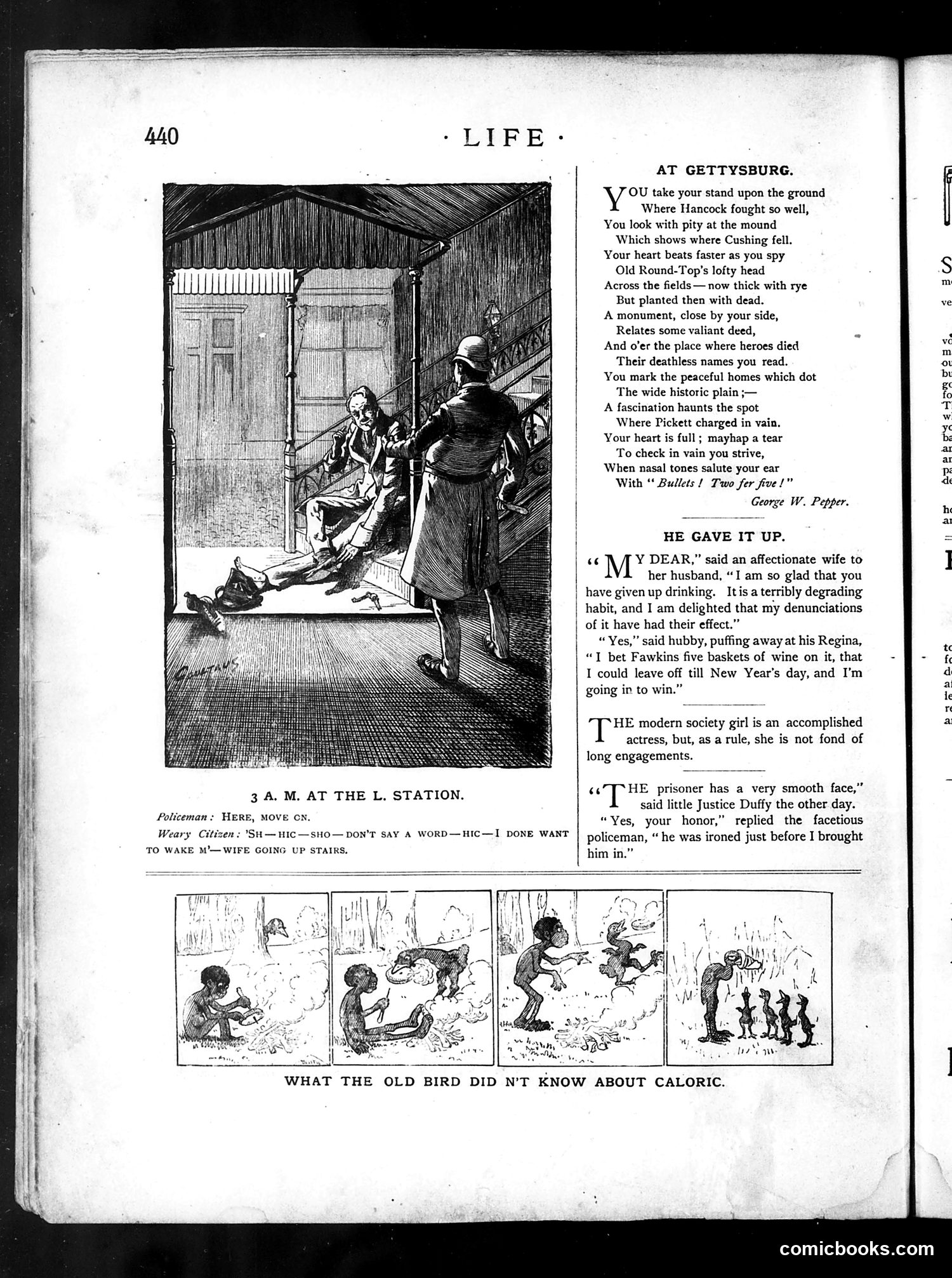
This page contains three satirical pieces typical of early 20th-century American humor: **"At Gettysburg"** is a poem mocking tourists visiting the Civil War battlefield. It contrasts the solemnity of the historical site—where soldiers died, where famous generals like Hancock and Pickett fought—with the crass commercialism of vendors hawking "Bullets! Two fer five!" to visitors. The satire targets American materialism intruding on sacred historical ground. **"He Gave It Up"** jokes about a husband who quit drinking not from virtue but to win a bet with his friend Fawkins—wagering wine baskets that he could abstain until New Year's. The humor lies in his deception of his well-meaning wife. **The bottom cartoon series**, "What the Old Bird Didn't Know About Caloric," appears to depict a moral lesson about food/nutrition through sequential panels, though details are unclear from this reproduction. All three pieces exemplify Life's satirical style: exposing hypocrisy, greed, and human folly in American society.
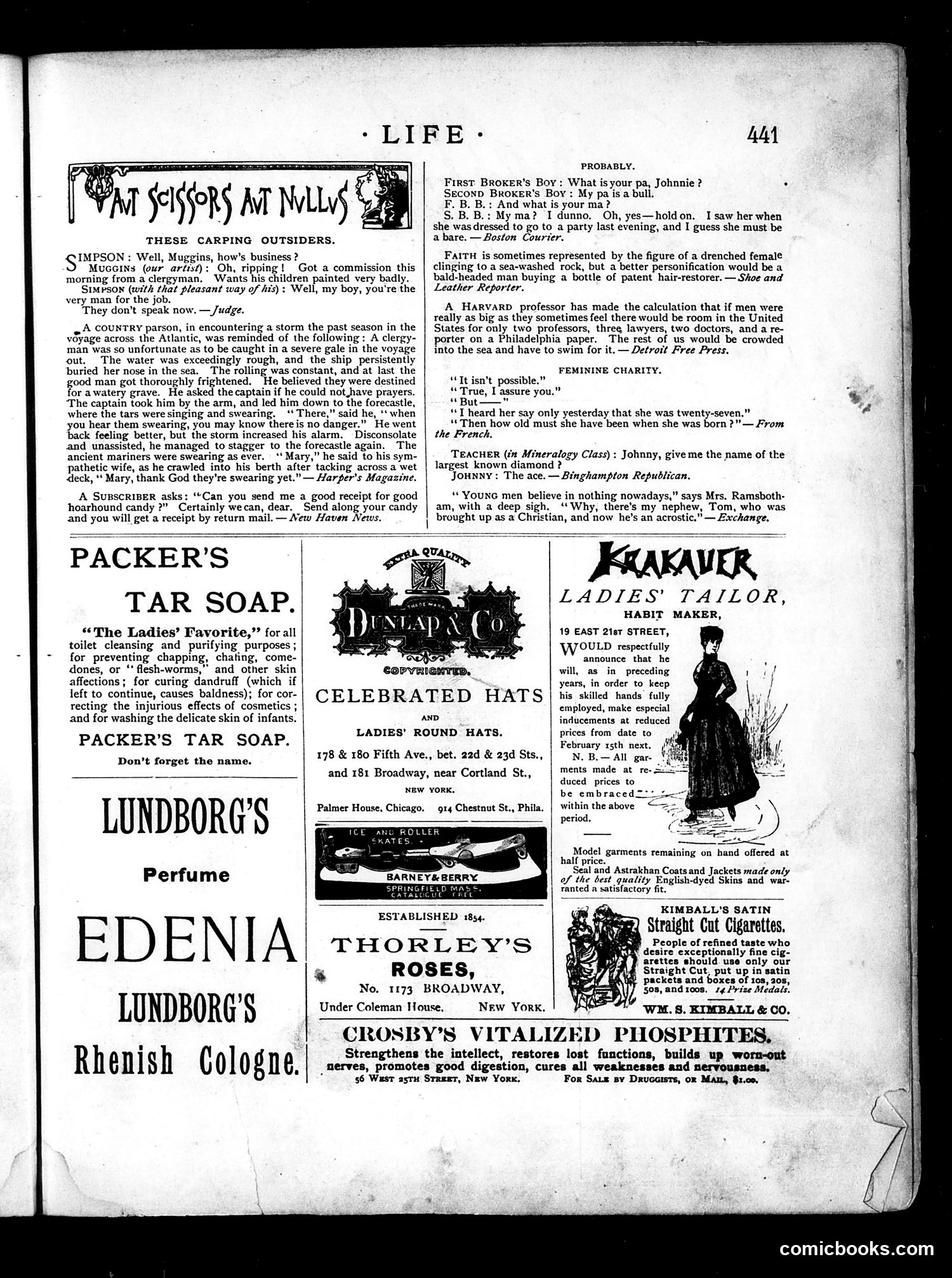
This page from *Life* magazine contains several short humorous anecdotes satirizing social pretense and human nature. The main cartoon "These Carping Outsiders" uses a pun: a clergyman wants his children painted "very badly" (poorly executed), and the artist Simpson is insulted when told he's the perfect man for such bad work. Other jokes mock Victorian social hypocrisy: one piece satirizes women's charity claims (a woman insists another stayed 27 years old, logically impossible). Another jokes about religious hypocrisy—a minister brought up as a Christian is now "an acrostic" (nonsensical, implying he's become something fragmented or meaningless). A Harvard professor joke mocks male ego: if men felt as important as they believe, only two could fit in the United States. The page is primarily **advertisements** for period products (tar soap, perfume, hats, cigars) interspersed with brief satirical humor. The satire targets vanity, pretension, and the gap between self-image and reality—typical *Life* magazine fare from this era.
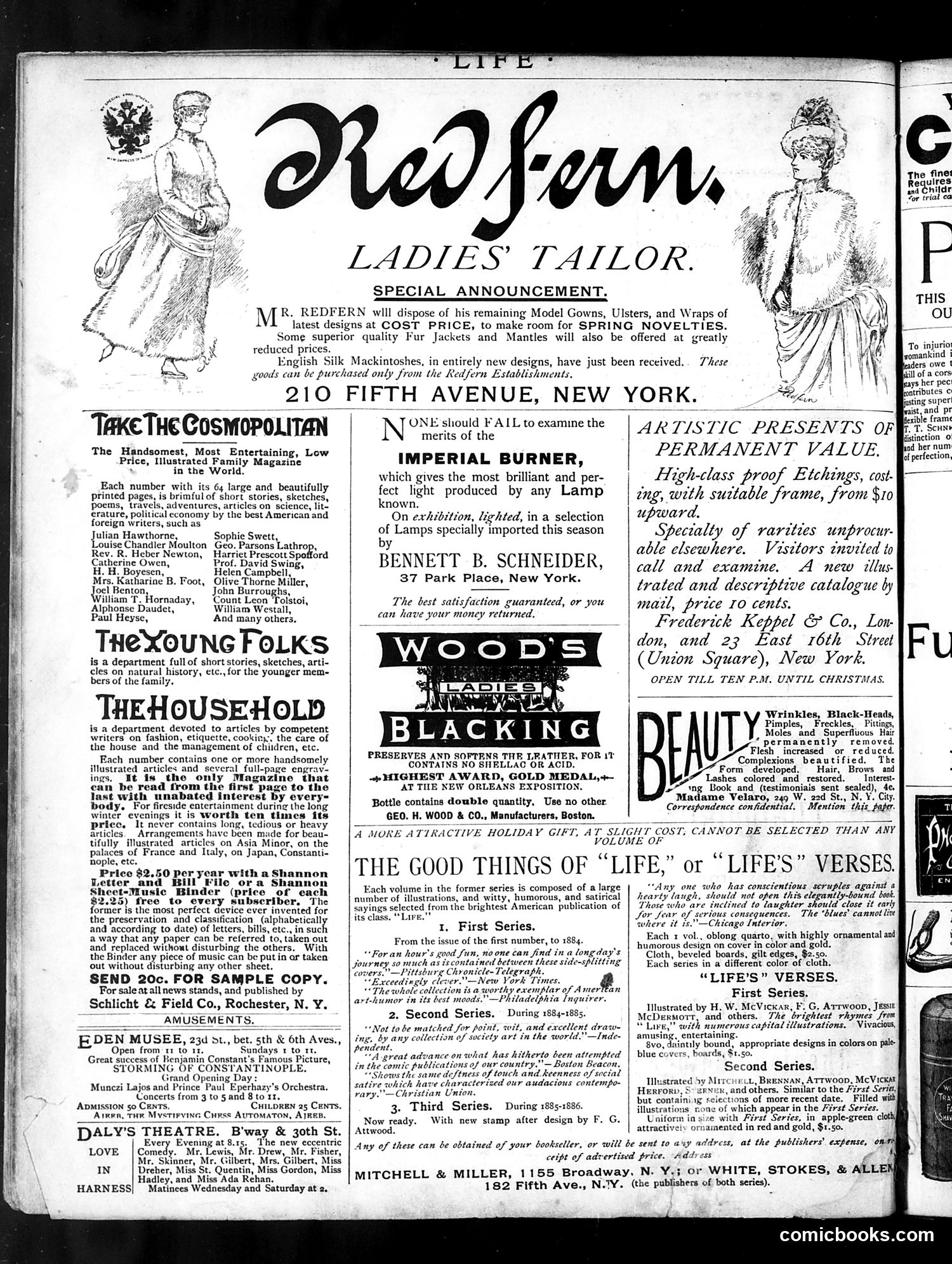
This page is **primarily advertising and promotional content**, not satirical cartoons or political commentary. It's a typical late-19th-century Life magazine layout combining fashion advertisements with magazine subscription promotions. The decorative header features **Red Fern, Ladies' Tailor** at 210 Fifth Avenue, New York, advertising spring clothing at reduced prices to clear inventory. Below are advertisements for *The Cosmopolitan* magazine (promoting its literary contributors and family appeal), *The Young Folks* and *The Household* sections, and various entertainment venues and consumer products (Imperial Burner lamps, Wood's Blacking shoe polish, Beauty products, and theatrical performances at Daly's Theatre). The right column advertises *Life's Verses*—illustrated poetry collections available in multiple series. **There is no political satire or cartoon content visible on this page.** It represents standard commercial publishing practice of the era, where editorial and advertising content mixed freely.
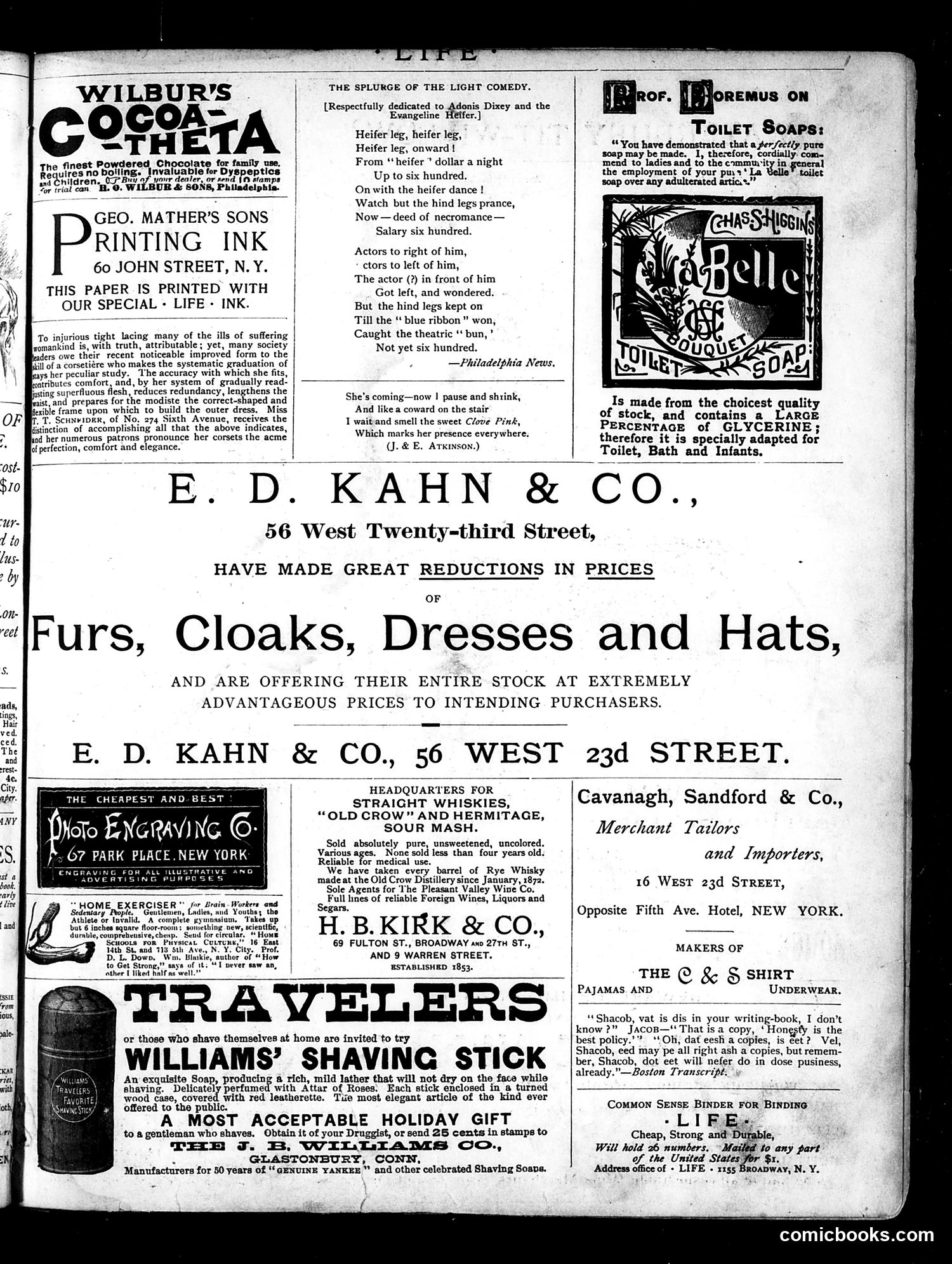
This page is primarily **advertising**, with minimal cartoon content. The text references "The Splurge of the Light Comedy" dedicated to "Adonis Dixey and the Evangeline Heifer," suggesting a theatrical parody. The verse mocks a light comedy performance, with repeated mentions of "heifer leg" and "heifer dance"—likely satirizing either a specific show's weak choreography or the absurdity of contemporary theater. The small comedic dialogue at bottom involves a Jewish character (indicated by dialect spelling: "Shacob," "vat," "eesh") discussing honesty and copying—a common ethnic-stereotype joke format of the era. The rest consists of period advertisements for corsets, printing ink, furs, whiskey, and other goods. Without identifying the specific theatrical production referenced, the main satire appears to target frivolous contemporary entertainment.
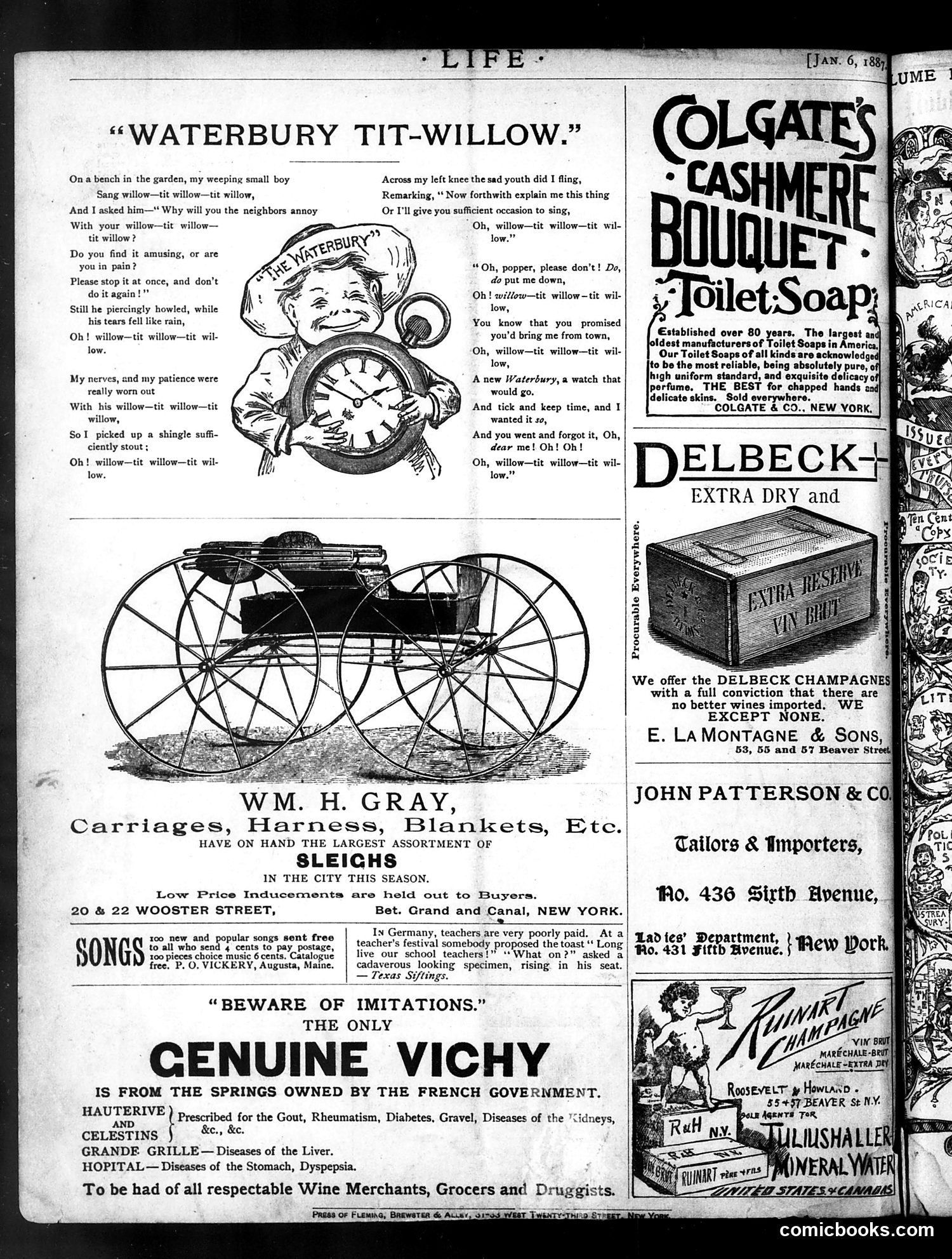
This is a parody of Gilbert & Sullivan's "The Mikado," specifically the song "Tit-Willow." The joke targets the **Waterbury Watch Company** through a narrative where an exasperated father spanks his son for incessantly singing the tune. The satire works on two levels: First, it mocks the annoying, repetitive nature of the song itself—which clearly irritated contemporary readers. Second, and crucially, it's an **advertisement for Waterbury watches disguised as complaint**. The child demands his promised Waterbury watch as punishment ends, making the product name memorable through the very song that frames the entire piece. This represents Victorian-era **satirical advertising**—using humor and pop-culture parody to make the product stick in readers' minds. The accompanying illustration shows a Waterbury clock/watch, reinforcing the commercial message while the humorous narrative keeps readers engaged longer than a standard ad would.