
Life, 1887-01-06 · page 7 of 16
Life — January 6, 1887 — page 7: what you’re looking at
What you’re looking at
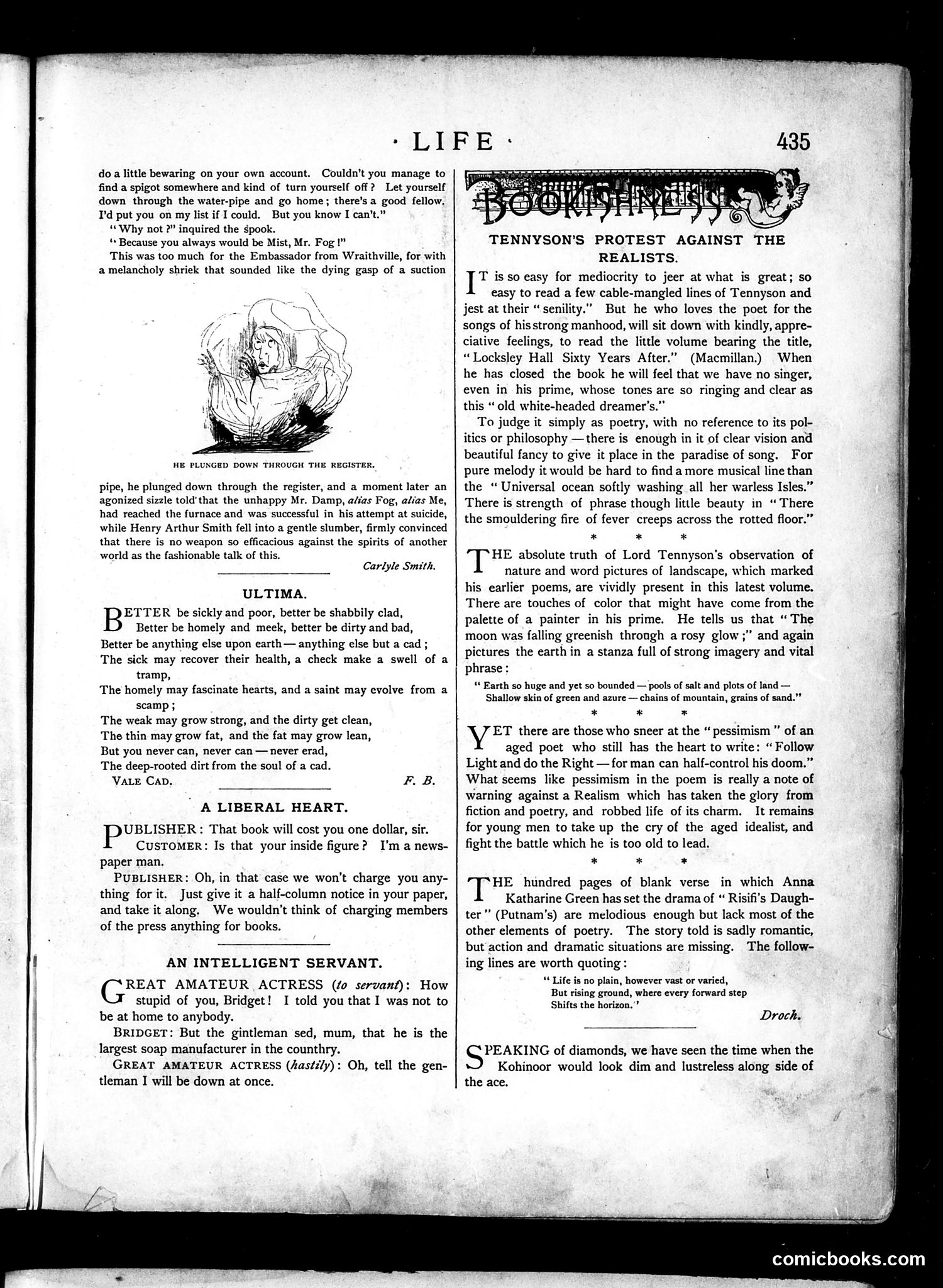
This page contains literary criticism rather than political satire. The main content discusses **Tennyson's "Locksley Hall Sixty Years After,"** defending the aged poet against critics who mock his work as sentimental. The piece argues that readers should appreciate Tennyson's "strong manhood" and poetic skill rather than dismiss him based on subject matter. The cartoons on the page are unrelated comic sketches: 1. **"He Plunged Down Through The Register"** — appears to be a humorous domestic scene about someone falling through a heating register 2. **"A Liberal Heart"** and **"An Intelligent Servant"** — brief comedic dialogues about publishing and employment These are standalone jokes typical of Life magazine's satirical humor, not connected to the Tennyson essay.
📄 Transcribed text from this page (OCR, searchable)
Machine-transcribed from the original scan — historical spelling and the odd misread are preserved.
ULDFE > do a little bewaring on your own account. Couldn't you manage to find a spigot somewhere and kind of turn yourself off? Let yourself down through the water-pipe and go home; there’s a good fellow. I'd put you on my list if I could. But you know I can't.” “Why not ?” inquired the spook. “Because you always would be Mist, Mr. Fog !” This was too much for the Embassador from Wraithville, for with a melancholy shriek that sounded like the dying gasp of a suction HE PLUNGED DOWN THROUGH THE REGISTER. pipe, he plunged down through the register, and a moment later an agonized sizzle told'that the unhappy Mr. Damp, a/ias Fog, alias Me, had reached the furnace and was successful in his attempt at suicide, while Henry Arthur Smith fell into a gentle slumber, firmly convinced that there is no weapon so efficacious against the spirits of another world as the fashionable talk of this. Carlyle Smith, ULTIMA. ETTER be sickly and poor, better be shabbily clad, Better be homely and meek, better be dirty and bad, Better be anything else upon earth— anything else but a cad ; The sick may recover their health, a check make a swell of a tramp, The homely may fascinate hearts, and a saint may evolve from a scamp ; ‘The weak may grow strong, and the dirty get clean, The thin may grow fat, and the fat may grow lean, But you never can, never can — never erad, The deep-rooted dirt from the soul of a cad. VALE Cab. ‘A LIBERAL HEART. UBLISHER : That book will cost you one dollar, sir. CusToMER: Is that your inside figure? I’m a news- Paper man. PUBLISHER: Oh, in that case we won’t charge you any- thing for it. Just give it a half-column notice in your paper, and take it along. We wouldn't think of charging members of the press anything for books. AN INTELLIGENT SERVANT. REAT AMATEUR ACTRESS (é0 servant): How stupid of you, Bridget! I told you that I was not to be at home to anybody. BRIDGET: But the gintleman sed, mum, that he is the largest soap manufacturer in the counthry. GREAT AMATEUR ACTRESS (hastily): Oh, tell the gen- tleman I will be down at once. REALISTS. T is so easy for mediocrity to jeer at what is great; so easy to read a few cable-mangled lines of Tennyson and jest at their “senility.” But he who loves the poet for the songs of his strong manhood, will sit down with kindly, appre- ciative feelings, to read the little volume bearing the title, “Locksley Hall Sixty Years After.” (Macmillan.) When he has closed the book he will feel that we have no singer, even in his prime, whose tones are so ringing and clear as this “old white-headed dreamer's.” To judge it simply as poetry, with no reference to its pol- itics or philosophy —there is enough in it of clear vision and beautiful fancy to give it place in the paradise of song. For pure melody it would be hard to find a more musical line than the “ Universal ocean softly washing all her warless Isles.” There is strength of phrase though little beauty in “There the smouldering fire of fever creeps across the rotted floor.” * * * HE absolute truth of Lord Tennyson's observation of nature and word pictures of landscape, which marked his earlier poems, are vividly present in this latest volume. There are touches of color that might have come from the palette of a painter in his prime. He tells us that “ The moon was falling greenish through a rosy glow ;” and again pictures the earth in a stanza full of strong imagery and vital phrase: “ Earth so huge and yet so bounded — pools of salt and plots of land — Shallow skin of green and azure — chains of mountain, grains of sand.”” * * x ET there are those who sneer at the “ pessimism ” of an aged poet who still has the heart to write: “Follow Light and do the Right — for man can half-control his doom.” What seems like pessimism in the poem is really a note of warning against a Realism which has taken the glory from fiction and poetry, and robbed life of its charm. It remains for young men to take up the cry of the aged idealist, and fight the battle which he is too old to lead. * * * HE hundred pages of blank verse in which Anna Katharine Green has set the drama of “ Risifi's Daugh- ter” (Putnam’s) are melodious enough but lack most of the other elements of poetry. The story told is sadly romantic, but action and dramatic situations are missing. The follow- ing lines are worth quoting: “ Life is no plain, however vast or varied, But rising ground, where every forward step Shifts the horizon.”” Droch. PEAKING of diamonds, we have seen the time when the Kohinoor would look dim and lustreless along side of the ace. comicbooks.com