
A complete issue · 16 pages · 1886
Life — September 2, 1886
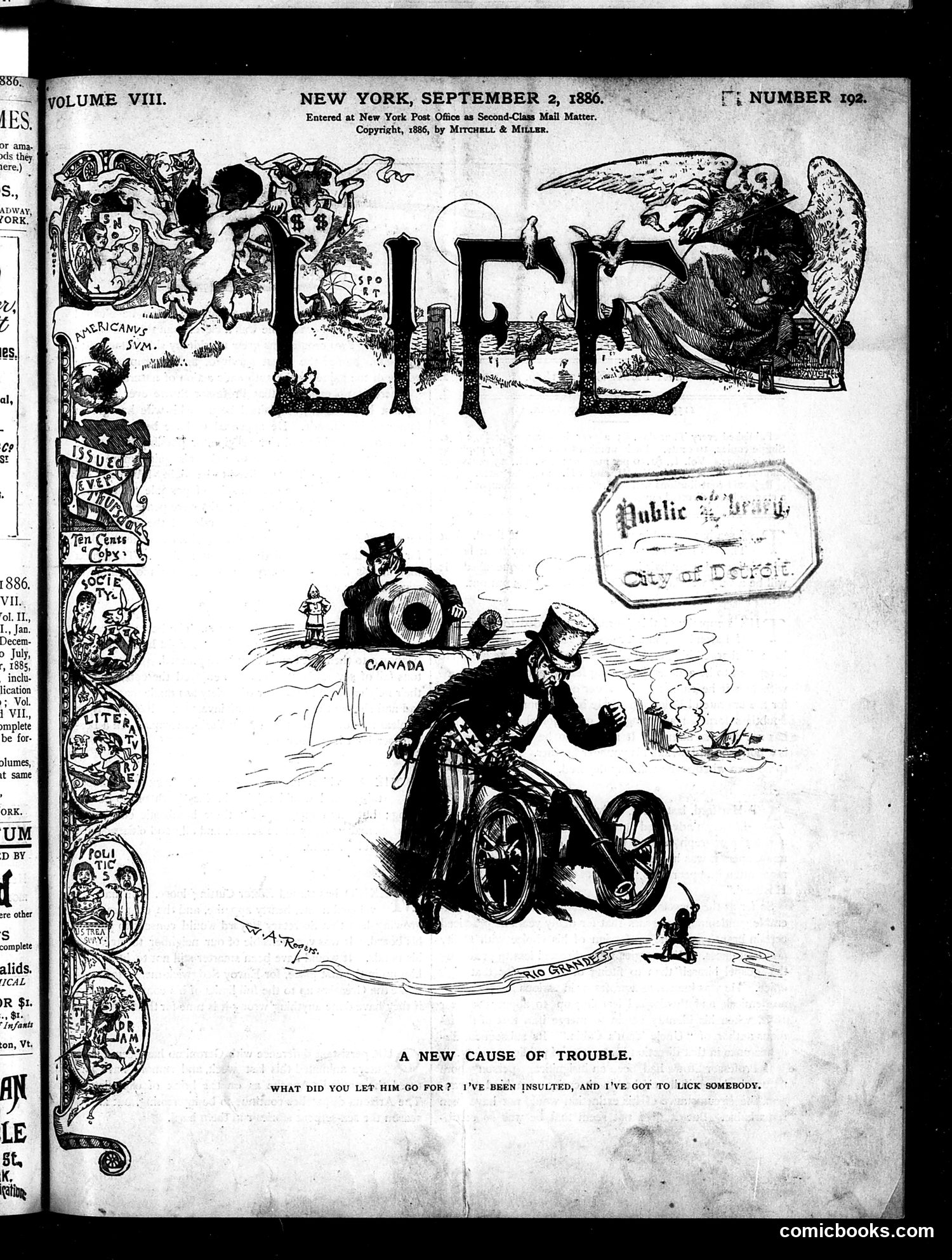
This 1886 *Life* magazine cartoon depicts a figure on a bicycle labeled "Rio Grande" being chased by what appears to be a Canadian official or military figure emerging from behind "Canada." The cyclist's speech bubble reads: "What did you let him go for? I've been insulted, and I've got to lick somebody." The cartoon appears to reference a border dispute or incident involving the Rio Grande (the U.S.-Mexico border) and Canadian-American tensions. The bicycle as transportation suggests modernity meeting political conflict. The figure's aggressive stance indicates escalating hostilities, likely satirizing how one international dispute prompts retaliation against another party—commenting on broader geopolitical tensions of the 1880s involving multiple borders.
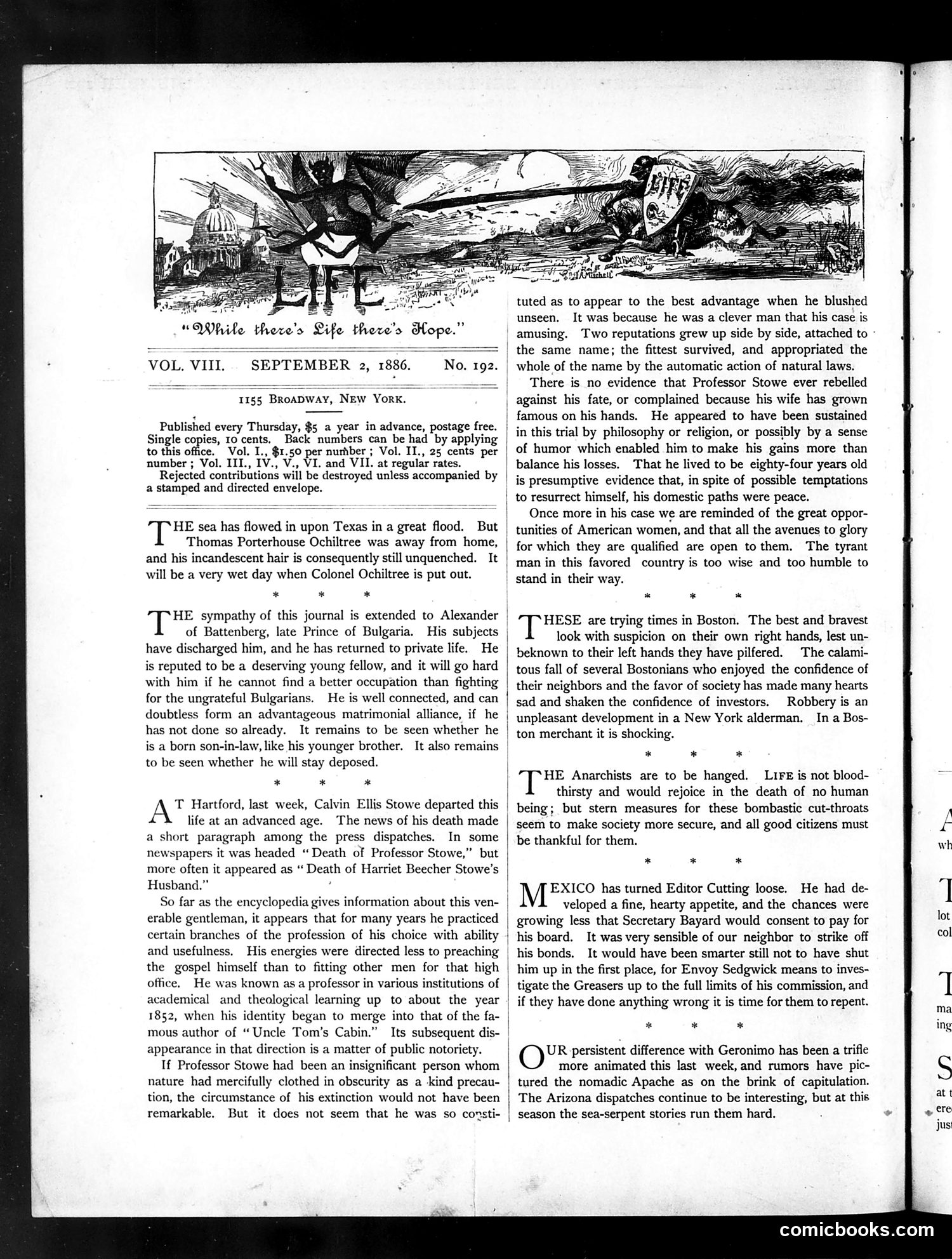
The main cartoon depicts a domestic scene with the caption "While there's Life there's Hope," likely illustrating a marriage or domestic relationship surviving despite difficulties. The text below discusses various contemporary issues: Thomas Porterhouse Ochiltree and a Texas flood; Alexander of Battenberg's return to private life in Bulgaria; Calvin Ellis Stowe's death; and Boston robbery concerns. A significant passage addresses "The Anarchists are to be hanged," referencing the Haymarket affair aftermath, where Chicago anarchists faced execution. The content reflects 1886's turbulent social climate—labor unrest, political upheaval abroad, and crime—presented with Life magazine's characteristic satirical commentary on current events and prominent figures of the era.
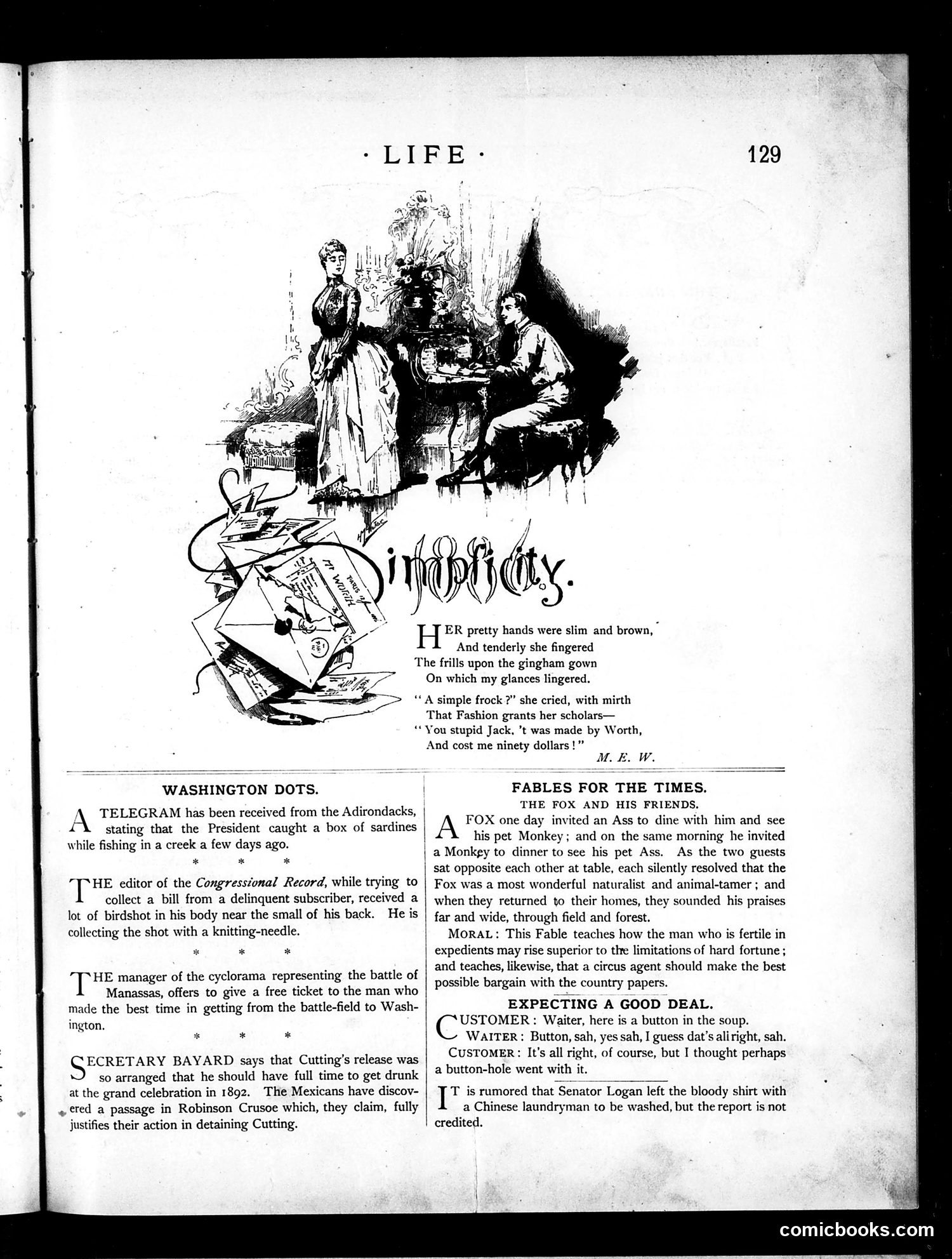
This page from *Life* magazine features satirical content and humor pieces typical of the publication's style. The main illustration shows a Victorian-era domestic scene with a woman and man examining what appears to be a gingham gown. The accompanying poem references fashion and a woman's "pretty hands" and "gingham gown," suggesting this is social satire about fashion pretensions. Below are several brief humorous anecdotes labeled "Washington Dots," mocking political figures and events. These include jokes about a congressman collecting a bill, a cyclorama manager, and Secretary Bayard's drinking arrangements. The "Fables for the Times" section offers moral tales, including "The Fox and His Friends," satirizing social climbing and false friendship. The page reflects *Life*'s focus on satirizing American politics, fashion, and social behavior of the period, though specific political figures aren't clearly identified in this particular section.
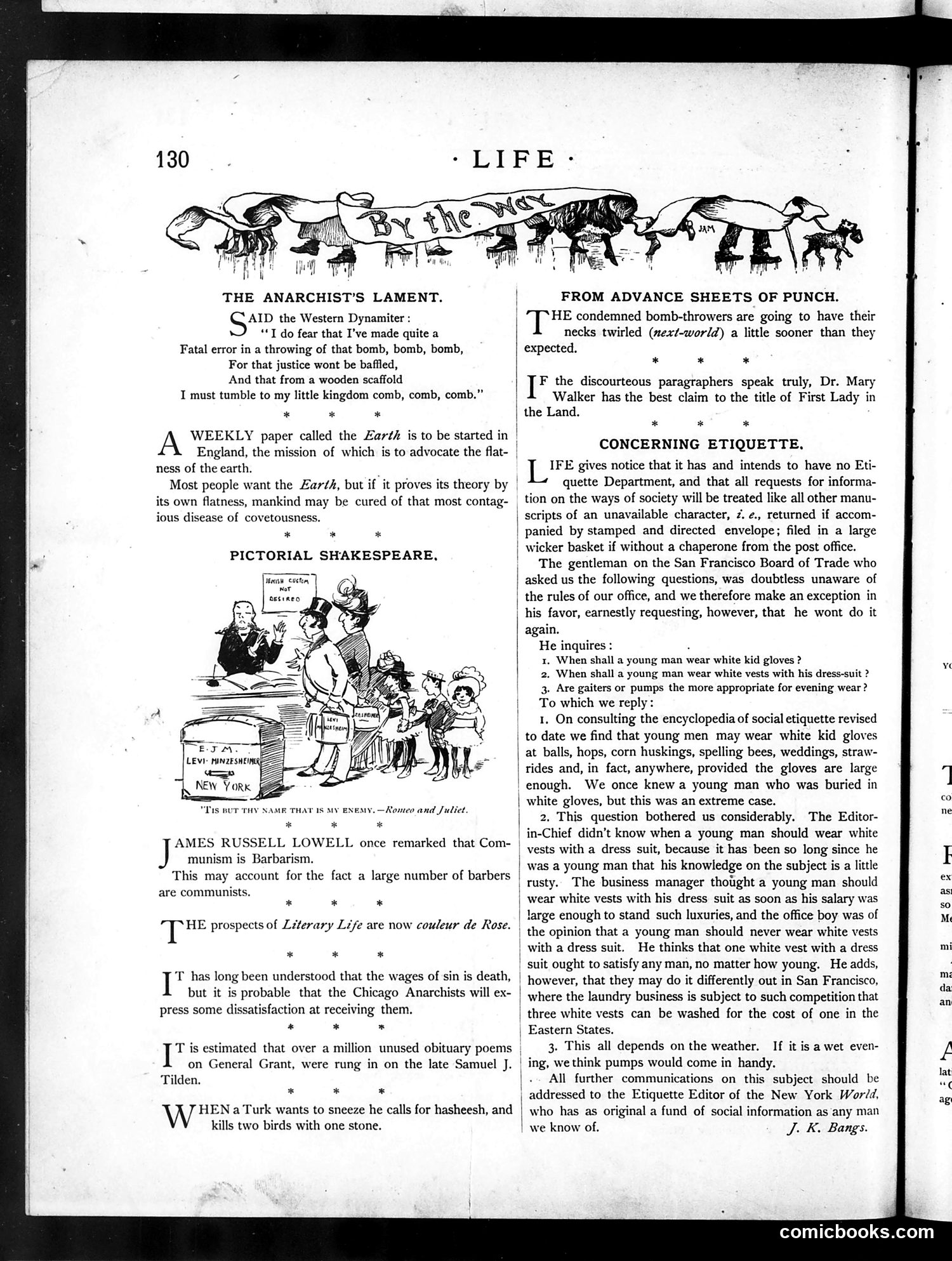
**"The Anarchist's Lament"** satirizes a dynamiter lamenting his failed bomb attack. The verse mocks anarchist violence while playing on the perpetrator's self-pity about legal consequences—a reference to the late 19th/early 20th century anarchist bombings that terrorized American cities. **"Pictorial Shakespeare"** cartoon appears to show a scene with multiple figures around what looks like a barrel or container labeled with New York references, likely satirizing how Shakespeare's works were being adapted or commercialized in America. The remaining items are brief satirical notes on topics including a flat-earth advocacy publication, literary prospects, and social observations—typical of Life's style mixing visual and textual humor targeting contemporary figures and movements.
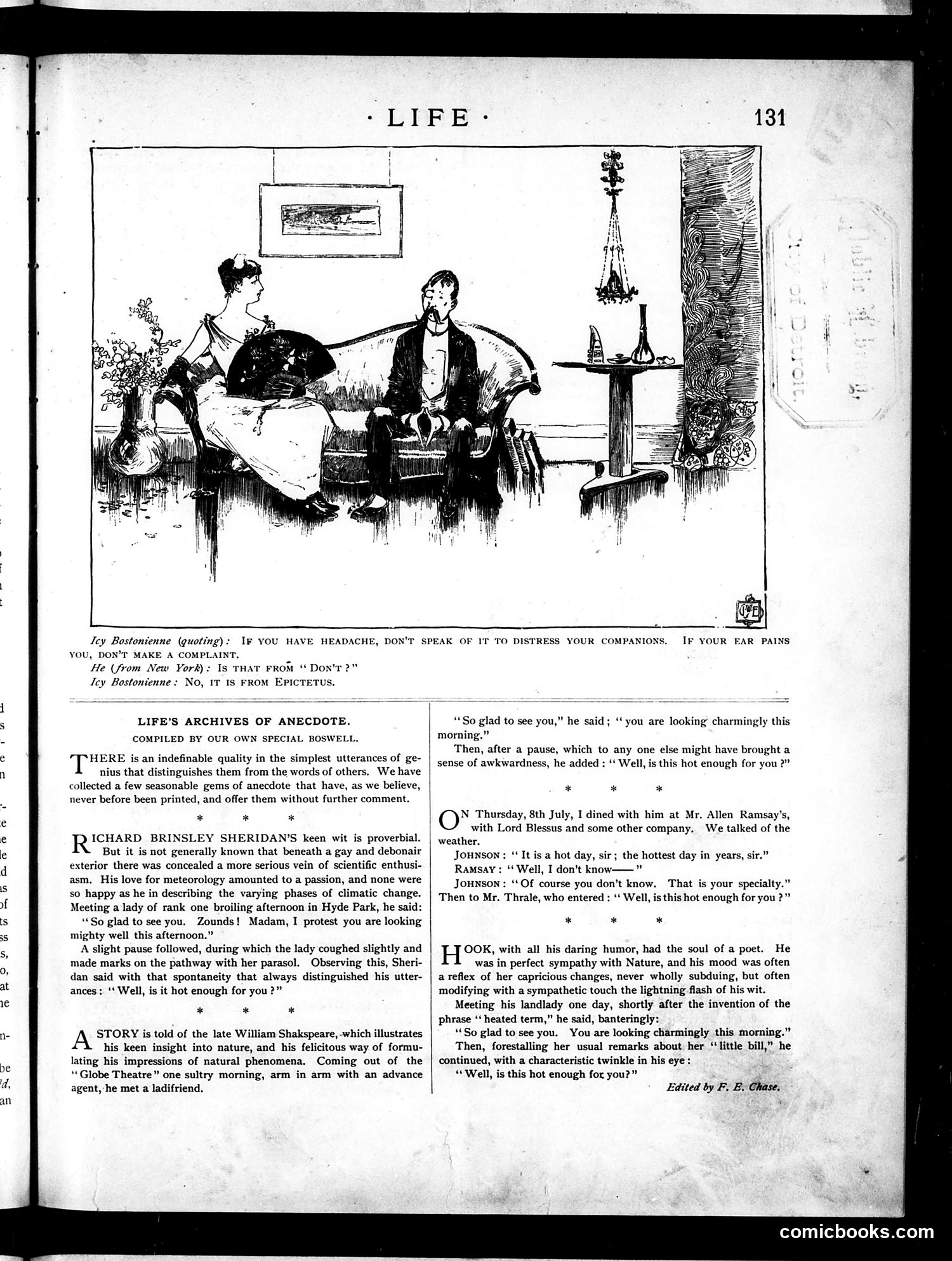
The cartoon at top depicts a social etiquette scenario. A woman and man sit together in an interior setting; the accompanying caption presents a humorous "Bostonienne" (Boston woman) offering advice about discretion: if you have a headache, don't mention it to companions, and if your ear pains, make no complaint. The joke satirizes upper-class Boston social conventions—specifically the expectation that women should maintain composure and avoid discussing physical discomforts in polite company, as doing so might burden one's companions. This reflects early 20th-century attitudes about feminine propriety and emotional restraint among the elite. The remainder of the page contains "Life's Archives of Anecdote," a section compiling amusing stories and observations. The anecdotes reference figures like Richard Brinsley Sheridan (18th-century playwright) and various social situations, but lack clear political significance.
This page contains literary content and social commentary rather than political cartoons. The main sections include: **"A Louer"** — Three poems about romantic heartbreak and loss of love, attributed to Sheffield Phelps. **"Social Contempt in Fiction"** — A critique of novelist Mr. Howells, praised for depicting American social attitudes. The text argues his "Studies of American Vulgarity" successfully mock pretentiousness in American life, particularly regarding dress, speech, and manners. It defends his satirical approach against those who find his dissections of peculiarities too harsh. **"Mottoes"** — Brief humorous sayings about various social types (fighters, seamstresses, speculators, messengers, etc.). The page functions as cultural commentary on American society and literature rather than visual satire.
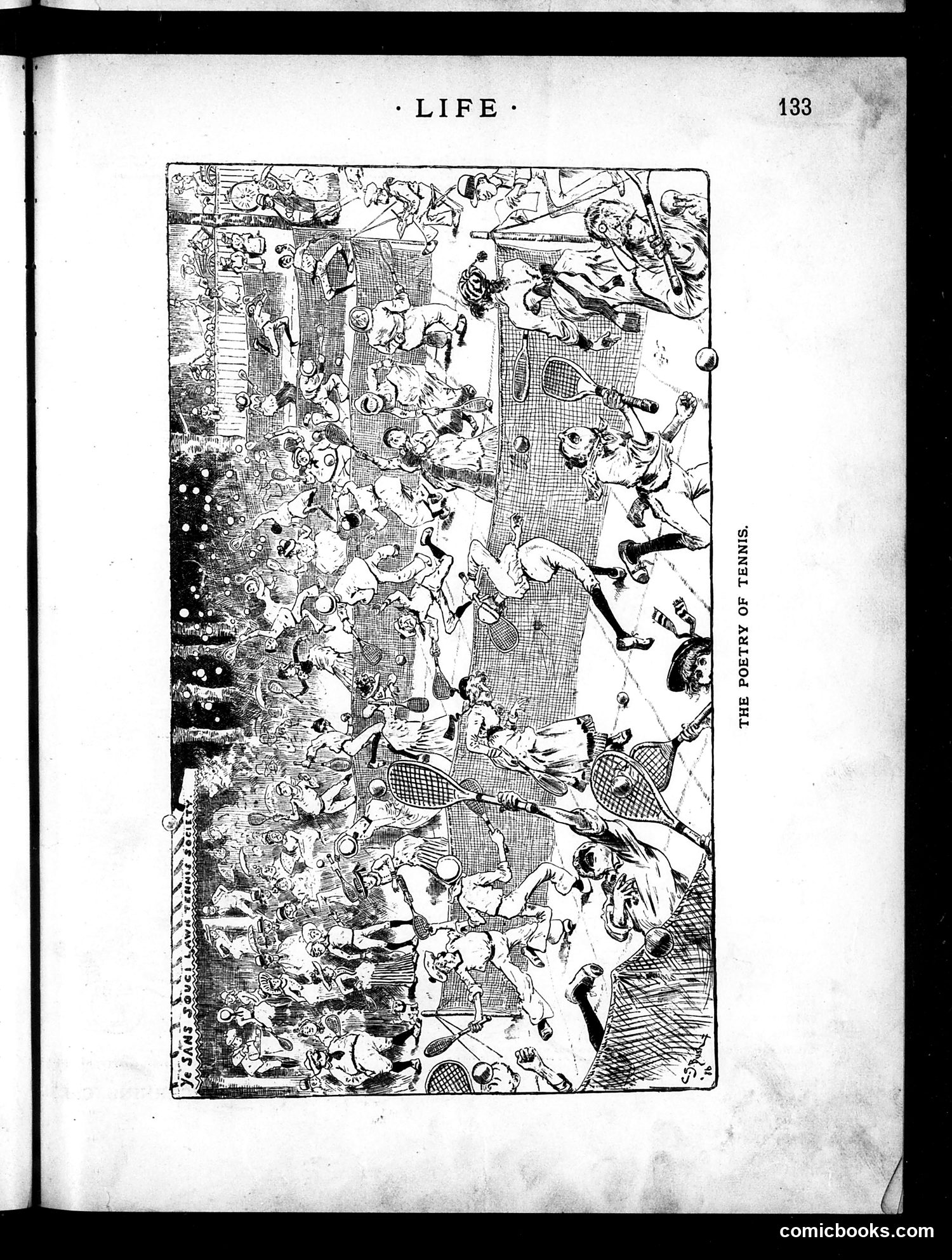
This satirical cartoon depicts a chaotic tennis match, likely from the early 1900s based on the Life magazine publication style. The image is oriented sideways and shows numerous players engaged in frenzied activity on a tennis court, with tennis rackets and balls scattered throughout. The satire appears to mock the absurdity and frenzy of competitive tennis culture—the title "The Pottery of Tennis" suggests the fragile, breakable nature of the sport or its participants. The overcrowding and chaos ridicule either tennis's growing popularity or specific social pretensions surrounding the sport among the wealthy classes who played it. The exaggerated, tumbling figures emphasize the undignified scrambling beneath tennis's supposedly genteel reputation.
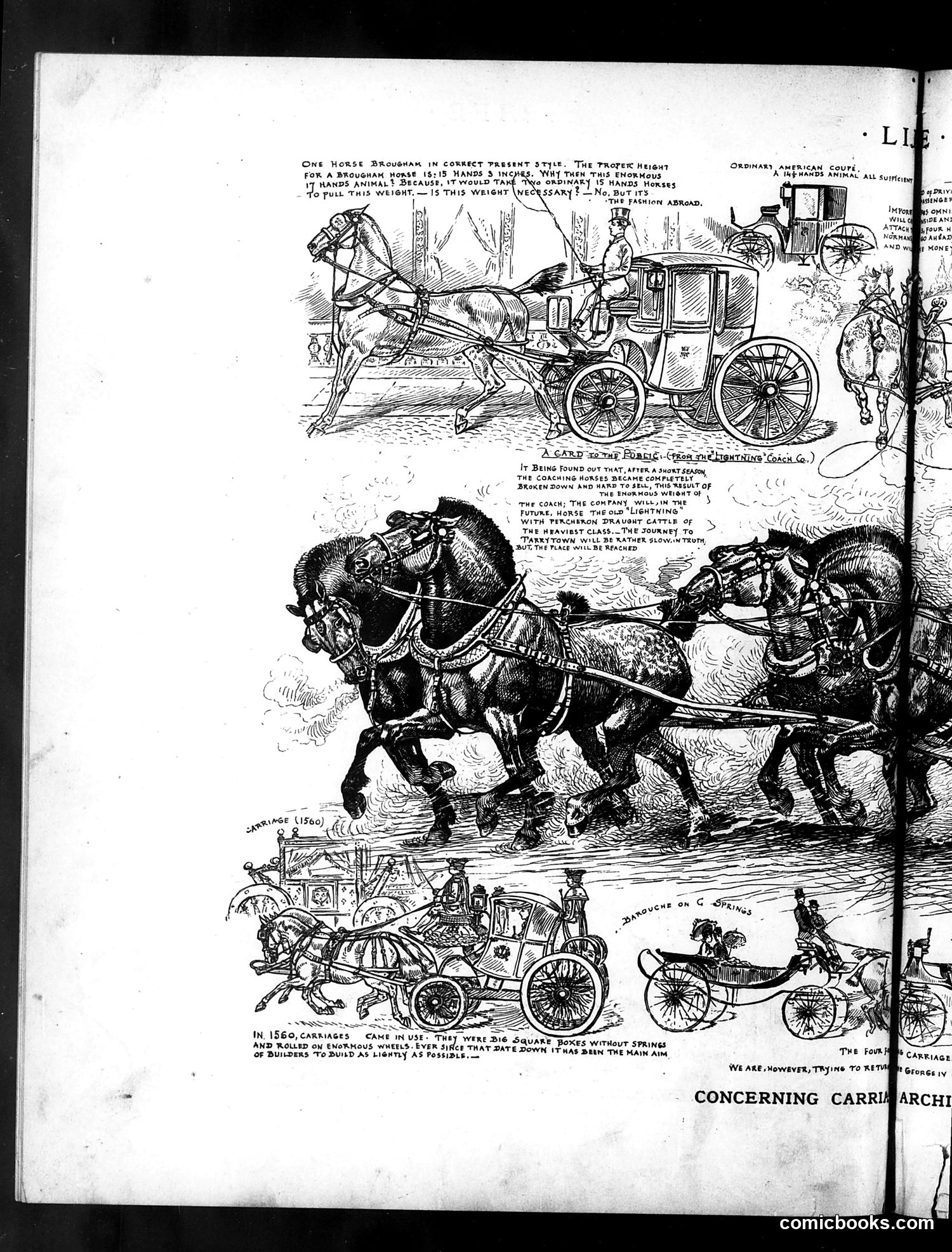
This page satirizes the evolution of horse-drawn carriages through detailed technical illustrations. The top section shows "one horse brougham in correct present style" — a modern enclosed carriage — contrasted with elaborately decorated vehicles below. The middle section depicts a pair-horse carriage, while the bottom shows various carriage designs labeled "carriage (1860)" and "barouche on C springs." The satire appears to mock the increasingly complex engineering and ornamentation of Victorian carriages. Text references spring mechanisms and structural details, suggesting the piece critiques how carriage design had become needlessly complicated or pretentious. This reflects broader 19th-century Life magazine humor about technological excess and class-consciousness in transportation design. The heading "Concerning Carriage Architecture" indicates this is part of a longer feature on the topic.
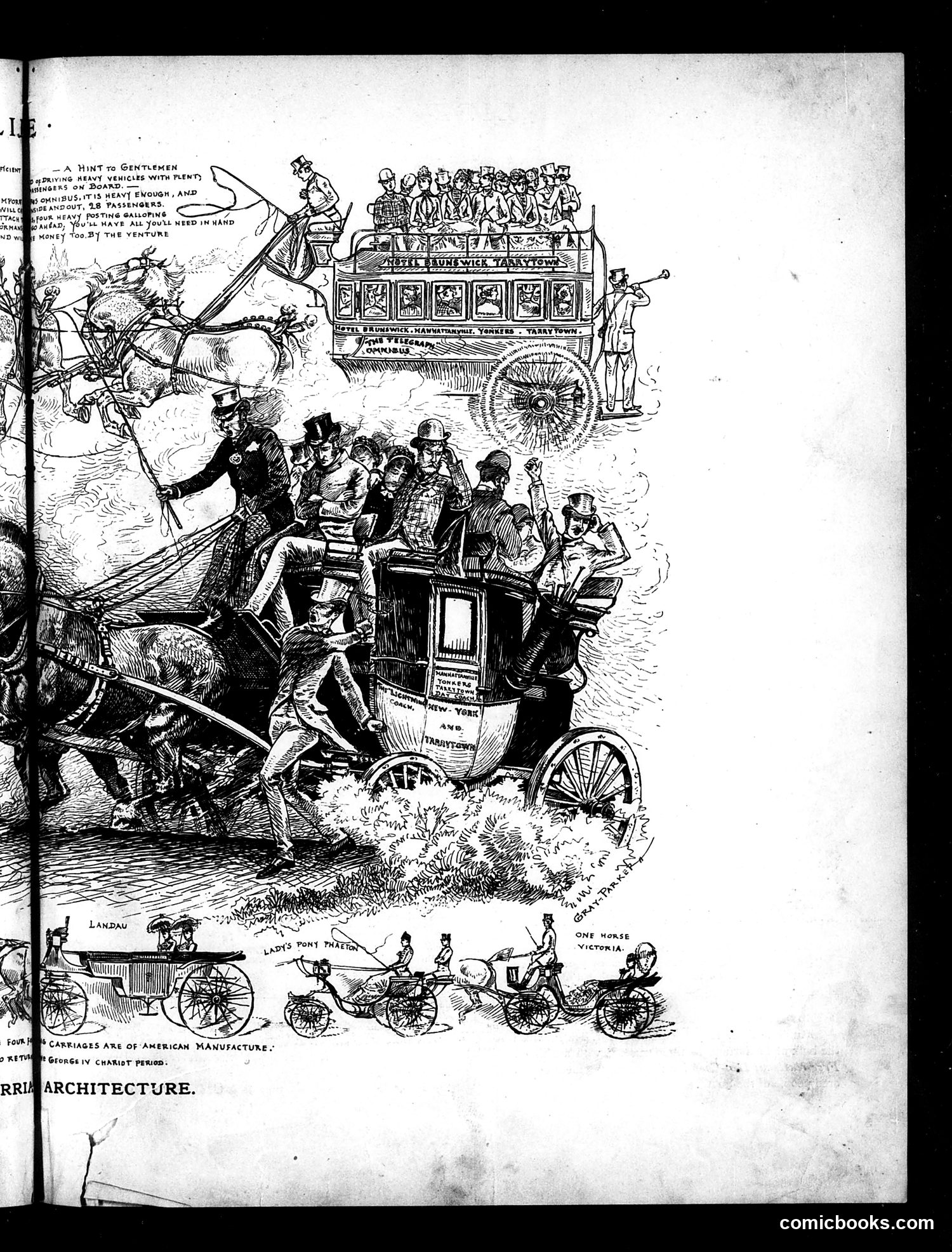
This illustration satirizes American carriage design and manufacturing through exaggerated "architecture." The main image shows an absurdly overcrowded omnibus-style carriage labeled "Hotel Brunswick," packed with passengers on multiple levels, pulled by struggling horses. The caption notes these are "American Manufacture" carriages, suggesting they're poorly designed despite American industrial pride. Below are smaller examples of different carriage styles (Landau, Lady's Phaeton, Victoria, One-Horse Victoria), labeled "Carriage Period Architecture." The satire mocks how American manufacturers prioritize passenger capacity and ornamentation over practical design and animal welfare. The horses appear exhausted, emphasizing the dysfunction of these vehicles. The piece critiques American industrial excess and poor engineering ethics in the transportation industry.
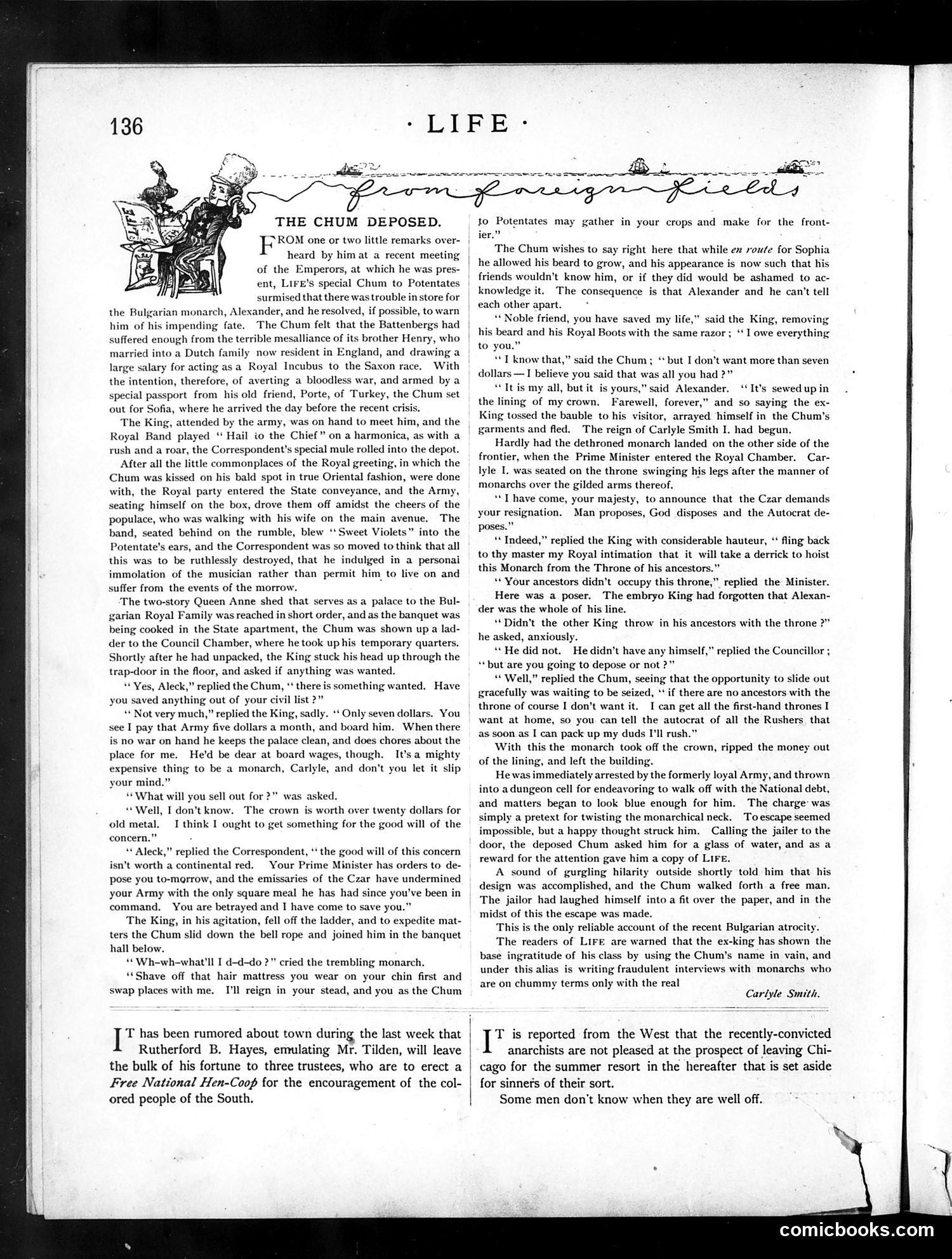
This satirical piece mocks a recent meeting where Life's "special Chum to Potentates" was supposedly rebuked by the Bulgarian Emperor Alexander. The narrative describes the Chum—a figure holding special royal favor—being humiliated after his long service. The cartoon depicts a rotund, elaborately-dressed man being ejected from court. The satire targets how the Chum had grown arrogant and untrustworthy, allegedly causing problems rather than solving them. The King demands his resignation, dismissing his pretensions of importance. The piece satirizes sycophancy and court favoritism, showing how those who rely on royal patronage can suddenly lose everything when they outlive their usefulness. The Chum's downfall illustrates the precarious nature of political favor.
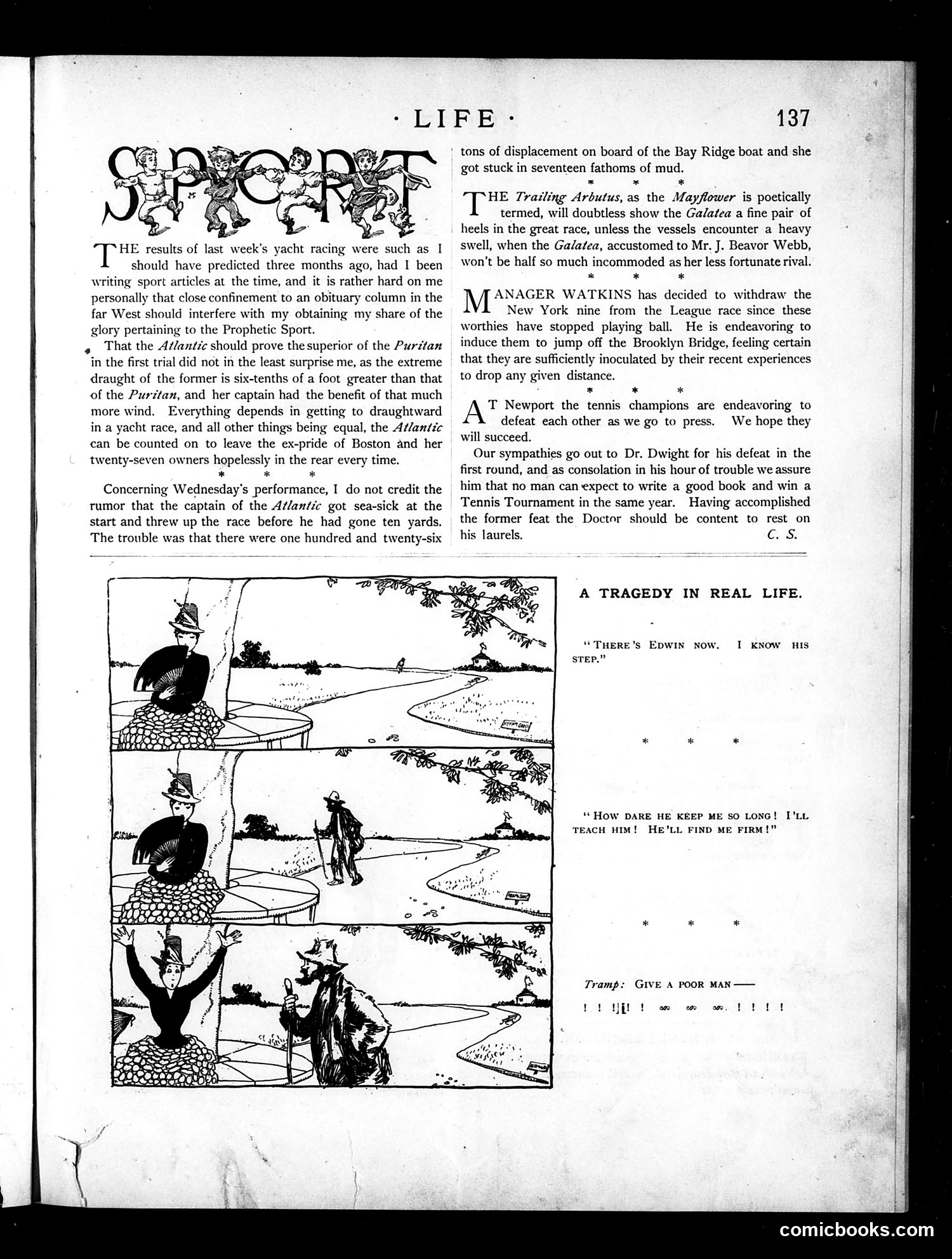
This page from *Life* magazine contains sports commentary and a three-panel comic strip titled "A Tragedy in Real Life." **The Sports Section** discusses yacht racing (Atlantic vs. Puritan), tennis tournaments at Newport, and a baseball team's withdrawal from the League race—all contemporary sporting events meant to entertain readers through witty, satirical commentary about athletic competition. **The Comic Strip** depicts domestic drama: A woman waiting inside grows increasingly angry at a man named Edwin for keeping her waiting. In the final panel, a tramp approaches asking for money. The joke appears to satirize either marital tension or the contrast between the woman's fury at her companion versus the beggar's desperation outside—suggesting misplaced priorities or social hypocrisy about who "deserves" sympathy. The strip's humor relies on period expectations about gender roles, propriety, and class distinctions that modern readers would need historical context to fully appreciate.
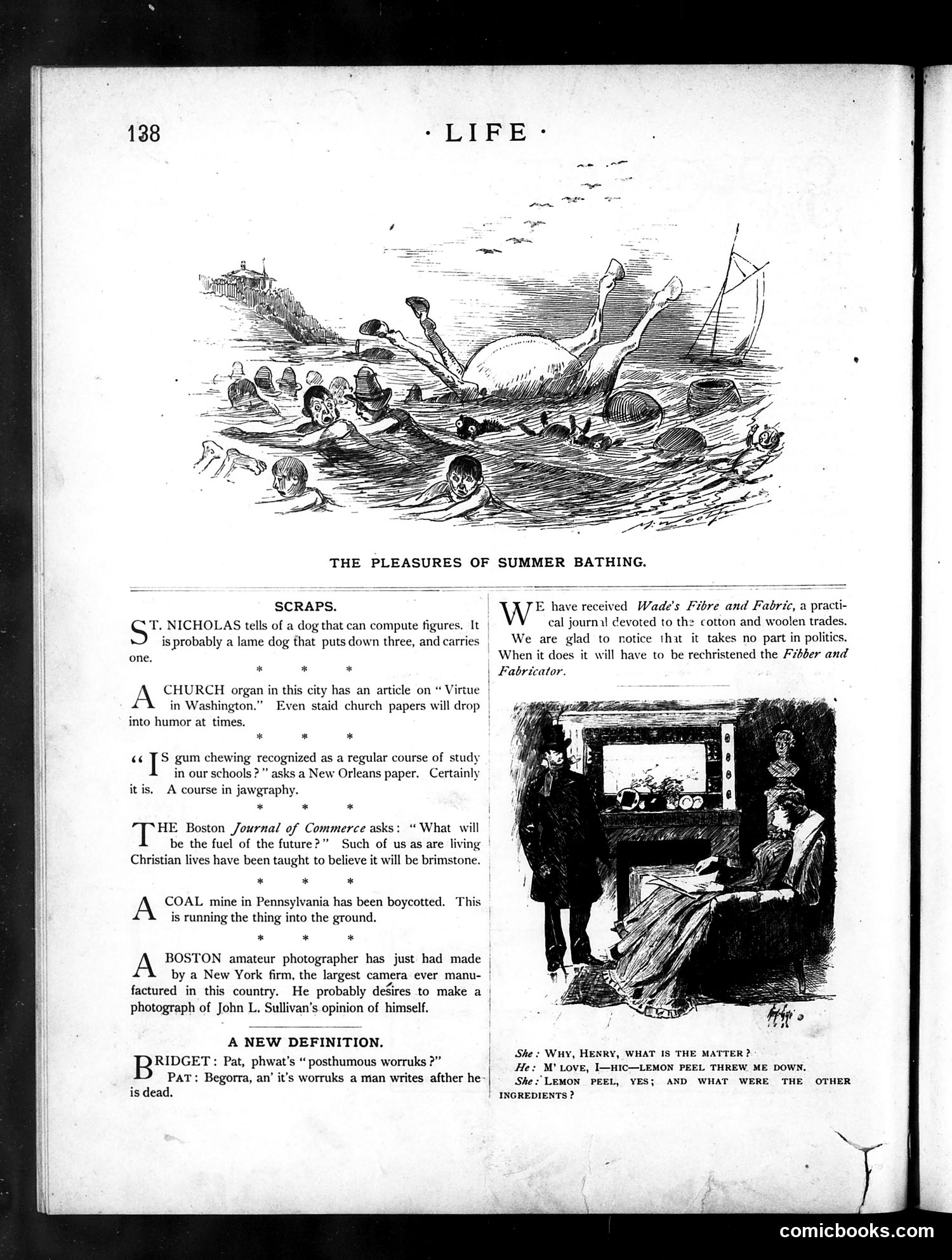
The main illustration shows Victorian-era beachgoers swimming and enjoying summer, with a capsized boat—a lighthearted scene titled "The Pleasures of Summer Bathing." The "Scraps" section consists of brief satirical quips mocking contemporary topics: - A joke about a calculating dog reflects skepticism of dubious claims in newspaper reporting - The "Virtue in Washington" article joke implies Washington politics lack virtue - Gum-chewing as "jawgraphy" puns on jaw/geography - A jab at the Boston Journal's question about future fuel predicts hell/damnation for unchristian lives - The Pennsylvania coal boycott pun ("running into the ground") plays on coal mining - A dig at John L. Sullivan (likely the famous boxer) mocks his intelligence - The Irish dialect joke defines "posthumous works" as writings after death The lower cartoon depicts a woman teaching a man to mix a drink with lemon peel, playing on his drunken confusion about ingredients—typical Victorian humor about alcohol. Overall, the page offers light social satire typical of 19th-century American humor magazines.
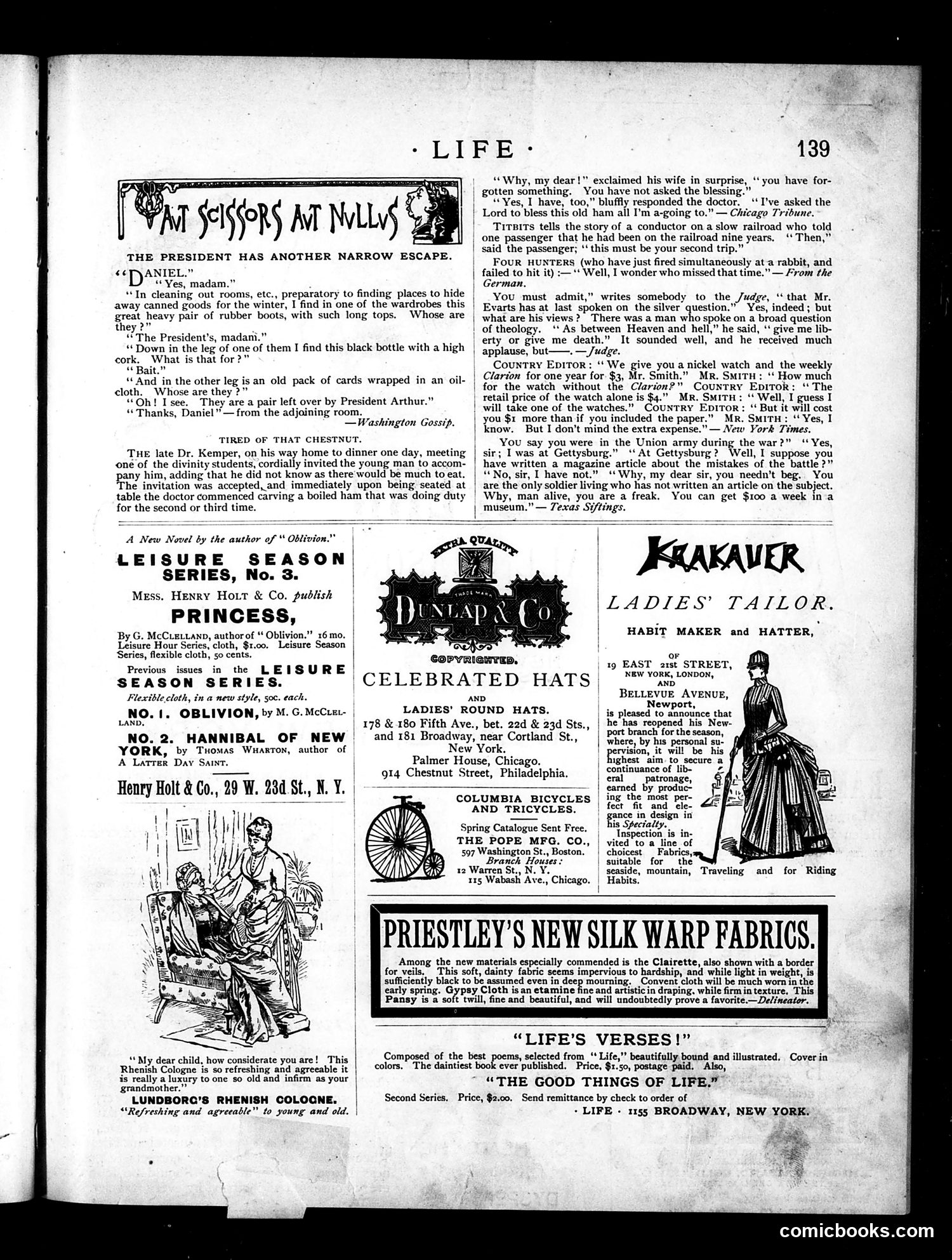
This page contains several short humorous anecdotes rather than a political cartoon. The satire is gentler and more domestic: **"The President Has Another Narrow Escape"** jokes about a servant discovering President Arthur's old rubber boots and a hidden bottle of liquor in them—satirizing the contrast between public propriety and private habits. The humor depends on recognizing Arthur as president. **Other brief jokes** mock: a doctor asking the same blessing for reheated ham; poor hunters missing a rabbit; vague political rhetoric (Evarts on silver); and a Union Army veteran who hasn't written self-aggrandizing magazine articles about Civil War battles (a jab at the proliferation of such accounts). The page is otherwise dominated by **advertisements**—books, bicycles, hats, and fabric—typical of Life's revenue model. There's no clear central political satire, just scattered social commentary on American domestic life, pretension, and the Civil War's lingering cultural impact.
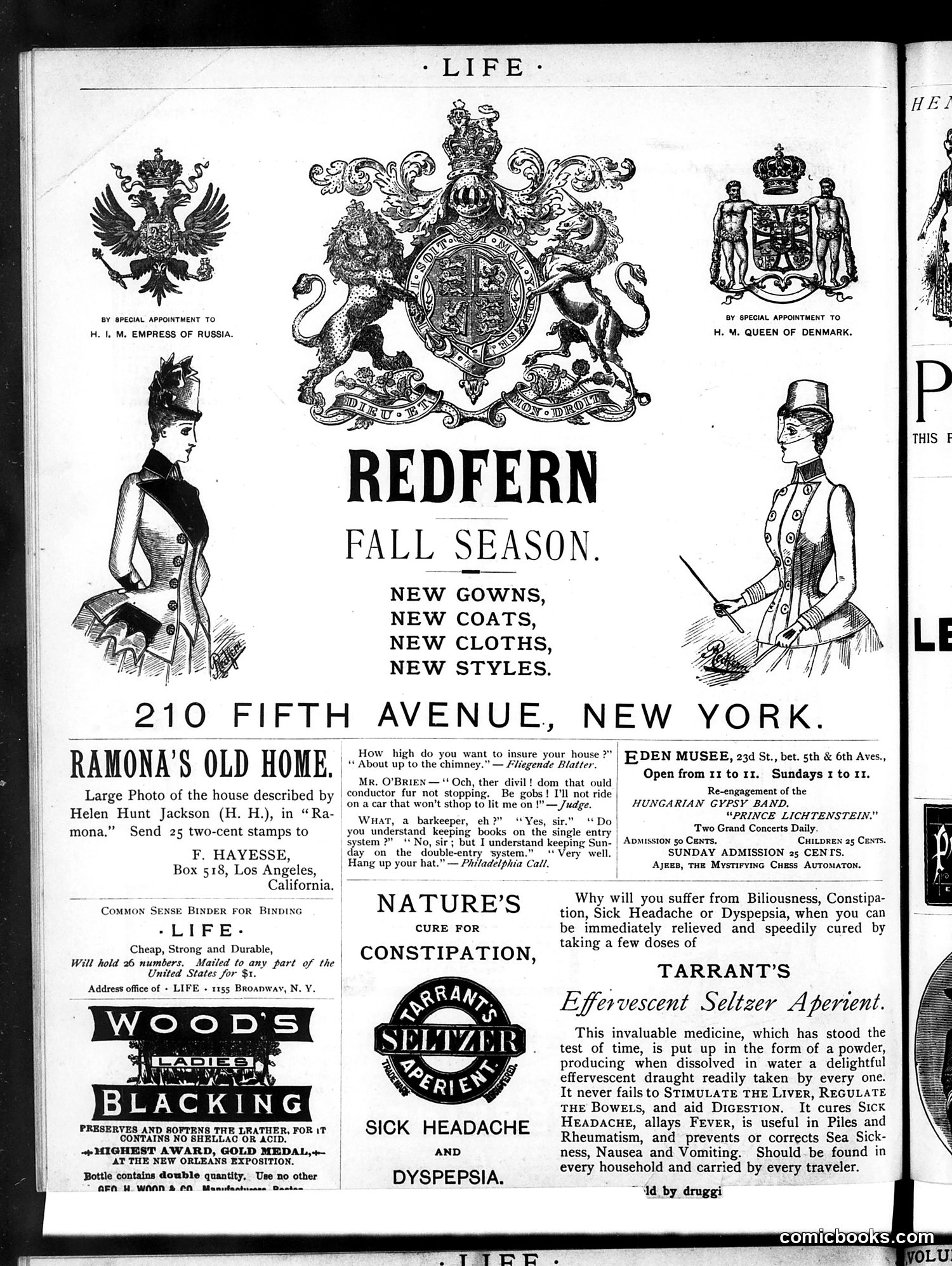
This is primarily an **advertising page** with minimal editorial cartoon content. The page showcases fashion advertisements (Redfern clothing) and patent medicines (Tarrant's Seltzer, Wood's Blacking), along with a few brief comic snippets at the page's center—short joke exchanges about house insurance, streetcar conductors, and barkeeper bookkeeping. These appear to be reprinted humor from other publications (*Fliegende Blatter*, *Judge*, *Philadelphia Call*). The masthead features royal warrant symbols ("by special appointment to H.I.M. Empress of Russia" and "H.M. Queen of Denmark"), lending prestige to commercial goods—a common advertising strategy of the period. The actual satirical content is negligible; this functions primarily as a revenue-generating classified/display advertising section with filler humor. No identifiable political figures or sustained satire are present.
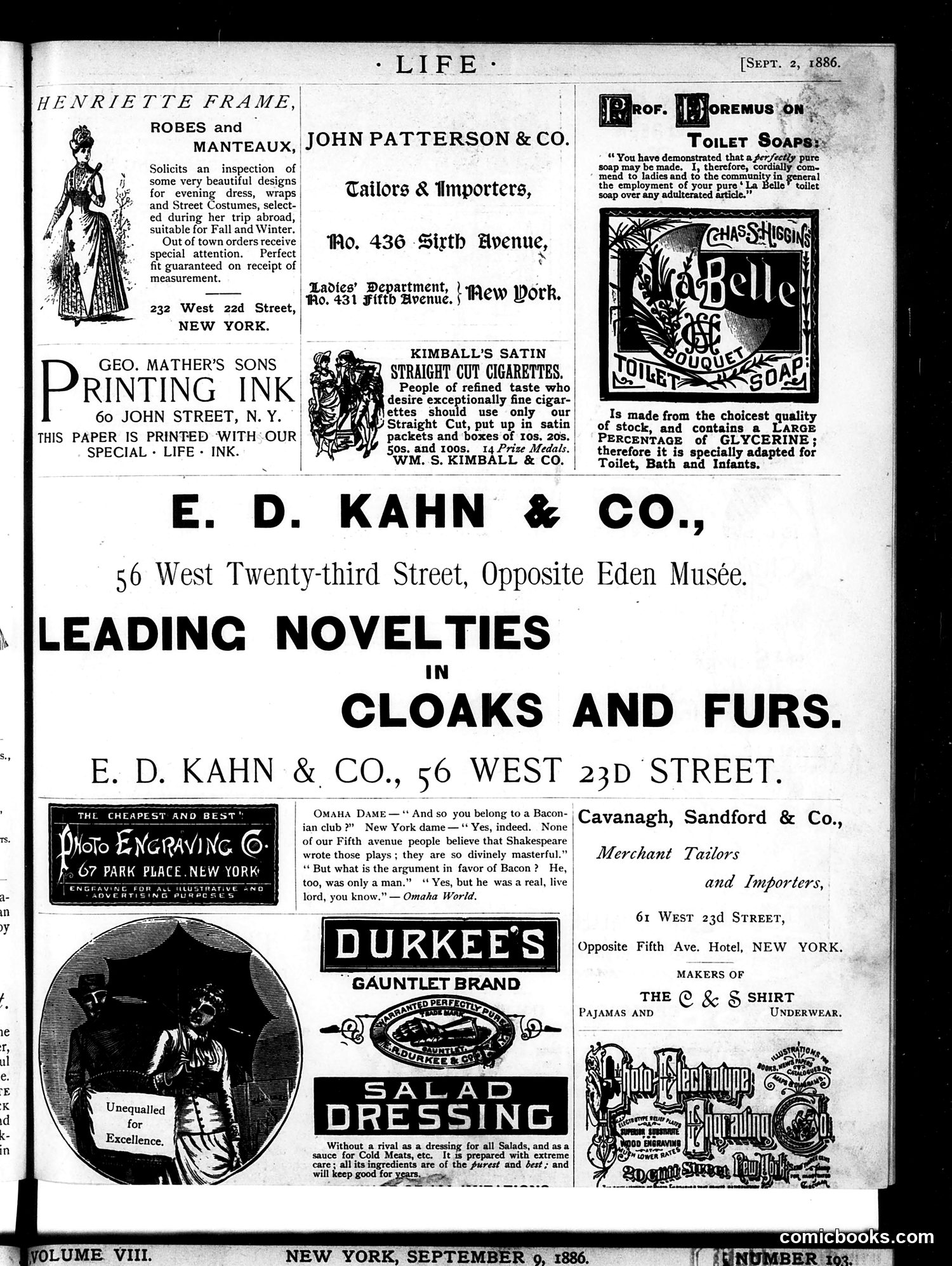
This is primarily an **advertising page** from Life magazine's early period, with one satirical exchange embedded among commercial notices. The page's sole satirical content is a brief **dialogue joke** between an "Omaha Dame" and a "New York dame" about Shakespeare authorship. The New York socialite claims that elite Fifth Avenue society denies Shakespeare wrote his own plays, attributing them instead to Francis Bacon. When challenged on the logic, she dismisses intellectual reasoning, snobbishly asserting Bacon's superiority simply because "he was a real, live lord." **The satire targets**: Social pretension and anti-intellectualism among wealthy New Yorkers who adopt contrarian positions not from genuine scholarship but to appear fashionably exclusive and aristocratic. The joke mocks how the wealthy use cultural claims to signal status rather than seek truth. The rest of the page consists of **period advertisements** for clothing (tailors, cloaks, furs), toiletries, cigarettes, and printing services—typical commercial content of 1880s magazines.
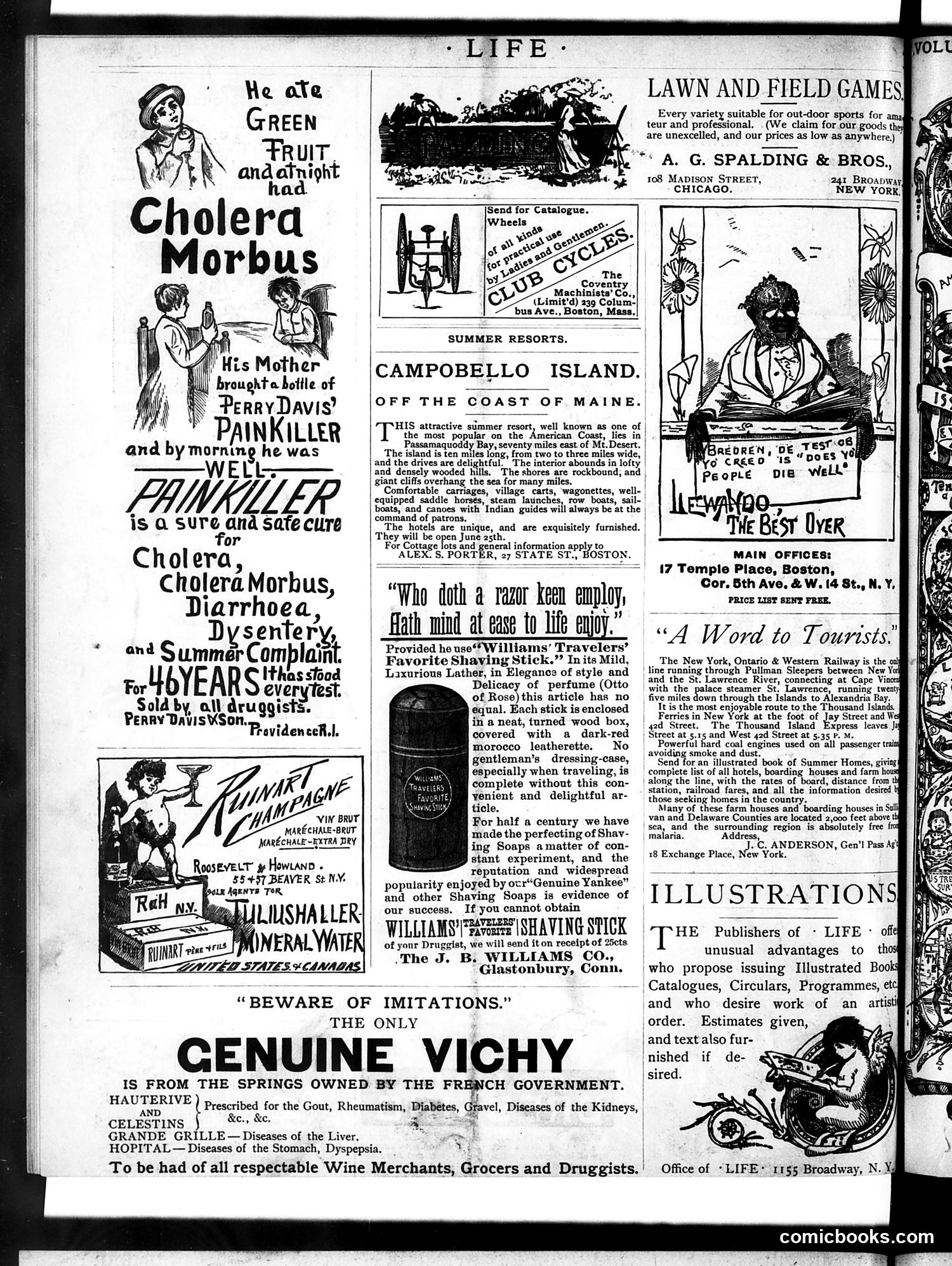
This page is primarily **advertising** rather than editorial satire. The dominant content includes patent medicine ads (Perry Davis' Painkiller for cholera), luxury goods (champagne, shaving products, mineral water), and travel/sports equipment promotions. The small cartoon in the upper left depicts a cautionary tale about cholera morbus—a figure ate green fruit, contracted the disease, and his mother gave him Perry Davis' Painkiller, which cured him by morning. This is typical 19th-century medical advertising that exploited public health fears. The page reflects the era's unregulated patent medicine industry, where products made broad curative claims without scientific basis. The ads target affluent readers interested in summer resorts, travel, and gentlemanly grooming products. There is no evident political satire here—this is a commercial publication supporting itself through advertising revenue.