
Life, 1886-09-02 · page 6 of 16
Life — September 2, 1886 — page 6: what you’re looking at
What you’re looking at
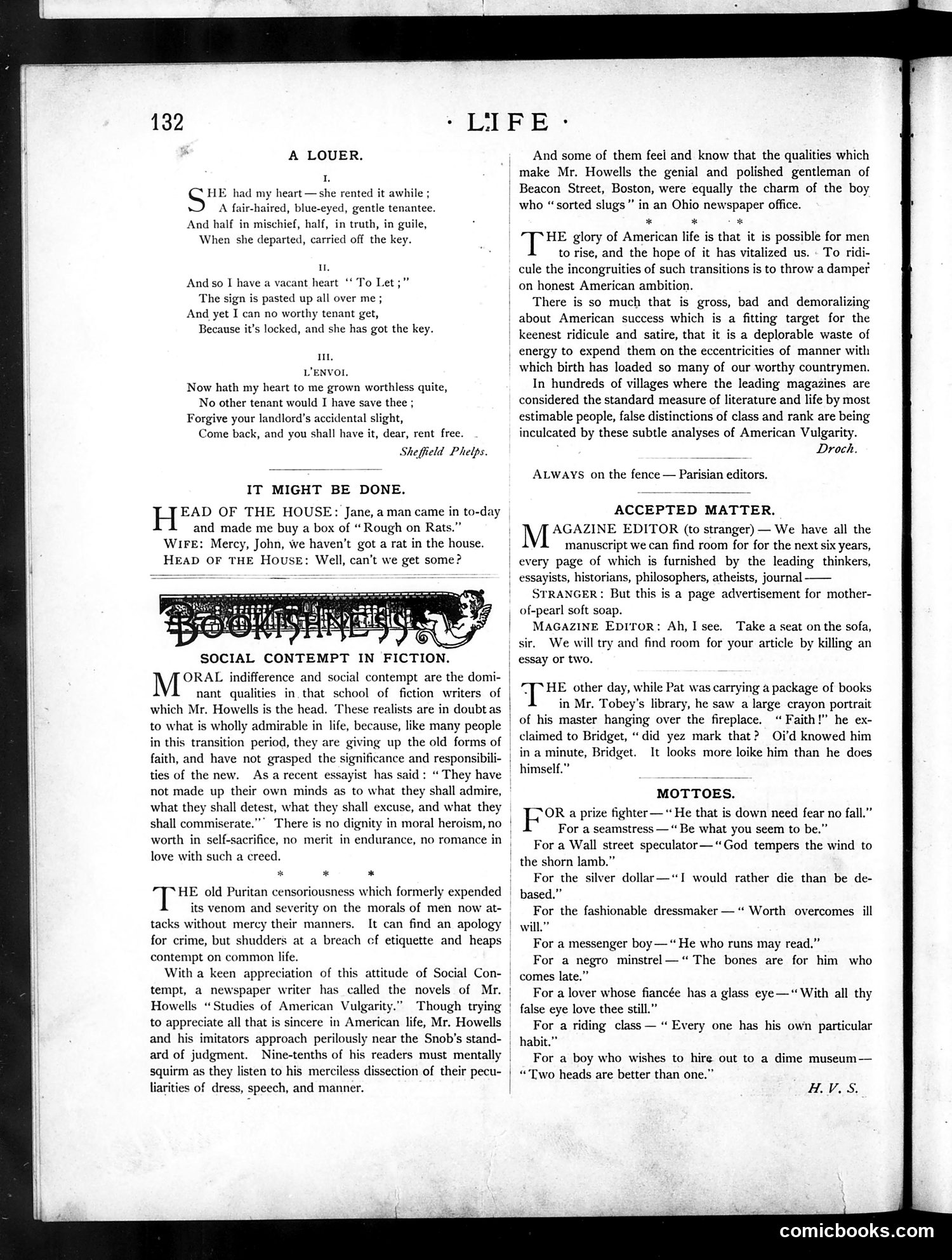
This page contains literary content and social commentary rather than political cartoons. The main sections include: **"A Louer"** — Three poems about romantic heartbreak and loss of love, attributed to Sheffield Phelps. **"Social Contempt in Fiction"** — A critique of novelist Mr. Howells, praised for depicting American social attitudes. The text argues his "Studies of American Vulgarity" successfully mock pretentiousness in American life, particularly regarding dress, speech, and manners. It defends his satirical approach against those who find his dissections of peculiarities too harsh. **"Mottoes"** — Brief humorous sayings about various social types (fighters, seamstresses, speculators, messengers, etc.). The page functions as cultural commentary on American society and literature rather than visual satire.
📄 Transcribed text from this page (OCR, searchable)
Machine-transcribed from the original scan — historical spelling and the odd misread are preserved.
oe bl A LOUER. I, HE had my heart — she rented it awhile ; A fair-haired, blue-eyed, gentle tenantee. And half in mischief, half, in truth, in guile, When she departed, carried off the key. ul. And so I have a vacant heart ‘To Let ;” The sign is pasted up all over me; And yet I can no worthy tenant get, Because it’s locked, and she has got the key. Il. L'ENVOI, Now hath my heart to me grown worthless quite, No other tenant would I have save thee ; Forgive your landlord’s accidental slight, Come back, and you shall have it, dear, rent free. Sheffield Phelps. IT MIGHT BE DONE. EAD OF THE HOUSE: Jane, a man came in to-day and made me buy a box of “ Rough on Rats.” WIFE: Mercy, John, we haven't got a rat in the house. HEAD OF THE House: Well, can’t we get some? SOCIAL CONTEMPT IN FICTION. ORAL indifference and social contempt are the domi- nant qualities in that school of fiction writers of which Mr. Howells is the head. These realists are in doubt as to what is wholly admirable in life, because, like many people in this transition period, they are giving up the old forms of faith, and have not grasped the significance and responsibili- ties of the new. As a recent essayist has said: “ They have not made up their own minds as to what they shall admire, what they shall detest, what they shall excuse, and what they shall commiserate.”"” There is no dignity worth in self-sacrifice, no merit in endurance, no romance in love with such a creed. * * HE old Puritan censoriousness which formerly expended its venom and severity on the morals of men now at- tacks without mercy their manners. It can find an apology for crime, but shudders at a breach cf etiquette and heaps contempt on common life. With a keen appreciation of this attitude of Social Con- tempt, a newspaper writer has called th Howells “Studies of American Vulgarit Though trying to appreciate all that is sincere in American life, Mr. Howells and his imitators approach perilously near the Snob’s stand- ard of judgment. Nine-tenths of his readers must mentally squirm as they listen to his merciless dissection of their pecu- liarities of dress, speech, and manner. in moral heroism, no | novels of Mr. | FE: And some of them feei and know that the qualities which make Mr. Howells the genial and polished gentleman of Beacon Street, Boston, were equally the charm of the boy who “sorted slugs” in an Ohio newspaper office. * * * HE glory of American life is that it is possible for men to rise, and the hope of it has vitalized us. - To ridi- cule the incongruities of such transitions is to throw a damper on honest American ambition. There is so much that is gross, bad and demoralizing about American success which is a fitting target for the keenest ridicule and satire, that it is a deplorable waste of energy to expend them on the eccentricities of manner with which birth has loaded so many of our worthy countrymen. In hundreds of villages where the leading magazines are considered the standard measure of literature and life by most estimable people, false distinctions of class and rank are being inculcated by these subtle analyses of American Vulgarity. Droch. ALWAYS on the fence — Parisian editors. AGAZINE EDITOR (to stranger) — We have all the manuscript we can find room for for the next six years, every page of which is furnished by the leading thinkers, essayists, historians, philosophers, atheists, journal —— STRANGER: But this is a page advertisement for mother- of-pearl soft soap. MaGAZINE Epiror: Ah, I see. Take a seat on the sofa, sir. We will try and find room for your article by killing an | essay or two. THE other day, while Pat was carrying a package of books in Mr. Tobey’s library, he saw a large crayon portrait of his master hanging over the fireplace. “Faith!” he ex- claimed to Bridget, “did yez mark that? Oi’d knowed him in a minute, Bridget. It looks more loike him than he does himself.” MOTTOES. OR a prize fighter— “ He that is down need fear no fall.” For a seamstress — “ Be what you seem to be.” For a Wall street speculator—“ God tempers the wind to the shorn lamb.” For the silver dollar—“I would rather die than be de- based.” For the fashionable dressmaker — ‘‘ Worth overcomes ill will.” For a messenger boy —“ He who runs may read.” For a negro minstrel—“ The bones are for him who comes late.” For a lover whose fiancée has a glass eye—‘ With all thy false eye love thee still.” For a riding class — “ Every one has his own particular habit.” For a boy who wishes to hire out to a dime museum— | “Two heads are better than one.” | HV.S. comicbooks.com