
A complete issue · 16 pages · 1886
Life — August 12, 1886
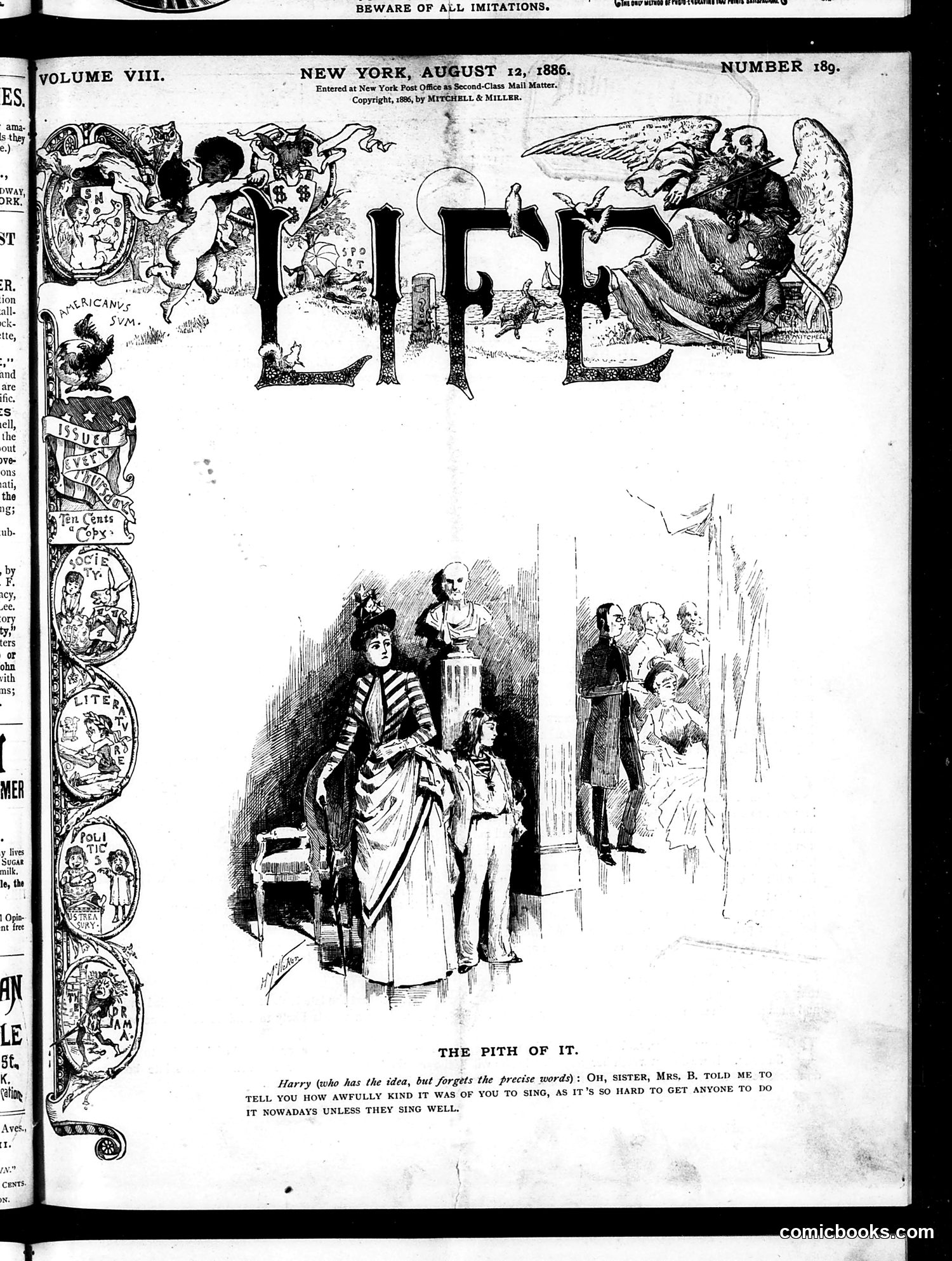
This cartoon satirizes the social expectation that women should sing well. The caption shows "Harry" quoting his sister Mrs. B., who complained it was "awfully kind" but "hard to get anyone to do it nowadays unless they sing well." The humor targets the contradiction: polite society demands women perform music as an accomplishment, yet simultaneously criticizes their actual singing ability. The scene depicts a domestic gathering where a woman is being pressured to sing despite her apparent reluctance or poor skill. The satire reflects Victorian-era gender expectations—women were expected to be talented musicians as markers of refinement and marriageability, creating awkward social situations when reality failed to match these ideals. The cartoon mocks both the impossible standard and the social awkwardness it created.
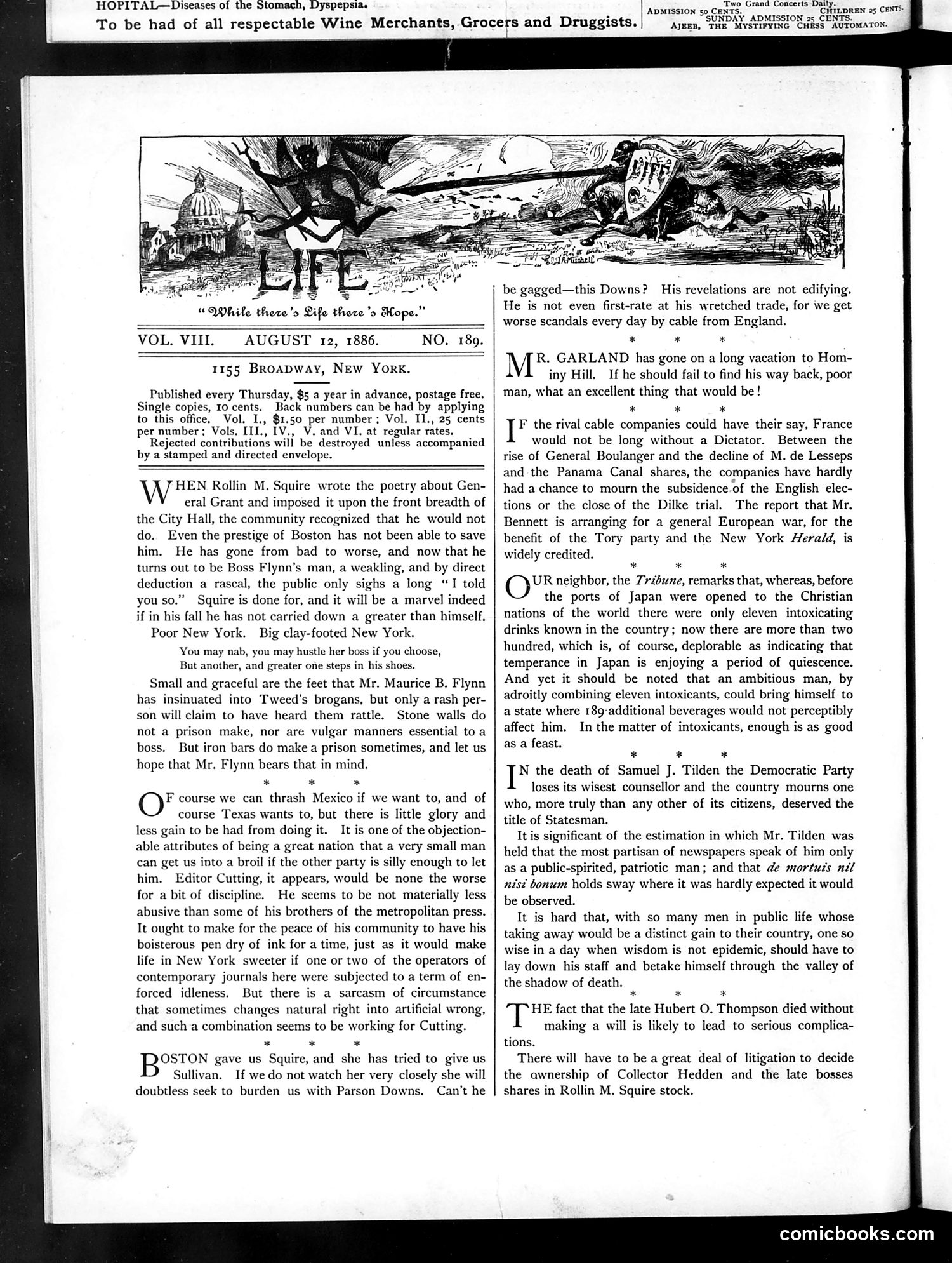
The masthead cartoon shows a skeletal figure labeled "LIFE" lounging beneath a gnarled tree, with a city (likely New York's St. Paul's Cathedral visible) in the background. The caption reads "While these's Life there's Hope." The text discusses various political and social matters of 1886, including criticism of General Grant, references to the Dilke trial scandal, and commentary on Boss Flynn's control in New York politics. There's also discussion of Japan opening its ports and satire about temperance advocates who paradoxically consume numerous intoxicating beverages. The page concludes with obituary-style commentary on Samuel J. Tilden, the Democratic statesman, and notes on Hubert O. Thompson's death without a will. The overall tone is witty political and social commentary typical of the satirical press.
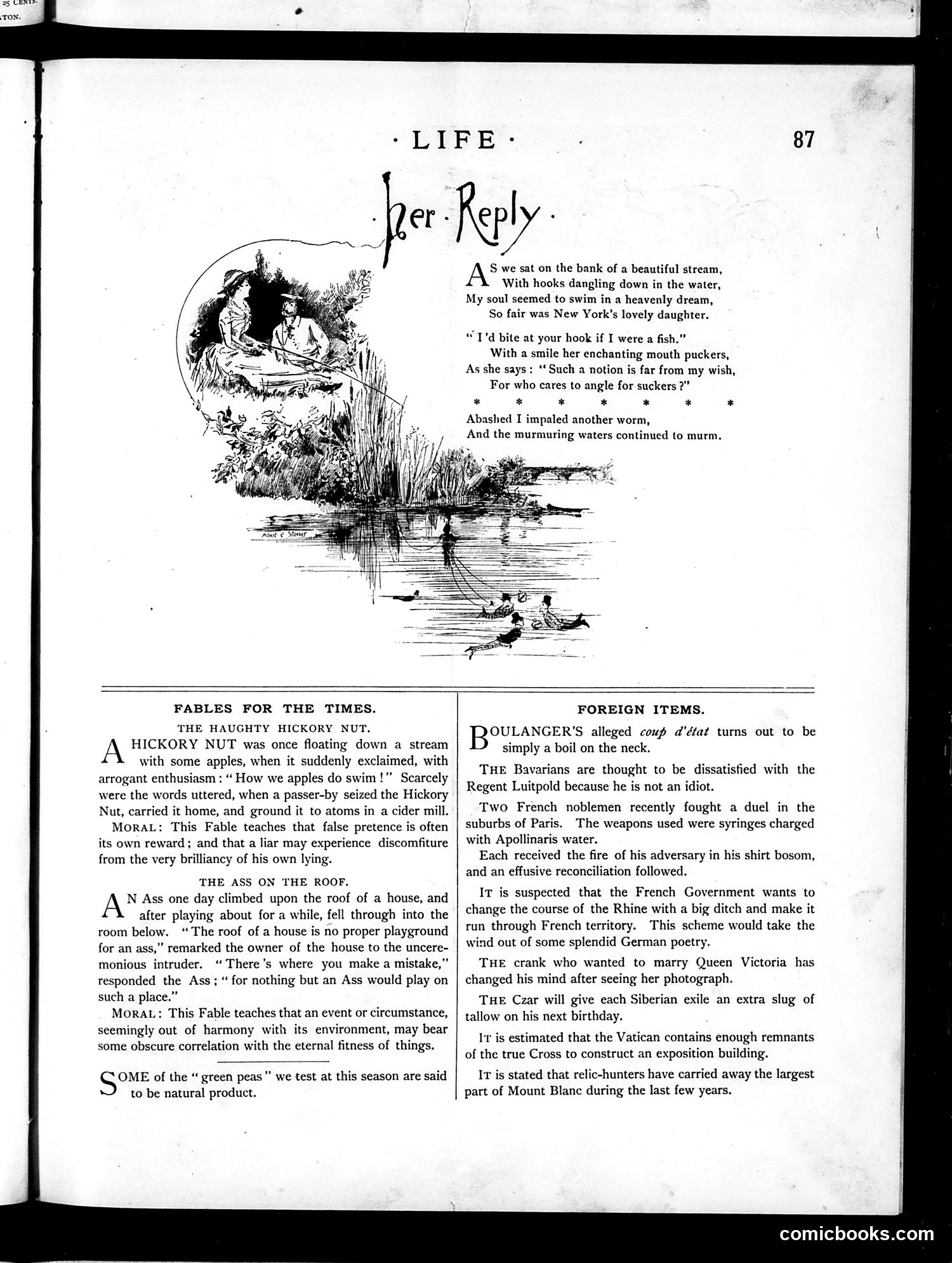
This page presents a romantic poem/illustration titled "Her Reply," depicting a man and woman fishing by a stream. The man flirts ("I'd bite at your hook if I were a fish"), and the woman responds coolly that she has no interest in such games ("Such a notion is far from my wish, / For who cares to angle for suckers?"). The satire targets conventional courtship rituals of the era—specifically the coy, indirect "fishing" metaphor men used to attract women. The woman's sharp retort mocks this approach, suggesting that intelligent women saw through such transparent romantic tactics. Below are unrelated humor pieces about a hickory nut fable and an ass on a roof. The right column contains brief "Foreign Items"—brief news snippets about European events, typical of Life's satirical news section.
This page contains satirical commentary rather than political cartoons. The header illustration depicts various animals in a procession, likely representing different political or social figures of the era. The content includes several brief satirical items: - A mock "Ode to the Vagrant Setter" about a dog - Jabs at "anti-silver men" and bond-holders upset about the silver dollar's value - A comment on Miss Florence Marryatt lecturing about treating men - Mockery of Emperor William and the Infant King of Spain going to battle - Ridicule of "Plon-Plon" and his son Victor as oddities - Dr. Bartol's hypothetical abolition of Hell The right column discusses Century magazine's new war coverage as a substitute for traditional war papers, praising its realistic tone compared to sensationalist accounts. The satire targets political figures, financial anxieties (silver/gold debate), and contemporary magazine culture of the period.
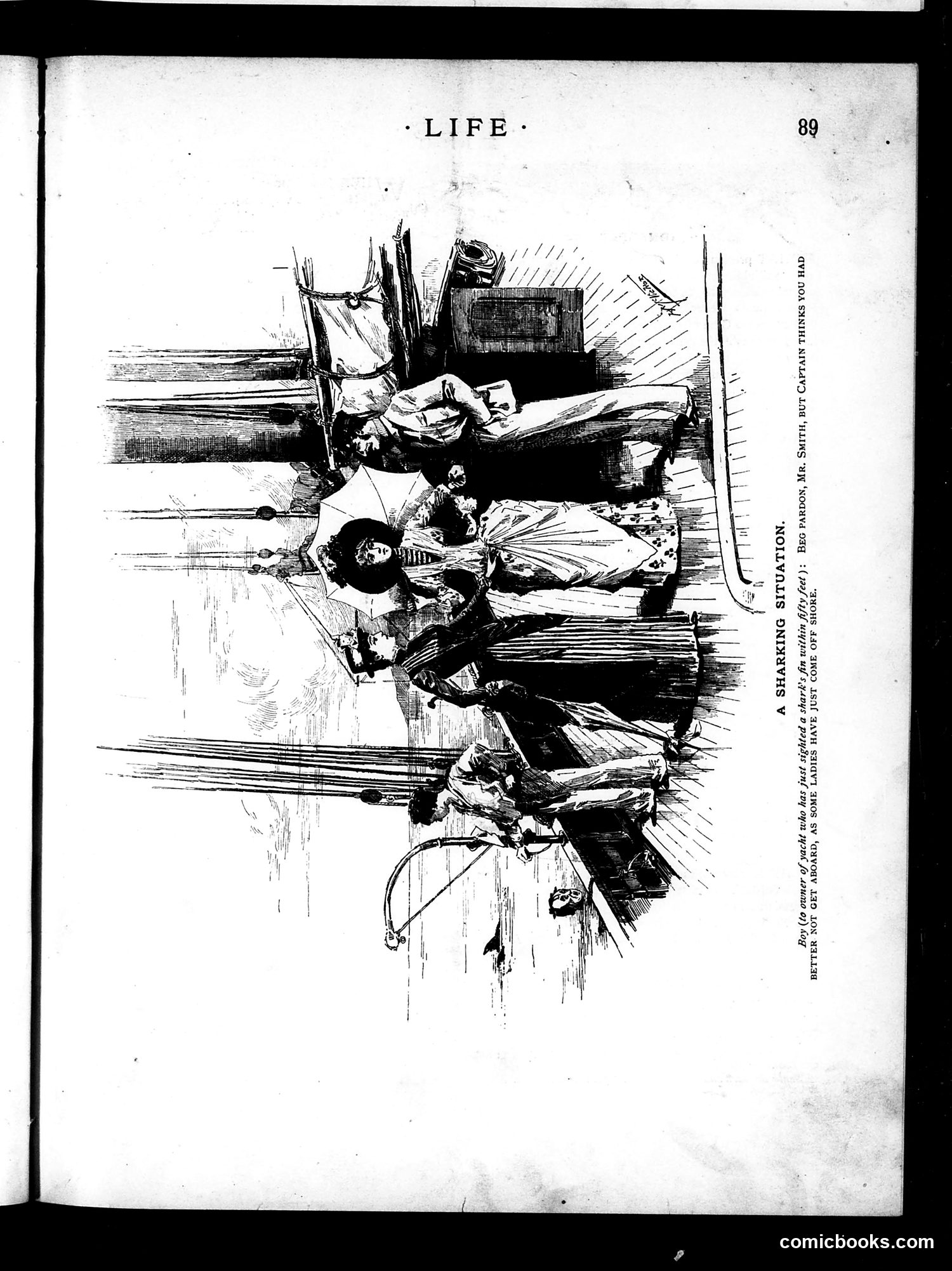
This illustration appears to depict a social scene involving sharking—a practice where well-dressed men would target fashionably dressed women in public spaces, attempting to cut off pieces of their clothing (particularly skirts or decorative elements) as souvenirs or pranks. The cartoon shows multiple figures in Victorian-era dress in what seems to be a public setting. A woman in an elaborate dress is the apparent victim, while men with tools (possibly scissors or knives) surround her. The title "A Sharking Situation" plays on the predatory nature of the practice. This was a genuine social problem in the late 19th/early 20th century, treated here with satirical humor—mocking both the perpetrators' brazenness and society's tolerance of such harassment of women in public spaces.
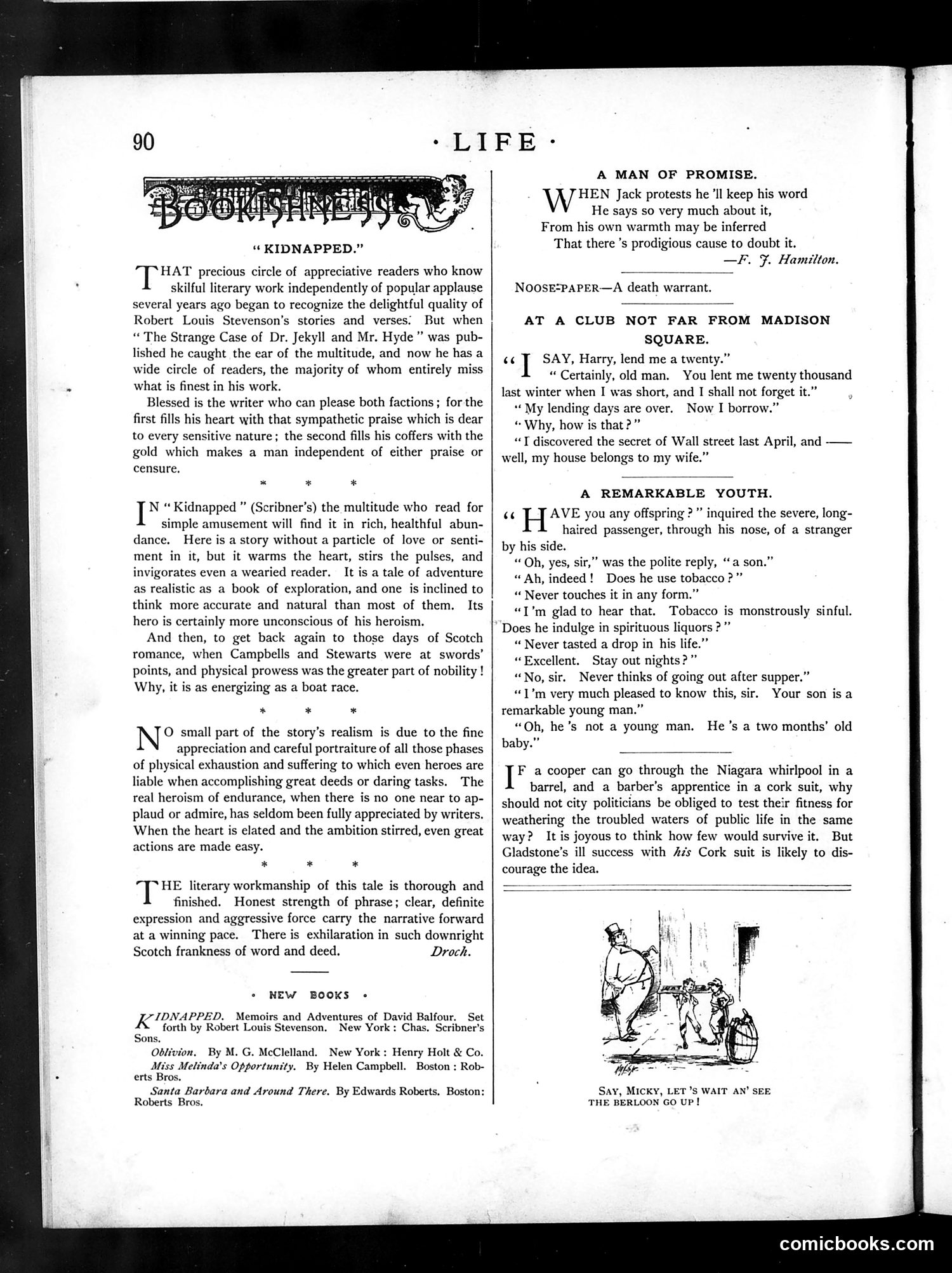
This page contains book reviews rather than political cartoons. The main content discusses Robert Louis Stevenson's "Kidnapped," praising its literary quality and realistic portrayal of physical hardship during adventure scenes. The reviewer notes that Stevenson succeeds where many writers fail by making such exertion genuinely appreciated by readers. The small illustration at bottom shows two figures (labeled "Say, Micky, let's wait an' see the balloon go up!") watching what appears to be a hot air balloon, likely a humorous social observation about public entertainment. The page also includes brief satirical items like "Nosepaper—A death warrant" and anecdotes about lending money and offspring, typical of Life's format mixing literary criticism with social humor.
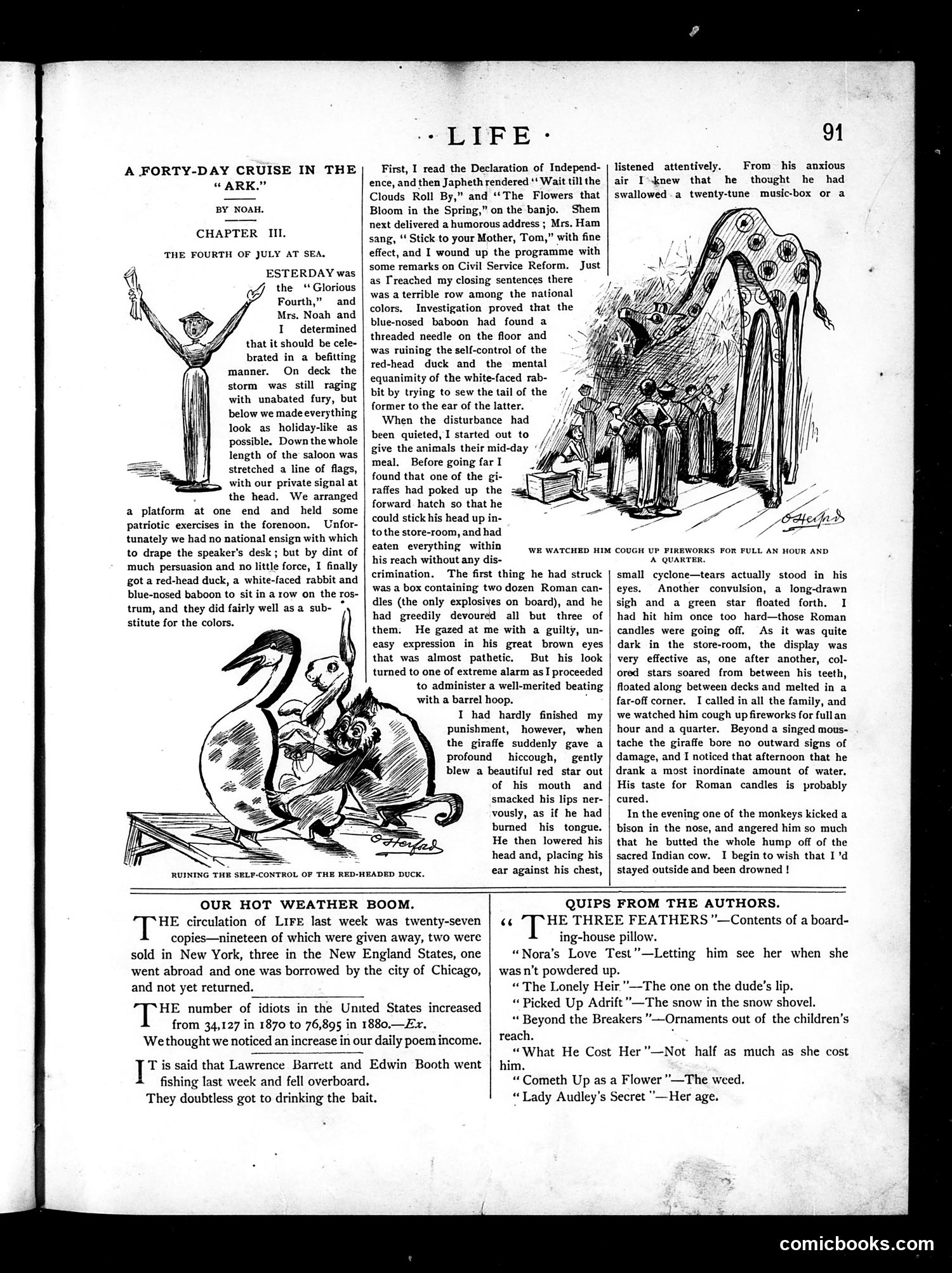
This page contains a serialized story "A Forty-Day Cruise in the Ark" by Noah (Chapter III), with accompanying illustrations of animals. The main narrative describes Fourth of July celebrations aboard a ship, including a humorous incident where a giraffe disrupts proceedings—apparently coughing up fireworks for "full an hour and a quarter." The bottom section, "Our Hot Weather Boom," presents statistics about *Life* magazine's circulation and brief news items (Lawrence Barrett and Edwin Booth falling overboard while fishing). The final section, "Quips from the Authors," offers witty one-liners about various literary works—simple, punny commentary on books and plays. This page is primarily **humorous fiction and light satire** rather than political commentary. The cartoons illustrate the whimsical animal narrative rather than addressing specific political events.
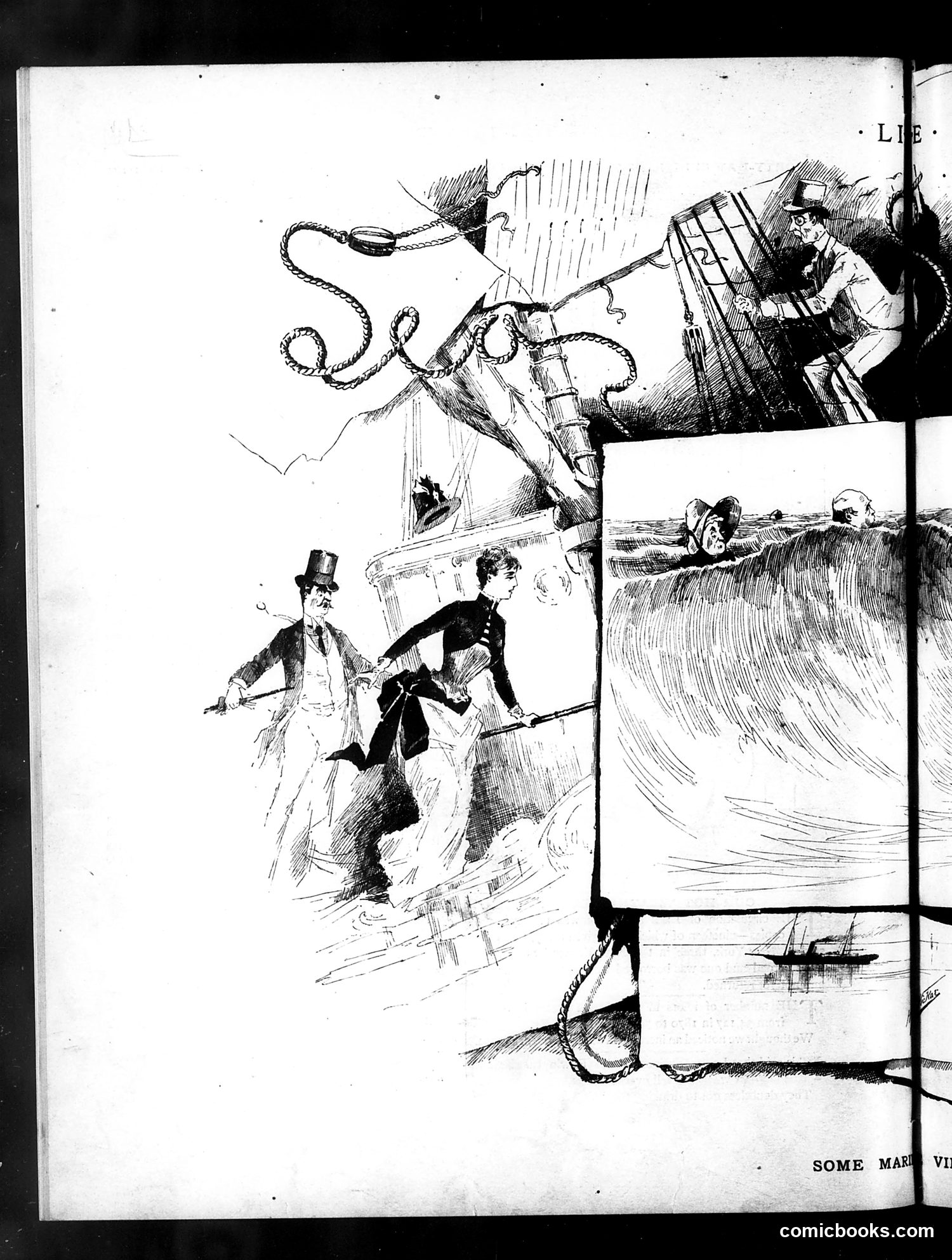
This page appears to be a maritime-themed satirical illustration, likely from the late 19th or early 20th century. The central image shows two gentlemen in formal attire (top hats and coats) on what appears to be a ship's deck, with a large octopus brandishing ropes or tentacles above them—a common metaphor for dangerous threats or entangling situations. The surrounding vignettes depict nautical scenes: rough seas, a small vessel, and figures in distress. The octopus imagery suggests the cartoon satirizes some "octopus-like" threat (possibly monopolistic business practices, foreign menace, or political entanglement) engulfing the nation. The partial text "SOME MARI" at bottom remains unclear without the complete caption. The page's content requires fuller context to identify the specific political or social reference intended.
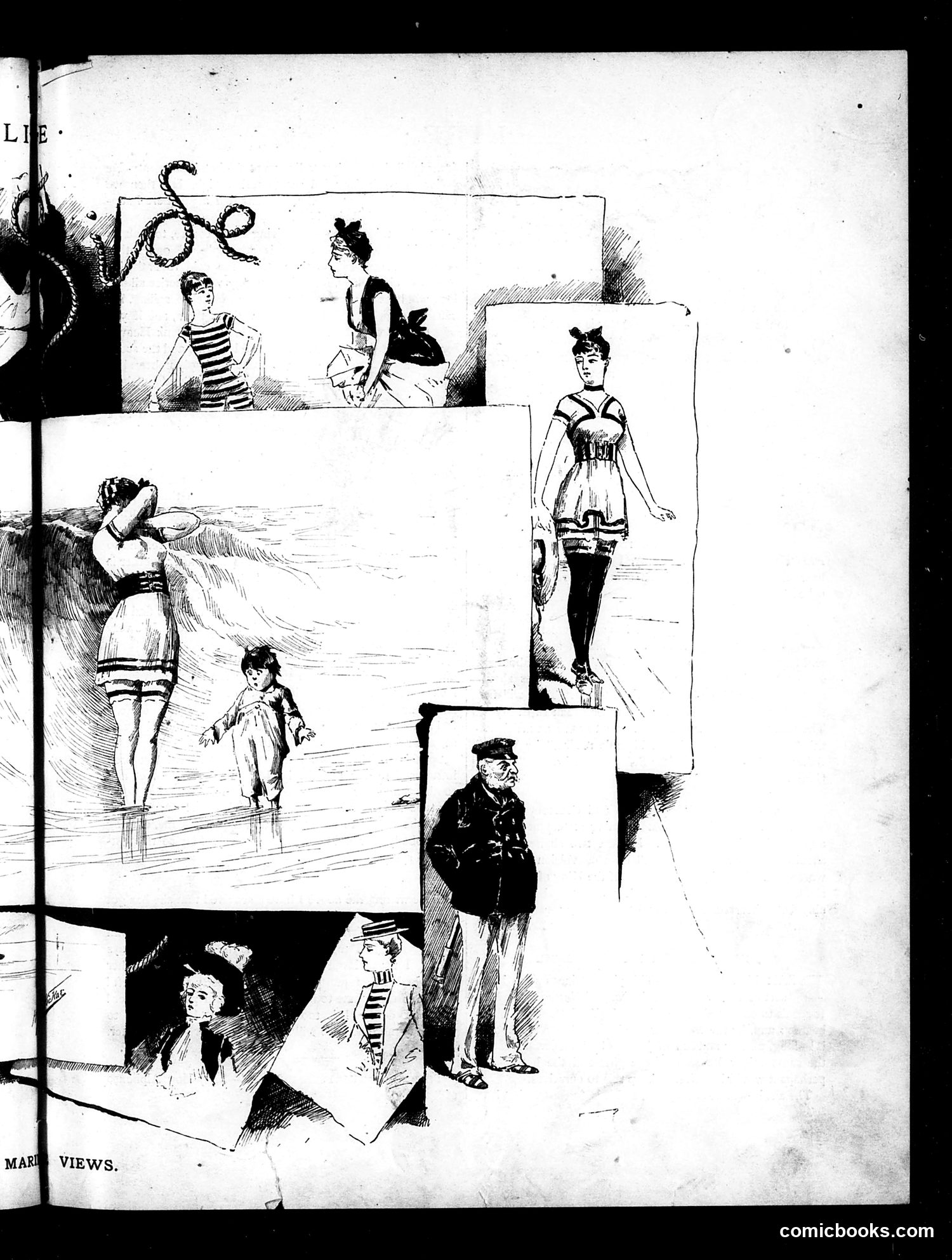
This page titled "VIEWS" appears to be a satirical illustration about **women's fashion and social roles** in late 19th or early 20th-century America. The composition shows multiple vignettes displaying women in different states of dress and undress, likely critiquing contemporary attitudes toward female bodies and clothing. The stacked, overlapping panels suggest different "perspectives" or social viewpoints on women—from idealized fully-dressed figures to more revealing depictions. A male figure (bottom right) observes these scenes, possibly representing the male gaze or societal judgment of women's appearance. The satire appears to mock either **the contradictions in how society judged women's modesty**, or the increasing visibility of women's bodies in public life and fashion. Without the OCR text being legible, the specific satirical target remains somewhat unclear.
This page contains a "Sport" header with decorative figures dancing/celebrating, followed by several short commentary pieces about recreational activities and social gossip from what appears to be the early 20th century. The content discusses yacht racing (comparing ships named *Galatea*, *Puritan*, and *Genesta*), baseball commentary referencing L.E. Myers, and an announcement that rowers Hanlan and Courtney will compete—described as potentially dangerous due to health concerns. The final section, "Echoes from Bar Harbor," describes a coastal resort location as resembling "a cross between Corsica and Narragansett Pier," commenting on its architecture and social atmosphere. The tone is lighthearted social commentary rather than sharp political satire. The page represents typical turn-of-century *Life* magazine content: witty observations about upper-class leisure activities and fashionable vacation destinations.
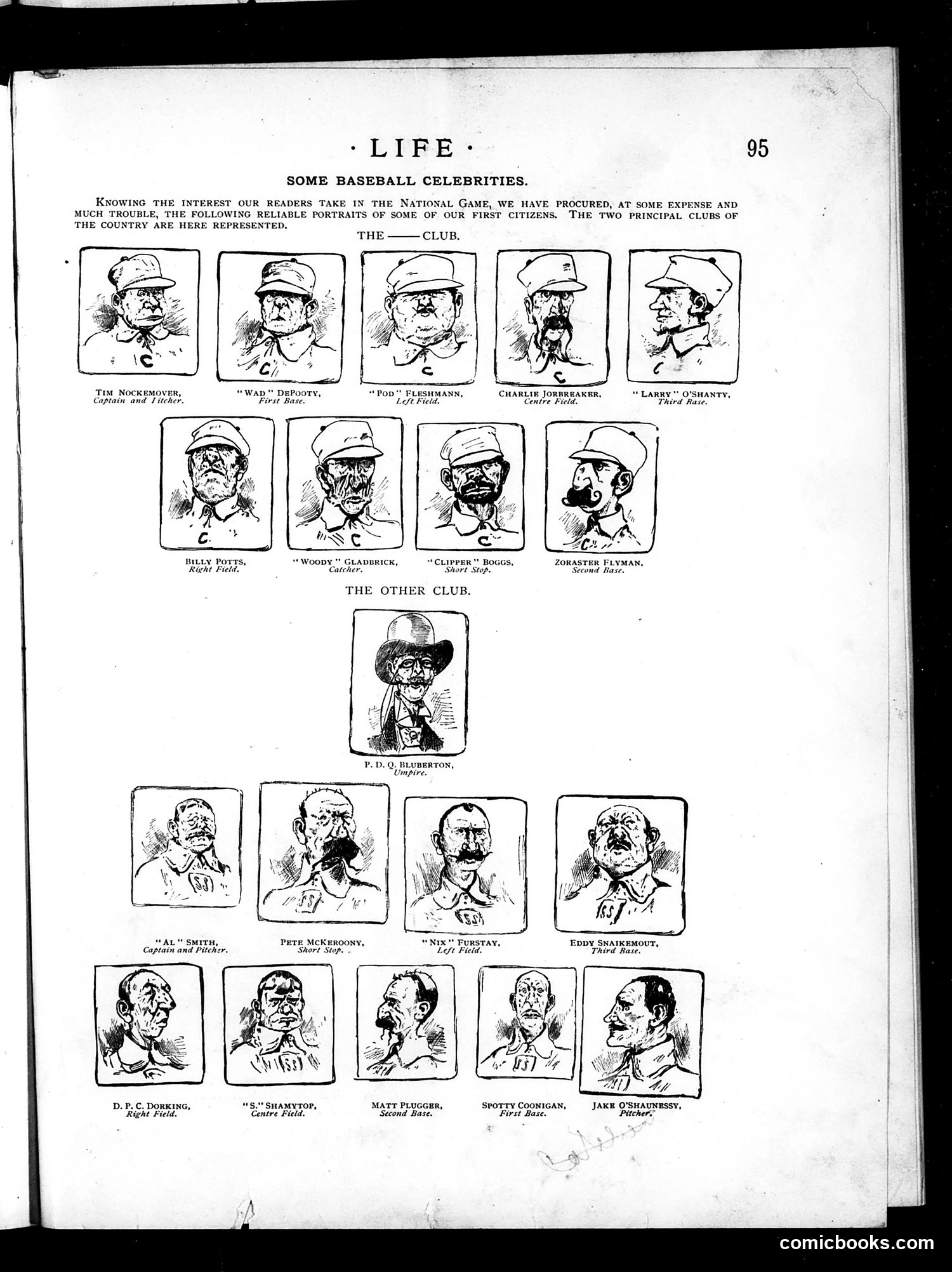
This is a satirical baseball roster from Life magazine featuring caricatured portraits labeled with absurdly punny, made-up player names. Rather than depicting real baseball celebrities, the page presents fictional players with comedic names like "Wad Deepooty," "Pop Fleshmann," "Charlie Jorbbreaker," and "Nix Furstay"—wordplay designed to amuse readers. The satire targets baseball's pretense of seriousness by treating these ridiculous characters as "first citizens" worthy of expensive portraiture. The exaggerated facial features in the drawings emphasize the mockery. By dividing players into two clubs without identifying them as real teams, Life suggests baseball culture itself is absurd theater deserving parody. The joke relies on readers recognizing baseball's popularity while finding humor in the magazine's tongue-in-cheek presentation of utterly fictional "celebrities."
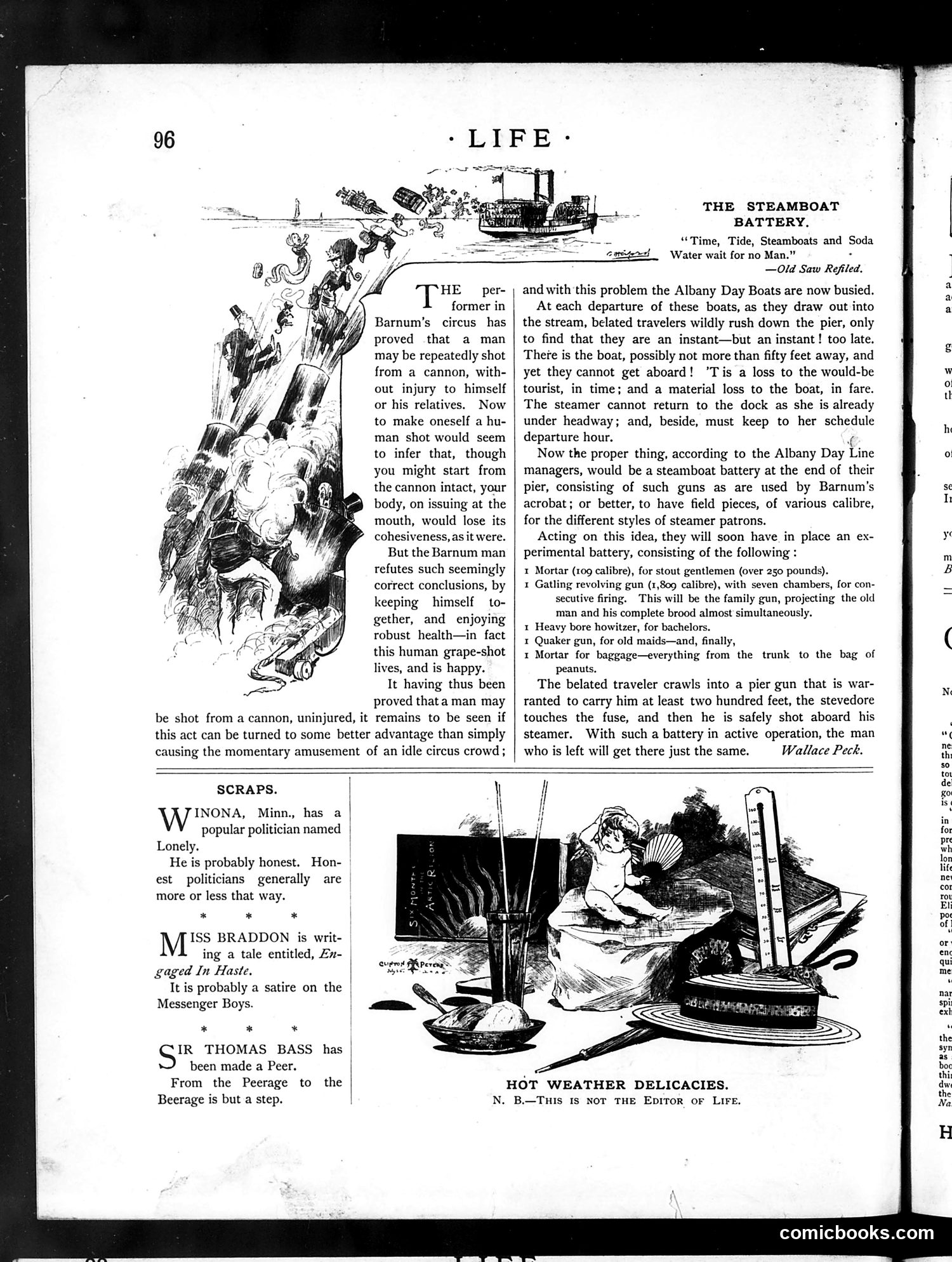
This is a humorous satirical piece responding to a real problem: passengers missing Albany Day Line steamboats because the vessels depart on strict schedules and cannot return to the dock. The satire proposes an absurd "solution" inspired by P.T. Barnum's circus act of shooting a man from a cannon without injury. The joke suggests the steamboat company should install cannons on the pier to literally *shoot* late passengers onto the departing boat—a ridiculous escalation of the inconvenience. The piece catalogs mock "artillery" for different passenger types: mortars for heavy gentlemen, a Gatling gun for families, howitzers for bachelors, and even a mortar specifically for baggage. The accompanying illustration shows comically oversized weapons and a woman being launched. The humor lies in the absurd literalism—taking a circus stunt as precedent for solving a mundane scheduling problem through dangerous, theatrical means. It's period-specific satire about steamboat operations and Barnum's famous performances.
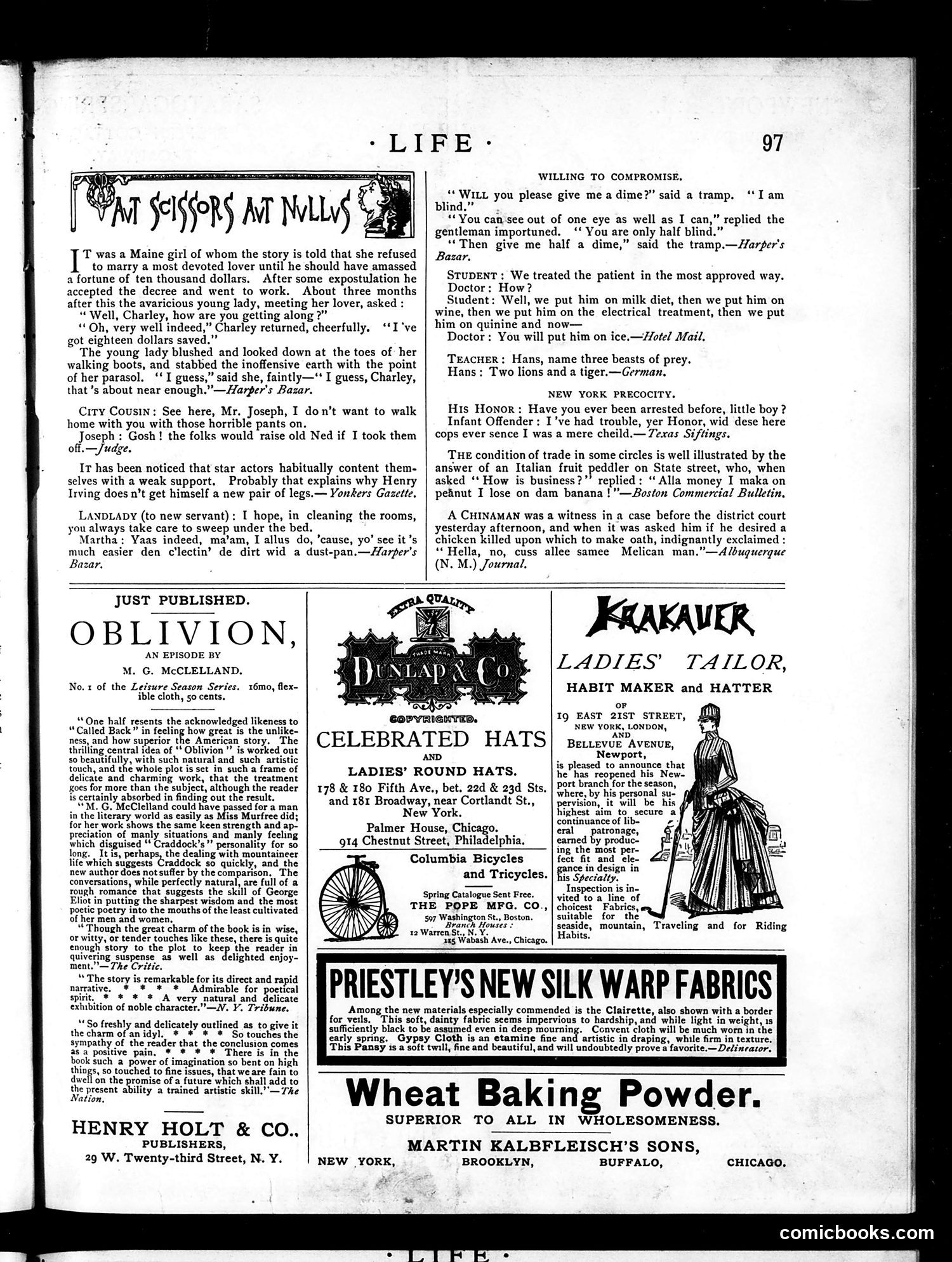
This page is primarily a collection of **brief humorous anecdotes** and advertisements rather than political cartoons. The jokes target various social stereotypes common to the era: **The humor relies on ethnic and class caricatures:** - A Maine girl abandons her suitor after he's only saved $18 toward a $10,000 dowry—satirizing female greed - A "City Cousin" mocks a rural man's clothing—urban/rural snobbery - A tramp argues for "half a dime" for being "half blind"—poking fun at begging logic - A German schoolboy confuses "beasts of prey" (naming lions and tigers instead of understanding the category)—ethnic stereotype humor - An Italian peddler's broken English about losing money on bananas - A Chinese immigrant's indignant refusal to swear on a chicken, using stereotypical dialect The page also advertises hats, bicycles, baking powder, and silk fabrics. The humor is gentle mockery of working-class people, immigrants, and rural Americans—typical of *Life* magazine's satirical approach during this period.
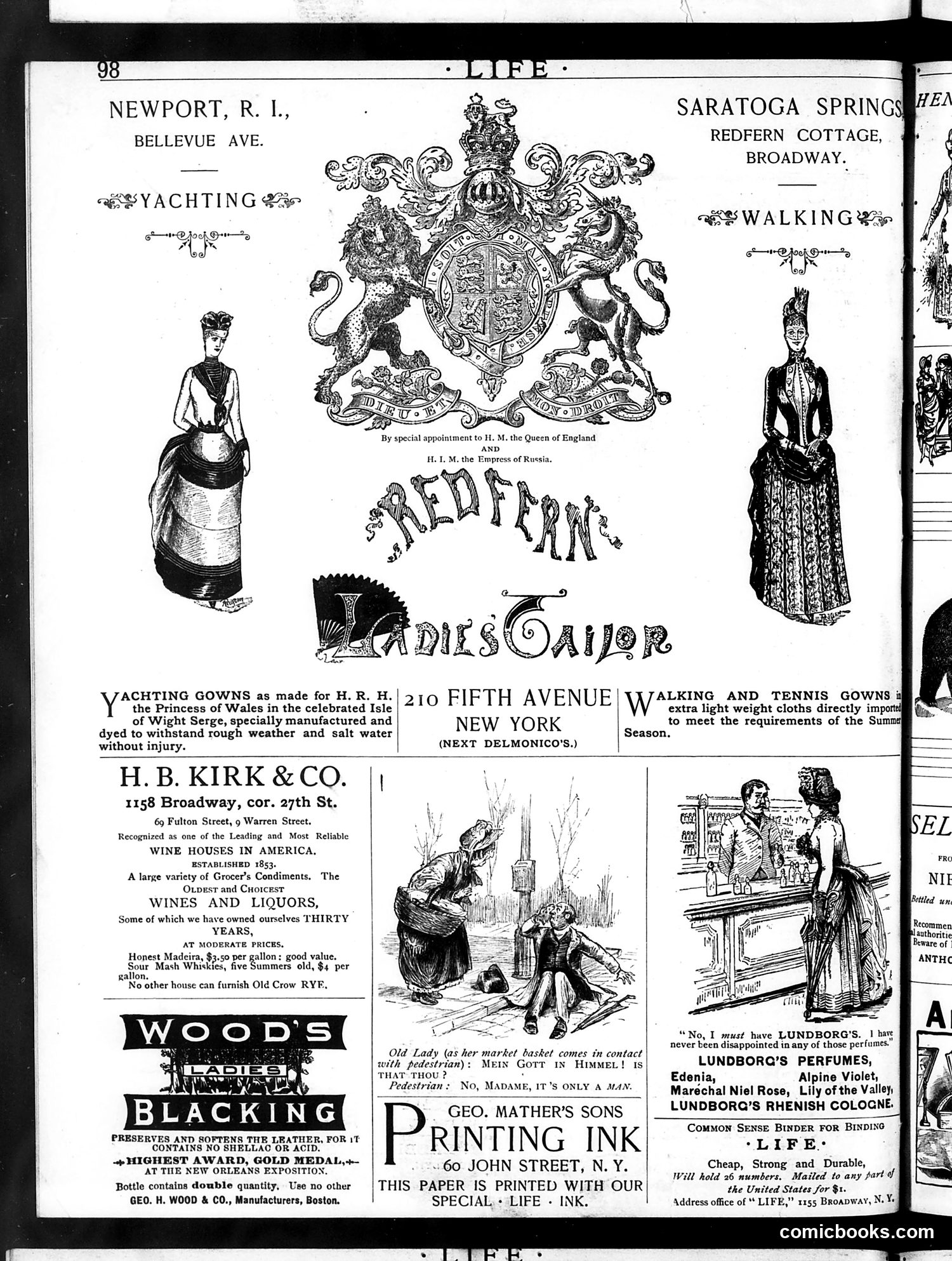
This is primarily an **advertising page** from Life magazine, with one small cartoon embedded among the ads. ## The Cartoon The only cartoon appears in the middle-lower section, captioned by George Mather's Sons. It shows an elderly woman whose market basket collides with a pedestrian. She exclaims in German dialect: "MEN GOTT IN HIMMEL! IS THAT THOU?" The pedestrian replies: "No, MADAME, IT'S ONLY A MAN." **The joke**: The woman mistakes the pedestrian for something else entirely—the humor likely plays on either physical appearance or perhaps a pun lost to modern readers. The German dialect suggests the woman is a recent immigrant, a common comedic trope of the era. ## Advertisements The page features fashion (Redfern gowns for Newport yachting and Saratoga Springs), wines and liquors (H.B. Kirk & Co.), shoe blacking (Wood's), perfumes (Lundborg's), and printing services. These ads target wealthy, fashionable audiences and emphasize luxury and social status—consistent with Life's audience of the era.
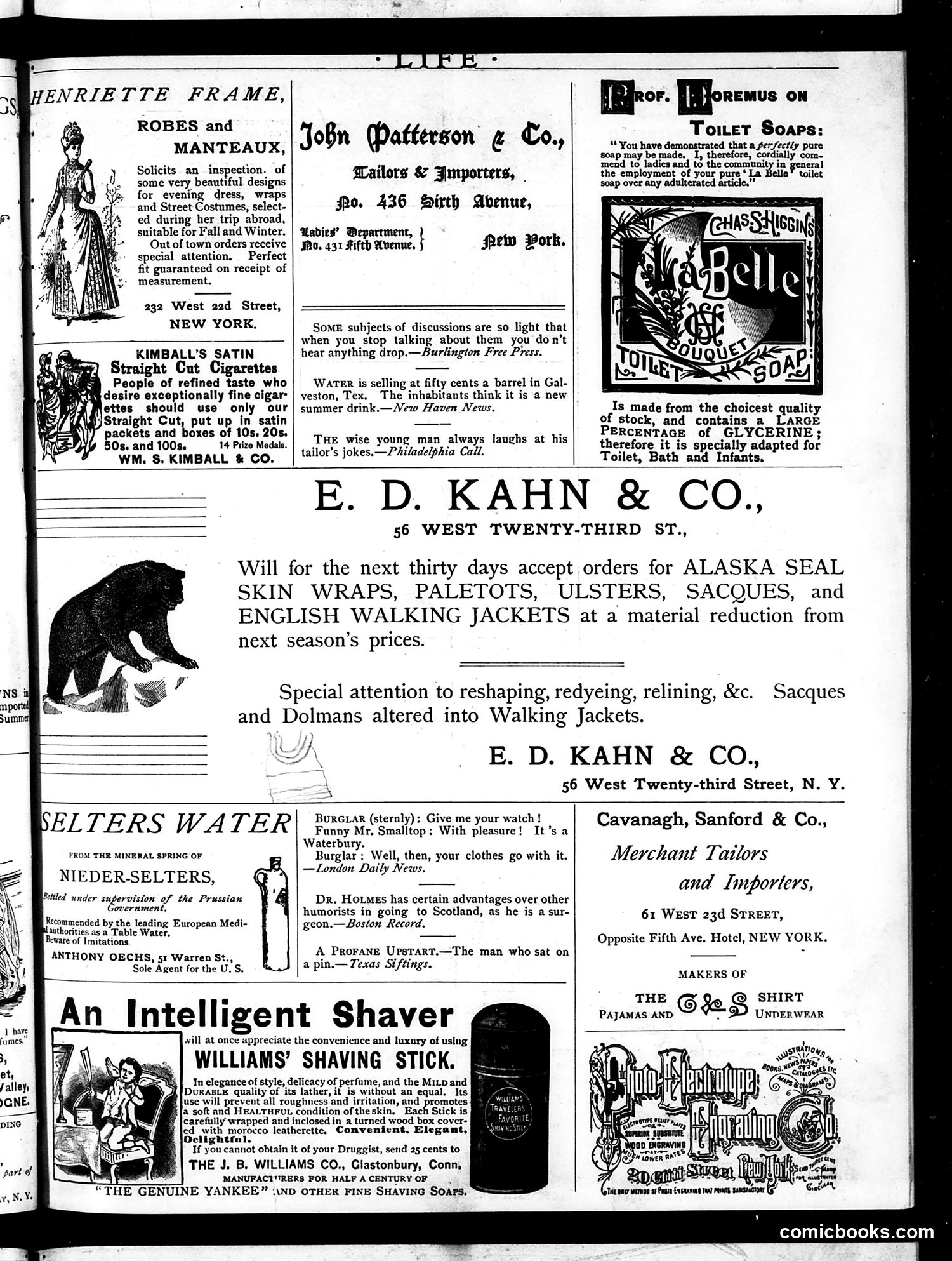
This page is primarily **advertising with brief humorous snippets**, not political cartoons requiring historical context. The small jokes scattered throughout are light social observations typical of the era: - A burglar assumes a "Waterbury" watch (cheap/unreliable) is worthless, then takes the victim's clothes anyway—mocking the poor reputation of inexpensive watches. - A tailor's customer laughs at jokes to maintain the relationship, a gentle jab at social etiquette. - Water selling for fifty cents in Galveston is presented as absurdly expensive (or residents naively treating it as a novelty drink). The page features advertisements for luxury goods: **fur wraps and walking jackets** (E.D. Kahn & Co.), **custom tailoring** (Cavanagh, Sanford & Co.), **women's dresses** (Henriette Frame), and **grooming products** (Williams' Shaving Stick). These target wealthy New York readers. The lone illustration—a bear—accompanies the fur company's ad, emphasizing the seal-skin merchandise. No significant political satire is present; this is a standard late-19th-century advertising page with filler humor.
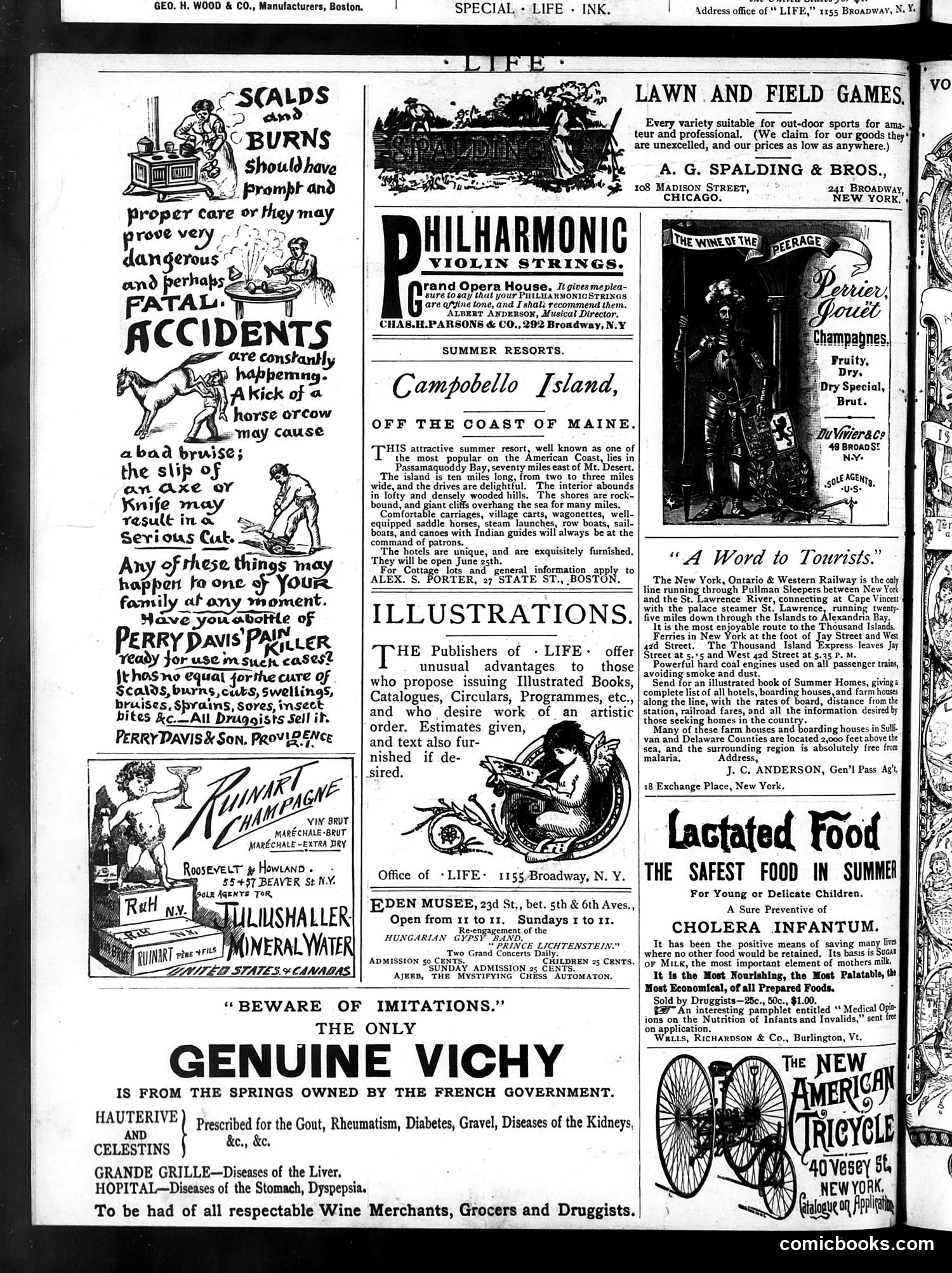
This is primarily an **advertising page** from Life magazine, not a satirical cartoon page. The layout features multiple paid advertisements for products and services popular in the late 19th century. The largest ad (left side) promotes **Perry Davis Pain Killer**, using illustrations of common domestic accidents—falls, animal kicks, cuts—to scare readers into buying the patent medicine as a household necessity. The messaging exploits anxiety about injury. Other notable ads include: - **Vichy mineral water** (bottom), claiming French government ownership and medical benefits - **Sporting goods** and **violin strings** - **Summer resort** promotions (Campobello Island) - A **chess-playing automaton** exhibit The page reflects Gilded Age consumer culture: patent medicines with dubious health claims, luxury tourism, and mechanical novelties marketed to affluent readers. There's no political satire visible—this appears to be a revenue-generating advertising section rather than editorial content.