
A complete issue · 16 pages · 1886
Life — April 15, 1886
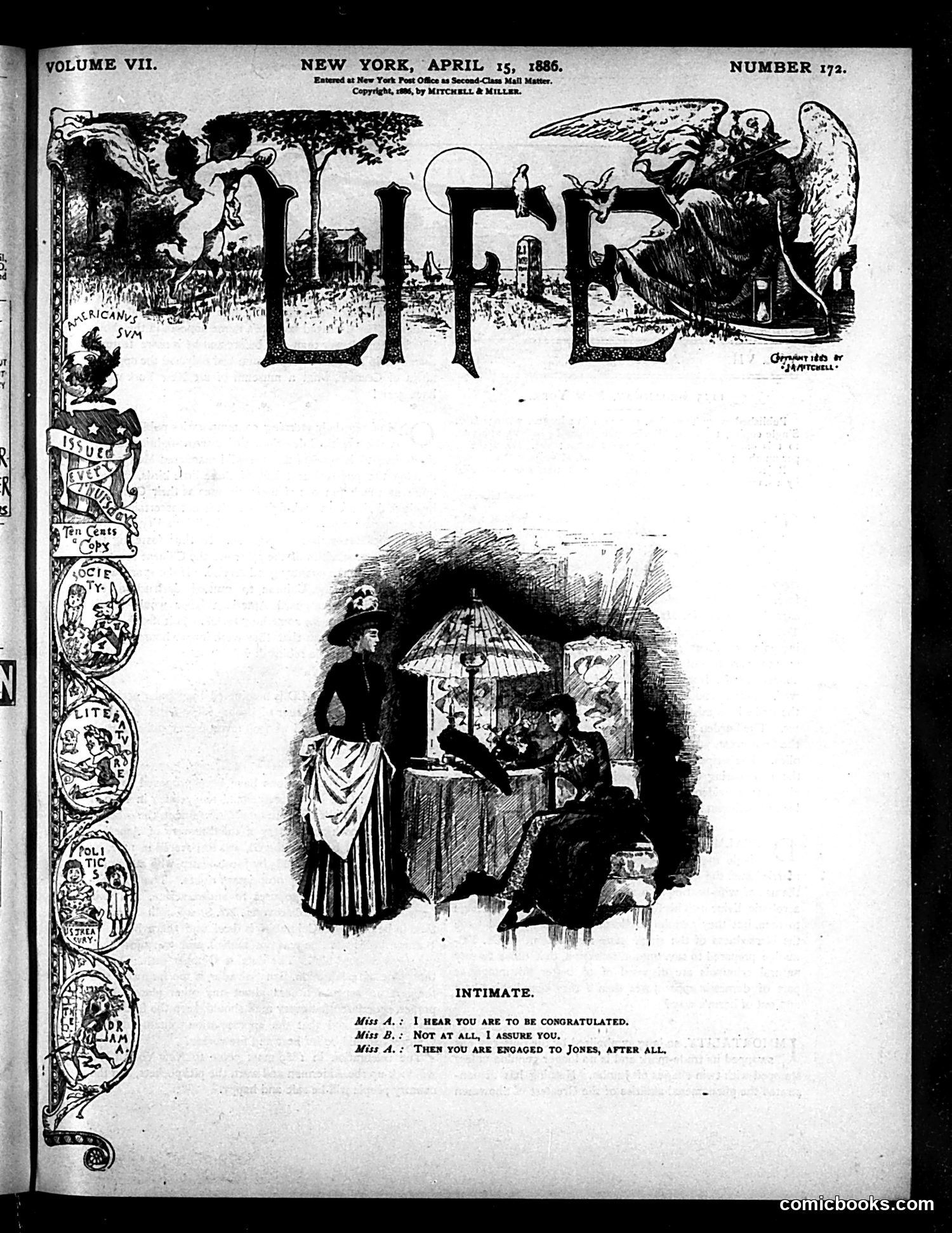
This brief satirical sketch depicts two women gossiping under a parasol, with a third woman approaching. The caption reveals the joke: Miss A congratulates Miss B on an engagement, but Miss B denies it—insisting she's still engaged to Jones. Miss A responds that "then you are engaged to Jones, after all," exposing the contradiction in Miss B's protest. The humor derives from social commentary on women's public personas and gossip. The "intimate" setting (emphasized by the title) suggests private female conversation where contradictions and social pretenses are revealed. The sketch mocks how women navigate competing social claims and the gap between public denials and actual circumstances—typical Victorian-era satire about feminine propriety and duplicity.
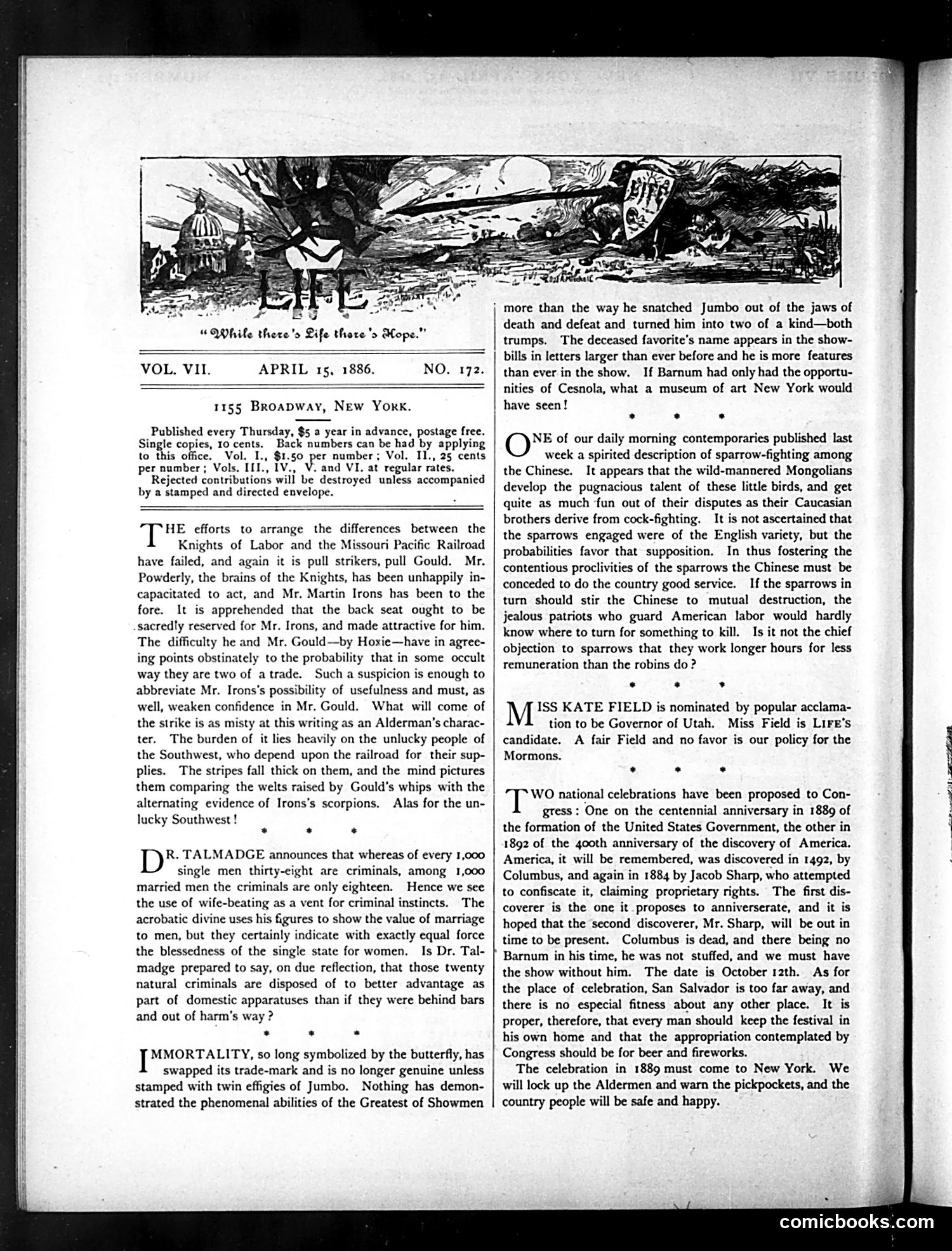
The masthead cartoon depicts a figure in a wide-brimmed hat overlooking a landscape with a crescent moon—likely referencing the caption "While there's Life there's Hope," a common Victorian saying. The page's main content addresses labor disputes: the article discusses failed negotiations between the Knights of Labor and Missouri Pacific Railroad regarding strikes and labor leader Jay Gould. The satire criticizes both Gould's tactics and the suspicion between negotiating parties, suggesting their mutual distrust undermines resolution. A secondary piece mocks Dr. Talmadge's statistics on criminality among married versus single men, satirizing the pseudo-scientific claims being made about morality and marriage. The page reflects 1880s anxieties about labor unrest, industrial power, and social reform debates.
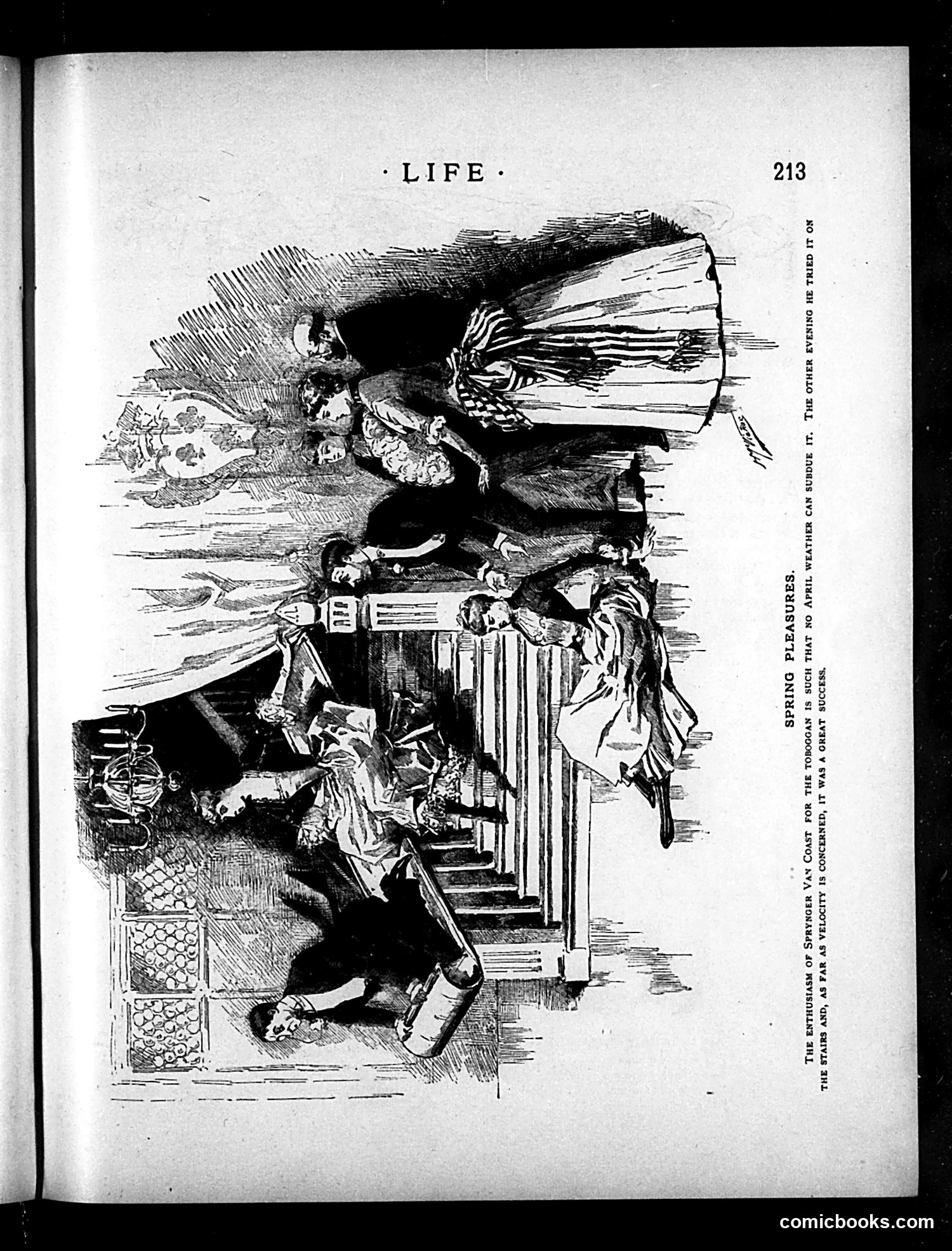
This cartoon satirizes the social pretensions and discomforts of wealthy spring activities in the Gilded Age. The scene depicts fashionably dressed people ascending an elaborate staircase or pavilion, clearly struggling with the physical demands of their ornate clothing and accessories—corsets, bustles, and formal wear. The title "Spring Pleasures" is ironic: what should be enjoyable social occasions becomes torturous due to restrictive Victorian fashion. The cramped, crowded arrangement emphasizes how these displays of wealth and status actually inhibit natural movement and comfort. The satire targets the contradiction between fashionable appearance and practical reality—society women enduring physical pain to maintain social standing. This reflects period criticism of women's fashion constraints that damaged health.
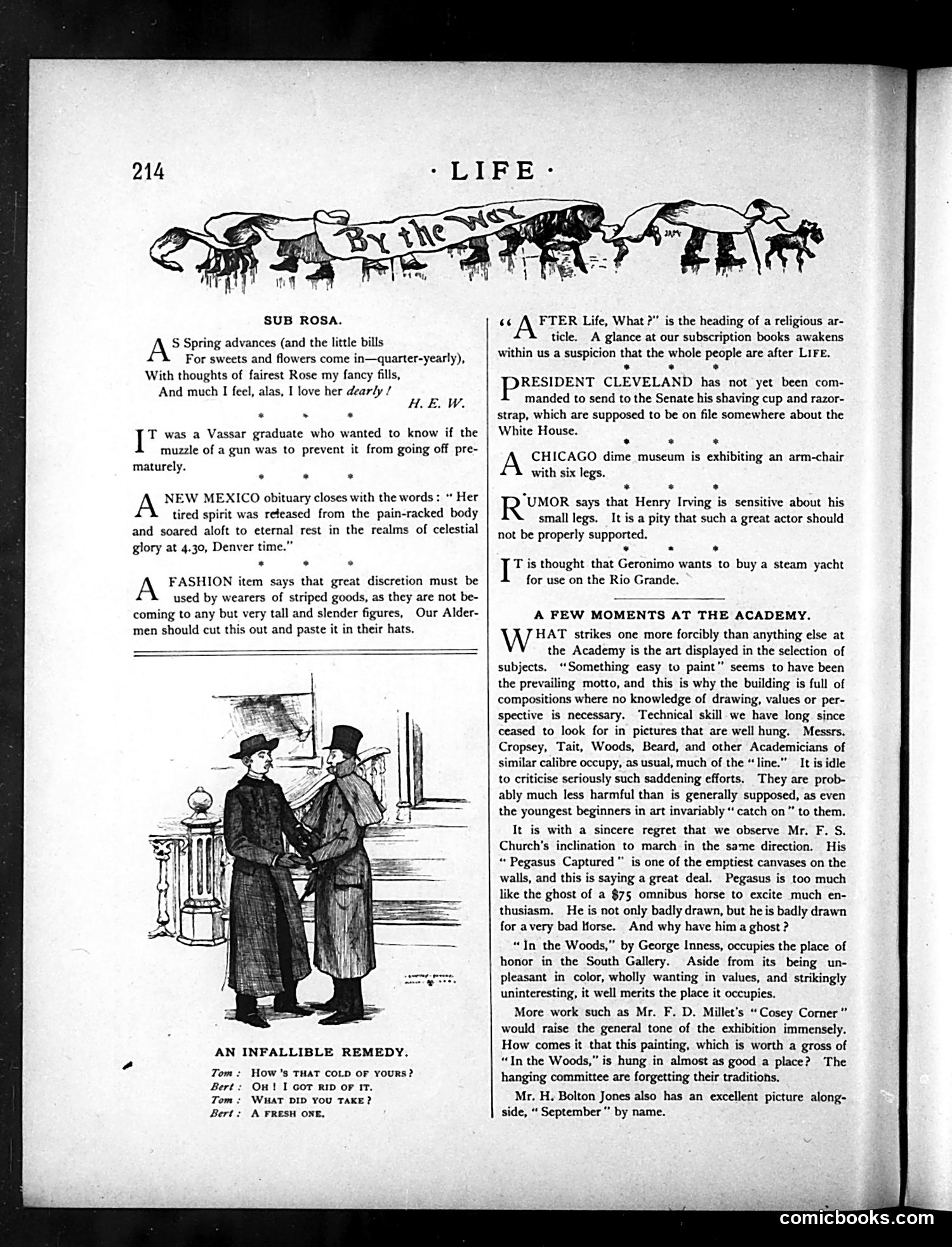
The cartoon depicts two men in top hats and overcoats. One asks the other about his cold; the exchange is: **Tom:** "How's that cold of yours?" **Bert:** "Oh! I got rid of it." **Tom:** "What did you take?" **Bert:** "A fresh one." This is a simple, timeless joke playing on the ambiguity of "take"—Bert claims to have cured his cold by contracting a fresh one instead, implying that deliberately catching a new illness somehow resolves the original ailment. The satire targets folk remedies and superstitious medical thinking, suggesting absurd logic persisted in treating common ailments. The joke requires no specific historical context to land with modern readers.
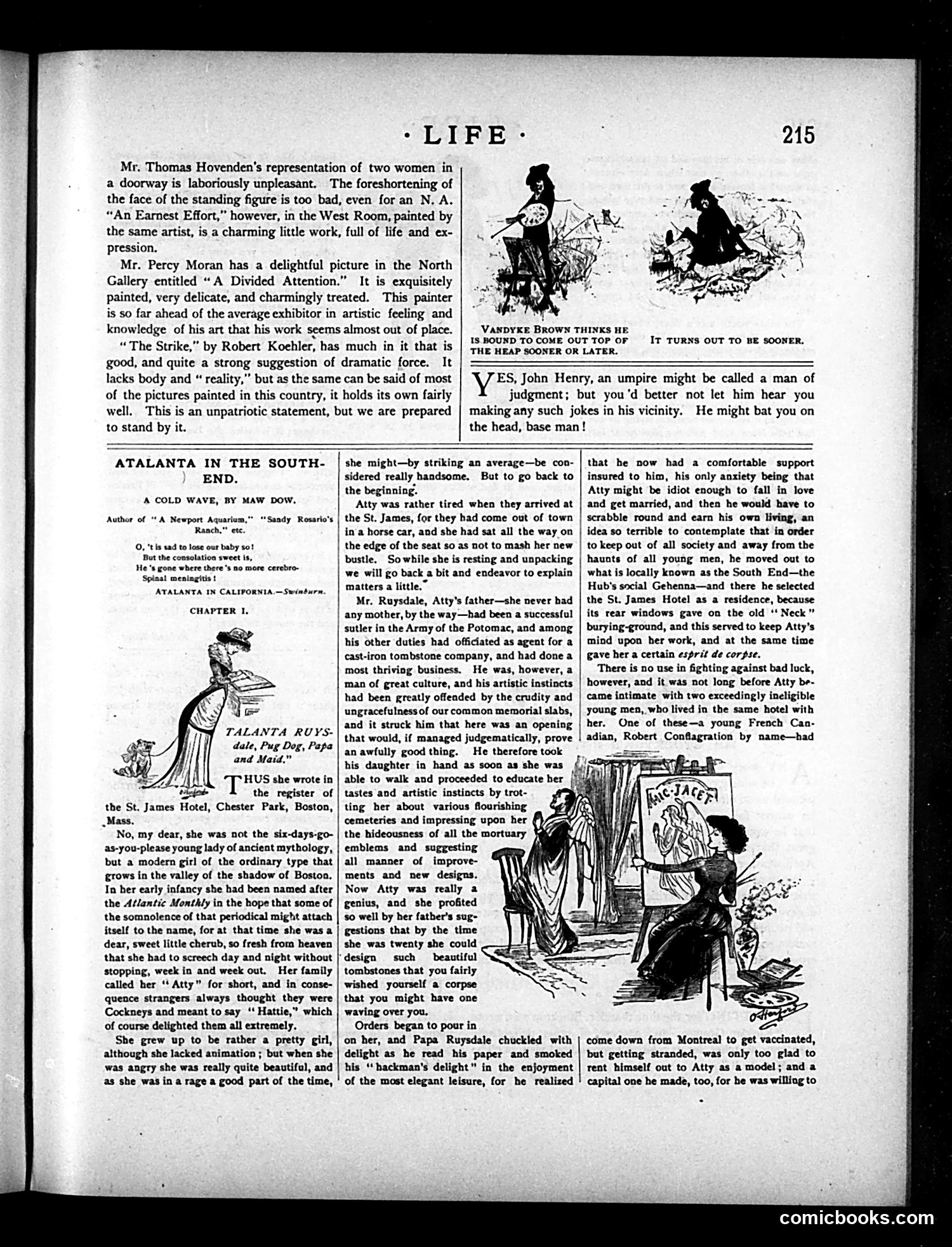
The page contains two cartoons with captions about hunting/outdoor mishaps: 1. **"Vandyke Brown Thinks He Is Bound to Come Out Top of the Head Sooner or Later"** — appears to depict a hunter in an awkward position, likely commenting on incompetence or bad luck during hunting. 2. **"It Turns Out to Be Sooner"** — the follow-up panel, suggesting the hunter's prediction of failure came true immediately. These seem to be humorous commentary on amateur hunters and their misadventures, a common satirical subject in early 20th-century Life magazine. The page also contains the beginning of a serialized story titled "Atlanta in the South-End" by an author identified as having written "A Newport Assertion" and "Sandy Rosalie's Beaux." The cartoons appear designed to break up the dense text of the narrative fiction.
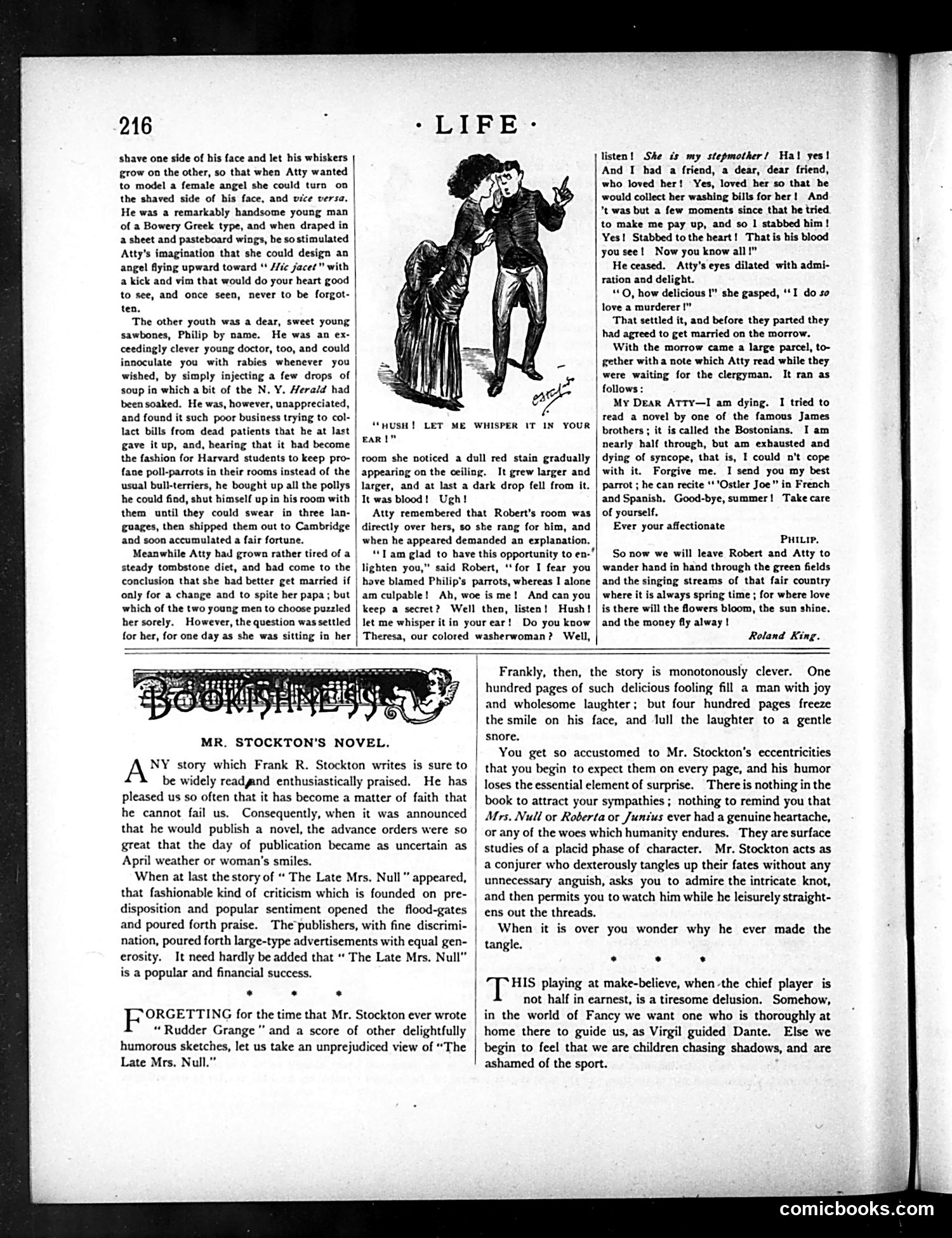
This page contains **literary criticism and fiction** rather than political cartoons. The main illustration depicts two figures in Victorian-era dress, with text indicating dialogue about whispered secrets. The content reviews **Frank R. Stockton's novel "The Late Mrs. Null,"** praising its humor while noting the author's tendency toward predictable eccentricities. The critic suggests Stockton's comedic formula—tangling up character fates without genuine consequence—becomes repetitive and loses surprise value. The reviewer expresses skepticism about make-believe entertainment, arguing that audiences should demand earnest engagement rather than childish fancy from serious literature. **No clear political satire is evident** on this page; it's primarily a book review in Life's literary section.
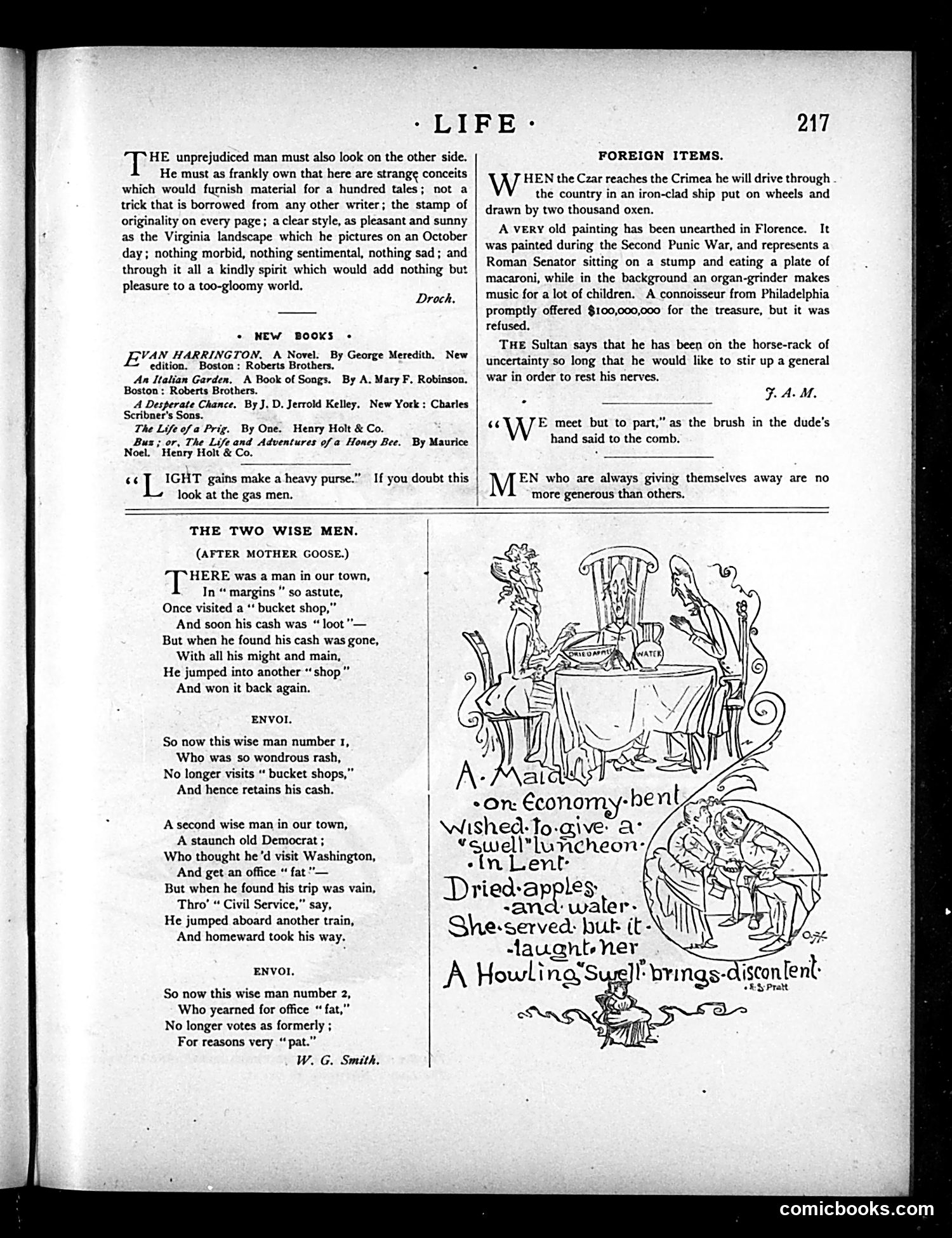
**Main Content: "The Two Wise Men" (After Mother Goose)** This poem satirizes two local politicians through nursery-rhyme format. The first "wise man" visits a bucket shop (an illegal gambling operation), loses his money, then recovers it by jumping into another shop—suggesting he regains wealth through similarly dubious means. The second wise man, described as "a staunch old Democrat," thought he'd visit Washington, got "fat," and now votes for "reasons very 'pat'"—satirizing political corruption and the spoils system where politicians benefit personally from office. The accompanying illustration shows two men at a dining table, captioned about "economy-bent" wishes and luncheon providing "dried-apples and-water," mocking politicians' hypocritical claims of frugality while enriching themselves. The satire targets turn-of-century American political corruption and graft.
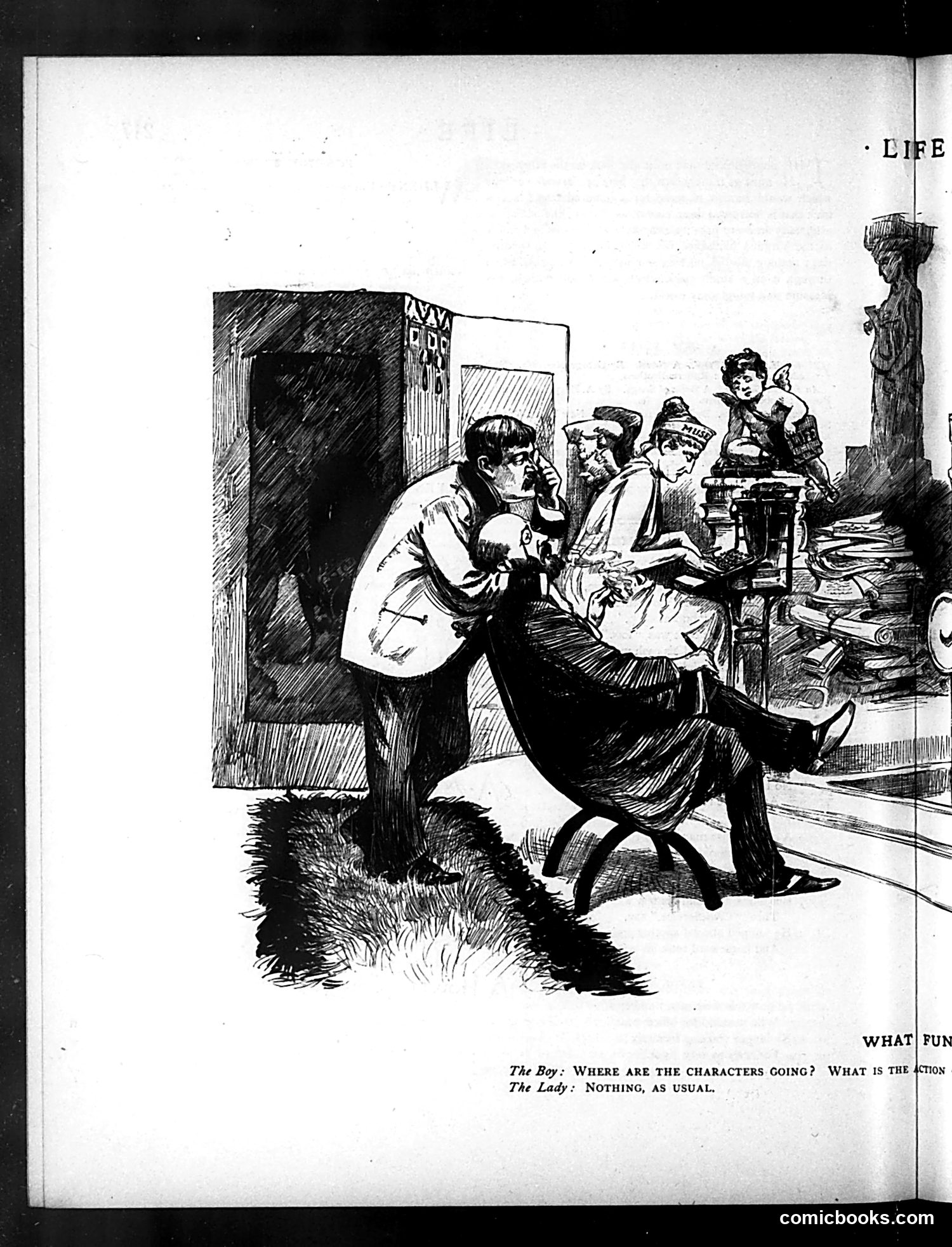
This cartoon from *Life* magazine shows a theatrical scene where a boy asks a lady "Where are the characters going? What is the action?" The lady responds "Nothing, as usual." The satire targets contemporary theater—likely early 20th century—by mocking productions that lack compelling plot or character development. The crowded stage with multiple figures suggests an overcrowded, confusing theatrical production offering nothing substantive to audiences. The boy's innocent question exposes the absurdity: despite numerous actors and apparent activity, there's no coherent story or meaningful action. This reflects *Life* magazine's role as social critic, poking fun at pretentious or poorly constructed theatrical productions that confused rather than entertained audiences. The joke assumes readers shared frustrations with confusing modern theater.
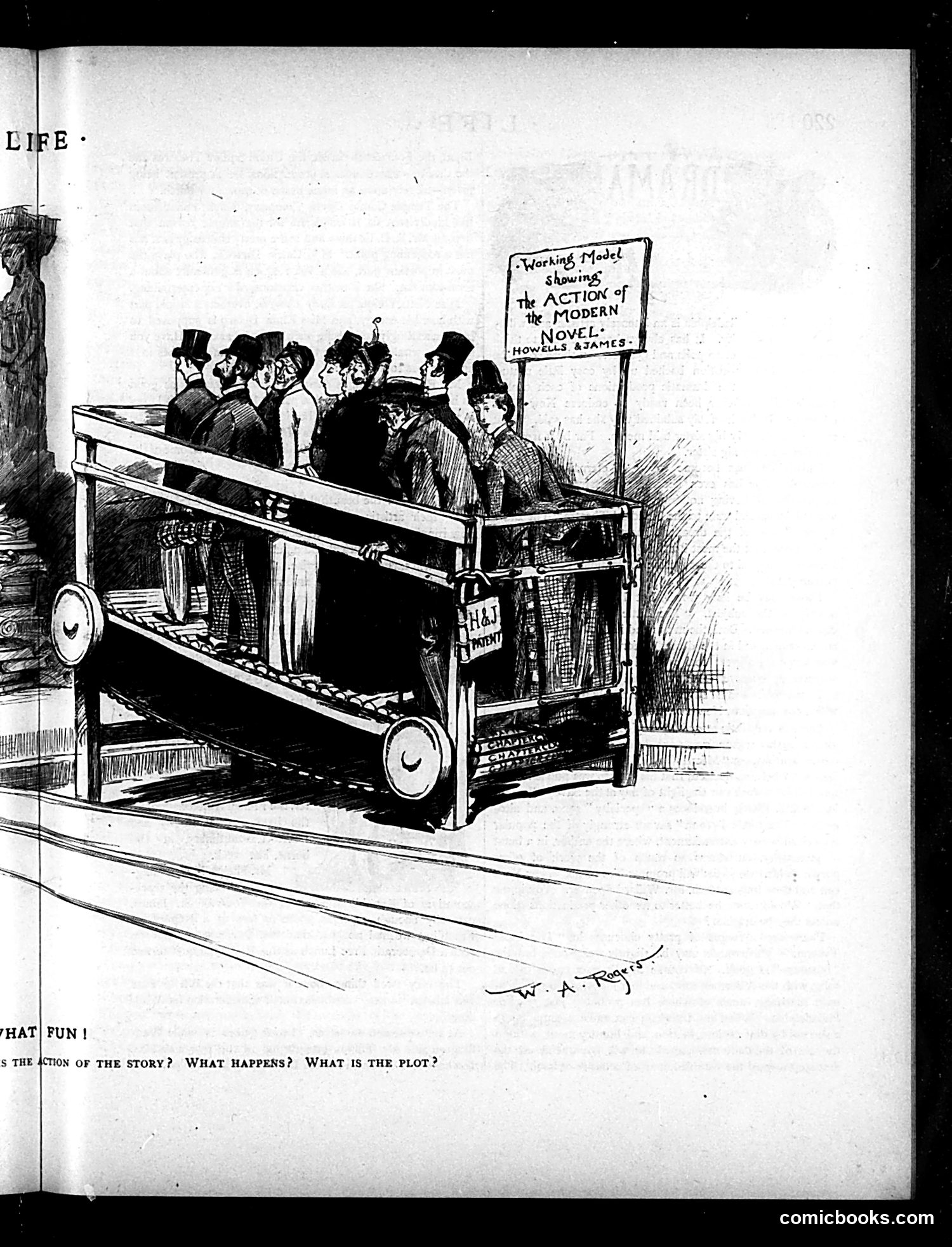
This Life magazine cartoon satirizes the contemporary literary world, likely from the early 20th century. The image depicts a "working model" of a modern novel displayed on what appears to be a carnival or exhibition platform, labeled "Howells & James" (referencing prominent authors William Dean Howells and Henry James). The satire mocks how modern fiction operates mechanistically—like a mechanical exhibit rather than organic storytelling. Well-dressed observers examine the contraption, suggesting intellectuals studying literature. The caption "What fun! Is the action of the story? What happens? What is the plot?" implies that modern novels lack clear narrative drive or traditional plot structure, prioritizing instead psychological analysis and literary technique over entertaining storylines. This reflects contemporary literary debates about realism versus plot-driven fiction.
This is a scathing theater review of "The Little Tycoon," a musical comedy that Philadelphia's Temple Comic Opera Company sent to New York. The critic attacks both the production and Philadelphia's theatrical ambitions with acidic wit. **The satire's targets:** The piece mocks Philadelphia's provincial deference to New York ("My big sister told me so") and its desperate attempt to prove artistic credentials by exporting this mediocre show. The critic dismisses "The Little Tycoon" as derivative trash—assembled from borrowed topical songs, Japanese costumes apparently imitating Gilbert & Sullivan's "Mikado," and vaudeville "business" rather than genuine artistry. **The performers are individually lambasted:** Miss Dietrick sings flat and lacks charm; Miss Guion overacts; Miss Delaro's "wit" is incomprehensible. The underlying point: American musical theater relies on newspapers, spectacle, and cheap entertainment rather than literary merit and original composition. The critic calls this a failed opportunity for establishing genuine American theatrical art.
This appears to be a humorous fictional narrative mocking British royalty and diplomatic protocol. The story depicts Queen Victoria hosting a dinner with French ambassador M. Waddington and various guests, including "Battenberg" (Prince Henry of Battenberg, Victoria's son-in-law, serving as a disguised waiter). The satire targets: - **Royal incompetence**: The Queen mangles French ("soupgons" for soup, "champignon" for champagne), revealing aristocratic pretension masking ignorance - **Diplomatic tension**: A minor beer-serving incident nearly causes war between France and England - **Class absurdity**: A royal family member disguised as servant, stammering apologies - **American bluntness**: "Mr. Phelps" (likely representing American directness) demands accountability about missing pie, cutting through courtly evasion The humor relies on contrast between formal diplomatic expectations and comedic reality—everyone speaking past each other in broken French, missing dishes, and accusations of pie-theft among dignitaries. It's satire of European court pretension viewed through an American lens.
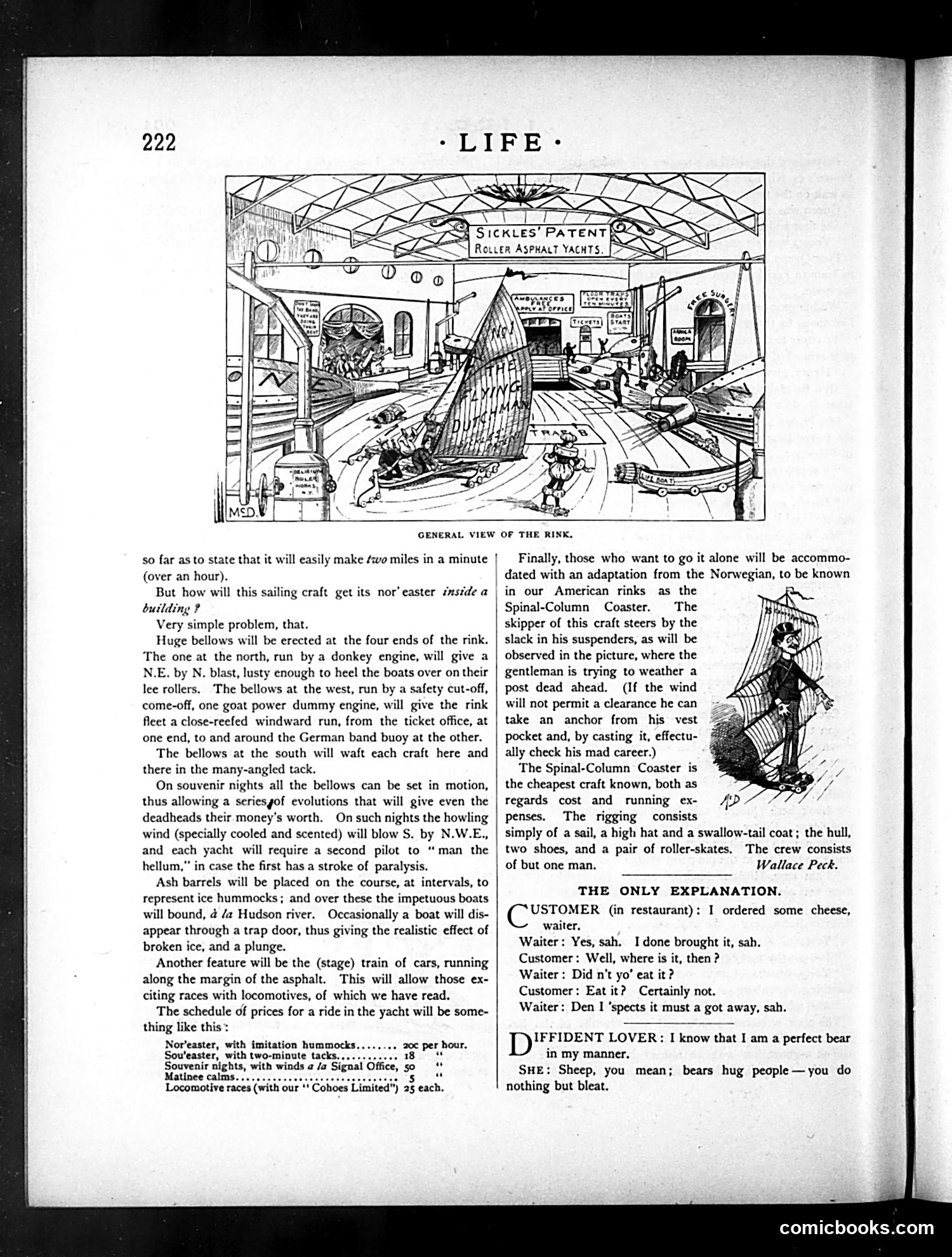
This page satirizes an absurd invention: an indoor ice-skating rink that simulates sailing yachts using mechanical bellows to create directional wind. The elaborate diagram and detailed text mock both the impracticality of the concept and the breathless enthusiasm of patent promoters. The humor lies in the ridiculous engineering: donkey engines and goat power running bellows at cardinal points, ash barrels representing ice hummocks, trap doors for "realistic" boat disappearances, and a locomotive racing track. The "Spinal-Column Coaster" alternative—essentially a sailor outfit on roller skates—lampoons the entire scheme's absurdity. The page also includes two unrelated short comedic sketches: a dialect-heavy restaurant exchange where a waiter assumes a customer ate missing cheese, and a romantic quip about someone being sheepish rather than bearish. This mixed format was typical of *Life* magazine's satirical approach.
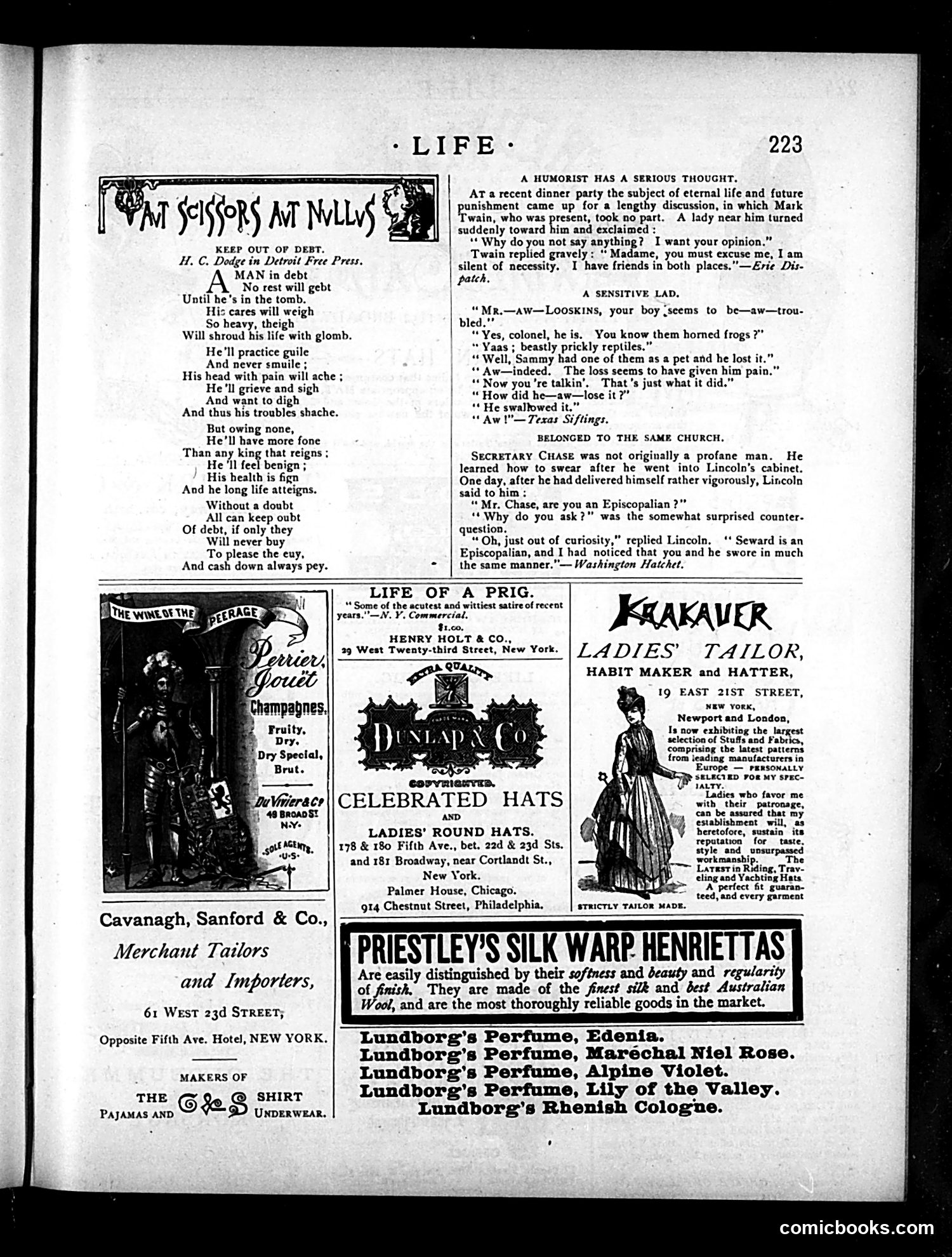
This page from *Life* magazine contains several humorous anecdotes and advertising rather than political cartoons. **Key Content:** The opening poem "Keep Out of Debt" is a moralistic verse warning against financial obligation, using awkward rhymes (debt/gebt, tomb/glomb) for comedic effect. **Notable anecdotes include:** 1. **Mark Twain quip**: Twain, when asked his opinion on eternal life and punishment, replies he must remain silent because he "has friends in both places"—a joke suggesting uncertainty about heaven and hell. 2. **Lincoln and Secretary Chase**: Lincoln observes that Chase swears like Seward, an Episcopalian, asking if Chase shares that faith. Lincoln's humor plays on Chase's newly acquired profanity, attributing it to Cabinet service influence. 3. **The "Sensitive Lad"**: A dialect piece about a boy grieving a pet horned frog he swallowed. The remainder is advertising for tailors, hatmakers, perfumes, and other Victorian-era goods. The page serves primarily as entertainment and commerce rather than political satire.
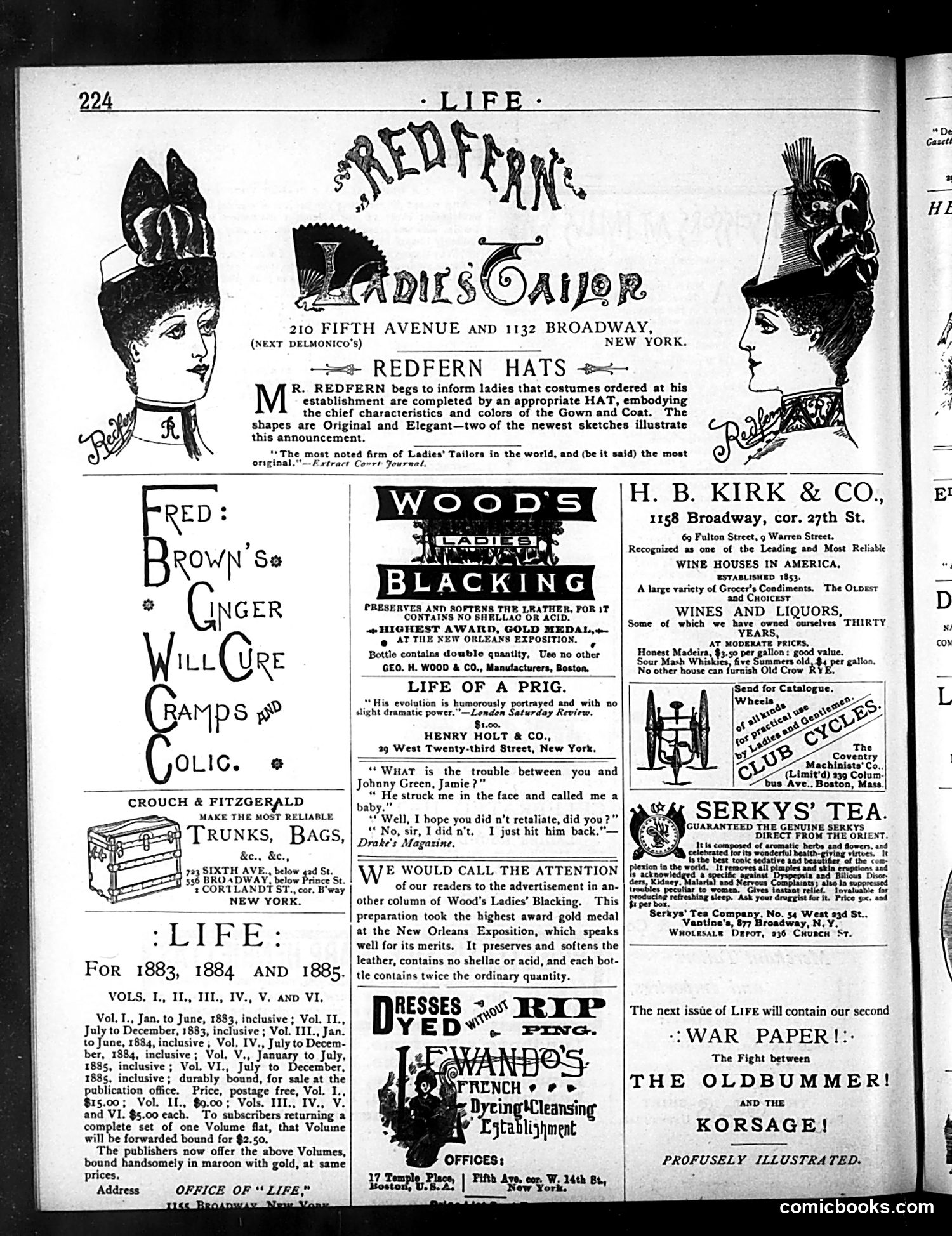
This is primarily an **advertisements page** from Life magazine (1883-1885), with minimal editorial cartoon content. The page features two decorative illustrations of fashionable women's heads wearing elaborate hats, advertising **Redfern's Ladies' Tailor** shop on Fifth Avenue and Broadway—a high-end establishment where custom gowns came with matching, "original and elegant" hats. The bulk of the page consists of period advertisements for luxury goods: trunks, wine, tea, shoe polish (which won a gold medal), and tailoring services. There's a brief joke about a boy named Jamie who claims he "didn't retaliate" when hit, then admits he "just hit him back"—gentle wordplay about childhood logic. The page concludes with a teaser for the **next issue's "War Paper,"** promising an illustrated battle between "The Oldbummer" and "The Korsage" (corset)—likely satirizing contemporary debates about women's fashion and restrictive clothing. This is primarily a commercial page reflecting 1880s consumer culture and fashion obsessions.
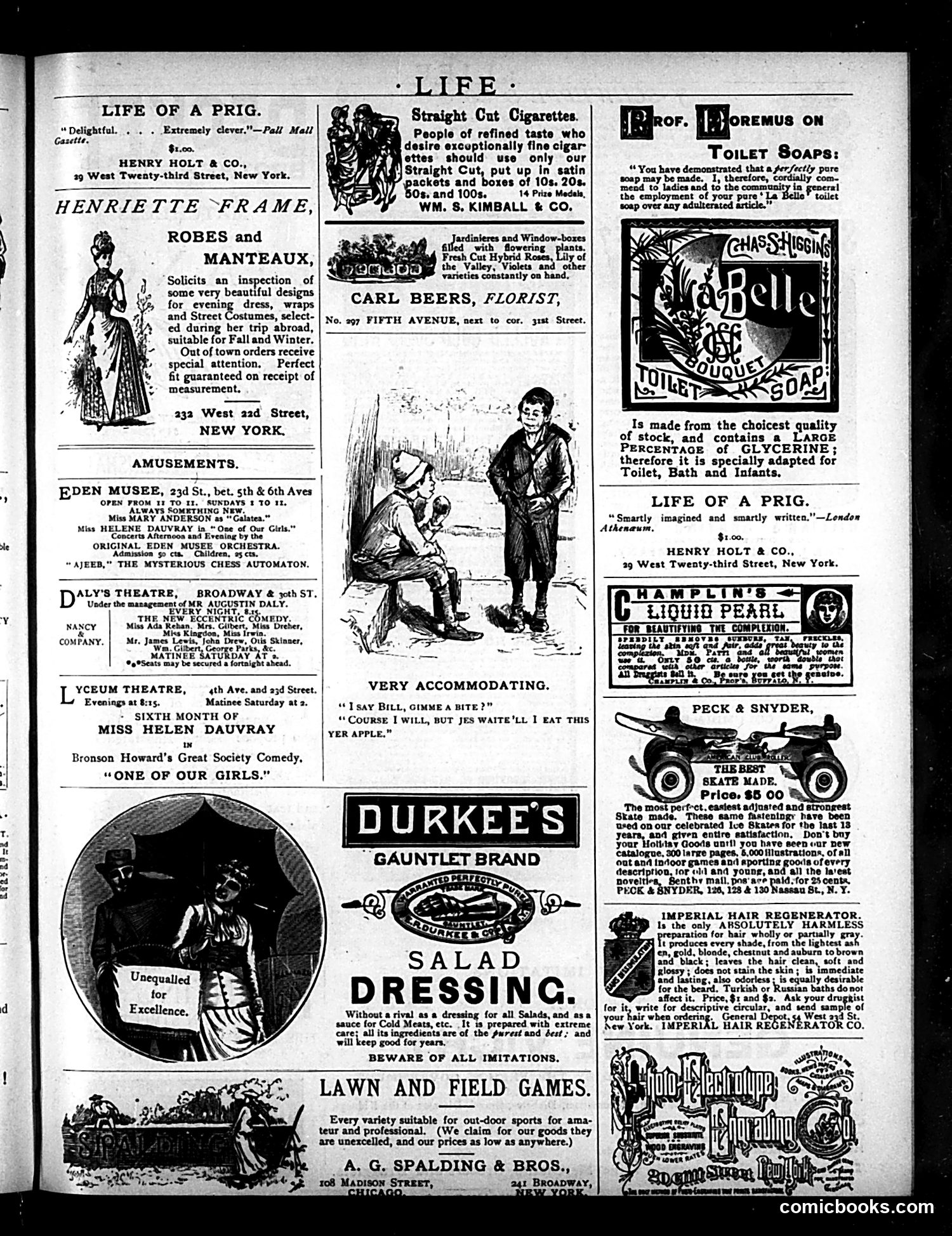
This page from *Life* magazine is primarily **advertisements and entertainment listings**, not a political cartoon. The title "Life of a Prig" appears twice—it's a book being advertised by publisher Henry Holt & Co., described as "delightfully" and "extremely clever" by contemporary reviewers. The page contains typical late 19th-century ads: women's clothing (Henriette Frame's robes), florist services, theater announcements (Eden Musee, Daly's Theatre, Lyceum Theatre), and commercial products (cigarettes, salad dressing, skates, hair regenerator). The one illustrative content shows a genre scene captioned "Very Accommodating"—two figures sharing an apple, with dialogue about waiting one's turn. This appears to be gentle social humor rather than political satire, depicting ordinary courtesy or mild humor about sharing food. The page reflects the magazine's mixed content: literature promotion, entertainment, and consumer goods aimed at middle-class readers.
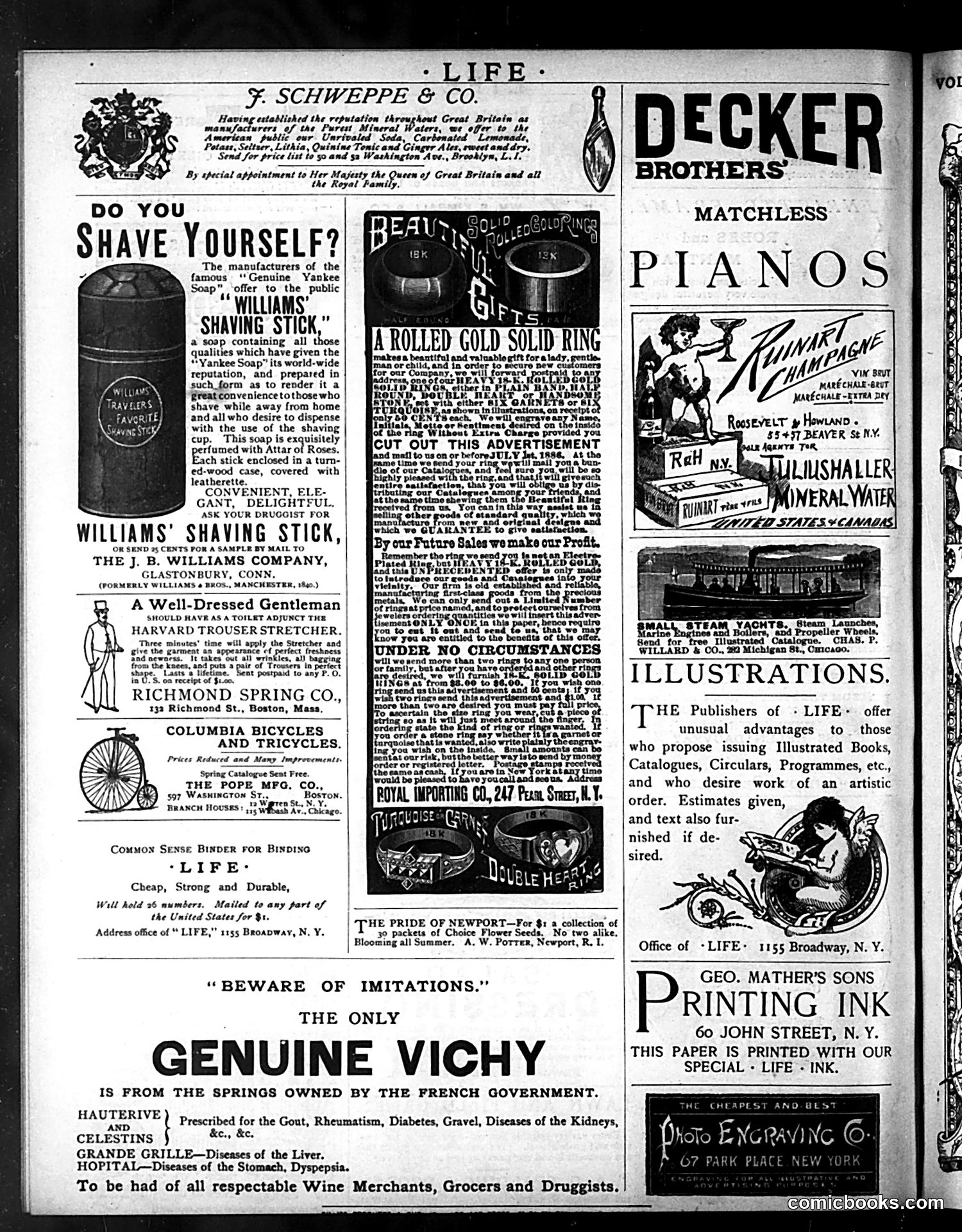
This is primarily an **advertising page** from Life magazine, not a political cartoon or satirical content page. It contains approximately 15-20 advertisements for consumer goods and services from the late 19th century. The ads showcase products typical of the era: Williams' Shaving Stick (with Attar of Roses), Columbia bicycles, Harvard Trouser Stretcher, Decker Brothers pianos, and Vichy mineral water (with royal appointment seal). Most notably, there's a lengthy advertisement for a "Rolled Gold Solid Ring" that appears designed to counter skepticism about jewelry authenticity. The only potentially satirical element is the repeated emphasis on "BEWARE OF IMITATIONS"—particularly for Vichy water and the shaving products—suggesting consumer anxiety about counterfeit goods was a significant marketing concern in this period. The page demonstrates how Life supported itself financially through high-end consumer advertising rather than relying solely on editorial content.