
Life, 1886-04-15 · page 6 of 16
Life — April 15, 1886 — page 6: what you’re looking at
What you’re looking at
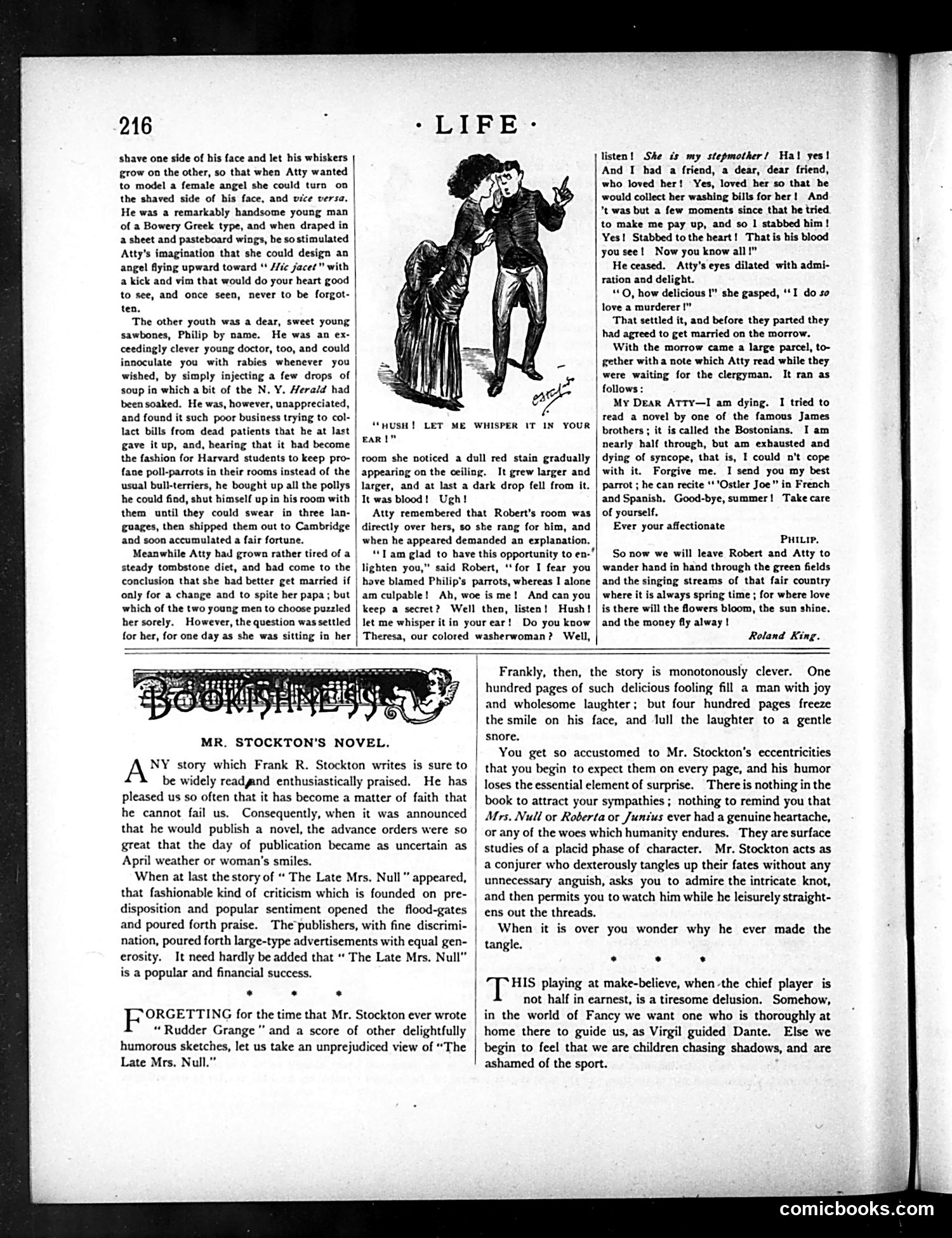
This page contains **literary criticism and fiction** rather than political cartoons. The main illustration depicts two figures in Victorian-era dress, with text indicating dialogue about whispered secrets. The content reviews **Frank R. Stockton's novel "The Late Mrs. Null,"** praising its humor while noting the author's tendency toward predictable eccentricities. The critic suggests Stockton's comedic formula—tangling up character fates without genuine consequence—becomes repetitive and loses surprise value. The reviewer expresses skepticism about make-believe entertainment, arguing that audiences should demand earnest engagement rather than childish fancy from serious literature. **No clear political satire is evident** on this page; it's primarily a book review in Life's literary section.
📄 Transcribed text from this page (OCR, searchable)
Machine-transcribed from the original scan — historical spelling and the odd misread are preserved.
216 shave one side of his face and let his whiskers grow on the other, so that when Atty wanted to model a female angel she could turn on the shaved side of his face, and vice versa. He was a remarkably handsome young man of a Bowery Greek type, and when draped in a sheet and pasteboard wings, be so stimulated Atty’s imagination that she could design an angel fying upward toward “ Mic jacet” with a kick and vim that would do your heart good to see, and once seen, never to be forgot- ten, The other youth was a dear, sweet young sawbones, Philip by name. He was an ex- ceedingly clever young doctor, too, and could innoculate you with rabies whenever you wished, by simply injecting a few drops of soup in which a bit of the N. Y. Hera/d had been soaked. He was, however, unappreciated, and found it such poor business trying to col- | lact bills from dead patients that he at last gave it up, and, hearing that it had become the fashion for Harvard students to keep pro- fane poll-parrots in their rooms instead of the usual bull-terriers, he bought up all the pollys he could find, shut himself up in bis room with them until they could swear in three lan- guages, then shipped them out to Cambridge and soon accumulated a fair fortune. Meanwhile Atty had grown rather tired of a steady tombstone diet, and had come to the conclusion that she had better get married if only for a change and to spite her papa; but which of the two young men to choose puzzled her sorely. However, the question was settled for her, for one day as she was sitting in her | “nus! LET ME WHISPER IT IN YOUR ear I" room she noticed a dull red stain gradually appearing on the ceiling. It grew larger and larger, and at last a dark drop fell from it. It was blood! Ugh! Atty remembered that Robert's room was directly over hers, so she rang for him, and when he appeared demanded an explanation. “Tam glad to have this opportunity to en-'| lighten you," said Robert, ‘for I fear you | have blamed Philip's parrots, whereas I alone am culpable! Ah, woe isme! And can you keep a secret? Well then, listen! Hush! let me whisper it in your ear! Do you know Theresa, our colored washerwoman? Well, listen! She ts my stepmother! Ha! yes! And I had a friend, a dear, dear friend, who loved her! Yes, loved her so that he would collect her washing bills for her! And "t was but a few moments since that he tried to make me pay up, and so | stabbed him! Yes! Stabbed tothe heart! That is his blood you see! Now you know all!” He ceased. Atty's eyes dilated with admi- ration and delight. “<Q, how delicious !" she gasped, ‘I do so | love a murderer I” ‘That settled it, and before they parted they had agreed to get married on the morrow. With the morrow came a large parcel, to- gether witha note which Atty read while they were waiting for the clergyman. It ran as follows : My Dear AtTTy—I am dying. I tried to read a novel by one of the famous James brothers ; it is called the Bostonians. I am nearly half through, but am exhausted and dying of syncope, that is, I could n't cope with it. Forgive me. I send you my best parrot ; he can recite ‘* Ostler Joe” in French and Spanish. Good-bye, summer! Take care of yourself. Ever your affectionate PHILIP, So now we will leave Robert and Atty to wander hand in hand through the green fields and the singing streams of that fair country where it is always spring time ; for where love is there will the flowers bloom, the sun shine. and the money fly alway ! Roland King. MR. STOCKTON’S NOVEL. NY story which Frank R. Stockton writes is sure to be widely readgand enthusiastically praised. He has pleased us so often that it has become a matter of faith that he cannot fail us. Consequently, when it was announced that he would publish a novel, the advance orders were so great that the day of publication became as uncertain as April weather or woman's smiles. When at last the story of “ The Late Mrs. Null” appeared, that fashionable kind of criticism which is founded on pre- disposition and popular sentiment opened the flood-gates and poured forth praise. nation, poured forth large-type advertisements with equal gen- erosity. It need hardly be added that “‘ The Late Mrs. Null is a popular and financial success. * . * ORGETTING for the time that Mr. Stockton ever wrote “Rudder Grange" and a score of other delightfully humorous sketches, let us take an unprejudiced view of “The Late Mrs. Null.” The’ publishers, with fine discrimi- | Frankly, then, the story is monotonously clever. One hundred pages of such delicious fooling fill a man with joy and wholesome laughter; but four hundred pages freeze the smile on his face, and lull the laughter to a gentle snore. You get so accustomed to Mr. Stockton’s eccentricities that you begin to expect them on every page, and his humor loses the essential element of surprise. There is nothing in the | book to attract your sympathies ; nothing to remind you that | Mfrs. Null or Roberta or Junius ever had a genuine heartache, or any of the woes which humanity endures. They are surface studies of a placid phase of character. Mr. Stockton acts as a conjurer who dexterously tangles up their fates without any unnecessary anguish, asks you to admire the intricate knot, and then permits you to watch him while he leisurely straight- ens out the threads. When it is over you wonder why he ever made the | tangle. . . * ARES playing at make-believe, when the chief player is not half in earnest, is a tiresome delusion. Somehow, in the world of Fancy we want one who is thoroughly at home there to guide us, as Virgil guided Dante. Else we begin to feel that we are children chasing shadows, and are ashamed of the sport. comicbooks.com