
A complete issue · 16 pages · 1886
Life — March 4, 1886
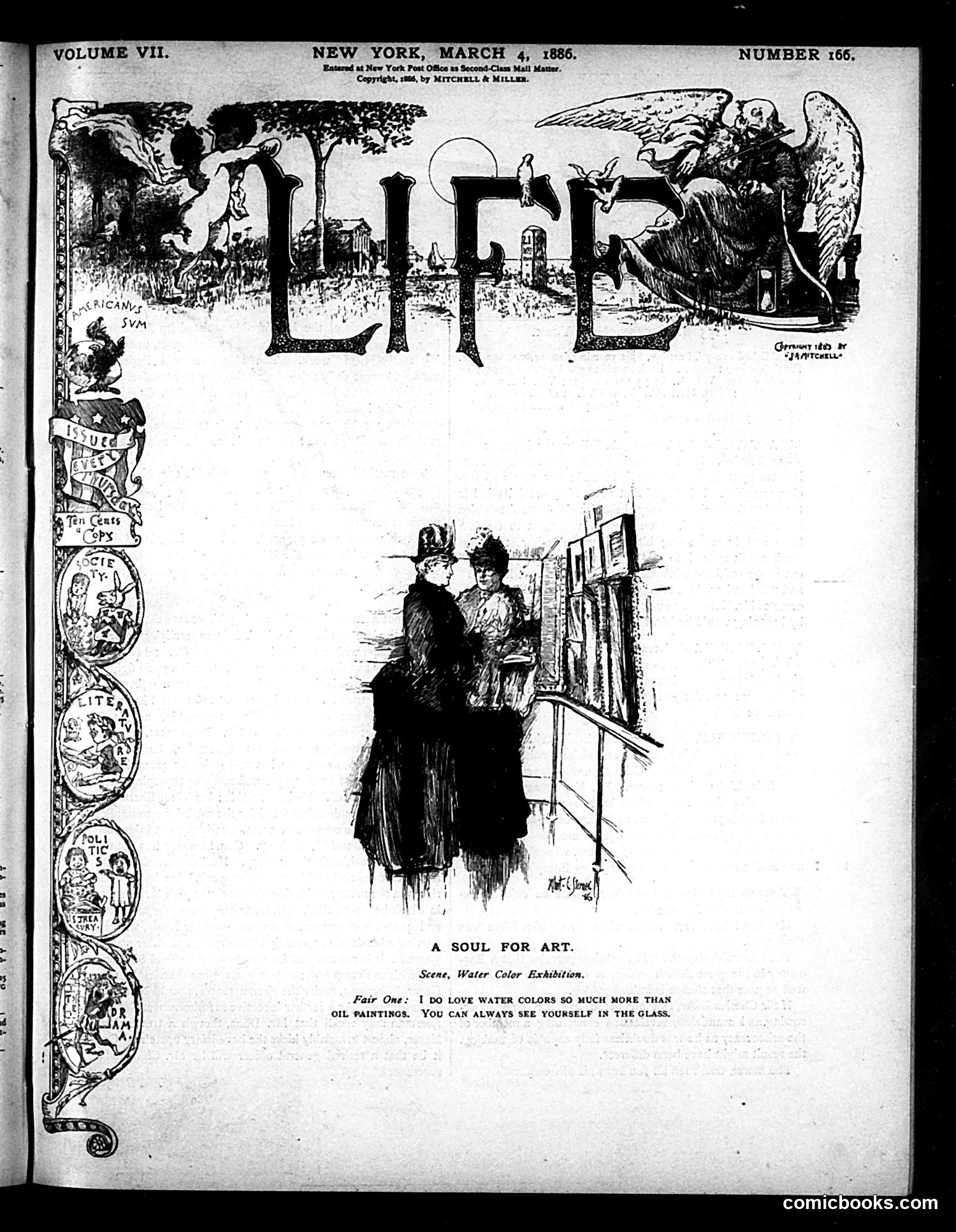
This satirical sketch depicts two figures at a water color exhibition. One enthusiastically declares: "I do love water colors so much more than oil paintings. You can always see yourself in the glass." The joke is a pun on vanity. The fair one praising water colors isn't genuinely appreciating the artistic medium—they're attracted to water color paintings because they're displayed behind glass, allowing them to admire their own reflection rather than the artwork itself. This mocks shallow aesthetes of the Gilded Age who claimed artistic sophistication while being primarily interested in self-admiration and social posturing. The satire suggests their "soul for art" is actually just narcissism masquerading as refined taste.
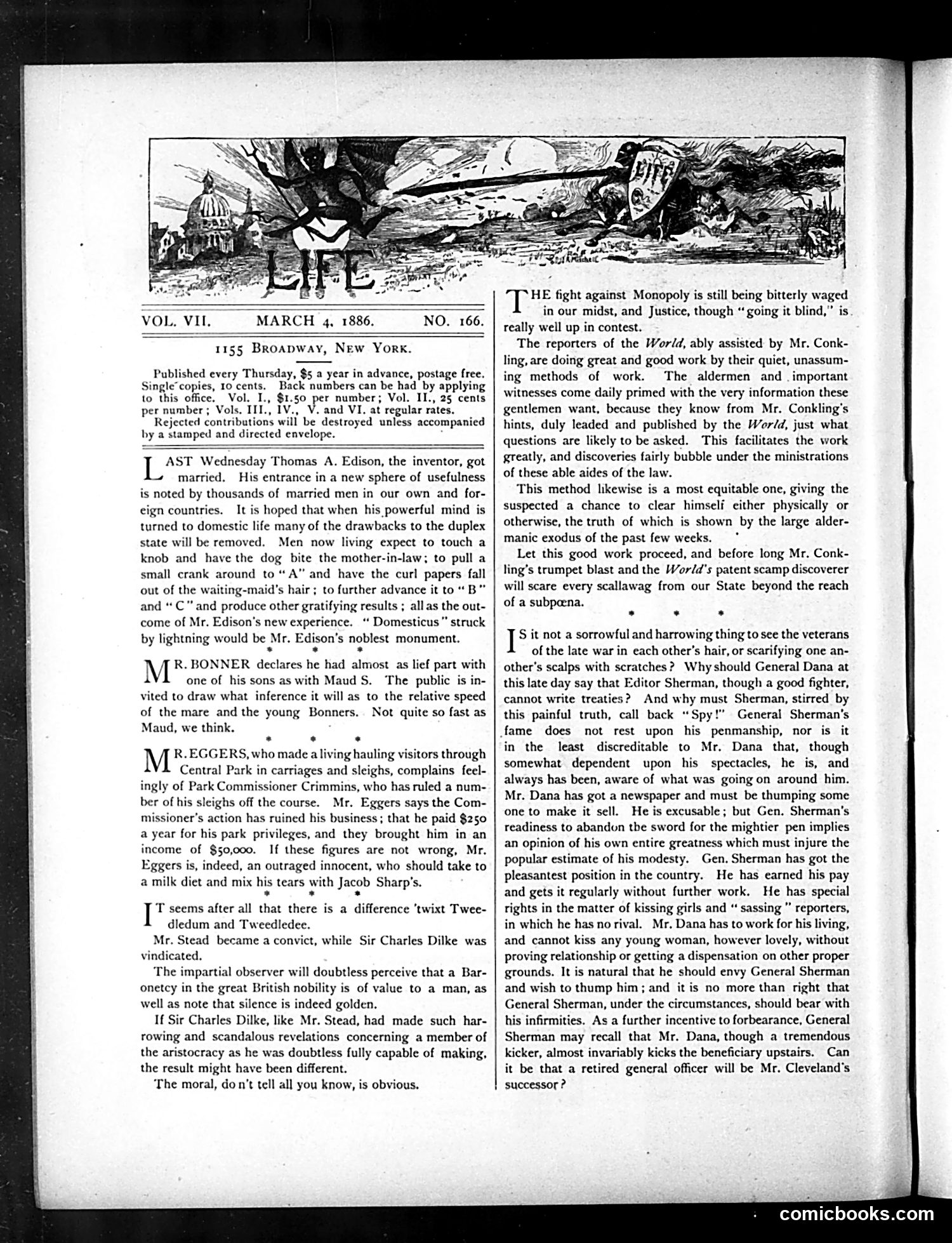
The page contains three brief satirical items about contemporary figures: 1. **Thomas Edison's marriage** is mocked as entering a "new sphere of usefulness"—a joke about his inventions and domestic life combining awkwardly. 2. **M.F. Bonner's claim** to be "almost as lief part with one of his sons as with Maud S." references Maud S., a famous racehorse of the era. The satire suggests Bonner values his prized horse as much as his children—a commentary on wealthy men's material obsessions. 3. **General Sherman vs. Editor Dana**: The longest piece criticizes General Sherman for refusing to write peace treaties while Editor Charles Dana (of the *New York Sun*) freely publishes opinions. It suggests Dana, dependent on his newspaper for income, should defer to Sherman's greater authority on military matters—a class-based critique of journalism.
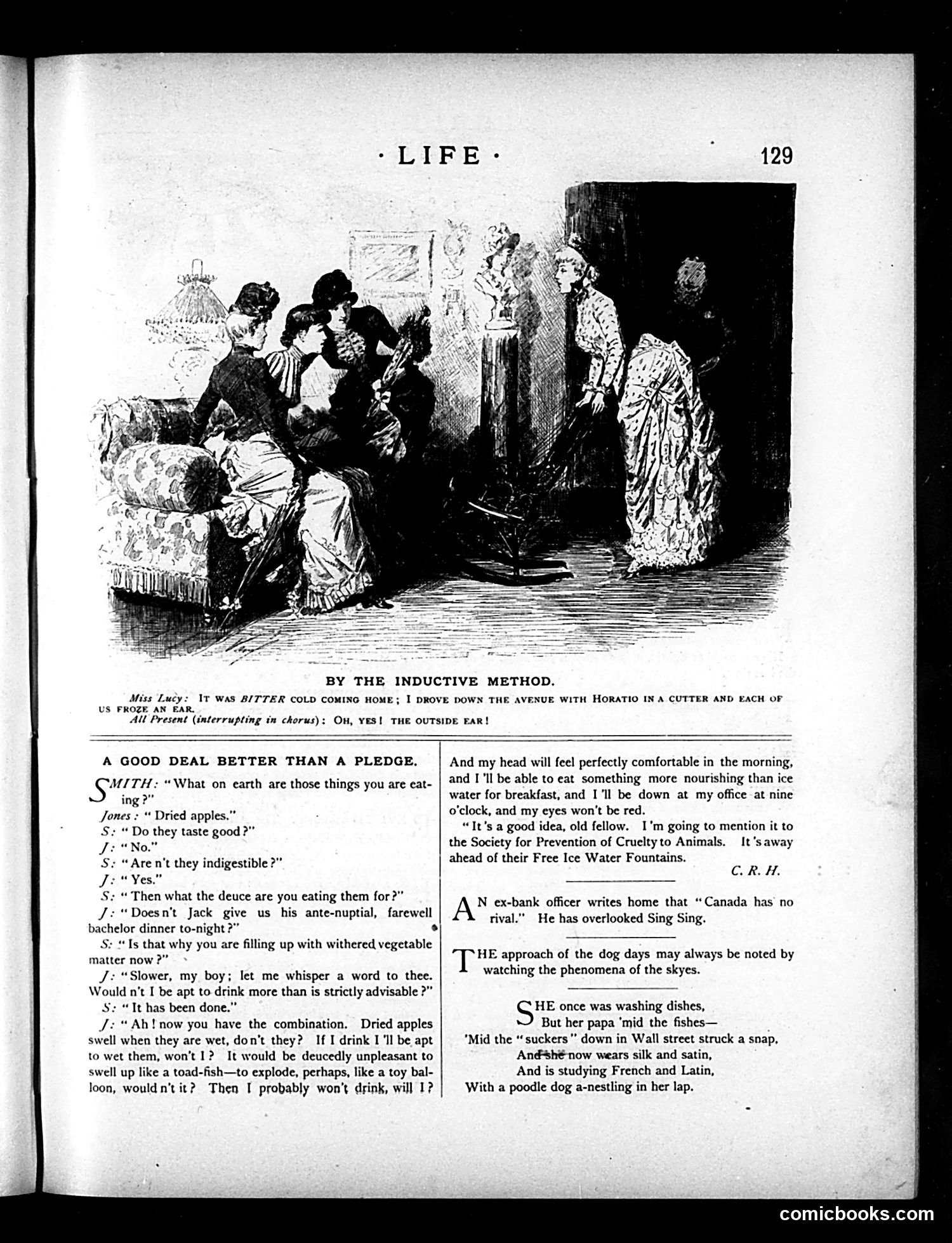
The main illustration depicts a social scene where someone is explaining dried apples to guests—captioned "BY THE INDUCTIVE METHOD." Below, the dialogue "A GOOD DEAL BETTER THAN A PLEDGE" shows Smith questioning Jones about eating dried apples, with Jones making increasingly absurd justifications for consuming them despite their unpalatability. The satire targets someone's argument that dried apples are acceptable food because they produce desirable effects (supposedly making one drink less water). This appears to satirize faulty logical reasoning—using a poor solution to justify accepting an undesirable situation. The smaller verse items below mock trivial social observations about dogs and a woman's domestic education. The humor relies on absurdist logic and social observation typical of *Life* magazine's satirical style, though the specific real-world reference is unclear without additional context.
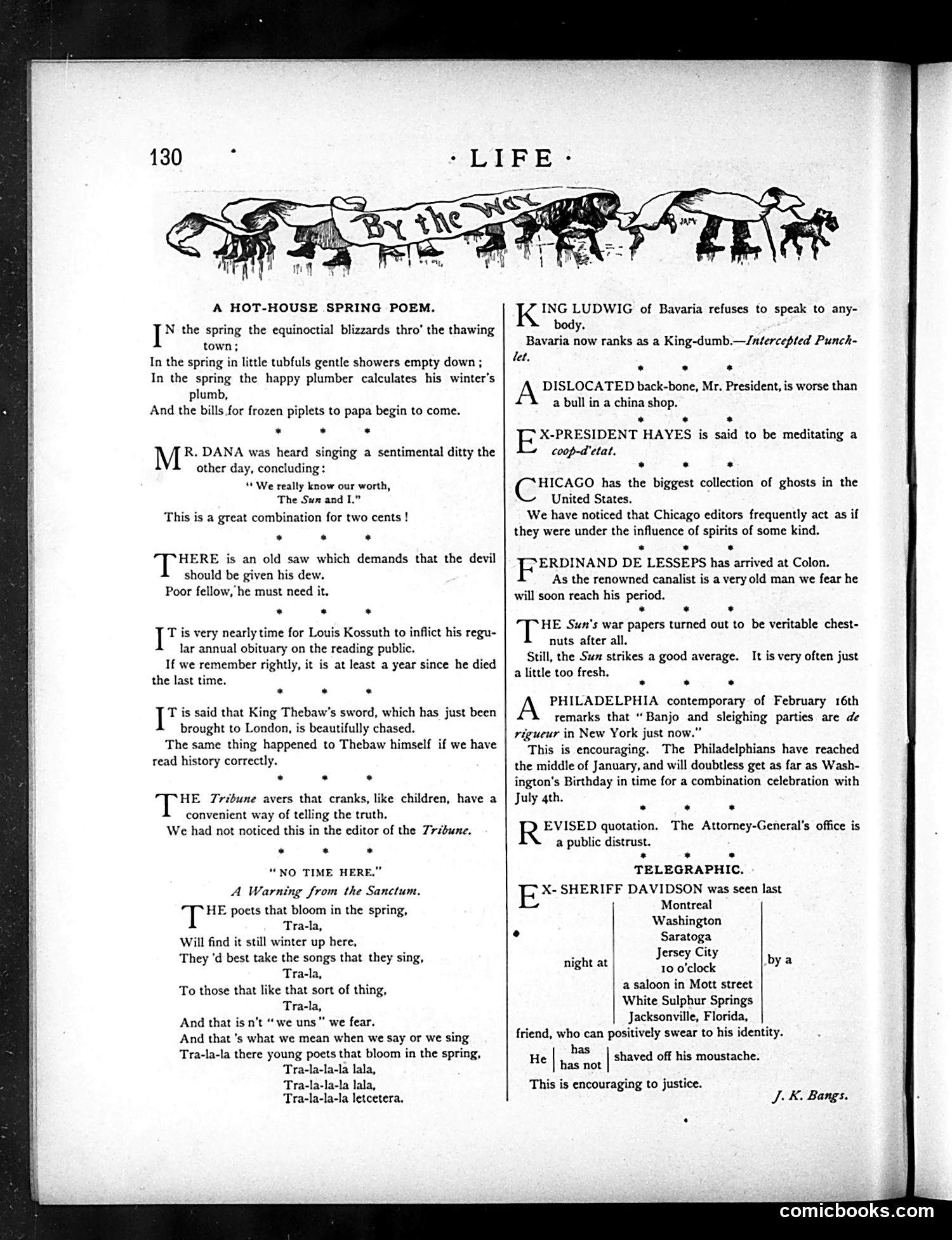
This page contains satirical commentary rather than political cartoons. The decorative header shows a procession of animals and figures, likely representing "the way" referenced in the poem title. **Key satirical items:** - **King Ludwig of Bavaria**: Mocked for his silence/refusal to communicate - **President Hayes**: Criticized as clumsy ("worse than a bull in a china shop") - **Chicago editors**: Suggested to be influenced by spirits/ghosts—implying irrational behavior - **Ferdinand de Lesseps**: The renowned canal engineer, feared to be aging ("very old man") - **The Sun newspaper**: Criticized as striking "a good average" but "a little too fresh"—impudent The page satirizes public figures through brief, pointed jabs at their character flaws or recent controversies. The tone is gossipy and irreverent, typical of 19th-century satirical journalism that mocked politicians and public personalities for entertainment.
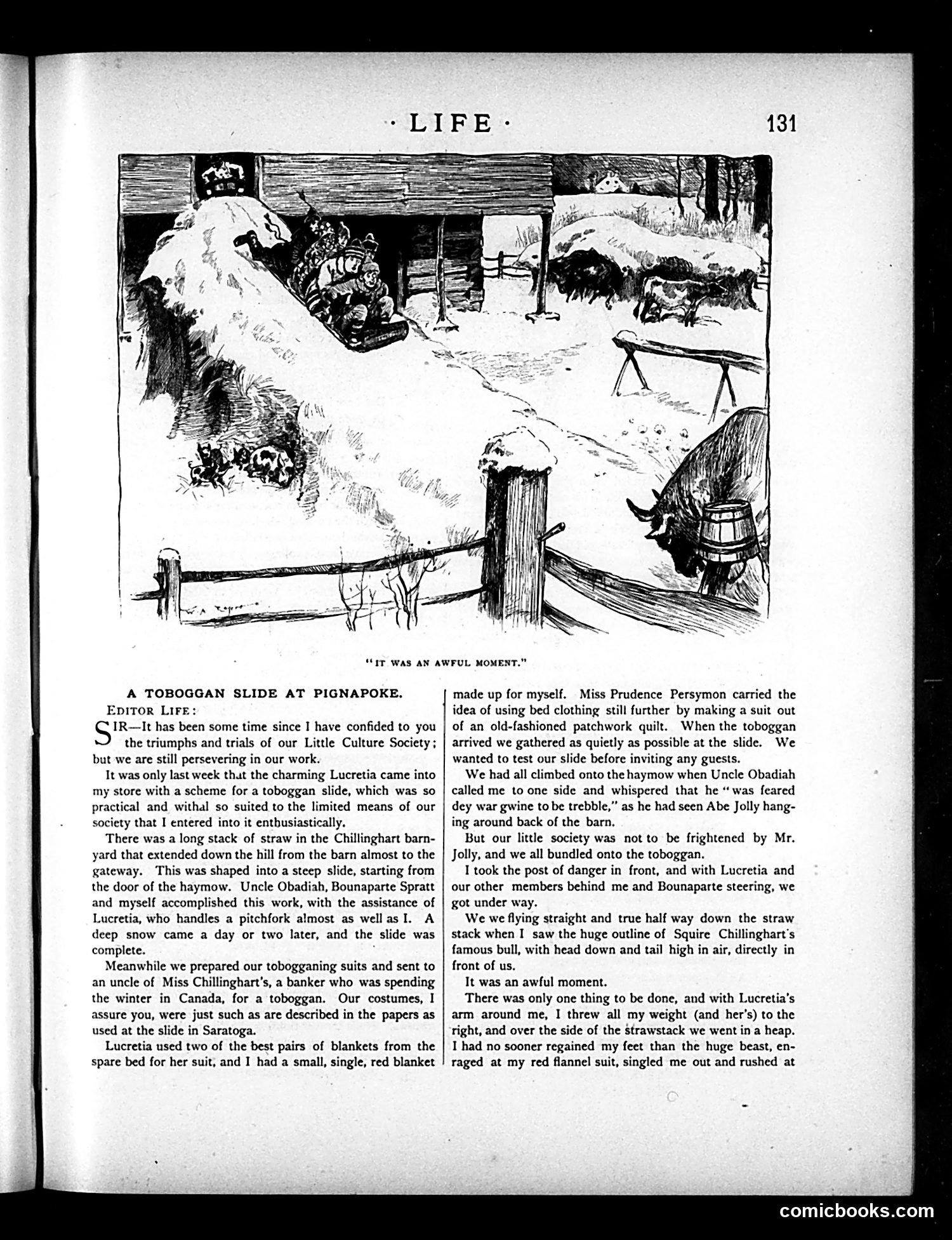
This is a humorous personal anecdote rather than political satire. The author describes organizing a toboggan slide for their "Little Culture Society" at a rural location (Pignapoke). The illustration shows the snowy scene where members assembled homemade toboggans using blankets and straw. The humor derives from an incident where a neighbor's bull, Squire Chillinghart's animal, unexpectedly appeared at the top of the slide "with head down and tail high in air, directly in front of us." The author threw their weight sideways to avoid collision, and the bull charged at their red flannel suit. It's essentially a tall tale about rural misadventure—amusing because of the incongruity of civilized leisure activities meeting barnyard chaos. The satire targets genteel culture societies attempting refinement in rustic settings.
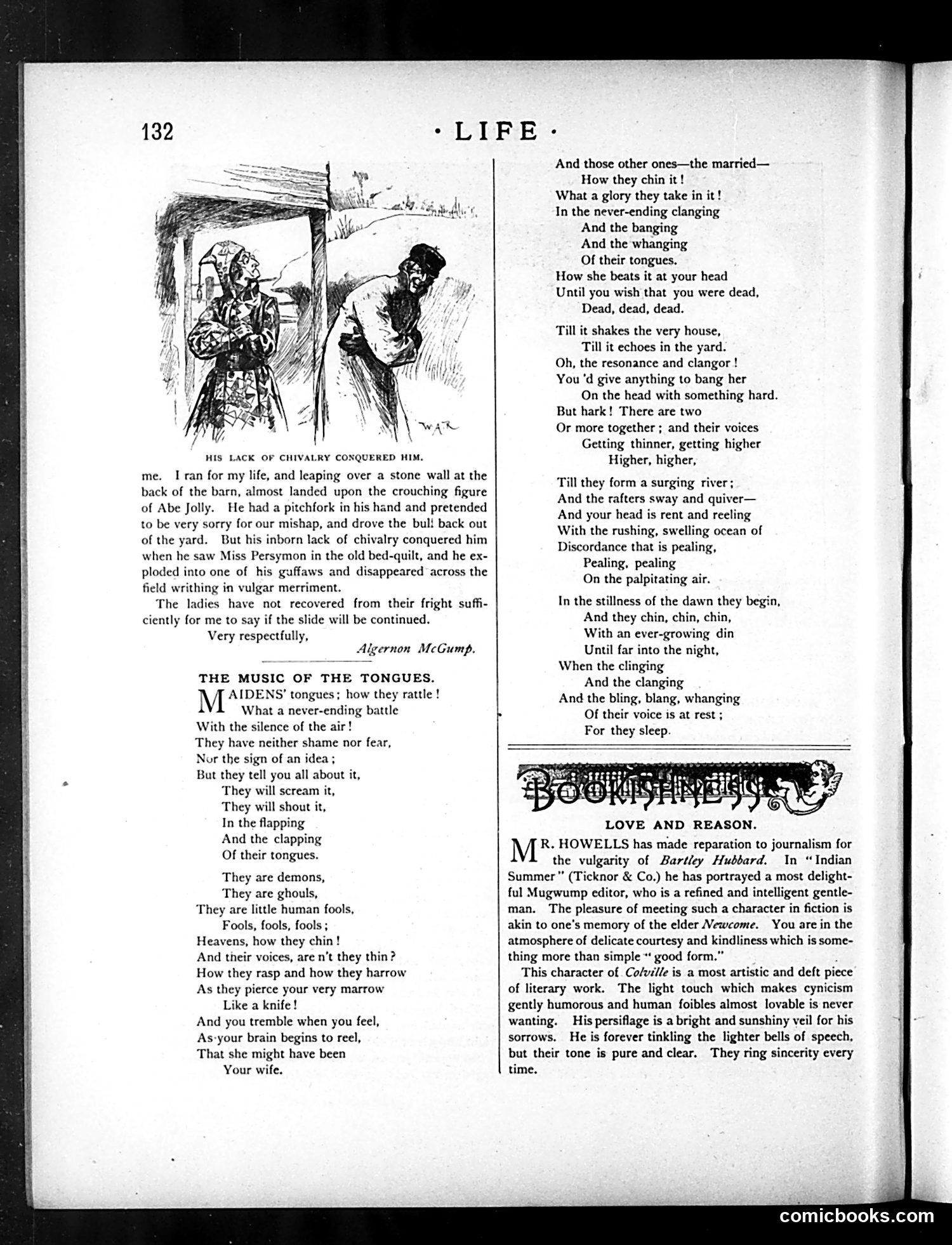
The cartoon titled "HIS LACK OF CHIVALRY CONQUERED HIM" depicts a domestic scene where a man appears to be confronted by a woman, likely his wife. The accompanying text describes the man running from his home in "vulgar merriment" after driving a ball into the yard—suggesting he prioritized sports over household responsibilities or family obligations. The satire targets masculine behavior and lack of chivalry. The narrative criticizes the man for choosing leisure activities over domestic duties and respectful conduct toward women. This reflects early 20th-century anxieties about gender roles and male irresponsibility in marriage. The phrase "lack of chivalry" suggests the satire promotes traditional ideals of gentlemanly behavior toward women, even while mocking this man's failure to meet such standards.
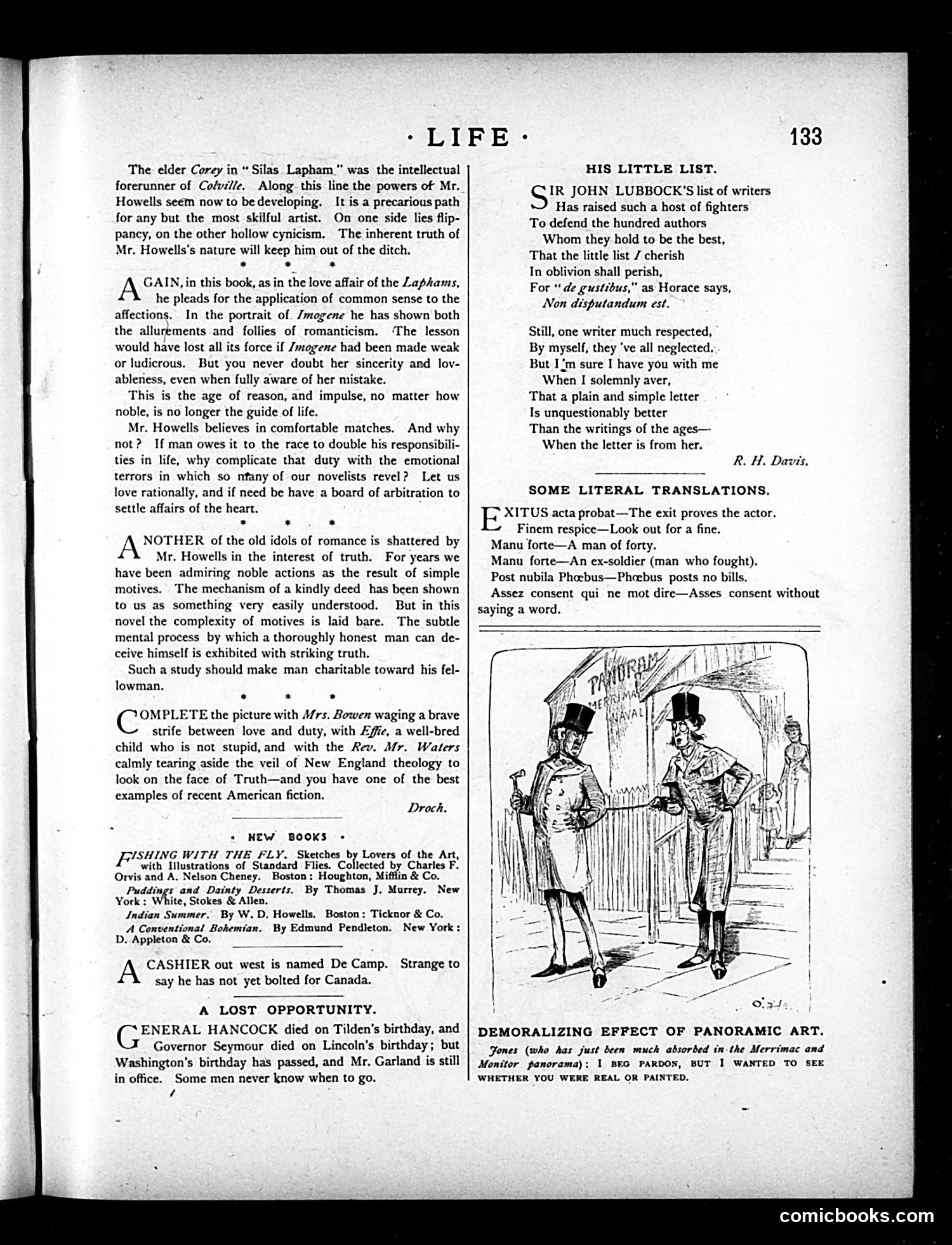
The page contains literary criticism and a single cartoon titled "Demoralizing Effect of Panoramic Art." The cartoon depicts two well-dressed men in top hats conversing outside what appears to be a panoramic exhibition (marked "PANORAM" on the building). One man has just exited the show. The joke, explained in the caption below, involves a man absorbed by a panoramic display (likely a popular 19th-century entertainment featuring large circular paintings viewed from within). He tells his companion he wanted to see whether the depicted scenes were "real or painted"—suggesting the panorama was so immersive and realistic that it blurred the distinction between art and reality, leaving him confused about what he'd actually witnessed. This satirizes both the technological novelty of panoramic art and contemporary anxieties about artistic illusion.
I can see this is a page from Life magazine with what appears to be a satirical illustration, but the image quality and orientation make it difficult to read the specific text clearly or identify particular figures with certainty. The page shows what seems to be multiple illustrated scenes arranged vertically, typical of Life's satirical cartoons from the early-to-mid 20th century. There appear to be caricatured figures in various situations, and the word "LIFE" is visible on the left margin. However, without being able to reliably read the captions or clearly identify the specific individuals depicted, I cannot accurately explain what political or social commentary this particular cartoon makes. To provide accurate historical context as requested, I would need clearer text visibility or additional information about the publication date and subject matter.
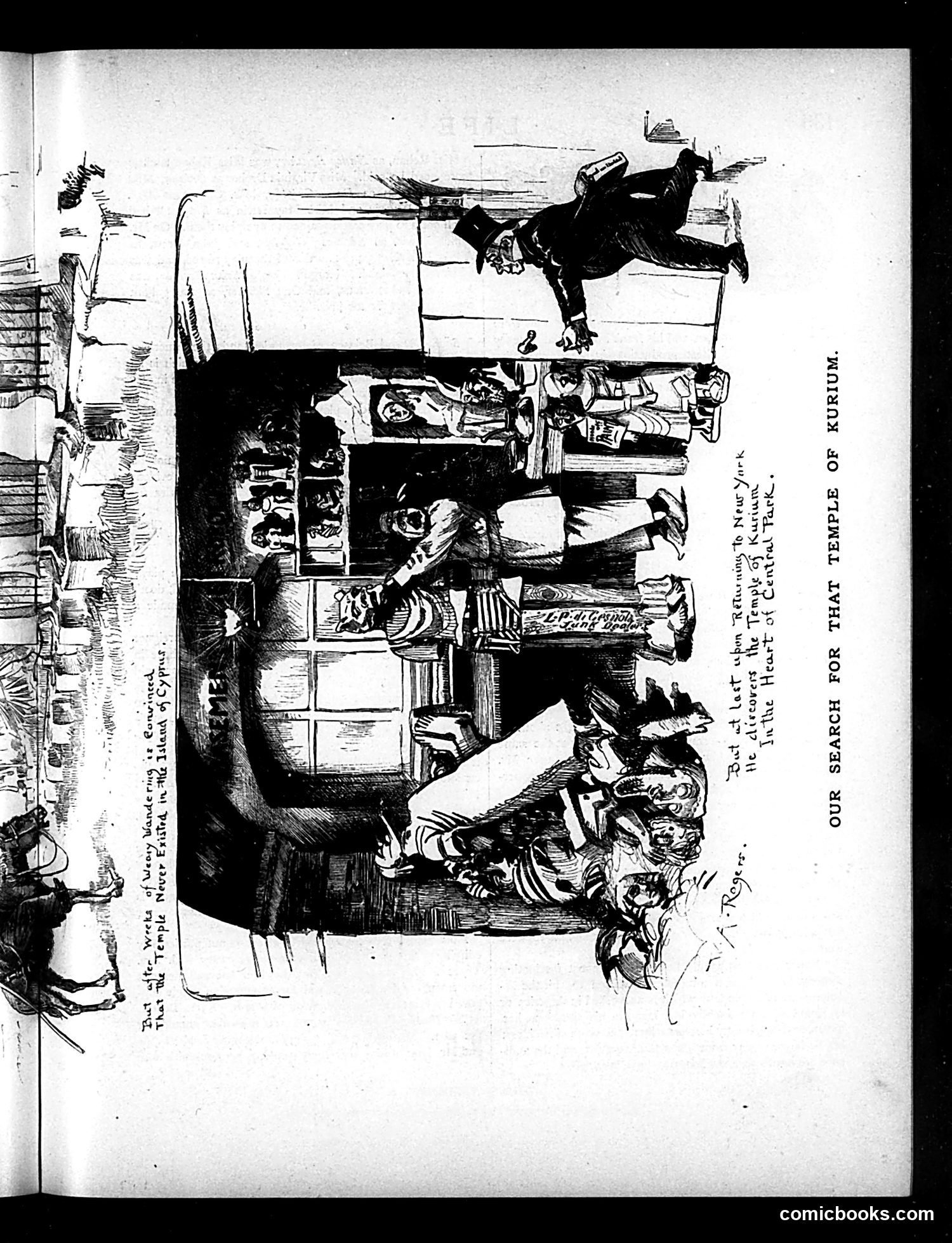
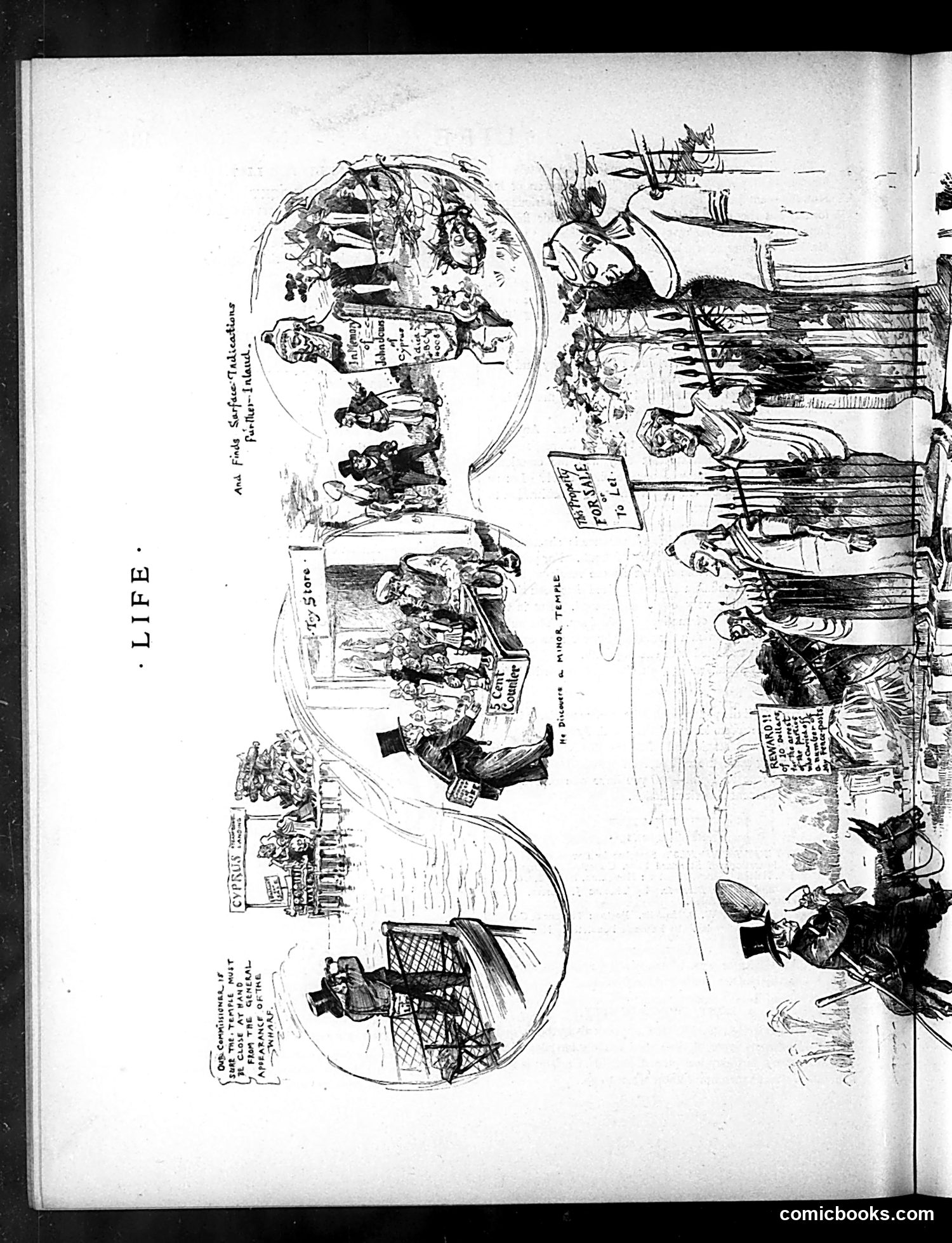
This page is rotated 90 degrees, showing a satirical illustration titled "OUR SEARCH FOR THAT TEMPLE OF KURDUM" (visible on the right margin). The image appears to be a chaotic interior scene rendered in black ink, depicting multiple figures in various states of activity or distress within what looks like a building or temple structure. The text references a "Temple of Kurdum," suggesting this is political satire mocking some contemporary search or expedition—likely referring to a real historical event or political pursuit from Life magazine's era. However, without being able to clearly identify specific figures or read all accompanying caption text, I cannot definitively explain which political figures or events are being satirized or what "Kurdum" represents. The dense, frantic illustration style suggests absurdity or chaos as the satirical point.
This page contains theater criticism reviewing two productions: Augustin Daly's "Nancy and Company" and David Belasco's adaptation of Sardou's "Fernande" (retitled "Valerie"). The critic praises Daly's comedy, calling it "fascinating" despite its base in a German play by Julius Rosen. The review highlights Ada Rehan's performance and notes the ensemble cast's skill, though it gently mocks some "horse-play" elements and pantomime-like scenes as possibly not Daly's intention. Regarding Belasco's work, the critic questions why an adaptation of a French play is set entirely in England with English characters, arguing an American setting would be more appropriate and serve to popularize American theater. The tone is constructive criticism aimed at major theatrical figures of the era.
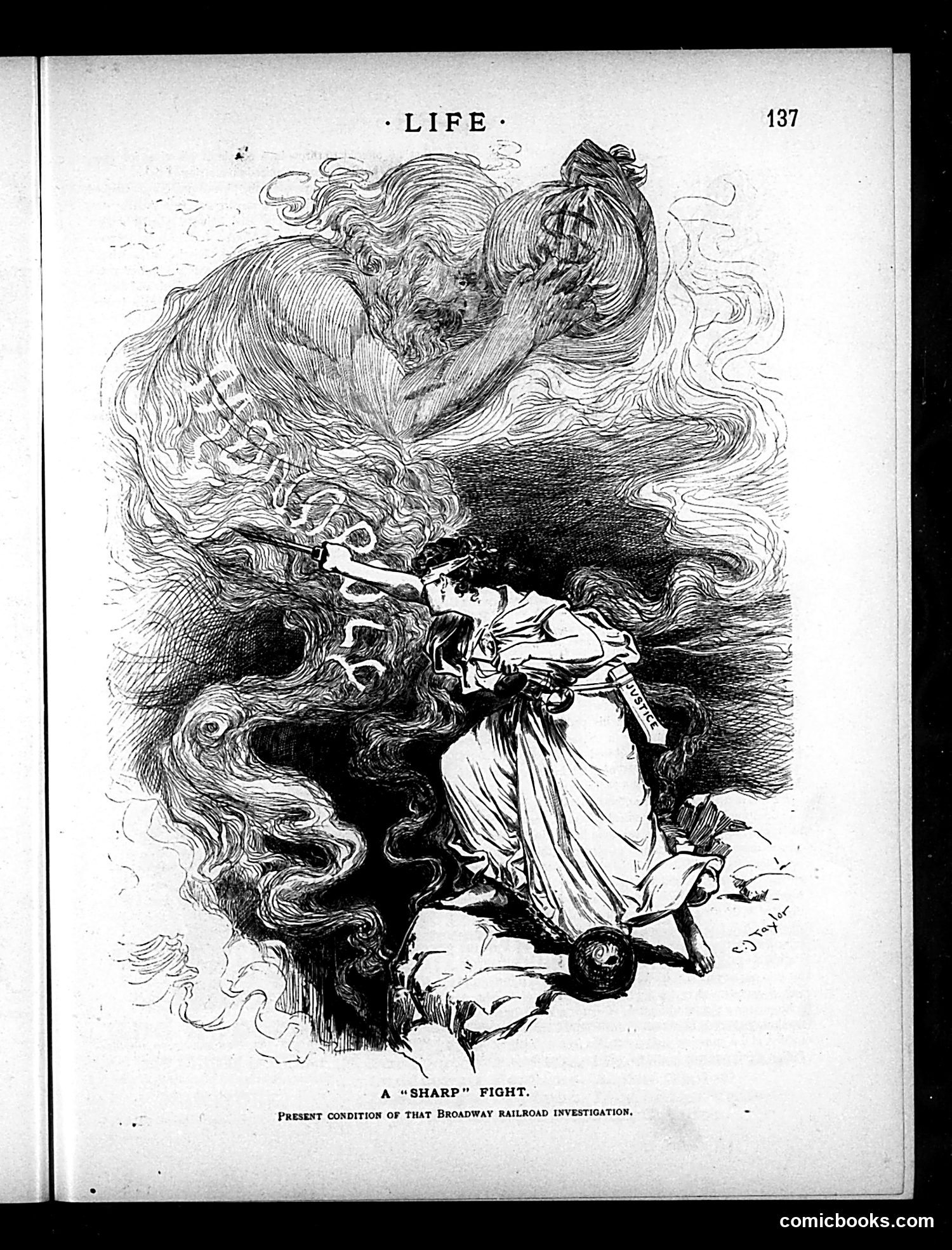
This satirical illustration depicts a violent struggle between a woman (representing justice or investigation) and a grotesque, demonic figure with wild hair and serpentine features (representing corruption or obstructive forces). The caption references a "Broadway Railroad Investigation" and describes it as a "sharp fight." The cartoon critiques ongoing legal proceedings related to a Broadway railroad scandal. The monstrous figure likely represents either corrupt railroad officials or the systemic obstacles preventing investigation. The woman's aggressive posture suggests determination to pursue justice, while the demon's resistance symbolizes entrenched opposition. This reflects Life magazine's typical role exposing Gilded Age corporate malfeasance and regulatory failures. The "sharp fight" suggests the investigation remained contentious and unresolved at publication.
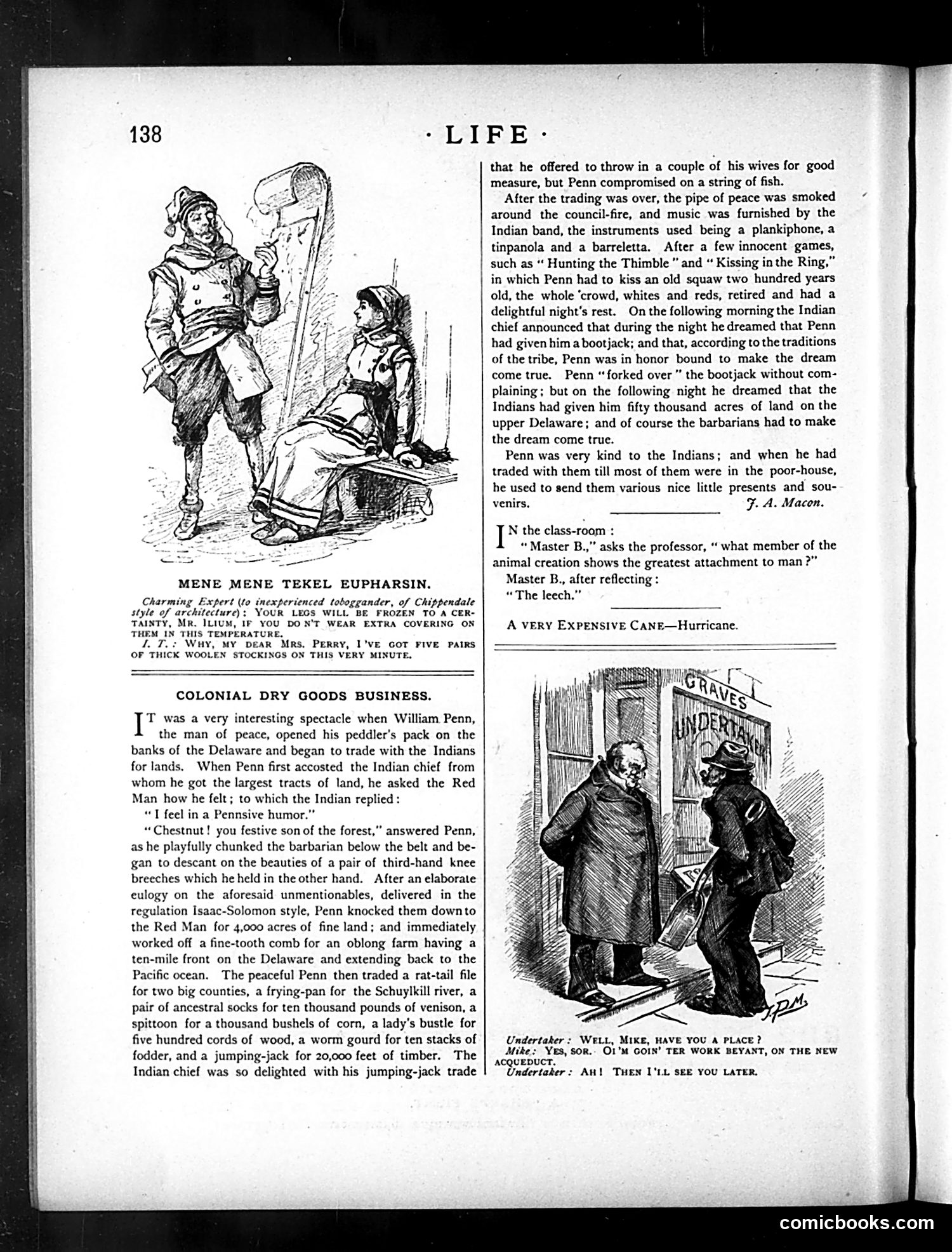
This page contains satirical content mocking William Penn's historical land dealings with Native Americans. The main article, "Colonial Dry Goods Business," presents Penn's treaty negotiations as crude commercial fraud—he allegedly traded worthless items (worn breeches, combs, spittoons) for vast territories and valuable resources. The satire portrays Penn as a dishonest peddler and the Native Americans as naive, easily duped by inferior goods and parlor games. The humor relies on exaggeration and the ironic framing of colonial appropriation as lighthearted commerce. The piece reflects 19th-century attitudes viewing Native Americans as unsophisticated. The page also includes unrelated brief jokes: one about toboggan safety and woolens, another about a student identifying "the leech" as most attached to man (a dark pun), and a final joke about an undertaker and a worker on a new aqueduct project, suggesting dangerous working conditions.
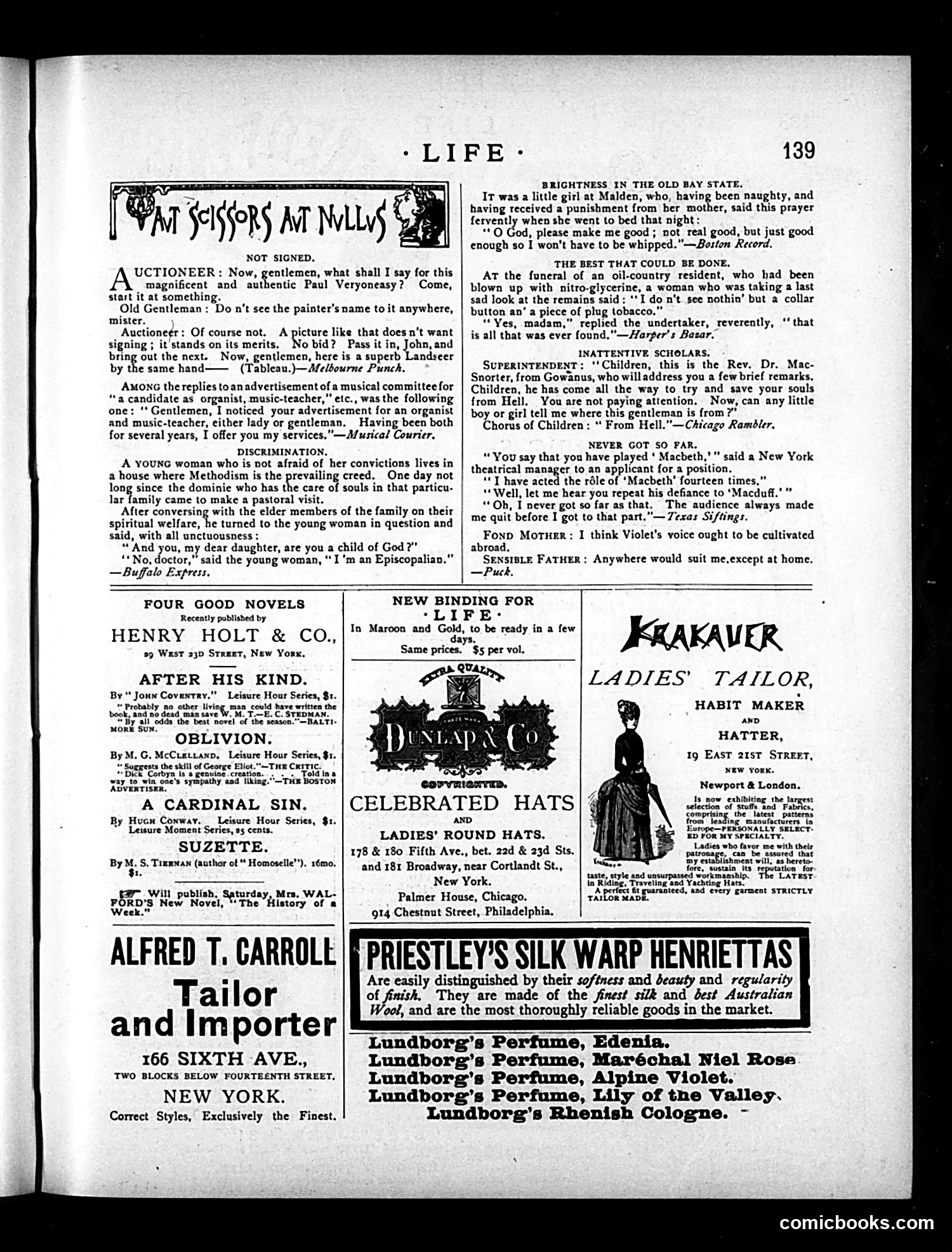
This page is primarily **advertisements and humorous anecdotes** rather than a political cartoon. The main illustrated piece at top—"Scissors at Nulls"—appears to be a short joke (credited to *Melbourne Punch*) about an art auctioneer selling unsigned paintings attributed to famous artists like Paul Veryonese and Landseer. The humor is that the auctioneer dismisses the lack of a signature as irrelevant ("it stands on its merits"), implying the paintings are likely forgeries or worthless—yet he successfully passes them off anyway. The page's other content consists of brief anecdotes poking fun at: religious hypocrisy (a Methodist pastor's confusion when told someone is Episcopalian), parental discipline, industrial accidents, inattentive students, and theatrical incompetence. These are gentle, middle-class satirical humor typical of *Life* magazine's era. The remainder is advertising for novels, clothing, and perfume.
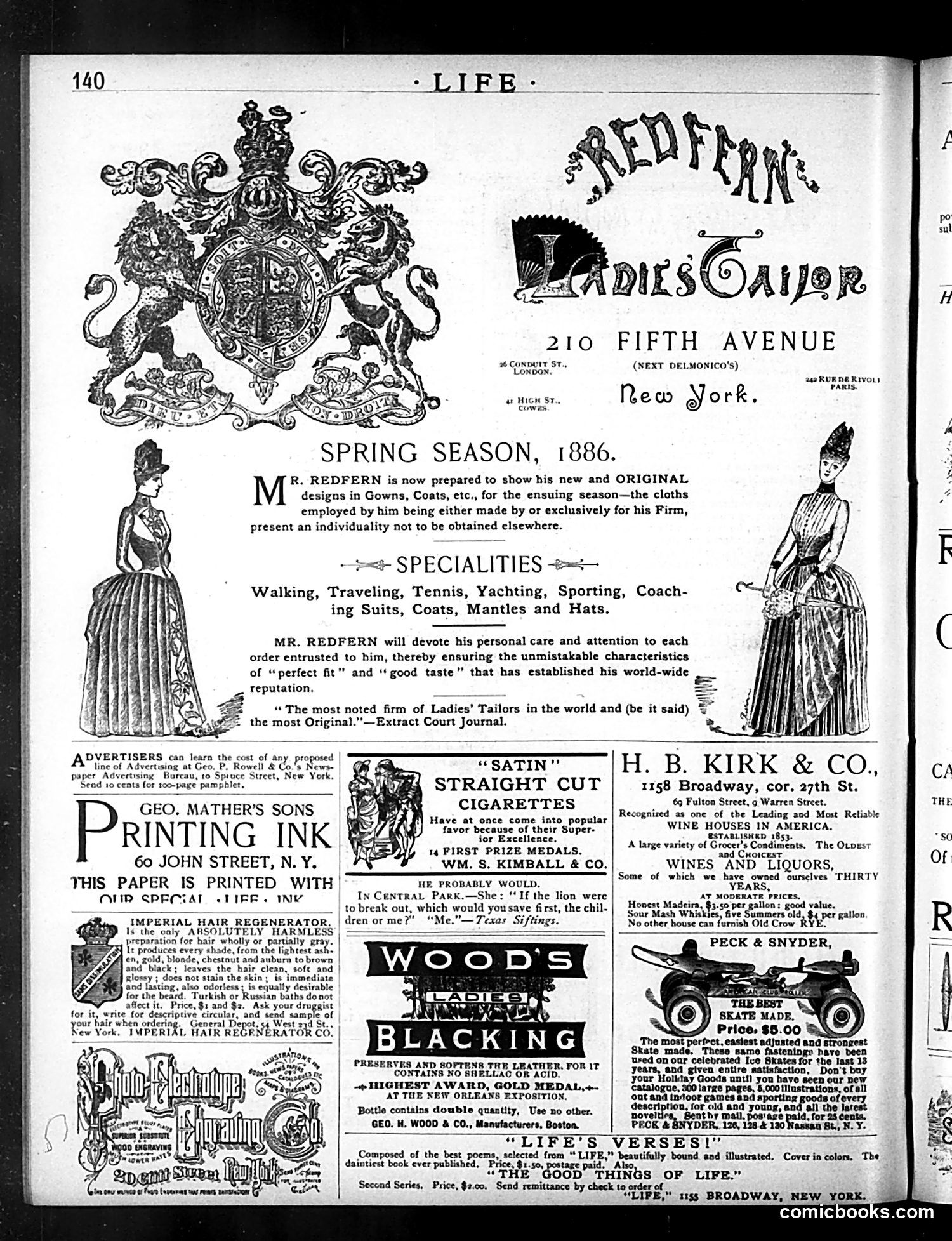
This is primarily an **advertising page** rather than editorial content. The dominant feature is an advertisement for **Mr. Redfern's ladies' tailoring establishment** at 210 Fifth Avenue, New York, which proclaims itself "the most noted firm of Ladies' Tailors in the world." The page illustrates the fashion and commercial concerns of 1880s New York's upper class. Two illustrated women in elaborate Victorian dress showcase Redfern's specialties: walking suits, traveling clothes, tennis and yachting wear, and coaching costumes—reflecting the leisure activities available to wealthy women of the era. The surrounding advertisements (printing ink, hair dye, cigarettes, wine, skates, and a book of poetry from *Life* itself) reveal the magazine's audience: affluent urbanites interested in consumer goods, grooming, and cultural refinement. The single joke visible is a brief Texas humor piece about which parent a lion would eat first—typical of period comic filler, not political satire.
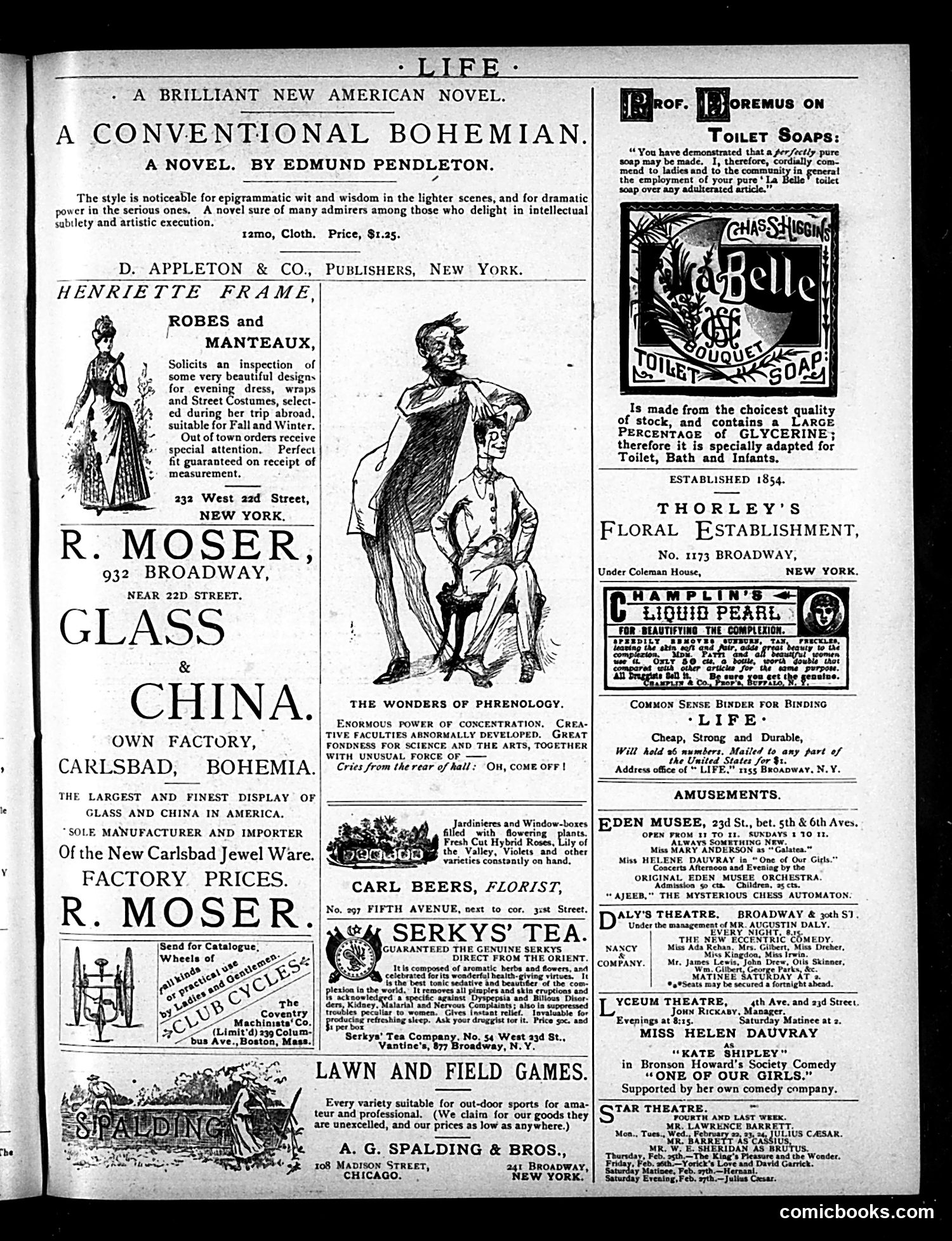
This page is primarily **advertisements and entertainment notices**, not political satire or cartoons with political content. The central illustration—labeled "The Wonders of Phrenology"—shows a profile of a head with exaggerated bump markings and includes audience members calling "OW, COME OFF!" from the rear. This reflects contemporary skepticism about **phrenology** (the pseudoscience claiming skull shape revealed character and ability), which was being publicly debunked by the 1880s-90s. The cartoon gently mocks phrenology demonstrations as obvious frauds that even audience members recognized and heckled. The rest consists of commercial ads: clothing, glass and china imports, florist services, soap endorsements (notably claiming purity), theatrical listings, and sporting goods—typical of *Life* magazine's revenue model. The only substantive cultural note is the novel advertisement at top for Edmund Pendleton's *A Conventional Bohemian*, suggesting literary interests among the magazine's educated readership.
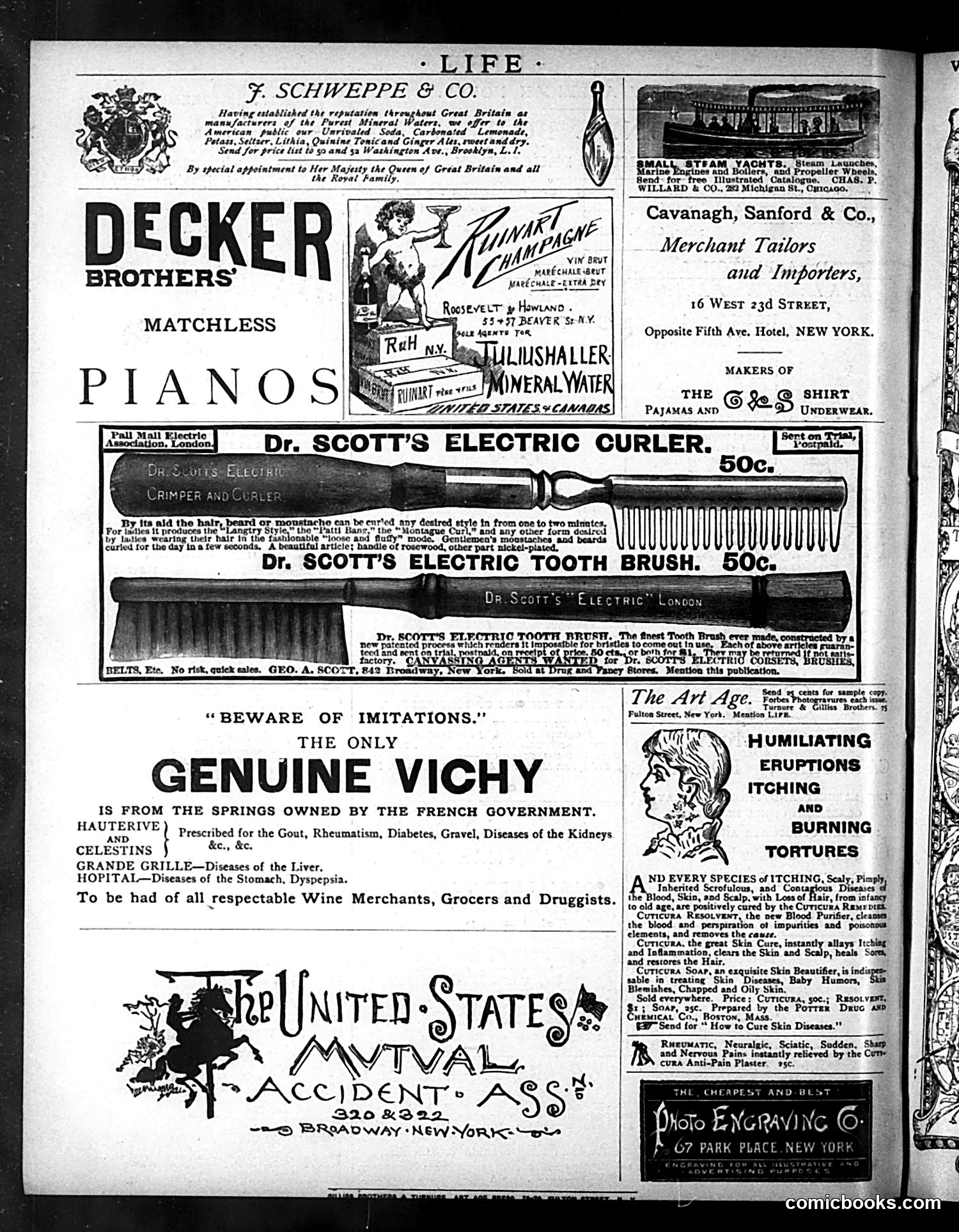
This is primarily an **advertisement page** from Life magazine, not a satirical cartoon page. The page contains numerous product advertisements typical of late 19th/early 20th-century American consumer magazines. Key advertised products include: - **Decker Brothers Pianos** ("Matchless") - **Dr. Scott's Electric Curler and Toothbrush** (50 cents each—examples of the "electrical cure-all" trend of the era) - **Genuine Vichy mineral water** (French springs, prescribed for gout and rheumatism) - **Cuticura remedies** (for skin diseases and itching) - **Merchant tailoring services** and various other goods The page reflects the commercial culture and medical beliefs of the period: electrical devices were marketed as panaceas, imported European products commanded premium prices, and patent medicines promised cures for numerous ailments with minimal evidence. The "Beware of Imitations" Vichy advertisement notably warns against counterfeits—a common consumer concern of the time.