
Life, 1886-03-04 · page 12 of 16
Life — March 4, 1886 — page 12: what you’re looking at
What you’re looking at
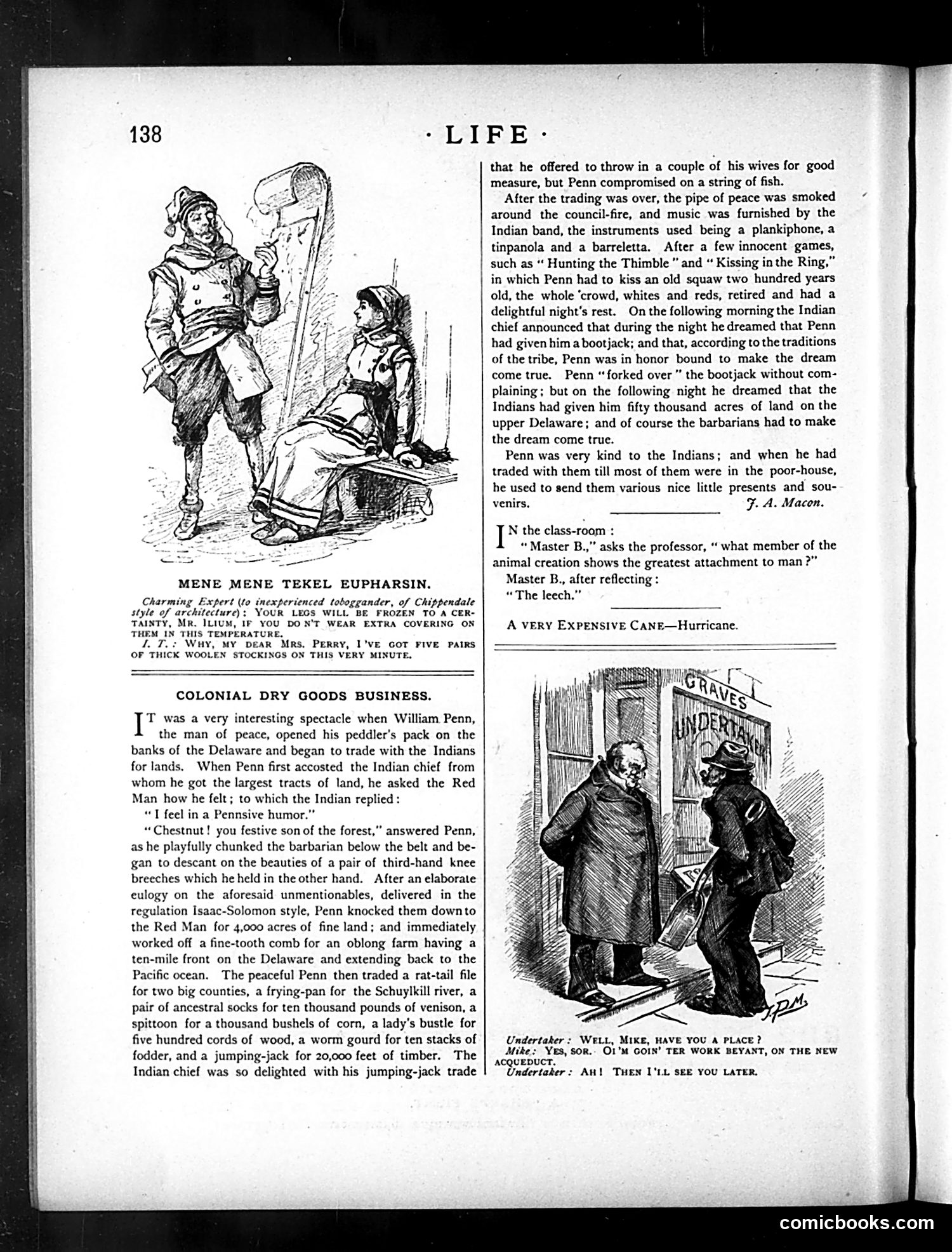
This page contains satirical content mocking William Penn's historical land dealings with Native Americans. The main article, "Colonial Dry Goods Business," presents Penn's treaty negotiations as crude commercial fraud—he allegedly traded worthless items (worn breeches, combs, spittoons) for vast territories and valuable resources. The satire portrays Penn as a dishonest peddler and the Native Americans as naive, easily duped by inferior goods and parlor games. The humor relies on exaggeration and the ironic framing of colonial appropriation as lighthearted commerce. The piece reflects 19th-century attitudes viewing Native Americans as unsophisticated. The page also includes unrelated brief jokes: one about toboggan safety and woolens, another about a student identifying "the leech" as most attached to man (a dark pun), and a final joke about an undertaker and a worker on a new aqueduct project, suggesting dangerous working conditions.
📄 Transcribed text from this page (OCR, searchable)
Machine-transcribed from the original scan — historical spelling and the odd misread are preserved.
LIFE: MENE MENE TEKEL EUPHARSIN. Charming Expert (to inexperienced toboggander, of Chippendale style of architecture): YOUR LEGS WILL BE FROZEN TO A CER- TAINTY, MR, ILIUM, IF YOU DON'T WEAR EXTRA COVERING ON THIS TEMPERATURE. Why, MY DEAR MRs. PERRY, I'VE GOT FIVE PAIRS WOOLEN STOCKINGS ON THIS VERY MINUTE. COLONIAL DRY GOODS BUSINESS. T was a very interesting spectacle when William Penn, the man of peace, opened his peddler’s pack on the banks of the Delaware and began to trade with the Indians for lands. When Penn first accosted the Indian chief from whom he got the largest tracts of land, he asked the Red Man how he felt; to which the Indian replied : “T feel in a Pennsive humor.” “Chestnut! you festive son of the forest,” answered Penn, as he playfully chunked the barbarian below the belt and be- gan to descant on the beauties of a pair of third-hand knee breeches which he held in the other hand. After an elaborate eulogy on the aforesaid unmentionables, delivered in the regulation Isaac-Solomon style, Penn knocked them downto the Red Man for 4,000 acres of fine land; and immediately worked off a fine-tooth comb for an oblong farm having a ten-mile front on the Delaware and extending back to the Pacific ocean. The peaceful Penn then traded a rat-tail file for two big counties, a frying-pan for the Schuylkill river, a pair of ancestral socks for ten thousand pounds of venison, a spittoon for a thousand bushels of corn, a lady's bustle for five hundred cords of wood, a worm gourd for ten stacks of fodder, and a jumping-jack for 20,000 feet of timber. The Indian chief was so delighted with his jumping-jack trade that he offered to throw in a couple of his wives for good measure, but Penn compromised on a string of fish. After the trading was over, the pipe of peace was smoked around the council-fire, and music was furnished by the Indian band, the instruments used being a plankiphone, a tinpanola and a barreletta. After a few innocent games, such as “ Hunting the Thimble ” and “ Kissing in the Ring,” in which Penn had to kiss an old squaw two hundred years old, the whole ‘crowd, whites and reds, retired and had a delightful night’s rest. On the following morning the Indian chief announced that during the night he dreamed that Penn had given him a bootjack; and that, according to the traditions of the tribe, Penn was in honor bound to make the dream come true. Penn “forked over” the bootjack without com- plaining; but on the following night he dreamed that the Indians had given him fifty thousand acres of land on the upper Delaware; and of course the barbarians had to make the dream come true. Penn was very kind to the Indians; and when he had traded with them till most of them were in the poor-house, he used to send them various nice little presents and sou- venirs, F. A. Macon. N the class-room : “Master B.,” asks the professor, “ what member of the animal creation shows the greatest attachment to man ?” Master B., after reflecting : “The leech.” A VERY EXPENSIVE CANE—Hurricane. Undertaker : WeLL, MIKE, HAVE YOU A PLACE? Mike: YES, SOR. O1'M GOIN’ TER WORK BEYANT, ON THE NEW ACQUEDUCT. Undertaker: Aw! THEN I'LL SEE YOU LATER. comicbooks.com