
Life, 1886-03-04 · page 2 of 16
Life — March 4, 1886 — page 2: what you’re looking at
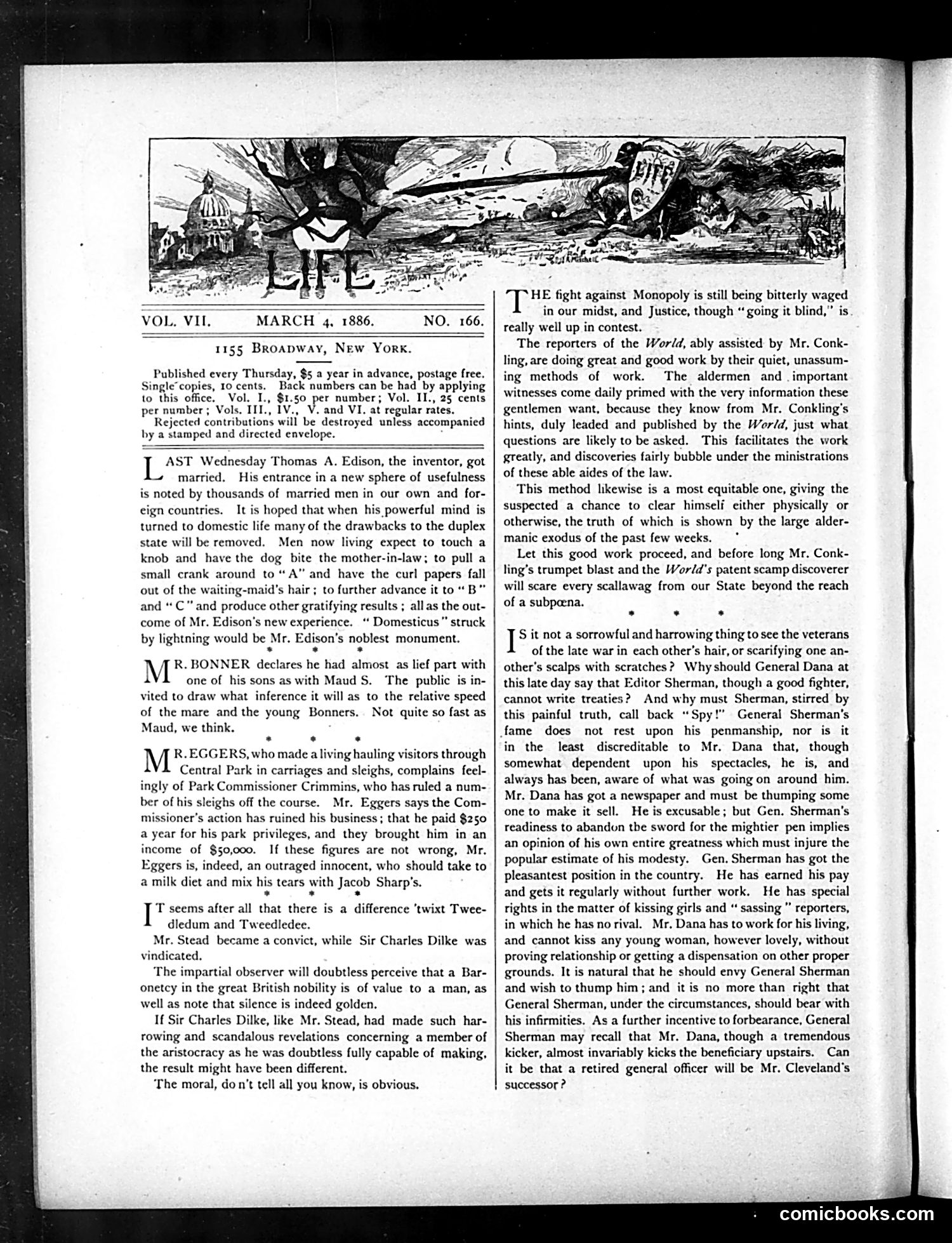
What you’re looking at
The page contains three brief satirical items about contemporary figures: 1. **Thomas Edison's marriage** is mocked as entering a "new sphere of usefulness"—a joke about his inventions and domestic life combining awkwardly. 2. **M.F. Bonner's claim** to be "almost as lief part with one of his sons as with Maud S." references Maud S., a famous racehorse of the era. The satire suggests Bonner values his prized horse as much as his children—a commentary on wealthy men's material obsessions. 3. **General Sherman vs. Editor Dana**: The longest piece criticizes General Sherman for refusing to write peace treaties while Editor Charles Dana (of the *New York Sun*) freely publishes opinions. It suggests Dana, dependent on his newspaper for income, should defer to Sherman's greater authority on military matters—a class-based critique of journalism.
📄 Transcribed text from this page (OCR, searchable)
Machine-transcribed from the original scan — historical spelling and the odd misread are preserved.
VOL, VII. MARCH 4, 1886. NO. 166. 1155 Broapway, New York. Published every Thursday, $5 a year in advance, postage free. Single’ copies, 10 cents. Back numbers can be had by applying to this office. Vol. I., $1.50 per number; Vol. II., 25 cents per number; Vols. III., 1V., V. and VI, at regular rates. Rejected contributions will be destroyed unless accompanied by a stamped and directed envelope. AST Wednesday Thomas A. Edison, the inventor, got — married. His entrance in a new sphere of usefulness is noted by thousands of married men in our own and for- eign countries. It is hoped that when his powerful mind is turned to domestic life many of the drawbacks to the duplex state will be removed. Men now living expect to touch a knob and have the dog bite the mother-in-law; to pull a small crank around to “A” and have the curl papers fall out of the waiting-maid’s hair ; to further advance it to “B” and ‘Cand produce other gratifying results ; all as the out- come of Mr. Edison's new experience. ‘“ Domesticus” struck by lightning would be Mr. Edison’s noblest monument. . . . M R. BONNER declares he had almost as lief part with a one of his sons as with Maud S. The public is in- vited to draw what inference it will as to the relative speed of the mare and the young Bonners. Not quite so fast as Maud, we think. . * . R.EGGERS, who made a living hauling visitors through Central Park in carriages and sleighs, complains feel- ingly of Park Commissioner Crimmins, who has ruled a num- ber of his sleighs off the course. Mr. Eggers says the Com- missioner’s action has ruined his business; that he paid $250 a year for his park privileges, and they brought him in an income of $50,000. If these figures are not wrong, Mr. Eggers is, indeed, an outraged innocent, who should take to a milk diet and mix his tears with Jacob Sharp's. * * * T seems after all that there is a difference 'twixt Twee- dledum and Tweedledee. Mr. Stead became a convict, while Sir Charles Dilke was vindicated. The impartial observer will doubtless perceive that a Bar- onetcy in the great British nobility is of value to a man, as well as note that silence is indeed golden. If Sir Charles Dilke, like Mr. Stead, had made such har- rowing and scandalous revelations concerning a member of the aristocracy as he was doubtless fully capable of making, the result might have been different. The moral, don’t tell all you know, is obvious. HE fight against Monopoly is still being bitterly waged in our midst, and Justice, though “ going it blind,” is really well up in contest. The reporters of the World, ably assisted by Mr. Conk- ling, are doing great and good work by their quiet, unassum- ing methods of work. The aldermen and . important witnesses come daily primed with the very information these gentlemen want, because they know from Mr. Conkling’s hints, duly leaded and published by the Wor/d, just what questions are likely to be asked. This facilitates the work greatly, and discoveries fairly bubble under the ministrations of these able aides of the law. This method likewise is a most equitable one, giving the suspected a chance to clear himseli either physically or otherwise, the truth of which is shown by the large alder- manic exodus of the past few weeks. Let this good work proceed, and before long Mr. Conk- ling’s trumpet blast and the Wor/d's patent scamp discoverer will scare every scallawag from our State beyond the reach of a subpena. . . . S it not a sorrowful and harrowing thing to see the veterans of the late war in each other’s hair, or scarifying one an- other's scalps with scratches? Why should General Dana at this late day say that Editor Sherman, though a good fighter, cannot write treaties? And why must Sherman, stirred by this painful truth, call back “Spy!" General Sherman's fame does not rest upon his penmanship, nor is it in the least discreditable to Mr. Dana that, though somewhat dependent upon his spectacles, he is, and always has been, aware of what was going on around him. Mr. Dana has got a newspaper and must be thumping some one to make it sell. He is excusable; but Gen. Sherman's readiness to abandon tbe sword for the mightier pen implies an opinion of his own entire greatness which must injure the popular estimate of his modesty. Gen. Sherman has got the pleasantest position in the country. He has earned his pay and gets it regularly without further work. He has special rights in the matter of kissing girls and “ sassing " reporters, in which he has no rival. Mr. Dana has to work for his living, and cannot kiss any young woman, however lovely, without proving relationship or getting a dispensation on other proper grounds. It is natural that he should envy General Sherman and wish to thump him; and it is no more than right that General Sherman, under the circumstances, should bear with his infirmities. As a further incentive to forbearance, General Sherman may recall that Mr. Dana, though a tremendous kicker, almost invariably kicks the beneficiary upstairs. Can it be that a retired general officer will be Mr. Cleveland's successor ? comicbooks.com