
A complete issue · 16 pages · 1885
Life — May 14, 1885
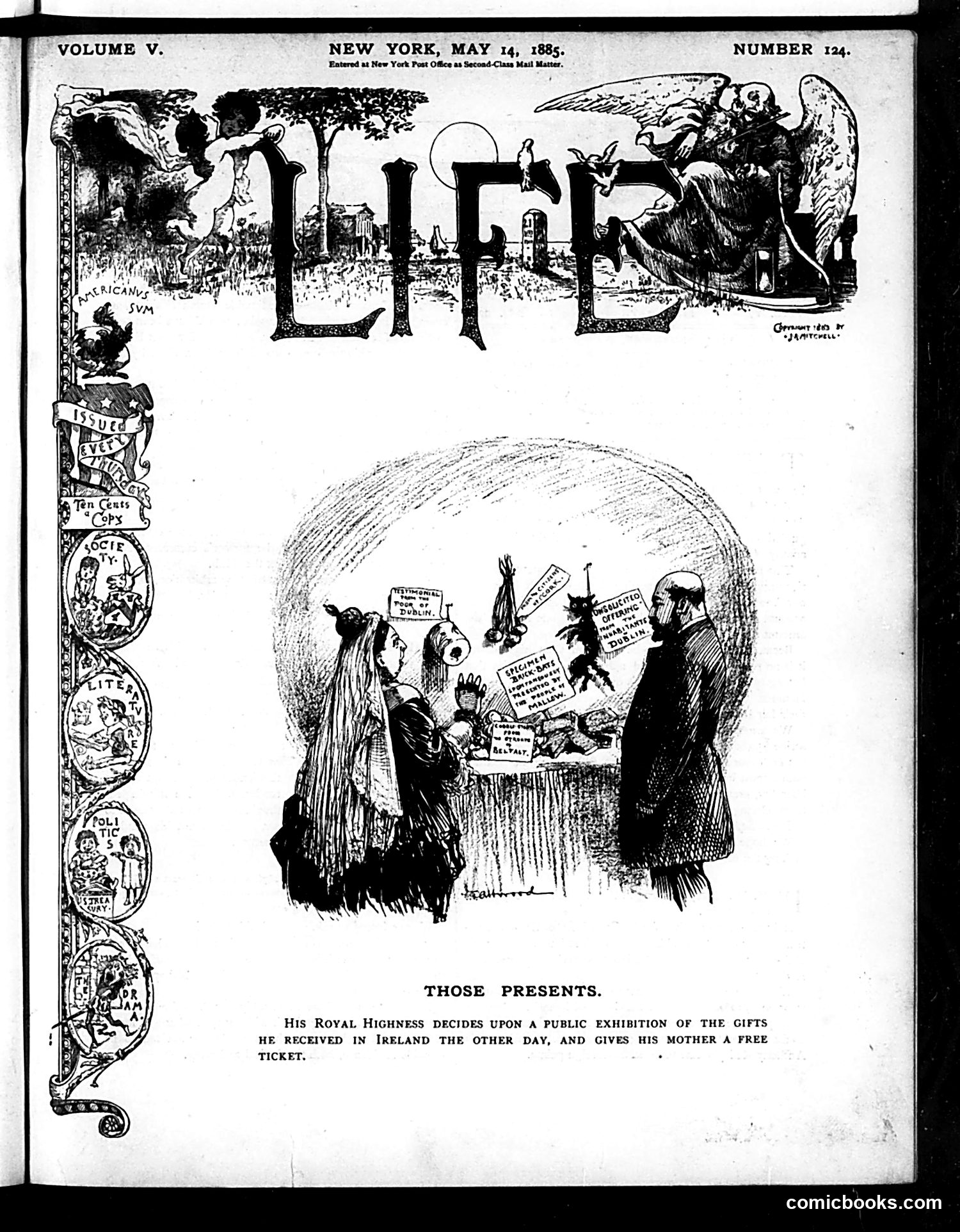
This satirical cartoon depicts "His Royal Highness" displaying gifts received in Ireland, mocking what appears to be a royal or aristocratic visit. The central image shows a figure inside a giant head/skull examining gifts with labels (text illegible in reproduction) while two onlookers observe—likely representing the public or press witnessing this "exhibition." The satire targets the recipient's decision to publicly display Irish gifts, possibly critiquing either ostentatious behavior or the awkward diplomatic situation surrounding British-Irish relations during this period. The skull imagery suggests Death or morbidity, implying the gifts themselves—or their symbolic meaning—are distasteful or represent something sinister rather than genuine goodwill. The ornate left border featuring classical medallions is typical Life magazine decoration.
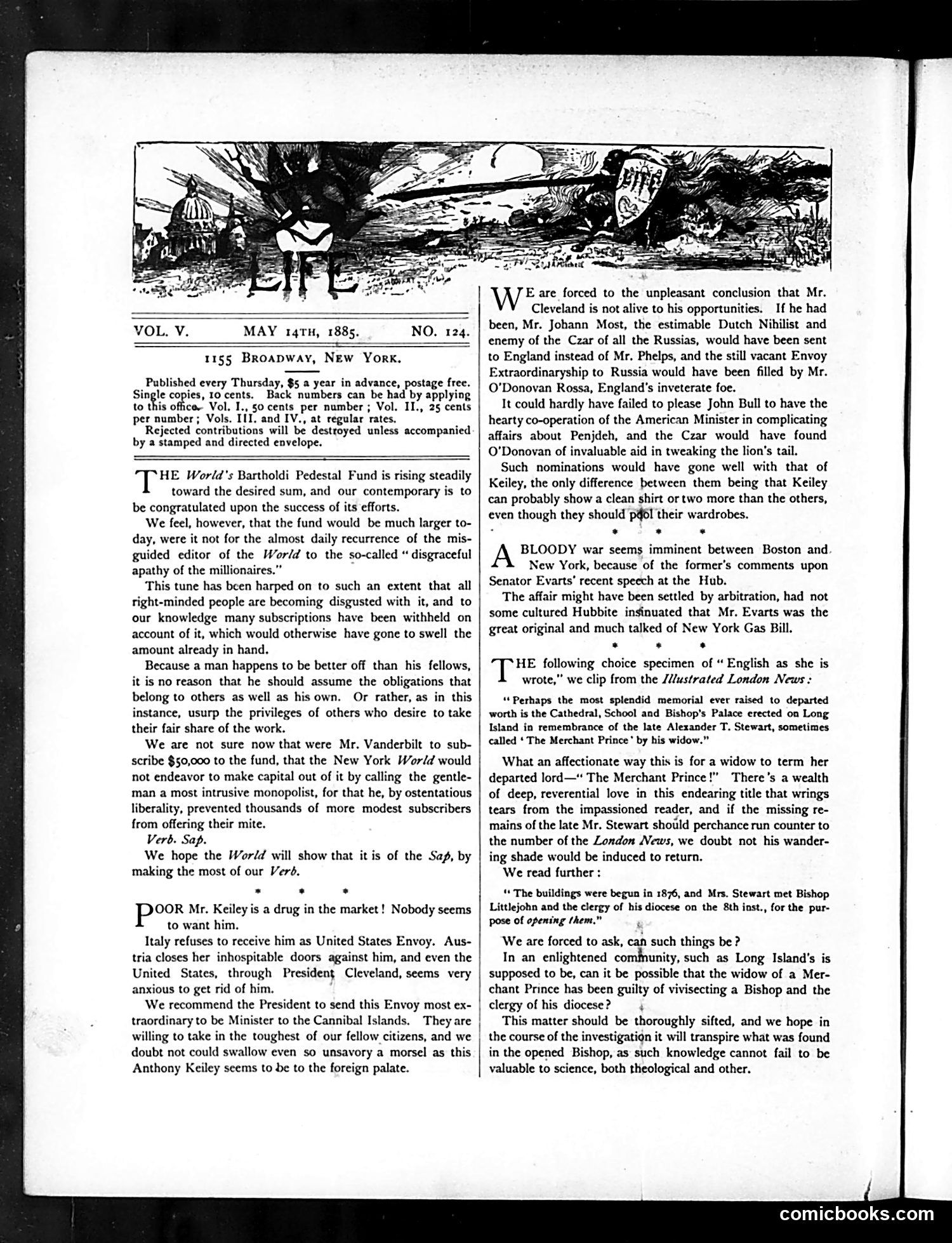
The masthead cartoon depicts a graveyard scene with "Life" emerging from a coffin, suggesting the magazine's survival despite criticism. The text discusses political controversies of 1885: 1. **Cleveland administration criticism**: The editors argue President Cleveland missed diplomatic opportunities, particularly regarding Russian envoy appointments and the "Penjdeh affair" (a Central Asian border dispute). 2. **Keiley appointment dispute**: Anthony Keiley, nominated as U.S. Envoy to Italy and Austria, faced rejection because he was a widower—apparently considered scandalous. The magazine sarcastically suggests sending him to the "Cannibal Islands" instead. 3. **Boston-New York rivalry**: A dispute between Senator Evarts and the *New York World* over a recent speech. The tone is satirical political commentary on diplomatic bungling and social hypocrisy of the Gilded Age.
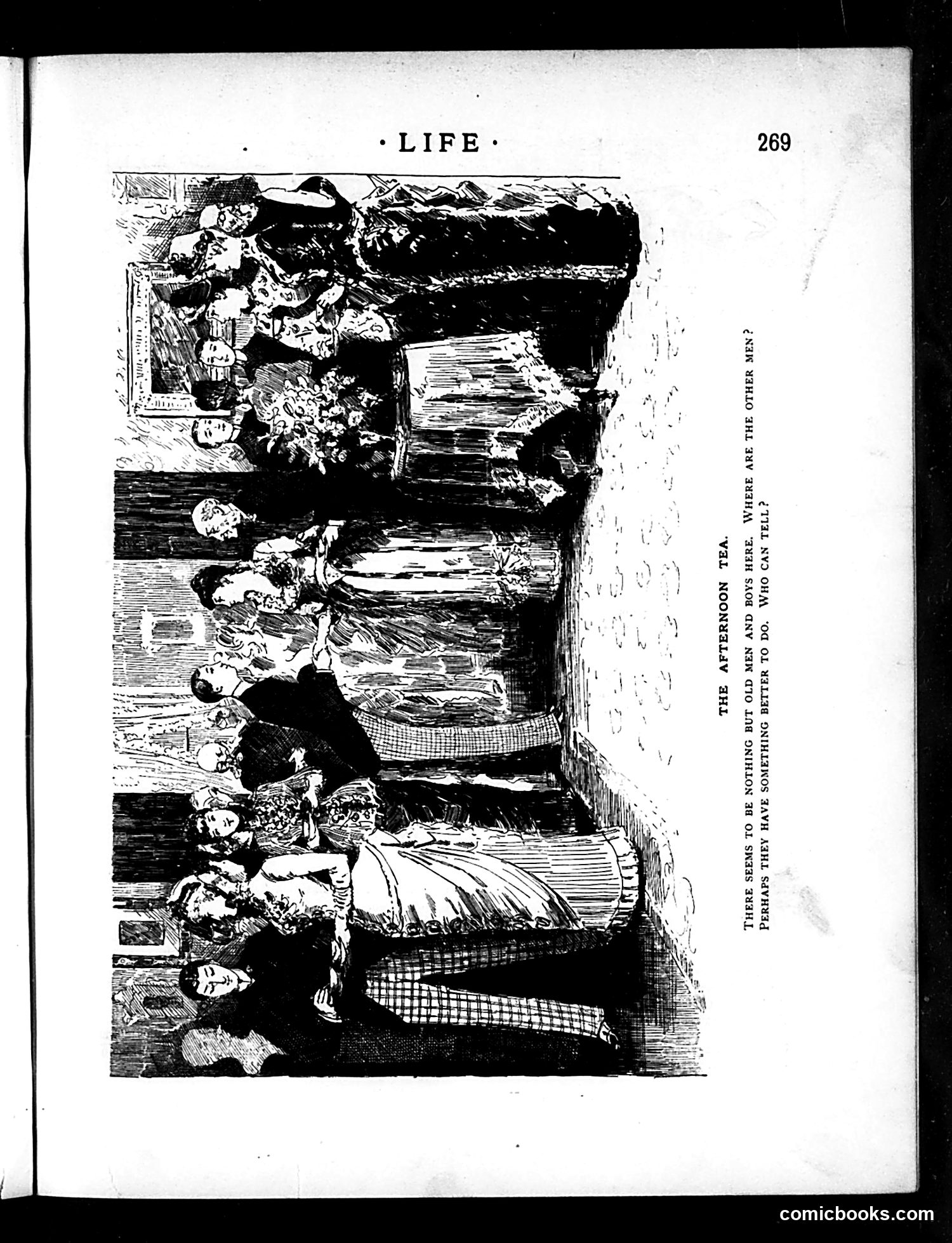
This page from *Life* magazine (page 269) contains a single illustration titled "The Afternoon Tea," depicting what appears to be a Victorian-era domestic scene rotated 90 degrees. The caption reads: "There seems to be nothing but old bones and boys here. Where are the other men? Perhaps every same something better to do, you fool!" The image shows multiple figures in period dress gathered indoors. However, without clearer visibility of specific individuals or knowing the publication date, I cannot definitively identify which historical figures are caricatured or what specific social/political commentary is intended. The satirical point appears to concern gender dynamics or social gathering customs of the era, but the exact meaning remains unclear from this reproduction. The caption suggests commentary on male absence from social events.
This page from *Life* magazine contains satirical commentary and poetry rather than political cartoons. Key content includes: **"To Spring Poets"** — A humorous poem mocking verbose spring poetry and struggling poets who produce lengthy, pretentious work without success. **"Information Wanted"** — A note about purchasing rights to a horse-related poem, satirizing American commercial culture's commodification of literary work. **Various brief satirical items** about contemporary figures: references to Polish immigrants forming associations, England's military situation, Charles O'Connor's criticism, Ellen Terry's husbands, and Henrietta Burdensick's lighthouse-building success. The humor relies on wordplay, irony, and topical references rather than visual imagery. The overall tone is light satirical commentary on contemporary American society, politics, and culture typical of *Life*'s editorial voice during this era.
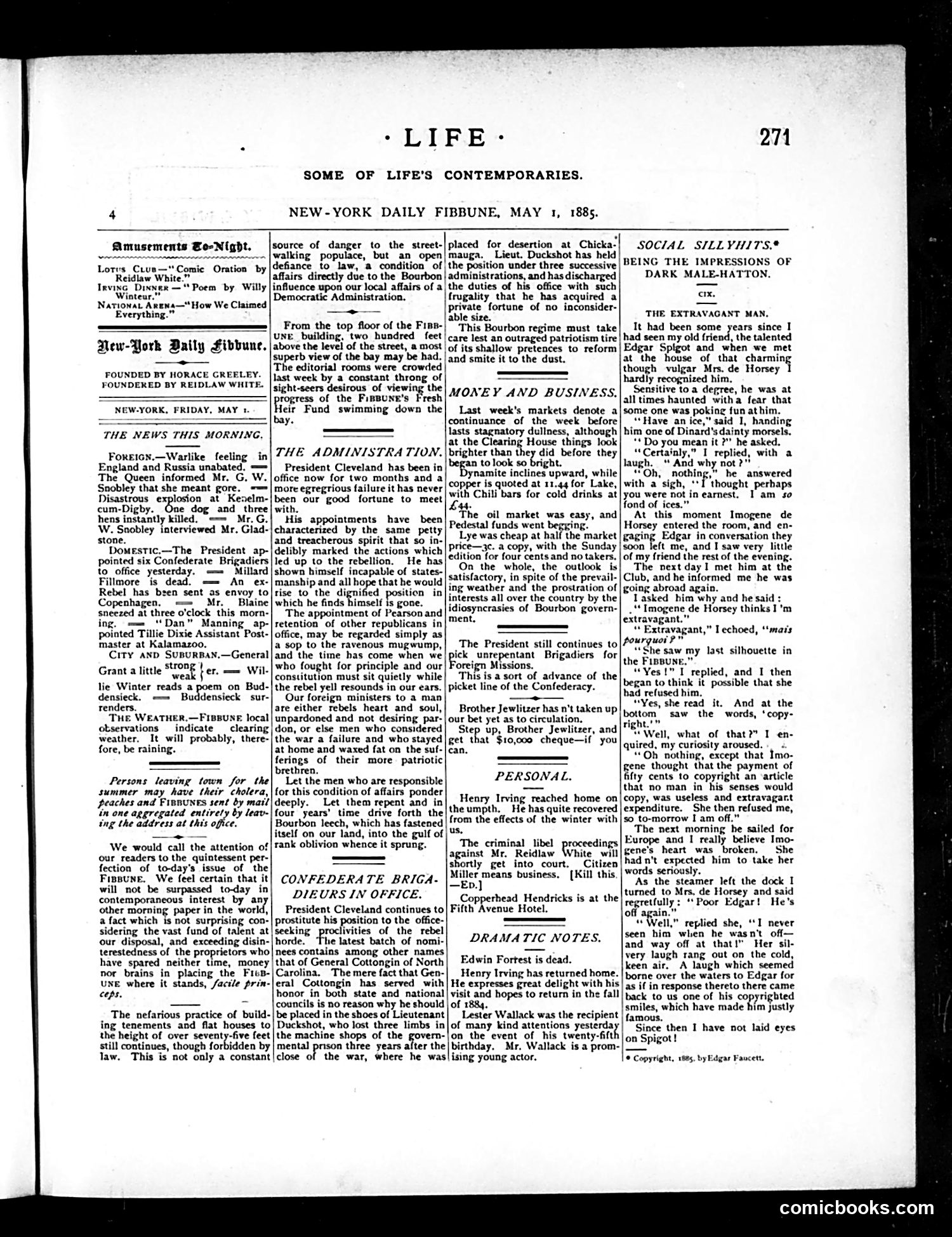
This page contains primarily text content rather than prominent political cartoons. The visible sections include news commentary, administrative notes, and social gossip columns rather than illustrated satire. The "Money and Business" section discusses market conditions and Bourbon government policy. References to "Confederate Brigadiers in Office" and debates over Republican retention of office suggest post-Reconstruction era political tensions. The "Social Silhouettes" gossip column satirizes New York society figures, including commentary on an "extravagant man" and romantic entanglements—typical light social satire of the Gilded Age. Without clearer illustrations visible, the page appears to represent Life's mix of political commentary, business news, and society gossip rather than featuring a major political cartoon requiring historical context for modern readers.
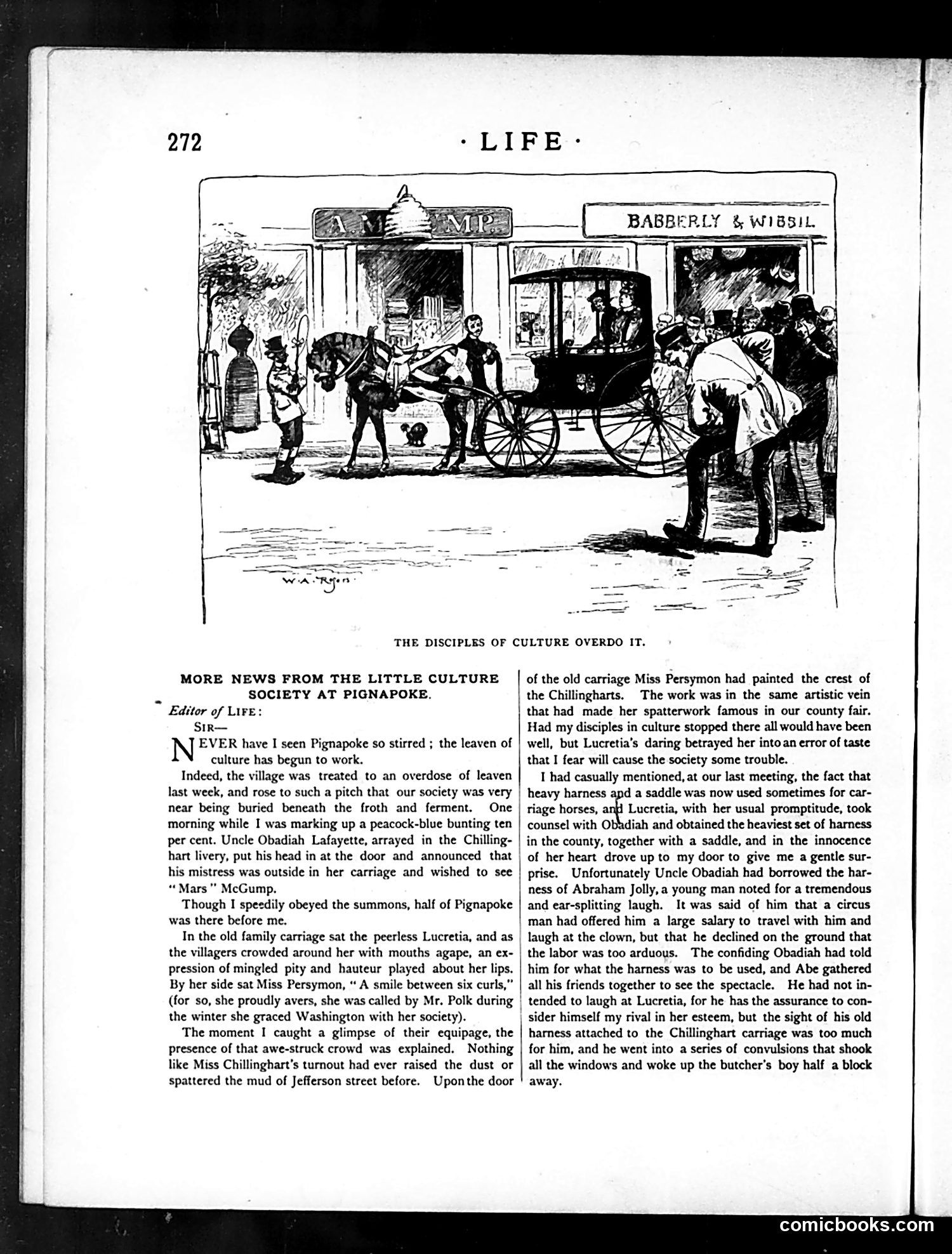
**The Cartoon**: "The Disciples of Culture Overdo It" depicts a street scene where a carriage labeled "Barberly & Wibsil" is stopped in front of a "Barberrly & Wibsil" shop. The accompanying letter ridicules Pignapoke's "Little Culture Society." **The Satire**: The humor targets pretentious social climbers in a small town who adopt cultured affectations. The specific joke involves Lucretia, a society woman, borrowing heavy carriage equipment from Uncle Obadiah to appear fashionable—only to cause chaos. The harness causes an accident that "shook all the windows," undermining her refined pretensions. **The Point**: The piece mocks how rural or provincial people eagerly embrace superficial "culture" without understanding it, with ridiculous consequences. It's a common Progressive-era American satire theme: small-town pretension and the absurdity of misapplied social aspiration.
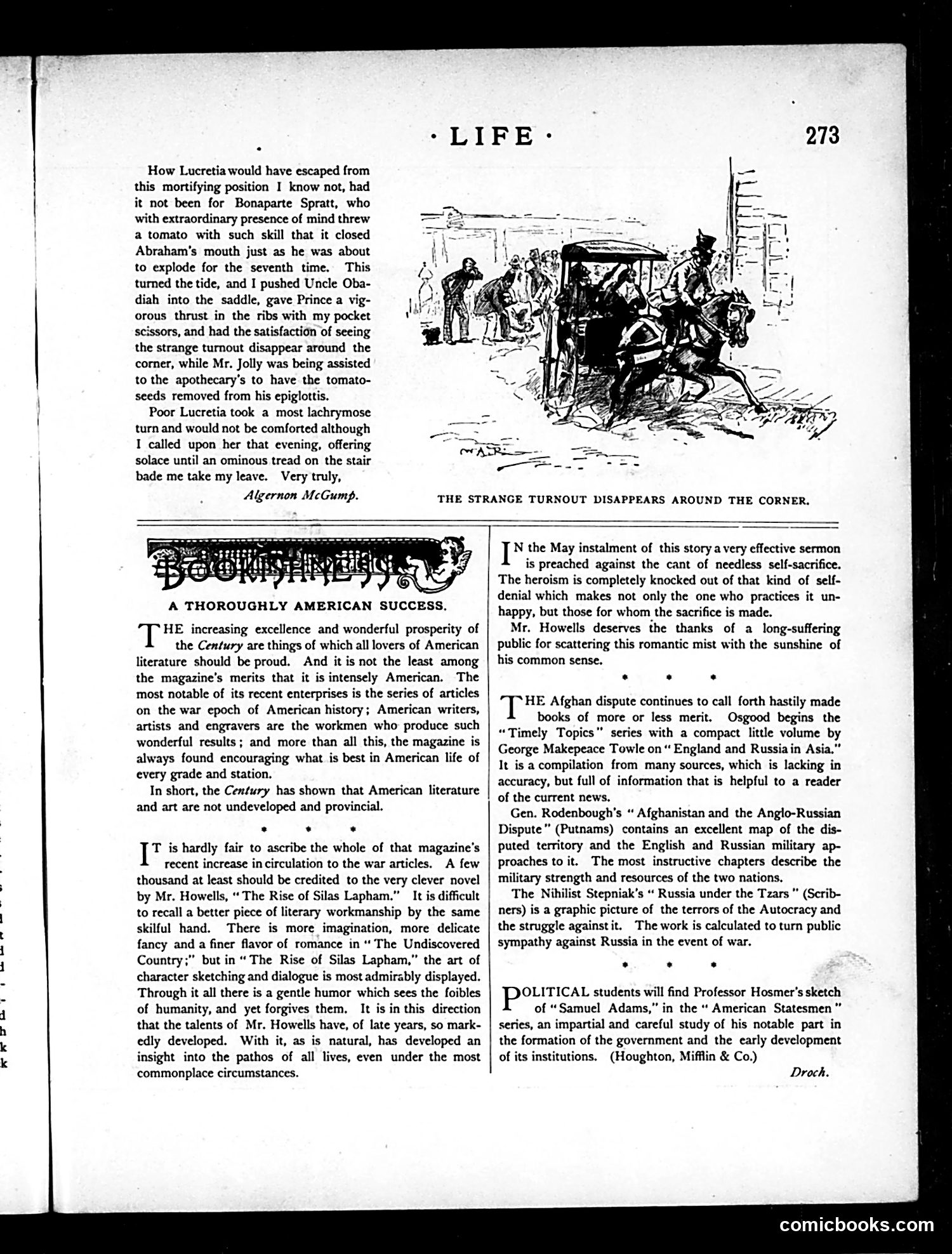
The page contains a fictional narrative excerpt about characters named Lucretia, Bonaparte Spratt, and Uncle Obadiah, culminating in an illustration titled "The Strange Turnout Disappears Around the Corner" depicting a horse-drawn carriage scene. Below this is an editorial section praising *Century* magazine's American literary merit and discussing a novel called "The Rise of Silas Lapham" by Mr. Howells. The text commends Howells' character development and gentle humor. The final section mentions book reviews covering Afghan-Russian disputes and a biographical sketch of "Samuel Adams" from an "American Statesmen" series. The content appears primarily literary criticism rather than political satire—this page emphasizes *Life*'s role as a cultural commentary magazine rather than partisan humor.
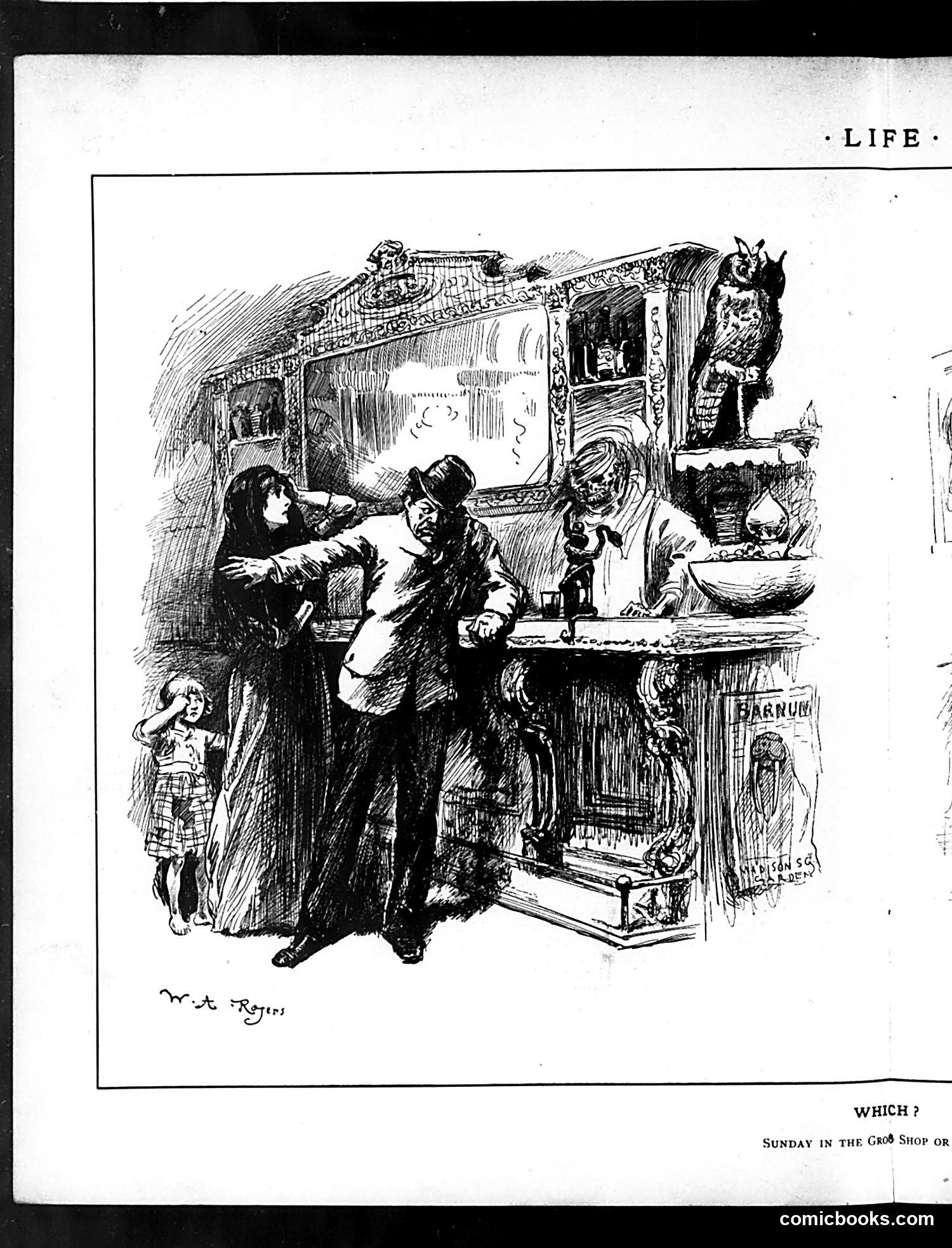
This cartoon depicts a shop scene titled "Sunday in the Gro[cery] Shop or Which?" A well-dressed man appears to be caught in an awkward situation with a woman in what looks like a grocery or shop setting. The woman on the left seems to be confronting or gesturing toward him, while another figure (possibly a shopkeeper) observes from behind a counter. A small child is visible on the left side. The satire appears to target middle-class social awkwardness or infidelity—the "which?" likely refers to choosing between two women, or explaining a compromising encounter. The sketch's style and setting suggest commentary on respectability and proper Sunday behavior in commercial spaces. The artist's signature appears to be present but is difficult to read with certainty.
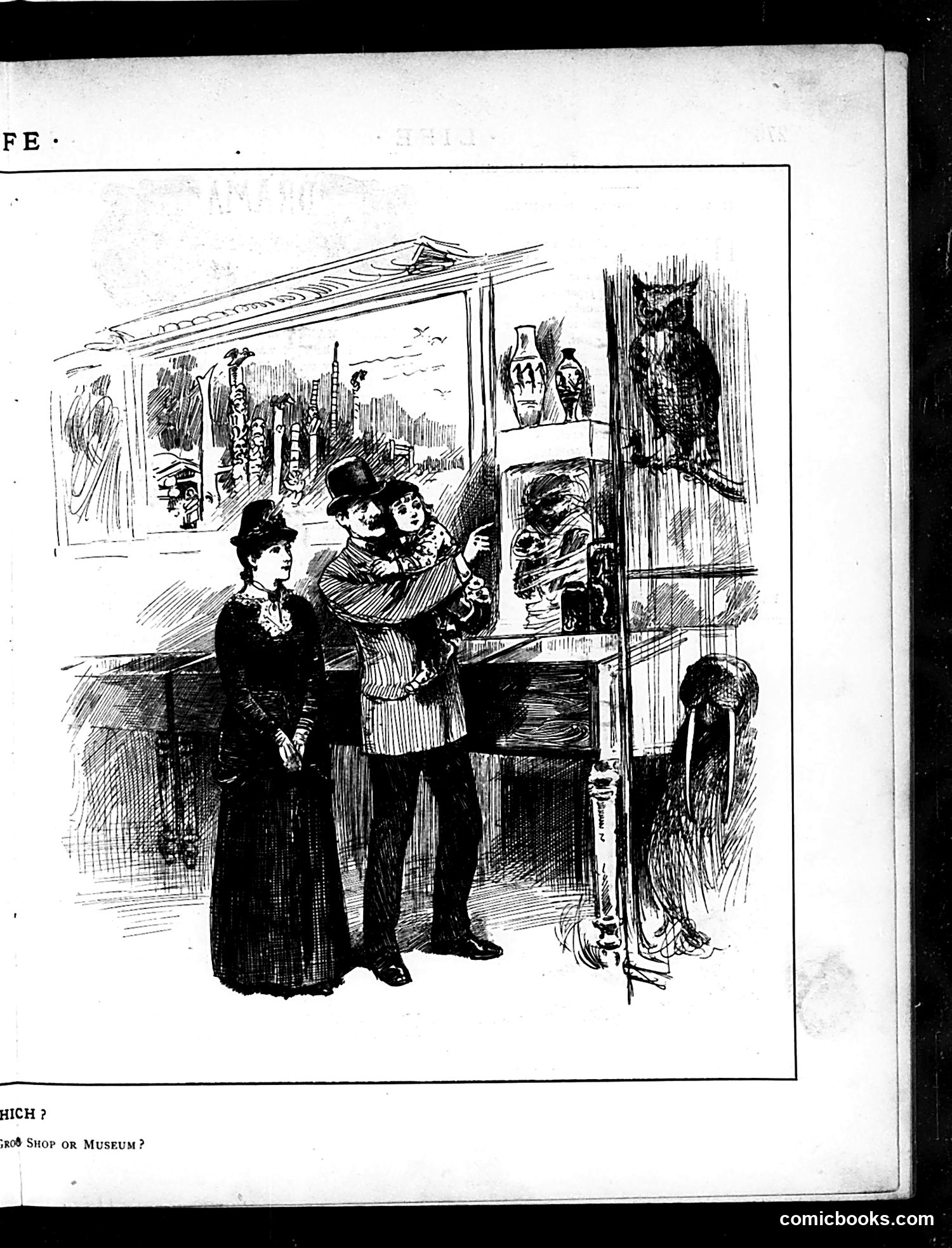
This satirical illustration depicts what appears to be a museum or shop visit, likely from the late 19th or early 20th century based on the clothing and art style. The caption below reads "WHICH? SHOP OR MUSEUM?" suggesting social satire about the commercialization of retail spaces. The scene shows fashionably dressed visitors examining displayed items, including what appears to be pottery and an owl perched on a shelf. The humor seems to mock the blurred line between a commercial shop and a museum—implying that some shopkeepers presented their wares with such pretension or artistic arrangement that it became difficult to distinguish their establishments from actual museums. This reflects period anxieties about consumerism, class performance, and the commercialization of "high culture."
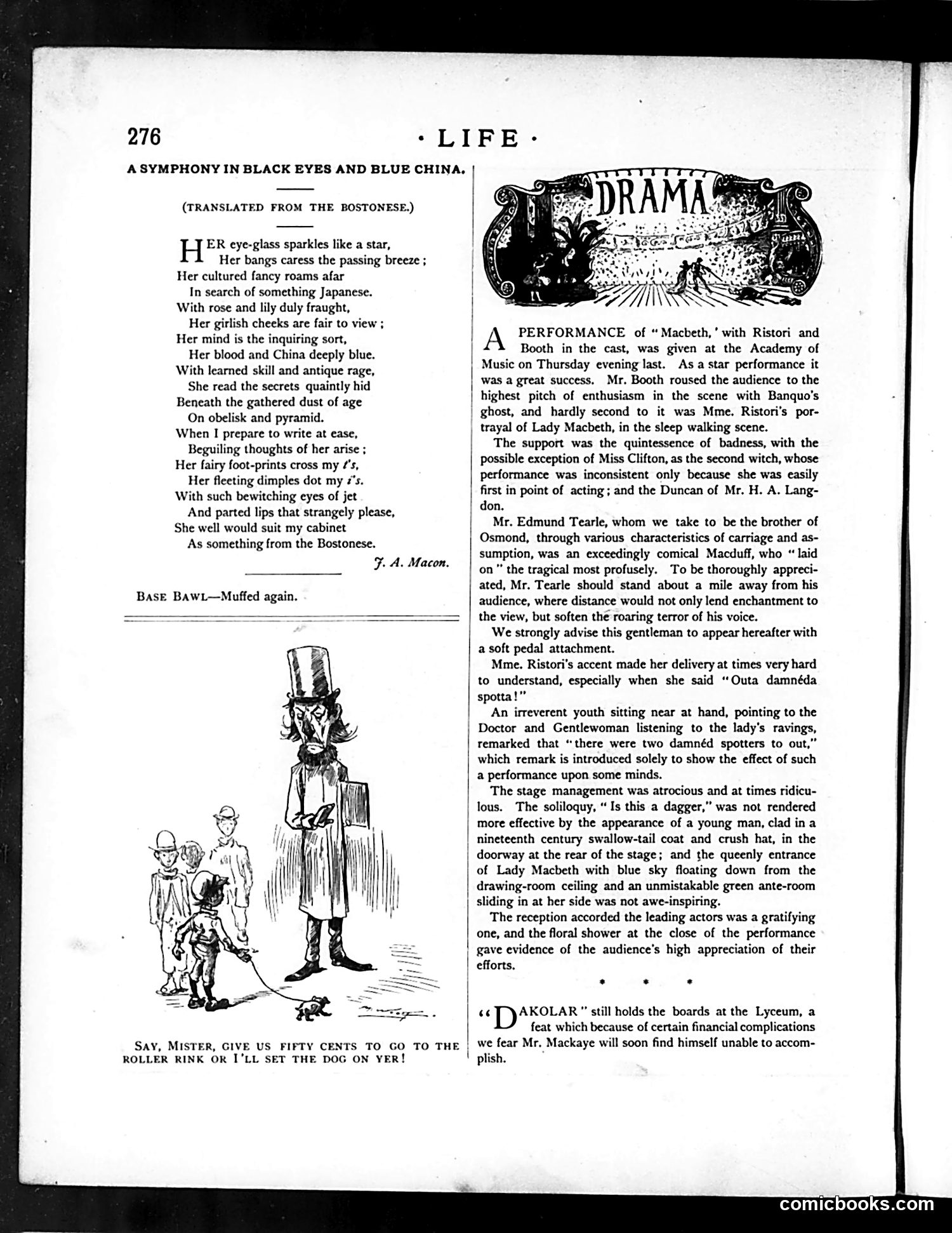
This satirical poem mocks a pretentious Bostonian woman obsessed with fashionable aesthetics and collecting Asian artifacts ("something Japanese," "China deeply blue"). The speaker describes her affected intellectualism—she studies ancient Egyptian monuments—while reducing her to a decorative object: her "bewitching eyes of jet" and dimples would suit his "cabinet / As something from the Bostonese," treating her as another curio to possess. The humor targets 19th-century American élites, particularly Bostonians, for their shallow Orientalism and the way cultured affectation masked superficiality. By comparing her to collectible objects, the poem critiques how such women were valued primarily as fashionable ornaments rather than genuine scholars. The accompanying theater review is unrelated satire of a "Macbeth" performance with poor supporting actors and absurd staging.
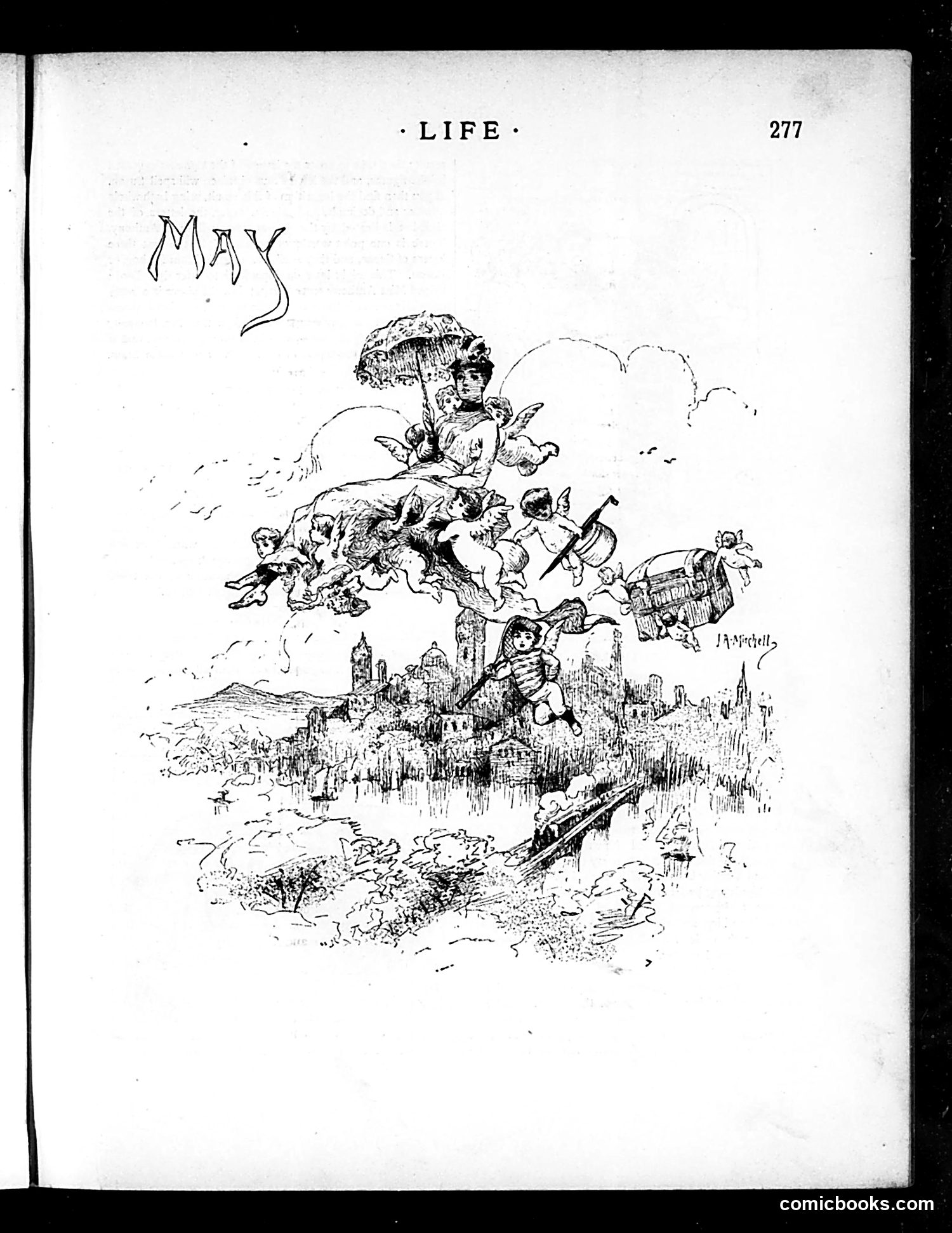
This page from *Life* magazine presents an allegorical illustration for the month of May. The composition shows a classical female figure (representing May) holding an umbrella, surrounded by cherubs and attendants floating among clouds above a cityscape. The illustration appears to be a traditional seasonal or calendar artwork rather than political satire. It depicts May as a nurturing, benevolent personification associated with spring and fertility—common themes in turn-of-the-century American humor magazines. The cherubs, umbrella, and pastoral elements evoke romantic ideals of the season. The artist's signature appears in the lower right, though it's difficult to read clearly in this reproduction. This is likely a decorative or thematic page rather than commentary on contemporary events.
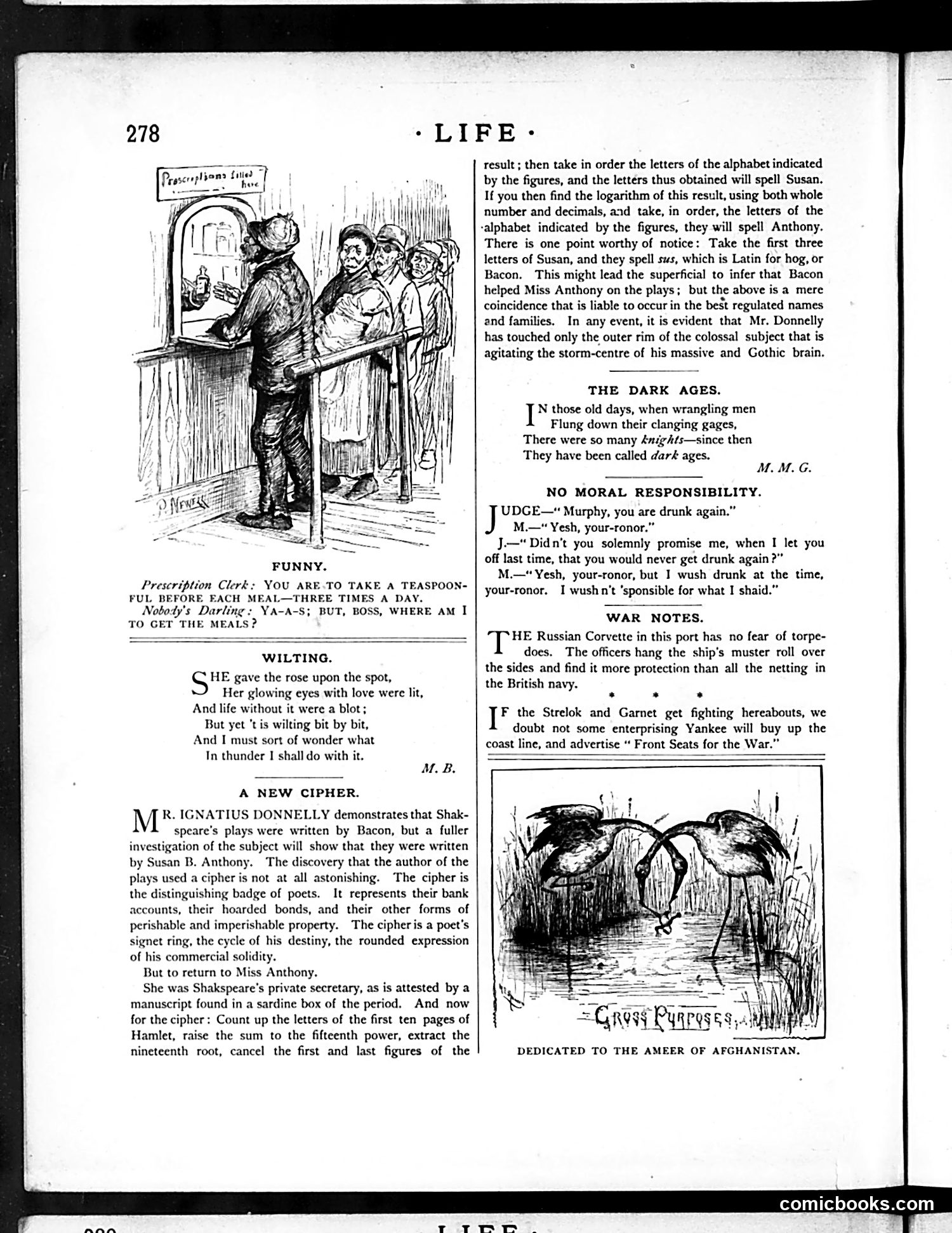
This page contains several distinct satirical pieces targeting late 19th-century American society: **"A New Cipher"** parodies the scholarly obsession with determining Shakespeare's true authorship. It mocks Mr. Ignatius Donnelly (a real figure who promoted the Bacon-Shakespeare theory) by absurdly proposing that Susan B. Anthony wrote Shakespeare's plays—then "proving" it through deliberately nonsensical mathematical gymnastics. The joke ridicules both pseudoscientific literary analysis and, implicitly, skepticism about women's intellectual capabilities by making the argument deliberately ridiculous. **"No Moral Responsibility"** satirizes Irish-American stereotypes and judicial leniency, depicting a drunk defendant (Murphy) claiming he made his promise while already intoxicated, thus bearing no responsibility. It mocks both alcoholism and legal excuses. **"War Notes"** contains cynical commentary on Russian naval capabilities and American commercial opportunism regarding potential foreign conflicts. The cartoons and poems throughout use humor to critique social pretensions, scientific charlatanism, and contemporary politics.
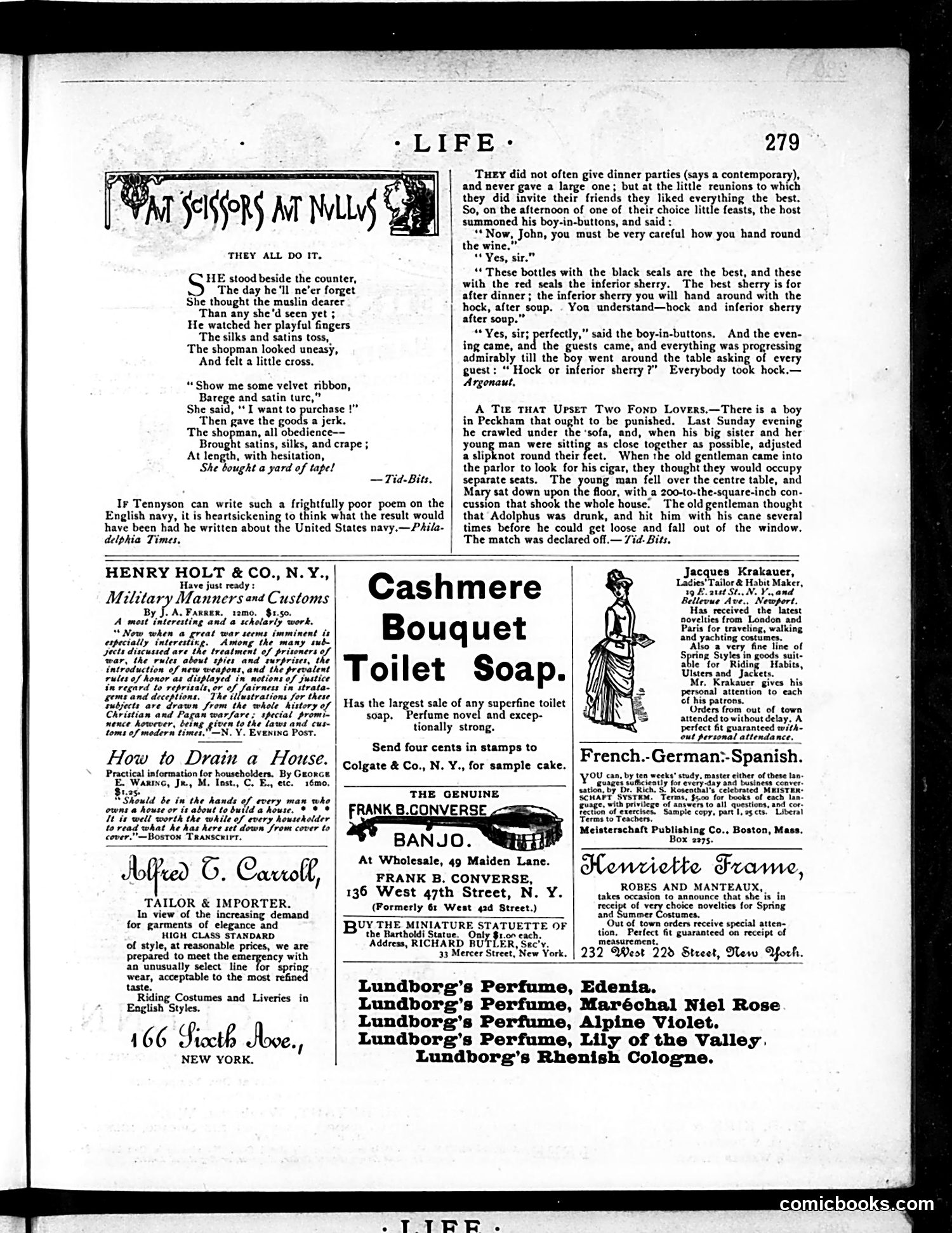
This page contains satirical sketches about human behavior and social customs, typical of Life's humor style. **"They All Do It"** presents a familiar social scenario: a couple shopping for fabric. The wife examines expensive materials (silks, satins, crape) with great interest while her husband watches, but ultimately purchases only a cheap yard of tape. The satire targets female shoppers' tendency to waste time examining luxury goods they cannot afford, while pretending serious intent to purchase. The shopman's discomfort reflects his recognition of this familiar charade. **"A Tie That Upset Two Fond Lovers"** mocks young courting couples through slapstick humor. A mischievous boy ties the feet of a couple sitting intimately on a sofa together. When interrupted by the girl's father, they attempt to separate quickly—the young man falls over a table, the girl crashes to the floor. The father, misinterpreting the commotion, beats the young man before he escapes through a window. The couple's engagement ends as a result. Both sketches use gentle ridicule to comment on class pretension and romantic courtship customs of the era.
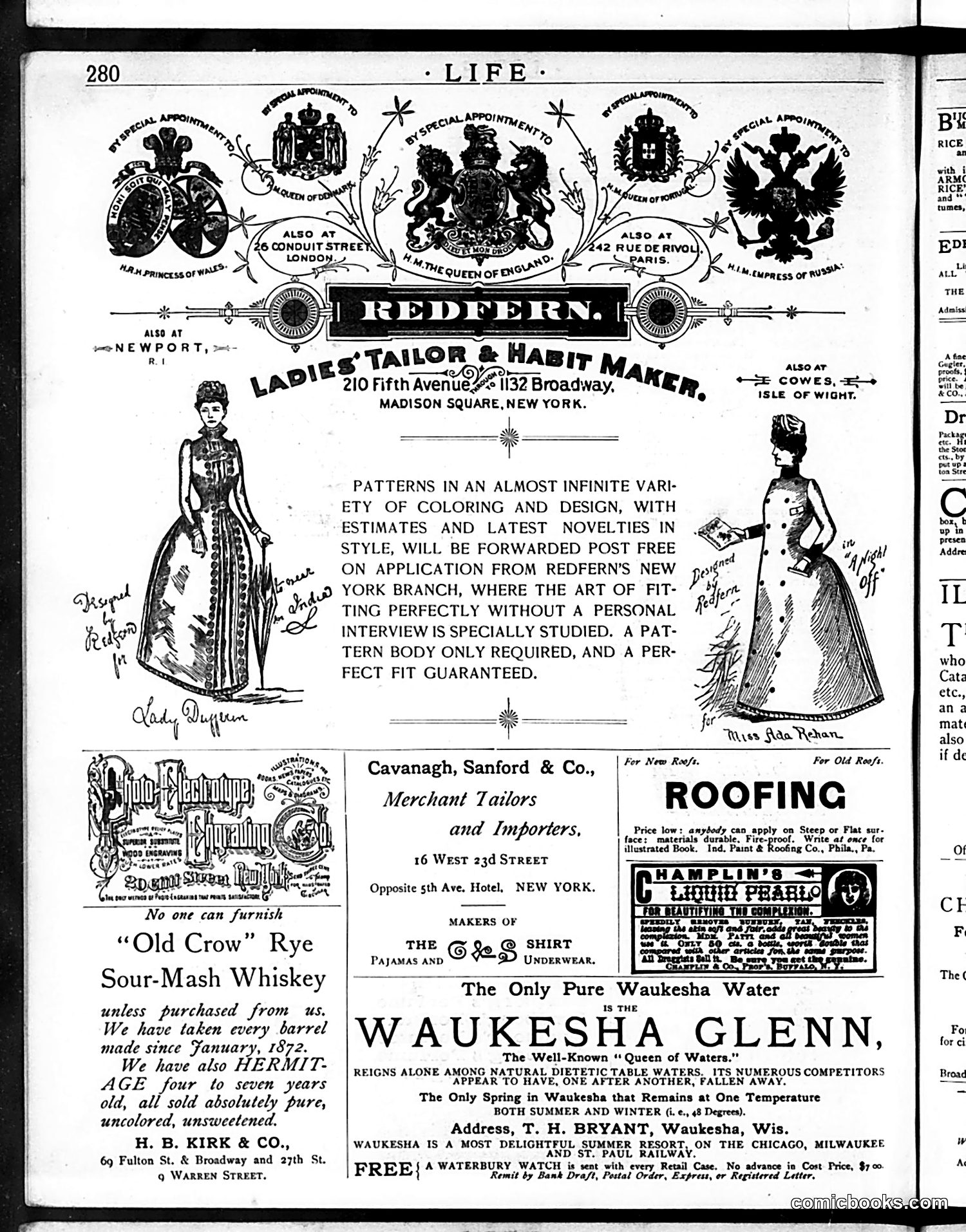
This page is primarily **advertising**, not political satire. The dominant content features commercial advertisements for luxury goods and services aimed at wealthy Americans circa early 1900s. The top section advertises **Redfern's Ladies' Tailor & Habit Maker** (located at prestigious addresses including Newport and Paris), emphasizing custom dressmaking with pattern bodies and guaranteed perfect fits—a service for affluent women. Below are advertisements for merchant tailors, whiskey ("Old Crow" brand), men's clothing (shirts and pajamas), roofing materials, and mineral water ("Waukesha Glenn"). Each ad emphasizes quality, purity, or exclusivity. The decorative heraldic crests and royal warrants at the top suggest British/European luxury branding—typical marketing strategy for wealthy American clientele who admired Old World prestige. There is **no political cartoon or satire** visible on this page. It functions as a commercial publication targeting the upper class.
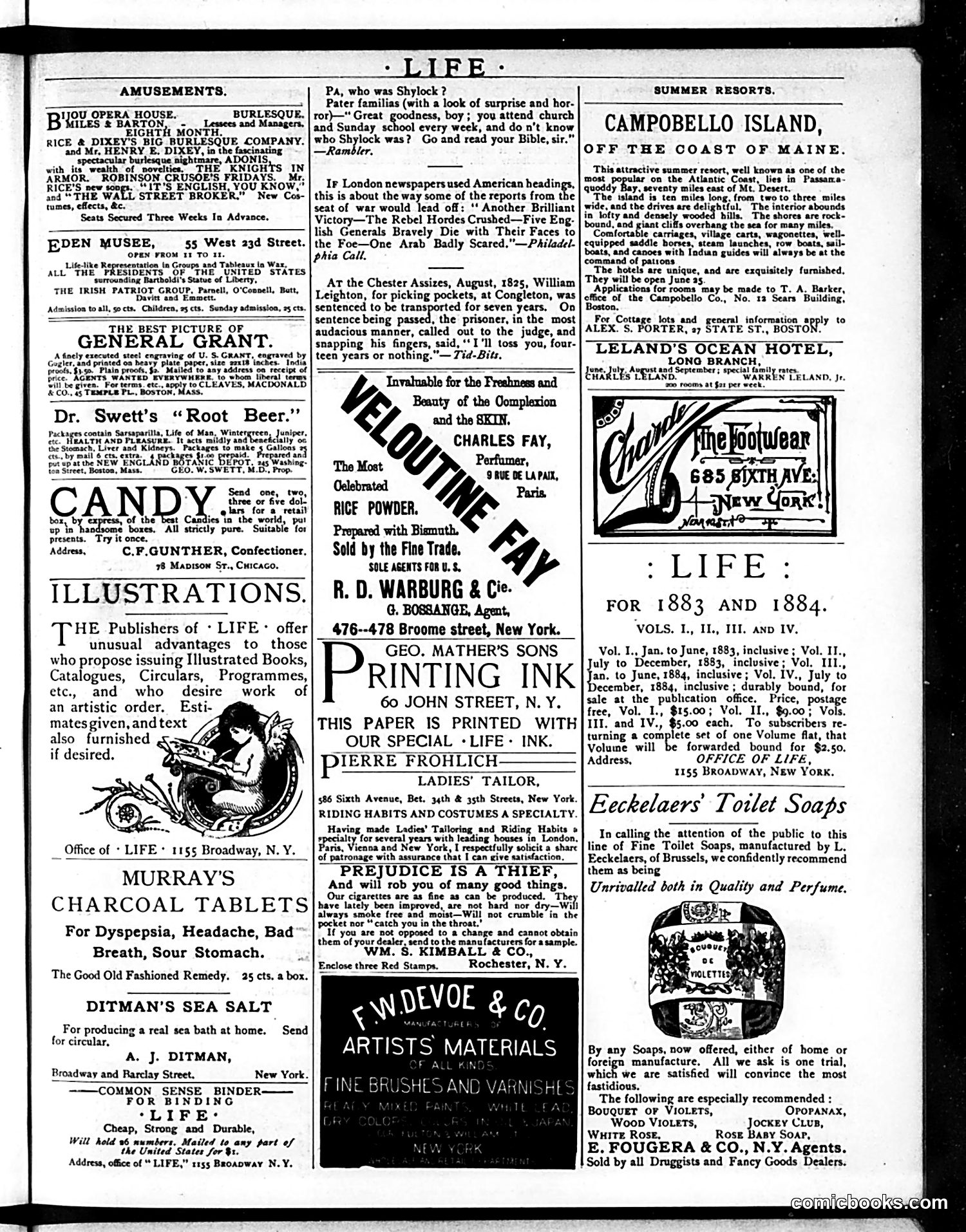
This page is primarily **advertisements and filler content** rather than political cartoons. However, it contains three brief humorous anecdotes: 1. **"Pa, who was Shylock?"** - A joke about a boy's religious education. The father is shocked his church-attending son doesn't know Shylock (Shakespeare's *Merchant of Venice* character), assuming he should know biblical references instead. The humor mocks either the boy's ignorance or the father's confusion about what constitutes essential knowledge. 2. **London War Reporting** - Satirizes sensationalist American newspaper headlines about the Sudan conflict, mocking their exaggerated rhetoric ("Brilliant Victory," "Rebel Hordes Crushed"). 3. **Chester Assizes anecdote** - A pickpocket's cheeky defiance when sentenced to transportation, offering to gamble with the judge ("I'll toss you, fourteen years or nothing"). The page is otherwise filled with period advertisements for patent medicines, printing services, and consumer goods typical of 1880s Life magazine.
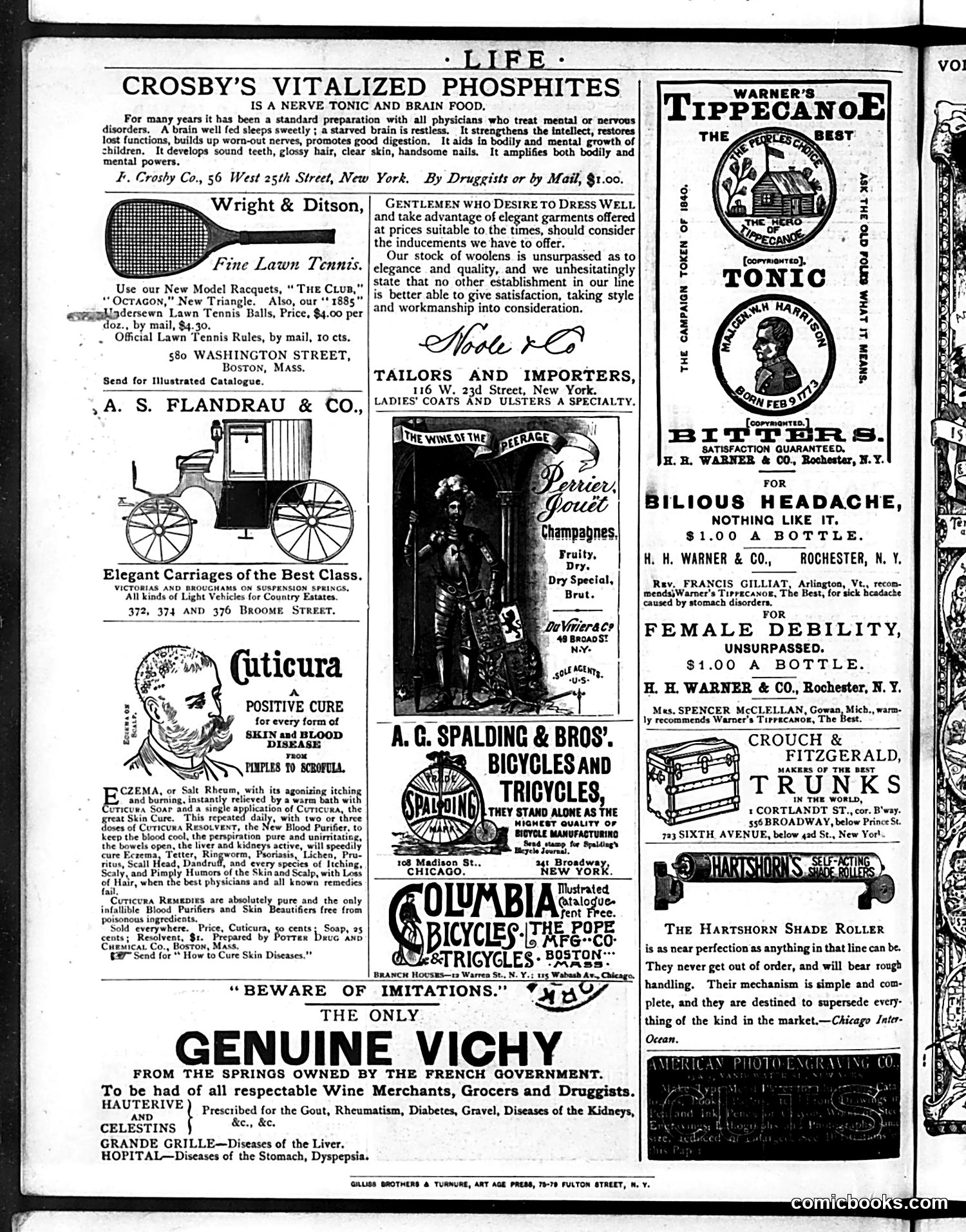
This page is primarily **advertising, not a political cartoon**. However, it contains one small historical reference worth noting: **"The Campaign Token of 1840"** appears as a circular image in the middle-right portion, showing what appears to be a commemorative campaign token—likely from William Henry Harrison's "Tippecanoe and Tyler Too" presidential campaign. This is an historical artifact being referenced in an advertisement context, not satirical commentary. The rest of the page consists entirely of **commercial advertisements** for period products: nerve tonics, tennis equipment, carriages, bicycles, skin treatments (Cuticura), patent medicines (Warner's products for headaches and "female debility"), and trunks. These ads reflect typical Victorian-era commercial culture and medical pseudo-science, but contain no apparent satire or political message—they're straightforward marketing of the era. The 1840 campaign token is the sole historically significant element, serving as a curiosity item, possibly for collectors.