
Life, 1885-05-14 · page 7 of 16
Life — May 14, 1885 — page 7: what you’re looking at
What you’re looking at
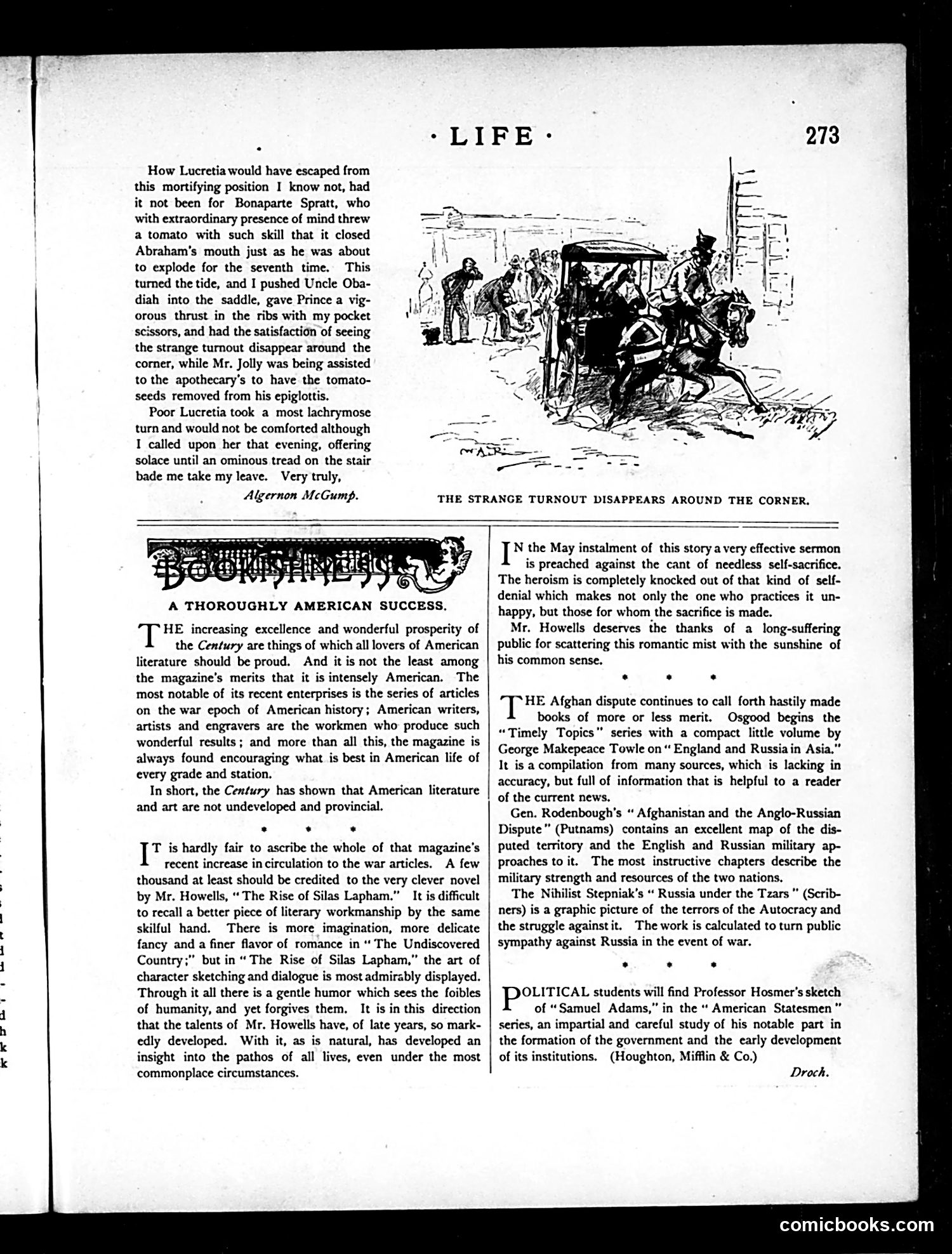
The page contains a fictional narrative excerpt about characters named Lucretia, Bonaparte Spratt, and Uncle Obadiah, culminating in an illustration titled "The Strange Turnout Disappears Around the Corner" depicting a horse-drawn carriage scene. Below this is an editorial section praising *Century* magazine's American literary merit and discussing a novel called "The Rise of Silas Lapham" by Mr. Howells. The text commends Howells' character development and gentle humor. The final section mentions book reviews covering Afghan-Russian disputes and a biographical sketch of "Samuel Adams" from an "American Statesmen" series. The content appears primarily literary criticism rather than political satire—this page emphasizes *Life*'s role as a cultural commentary magazine rather than partisan humor.
📄 Transcribed text from this page (OCR, searchable)
Machine-transcribed from the original scan — historical spelling and the odd misread are preserved.
ee es How Lucretia would have escaped from this mortifying position I know not, had it not been for Bonaparte Spratt, who with extraordinary presence of mind threw a tomato with such skill that it closed Abraham's mouth just as he was about to explode for the seventh time. This turned the tide, and I pushed Uncle Oba- diah into the saddle, gave Prince a vig- orous thrust in the ribs with my pocket scissors, and had the satisfaction of seeing the strange turnout disappear around the corner, while Mr. Jolly was being assisted to the apothecary’s to have the tomato- seeds removed from his epiglottis. Poor Lucretia took a most lachrymose turn and would not be comforted although I called upon her that evening, offering solace until an ominous tread on the stair bade me take my leave. Very truly, Algernon McGump. A THOROUGHLY AMERICAN SUCCESS. HE increasing excellence and wonderful prosperity of the Century are things of which all lovers of American literature should be proud. And it is not the least among the magazine's merits that it is intensely American. The most notable of its recent enterprises is the series of articles on the war epoch of American history; American writers, artists and engravers are the workmen who produce such wonderful results; and more than all this, the magazine is always found encouraging what is best in American life of every grade and station. In short, the Century has shown that American literature and art are not undeveloped and provincial. . . . T is hardly fair to ascribe the whole of that magazine's recent increase in circulation to the war articles. A few thousand at least should be credited to the very clever novel by Mr. Howells, “ The Rise of Silas Lapham.” It is difficult to recall a better piece of literary workmanship by the same skilful hand. There is more imagination, more delicate fancy and a finer flavor of romance in “ The Undiscovered Country ;” but in “ The Rise of Silas Lapham,” the art of character sketching and dialogue is most admirably displayed. Through it all there is a gentle humor which sees the foibles of humanity, and yet forgives them. It is in this direction that the talents of Mr. Howells have, of late years, so mark- edly developed. With it, as is natural, has developed an insight into the pathos of all lives, even under the most commonplace circumstances. ] N the May instalment of this story a very effective sermon is preached against the cant of needless self-sacrifice. The heroism is completely knocked out of that kind of self- denial which makes not only the one who practices it un- happy, but those for whom the sacrifice is made. Mr. Howells deserves the thanks of a long-suffering public for scattering this romantic mist with the sunshine of his common sense. . ° . HE Afghan dispute continues to call forth hastily made books of more or less merit. Osgood begins the “Timely Topics” series with a compact little volume by George Makepeace Towle on “ England and Russia in Asia.” It is a compilation from many sources, which is lacking in accuracy, but full of information that is helpful to a reader of the current news, Gen. Rodenbough’s “ Afghanistan and the Anglo-Russian Dispute” (Putnams) contains an excellent map of the dis- puted territory and the English and Russian military ap- proaches to it. The most instructive chapters describe the military strength and resources of the two nations. The Nihilist Stepniak’s “ Russia under the Tzars " (Scrib- ners) is a graphic picture of the terrors of the Autocracy and the struggle against it. The work is calculated to turn public sympathy against Russia in the event of war. * * * OLITICAL students will find Professor Hosmer’s sketch of “Samuel Adams,” in the “ American Statesmen” series, an impartial and careful study of his notable part in the formation of the government and the early development of its institutions. (Houghton, Mifflin & Co.) Droch. comicbooks.com