
Life, 1885-05-14 · page 2 of 16
Life — May 14, 1885 — page 2: what you’re looking at
What you’re looking at
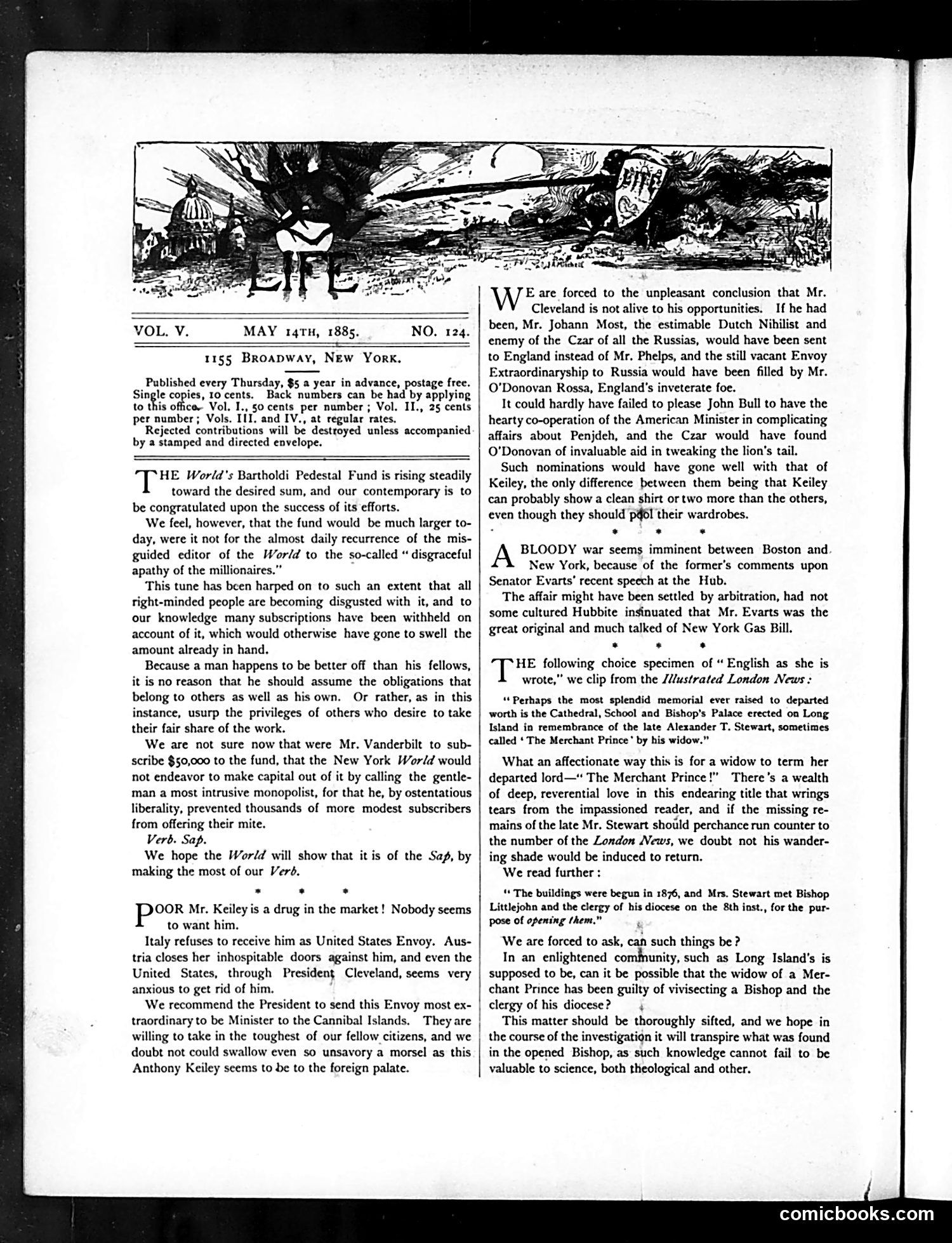
The masthead cartoon depicts a graveyard scene with "Life" emerging from a coffin, suggesting the magazine's survival despite criticism. The text discusses political controversies of 1885: 1. **Cleveland administration criticism**: The editors argue President Cleveland missed diplomatic opportunities, particularly regarding Russian envoy appointments and the "Penjdeh affair" (a Central Asian border dispute). 2. **Keiley appointment dispute**: Anthony Keiley, nominated as U.S. Envoy to Italy and Austria, faced rejection because he was a widower—apparently considered scandalous. The magazine sarcastically suggests sending him to the "Cannibal Islands" instead. 3. **Boston-New York rivalry**: A dispute between Senator Evarts and the *New York World* over a recent speech. The tone is satirical political commentary on diplomatic bungling and social hypocrisy of the Gilded Age.
📄 Transcribed text from this page (OCR, searchable)
Machine-transcribed from the original scan — historical spelling and the odd misread are preserved.
VOL. V. MAY 14TH, 1885. 1155 Broapway, New York. Published every Thursday, $5 a year in advance, postage free. Single copies, 10 cents. Back numbers can be had by applying to this ofice- Vol. I., 50 cents per number ; Vol. II., 25 cents per number; Vols. III. and IV., at regular rates. Rejected contributions will be destroyed unless accompanied by a stamped and directed envelope. HE World's Bartholdi Pedestal Fund is rising steadily toward the desired sum, and our contemporary is to be congratulated upon the success of its efforts. We feel, however, that the fund would be much larger to- day, were it not for the almost daily recurrence of the mis- guided editor of the World to the so-called “ disgraceful apathy of the millionaires.” This tune has bcen harped on to such an extent that all right-minded people are becoming disgusted with it, and to our knowledge many subscriptions have been withheld on account of it, which would otherwise have gone to swell the amount already in hand. Because a man happens to be better off than his fellows, it is no reason that he should assume the obligations that belong to others as well as his own. Or rather, as in this instance, usurp the privileges of others who desire to take their fair share of the work. We are not sure now that were Mr. Vanderbilt to sub- scribe $50,000 to the fund, that the New York World would not endeavor to make capital out of it by calling the gentle- man a most intrusive monopolist, for that he, by ostentatious liberality, prevented thousands of more modest subscribers from offering their mite. Verb. Sap. We hope the World will show that it is of the Sa, by making the most of our Verd. . * * OOR Mr. Keiley is a drug in the market ! Nobody seems to want him. Italy refuses to receive him as United States Envoy. Aus- tria closes her inhospitable doors against him, and even the United States, through President Cleveland, seems very anxious to get rid of him. We recommend the President to send this Envoy most ex- traordinary to be Minister to the Cannibal Islands. willing to take in the toughest of our fellow citizens, and we doubt not could swallow even so unsavory a morsel as this Anthony Keiley seems to be to the foreign palate. They are | E are forced to the unpleasant conclusion that Mr. Cleveland is not alive to his opportunities. If he had been, Mr. Johann Most, the estimable Dutch Nihilist and enemy of the Czar of all the Russias, would have been sent to England instead of Mr. Phelps, and the still vacant Envoy Extraordinaryship to Russia would have been filled by Mr. O'Donovan Rossa, England's inveterate foe. It could hardly have failed to please John Bull to have the hearty co-operation of the American Minister in complicating affairs about Penjdeh, and the Czar would have found O'Donovan of invaluable aid in tweaking the lion’s tail. Such nominations would have gone well with that of Keiley, the only difference between them being that Keiley can probably show a clean shirt or two more than the others, even though they should pg6l their wardrobes. ° . . . BLOODY war seems imminent between Boston and New York, because of the former’s comments upon Senator Evarts’ recent speech at the Hub. The affair might have been settled by arbitration, had not some cultured Hubbite insinuated that Mr. Evarts was the great original and much talked of New York Gas Bill. . . . HE following choice specimen of “ English as she is wrote,” we clip from the ///ustrated London News : “Perhaps the most splendid memorial ever raised to departed worth is the Cathedral, School and Bishop's Palace erected on Long Island in remembrance of the late Alexander T. Stewart, sometimes called ‘ The Merchant Prince’ by his widow.” What an affectionate way this is for a widow to term her departed lord—‘ The Merchant Prince!” There's a wealth of deep, reverential love in this endearing title that wrings tears from the impassioned reader, and if the missing re- mains of the late Mr. Stewart should perchance run counter to the number of the London News, we doubt not his wander- ing shade would be induced to return. We read further : “The buildings were begun in 1876, and Mrs. Stewart met Bishop Littlejohn and the clergy of his diocese on the 8th inst., for the pur- pose of opening them.” ‘ We are forced to ask, can such things be ? In an enlightened comfnunity, such as Long Island's is supposed to be, can it be possible that the widow of a Mer- chant Prince has been guilty of vivisecting a Bishop and the clergy of his diocese? ‘ This matter should be thoroughly sifted, and we hope in the course of the investigation it will transpire what was found in the opened Bishop, as such knowledge cannot fail to be valuable to science, both theological and other. comicbooks.com