
A complete issue · 16 pages · 1885
Life — May 7, 1885
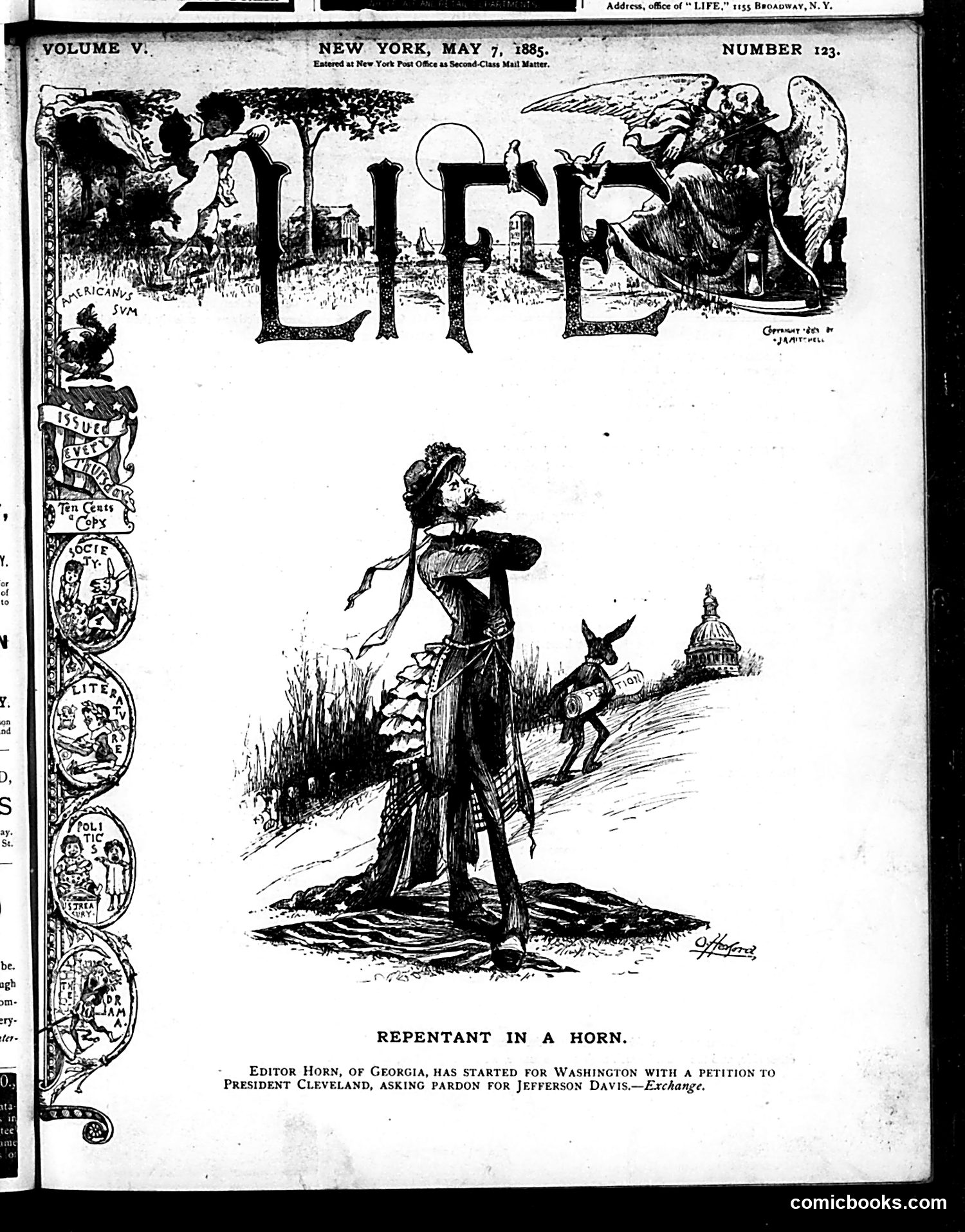
This political cartoon satirizes Editor Henry Grady of Georgia, who has petitioned President Cleveland to pardon Confederate general Jefferson Davis. The image depicts a figure in Civil War-era military dress standing in a swampy landscape, blowing a horn toward the Capitol building. The horn itself appears to be labeled, suggesting the "horn" is Grady's petition—a play on words treating his written appeal as literally a horn used to summon authority. The satire targets Grady's apparent reversal on Reconstruction politics: by seeking Davis's pardon, he's portrayed as hypocritically "repenting" or backtracking from previous stances. The cartoon mocks what the artist sees as opportunistic or insincere political positioning regarding the still-contentious question of Confederate reconciliation in post-Reconstruction America.
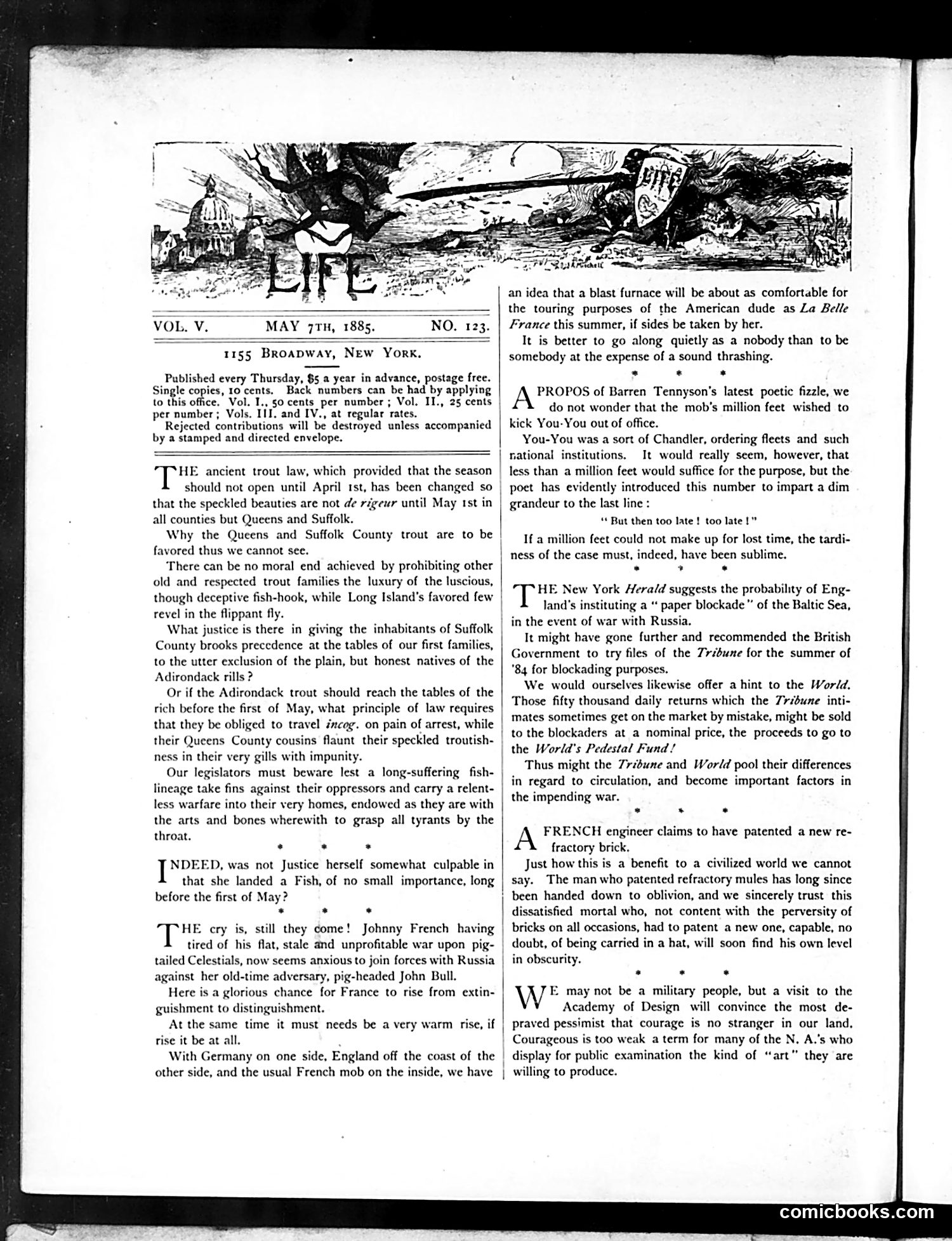
The visible cartoon header depicts a chaotic scene with military elements and destruction, though specific figures are unclear from this reproduction quality. The text consists of brief satirical commentaries on contemporary issues: 1. **Trout fishing regulations** — criticism of rule changes requiring May 1st season opening, disadvantaging certain regions (Queens, Suffolk County) 2. **Johnny French** — appears to reference a political or military figure involved in conflicts, possibly related to colonial disputes 3. **Newspaper rivalry** — satire about *Herald*, *Tribune*, and *World* newspapers proposing absurd war-preparation ideas (blocking harbors, selling newspaper returns to fund defense) 4. **French engineering patent** — mockery of patent claims for a "refractory brick" 5. **Academy of Design** — criticism of the National Academy's artistic standards and public exhibition choices The tone is typical of *Life*'s irreverent editorial satire of the 1880s.
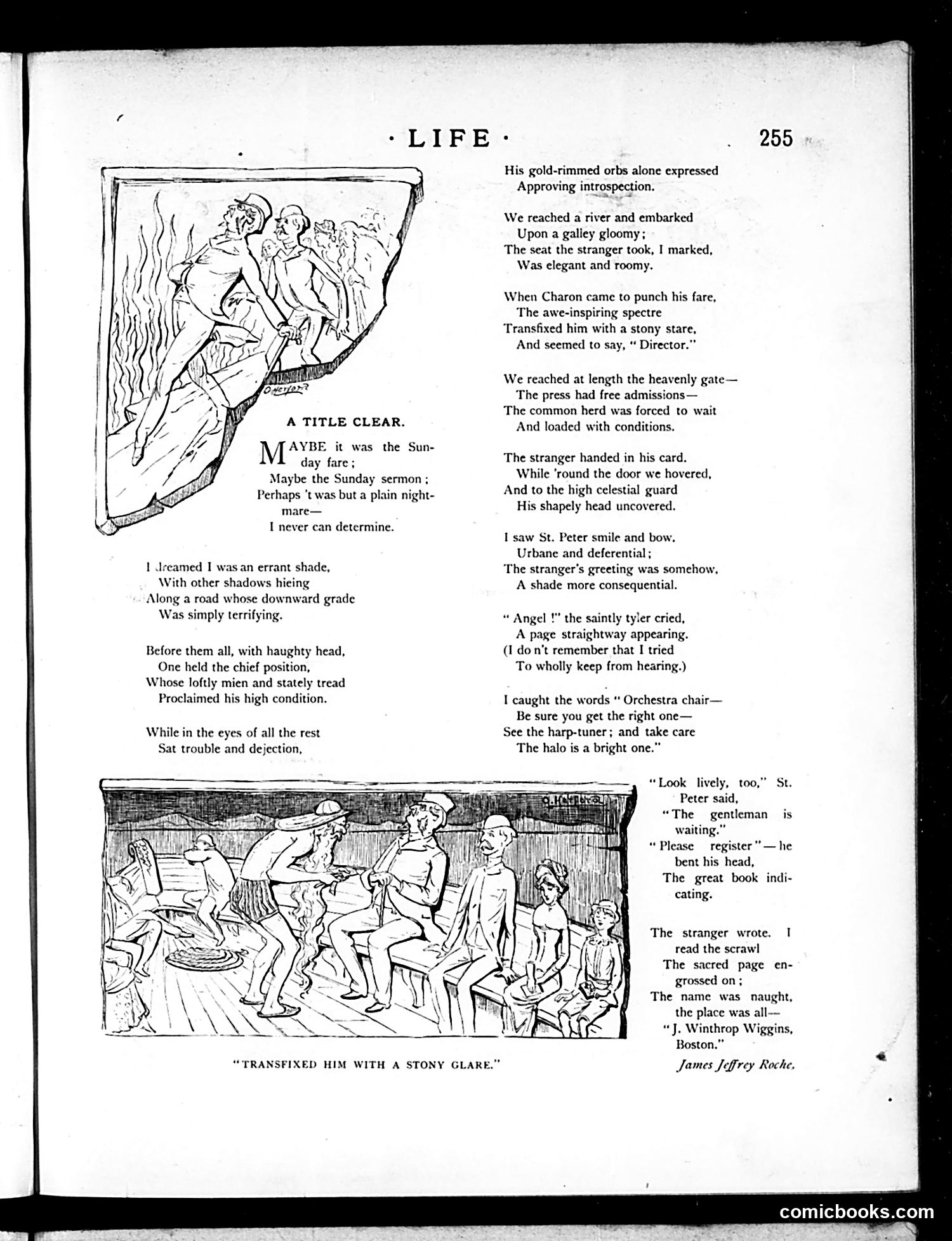
This page contains a literary poem by James Jeffrey Roche rather than political satire. The piece appears to be a humorous afterlife narrative where the narrator dreams of being a shade journeying toward heaven's gate. The two illustrations support the poem's themes: the upper image depicts classical/mythological figures (possibly Charon ferrying souls), while the lower illustration shows what appears to be heavenly bureaucracy—figures at a desk processing admissions with a ledger or registry book. The satire targets institutional red tape and admission requirements, even in paradise. The joke is that heaven operates like an earthly institution requiring paperwork and credentials ("Please register"), poking fun at bureaucratic formality extending beyond death itself.
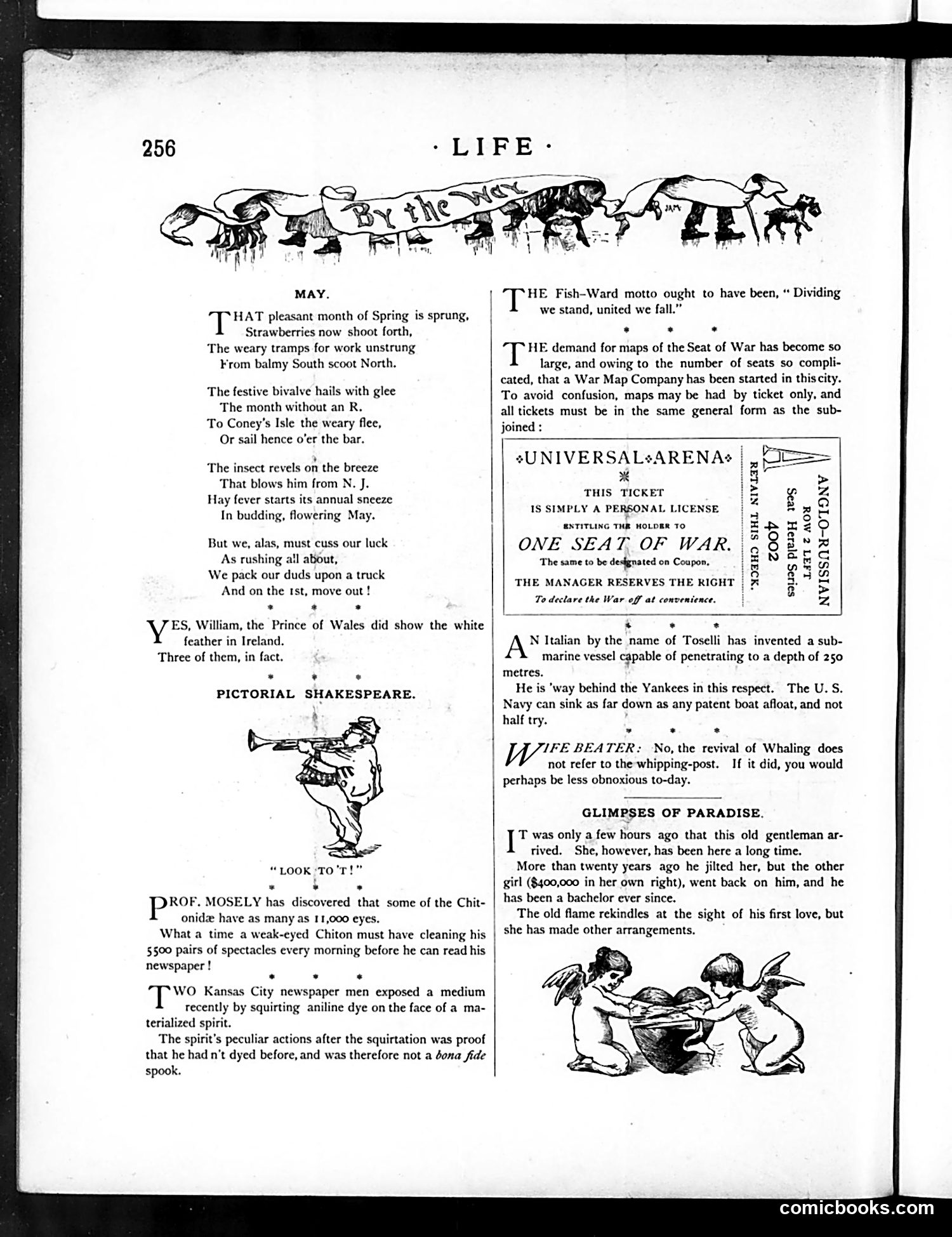
This page from Life magazine contains several satirical items typical of the publication's format: **"MAY"** poem mocks spring activities and wartime conditions—references to "weary trampers," "Coney's Isle," and packing "duds" suggest complaints about crowded recreational spots during what appears to be a WWI-era spring season. **"Pictorial Shakespeare"** shows a figure with a trumpet labeled "Look To't!"—likely a visual pun playing on Shakespearean references. **Prof. Mosely anecdote** jokes that Chitonidae (a mollusk) have 11,000 eyes, making spectacle-cleaning absurdly time-consuming—pure nonsense humor. **Kansas City medium story** satirizes spiritualism by describing a materialized spirit's peculiar reaction to aniline dye, questioning whether it was genuinely supernatural. The page also includes advertisements for war-related maps and tickets, reflecting wartime commercial interests.
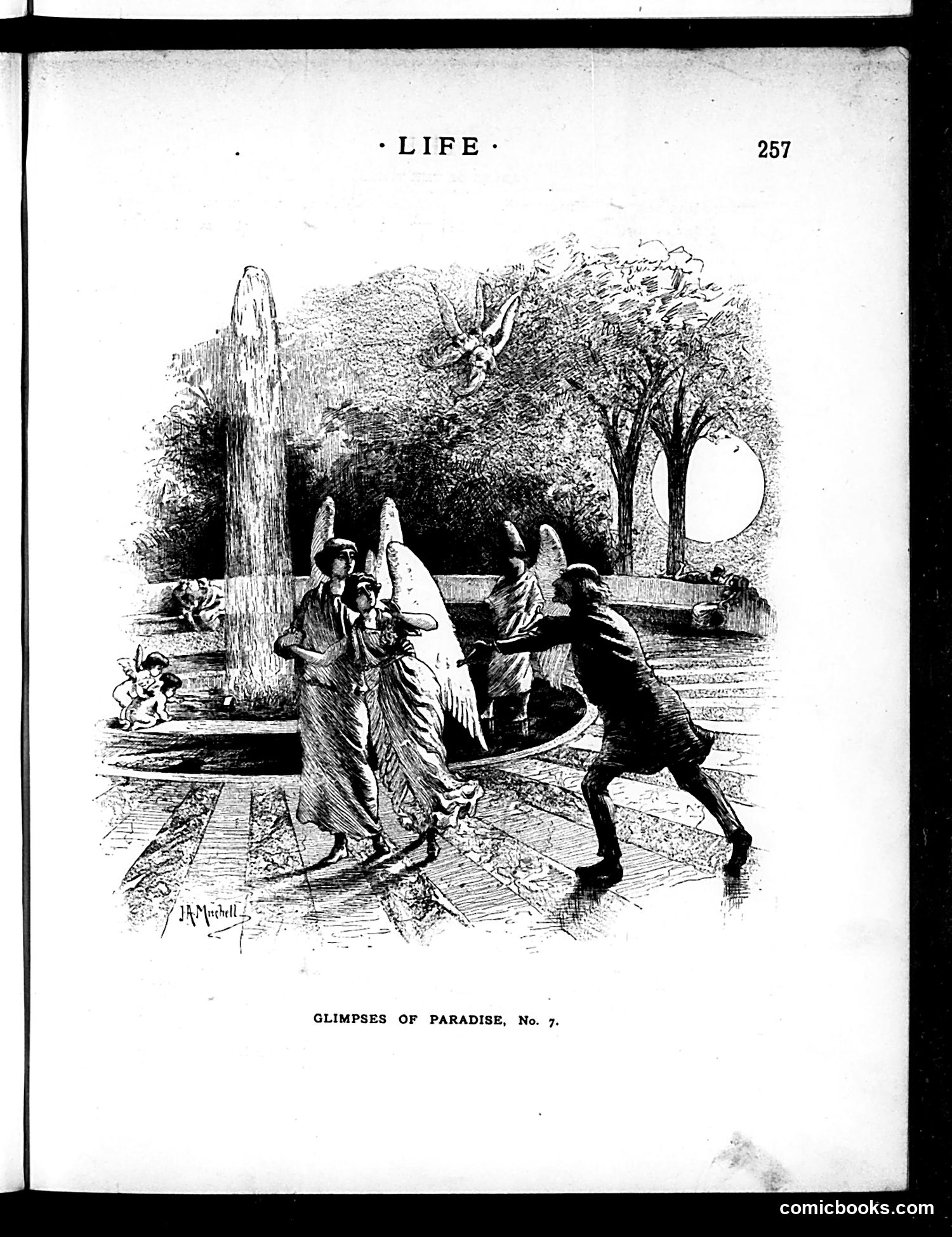
This satirical illustration depicts a romantic scene in a pastoral garden setting. A winged angelic figure (representing Paradise or an idealized romantic vision) gestures toward a couple and what appears to be a demon or devil figure on the right. The satire likely mocks the contrast between romantic ideals and reality—the "glimpses of paradise" promised by love or courtship versus the actual complications that emerge. The demonic figure may represent jealousy, temptation, or the darker aspects of human relationships that intrude upon romantic fantasy. The series title ("No. 7") suggests this was part of Life magazine's recurring satirical commentary on love, courtship, and relationships—common targets of turn-of-the-century American humor. The artist's signature appears to read "J.A.Mitchell" or similar.
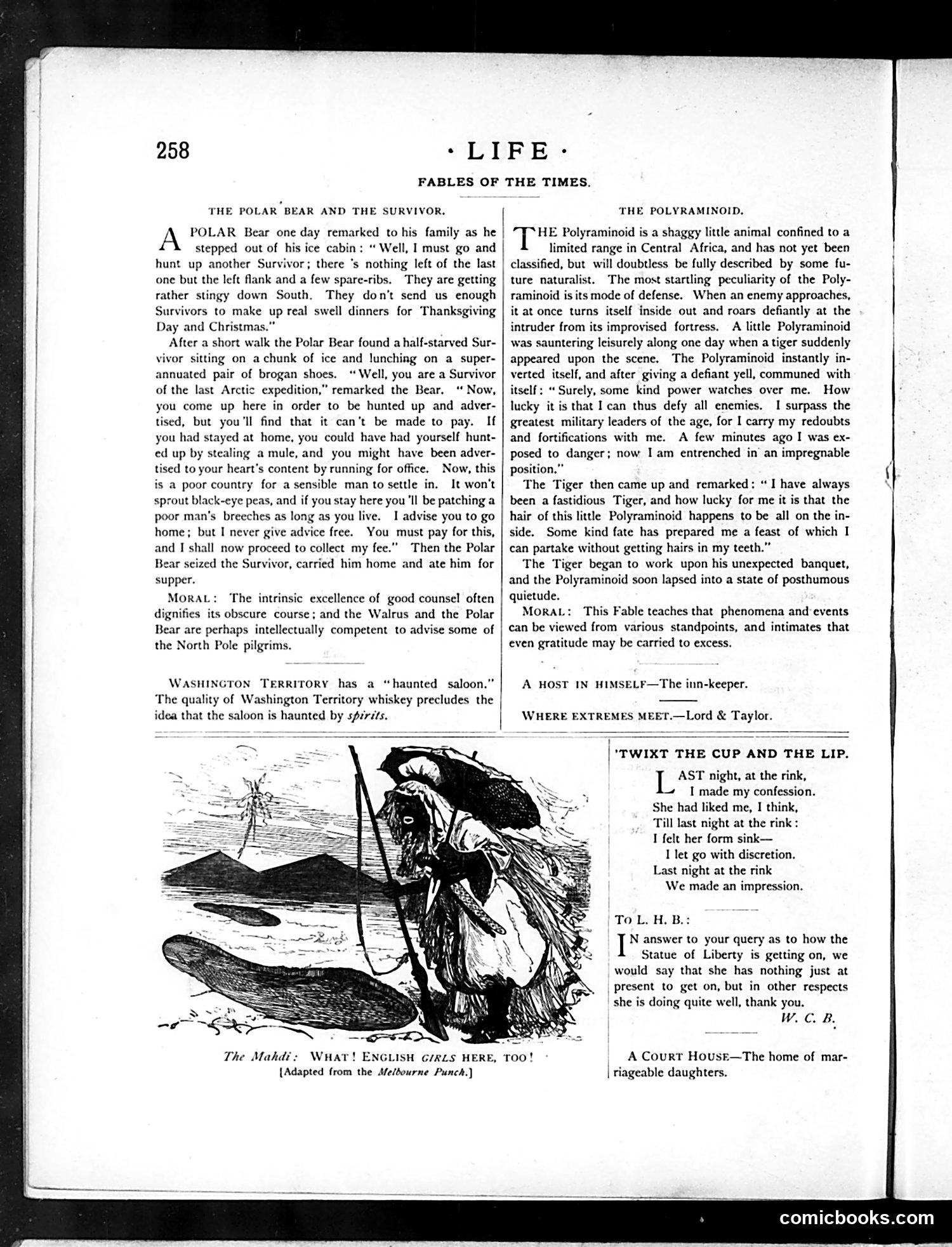
The main cartoon depicts "The Mahdi" captioned "What! English girls here, too!" adapted from the Melbourne Punch. The Mahdi was a Sudanese Islamic military leader who led a revolt against British colonial rule in the 1880s. The image shows him as a skeletal, threatening figure confronting English women, satirizing Victorian anxieties about colonial conflicts and the vulnerability of British subjects—particularly women—in imperial territories. The cartoon reflects contemporary concerns about British imperial expansion and the dangers colonists faced from indigenous resistance movements. The exaggerated, dehumanizing depiction of the Mahdi was typical of period racism and served to justify imperial military campaigns. The satirical point appears to mock both the Mahdi's surprise and British complacency about colonial vulnerabilities.
The page contains a letter from Léon Verdi in New York to Prosper Gobain in Lille (May 1st), accompanied by a decorative illustration of a tree with small figures beneath it. Verdi's letter is a satirical critique of Boston's literary and cultural pretensions. He mocks the city's "wasp-waisted imitator of Madame de Sevigny" and criticizes Boston's intellectual circles—particularly Harvard University graduates—as possessing "hardly feathers enough to cover their intellectual nudity." The satire targets Boston's self-regard as an elite cultural center while suggesting its actual literary output is derivative and underwhelming. The illustration appears decorative rather than directly illustrative of the letter's content.
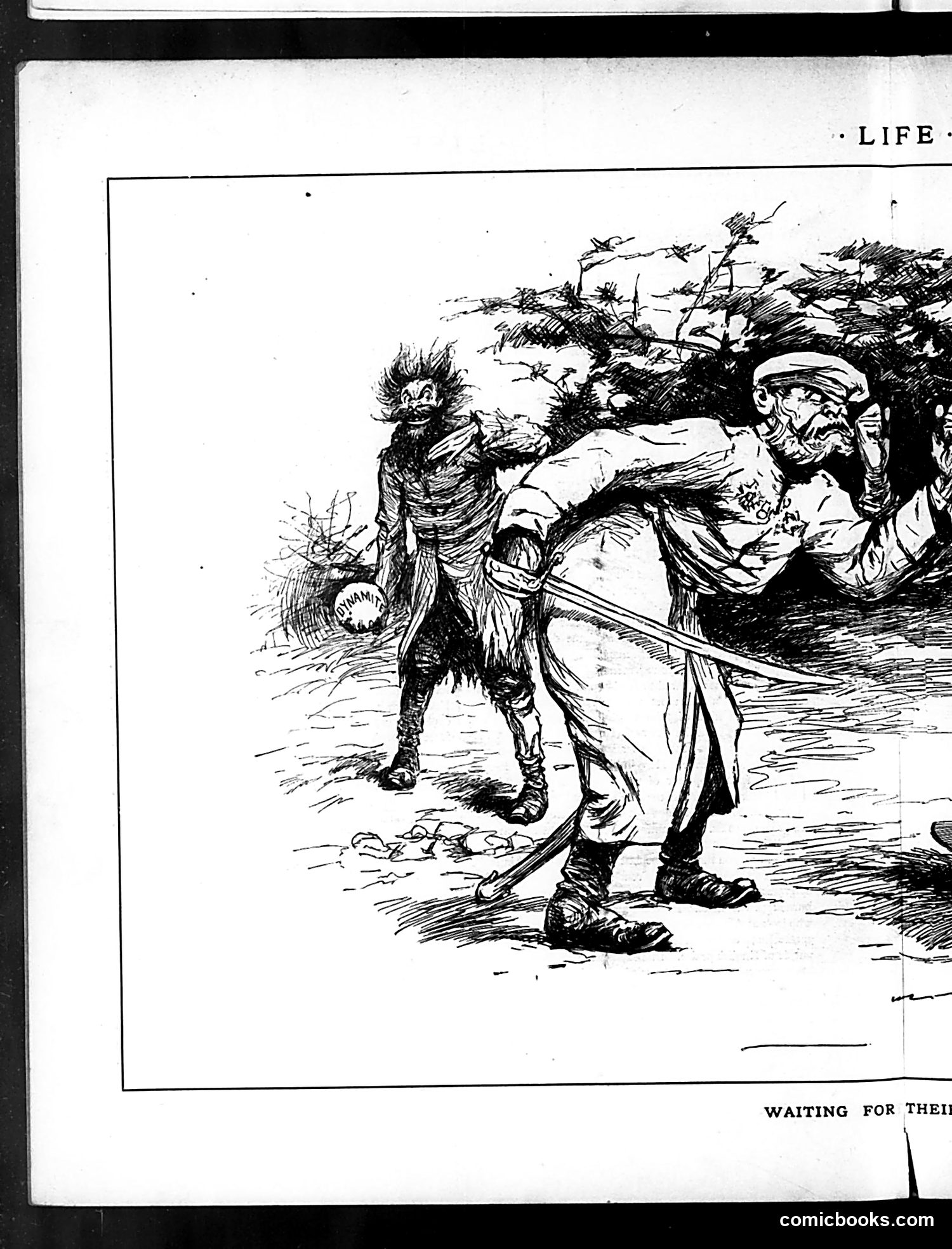
This appears to be a political cartoon from Life magazine depicting a scene titled "WAITING FOR THEIR" (caption cut off). The image shows several figures in what appears to be a coastal or waterfront setting with windswept vegetation. The central figure is a disheveled, wild-haired character holding what looks like a fishing rod or similar implement, rendered in exaggerated caricature style typical of early 20th-century satirical illustration. Other figures observe from the right side of the composition. Without the complete caption or accompanying article text, the specific political or social commentary cannot be definitively identified. The style and composition suggest social satire regarding waiting, patience, or anticipation for something unspecified—possibly related to government action, public relief, or social conditions of the era. The exaggerated characterizations and outdoor setting suggest commentary on working-class or marginalized populations.
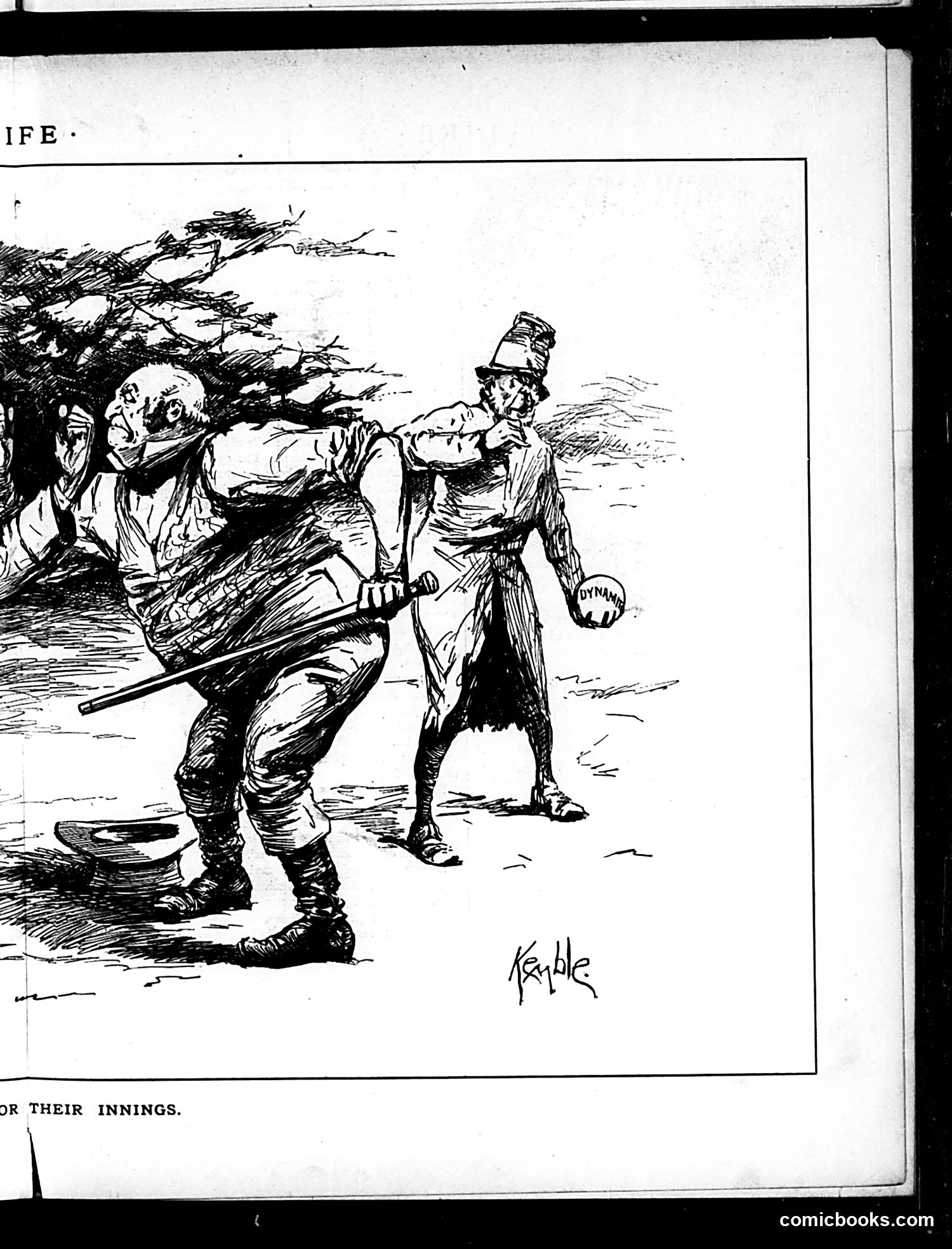
This cartoon depicts a confrontation between two figures: a soldier or military man on the left carrying a rifle, and a well-dressed gentleman on the right holding what appears to be a spherical object labeled "DYNAMITE." The caption reads "OR THEIR INNINGS," suggesting this relates to taking turns or opportunities in conflict. The cartoon appears to satirize tensions between military/governmental power (represented by the armed soldier) and anarchist or radical political movements (suggested by the dynamite-wielding figure). The "dynamite" label likely references late-19th/early-20th-century anarchist violence, a significant American concern during that era. The satire may critique either side—either the threat of radical violence or government overreach—though without additional context the specific political target remains unclear.
This page contains theater criticism and satirical fiction typical of *Life* magazine's entertainment coverage. **Theater Reviews:** The critics harshly pan several Broadway productions—"Mona" (lacking essential qualities), Minnie Palmer's "My Sweetheart" (dismissed as formulaic), and Solomon's comic opera "Polly" (called "rubbish" despite lavish production). Lilian Russell-Solomon-Braham, a famous opera singer, appears in "Polly"; the critic notes only Anglophilic "dupes" appreciate it. Positive mention goes to "Sealed Instructions" at Madison Square Theatre. **"Tempora Mutantur"** (Times Change): A mock-archaic poem lamenting that chivalric knights have been replaced by "fops," and love now yields to money ("Steele has given way to Golde"). **"The Rise of Silas Slap 'Em":** A serialized story by W.D. Howells satirizes Boston's rigid class hierarchy. Silas, born in the unfashionable South End, is permanently marked as uncultured regardless of merit—a pointed critique of Brahmin snobbery.
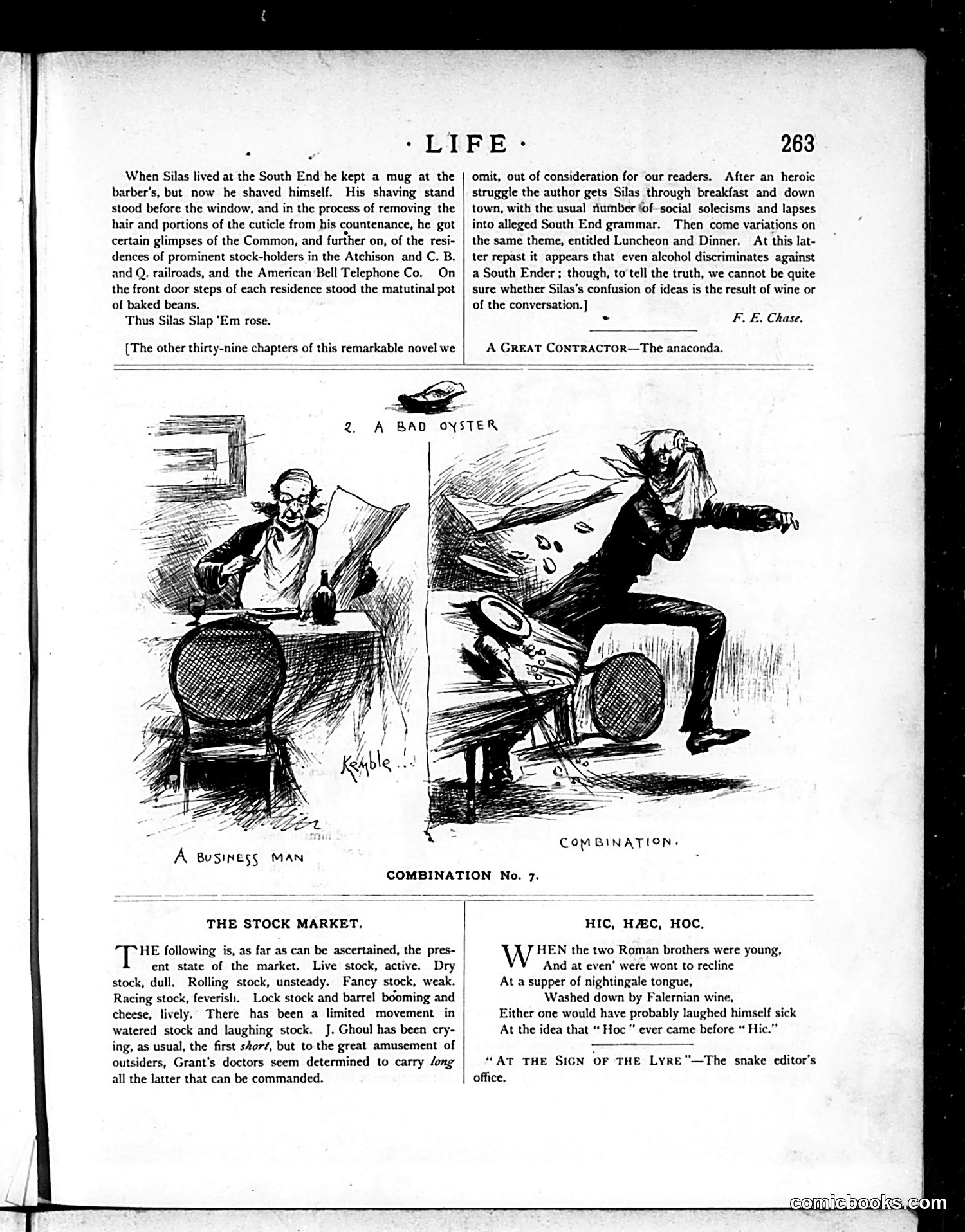
This page from *Life* magazine contains two distinct satirical pieces: **"Silas Slap 'Em Rose"** (top): A mock-heroic narrative mocking a man's social climb from South End (a working-class Boston neighborhood) to prominence. The satire targets his pretensions and poor grammar as he observes wealthy railroad and telephone company executives. The humor lies in his social awkwardness and the absurdity of tracking his mundane daily meals. **"Combination No. 7"** (bottom): Two cartoons depicting business stereotypes. "A Business Man" shows a scheming figure at a desk; "A Bad Oyster/Combination" shows him literally knocked back by consequences—satirizing corrupt businessmen getting comeuppance. The accompanying "Stock Market" column uses absurdist financial jargon (mixing real stocks with nonsense like "laughing stock") to mock market speculation and manipulation, apparently referencing Grant's administration and medical advisors attempting to control market movements. The tone is cynical about both social climbing and financial corruption.
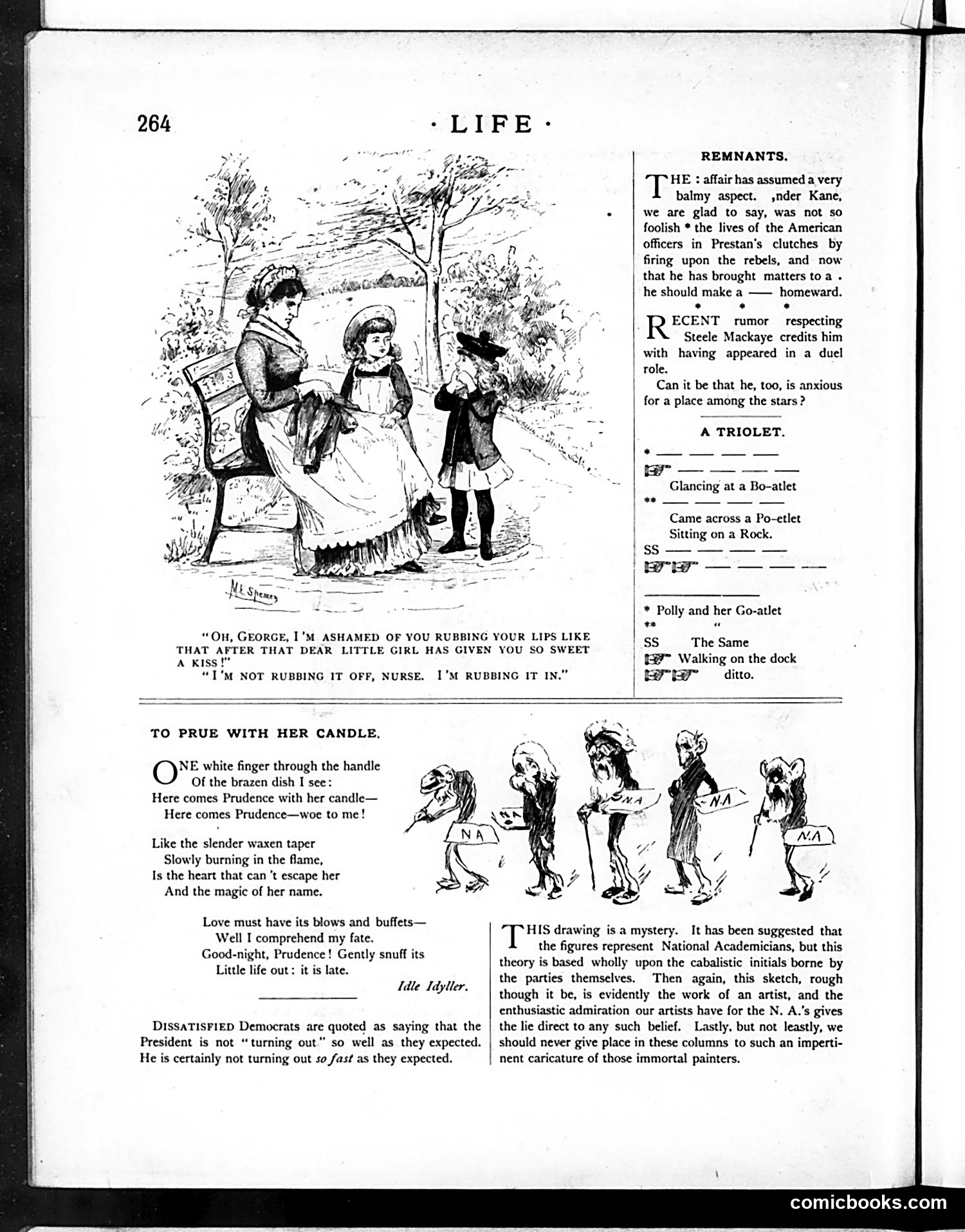
This page contains several satirical pieces typical of the era: **Top cartoon**: A nurse scolds "George" for rubbing off a kiss from a little girl, but he replies he's "rubbing it in"—a mild, flirtatious joke about savoring an innocent kiss. **"Remnants" section**: Brief political/social gossip, including a jab at General Kane's handling of American officers in "Prestan's clutches" (appears to reference a military incident), and gossip about actor Steele Mackaye's ambitions. **"A Triolet"**: A playful poetic form with clever rhyming about romantic encounters ("Bo-atlet," "Po-etlet"). **"To Prue with Her Candle"**: A romantic poem by "Idle Idyller" about unrequited love. **Bottom section**: A satirical drawing (described as "a mystery") mocking National Academicians—likely painters or artists—with the magazine claiming it cannot identify or properly lampoon them due to editorial standards. The page is primarily humorous, gossipy content rather than hard political satire.
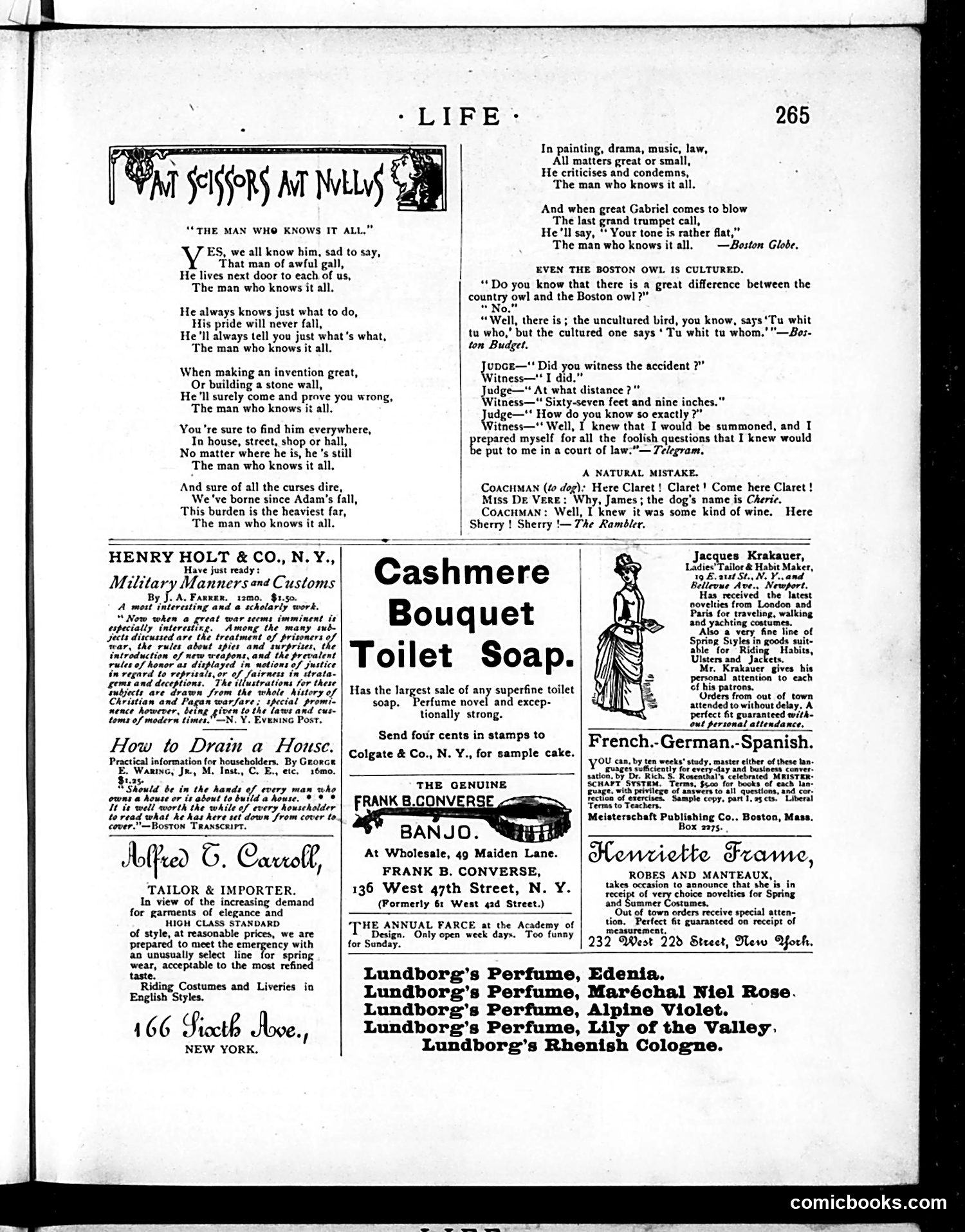
This page features a satirical poem attacking a universal social type: the know-it-all—the insufferable person who intrudes everywhere with unsolicited opinions and "corrections." The poem catalogs his irritating presence in homes, streets, shops, and professional fields (painting, drama, music, law), where he "criticises and condemns" all matters. The humor culminates in an absurdist image: even when Gabriel blows the final trumpet at Judgment Day, this man will criticize God's tone as "rather flat." The page includes related brief comedic pieces mocking similar pretensions: a Boston owl pronouncing "Tu whit tu whom" (grammar-correcting even bird calls), and a coachman calling his dog "Claret" when the owner insists the name is "Cherie"—all variants on social pomposity and miscommunication. The satire targets bourgeois self-importance and pedantry common in early 1900s American culture.
This page is primarily **advertising**, not political satire. It's from Life's 1883-1884 publication issues and consists almost entirely of commercial advertisements for luxury goods and services. The only editorial content is a brief satirical anecdote attributed to the "Deadwood Roarer" (a frontier newspaper). The joke mocks a newspaper editor who attends church for the first time and complains that while the preacher discusses the Egyptian army drowning in the Red Sea, nobody is reporting actual war news—he wants his competitor's scoop covered instead. The humor targets journalistic competition and the editor's singular focus on scoops over spiritual contemplation. The advertisements feature high-end retailers: tailors (Redfern, Pierre Frohlich, Cavanagh), whiskey, pens, cocoa, and mineral water—reflecting the wealthy readership Life cultivated during this Gilded Age period.
This is primarily an **advertising and announcements page** from Life magazine, not a satirical political cartoon page. The page features theater advertisements (Clara Morris, burlesque at Rice & Dixey's Opera House, the Lyceum Theatre), museum notices (Eden Musée displaying wax figures of U.S. Presidents and Irish patriots), and commercial ads (candy, charcoal tablets, sea salt, carpets, printing ink, toilet soaps). The only narrative content is "A Charming Story," a brief excerpt praising Helen Campbell's book *The What To Do Club*, which apparently addressed employment opportunities for women. There's also a humorous anecdote about a minister's tedious sermon, where a child asks "Mamma, were we all made of dust?" and responds the Creator couldn't make her father "stick"—mild domestic humor typical of the era. The page reflects late 19th-century commercial life and modest gender-discussion, but contains no political satire or caricature worthy of detailed historical analysis.
This page is **primarily advertising**, not satirical content. It's a collection of late 19th-century patent medicine and consumer product ads typical of Life magazine's revenue model. **Notable elements:** The ads promote dubious "cure-all" remedies common to the era—Crosby's Phosphites for nerves and brain power, Mellin's Food as a breast-milk substitute, Cuticura for skin conditions, and Warner's Tippecanoe bitters for stomach disorders. These products made sweeping medical claims with minimal regulation. One item stands out: **Warner's Tippecanoe** is labeled "The Campaign Token of 1840," referencing William Henry Harrison's "Tippecanoe and Tyler Too" presidential campaign. By the magazine's publication date, the brand had become a patent medicine trading on that historical name. The ads reflect period anxieties about health, nutrition, and appearance, while modern readers should note these products were largely ineffective and sometimes harmful—the FDA wouldn't regulate such claims until the 20th century.