
A complete issue · 16 pages · 1885
Life — January 15, 1885
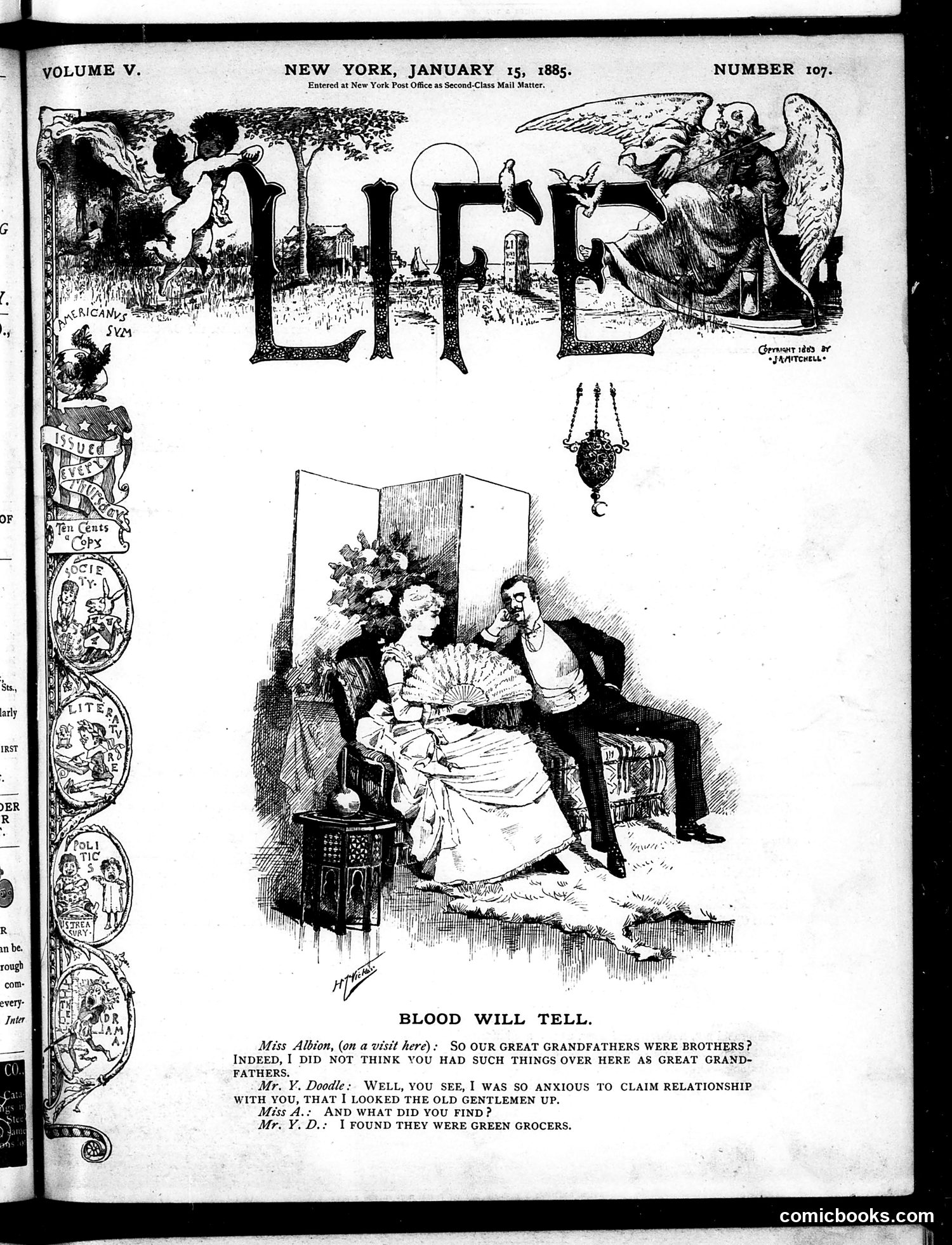
This satirical cartoon mocks the pretensions of American social climbers. Miss Albion (representing Britain) claims her "great grandfathers were brothers"—attempting to establish aristocratic kinship with an American family to elevate her social standing. The joke's punchline: Mr. V. Doodle investigated the family genealogy and discovered the alleged distinguished ancestors were merely "green grocers"—humble vegetable merchants, not nobility. The satire targets both the snobbish American desire to claim British aristocratic connections and the false genealogical claims such social-climbing visitors would make. "Blood will tell" (you cannot hide one's true origins) becomes ironic: the family's actual humble merchant background is exposed despite their pretensions.
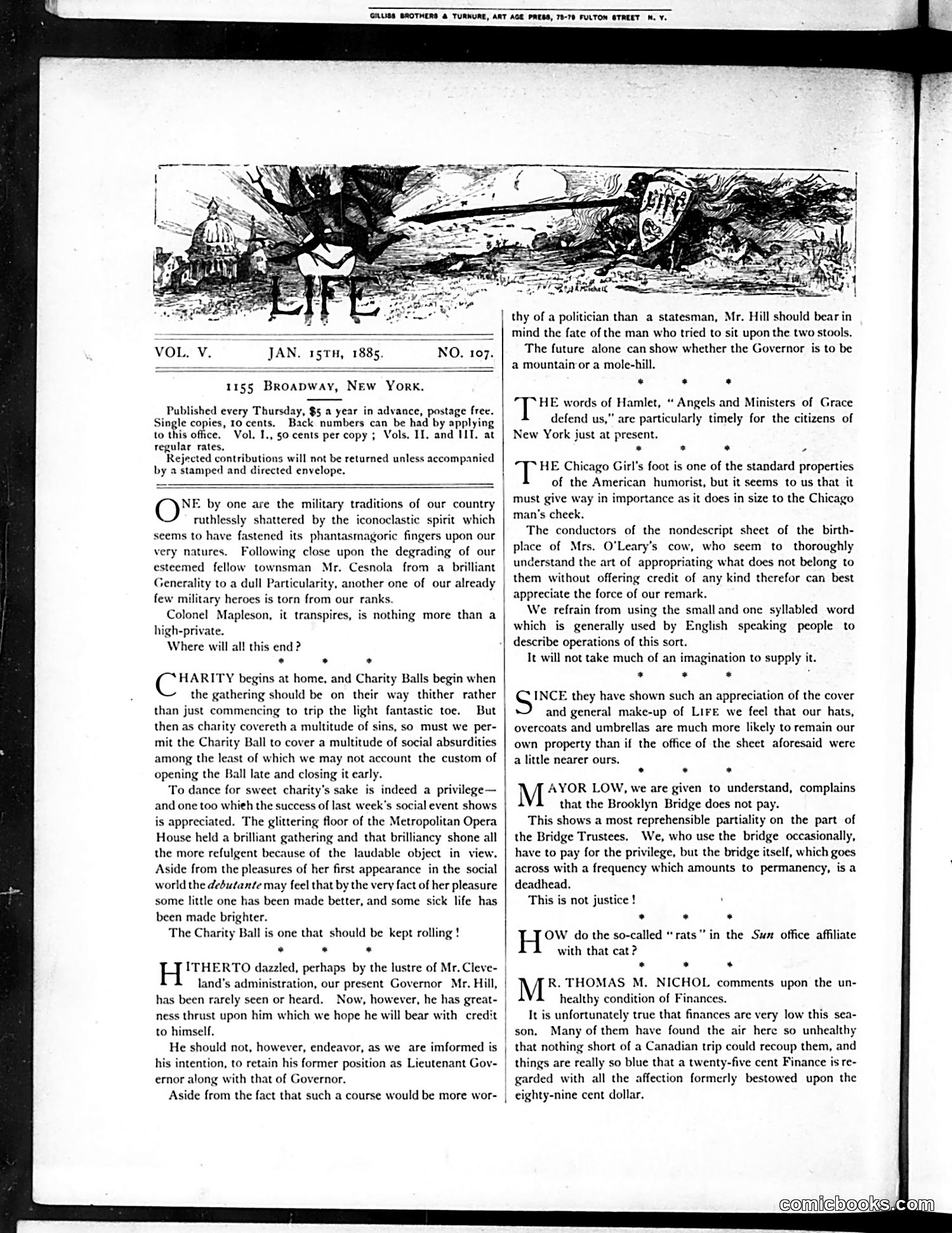
The masthead cartoon depicts "LIFE" as a allegorical figure surveying a landscape of destruction and death. This appears to be satirizing the destructive consequences of contemporary politics or social conditions. The text references Governor Hill of New York, suggesting he should abandon hopes of becoming Lieutenant Governor alongside the current Governor—a clear political jab at his ambitions. The piece warns that such a "course would be more worthy of a politician than a statesman." Other brief commentaries mock the "Chicago Girl's foot" (referencing a popular American humor trope), criticize Brooklyn Bridge tolls as unjust, and lament unhealthy public finances. The overall tone blends sharp political critique with social commentary typical of 1880s American satirical journalism, targeting specific New York political figures and local governance failures.
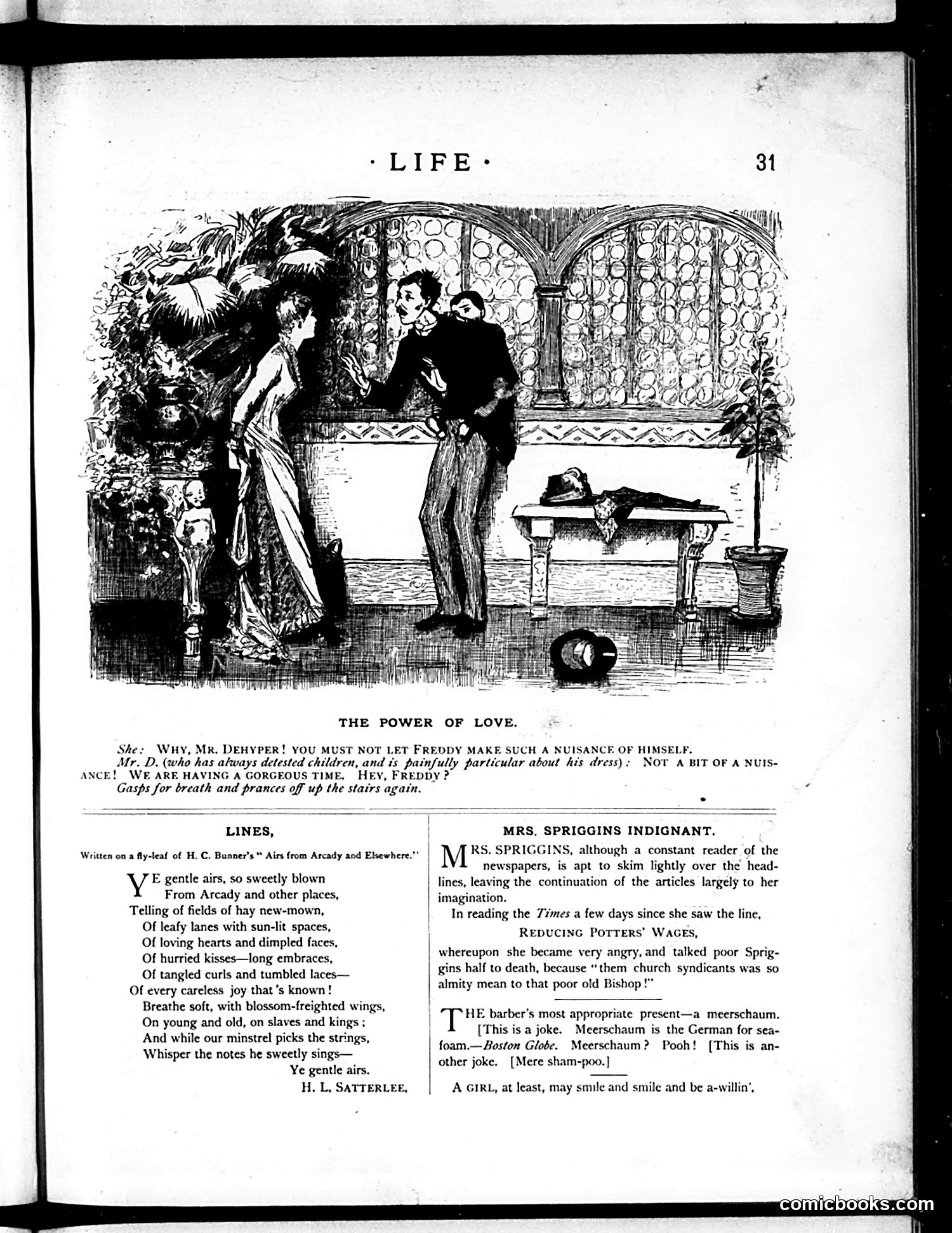
This cartoon satirizes domestic discord. A woman confronts Mr. Dehyper about "Freddy" making a nuisance of himself, while Mr. D. insists they're "having a gorgeous time." A man lies passed out on a bench with his hat fallen off, apparently drunk or unconscious. The satire targets marital tension: the wife objects to Freddy's disruptive behavior (implied drunkenness—"gasps for breath"), while the husband dismisses her complaints, prioritizing male camaraderie over domestic peace. The "power of love" title is ironic—suggesting that romantic attachment should resolve conflicts, but instead the husband's loyalty to his friend Freddy undermines marital harmony. The joke reflects period anxieties about alcohol and masculine socializing conflicting with respectable family life.
This page contains satirical commentary rather than political cartoons. The "By the Way" column offers brief, witty observations on contemporary figures and events: - **Worth's fashion wraps** are mocked for creating a deceptively slender silhouette - **Pope Leo XIII** is humorously described as superstitious about the number 13 at dinner - A **fashion writer's lament** about lacking new stocking innovations - **Dr. Sundstrom** (likely a Stockholm physician) is credited with observations about eider ducks and summer travel patterns - **Colonel Oliver Payne** is noted as ambitious for political appointment The right column features "Pocket Biographies" of contemporary notable figures including Thomas DeWitt Talmage, Henry James, and Charles A. Dana, with brief, often satirical biographical sketches highlighting their quirks and public personas.
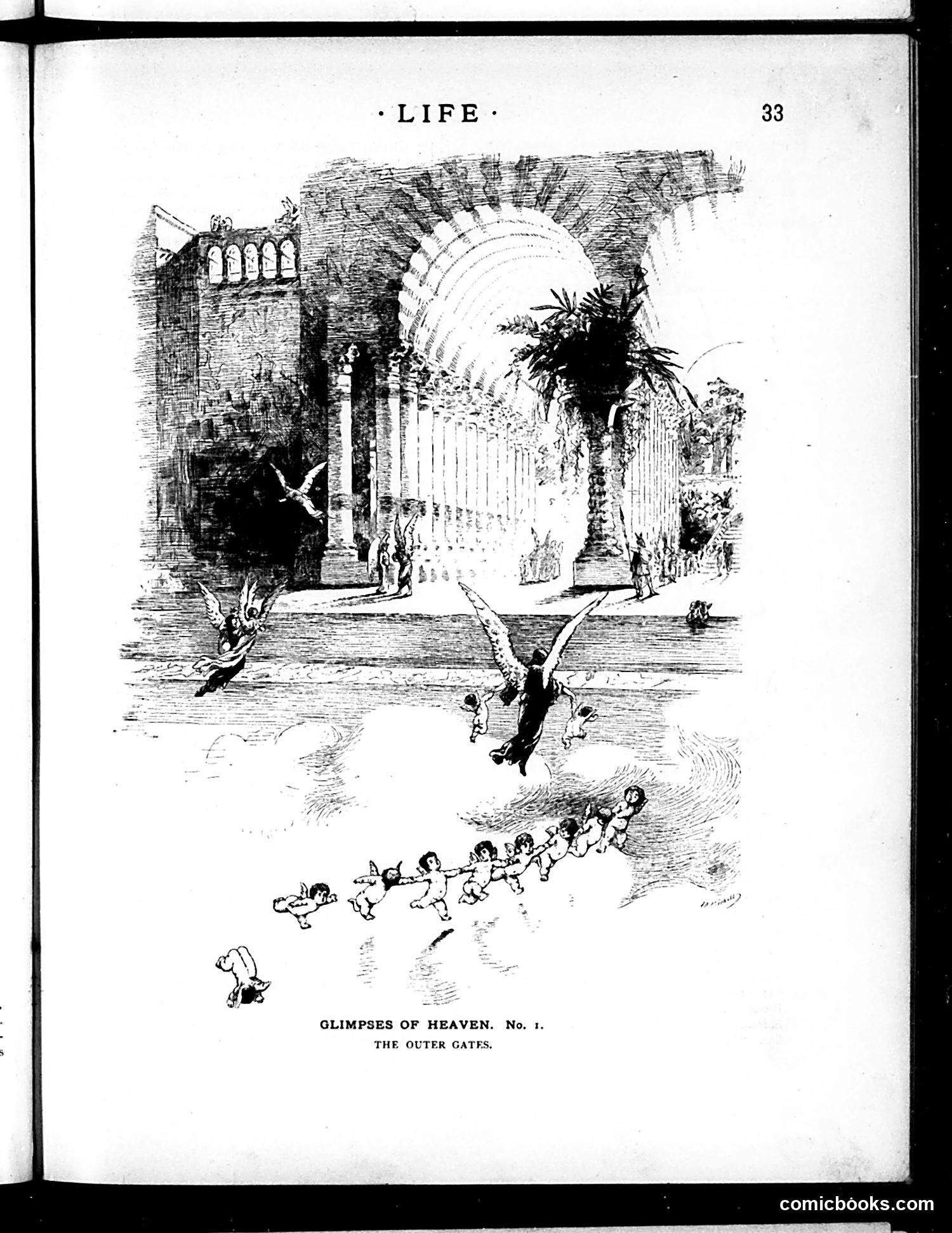
This satirical illustration depicts cherubs and children approaching the gates of heaven through an ornate classical archway. The imagery appears to be social commentary using religious imagery as metaphor. The cartoon likely satirizes concepts of heaven, salvation, or spiritual worthiness through a humorous lens. The inclusion of various cherubic figures—some appearing more refined than others—may comment on how different social classes or types of people view or access heaven/salvation. The architectural setting (classical columns and gates) suggests a hierarchical system of entry. The cherubs' varied appearances and positions could represent social commentary about who is considered "worthy" of heavenly reward, though the specific satirical target—whether about class, morality, or religion itself—remains unclear without additional historical context from Life magazine's specific publication date.
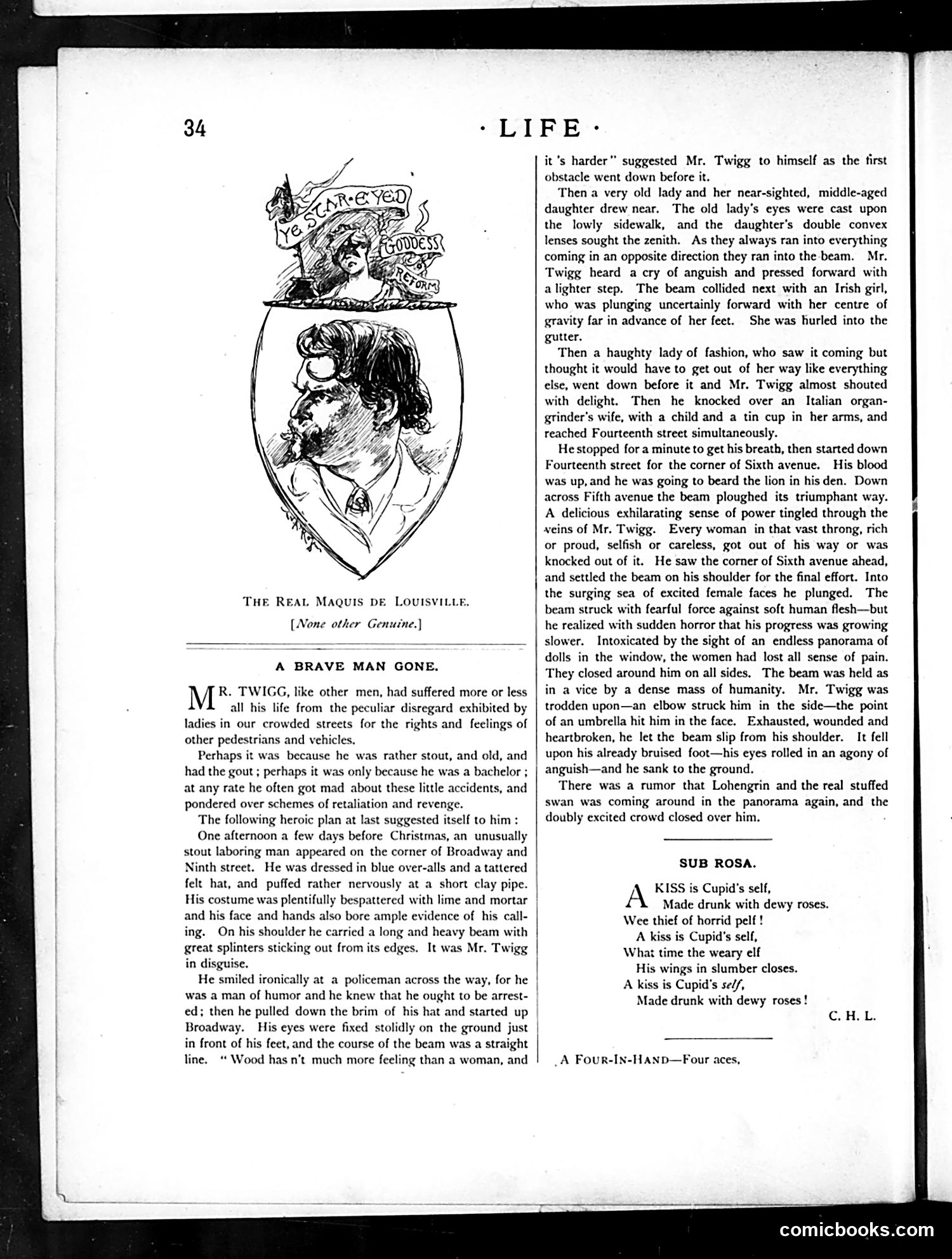
The cartoon depicts a rotund man carrying a beam that's destroying everything in its path—a visual metaphor for oblivious carelessness. The caption "The Real Marquis de Louisville" and subtitle "[None other Genuine.]" suggest satirizing someone claiming false aristocratic status or pretension. The accompanying story "A Brave Man Gone" describes Mr. Twigg, a stout laborer, navigating New York streets with his beam, inadvertently knocking over pedestrians, vendors, and even an Italian organ-grinder's family. The satire targets his blissful unawareness of the chaos he causes—he feels empowered while countless people suffer collateral damage. This appears to mock either urban carelessness, oblivious privilege, or possibly a specific public figure's destructive incompetence, though the exact reference remains unclear without additional historical context.
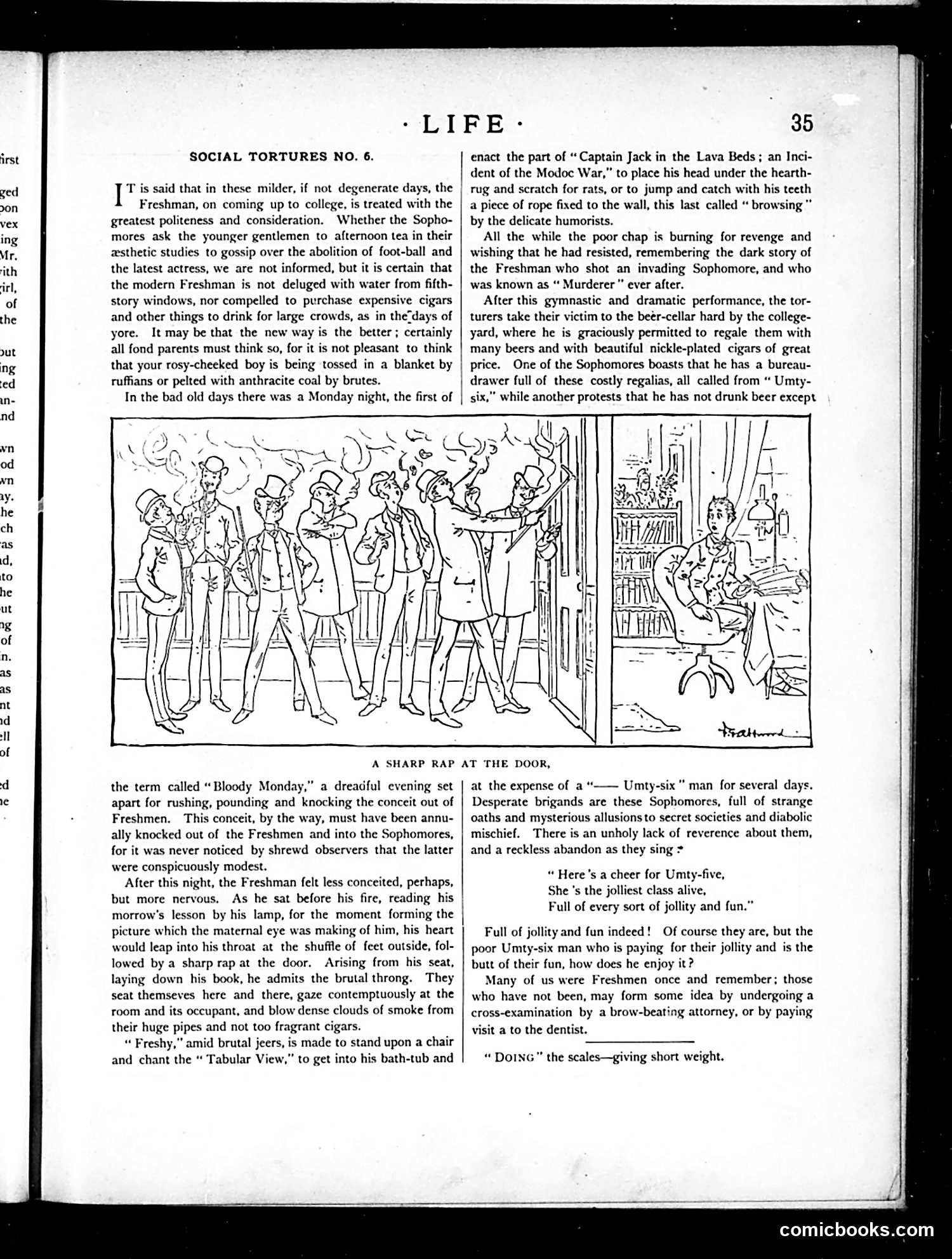
This page satirizes college hazing practices, specifically targeting the mistreatment of freshman students. The cartoon titled "A Sharp Rap at the Door" depicts upperclassmen subjecting a freshman to brutal initiation rituals. The text describes "Bloody Monday"—a hazing tradition where freshmen faced physical abuse, public humiliation, and forced participation in degrading acts. The satire highlights the hypocrisy: despite the brutality, the perpetrators claim freshness and innocence, boasting of "jollity and fun." The piece ridicules both the hazing culture and the modest facade upperclassmen maintained publicly while committing these abuses. It presents hazing as organized torture disguised as collegiate tradition, mocking the disconnect between the violence inflicted and the perpetrators' self-image as respectable gentlemen.
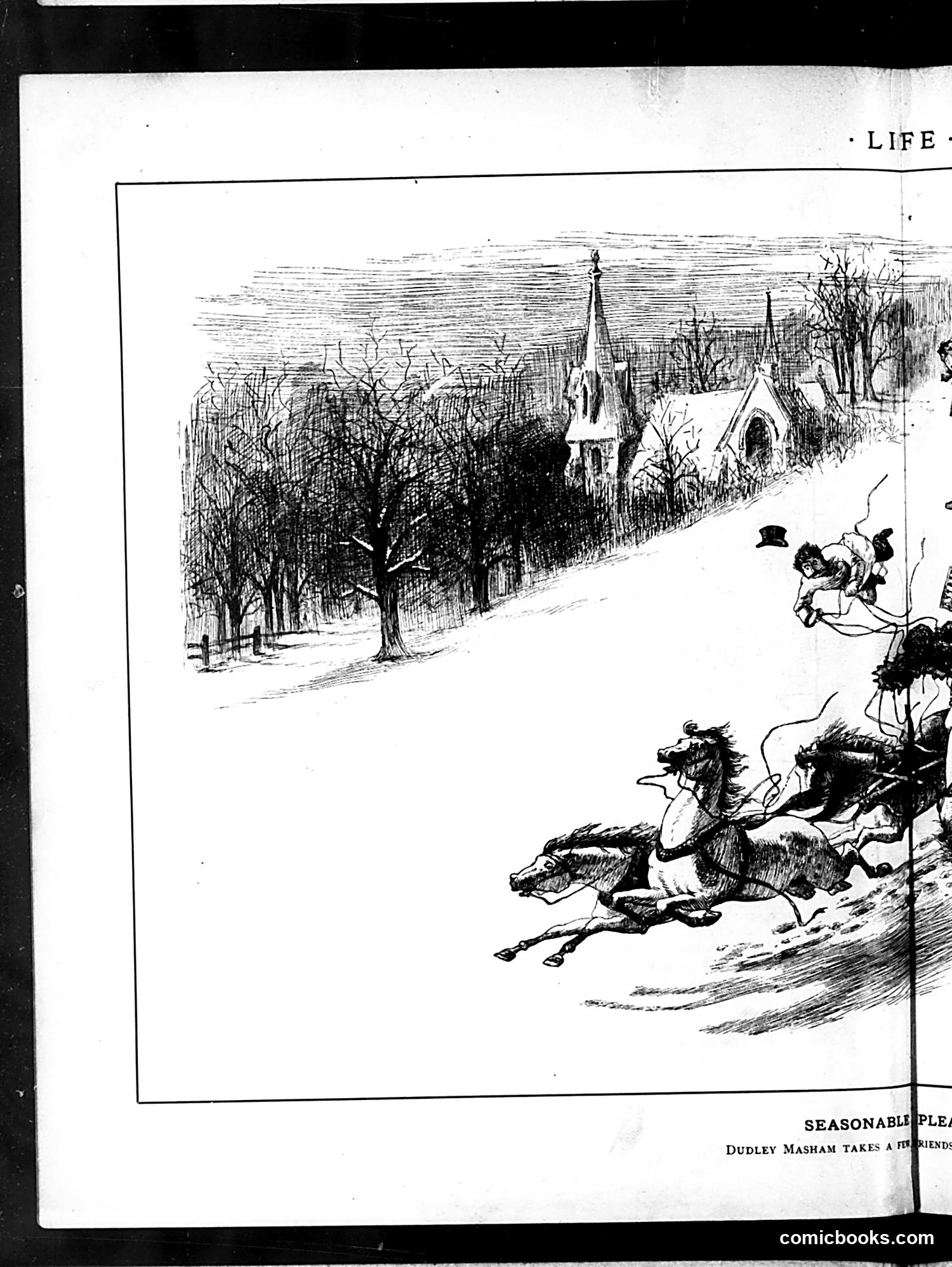
This illustration depicts a fox hunting scene titled "Dudley Masham Takes a Fence." The image shows mounted riders on horseback jumping over an obstacle while pursuing foxes across a snowy landscape. In the background stands a church with a steeple, suggesting an English countryside setting. The caption credits "Dudley Masham," likely a real person known for fox hunting activities. This appears to be a straightforward sporting illustration rather than political satire—Life magazine frequently featured such scenes celebrating upper-class leisure activities. The sketch style and winter setting emphasize the vigor and tradition of fox hunting, a pastime associated with British aristocracy and American gentry. Without additional context, this seems celebratory rather than satirical commentary.
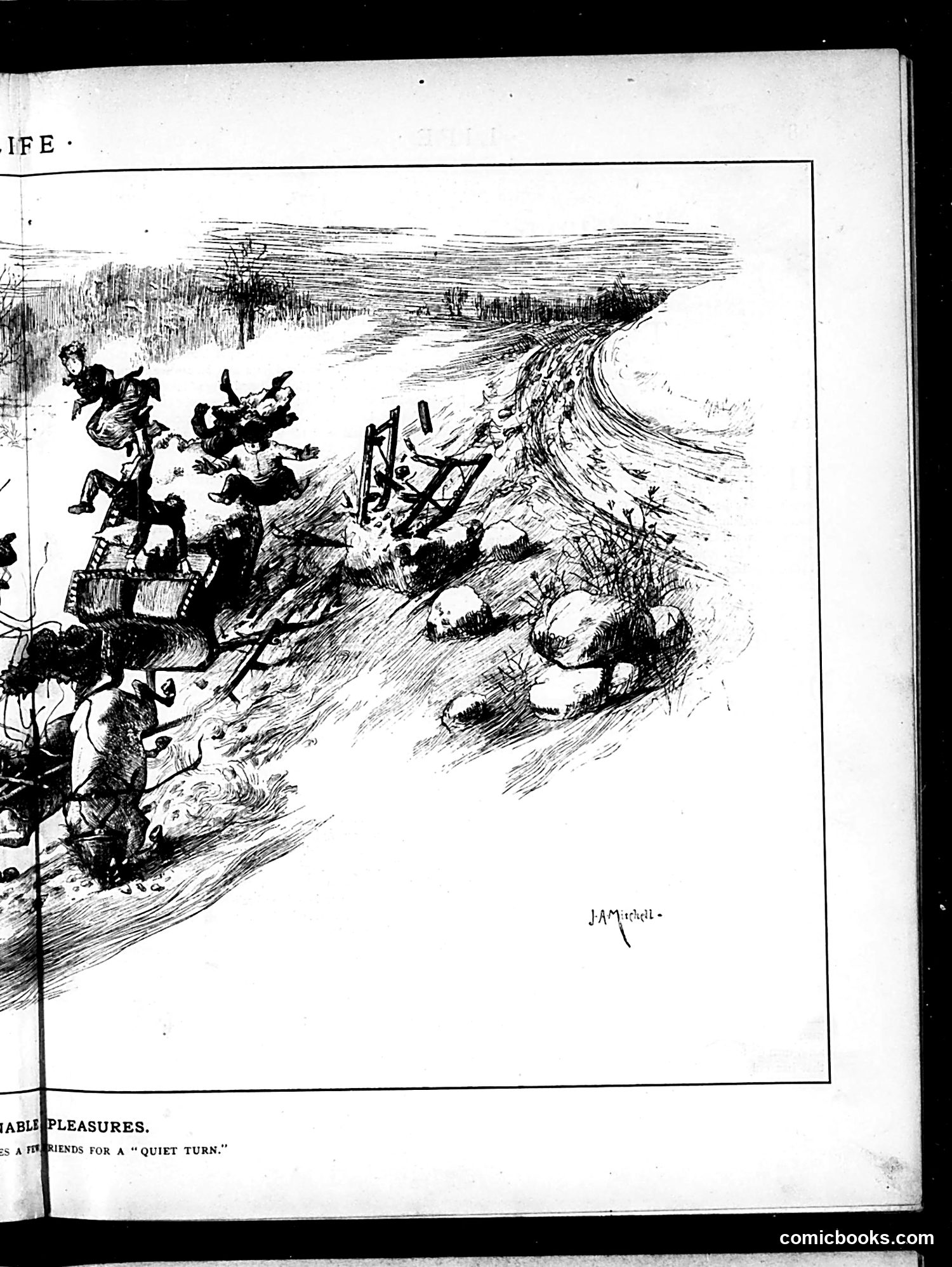
This appears to be a satirical cartoon from *Life* magazine depicting a sledding accident or mishap. The illustration shows several figures tumbling down a snowy slope, with a sled overturned and people scattered about. The caption references "TABLE PLEASURES" and mentions friends enjoying "a quiet turn," suggesting the satire is about recreational winter activities gone wrong. The artist's signature reads "JAM[something]" (unclear). Without additional context or a visible date, I cannot identify the specific political or social reference this cartoon makes. The humor appears to be situational—depicting the chaos and physical comedy of an accident—rather than commentary on a particular historical event or figure. The precise satirical point remains unclear from the image alone.
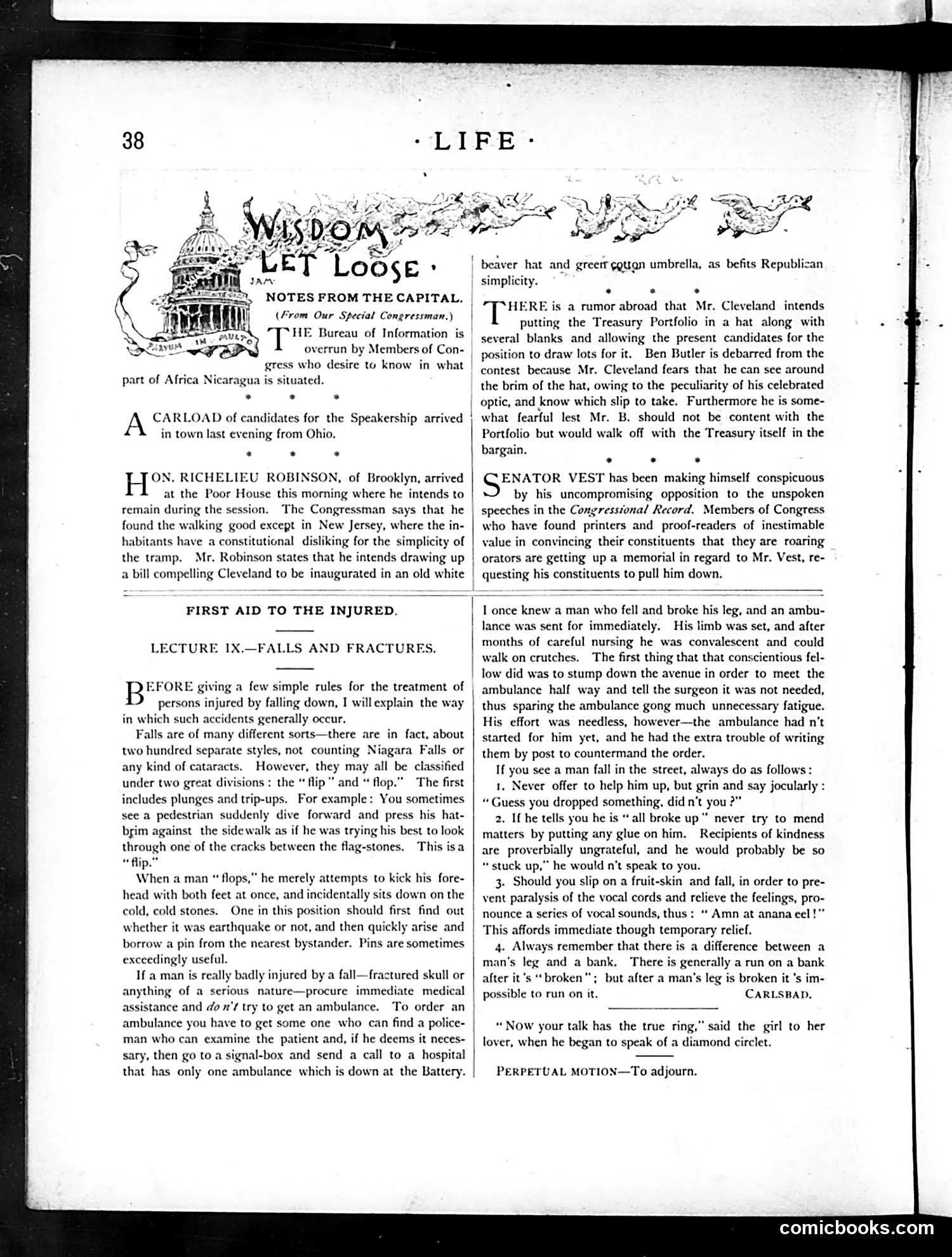
This page contains three distinct satirical pieces targeting American politics circa the Cleveland administration: **"Notes from the Capital"** mocks Congressional ignorance (members don't know where Nicaragua is), criticizes the Speakership race, and ridicules Hon. Richelieu Robinson of Brooklyn for his vagabond lifestyle—suggesting he "intends drawing up a bill compelling Cleveland to be inaugurated in an old white beaver hat," satirizing Republican demands for simplicity over dignity. **The Treasury Portfolio rumor** lampoons President Cleveland's supposed plan to randomly select a Treasury Secretary by lottery, excluding General Ben Butler (known for his prominent eye) lest he "see around the brim" and steal the Treasury itself. **Senator Vest's opposition** targets his criticism of congressmen fabricating speeches in the *Congressional Record*—a practice members exploited to appear eloquent to constituents without actually speaking. The "First Aid" lecture appears to be unrelated humor about falls and fractures, possibly satirizing medical advice manuals of the era.
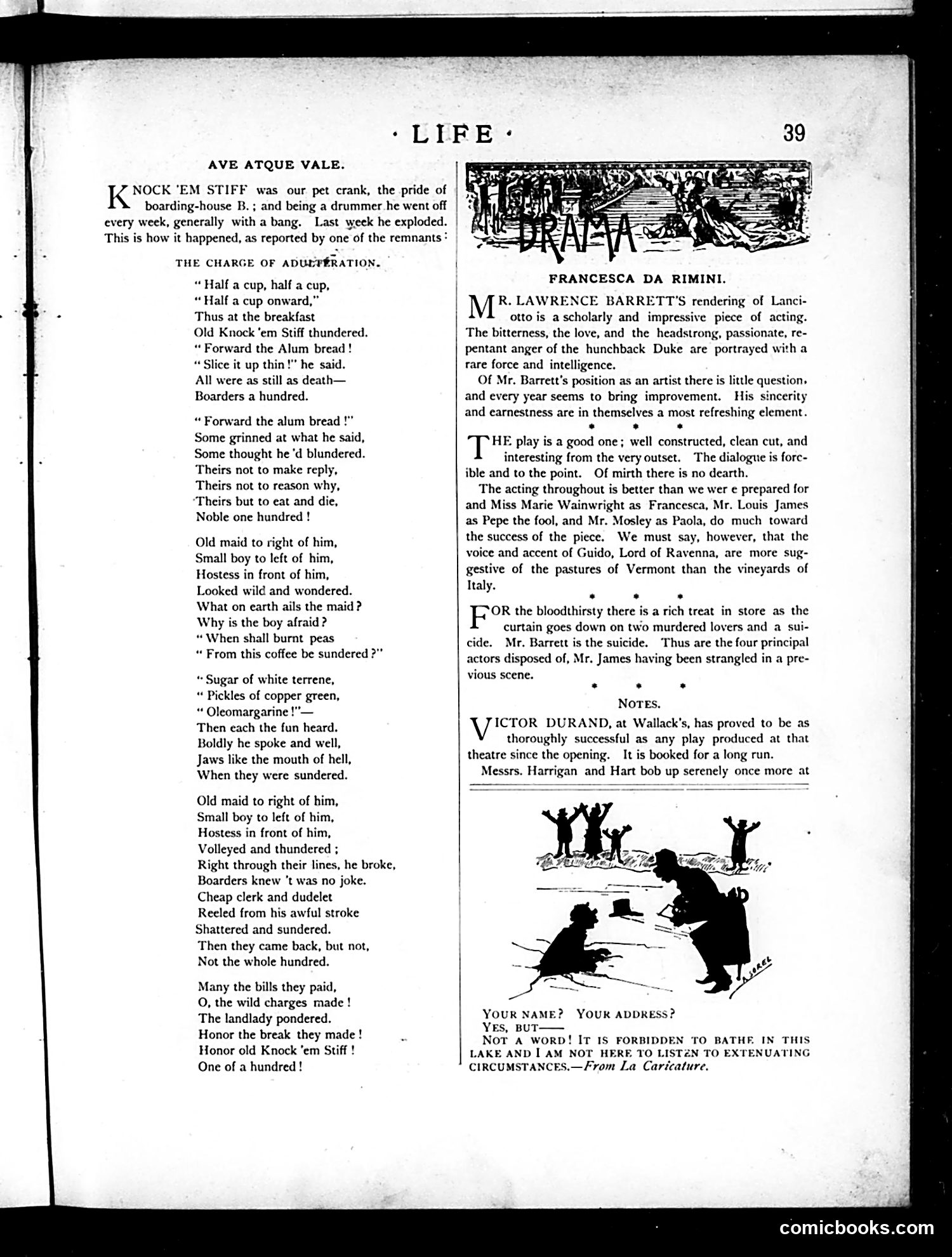
This page contains two distinct pieces: **Left side — "The Charge of Adulteration":** A humorous poem parodying Tennyson's famous war poem "The Charge of the Light Brigade." It describes a boarding-house character called "Knock 'em Stiff," a traveling salesman, who loudly demands inedible breakfast items—alum bread, burnt peas, oleomargarine, and suspicious coffee. The joke satirizes cheap boarding-house food quality and the character's dramatic, outrageous complaints about adulteration (food mixed with inferior ingredients). The boarding-house residents flee in terror from his rants. **Right side — Theater reviews:** Professional assessments of contemporary stage productions, including praise for actor Lawrence Barrett's performance in "Francesca da Rimini" and notes on other plays at Wallack's theater. **Bottom cartoon:** A simple illustration about discretion, showing someone being warned not to discuss compromising circumstances. The page reflects late-19th-century American concerns about food fraud and boarding-house conditions, popular entertainment, and social propriety.
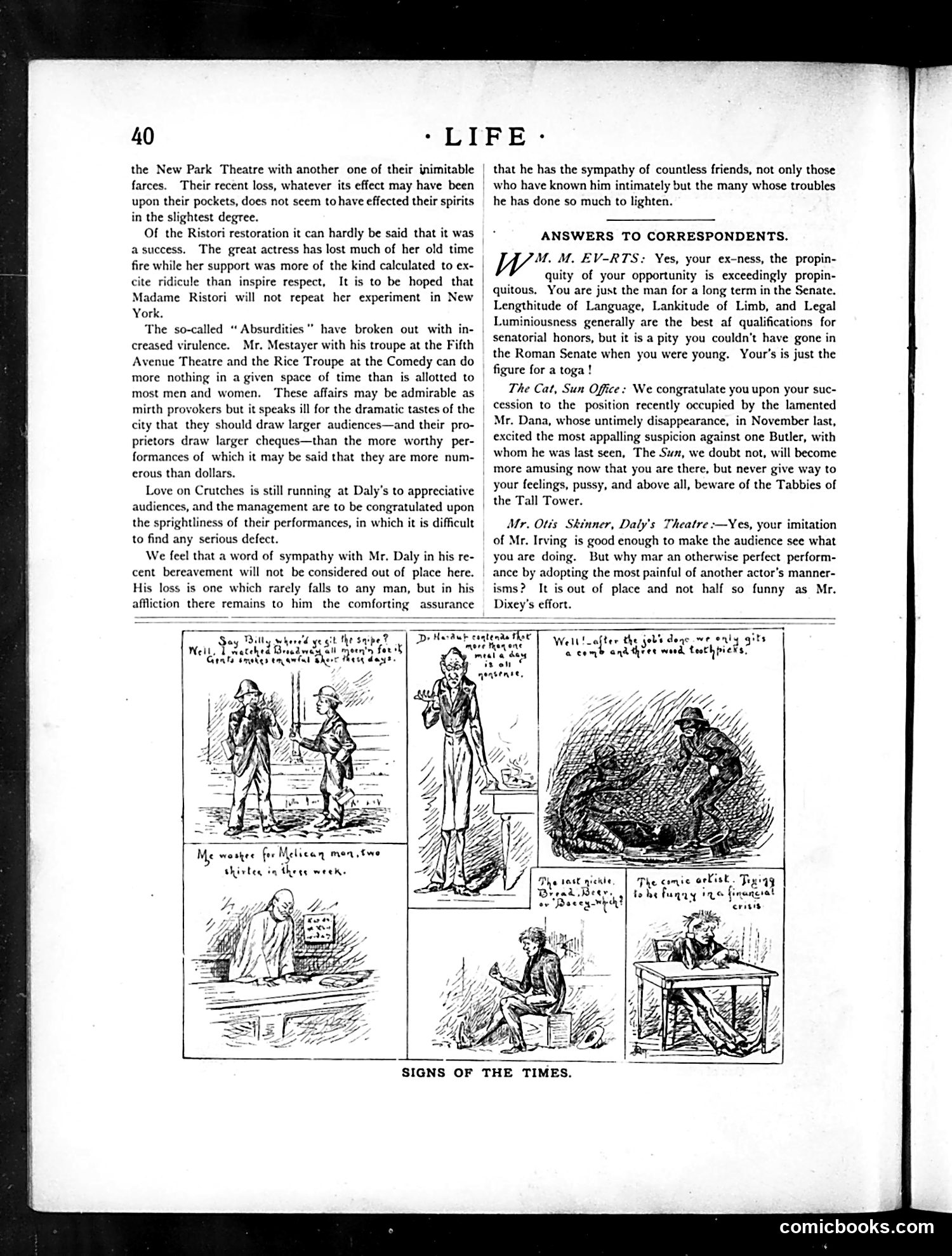
This page features a series of six sketch-cartoons titled "Signs of the Times," satirizing contemporary social observations through exaggerated scenarios. While specific individuals aren't identified in captions, the cartoons appear to mock various urban types and behaviors: a man confronting another about etiquette or debts; a tall, thin gentleman (possibly mocking affected fashion); someone dealing with financial troubles or domestic chaos; a crocodile or alligator encounter (likely absurdist humor); a figure in distress; and someone hunched at a desk, possibly depicting overwork or desperation. The humor relies on visual exaggeration and physical comedy typical of Victorian-era satire. The accompanying text discusses theatrical productions and contains mock "answers to correspondents" with wordplay and satirical commentary on public figures (appearing to reference William M. Evarts and theatrical personalities), but the cartoons themselves present generalized social commentary rather than specific political targets.
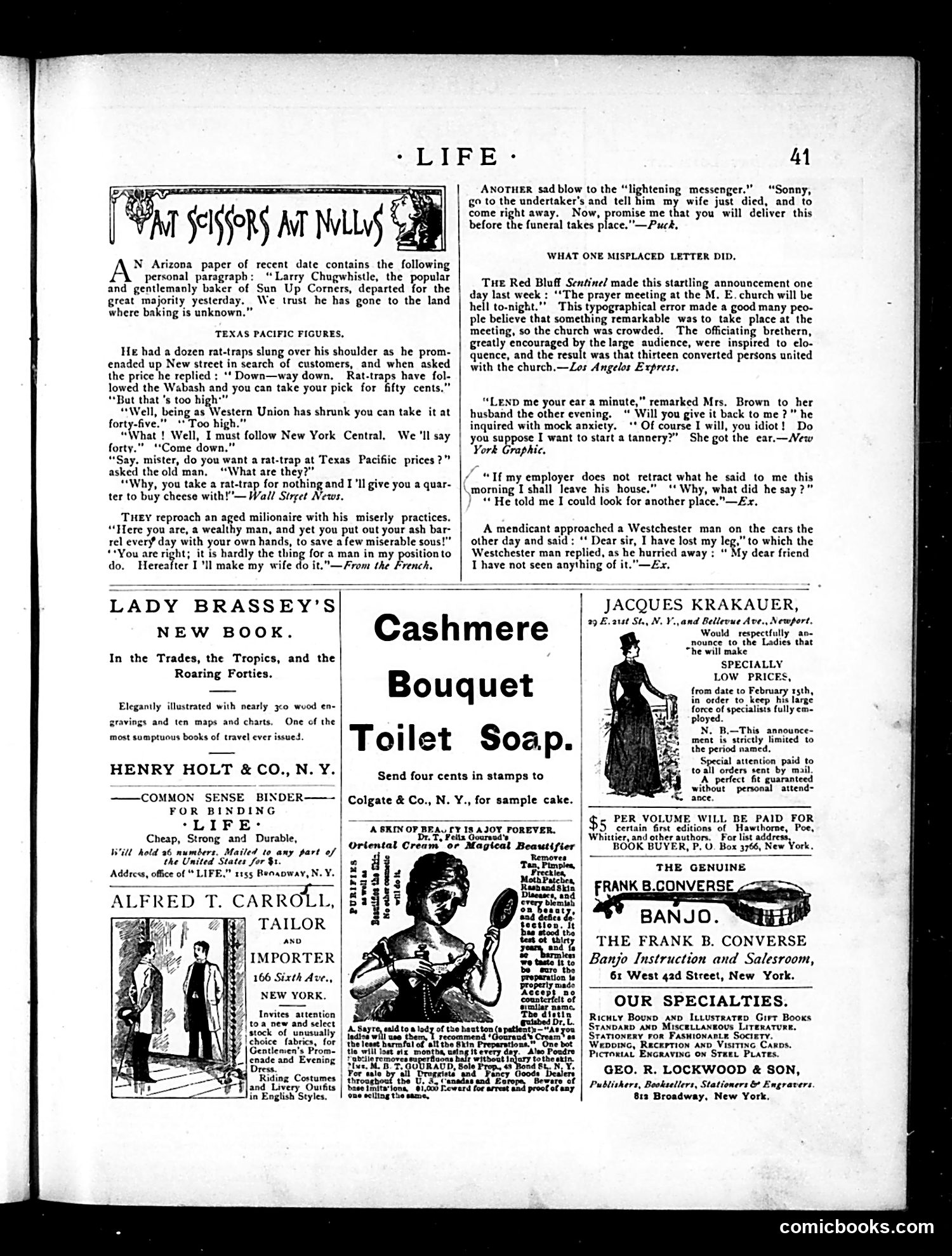
This page is primarily **advertisements and humorous anecdotes** rather than political cartoons. The visual elements—"Scissors at Nulls" (top) and a woman's portrait for beauty products—are minimal. The humor pieces mock contemporary events and absurdities: - **Arizona baker's obituary**: Satirizes newspaper notices and frontier life - **Texas Pacific Figures**: A joke about railroad stock prices (the Wabash and New York Central had recently failed), using a rat-trap vendor's declining prices as metaphor for market collapse - **Prayer meeting typo**: A real incident where "hell" instead of "held" drew crowds—satirizing both newspaper errors and public gullibility - **Miserliness anecdote**: Social satire about wealthy men's stinginess - **Mendicant's lost leg**: Dark humor about vagrancy and indifference The advertisements promote books, tailoring services, binders, and beauty soap—reflecting late-19th-century consumer culture. The page demonstrates *Life*'s formula: satirical jabs at economics, social behavior, and human folly, mixed with commercial messaging.
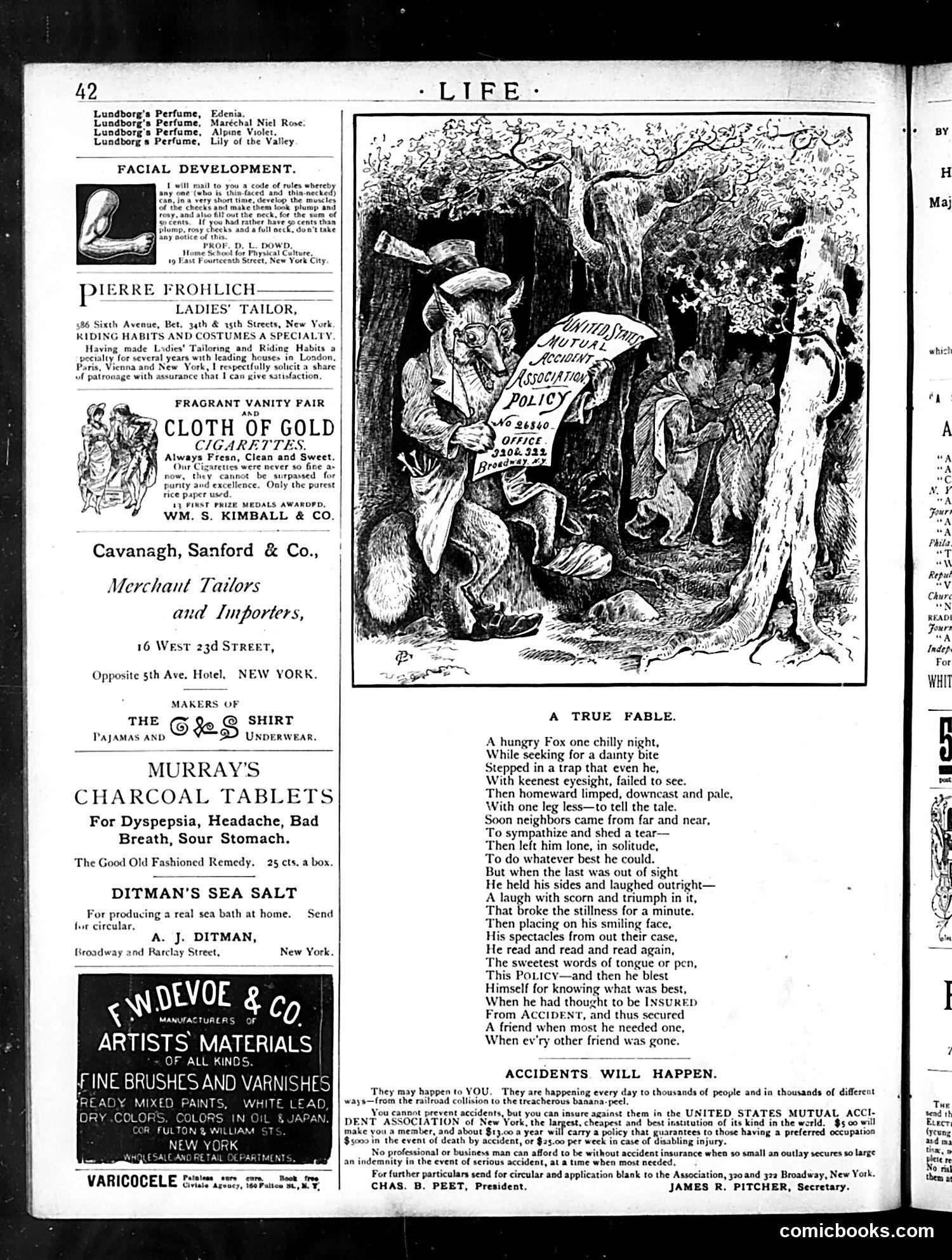
This page features a moral fable illustrated with a satirical cartoon promoting accident insurance. The image depicts a fox who stepped in a trap, lost a leg, but then celebrates after discovering he had purchased an accident insurance policy. The cartoon's message is a direct advertisement for the United States Mutual Accident Dent Association. The fox represents any person who might suffer an accident and initially despair—but the "policy" becomes his salvation. The fable emphasizes that while accidents are inevitable ("they may happen to YOU"), insurance provides crucial financial protection when other support disappears. The satire is gentle and self-aware: the fox's initial misfortune becomes fortunate because of foresight. The accompanying text reinforces this by listing accident statistics and promoting affordable membership ($5 initial fee, ~$13 annually for substantial coverage). The page is primarily commercial, mixing this moral tale with period advertisements for tailors, perfumes, and remedies. The insurance pitch dominates the content, framing accident protection as essential middle-class prudence.
This page is **primarily advertising and literary notices**, not political satire. The bulk consists of commercial advertisements for luxury goods (Redfern Ladies' Tailor, Baker's Breakfast Cocoa, printing ink) interspersed with book reviews and comic anecdotes. The humor appears in brief satirical **one-liners** rather than cartoons: - A joke about Western burial customs equating death to "real estate business" - Mockery of a Cincinnati girl losing a gold tooth filling (conflating vanity with carelessness) - Skepticism toward a St. Louis boy's world travels at age 15 - A children's Sunday school joke where pupils define faith as "peanuts" (the kernel inside the shell) These reflect typical **19th-century American periodical humor**: gentle social observation, regional stereotypes, and wordplay targeting vanity and pretension. The page demonstrates how Life magazine balanced serious literary content with light satirical commentary aimed at middle-class readers.
This page is primarily **advertising**, not satire or political commentary. It's a typical late-19th-century magazine advertisement section from January 1885. The only illustration with potential satirical content is a small **profile sketch labeled "Disfiguring Humors"**—showing a person's face afflicted with skin conditions. This accompanies an advertisement for Cuticura products (blood purifier, skin cream, and soap), which promised to cure various dermatological complaints. The imagery is sensationalized to motivate purchase, not to mock a specific political figure or event. The page otherwise contains straightforward commercial advertisements for pianos, carriages, diamonds, theatrical performances (including burlesque shows featuring Henry E. Dixey), champagne, bicycles, and medicines—typical merchandise marketed to affluent late-Victorian readers. There is no discernible political satire or cartoon commentary here.