
A complete issue · 16 pages · 1885
Life — January 1, 1885
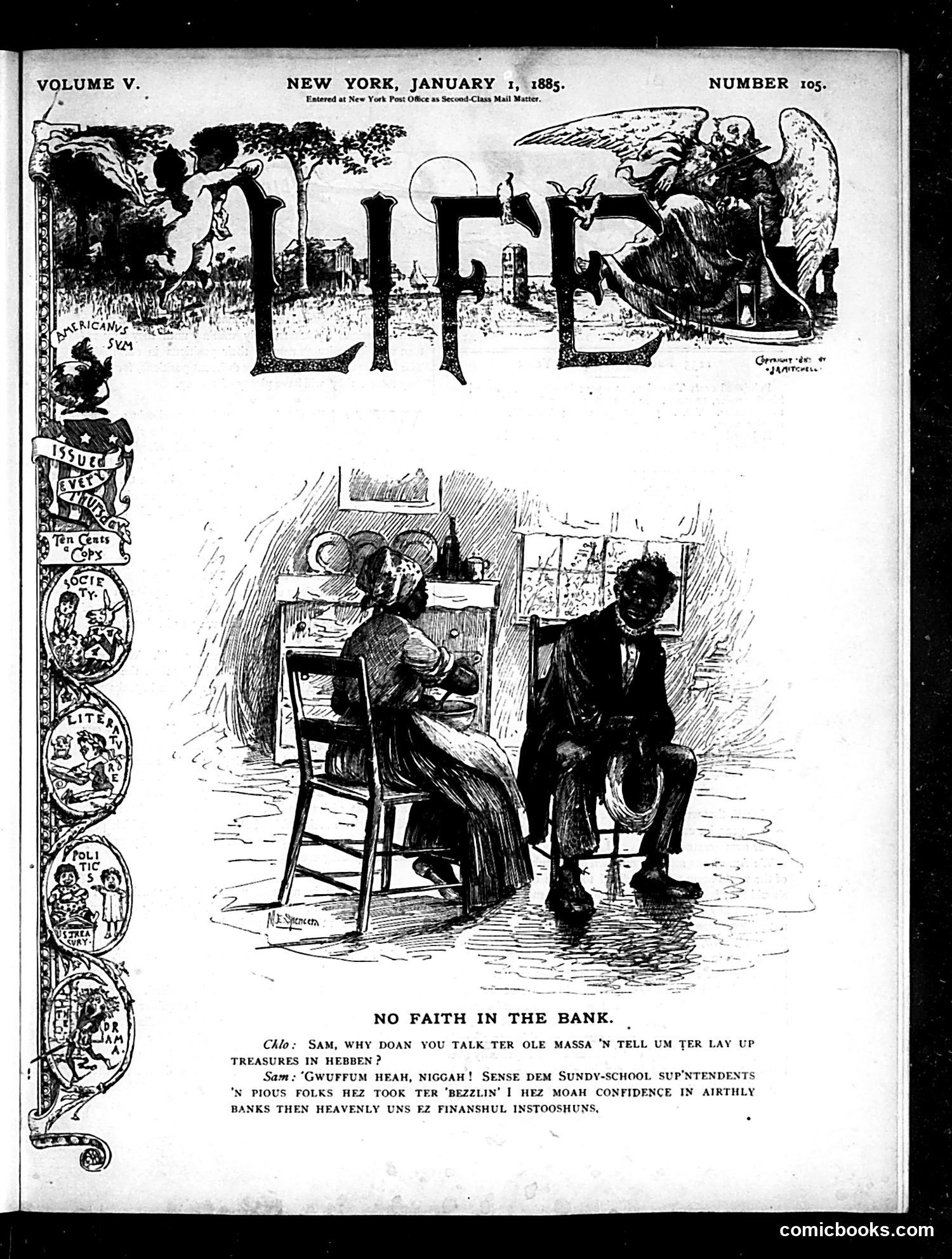
This cartoon satirizes African American distrust of banks following the Freedmen's Bank collapse (1874), which devastated Black depositors who lost their savings. The scene shows two Black men in conversation about financial institutions. The dialogue uses period dialect to convey their skepticism: one warns against trusting banks with money, suggesting Sunday school superintendents and "pious folks" who promoted banking have lost confidence in financial institutions themselves. The satire targets the irony that respectable community leaders encouraged Black families to deposit savings in banks that ultimately failed them. The cartoon reflects genuine economic anxiety in Black communities about financial security and institutional reliability during the Reconstruction era's aftermath.
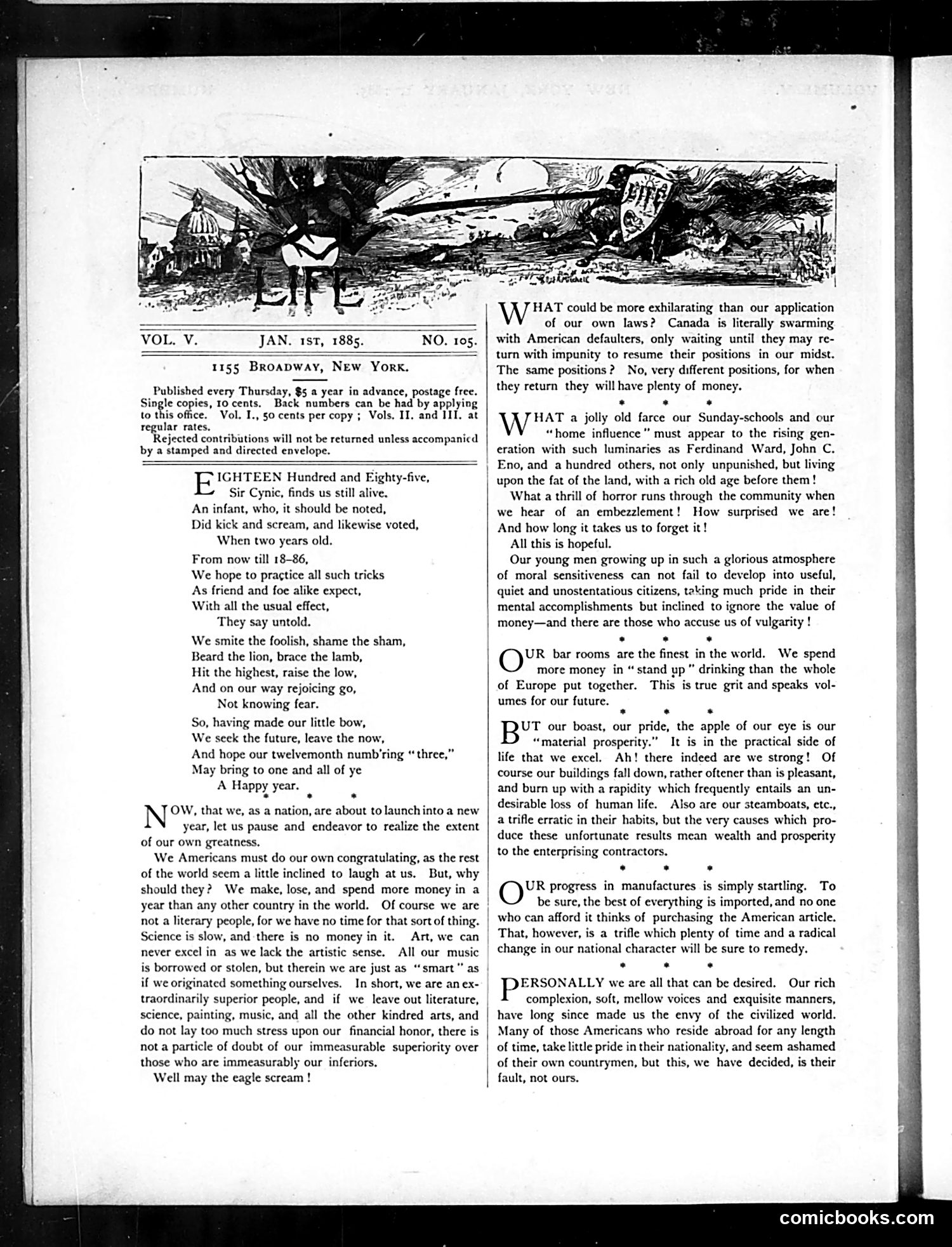
The masthead illustration shows a skeletal Death figure operating a printing press, symbolizing the magazine's satirical power to critique society. The editorial content criticizes American materialism and cultural pretension. The text mocks wealthy Americans who spend excessively on "stand up" drinking in bars while claiming cultural superiority, and attacks the obsession with "material prosperity" over moral development. The piece particularly targets the vanity of American industrialists and wealthy citizens who, despite their financial success, lack genuine artistic or intellectual accomplishment compared to European culture. The satire suggests Americans shamefully imitate foreign refinement while their own young people grow up valuing only money, not ethics or learning. This reflects Gilded Age anxiety about rapid industrialization, immigration, and whether American society was becoming morally corrupt through unchecked capitalism.
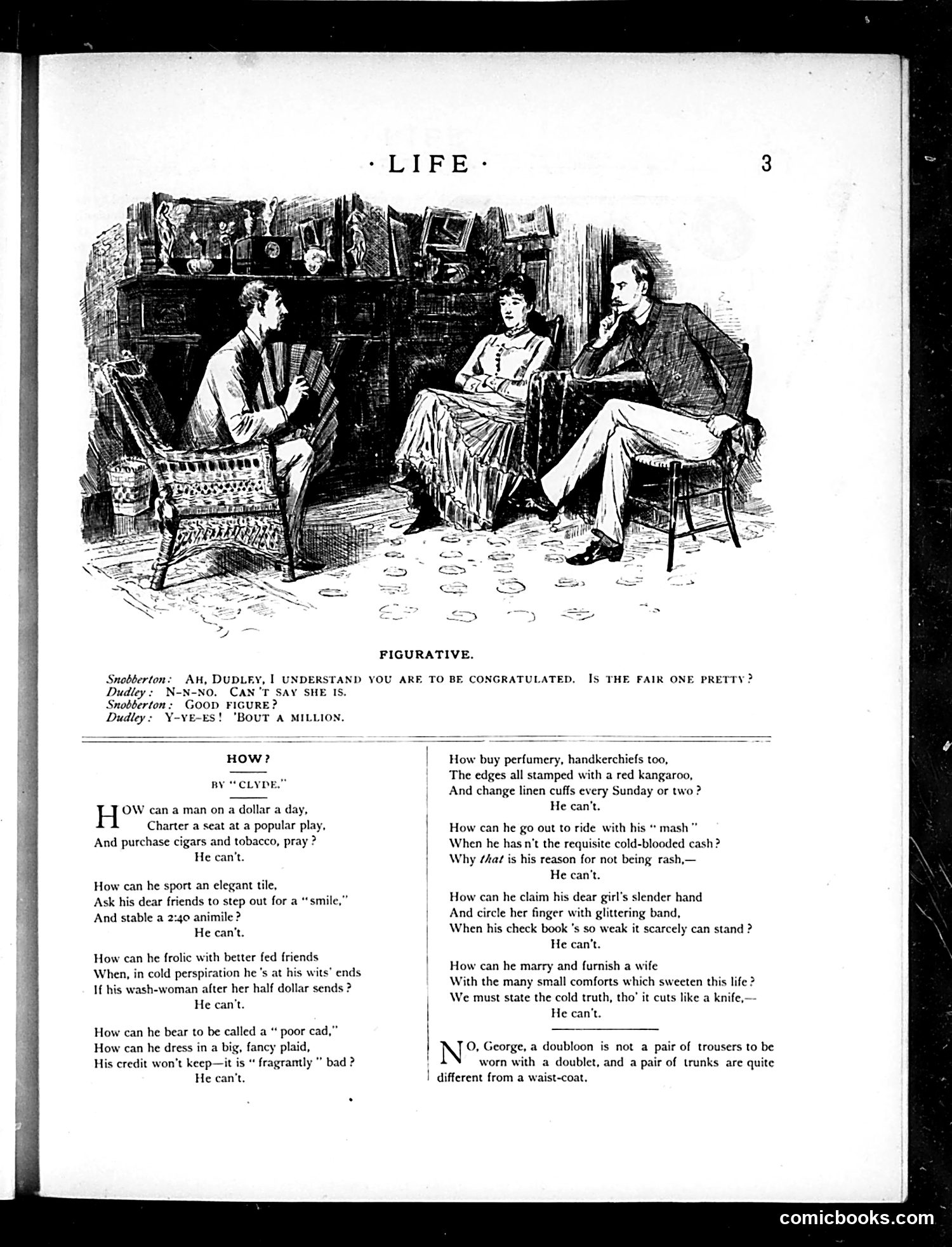
This page from *Life* magazine contains two satirical pieces about financial hardship among men of modest means. **The cartoon** (titled "Figurative") depicts a social conversation where a man announces his engagement. The snobbish responses mock the couple's modest circumstances—questioning whether the bride is "pretty" and joking about the groom being "about a million" (dollars short, presumably). **The poem "How?"** by "Clyde" sarcastically catalogs the impossibilities facing a poor man: affording cigars, dressing well, courting women, maintaining appearances, and supporting a wife—each verse ending with "He can't." **The closing note** humorously clarifies clothing terminology for the socially confused, suggesting the satire targets class pretensions and the gap between aspiration and economic reality for working-class men.
This page contains a satirical gossip column titled "By the Way" rather than a political cartoon. The column includes brief social commentary on contemporary topics: 1. **Frost King abroad** — A joke about the Tribune's claim that "the frost king is abroad," suggesting he's conveniently absent. 2. **Canadian defaulters** — Commentary that European Canada's defaulters are more popular than American ones, darkly joking they at least have "decency to shoot themselves." 3. **Fashionable society** — Satire about wealthy New Yorkers wearing spring covert coats to stay warm, mocking their affectation. 4. **Democratic paper collars** — Criticism of a novelty imitating handkerchiefs, sarcastically suggesting it's as reasonable as using handkerchiefs for telegrams. The tone is typical turn-of-century American humor: witty, cynical social observation rather than partisan politics.
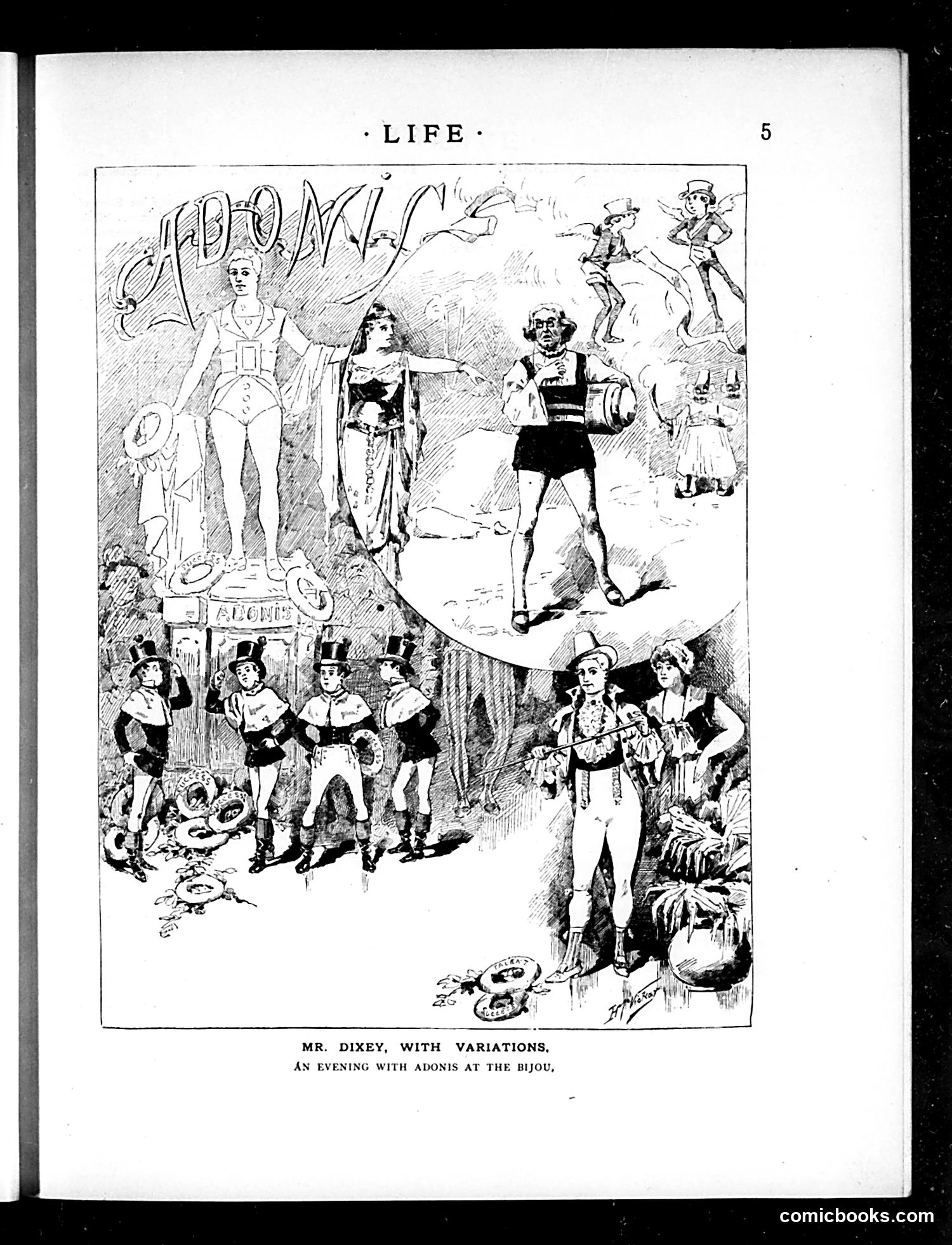
This satirical cartoon lampoons the theatrical phenomenon of "Adonis," likely a popular stage production featuring attractive male performers. The central figure appears to be Mr. Dixey (presumably the show's star), depicted multiple times in various theatrical poses and costumes to mock the production's emphasis on physical display and spectacle over substantive performance. The surrounding caricatured figures—wearing top hats and formal attire—represent the audience, perhaps wealthy patrons or critics. The satire suggests the show's shallow appeal, reducing entertainment to bodily exhibition. The word "Bijou" (French for "jewel") ironically describes what Life's editors considered a trivial theatrical venture. This reflects late-19th-century concerns about commercialized entertainment degrading theatrical standards.
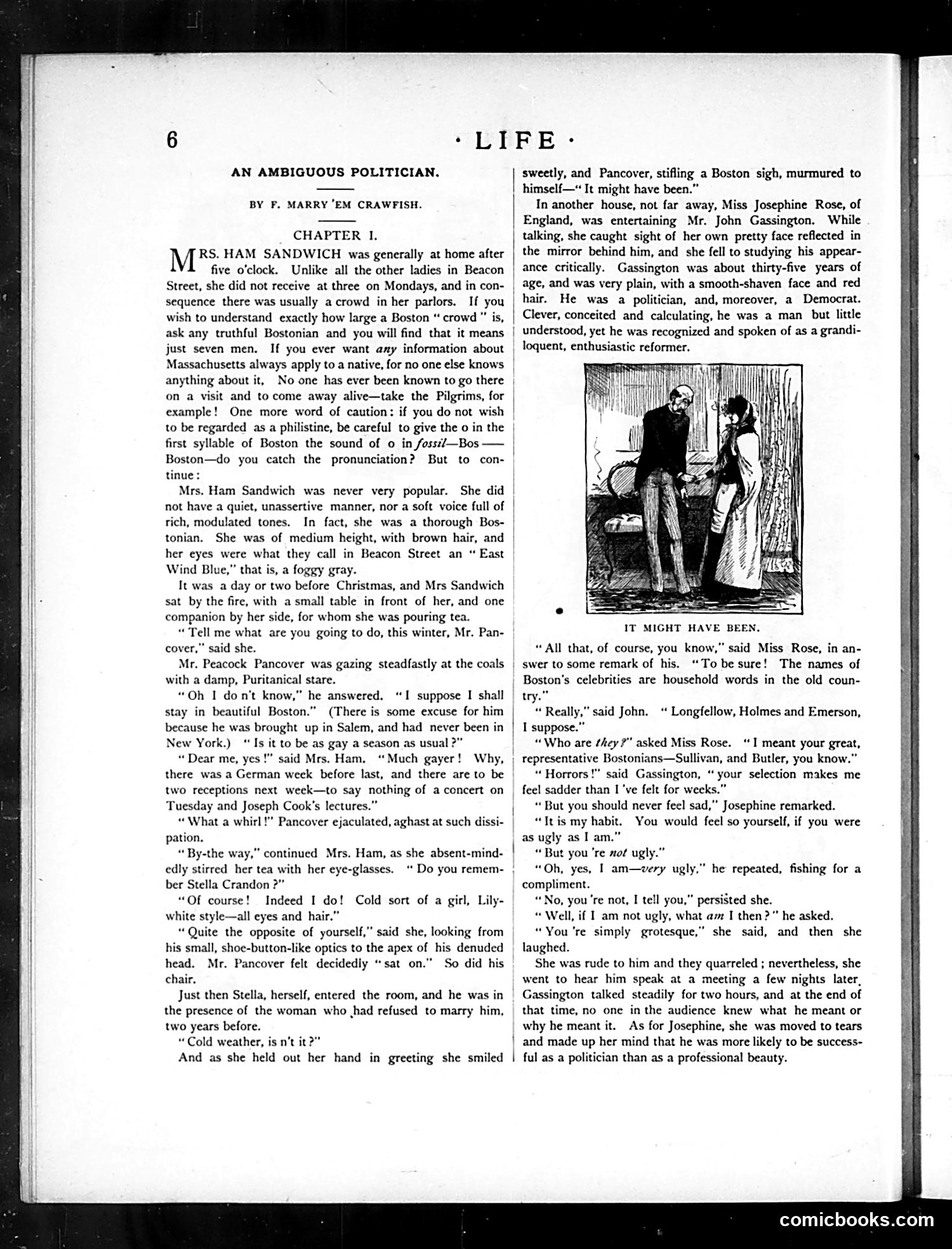
This page opens a serialized story titled "An Ambiguous Politician" by F. Marray 'Em Crawfish. The single illustration shows two figures in period dress (appearing to be 19th century) in an intimate moment—a man and woman near a window or doorway. The accompanying text introduces Mrs. Ham Sandwich, a Bostonian woman, and Mr. Pancover, a politician. The narrative establishes that Pancover is "a man but little understood, yet he was recognized and spoken of as a grandiose, eloquent, enthusiastic reformer." The illustration's caption reads "IT MIGHT HAVE BEEN," suggesting a romantic counterfactual—likely referencing Pancover's past relationship with a woman (Miss Josephine Rose) he didn't marry two years prior. The piece satirizes political ambition by framing a politician's personal romantic history alongside his public persona.
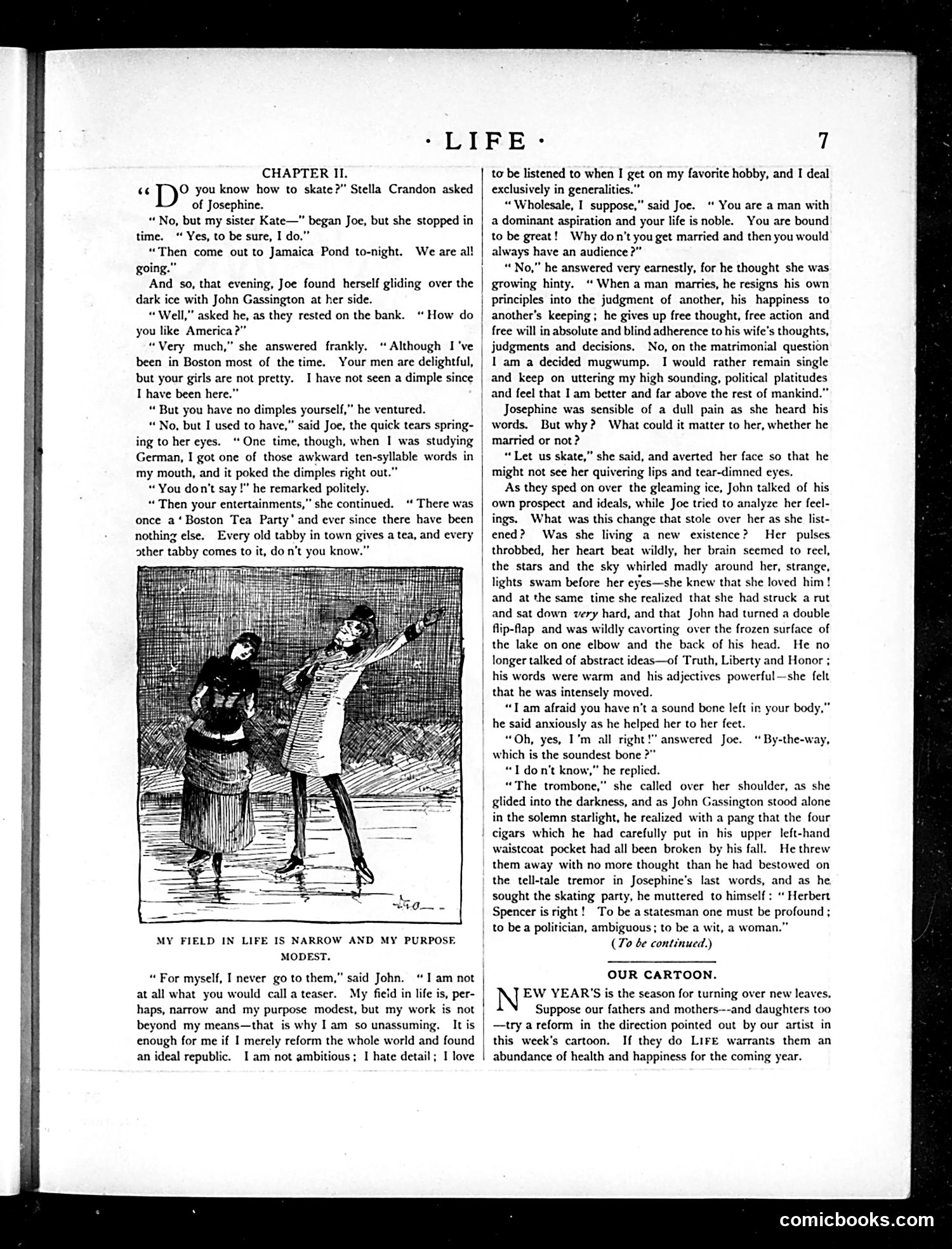
The main illustration depicts two figures ice skating at Jamaica Pond. Based on the surrounding dialogue, this appears to be a scene from a serialized story (Chapter II) rather than political commentary. The narrative involves characters named Joe and Josephine discussing marriage, ambition, and life choices—Joe expressing his belief that marriage compromises a man's independence and principles. Below the story excerpt is a section titled "OUR CARTOON" referencing New Year's as a season for reform and self-improvement. However, the actual political cartoon itself is not visible on this page fragment. The page is primarily literary content with social commentary embedded in character dialogue rather than direct political satire.
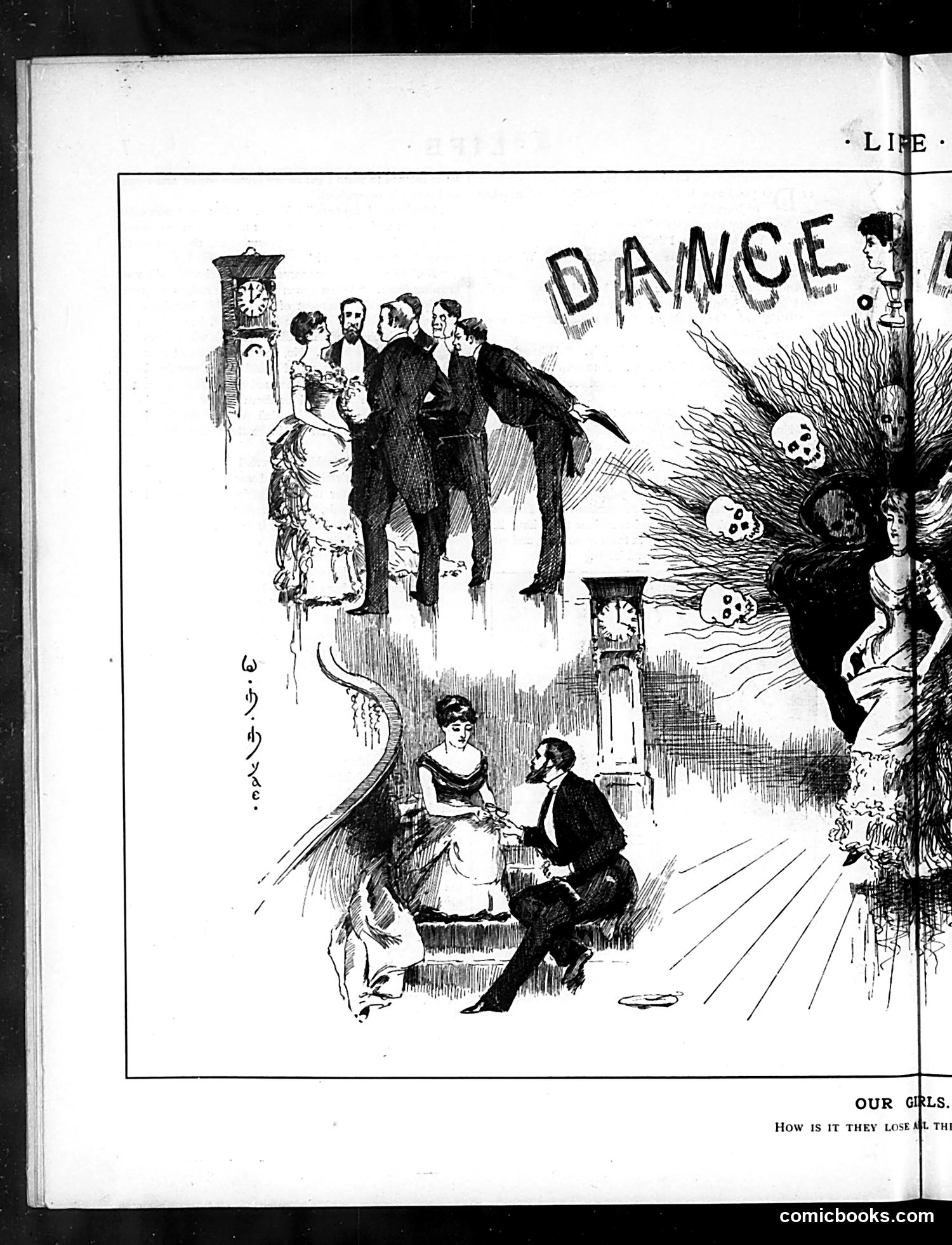
This satirical cartoon illustrates the Victorian-era moral panic about dancing and youth social behavior. The image contrasts two scenes: upper-level respectability (well-dressed adults near a clock, representing propriety and time) with lower-level moral danger (a couple dancing while skeletal death figures loom nearby). The skeleton imagery and "DANCE" text suggest the contemporary belief that dancing—particularly modern or unsupervised dancing—led to moral corruption, disease, and social ruin. The caption "OUR GIRLS: HOW IS IT THEY LOSE..." (text cut off) likely questions why young women were succumbing to this dangerous activity. This reflects late 19th/early 20th-century social anxieties about changing courtship norms, youth independence, and the perceived threats of modern entertainment venues.
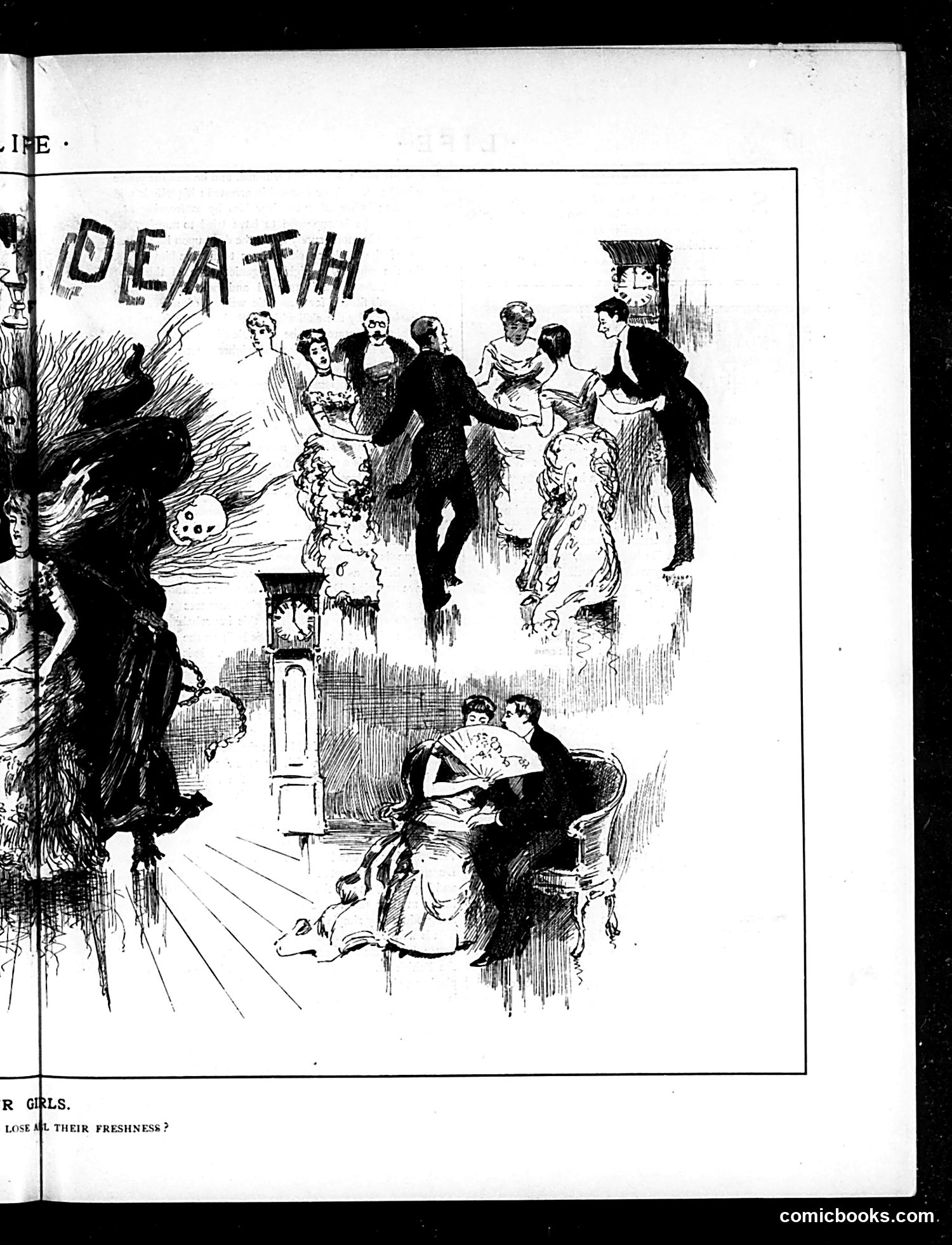
This satirical cartoon depicts a social gathering where "Death" (personified as a skeletal figure on the left) crashes an elegant party. Well-dressed guests appear alarmed or oblivious as Death arrives among them. The word "DEATH" is prominently displayed at top. The lower vignette shows two figures in an intimate moment, seemingly unaware of the chaos above—suggesting indifference or distraction from danger. The satire likely critiques how society ignores or trivializes mortality, or possibly references a specific public health crisis (epidemic or accident) that people were treating lightly despite its severity. The contrast between the elegant party-goers and Death's intrusion emphasizes the inevitability and indiscriminate nature of death, regardless of social status or revelry. The exact historical context remains unclear without additional publication information.
## The "Extravagance" Poem The small verse by Ward Ernest Smith satirizes feminine consumer excess: a woman ostentatiously examines luxury goods (laces, silks, diamond pins) while "proudly grumble[ing]" about costs—yet fumbles to pay with only fifty cents. The joke targets the contradiction between pretentious shopping aspirations and actual financial means, a common late-19th-century critique of women's spending habits. ## The Drama Review The bulk of the page reviews Henry Guy Carleton's new play *Victor Durand*, which debuted at Wallack's Theatre. The critic praises it as serious American drama comparable to recent hits like *Young Mrs. Winthrop*. The plot involves an innocent man wrongly condemned for crime, who escapes prison, marries an American woman, then faces arrest when his wife's former suitor falsely accuses him. The review emphasizes the play's psychological sophistication—focusing on marital trust rather than cheap sensations—marking it as legitimate theatrical art.
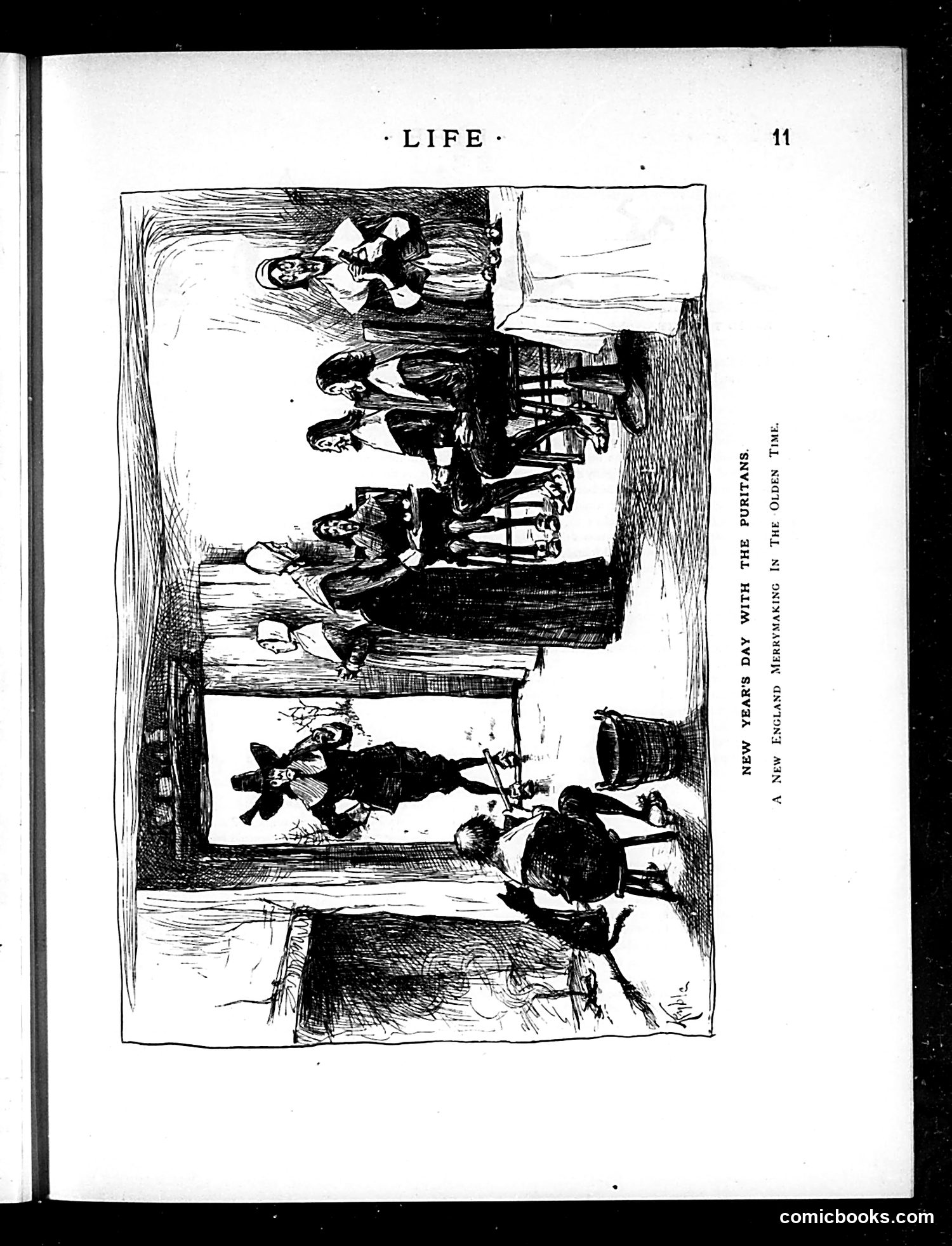
This page from *Life* magazine (page 11) contains a single sketch titled "A New England Merchant in the Olden Time." The cartoon depicts what appears to be a colonial or early American merchant scene, shown upside-down in the reproduction. The sketch illustrates period figures in historical dress, likely satirizing New England merchant practices or attitudes from earlier American history. Without being able to read the caption clearly due to the image orientation and OCR errors, the specific satirical point is difficult to determine with certainty. The style suggests social commentary on mercantile behavior, possibly wealth accumulation, trade practices, or character types associated with early American commerce. The pen-and-ink drawing style is typical of *Life*'s editorial cartoons from the early-to-mid 20th century.
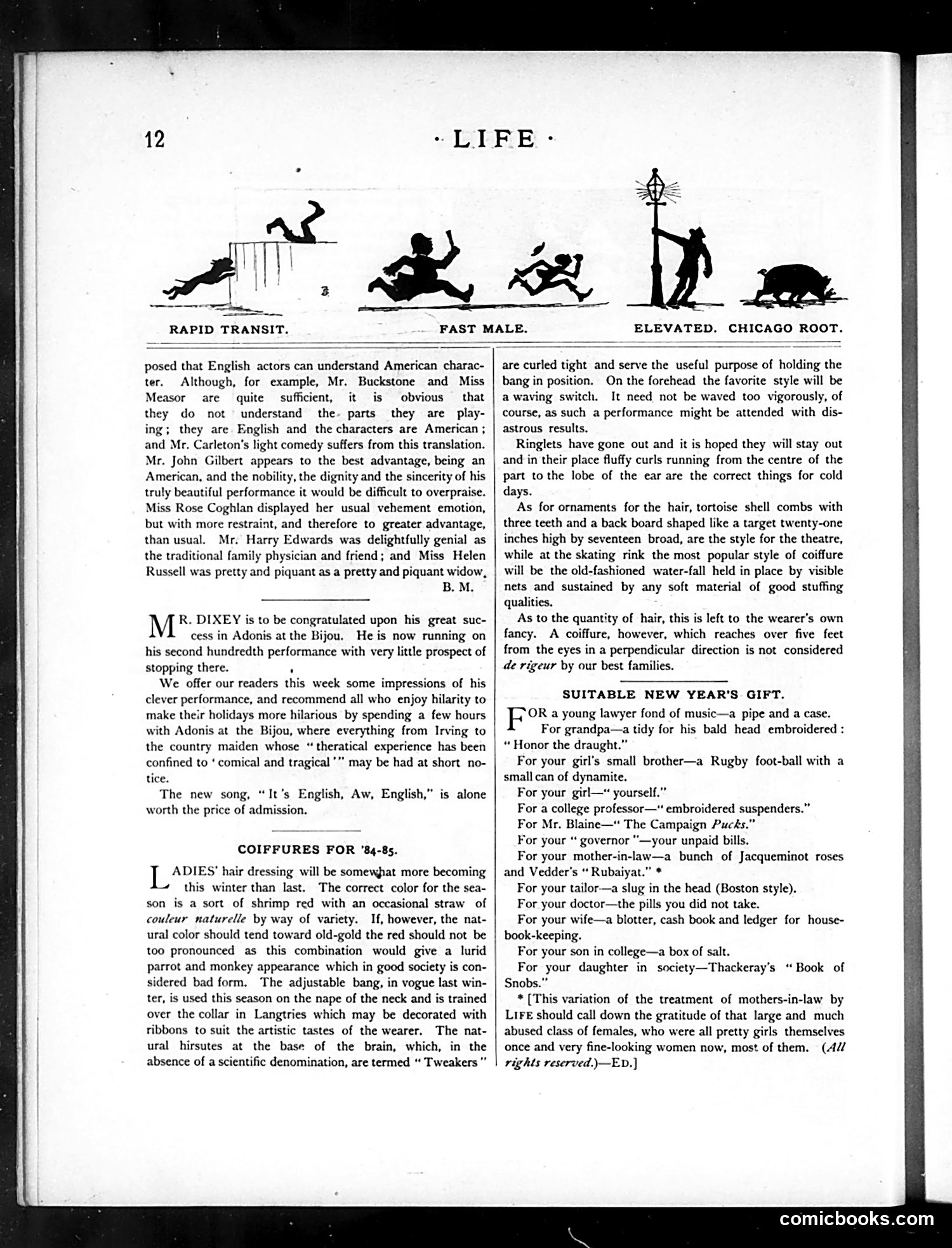
The top of the page shows four small silhouette cartoons labeled "Rapid Transit," "Fast Male," "Elevated," and "Chicago Root." These appear to be satirical visual jokes about modern urban life and movement in 1880s America—likely mocking the speed, chaos, and absurdity of city living, particularly in Chicago with its newly built elevated railway system. The main text discusses theater reviews (praising American actor John Gilbert over English performers misunderstanding American characters) and lengthy satirical commentary on women's hairstyling fashions for 1884-85. The fashion advice is deliberately absurd—discussing "shrimp red" hair color, elaborate ringlets and "tweakers" (curls at the base of the skull), and mockingly noting that hairstyles reaching "over five feet" from the eyes aren't considered proper by "our best families." The "Suitable New Year's Gift" section offers tongue-in-cheek gift suggestions with humorous inscriptions, poking fun at various social types and family members.
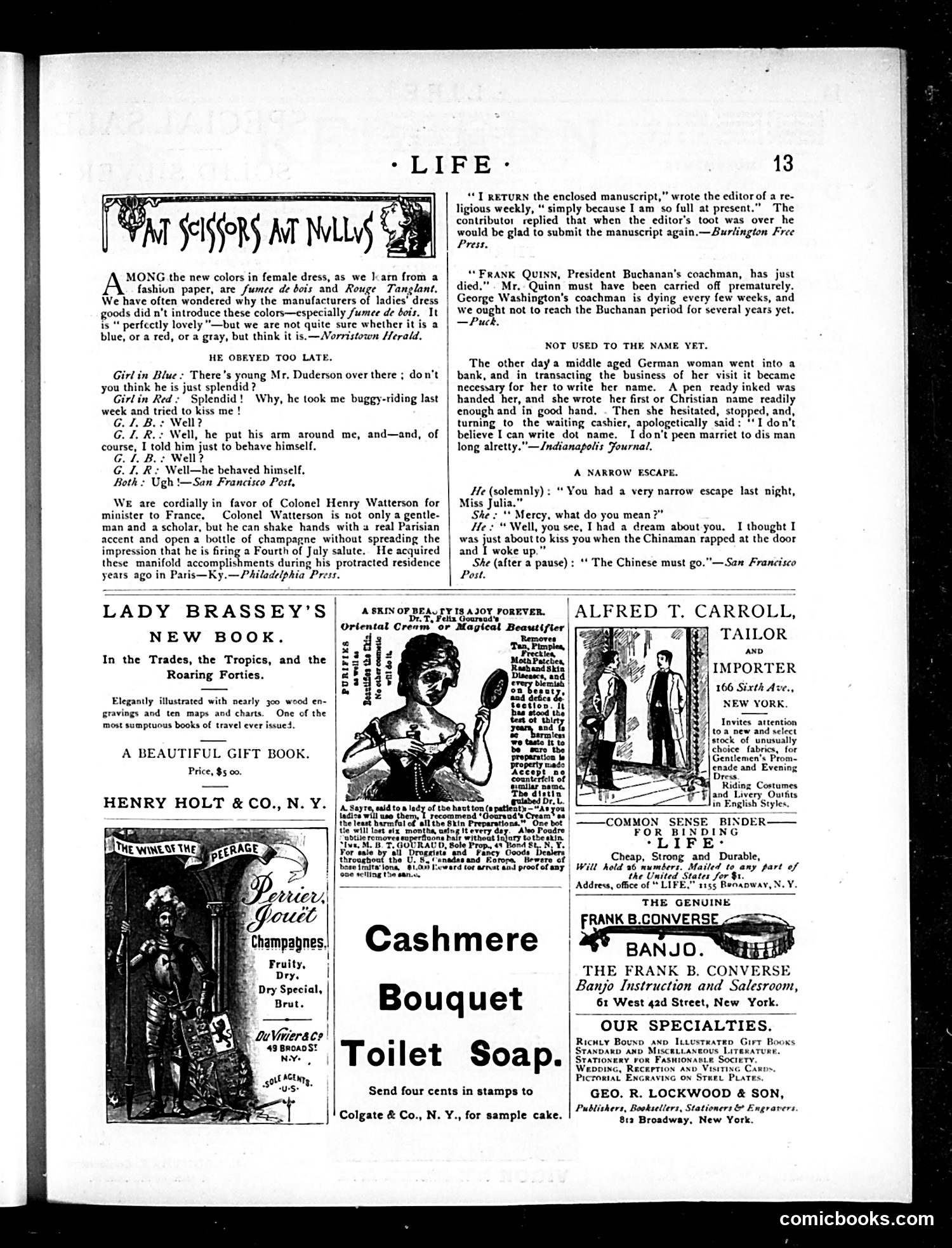
This page consists primarily of **humorous anecdotes and advertisements** rather than political cartoons. The main satirical content includes: **"He Obeyed Too Late"** — A dialogue joke about courtship etiquette: a young man tries to kiss a woman on a buggy ride; she tells him to behave himself, and he complies—disappointing her. This satirizes the contradictory social expectations placed on women (wanting romantic attention while maintaining propriety). **The Watterson reference** praises Colonel Henry Watterson as suitable for minister to France because he can "shake hands with a real Parisian accent" and open champagne properly—satire of American pretensions to European sophistication. **The German immigrant joke** mocks a woman's difficulty with her married name, suggesting she's not yet accustomed to being married ("I don't been married to dis man long already"). **The "Chinese must go" joke** references anti-Chinese sentiment of the period, using it as punchline humor. The rest is **commercial advertising** for books, fashion, cosmetics, and musical instruments—typical of *Life* magazine's revenue model.
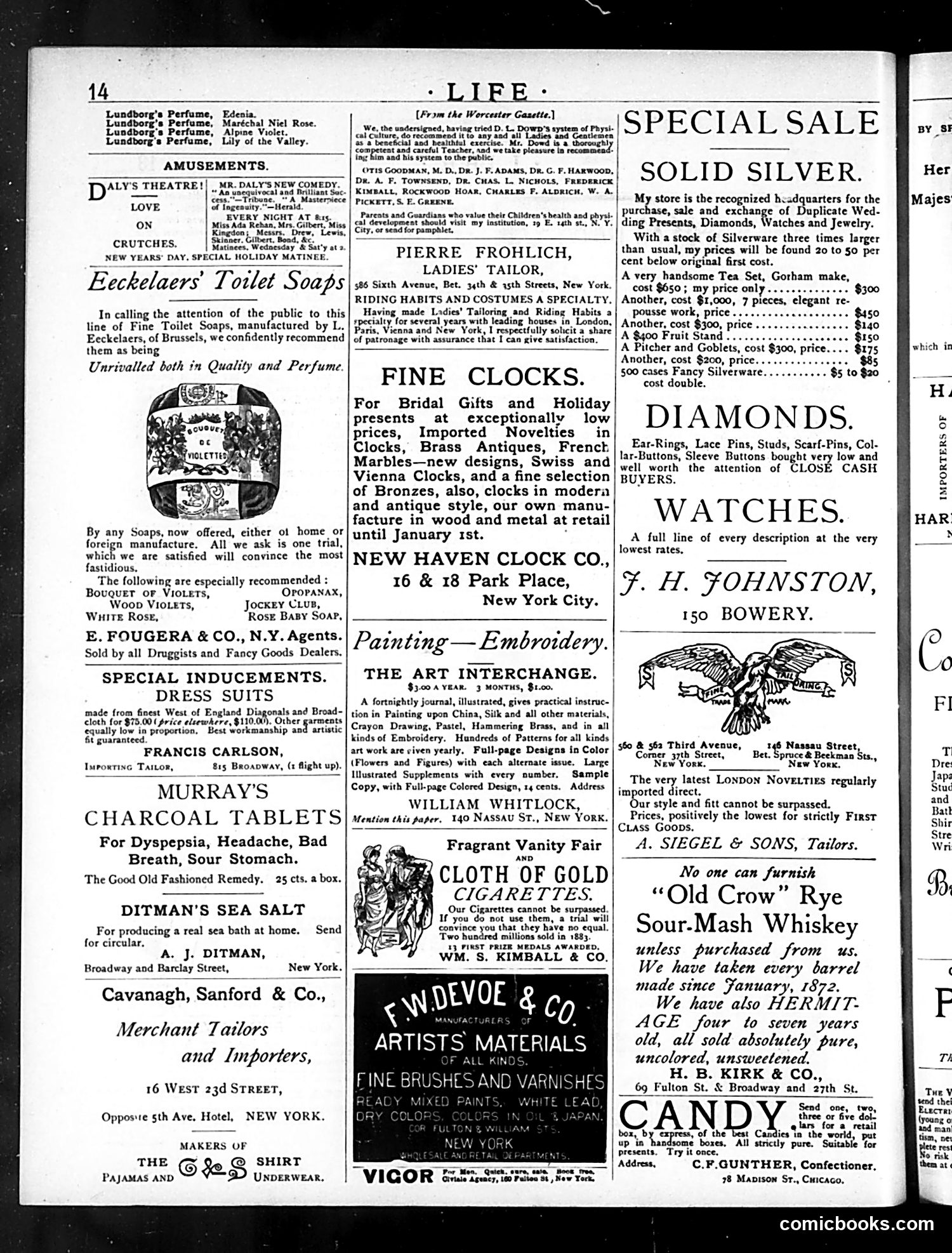
This page is primarily **advertising and announcements** from what appears to be an 1880s issue of *Life* magazine. There are no political cartoons or satirical illustrations requiring historical interpretation. The content consists of commercial ads for luxury goods—jewelry, watches, and silverware from F. H. Johnston; clocks from New Haven Clock Co.; tailoring services; and patent medicines like Murray's Charcoal Tablets. There are also notices for theatrical performances at Daly's Theatre and endorsements for a physical culture system. The only illustration is a decorative soap box for Eeckelaers' Toilet Soaps and a manufacturer's mark for F. W. Devoe & Co.'s art supplies—both straightforward product advertising. This is a commercial page, not satirical content requiring historical unpacking.
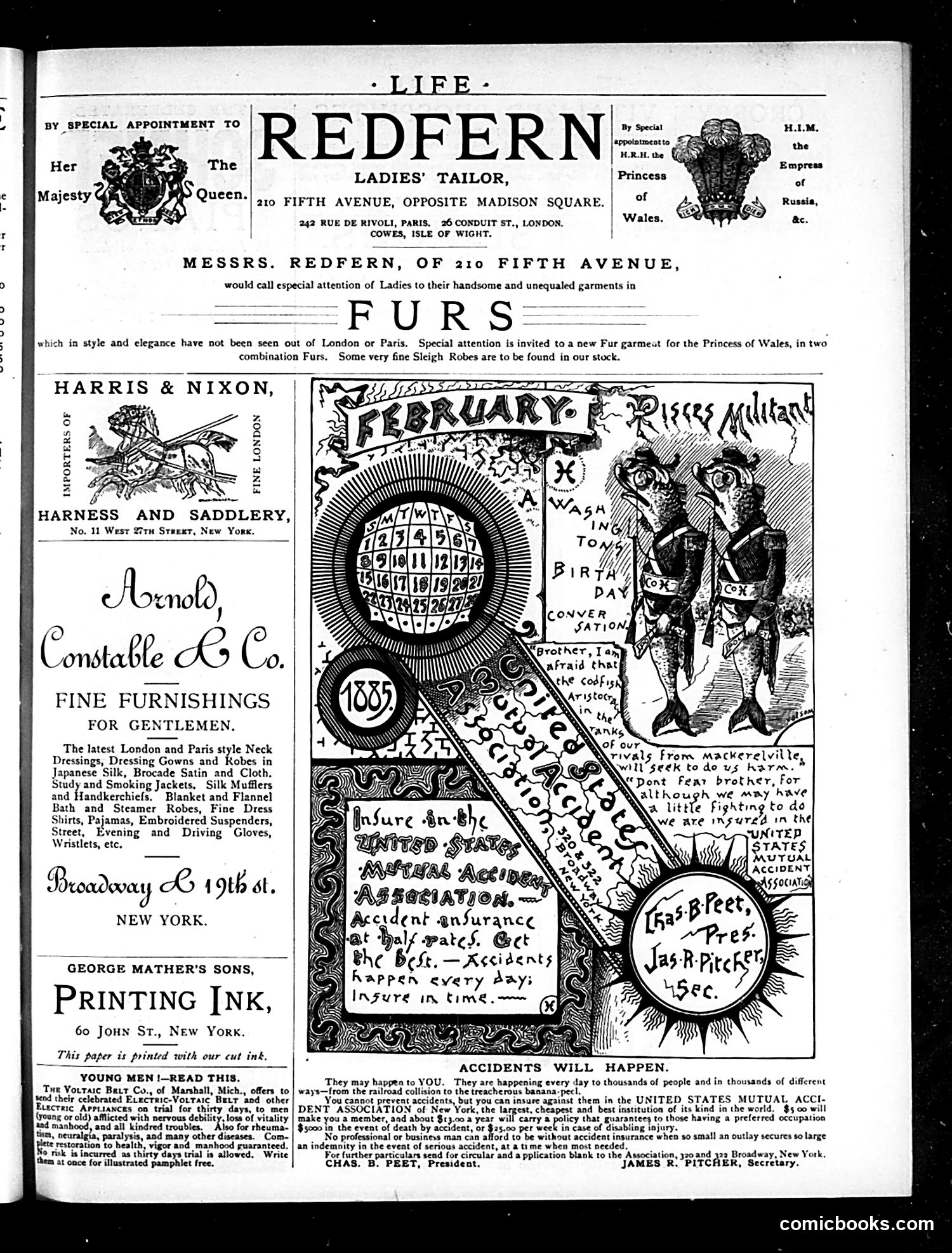
This page is primarily **advertising**, not political satire. The dominant content consists of upscale commercial notices for luxury goods (a ladies' tailor, furs, harnesses, fine furnishings, printing ink) appealing to wealthy clientele. The illustrated cartoon occupies the center-right. It depicts **two military figures in uniform** labeled "Isses Militant" celebrating a birthday, with dialogue referencing rivals from "Mackerelville" who "will seek to do us harm." The soldiers appear cheerful despite anticipating conflict. **Context**: This appears to be satirizing **contemporary militarism or military preparedness anxieties** of the era, likely mocking jingoistic attitudes or overseas military concerns. The cartoon uses the soldiers' casual attitude toward anticipated fighting as humor, suggesting either absurdity or inevitability of conflict. Below the cartoon sits an advertisement for the **United States Mutual Accident Association**, an insurance company ironically positioned beneath content about violence and warfare—a darkly humorous juxtaposition. Without a visible publication date, specific historical context remains unclear, though the style suggests late 19th or early 20th century.
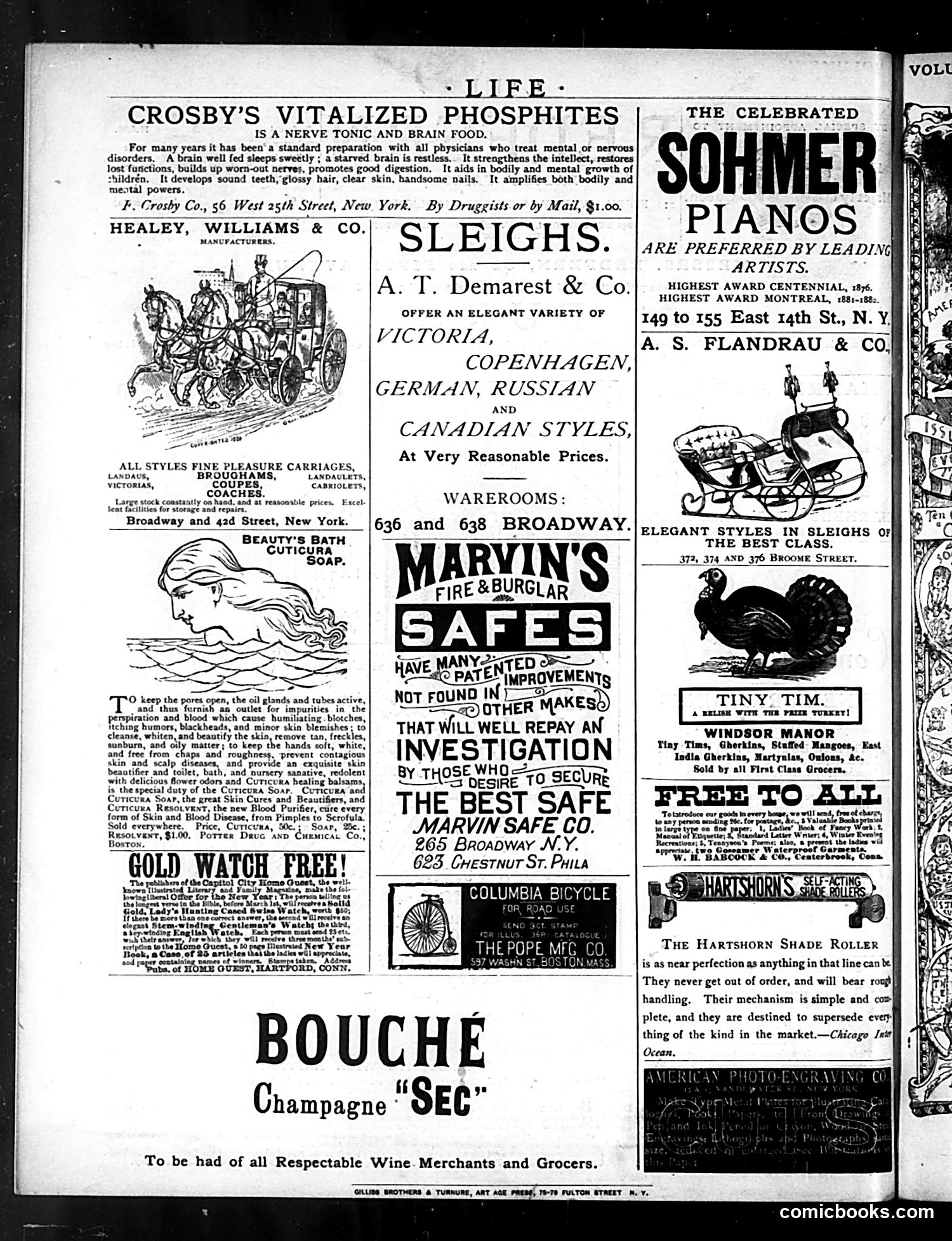
This is primarily an **advertising page** with no political cartoons or satirical content. The page showcases various late-19th-century consumer products and services: Notable advertisements include: - **Crosby's Vitalized Phosphites**: a "nerve tonic and brain food" claiming to treat mental disorders and improve digestion - **Marvin's Fire & Burglar Safes**: emphasizing patent improvements over competitors - **Sohmer Pianos**: marketed as preferred by leading artists - **Sleighs and carriages**: from multiple manufacturers (A.T. Demarest & Co., A.S. Flandrau & Co.) - **Beauty products**: Cuticura soap and other toiletries - **Hartshorn Shade Roller**: window blinds The page reflects the era's approach to medical/health marketing—making broad therapeutic claims without modern regulatory restrictions. The advertisements target affluent consumers seeking luxury items (carriages, pianos) and those concerned with health and beauty. This is typical commercial content from Life's business operations, not satirical editorial material.