
Life, 1885-01-01 · page 6 of 16
Life — January 1, 1885 — page 6: what you’re looking at
What you’re looking at
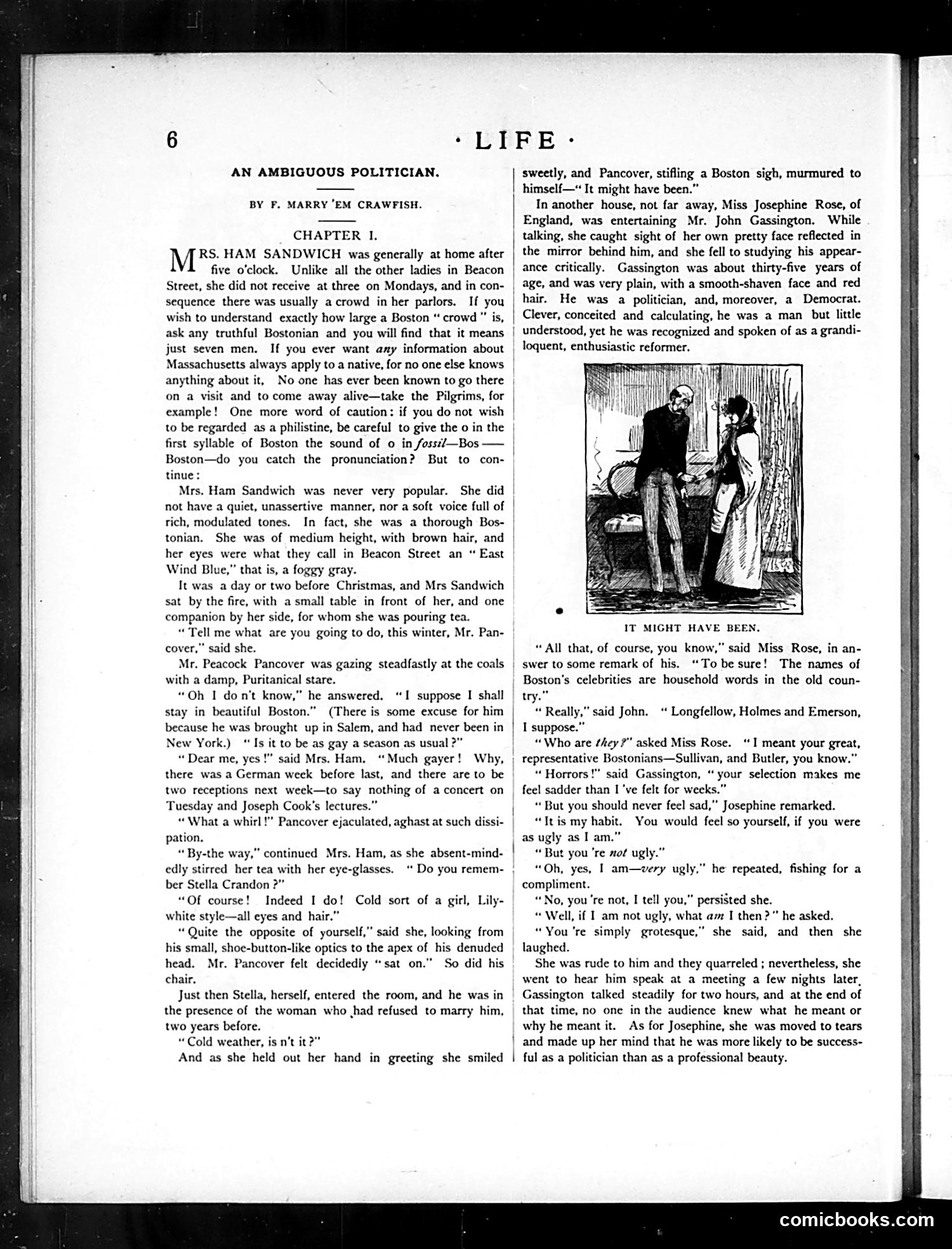
This page opens a serialized story titled "An Ambiguous Politician" by F. Marray 'Em Crawfish. The single illustration shows two figures in period dress (appearing to be 19th century) in an intimate moment—a man and woman near a window or doorway. The accompanying text introduces Mrs. Ham Sandwich, a Bostonian woman, and Mr. Pancover, a politician. The narrative establishes that Pancover is "a man but little understood, yet he was recognized and spoken of as a grandiose, eloquent, enthusiastic reformer." The illustration's caption reads "IT MIGHT HAVE BEEN," suggesting a romantic counterfactual—likely referencing Pancover's past relationship with a woman (Miss Josephine Rose) he didn't marry two years prior. The piece satirizes political ambition by framing a politician's personal romantic history alongside his public persona.
📄 Transcribed text from this page (OCR, searchable)
Machine-transcribed from the original scan — historical spelling and the odd misread are preserved.
‘LIFE: AN AMBIGUOUS POLITICIAN. BY F, MARRY ’EM CRAWFISH. CHAPTER I. RS. HAM SANDWICH was generally at home after five o'clock. Unlike all the other ladies in Beacon Street, she did not receive at three on Mondays, and in con- | sequence there was usually a crowd in her parlors. If you wish to understand exactly how large a Boston “ crowd " is, ask any truthful Bostonian and you will find that it means just seven men. If you ever want aay information about Massachusetts always apply to a native, for no one else knows | anything about it, No one has ever been known to go there on a visit and to come away alive—take the Pilgrims, for | example! One more word of caution: if you do not wish to be regarded as a philistine, be careful to give the o in the first syllable of Boston the sound of o in foss:/—Bos — Boston—do you catch the pronunciation? But to con- tinue: Mrs. Ham Sandwich was never very popular. not have a quiet, unassertive manner, nor a soft voice full of rich, modulated tones. tonian. She was of medium height, with brown hair, and her eyes were what they call in Beacon Street an “ East Wind Blue,” that is, a foggy gray. It was a day or two before Christmas, and Mrs Sandwich sat by the fire, with a small table in front of her, and one companion by her side, for whom she was pouring tea. “ Tell me what are you going to do, this winter, Mr. Pan- cover,” said she. Mr. Peacock Pancover was gazing steadfastly at the coals with a damp, Puritanical stare. “Oh I don't know,” he answered. stay in beautiful Boston.” because he was brought up in Salem, and had never been in New York.) “Is it to be as gay a season as usual ?” “ Dear me, yes!" said Mrs. Ham, ‘“ Much gayer! there was a German week before last, and there are to be two receptions next week—to say nothing of a concert on Tuesday and Joseph Cook’s lectures.” “What a whirl!" Pancover ejaculated, aghast at such dissi- pation. “T suppose I shall “ By-the way,” continued Mrs. Ham, as she absent-mind- | edly stirred her tea with her eye-glasses. ber Stella Crandon ?” “Of course! Indeed I do! white style—all eyes and hair.” “Quite the opposite of yourself,” said she, looking from his small, shoe-button-like optics to the apex of his denuded head. Mr. Pancover felt decidedly “sat on.” So did his chair. Just then Stella, herself, entered the room, and he was in the presence of the woman who jhad refused to marry him, two years before. “Cold weather, is n't it?” “ Do you remem- Cold sort of a girl, Lily- She did | In fact, she was a thorough Bos- | (There is some excuse for him | Why, | sweetly, and Pancover, stifling a Boston sigh, murmured to himself—“ It might have been.” In another house, not far away, Miss Josephine Rose, of England, was entertaining Mr. John Gassington. While talking, she caught sight of her own pretty face reflected in the mirror behind him, and she fell to studying his appear- ance critically. Gassington was about thirty-five years of age, and was very plain, with a smooth-shaven face and red hair. He was a politician, and, moreover, a Democrat. Clever, conceited and calculating, he was a man but little | understood, yet he was recognized and spoken of as a grandi- loquent, enthusiastic reformer. IT MIGHT HAVE BEEN, “All that, of course, you know,” said Miss Rose, in an- swer to some remark of his. “To be sure! The names of Boston's celebrities are household words in the old coun- y," said John, “ Longfellow, Holmes and Emerson, | I suppose.” “Who are they?” asked Miss Rose. “1 meant your great, representative Bostonians—Sullivan, and Butler, you know.” “ Horrors!" said Gassington, “ your selection makes me feel sadder than I 've felt for weeks. “But you should never feel sad,” Josephine remarked. “Itis my habit. You would feel so yourself, if you were as ugly as I am.” “ But you ‘re ot ugly.” “Oh, yes, I am—very ugly,” he repeated, fishing for a compliment. “No, you ‘re not, I tell you,” persisted she. “ Well, if 1 am not ugly, what am I then?” he asked. “You 're simply grotesque,” she said, and then she laughed. She was rude to him and they quarreled ; nevertheless, she went to hear him speak at a meeting a few nights later, Gassington talked steadily for two hours, and at the end of that time, no one in the audience knew what he meant or why he meant it. As for Josephine, she was moved to tears | and made up her mind that he was more likely to be success- And as she held out her hand in greeting she smiled | ful as a politician than as a professional beauty. comicbooks.com