
Life, 1885-01-01 · page 10 of 16
Life — January 1, 1885 — page 10: what you’re looking at
What you’re looking at
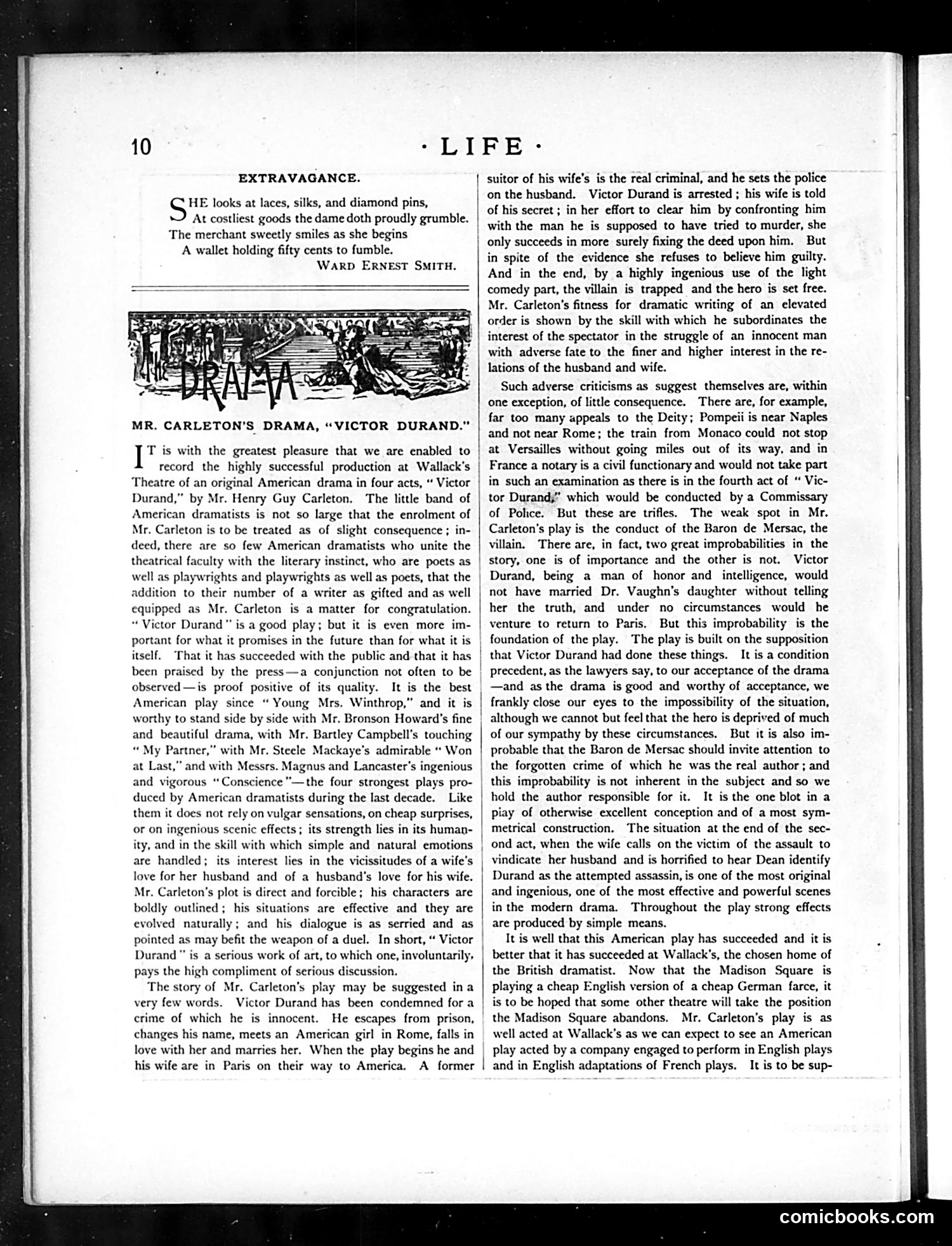
## The "Extravagance" Poem The small verse by Ward Ernest Smith satirizes feminine consumer excess: a woman ostentatiously examines luxury goods (laces, silks, diamond pins) while "proudly grumble[ing]" about costs—yet fumbles to pay with only fifty cents. The joke targets the contradiction between pretentious shopping aspirations and actual financial means, a common late-19th-century critique of women's spending habits. ## The Drama Review The bulk of the page reviews Henry Guy Carleton's new play *Victor Durand*, which debuted at Wallack's Theatre. The critic praises it as serious American drama comparable to recent hits like *Young Mrs. Winthrop*. The plot involves an innocent man wrongly condemned for crime, who escapes prison, marries an American woman, then faces arrest when his wife's former suitor falsely accuses him. The review emphasizes the play's psychological sophistication—focusing on marital trust rather than cheap sensations—marking it as legitimate theatrical art.
📄 Transcribed text from this page (OCR, searchable)
Machine-transcribed from the original scan — historical spelling and the odd misread are preserved.
- LIFE: EXTRAVAGANCE. HE looks at laces, silks, and diamond pins, At costliest goods the dame doth proudly grumble. The merchant sweetly smiles as she begins A wallet holding fifty cents to fumble. WarD ERNEST SMITH. MR. CARLETON’S DRAMA, “VICTOR DURAND.” T is with the greatest pleasure that we are enabled to | record the highly successful production at Wallack’s | Theatre of an original American drama in four acts, “ Victor | Durand,” by Mr. Henry Guy Carleton. The little band of American dramatists is not so large that the enrolment of Mr. Carleton is to be treated as of slight consequence ; in- deed, there are so few American dramatists who unite the theatrical faculty with the literary instinct, who are poets as | well as playwrights and playwrights as well as poets, that the | addition to their number of a writer as gifted and as well equipped as Mr. Carleton is a matter for congratulation. “ Victor Durand” is a good play; but it is even more im- portant for what it promises in the future than for what it is itself. ‘That it has succeeded with the public and that it has | been praised by the press—a conjunction not often to be | observed —is proof positive of its quality. It is the best American play since “ Young Mrs. Winthrop,” and it is worthy to stand side by side with Mr. Bronson Howard's fine and beautiful drama, with Mr. Bartley Campbell's touching “My Partner,” with Mr. Steele Mackaye’s admirable “ Won at Last,” and with Messrs. Magnus and Lancaster's ingenious and vigorous “Conscience"—the four strongest plays pro- duced by American dramatists during the last decade. Like them it does not rely on vulgar sensations, on cheap surprises, or on ingenious scenic effects; its strength lies in its human- ity, and in the skill with which simple and natural emotions are handled; its interest lies in the vicissitudes of a wife's | love for her husband and of a husband's love for his wife. Mr. Carleton’s plot is direct and forcible; his characters are boldly outlined; his situations are effective and they are evolved naturally; and his dialogue is as serried and as pointed as may befit the weapon of a duel. In short, “ Victor Durand " is a serious work of art, to which one, involuntarily, | pays the high compliment of serious discussion. The story of Mr. Carleton’s play may be suggested in a very few words. Victor Durand has been condemned for a | crime of which he is innocent. He escapes from prison, changes his name, meets an American girl in Rome, falls in love with her and marries her. When the play begins he and metrical construction. his wife are in Paris on their way to America. A former suitor of his wife's is the real criminal, and he sets the police on the husband. Victor Durand is arrested ; his wife is told of his secret ; in her effort to clear him by confronting him | with the man he is supposed to have tried to murder, she | only succeeds in more surely fixing the deed upon him. But in spite of the evidence she refuses to believe him guilty. And in the end, by a highly ingenious use of the light comedy part, the villain is trapped and the hero is set free. Mr. Carleton’s fitness for dramatic writing of an elevated order is shown by the skill with which he subordinates the E | interest of the spectator in the struggle of an innocent man with adverse fate to the finer and higher interest in the re- lations of the husband and wife. Such adverse criticisms as suggest themselves are, within one exception, of little consequence. There are, for example, far too many appeals to the Deity; Pompeii is near Naples and not near Rome; the train from Monaco could not stop at Versailles without going miles out of its way, and in France a notary is a civil functionary and would not take part in such an examination as there is in the fourth act of “ Vic- tor Durand;”’ which would be conducted by a Commissary of Pohce. But these are trifles. The weak spot in Mr. Carleton’s play is the conduct of the Baron de Mersac, the villain. There are, in fact, two great improbabilities in the story, one is of importance and the other is not. Victor Durand, being a man of honor and intelligence, would not have married Dr. Vaughn's daughter without telling her the truth, and under no circumstances would he venture to return to Paris. But this improbability is the foundation of the play. The play is built on the supposition that Victor Durand had done these things. It is a condition precedent, as the lawyers say, to our acceptance of the drama —and as the drama is good and worthy of acceptance, we frankly close our eyes to the impossibility of the situation, although we cannot but feel that the hero is deprived of much of our sympathy by these circumstances. But it is also im- probable that the Baron de Mersac should invite attention to the forgotten crime of which he was the real author ; and this improbability is not inherent in the subject and so we hold the author responsible for it. It is the one blot in a piay of otherwise excellent conception and of a most sym- The situation at the end of the sec- ond act, when the wife calls on the victim of the assault to vindicate her husband and is horrified to hear Dean identify Durand as the attempted assassin, is one of the most original and ingenious, one of the most effective and powerful scenes in the modern drama. Throughout the play strong effects are produced by simple means. It is well that this American play has succeeded and it is better that it has succeeded at Wallack’s, the chosen home of the British dramatist. Now that the Madison Square is playing a cheap English version of a cheap German farce, it is to be hoped that some other theatre will take the position the Madison Square abandons. Mr. Carleton’s play is as well acted at Wallack’s as we can expect to see an American play acted by a company engaged to perform in English plays and in English adaptations of French plays. It is to be sup- comicbooks.com