
A complete issue · 12 pages · 1884
Life — October 16, 1884
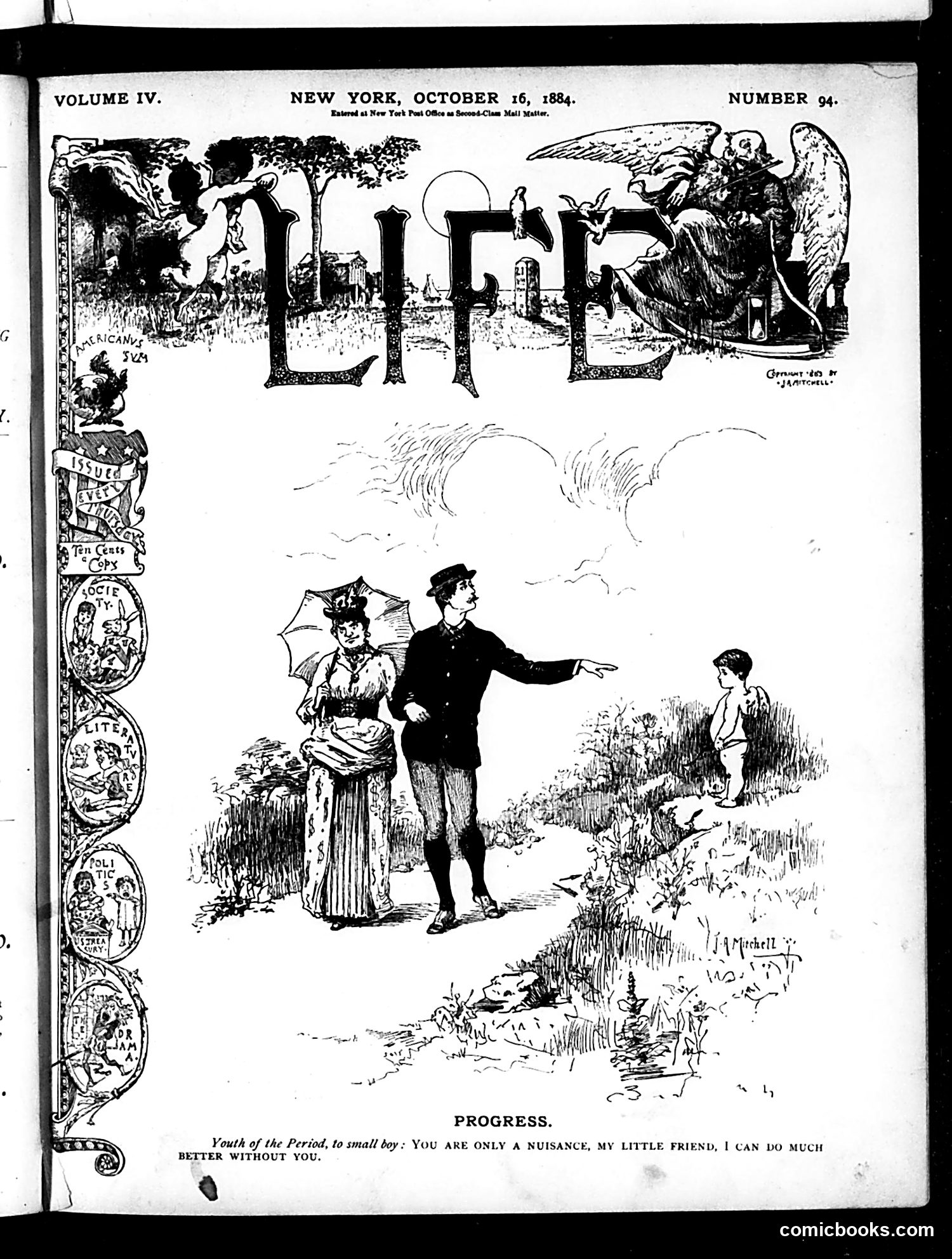
This page features two satirical illustrations. The title illustration "LIFE" shows a heavenly or idealized landscape with an angel, likely representing the magazine's aspirational view. The main cartoon titled "PROGRESS" depicts a well-dressed man and woman with a parasol encountering a small child on a country path. The caption reads: "Youth of the Period, to small boy: 'You are only a nuisance, my little friend, I can do much better without you.'" This satirizes the attitudes of the 1880s upper classes—specifically the indifference of fashionable society toward poor or working-class children. The "Youth of the Period" likely refers to the self-absorbed young adults of that era, whose dismissive treatment of childhood poverty exemplifies the social callousness the magazine critiques. The irony underscores hypocrisy about "progress" in an industrializing nation.
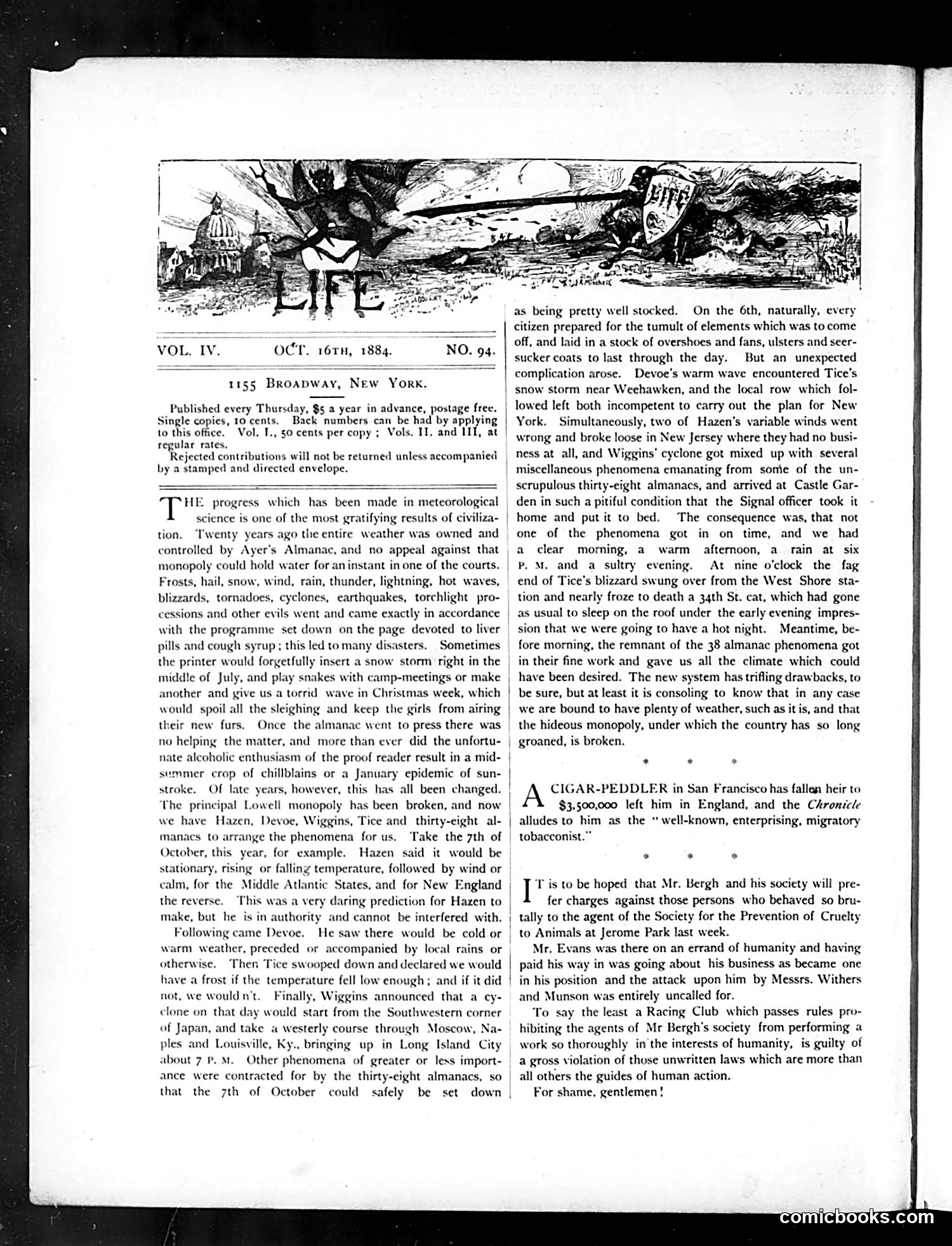
The masthead illustration depicts "LIFE" as an allegorical figure overlooking a chaotic landscape with a cityscape and stormy weather, suggesting Life magazine's role as observer of contemporary events. The main article discusses meteorological science and weather prediction, referencing debates between competing almanac makers (Hazen, Devoe, Wiggins, and Tice) who claimed ability to forecast weather phenomena. This reflects 1880s scientific disputes about whether weather could be reliably predicted through mathematical systems versus traditional almanac methods. The satirical point appears to criticize overconfident meteorologists and their conflicting predictions. The article mocks their failures while acknowledging improved methods, reflecting public skepticism about scientific weather forecasting's reliability during this era of competing pseudoscientific claims.
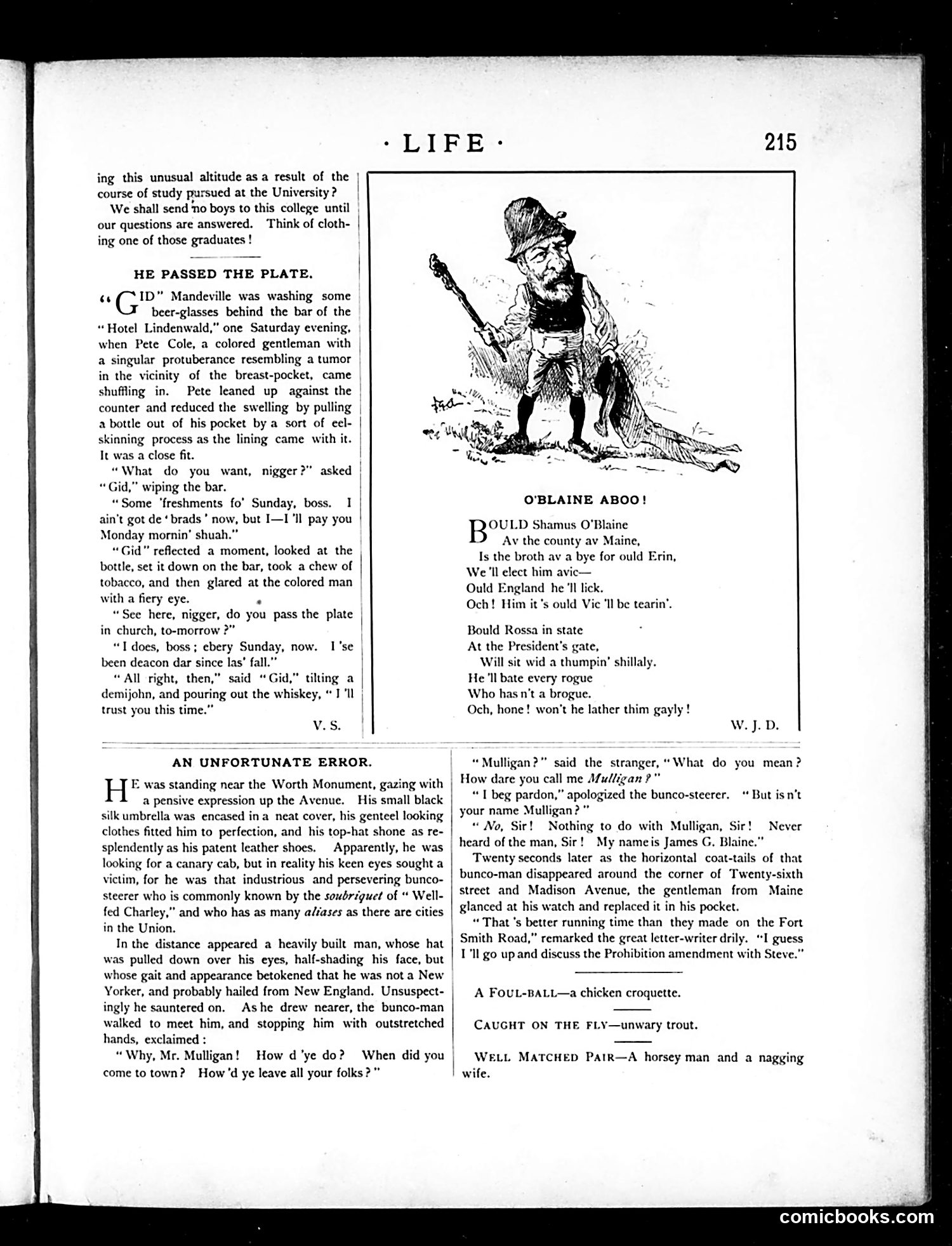
The main cartoon, titled "O'BLAINE ABOO!", depicts a caricatured figure with exaggerated facial features in a style consistent with late 19th-century satirical art. The poem references "Shamus O'Blaine" and mentions elections, "Old England," and "the President's gate," suggesting political satire concerning Irish-American electoral politics and possibly anti-Irish sentiment of the era. The accompanying prose stories—"He Passed the Plate" and "An Unfortunate Error"—contain racial slurs and stereotypical depictions typical of period satirical humor, reflecting attitudes now recognized as deeply offensive. Without specific dating or additional context, the exact political figures or events referenced remain unclear, though the content reflects characteristic xenophobic and racist satire from American magazines of this period.
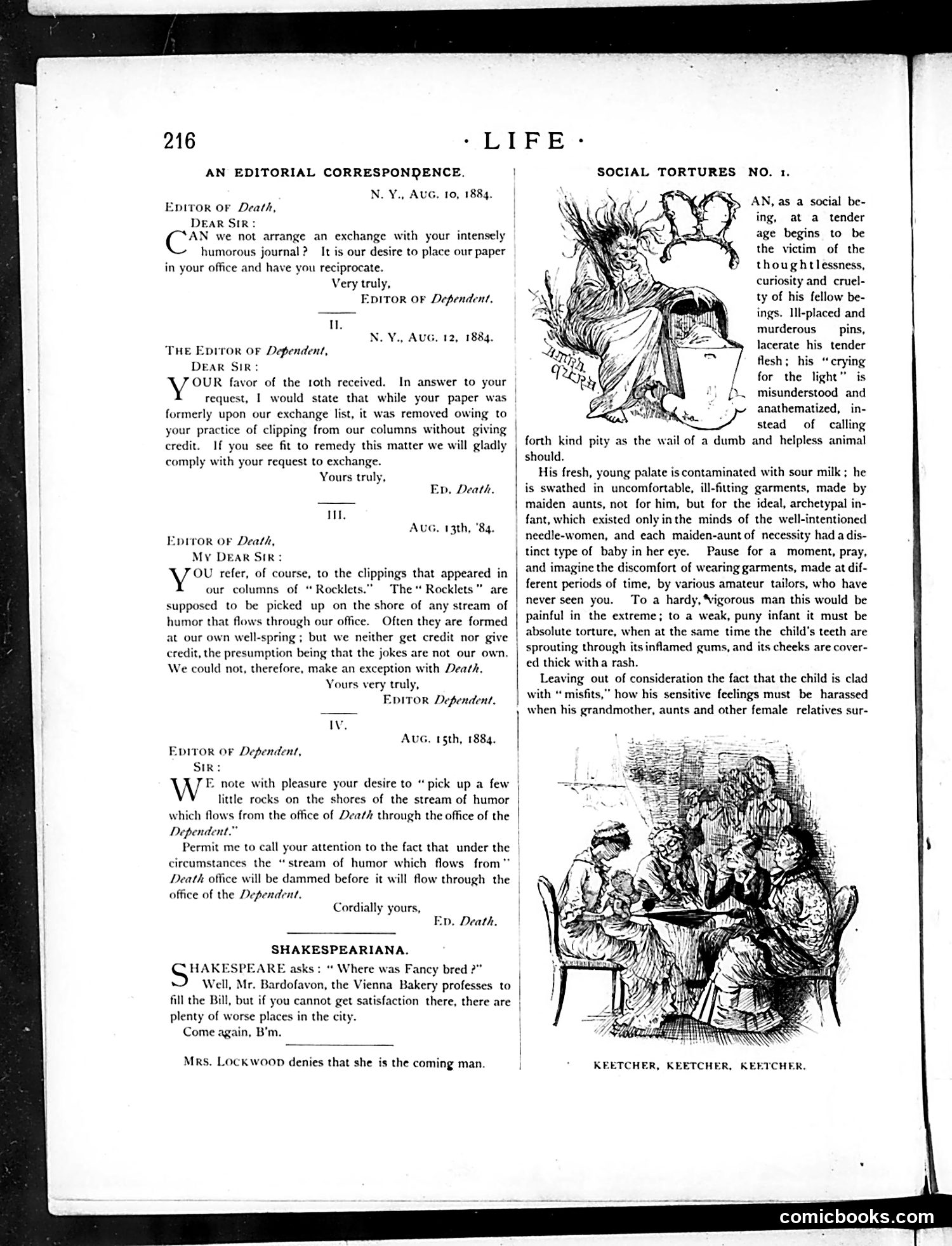
This page contains editorial correspondence and a satirical section titled "Social Tortures No. 1." **The Cartoon:** Labeled "Kketcher, Kketcher, Kketcher," the sketch depicts an uncomfortable social gathering where a woman appears to be sketching or drawing guests. The satire targets the social awkwardness created by amateur artists documenting social events—a practice apparently common among Victorian ladies. The repetitive "kketcher" emphasizes the annoyance guests felt being drawn without consent. **The Text:** The accompanying essay criticizes how young children at social events are dressed in uncomfortable, impractical clothing by their female relatives—garments designed for appearance rather than comfort. The satire mocks both the thoughtlessness of relatives and the suffering of children subjected to fashionable but torturous dress codes of the era. Both elements mock Victorian social conventions and gender-based practices.
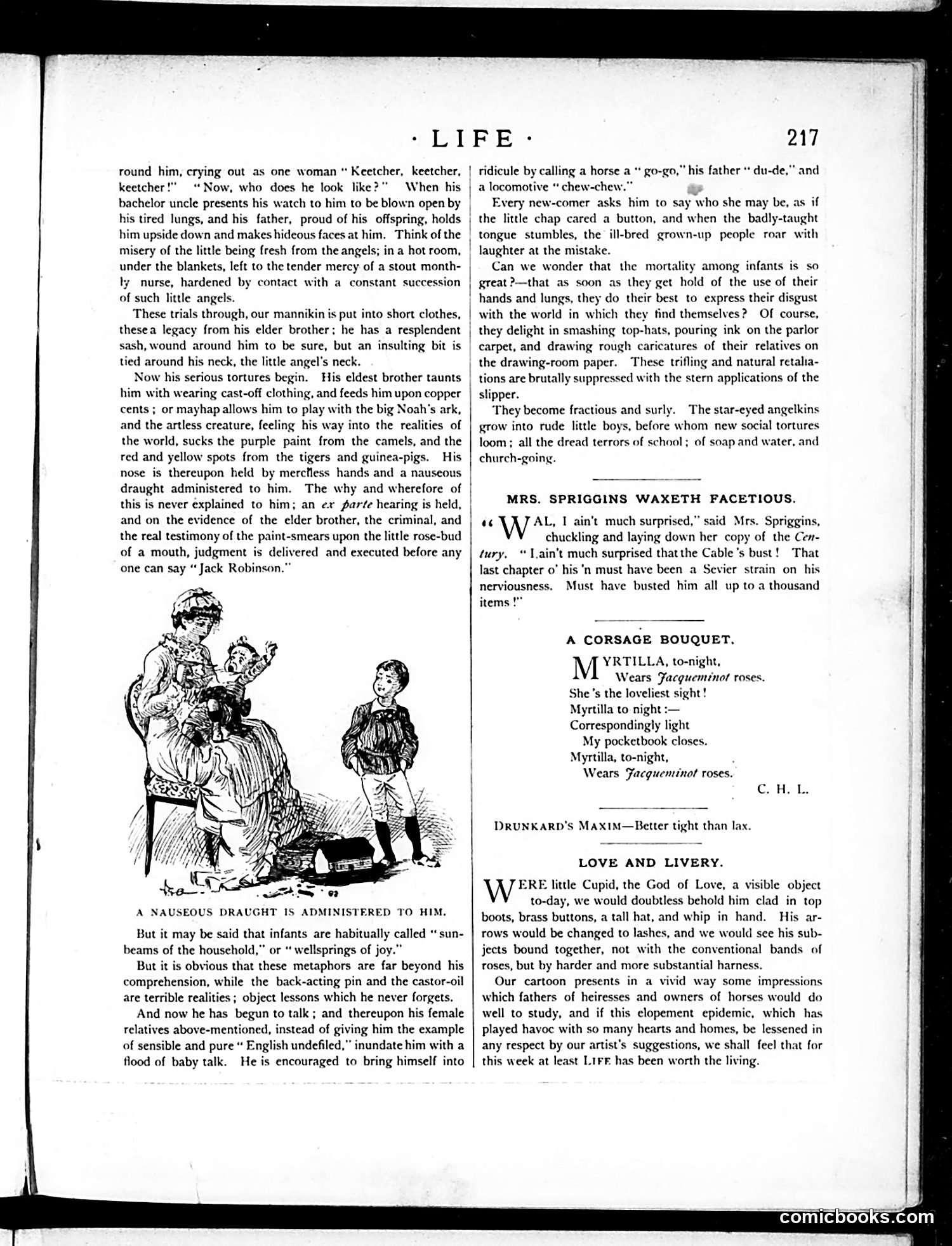
This page contains two main sections: 1. **The Cartoon**: Shows an adult (appears to be a parent or caretaker) administering medicine to a distressed child, with another child watching. The caption reads "A NAUSEOUS DRAUGHT IS ADMINISTERED TO HIM." This illustrates the text's discussion of infant mortality and child-rearing practices, satirizing the harsh medical treatments inflicted on children in this era. 2. **Three Short Pieces**: - "Mrs. Spriggins Waxeth Facetious" — a humorous domestic anecdote - "A Corsage Bouquet" — a brief poem about roses - "Love and Livery" — commentary on Cupid and horses, suggesting social critique of romantic ideals versus practical reality The overall page satirizes Victorian child-rearing methods and social conventions through gentle humor rather than sharp political commentary.
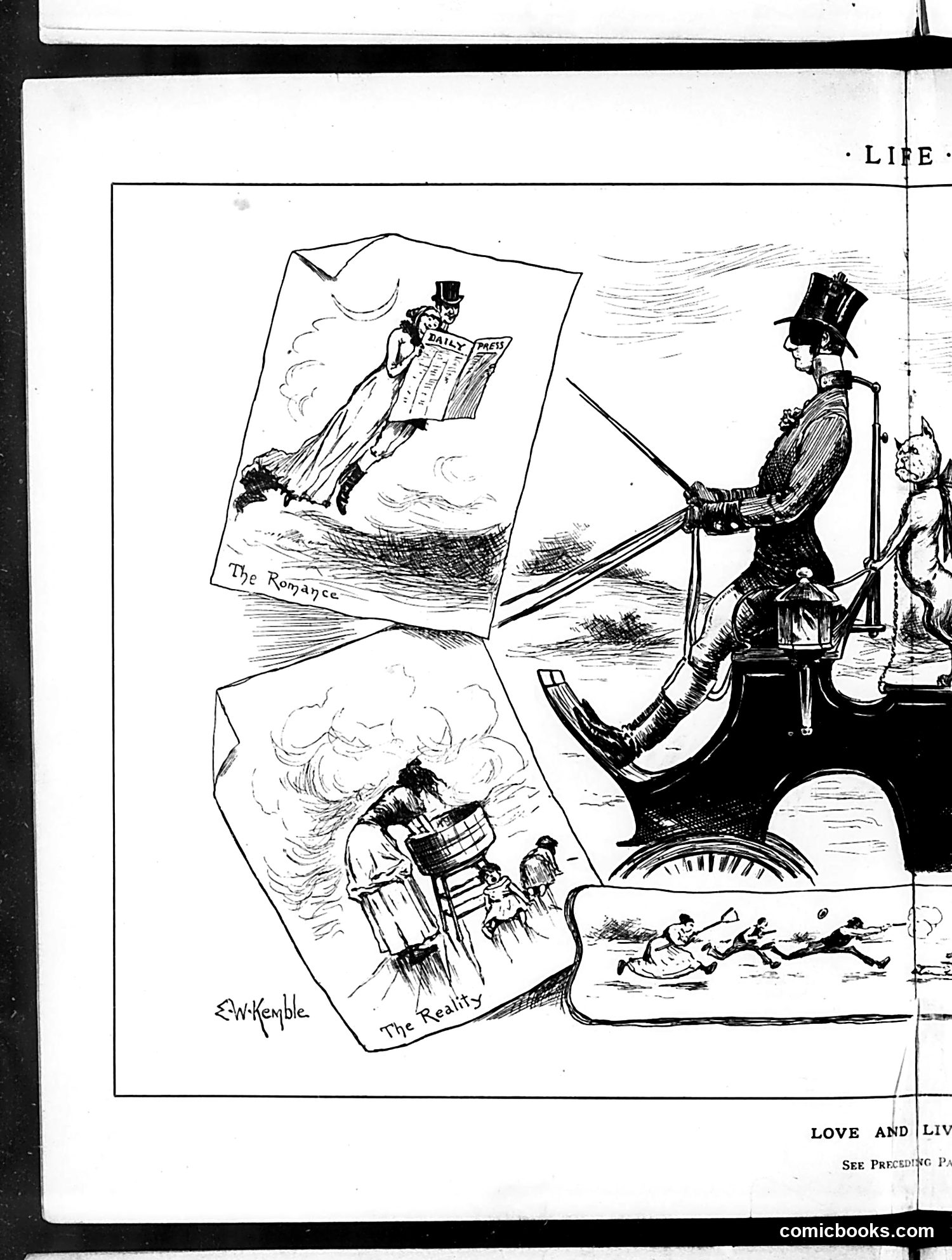
This satirical cartoon contrasts "The Romance" with "The Reality" of newspaper reading. On the left, two illustrated panels show idealized visions: a figure dreamily reading the "Daily" newspaper while floating among clouds, and another person contentedly reading by a fireplace. On the right, a gentleman operates a printing press (labeled with what appears to be "DAILY NEWS"), revealing the mundane, mechanical truth behind newspaper production. At the bottom, small figures appear exhausted or overwhelmed. The cartoon's point: the romantic fantasy people have about newspapers—leisurely, inspiring reading—contrasts sharply with the actual industrial, labor-intensive reality of their creation. It's a commentary on the gap between media consumption and production circa early 1900s.
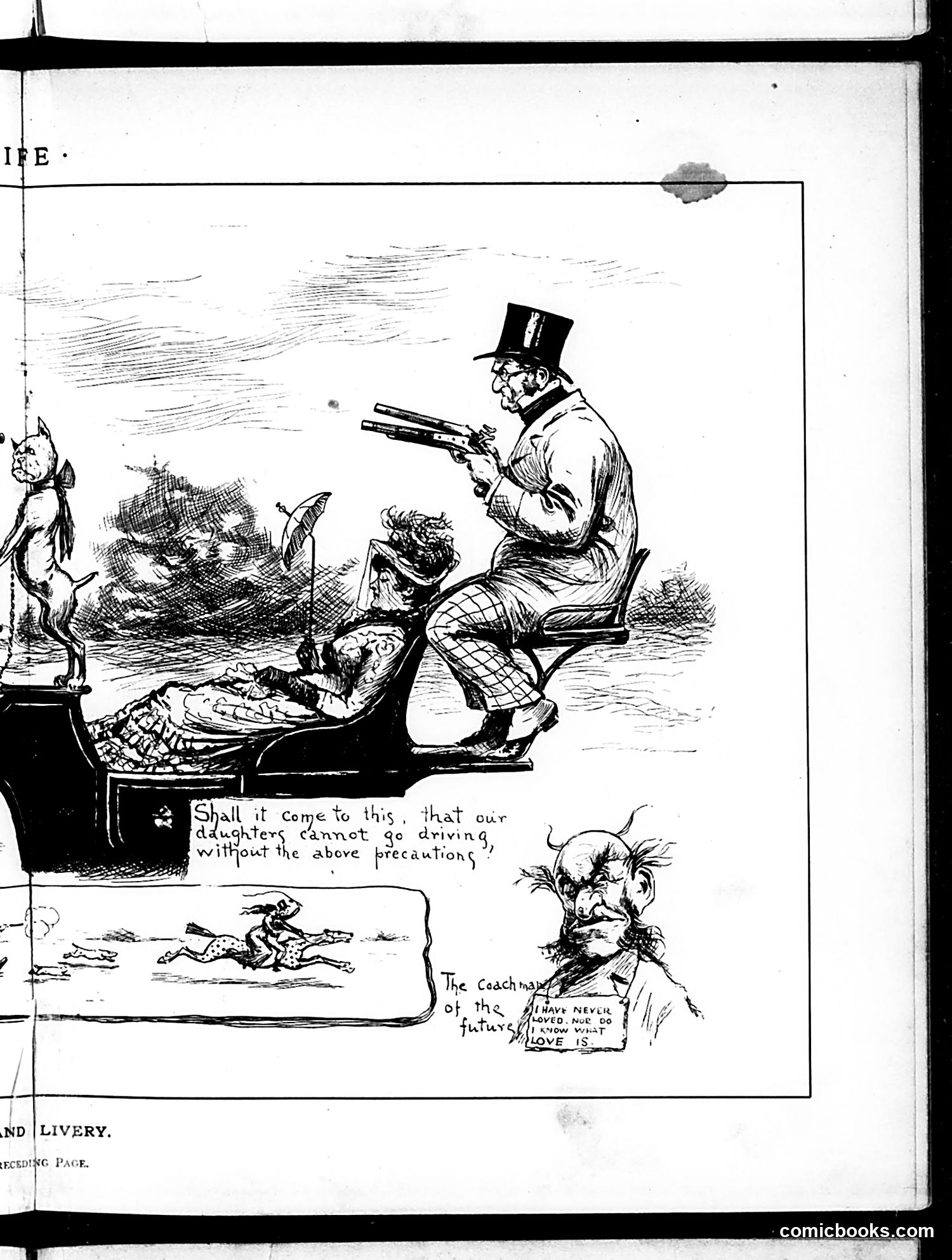
This satirical cartoon addresses women's driving safety, a contemporary social concern. A gentleman in a top hat operates binoculars while sitting beside a woman driver, illustrating the caption: "Shall it come to this, that our daughters cannot go driving without the above precautions?" The joke satirizes anxious fathers who worry excessively about women drivers—portrayed here as requiring absurd surveillance equipment. The "coachman of the future" at bottom, declaring "I have never loved nor do I love," appears to comment on the displaced role of male drivers as women gain independence. This reflects early 20th-century gender anxieties: as women gained more freedom and mobility through automobile ownership, conservative voices questioned whether this social change was appropriate or safe. The cartoon mocks such paternalistic overprotection.
This page from *Life* magazine contains three distinct literary pieces rather than political cartoons: 1. **"The Courtship"** — A humorous dialogue between Madame Bridget Maloney and her mistress about courtship and marriage, featuring Irish dialect humor typical of the era's comedic conventions. 2. **"A Proposal"** — A romantic poem about a suitor proposing to his love interest, written in Victorian sentiment. 3. **"A Plea for the 'Tribune'"** — A brief critical commentary mocking the *Tribune* newspaper's editorial stance on ethics and honesty, suggesting it pursues "steady, dull lying" without apology or confession. The page also includes short witticisms about social observations. These are satirical pieces typical of *Life*'s humorous magazine format, though they don't constitute political cartooning. The Irish dialect humor reflects period attitudes toward Irish immigrants.
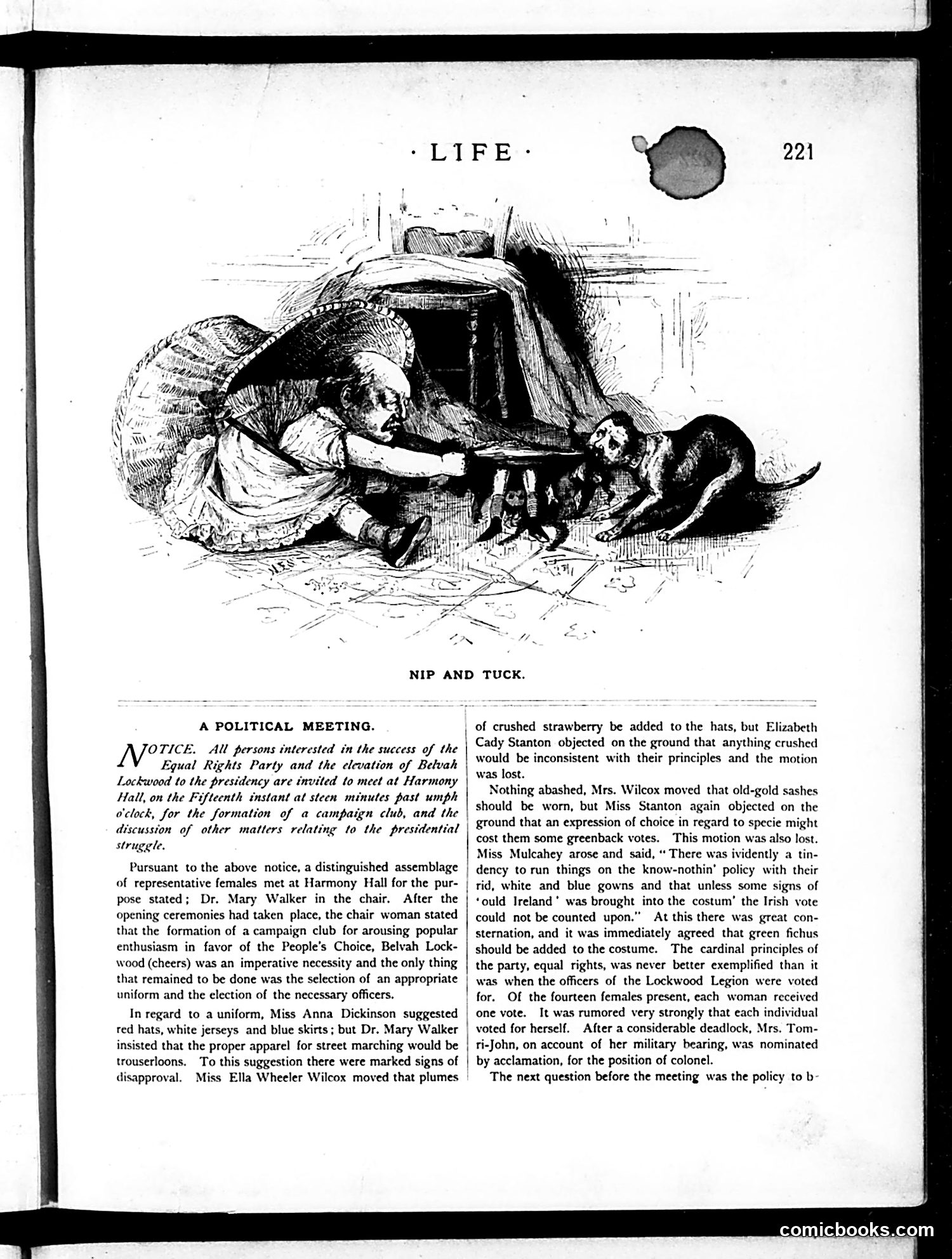
The top illustration depicts a homeless or impoverished person in a shell-like shelter with a dog, titled "Nip and Tuck"—likely a period expression meaning "close" or "evenly matched," here satirizing the struggle for survival. The bottom article mocks an "Equal Rights Party" campaign meeting at Harmony Hall. The satire centers on internal disputes over the uniform and platform—members argued about whether to wear plumes, white sashes, or trousers, and debated costume details like Irish symbols. The piece ridicules the organization's inability to agree on basic principles, suggesting the party prioritizes appearance and symbolic gestures over substantive political action. The deadlock over such trivial matters implies the group is ineffectual and disorganized.
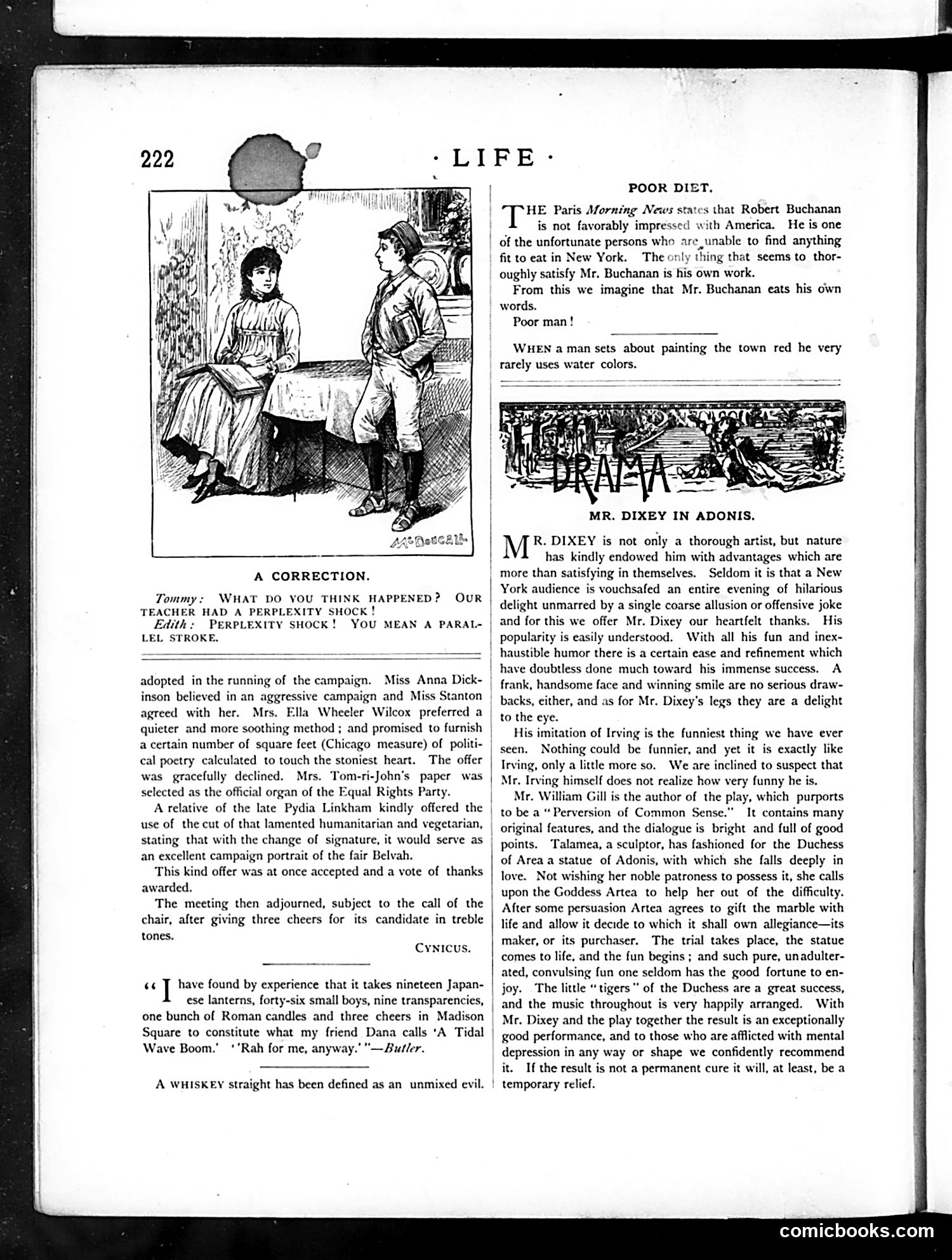
This page contains two distinct items: **"A Correction"** (left cartoon): A dialogue between Tommy and his teacher about a "perplexity shock." The cartoon illustrates a humorous misunderstanding—Tommy mishears "paralysis" as "perplexity," a child's malapropism joke. The surrounding text discusses women's suffrage campaigning, mentioning activists like Anna Dickinson and Ella Wheeler Wilcox organizing political strategy for the Equal Rights Party. **"Mr. Dixey in Adonis"** (right section): A theater review praising performer Henry Dixey's performance in the play *Adonis*. The reviewer praises his comedic talents, particularly his imitation of actor Henry Irving, and notes the play's refined humor without coarse content—unusual enough to merit special thanks. The plot involves a sculptor's statue of Adonis magically brought to life. Both pieces exemplify *Life*'s satirical approach: gentle mockery of everyday confusion alongside entertainment criticism.
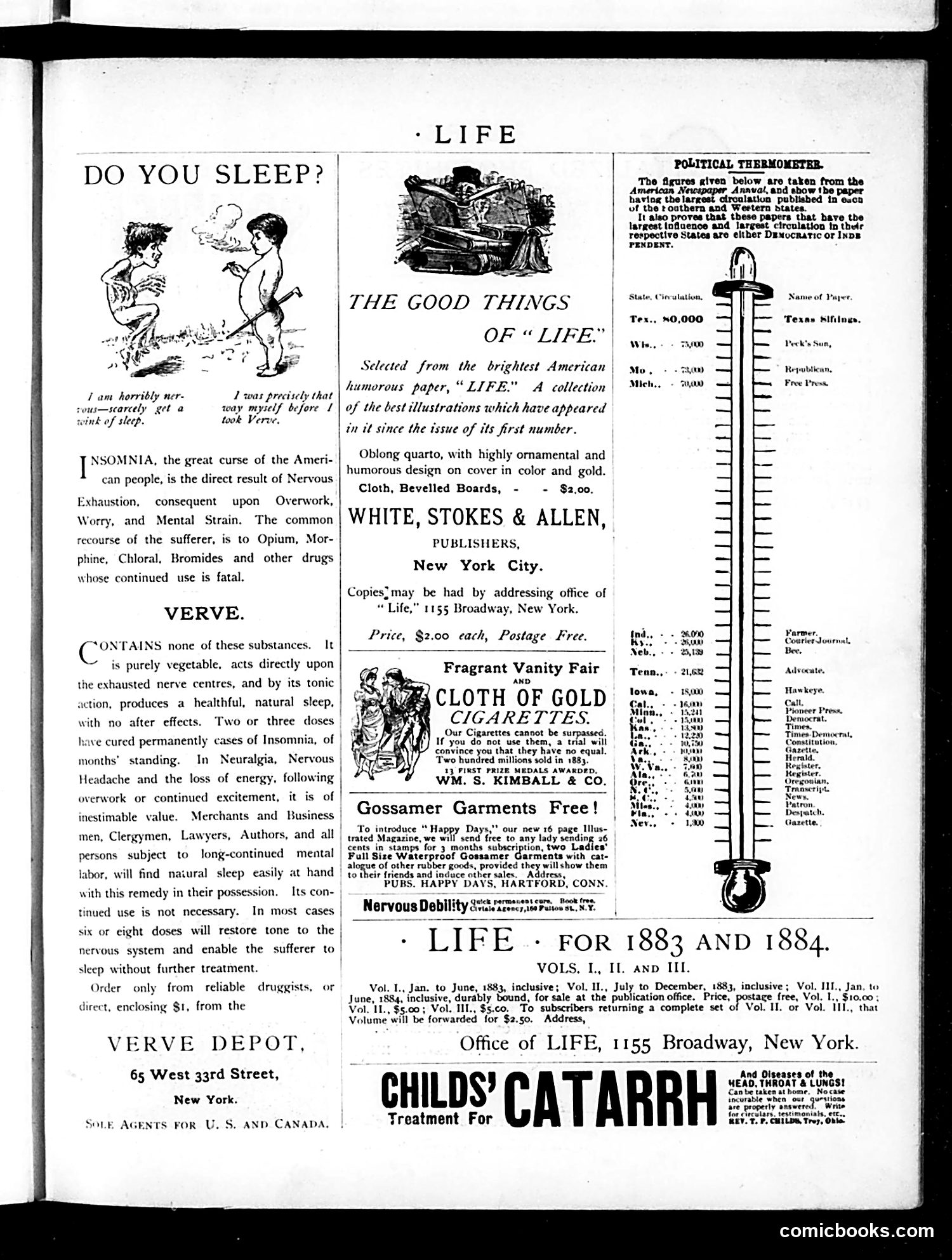
This page features a satirical cartoon mocking America's insomnia epidemic and the patent medicine industry's exploitative response. ## The Cartoon Two cherubic figures illustrate the problem: one claims "I am horribly nervous—scarcely get a wink of sleep," while the other boasts of taking "Verve" before bed. The joke targets widespread nervous exhaustion from overwork, attributed to the era's industrial pace. ## The Satire Life ridicules the pseudoscientific remedies flooding 1880s America. "Verve," a vegetable tonic, promises to cure insomnia without opium or chloral—yet the advertisement itself admits these dangerous drugs remain common treatments. The surrounding ads for cigarettes, gossamer garments, and "Nervous Debility" cures exemplify the predatory marketing targeting desperate consumers. ## Context This reflects genuine anxiety about modernity: rapid industrialization, mental strain, and overstimulation created real health concerns. Patent medicine companies capitalized on these fears with largely ineffective or harmful products. Life's satire exposed this medical quackery while acknowledging the legitimate crisis.
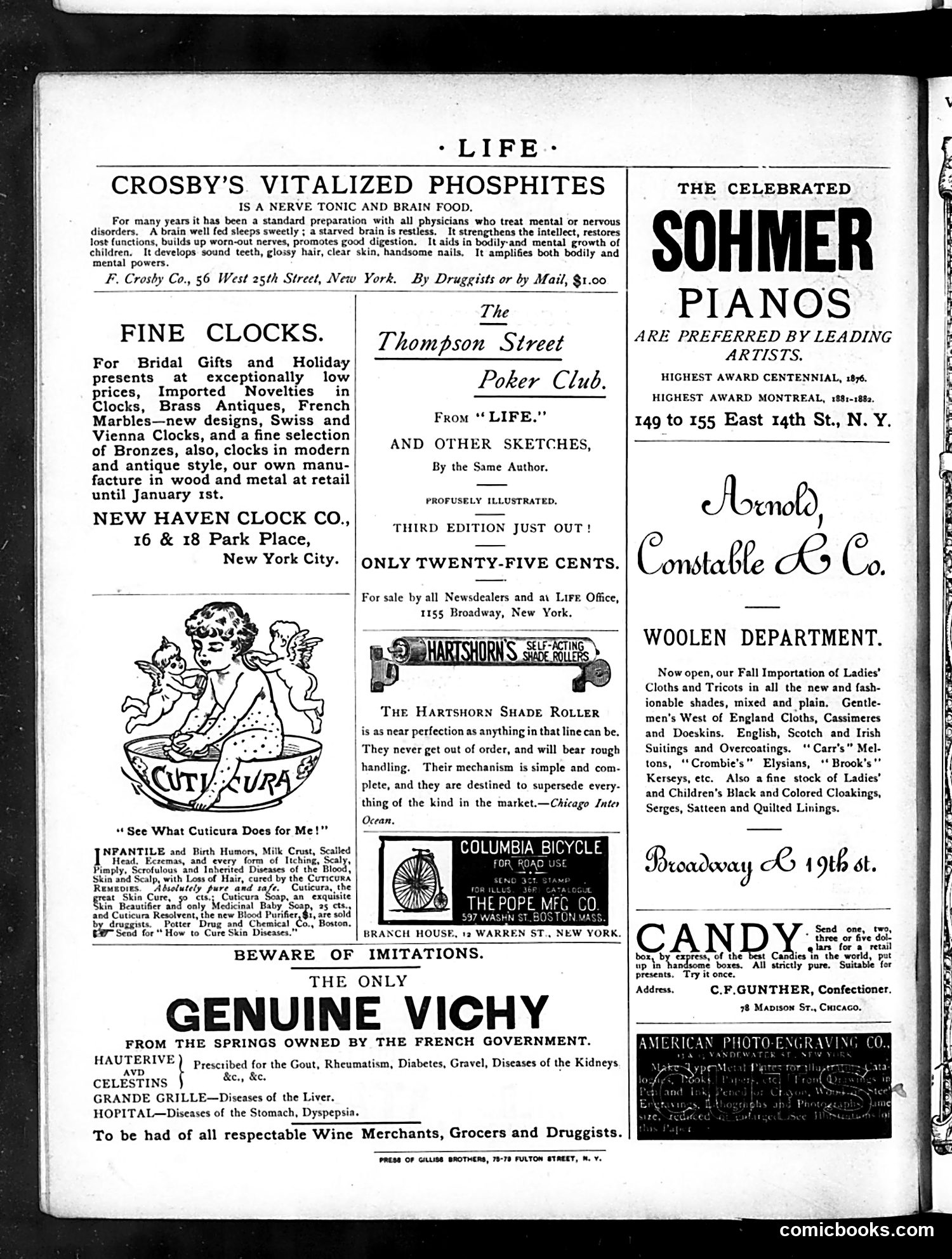
This is primarily an **advertising page** with no political cartoon content. The page consists entirely of late-19th-century product advertisements and promotional material. The ads showcase period remedies and goods: Crosby's "Vitalized Phosphites" (a nerve tonic claiming to cure mental disorders), Cuticura products (for skin conditions), and various luxury items (Sohmer pianos, fine clocks, bicycles). Notably, there's a small illustration—cherubs in a bathtub labeled "See What Cuticura Does for Me!"—which humorously suggests the product transforms children into cherubic perfection. The page also advertises a book: *Thompson Street Poker Club* sketches by the same author, priced 25 cents. **For modern readers**: This reflects the era's unregulated medical advertising, where companies made extravagant health claims without FDA oversight. The tone is earnest rather than satirical—Life magazine itself here functions as an advertising vehicle, not social commentary.