
A complete issue · 16 pages · 1884
Life — October 9, 1884
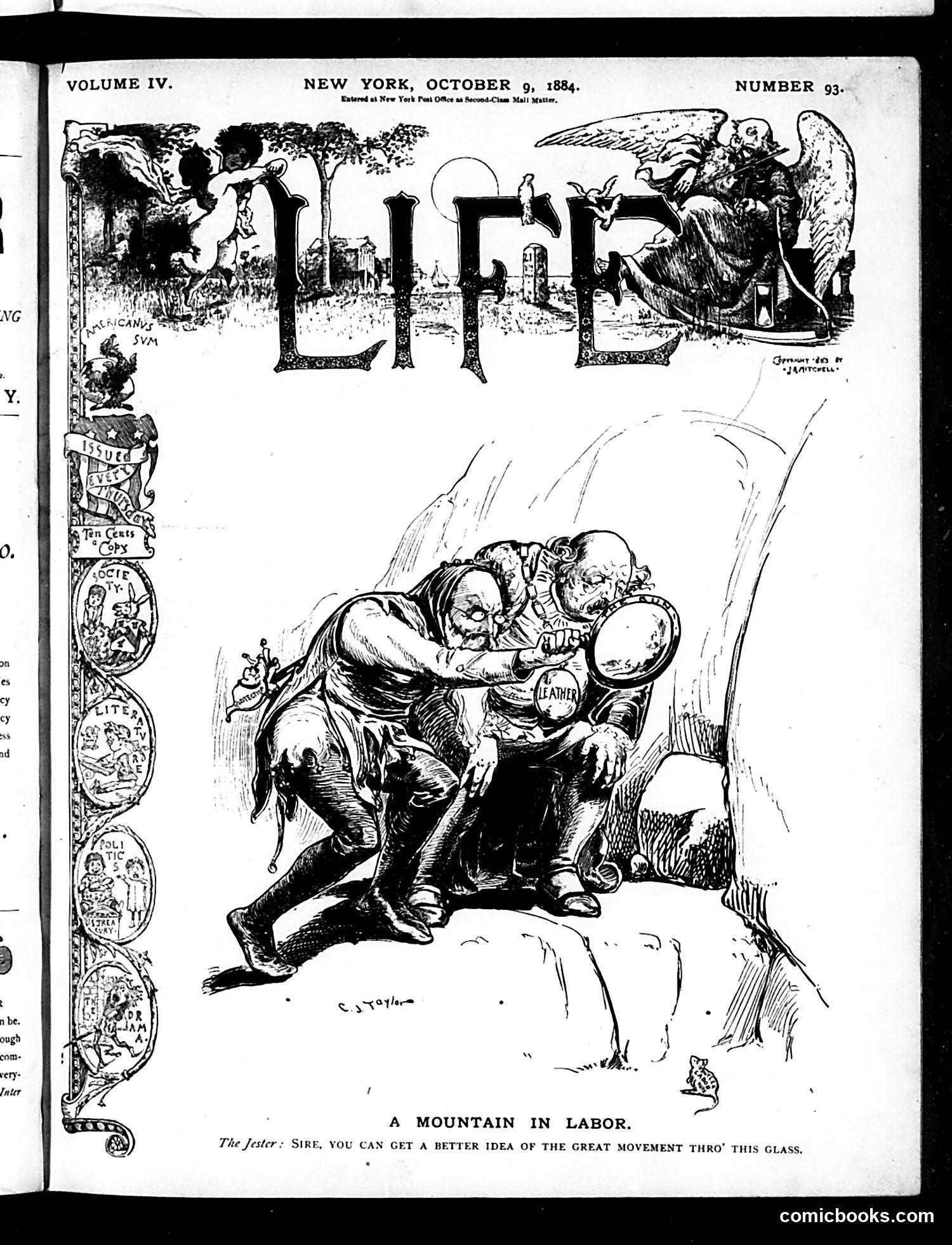
This October 1884 *Life* cartoon satirizes the labor movement's perceived ineffectiveness. The title references Aesop's fable "The Mountain in Labor," where dramatic buildup produces trivial results—here, workers straining mightily appear to accomplish nothing of consequence. The jester's caption mocks "the great movement" through "this glass," suggesting the labor movement is being examined and found wanting. The caricatured workers, depicted with exaggerated features common to 19th-century satirical art, strain within what appears to be a cave or enclosed space—visually representing constraint or futility. The cartoon reflects elite skepticism toward organized labor during the 1880s, a period of significant labor unrest and strikes in America. *Life* magazine's satirical stance dismisses workers' organizing efforts as ultimately producing negligible change.
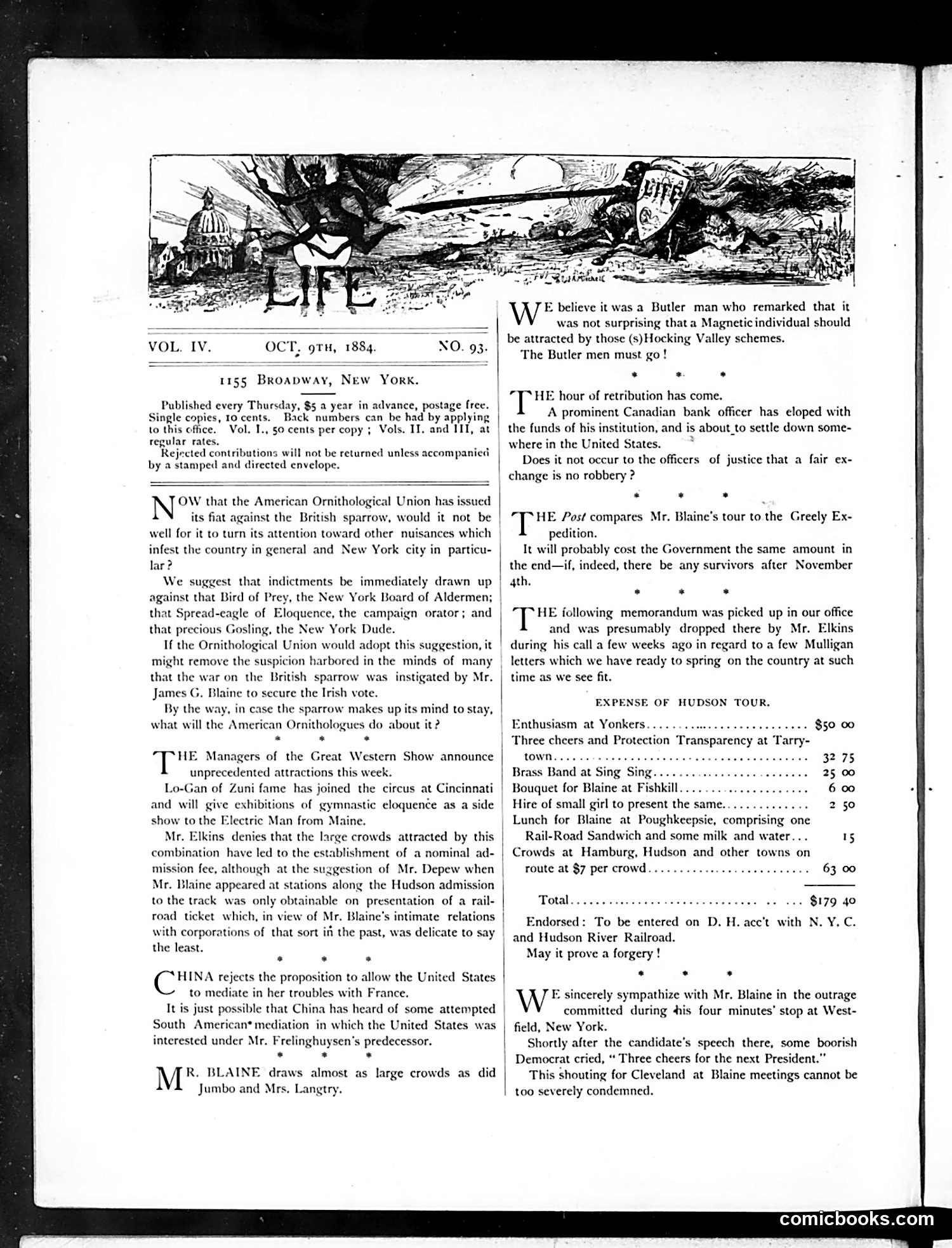
This page contains political commentary from the 1884 presidential campaign. The text references **Mr. Blaine** (likely James G. Blaine, the Republican candidate) and mentions his tour compared to a "Greely Expedition," suggesting his campaign efforts are as ambitious and costly as an Arctic expedition. There's criticism of Democratic disruptions at Blaine rallies in Westfield, New York, where hecklers shouted "Three cheers for Cleveland"—referring to Democrat Grover Cleveland, Blaine's opponent. An itemized "Expense of Hudson Tour" lists campaign costs totaling $179.40, mocking the financial extravagance of campaign activities. The overall tone satirizes the expense and chaos of 1884 campaign politics, particularly attacking Republican campaign management and Democratic rowdiness at rallies.
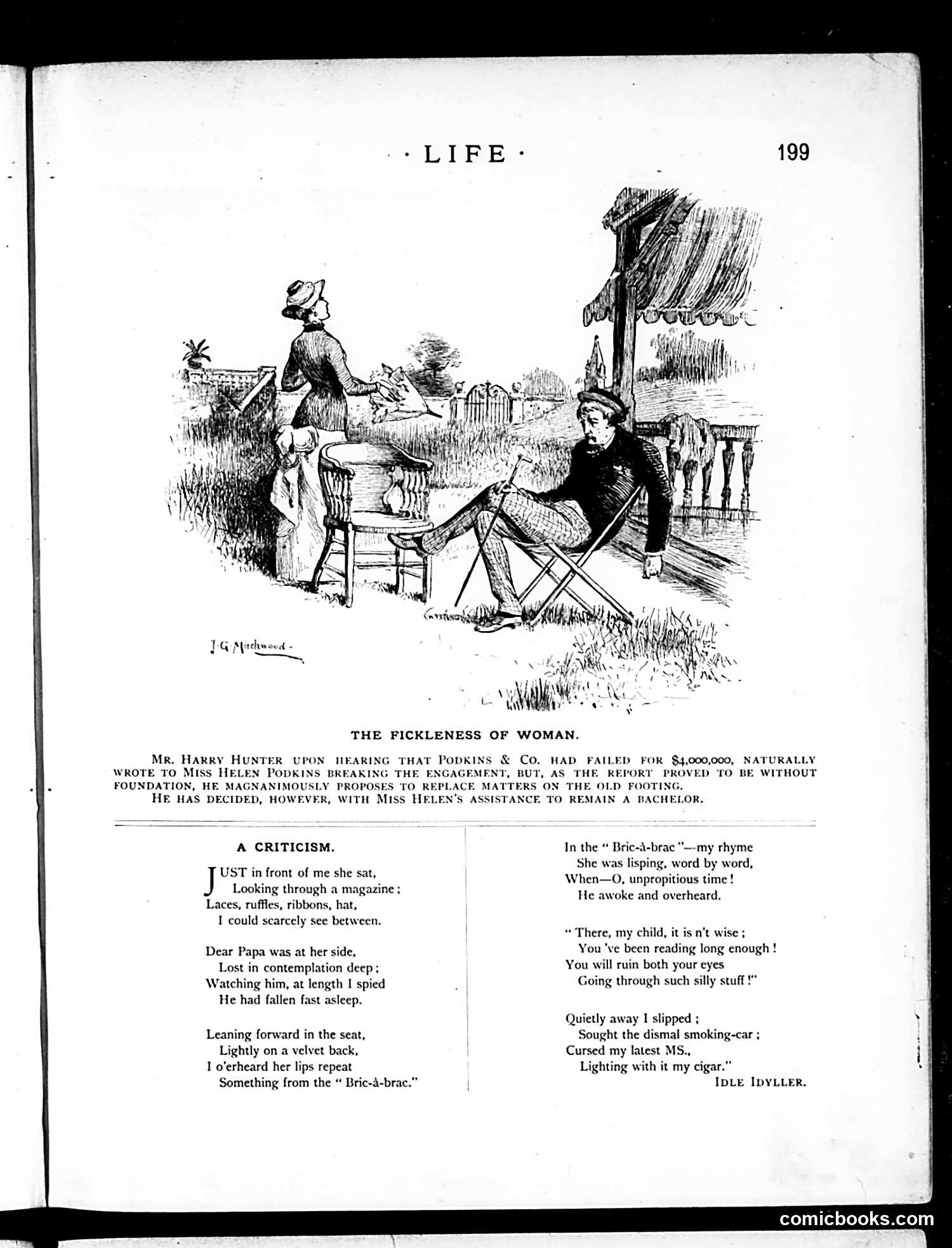
This Life magazine page contains two pieces: **"The Fickleness of Woman"** (top cartoon): A satirical jab at a wealthy businessman named Harry Hunter. The caption explains that upon hearing Podkins & Co. failed for $4,000,000, Hunter wrote to Miss Helen Podkins breaking their engagement. However, when the Podkins family lost their fortune, Hunter magnanimously proposed to remain as a bachelor rather than burden Miss Helen with his assistance. The cartoon mocks Hunter's self-serving logic—he abandoned the woman when her family lost money, then congratulated himself for his "generosity" in not forcing her to marry him under reduced circumstances. It's satire about male hypocrisy and fortune-hunting. **"A Criticism"** (bottom poems): Two contrasting pieces about women reading in public. The first criticizes a woman absorbed in a magazine while her father sleeps nearby; the second humorously recounts a man catching his wife reading French poetry aloud, prompting him to escape to a smoking car rather than endure her literary pursuits.
This page contains political campaign satire from an unspecified era. The left column lists mock "devices for campaign transparencies" (campaign slogans), including references to political figures like "Blaine and Bluster, Logan and Lungs" and "Maine and Mulligan." These appear to be satirical candidate names or party representatives. Below is campaign poetry mocking political rhetoric—references to "Salt River" (a euphemism for electoral defeat) and colorful insults like "Cock-eye-doodle-doo" suggest mockery of opposing politicians and their supporters. The right side contains an unrelated tribute to poet Bayard Taylor. Overall, this page uses wordplay and absurdist humor to ridicule contemporary political campaigning and speeches, though specific candidates and events remain unclear without additional historical context.
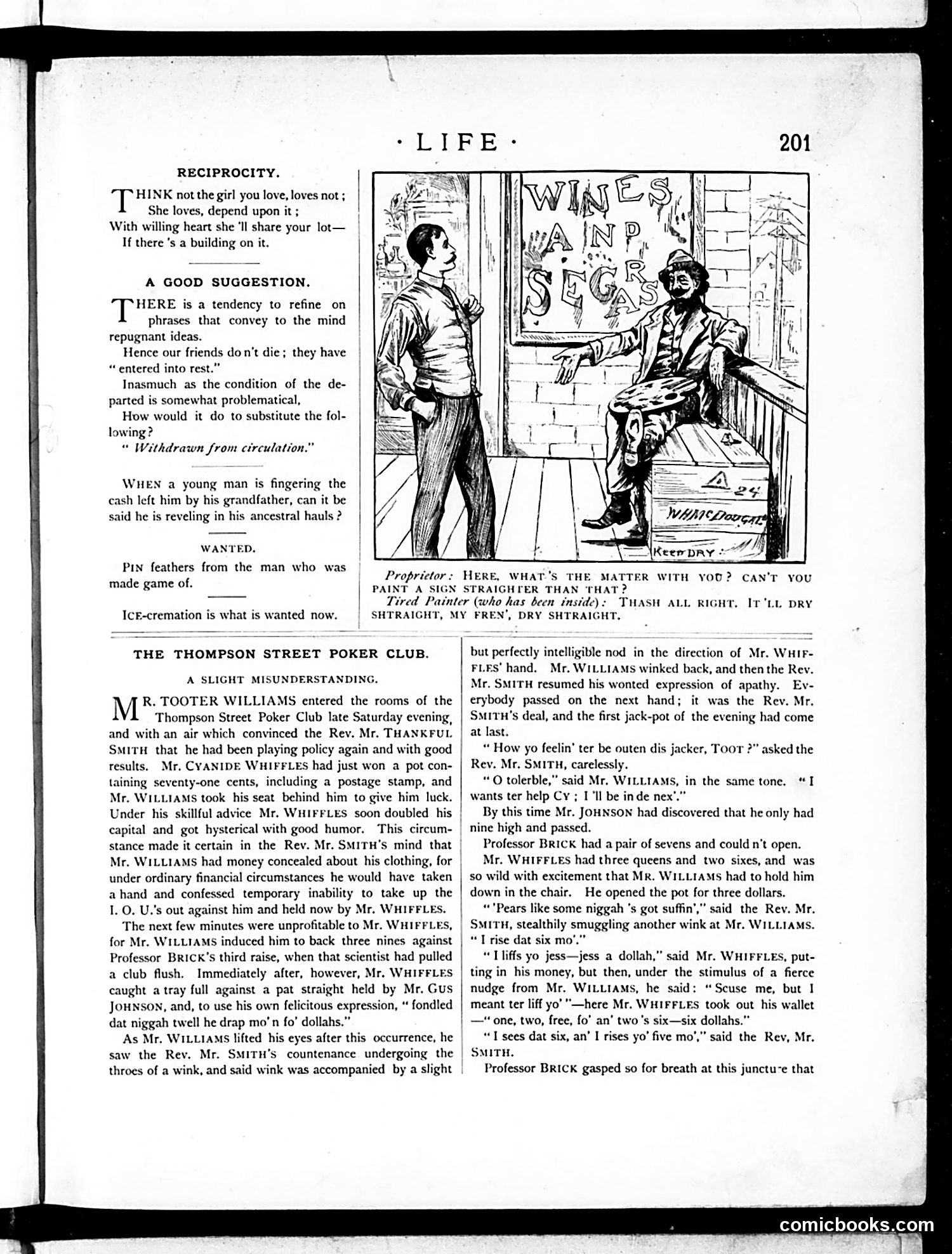
The main cartoon depicts a sign painter and proprietor in a humorous misunderstanding. The proprietor criticizes the painter's crooked "WINES AND SEGAS" sign, demanding it be painted straighter and dry immediately. The painter, appearing disheveled and possibly intoxicated, responds with exaggerated compliance. The satire targets working-class incompetence and communication breakdown—the proprietor's frustration with shoddy workmanship and the painter's comically defensive response. The painted sign's poor quality and the painter's appearance suggest he may be sampling the establishment's wares, adding irony to the complaint about crooked work. Below, "The Thomson Street Poker Club" story details a card game among gentlemen (Williams, Smith, Whiffles, Johnson, Brick) and their various misadventures involving small monetary bets and humorous misunderstandings about winnings.
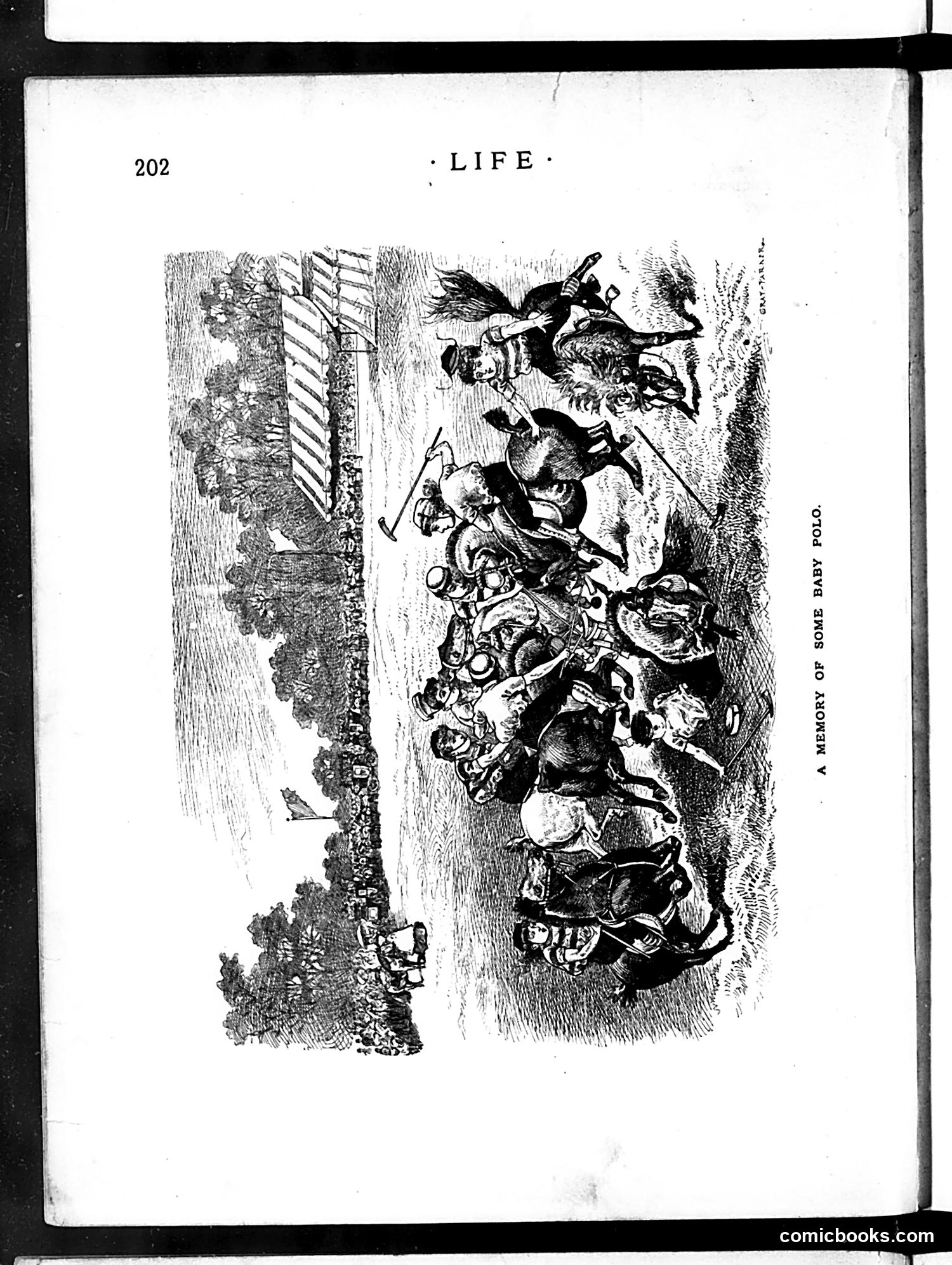
This page from *Life* magazine shows "A Memory of Some Baby Polo," a satirical engraving depicting a chaotic polo match. The cartoon mocks the sport of polo—then an exclusive pastime of the wealthy and aristocratic classes—by portraying it as absurdly rowdy and undignified. The figures appear to be exaggerated caricatures of polo players in disarray, with horses and riders tumbling about in apparent pandemonium. The satire likely critiques the pretensions of high society's sporting activities, suggesting that despite polo's reputation as a refined gentleman's game, it's actually just violent chaos masquerading as elegant sport. The engraving style and composition emphasize the disorder, mocking both the sport and those who participate in it.
This page contains a narrative story about Mr. Johnson, Mr. Whiffles, Mr. Williams, and Reverend Mr. Thankful Smith engaged in a card game and money exchange. The dialogue uses dialect humor typical of 19th-century American satire, with characters speaking in exaggerated vernacular ("Goferim!" "nigan," "dat thutty dollahs"). The joke appears to center on a confidence scheme or bet where money changes hands, with Reverend Smith serving as witness to a transaction involving $10. The comedic point relies on wordplay and the incongruity of a reverend participating in or blessing questionable financial dealings. The page also includes a serious poem, "The Wreck of the Ship" (1860), by Ward Ernest Smith, unrelated to the humorous story above.
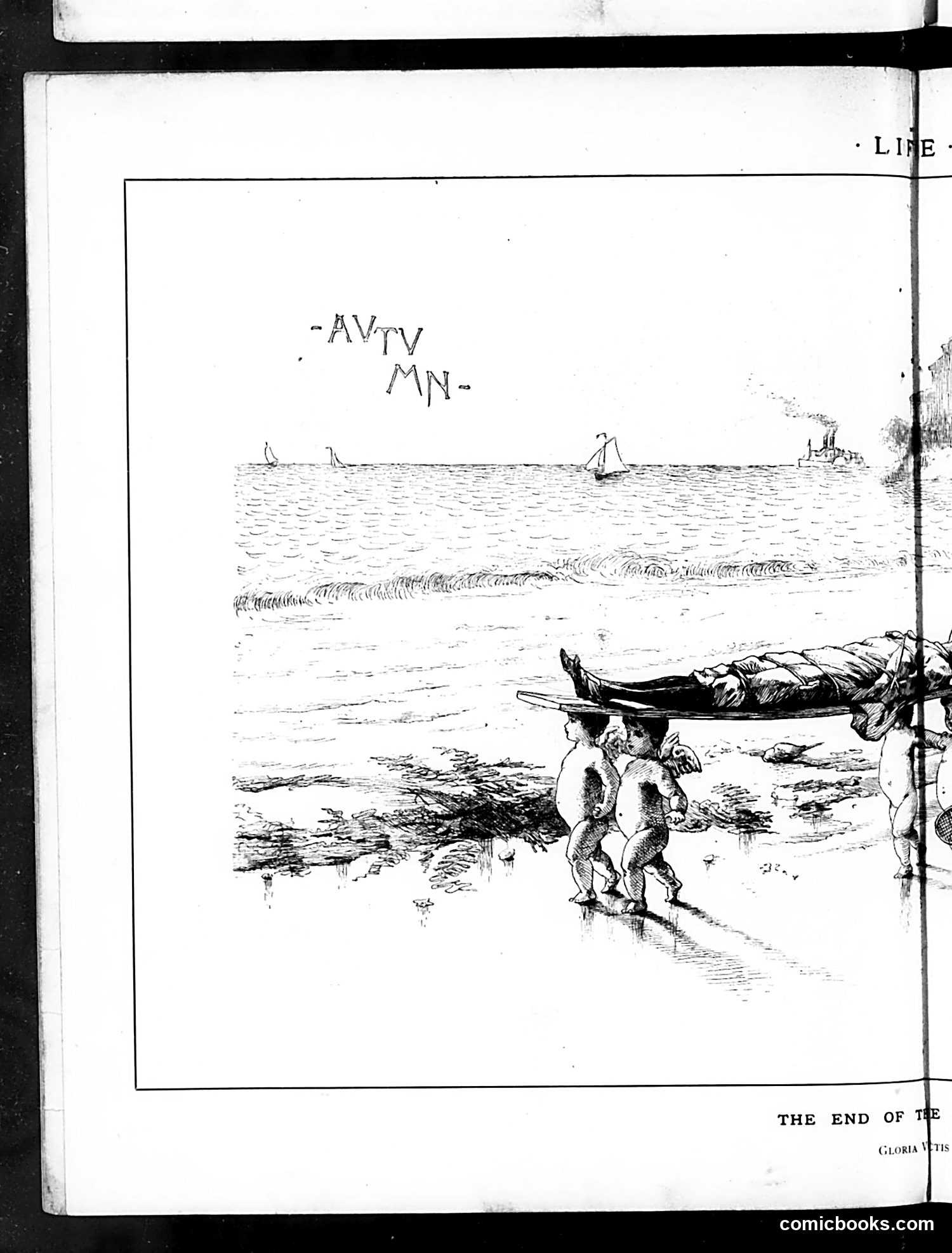
This appears to be an illustration titled "The End of the Gloria" (visible at bottom), showing a beach scene with sailboats on the water and two figures on the shore near what appears to be a beached boat or wreckage. The handwritten notation "-AVRY MN-" at the top likely indicates the artist's initials or marks. Without additional context from the surrounding magazine pages, I cannot definitively identify which specific historical event or satirical subject this references. The maritime scene with beached vessel could reference a shipwreck, maritime accident, or naval incident that Life magazine's readers would have recognized from contemporary news. To properly explain the satire and its political or social meaning, I would need either the article text accompanying this illustration or knowledge of what "Gloria" vessel this references and when this issue was published.
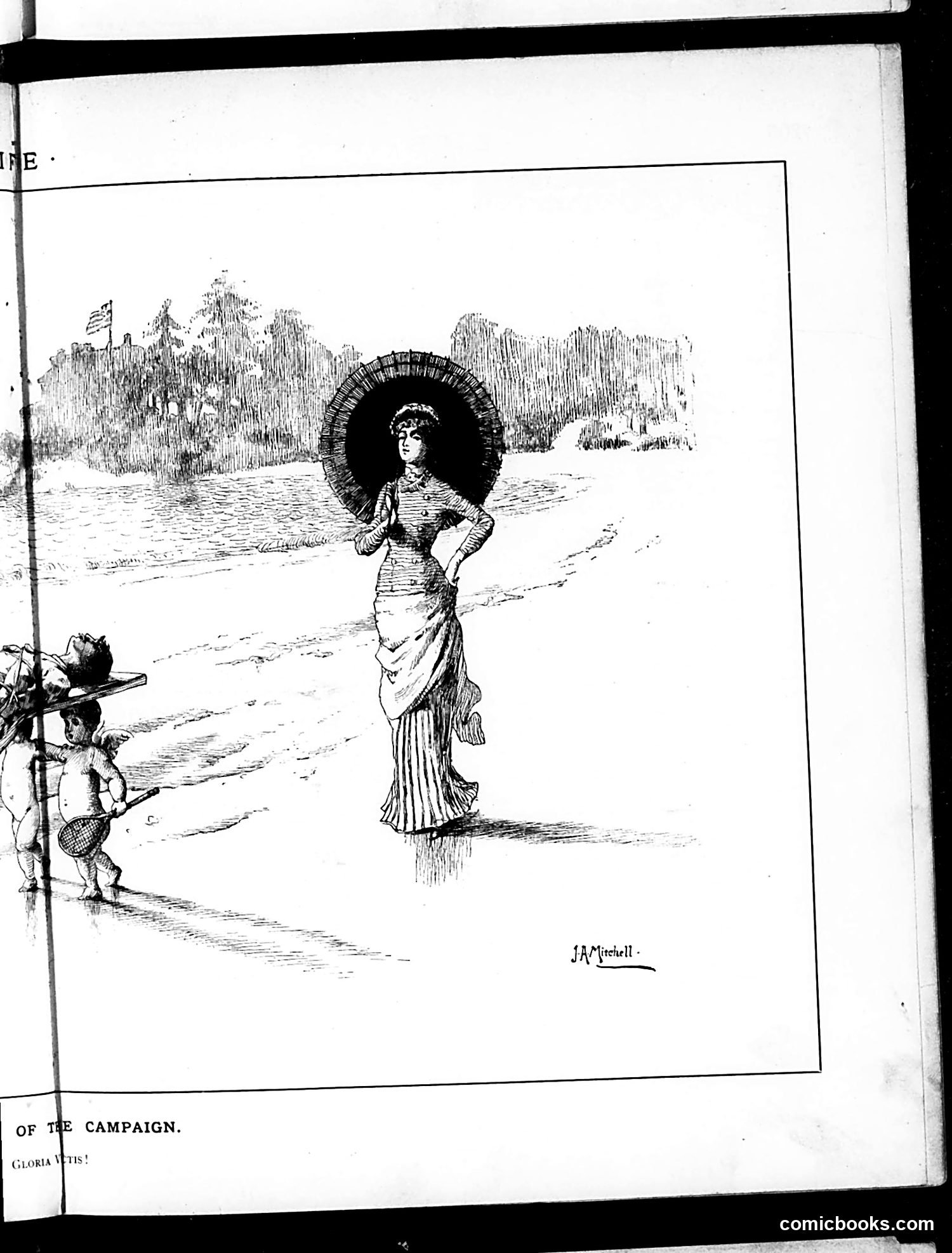
This is a satirical illustration signed by J.A. Mitchell from *Life* magazine's coverage of a political campaign (text references "OF THE CAMPAIGN"). The cartoon depicts a well-dressed woman holding a parasol while wading in water, with a small Cupid-like figure to her left. The woman appears to be a personification or allegorical figure—likely representing a political cause, candidate's wife, or abstract concept relevant to the campaign period. The exact campaign and figures remain unclear without additional context or dating information. The satirical intent appears to mock either the superficiality of political rhetoric, the role of feminine influence in politics, or the disconnect between serious political matters and frivolous public presentation—common themes in *Life* magazine's political satire of the era.
This page satirizes the confusing political debate over **"Horizontal Reduction"** in tariff policy—a term that dominated 1880s-90s trade discussions but that few people actually understood. Life's genius here is mock-serious pedantry. The article pretends to explain the concept by defining it literally: "horizontal reduction" means reduction "pertaining to or near the horizon." The satire then exposes the absurdity by showing you literally *cannot* approach a horizon—it always recedes. Therefore, horizontal reduction is impossible by definition. The author invents ridiculous pseudo-academic terms ("je-ne-sais-quoisity," "braingraspable relations") to mock the pretentious jargon politicians used to obscure simple concepts. The included anecdote about the railroad denying wage cuts demonstrates how language obscures reality—nothing actually gets clarified. **The point**: Tariff politicians deliberately used incomprehensible terminology to confuse voters about economically harmful policies. Life's absurdist takedown exposes this rhetorical fraud.
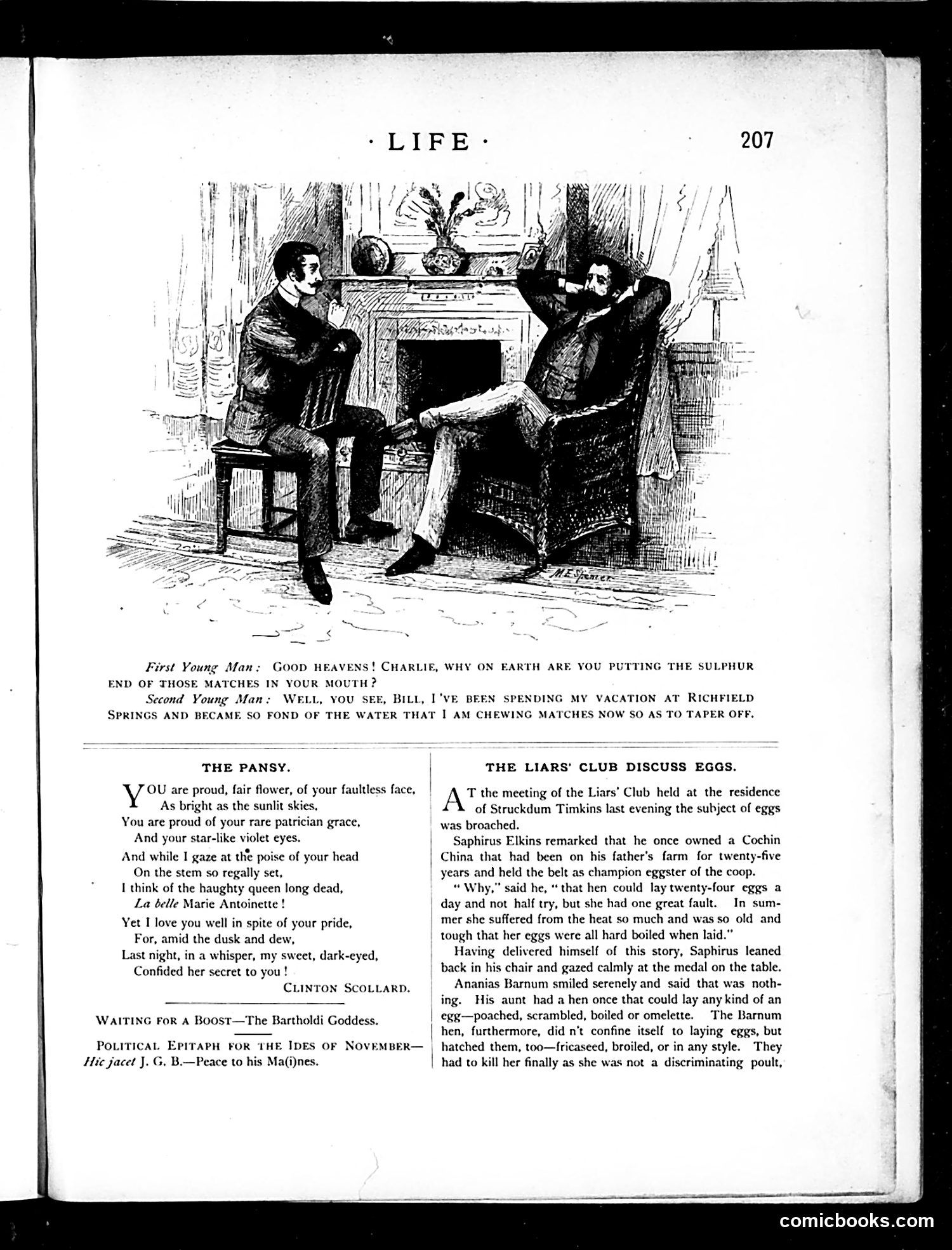
**The Cartoon (top):** Two young men discuss matches one is chewing. The second explains he's been at Richfield Springs (a mineral spa) and is now chewing sulfur-end matches to "taper off" from the water he was drinking there—a joke about the supposed medicinal properties (and taste) of mineral springs water. The humor lies in the absurd logic of substituting one unpleasant substance for another. **"The Liars' Club Discuss Eggs":** This is a tall-tale humor piece where club members compete with increasingly ridiculous fabrications about extraordinary chickens. One describes a hen laying 24 eggs daily for 25 years; another claims an aunt's hen that could lay eggs in any prepared style (poached, scrambled, omelette) without human intervention. The satire mocks the exaggeration common in boastful storytelling. **Other items:** Include poetry ("The Pansy"), a reference to Marie Antoinette, and a political epitaph (the "J.G.B." reference remains unclear without additional context).
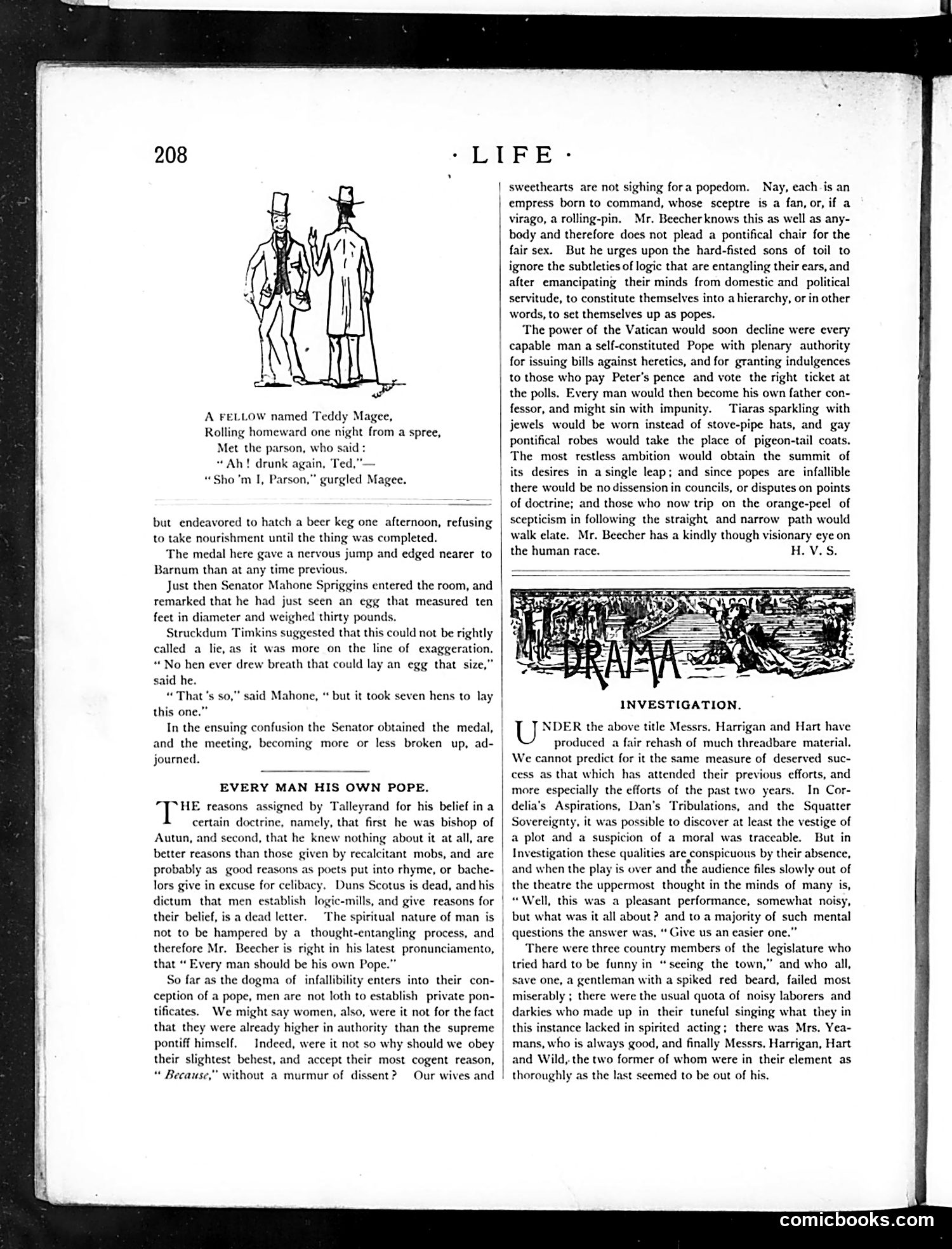
The cartoon depicts two gentlemen in top hats—likely representing pompous public figures or politicians of the era. The accompanying text mocks absurd tall tales: a man claims to have seen a ten-foot egg weighing thirty pounds, which another character defends as "exaggeration" rather than outright lying. The joke ridicules the elastic logic and dishonesty of public discourse. The main article "Every Man His Own Pope" satirizes preacher Henry Ward Beecher's advocacy for working-class self-determination. Life sarcastically imagines if every laborer became his own "pope"—self-appointed moral authority—wearing tiaras and pontifical robes instead of work clothes. The satire mocks both Beecher's idealism and the notion that ordinary men should reject established hierarchies (whether religious or social) to claim personal authority. It's fundamentally conservative political humor defending existing power structures.
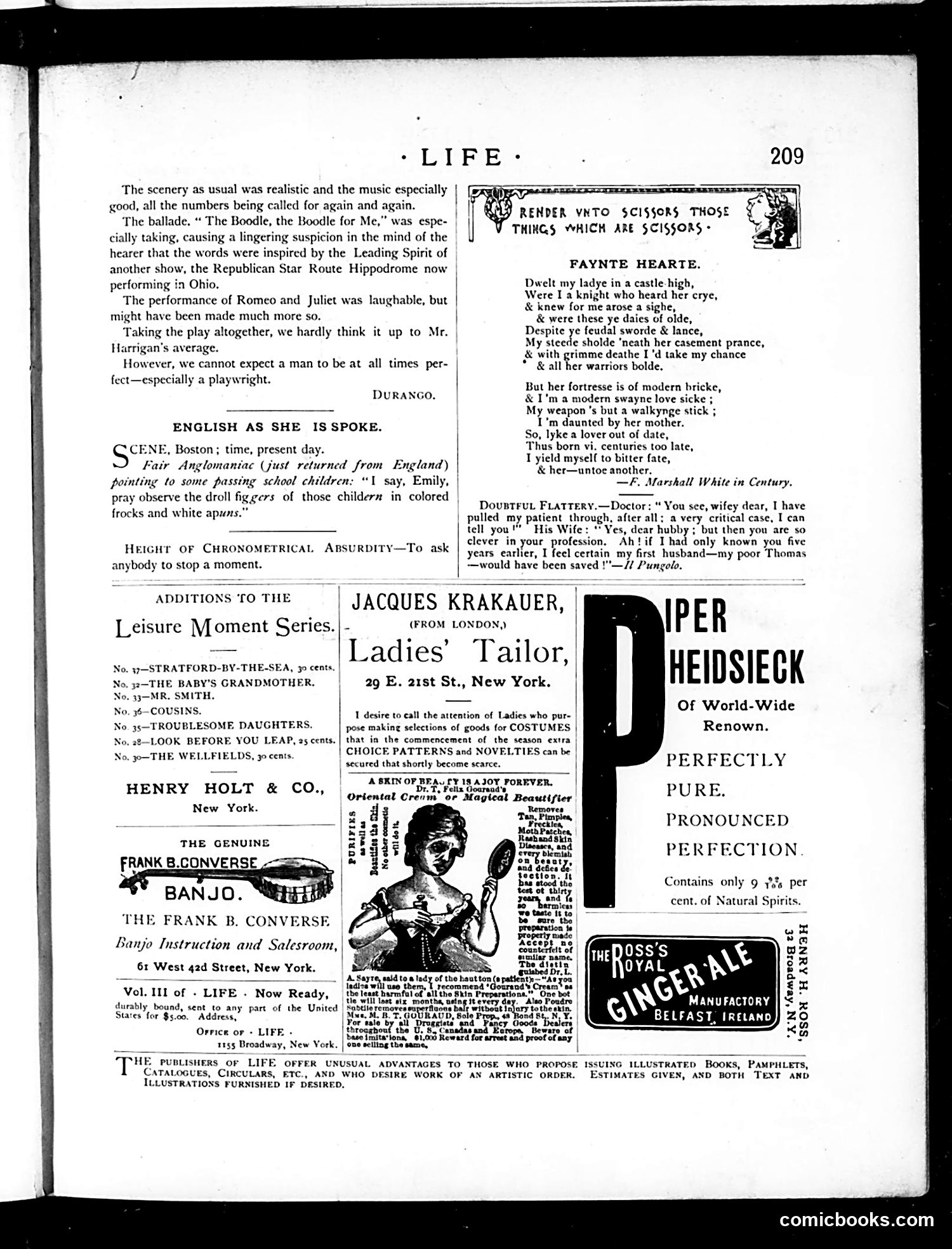
This page is primarily **advertisements and literary content** rather than political cartoons. The notable satire appears in the opening theater review section: ## "The Boodle" Reference The text mentions a song called "The Boodle, the Boodle for Me" performed at what appears to be a theatrical production by Harrigan (likely Edward Harrigan, a prominent 19th-century playwright). The author suspects the lyrics were inspired by the "Republican Star Route Hippodrome" performing in Ohio—a satirical jab at Republican corruption. "Star Route" refers to the actual **Star Route Mail Fraud scandal** of the 1880s, where Republican officials were accused of embezzling postal contract money. The joke implies the song's celebration of "boodle" (slang for bribes/stolen money) was inspired by real Republican graft. ## Other Content The page includes poetry ("Faynte Hearte"), a medical humor piece about flattery, and numerous period advertisements for banjos, tailors, and beauty products. The "English as She Is Spoke" section mocks affected Anglophilia—a common Life satire target.
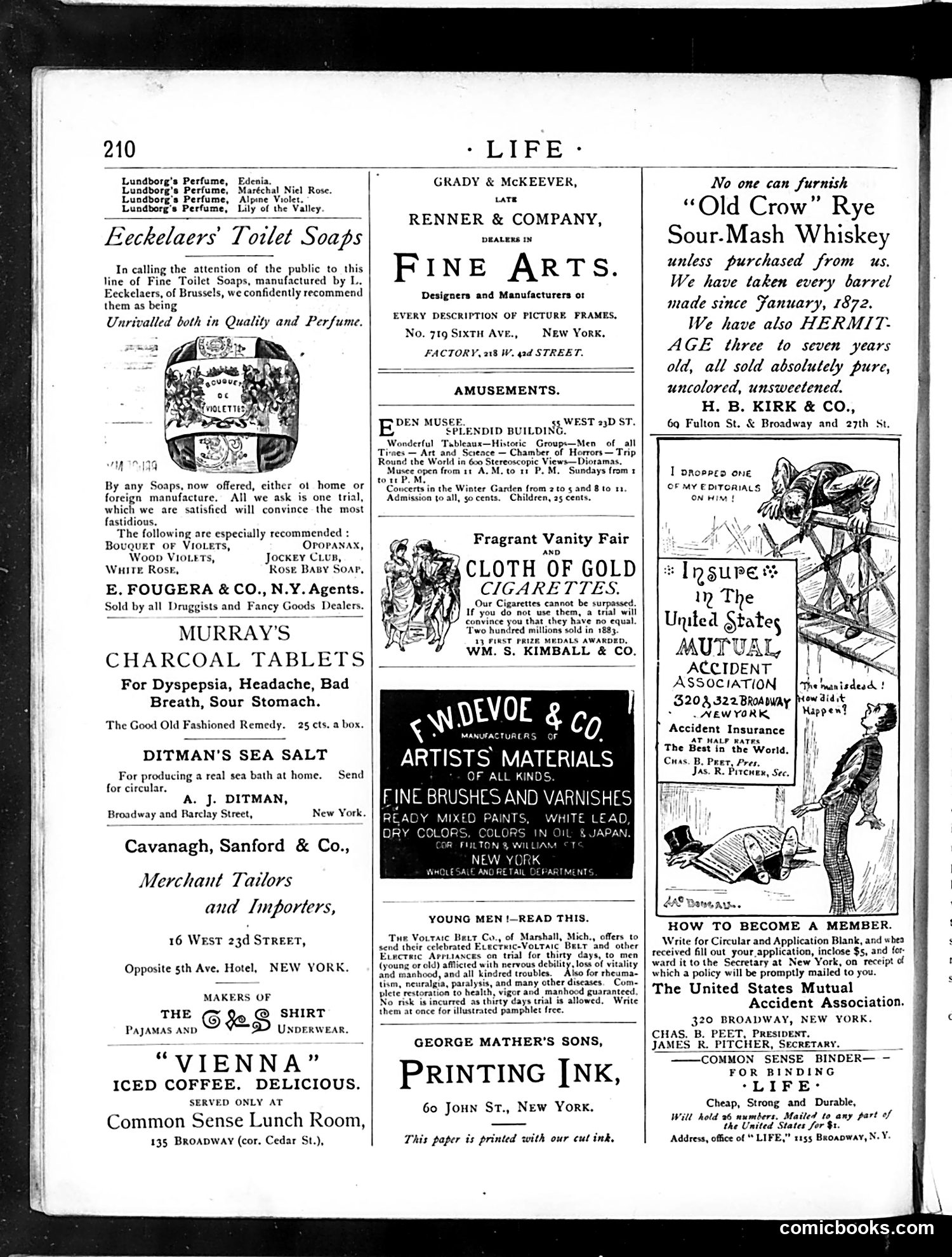
This is primarily an advertising page from *Life* magazine. There is one notable cartoon titled "Suppose one of my editorials on my neck" (top right), which appears to be a humorous editorial cartoon mocking journalists or editors—it shows what seems to be a person or caricature, though the image quality makes specific identification difficult. The cartoon likely satirizes self-importance or pretension among magazine writers. The remainder of the page contains period advertisements for consumer products (soaps, ink, charcoal tablets, whiskey), merchant services (tailoring, lunch rooms), and medical devices (notably the "Voltaic Belt," a dubious electrical apparatus marketed to men for treating "nervous debility"). This reflects late 19th-century commercial culture and pseudo-scientific medicine. The cartoon's presence suggests *Life*'s editorial voice critiquing contemporary society, even as its pages relied heavily on advertising revenue.
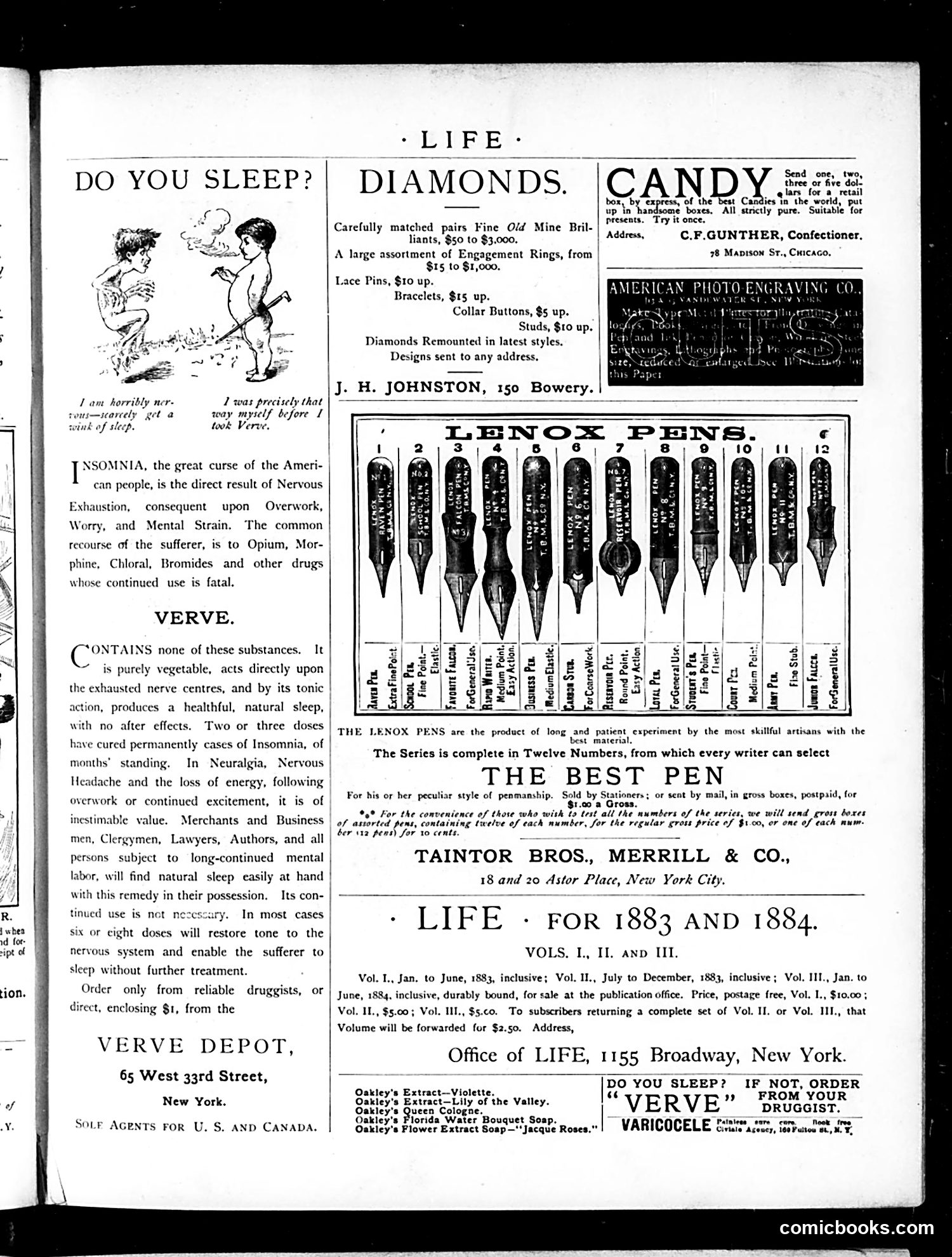
This page is primarily **advertising**, not political satire. The dominant content is a promotional campaign for **Verve**, a patent medicine claiming to cure insomnia. The small cartoon at top-left shows two cherubic figures: one claiming "I am horribly nervous—scarcely get a wink of sleep," the other responding "I was precisely that way myself before I took Verve." This is a simple before/after testimonial device. The lengthy text below makes expansive health claims: Verve allegedly cures insomnia caused by "Nervous Exhaustion" from overwork and worry. Crucially, it advertises itself as superior to dangerous alternatives—opium, morphine, chloral, and bromides—whose "continued use is fatal." The product targets professionals: merchants, clergymen, lawyers, and authors. The page also advertises diamonds, pens, candy, and other products typical of 1880s magazines. The Verve depot address in New York is prominently listed. This reflects the era's unregulated patent medicine market, where extravagant health claims were standard advertising practice.
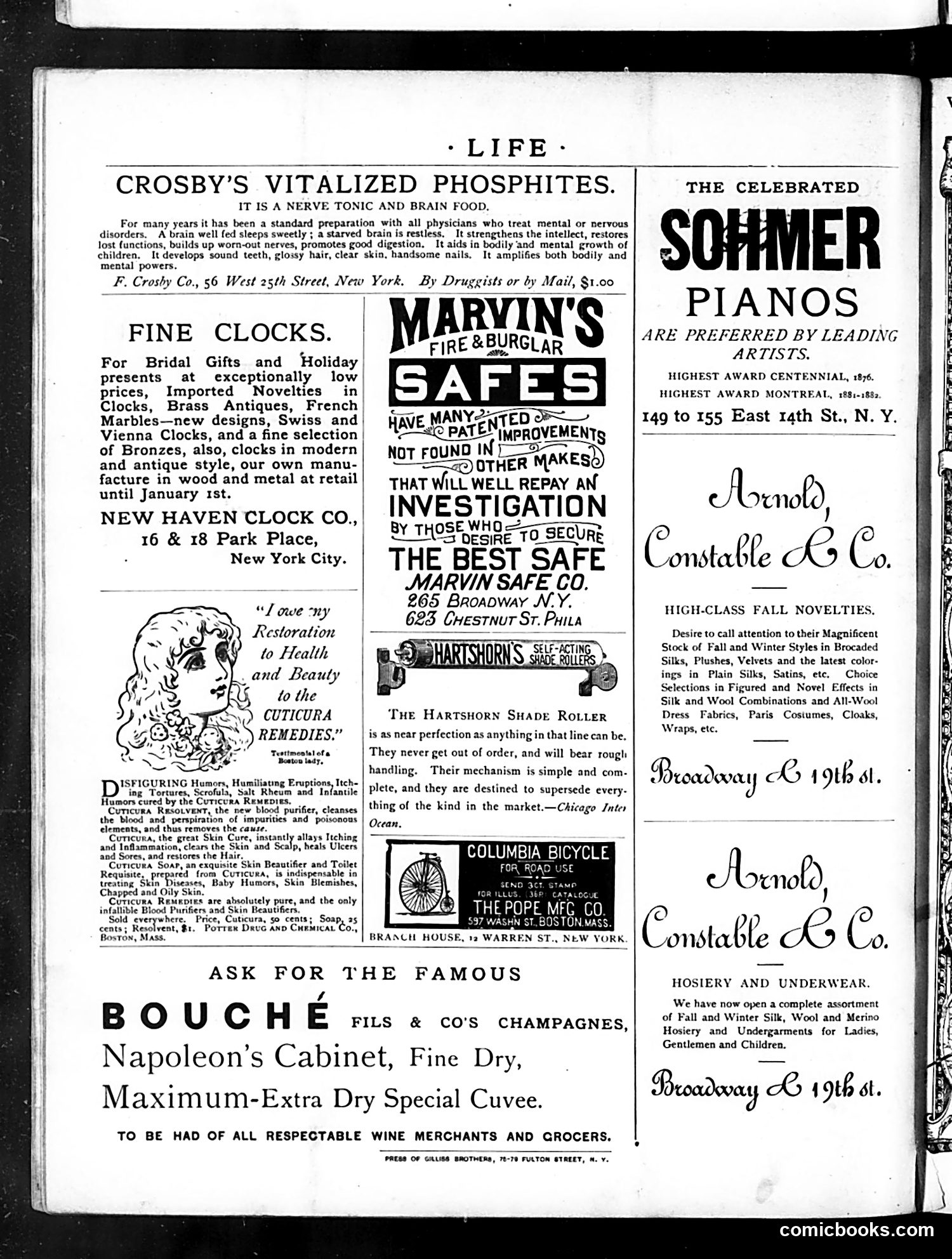
This is primarily an **advertising page** with minimal editorial content. The page features late 19th-century patent medicines and luxury goods typical of the era. The most notable advertisement is **Marvin's Fire & Burglar Safes**, which uses comparative marketing language claiming superiority over competitors. The ad boasts "patented improvements not found in other makes" and invites investigation—a rhetorical strategy common when products made dubious claims. Other prominent ads include **Crosby's Vitalized Phosphites** (a nerve tonic claiming to cure mental disorders and improve appearance), **Cuticura Remedies** (for skin conditions), and luxury items like **Sohmer Pianos** and **Arnold Constable & Co.** clothing. These advertisements reflect Victorian-era attitudes: faith in patent medicines to cure ailments we'd now recognize as requiring legitimate medical care, and aspirational marketing toward middle/upper-class consumers. The page contains **no political cartoons or satire**—it's purely commercial content showcasing what Life magazine monetized.