
Life, 1884-10-09 · page 12 of 16
Life — October 9, 1884 — page 12: what you’re looking at
What you’re looking at
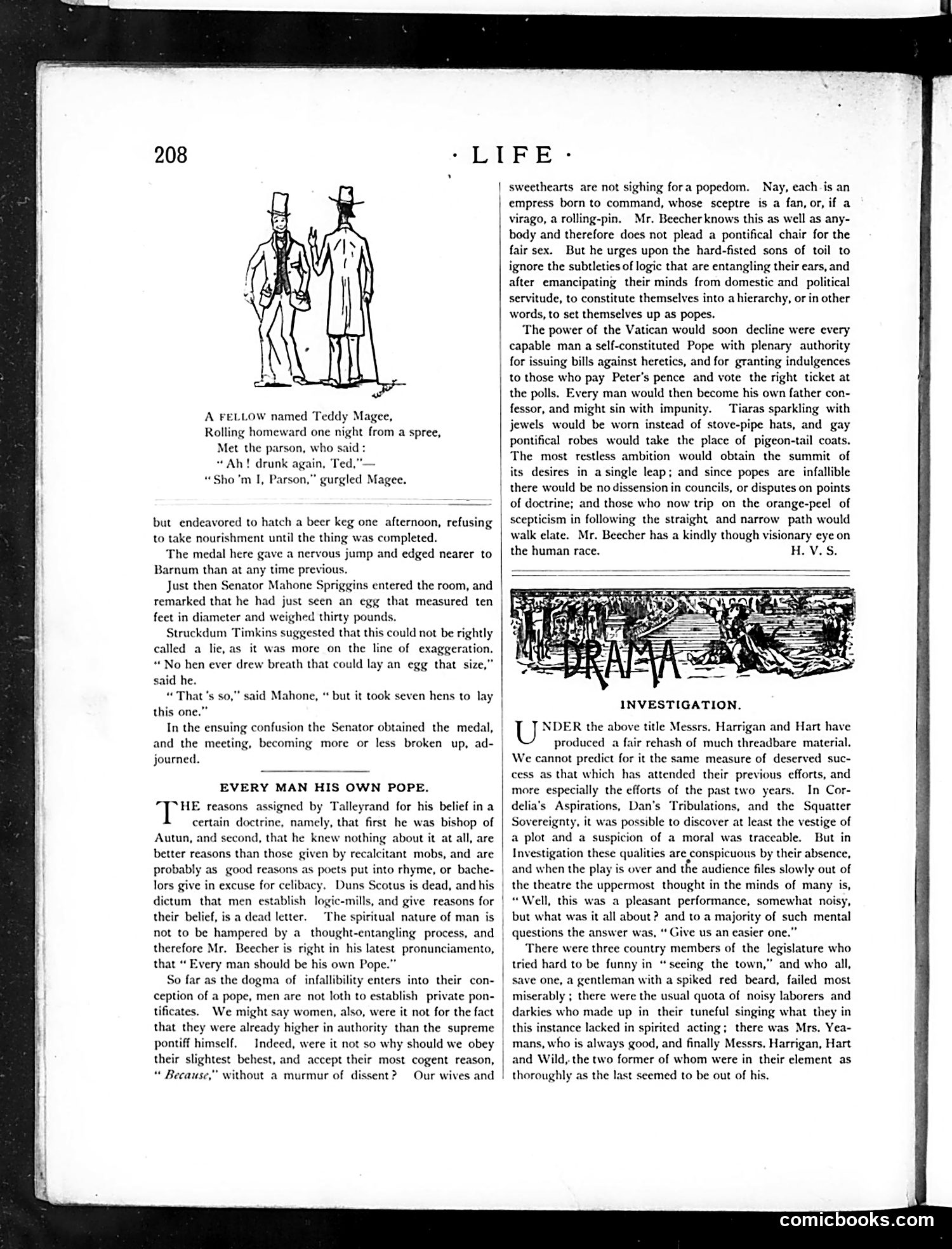
The cartoon depicts two gentlemen in top hats—likely representing pompous public figures or politicians of the era. The accompanying text mocks absurd tall tales: a man claims to have seen a ten-foot egg weighing thirty pounds, which another character defends as "exaggeration" rather than outright lying. The joke ridicules the elastic logic and dishonesty of public discourse. The main article "Every Man His Own Pope" satirizes preacher Henry Ward Beecher's advocacy for working-class self-determination. Life sarcastically imagines if every laborer became his own "pope"—self-appointed moral authority—wearing tiaras and pontifical robes instead of work clothes. The satire mocks both Beecher's idealism and the notion that ordinary men should reject established hierarchies (whether religious or social) to claim personal authority. It's fundamentally conservative political humor defending existing power structures.
📄 Transcribed text from this page (OCR, searchable)
Machine-transcribed from the original scan — historical spelling and the odd misread are preserved.
-LIFE-: A FELLOW named Teddy Magee, Rolling homeward one night from a spree, Met the parson, who said : “Ah! drunk again, Ted sho 'm I, Parson,” gurgled Magee. but endeavored to hatch a beer keg one afternoon, refusing | to take nourishment until the thing was completed. The medal here gave a nervous jump and edged nearer to Barnum than at any time previo Just then Senator Mahone Spriggins entered the room, and remarked that he had just seen an egg that measured ten feet in diameter and weighed thirty pounds. Struckdum Timkins suggested that this could not be rightly called a lie, as it was more on the line of exaggeration. “No hen ever drew breath that could lay an egg that size,” said he. “ That's so,” said Mahone, “ but it took seven hens to lay this one.” In the ensuing confusion the Senator obtained the medal, and the meeting, becoming more or less broken up, ad- journed. EVERY MAN HIS OWN POPE. TM reasons assigned by Talleyrand for his belief ina certain doctrine, namely, that first he was bishop of Autun, and second, that he knew nothing about it at all, are better reasons than those given by recalcitant mobs, and are probably as good reasons as poets put into rhyme, or bache- lors give in excuse for celibs Duns Scotus is dead, and his dictum that men establish logic-mills, and give reasons for their belief, is a de: not to be hampered by a thought-entangling process, therefore Mr. Beecher i that Every man should be his own Pope.” So far as the dogma of infallibility enters into their con- ception of a pope, men are not loth to establish private pon- tificates. We might say women, also, were it not for the fact that they were already higher in authority than the supreme pontiff himself. Indeed, were it not so why should we obey their slightest behest, and accept their most cogent reason, “ Because,” without a murmur of dissent? Our wives and The spiritual nature of man is | and | right in his latest pronunciamento, | sweethearts are not sighing fora popedom. Nay, each-is an empress born to command, whose sceptre is a fan, or, if a virago, a rolling-pin. Mr. Beecher knows this as well as any- | body and therefore does not plead a pontifical chair for the fair sex. But he urges upon the hard-fisted sons of toil to ignore the subtleties of logic that are entangling their ears, and after emancipating their minds from domestic and political servitude, to constitute themselves into a hierarchy, or in other words, to set themselves up as popes. The power of the Vatican would soon decline were every capable man a self-constituted Pope with plenary authority | for issuing bills against heretics, and for granting indulgences to those who pay Peter’s pence and vote the right ticket at the polls. Every man would then become his own father con- fessor, and might sin with impunity. Tiaras sparkling with jewels would be worn instead of stove-pipe hats, and gay pontifical robes would take the place of pigeon-tail coats. The most restless ambition would obtain the summit of its desires in a single leap; and since popes are infallible there would be no dissension in councils, or disputes on points of doctrine; and those who now trip on the orange-peel of scepticism in following the straight and narrow path would walk elate. Mr. Beecher has a kindly though visionary eye on the human race. H. Vv. INVESTIGATION. NDER the above title Messrs. Harrigan and Hart have produced a fair rehash of much threadbare material. | We cannot predict for it the same measure of deserved suc- s as that which has attended their previous efforts, and more especially the efforts of the past two years. In Cor- i Aspirations, Dan's Tribulations, and the Squatter Sovereignty, it was possible to discover at least the vestige of a plot and a suspicion of a moral was traceable. But in Investigation these qualities are conspicuous by their absence, and when the play is over and the audience files slowly out of the theatre the uppermost thought in the minds of many is, “Well, this was a pleasant performance, somewhat nois but what was it all about ? and to a majority of such mental ions the answer was, “ Give us an easier one. here were three country members of the legislature who tried hard to be funny in “seeing the town,” and who all, save one, a gentleman with a spiked red beard, failed most miserably ; there were the usual quota of noisy laborers and darkies who made up in their tuneful singing what they in this instance lacked in spirited acting; there was Mrs. Yea- mans, who is always good, and finally Messrs. Harrigan, Hart and Wild, the two former of whom were in their element as thoroughly as the last seemed to be out of his. comicbooks.com