
A complete issue · 16 pages · 1884
Life — September 25, 1884
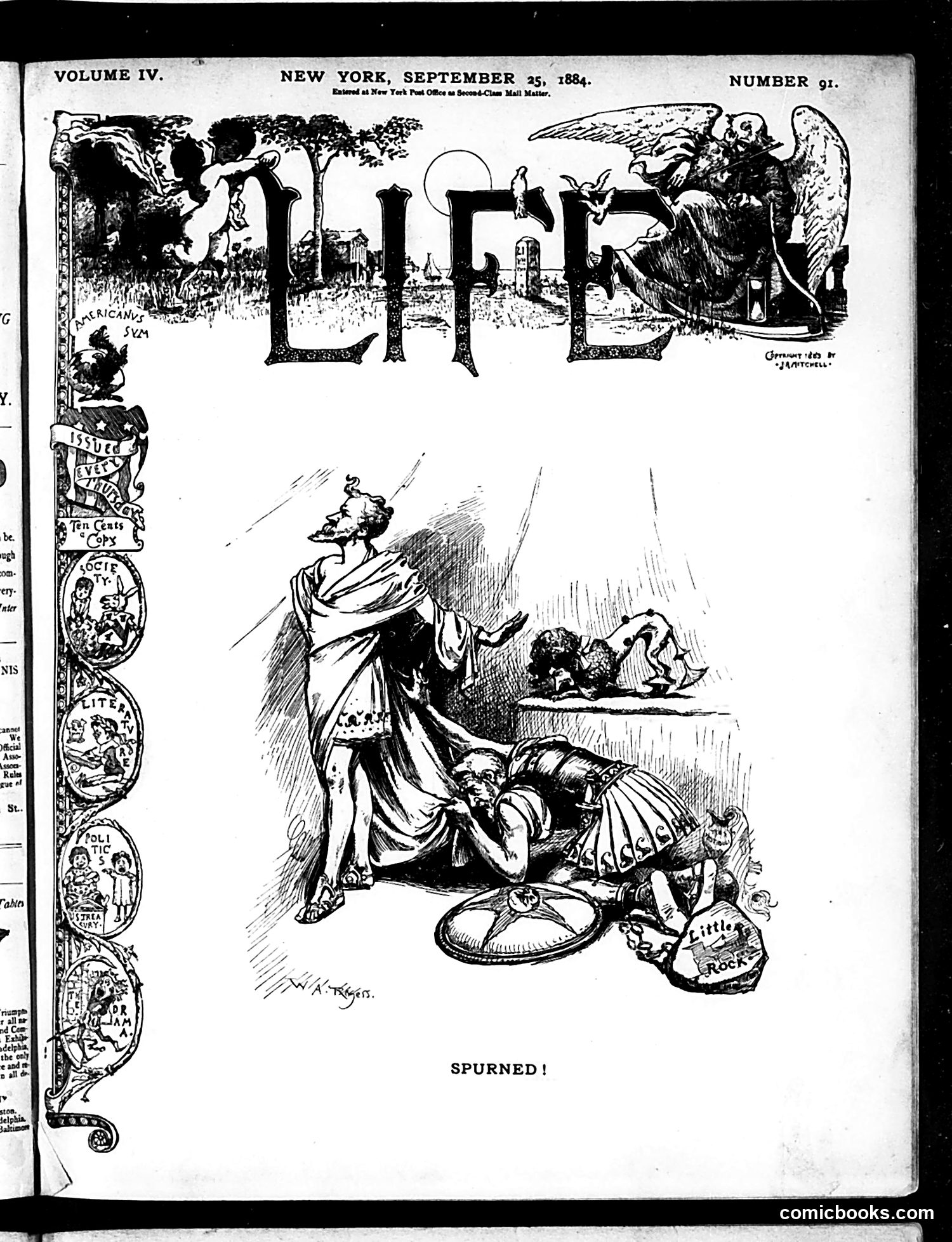
This appears to be a political satire from the 1884 U.S. presidential election. The main illustration titled "SPURNED!" depicts a classical female allegorical figure (likely representing America or Liberty) rejecting a supplicant figure below her. The rejected figure appears to be wearing political regalia, suggesting a candidate or political faction being rebuffed by the American electorate. The ornate left border contains multiple circular vignettes with political imagery and symbolism typical of 1880s satirical publications. Without clearer identification of specific candidates or parties from this election cycle, the exact political targets remain unclear, though the image clearly mocks a political figure's failed ambitions or rejected platform during this pivotal election year.
This page primarily contains **editorial text** mocking James Gillespie Blaine, a prominent political figure. The article satirizes Blaine's letters to Warren Fisher Jr., which became famous like those of the Roman statesman Junius. The satire focuses on Blaine's **suspicious financial dealings in Maine**, particularly stock disposals that enriched him while harming investors. The piece ridicules his grandiose language—especially his claim about "casting an anchor to the windward"—as pretentious obfuscation masking fraud. The final request to "Burn this letter" suggests Blaine is desperate to hide incriminating correspondence about the Fort Smith matter and Maine banking favoritism. This represents **hard-hitting political journalism** exposing alleged corruption during the 1884 election year.
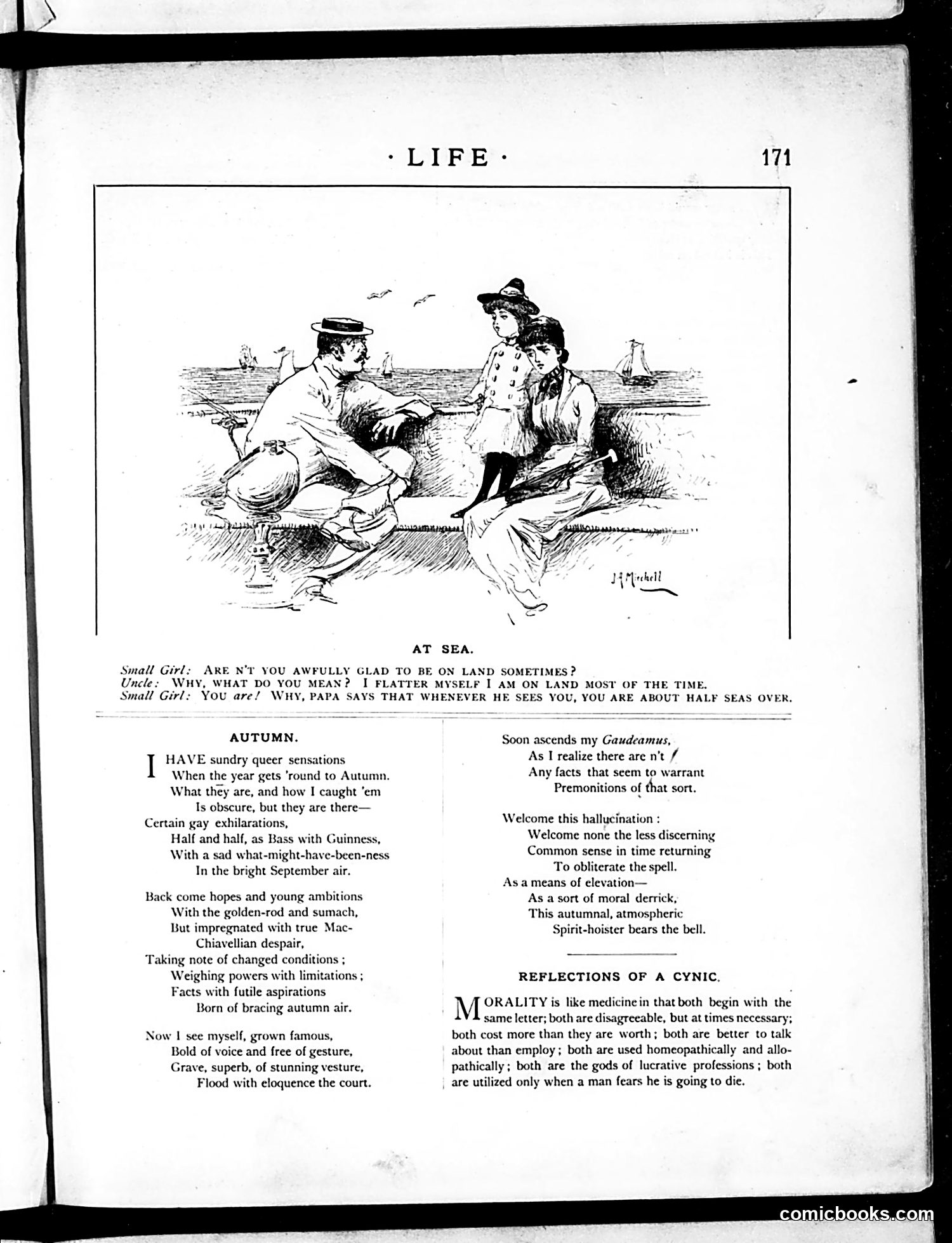
**The Cartoon ("At Sea"):** A seaside scene depicts an uncle and small girl in conversation while a woman sits nearby. The uncle deflects the girl's question about preferring land or sea with self-deprecating humor about his own seasickness. The girl's punchline—that her papa says whenever he sees the uncle, "you are about half seas over"—is a period slang joke. "Half seas over" meant intoxicated, suggesting the uncle has a drinking problem. This is straightforward domestic humor about a family character type rather than political satire. **The Literary Content:** The page includes romantic poetry ("Autumn") and an essay section titled "Reflections of a Cynic" making philosophical observations about morality and medicine, typical of Life's literary fare from this era.
This page contains satirical commentary on James G. Blaine's 1884 presidential campaign. The left column ("Boomlets") mocks Blaine supporters through brief anecdotes—including an incident where a man laughing at anti-Blaine political cartoons was knocked down outside a store, and references to "Mulligan letters" (a scandal involving Blaine's financial impropriety). The right column presents humorous letters between Blaine and a man named Fisher, depicting financial embarrassment. Fisher repeatedly borrows small amounts (75 cents, 50 cents, a dollar and a half) from Blaine, then asks for massive loans ($84,000, $95,000). The satire suggests Blaine himself is financially unreliable—undermining his credibility as a candidate through this absurdist humor about debt and borrowing.
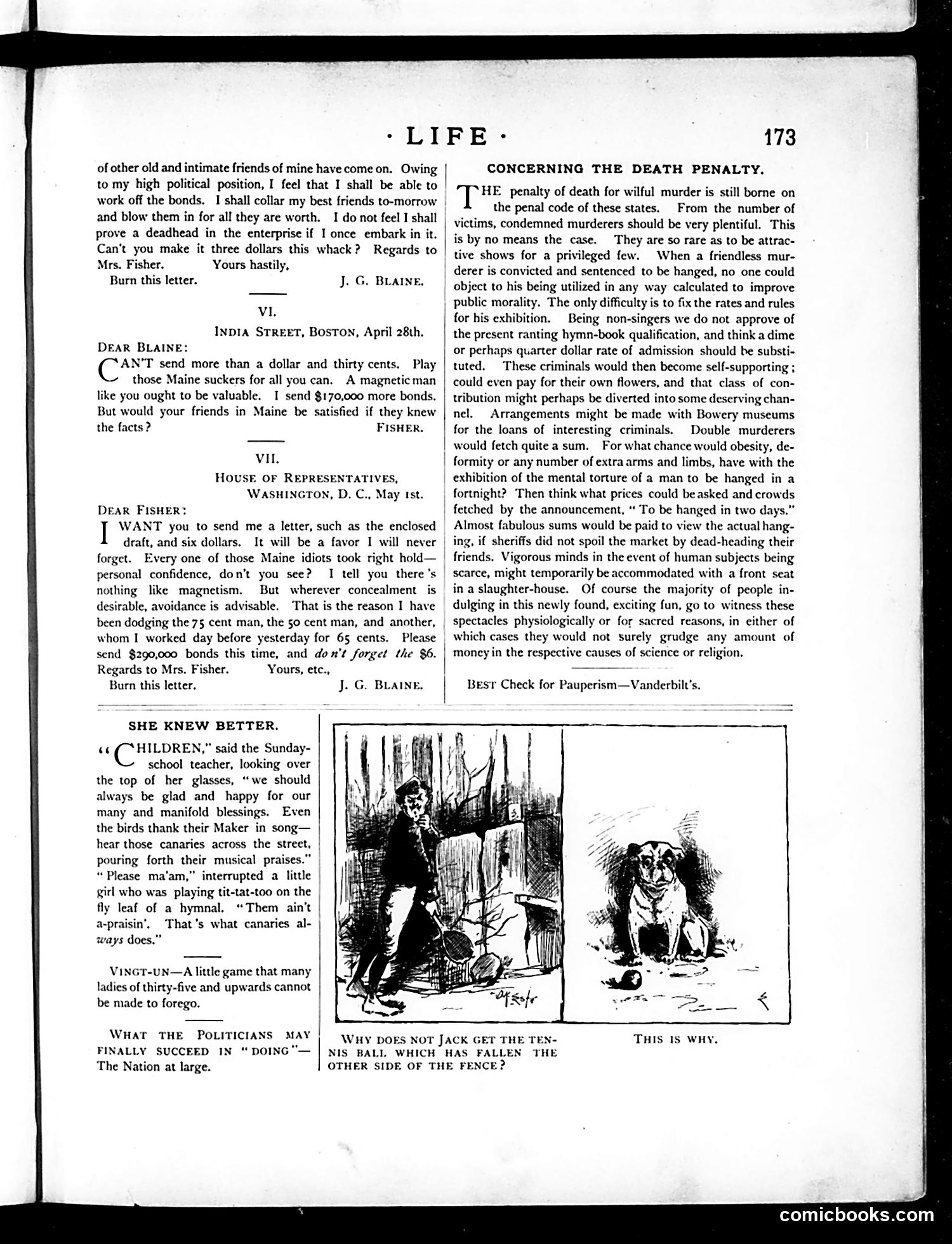
The page contains satirical letters to the editor and a cartoon. The main cartoon titled "She Knew Better" depicts a Sunday school teacher lecturing children about gratitude for blessings, using singing canaries as an example. A child interrupts, correcting the teacher: canaries don't sing "a-praisin'" but rather emit the sound "that's what canaries always does." The satire targets the teacher's sentimentality and misrepresentation of nature to teach moral lessons. The cartoon mocks how adults impose false, anthropomorphic interpretations on animal behavior to support religious instruction—a common Victorian pedagogical practice the magazine found absurd. The additional cartoons mock politicians' vague promises and childhood games, typical of Life's social commentary.
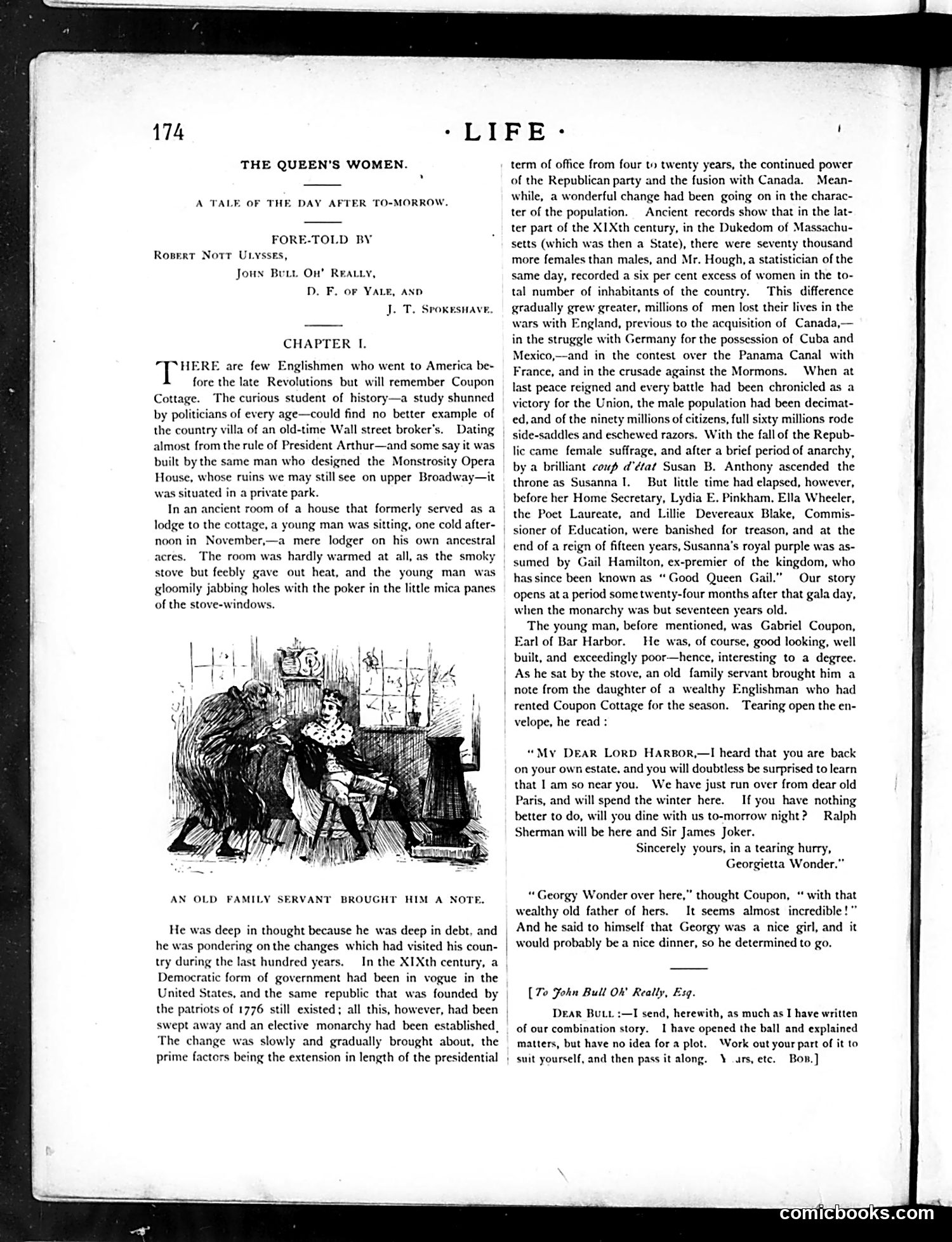
This page presents "The Queen's Women," a serialized story by Robert Nott Ulysses and others. The accompanying illustration shows an old family servant delivering a note to a young man by a fireplace—a Victorian domestic scene typical of 19th-century serialized fiction. The story itself, set in post-Civil War America, appears to be romantic fiction rather than political satire. It concerns Gabriel Coupon, an impoverished English gentleman renting a cottage, receiving an invitation from a wealthy acquaintance named Georgietta Wonder. The magazine text discusses American demographic shifts following the Civil War, noting increased female population due to male casualties. This contextual material frames the serial fiction within broader social commentary rather than containing satirical cartoons per se.
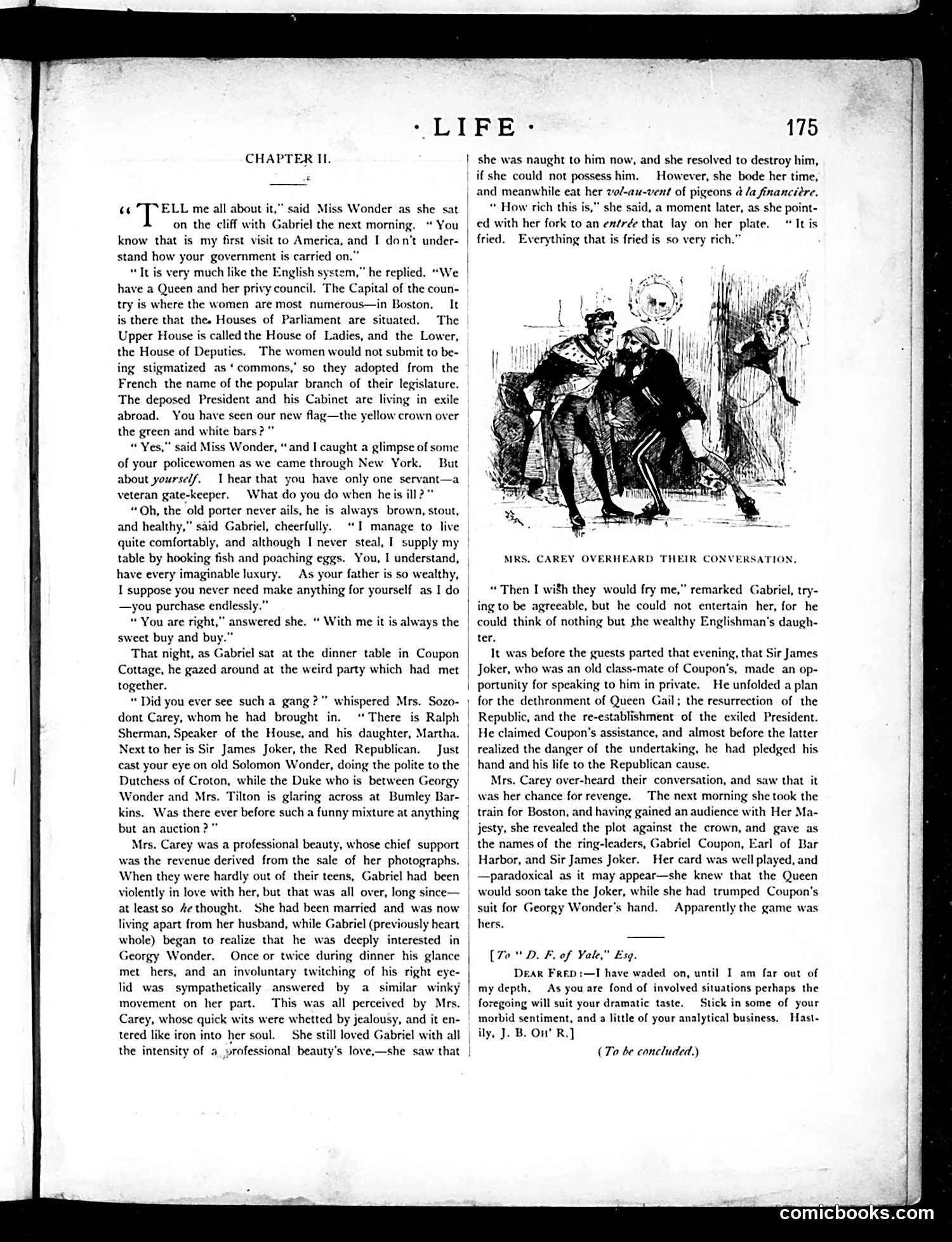
The illustration titled "Mrs. Carey Overheard Their Conversation" depicts a satirical scene of eavesdropping. The image shows figures listening in on a private discussion, likely mocking the social transgression of invading others' privacy. The accompanying text discusses American politics and governance—specifically Parliament, the President's exile, and the "yellow crown over the green and white bars" (apparently referencing a flag). The narrative involves characters named Gabriel, Miss Wonder, and Mrs. Carey discussing political intrigue related to a "wealthy Englishman's daughter." **Without additional historical context**, the specific political figures and events referenced remain unclear. The satire appears aimed at American political machinations and social pretension rather than specific identifiable individuals, though the references to exiled presidents and Republican/monarchist conflict suggest commentary on contemporary political tensions.
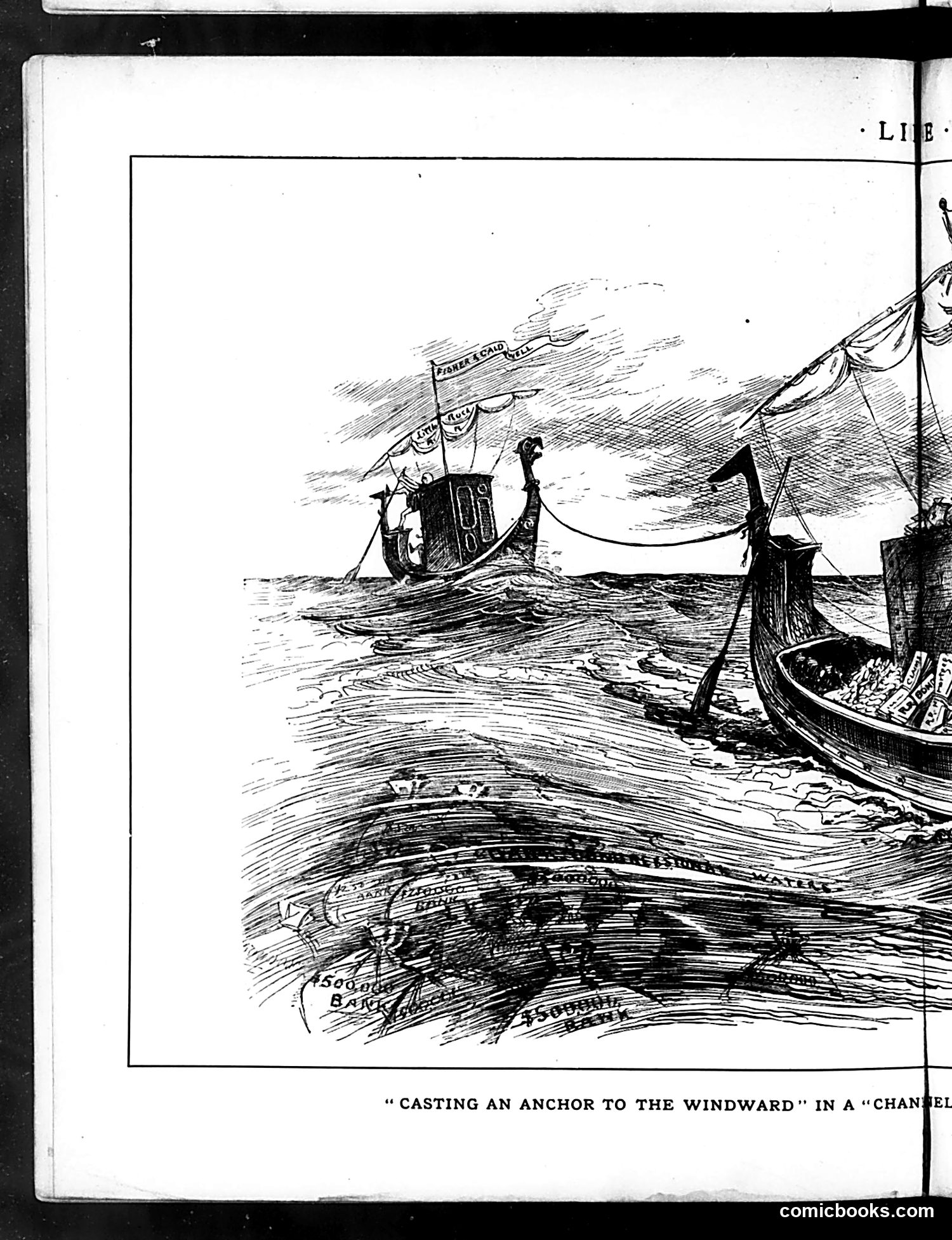
This engraving depicts Venetian gondolas on water, with the caption referencing nautical navigation. The phrase "casting an anchor to the windward" is a maritime idiom meaning to take precautionary action against adverse conditions. The "channel" likely refers to the English Channel, suggesting this is political satire about British foreign policy or navigation through diplomatic difficulties. The gondolas—distinctly Italian vessels—may represent Italy or Italian interests being maneuvered through treacherous waters. Without additional context about the publication date, the specific historical moment remains unclear, but the maritime metaphor appears to comment on strategic positioning during some period of international tension or diplomatic maneuvering involving Britain and possibly Italy.
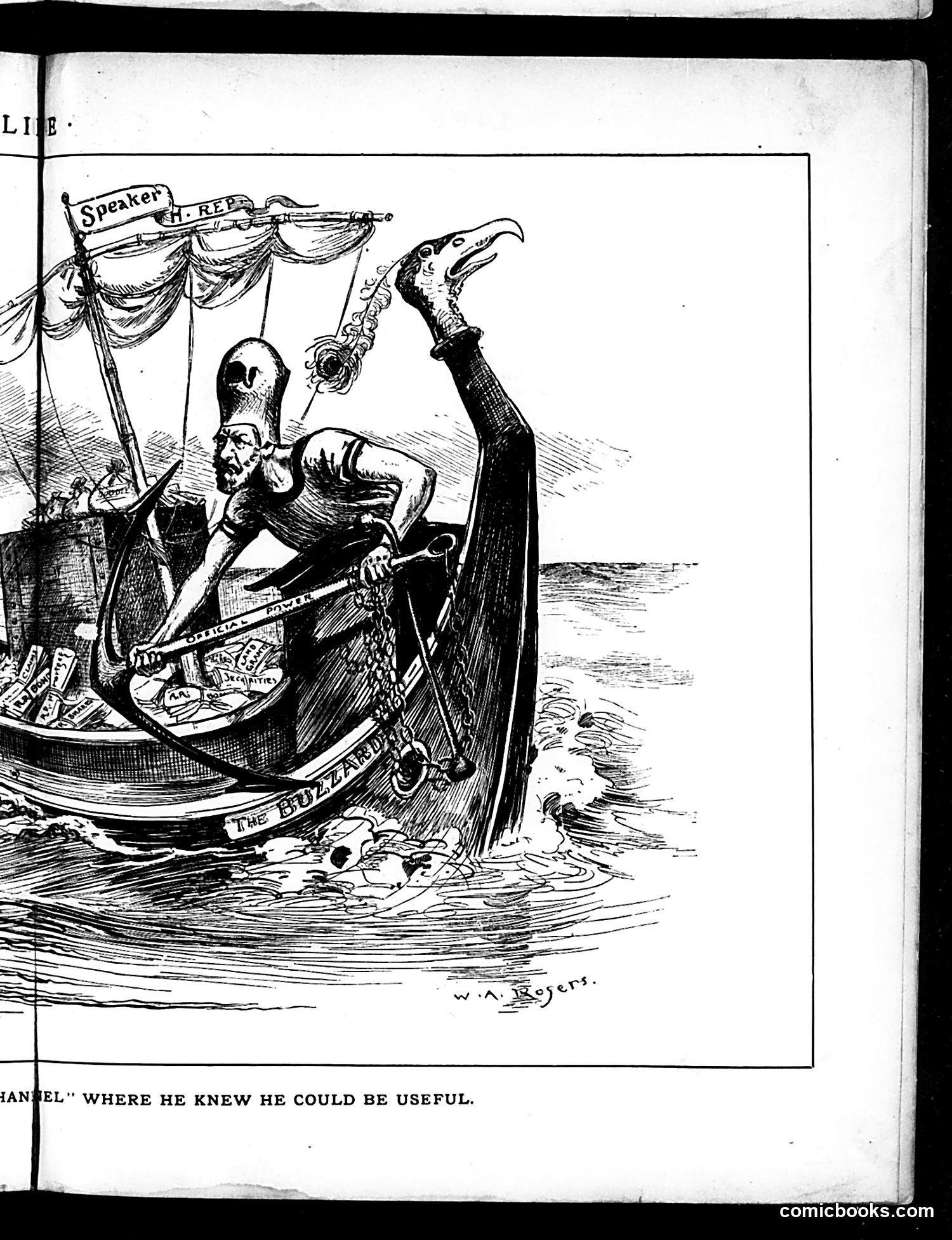
This satirical cartoon by W.A. Rogers depicts a figure labeled "The Blizzard" as a skeletal Death figure wielding a scythe, approaching a boat. The boat contains a "Speaker" (identifiable by the label) and appears to be styled as a governmental vessel, possibly representing Congress or political leadership. The cartoon uses the metaphor of Death/winter ("The Blizzard") as an approaching threat to political institutions. The Speaker attempts to row away or defend against this force. The exact historical context—which Speaker, which political crisis—isn't clearly labeled, but the image suggests commentary on a political figure or institution facing an existential threat during a period of crisis or scandal. The allegorical style was common in early 20th-century American political satire.
This is a serialized comic story satirizing both sentimental romance novels and the American Western myth. The plot follows Albemarle Van Bumblebug, a wealthy New York club man with an absurdly pretentious name, who loves the heiress Verbena Boggs. When she reads that "Mustang Bill, King of the Cowboys" has died, she declares she'll marry Albemarle only if he returns as the new Cowboy King. The satire mocks: - **Romance conventions**: Verbena's theatrical behavior learned at Madison Square matinees; Albemarle's rehearsed declarations - **Social pretension**: The ridiculous juxtaposition of Manhattan wealth and cowboy culture - **Western romanticism**: Cowboys are portrayed as crude (dealing cards from the bottom, shooting at dogs) rather than heroic The humor lies in contrasting genteel New York society with the rough, amoral frontier—showing both worlds as equally absurd.
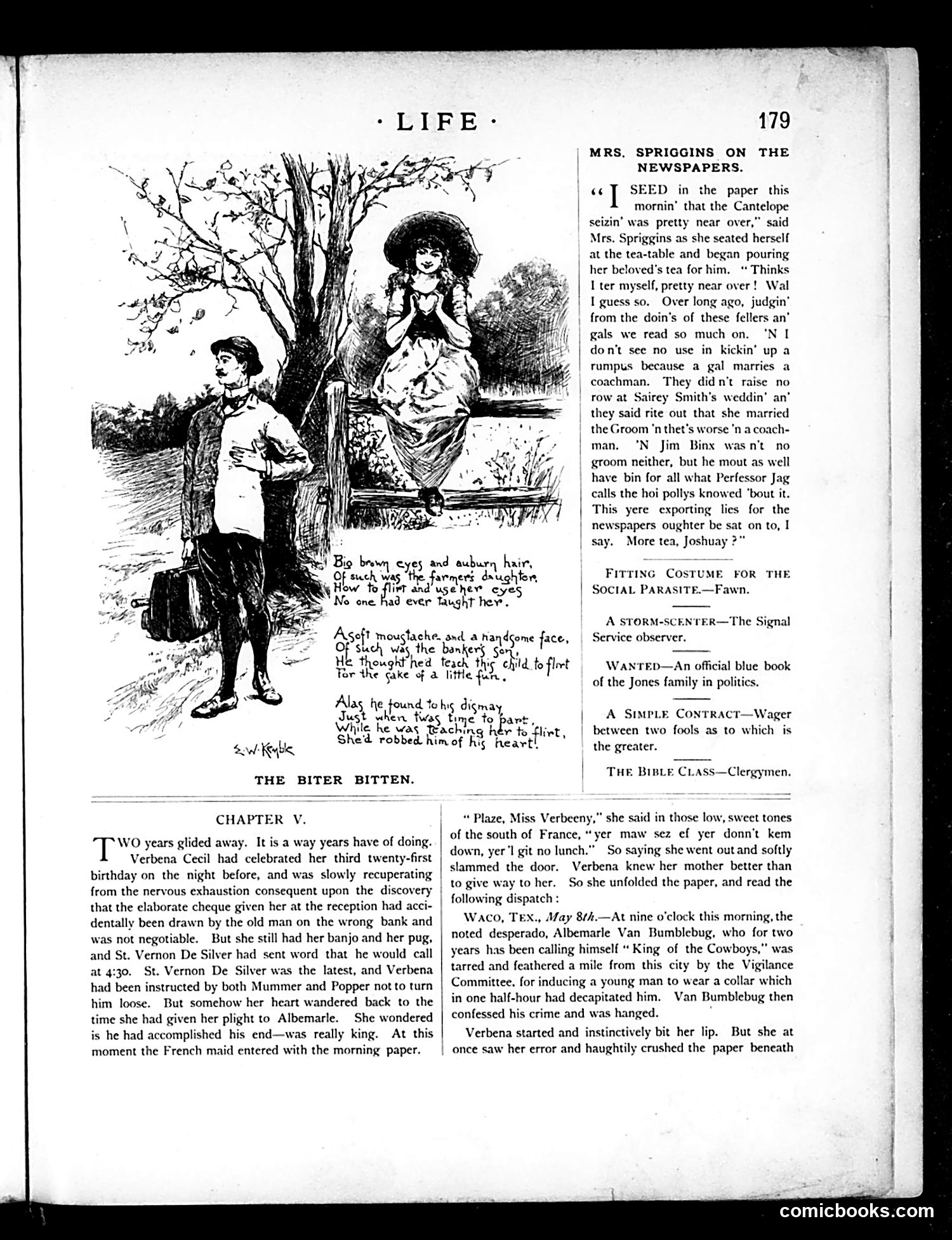
This page contains a serialized story parody and social commentary typical of Life's satirical approach. **"The Biter Bitten"** (illustrated cartoon) mocks romantic melodrama: a man teaches a young woman to flirt and use her "eyes," but she uses these skills against him, stealing his heart—hence "robbed him of his heart." The joke is the ironic reversal: the manipulator becomes the victim. **Mrs. Spriggins on the Newspapers** satirizes both sensationalist journalism and public reaction to it. The character (apparently a working-class woman) complains that newspapers exaggerate scandals—particularly about women marrying "beneath" their station. She dismisses outrage over a woman marrying a coachman as hypocritical, citing worse examples. The satire targets both the press's scandal-mongering and society's class-obsessed moralism. **Chapter V** continues the Verbena Cecil serialized fiction, which Life uses as a vehicle for gentle mockery of melodramatic literature and upper-class pretension.
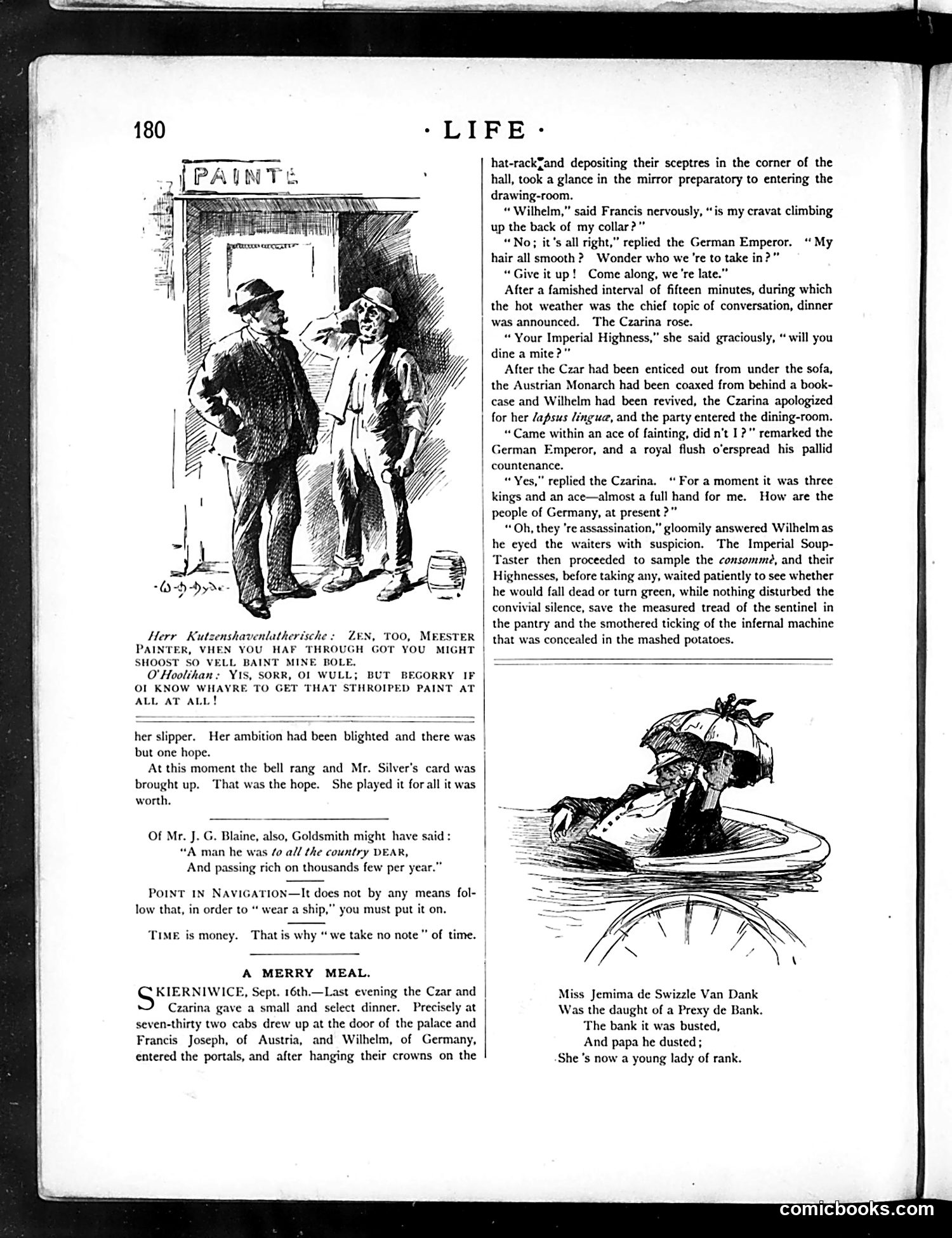
This satirical piece mocks the tensions among European monarchs during a period of political instability (the text references assassination attempts). The cartoon depicts two men in formal dress—likely representing Francis Joseph of Austria and Wilhelm II of Germany—nervously preparing for a formal dinner hosted by the Russian Czar and Czarina. The humor centers on mutual distrust and paranoia: Wilhelm worries about his appearance, they're anxious about being late, and most pointedly, the narrative describes an "Imperial Soup-Taster" who must sample food first to ensure it isn't poisoned. The joke references real political assassinations and anarchist threats of the era. The secondary cartoon and verse about "Miss Jemima de Swizzle Van Dank" appears to be unrelated social satire about a banker's daughter whose family lost their fortune. The overall tone mocks European royal anxiety and the precarious state of continental politics.
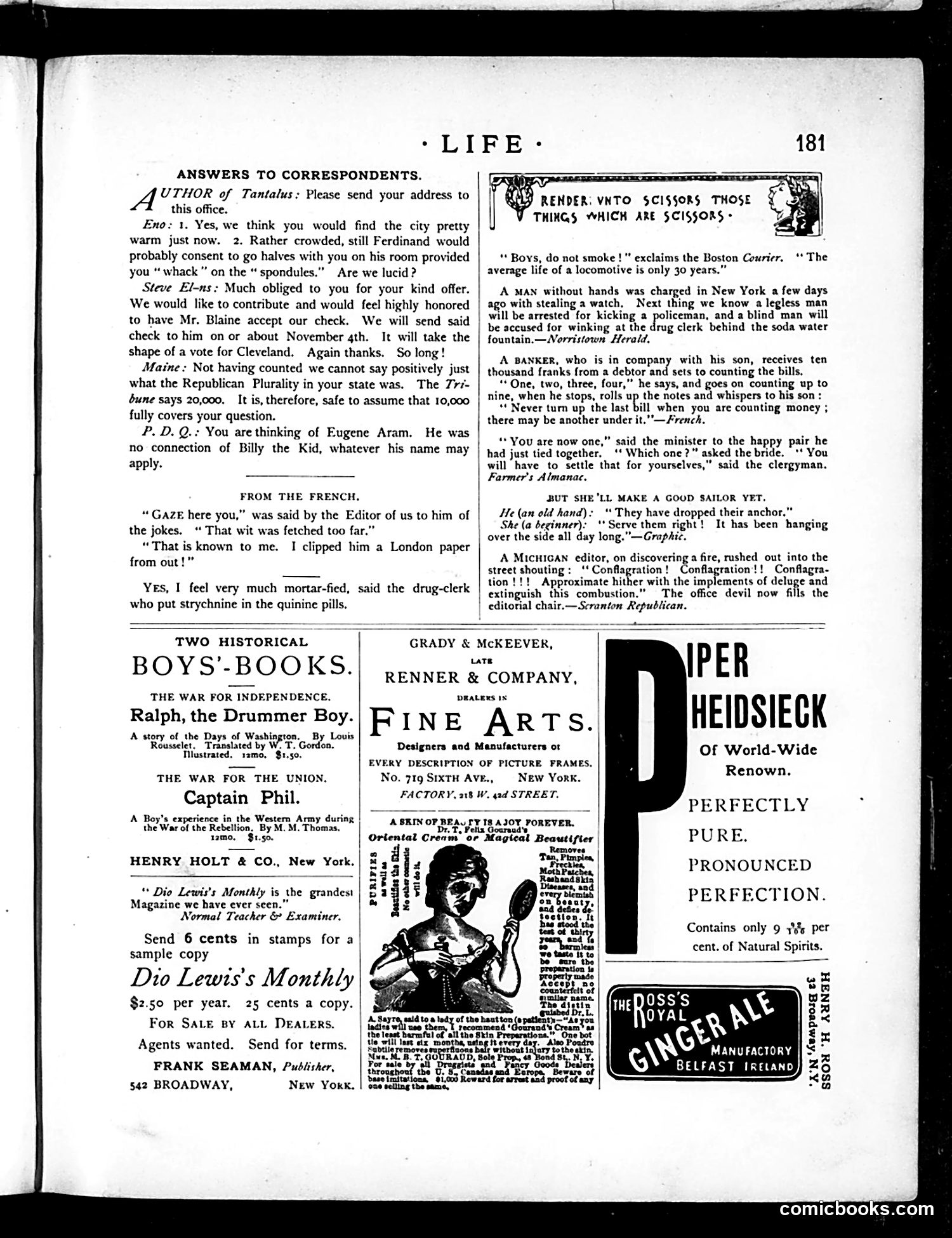
This page is primarily **advertisements and reader correspondence**, not political cartoons. However, it contains several satirical jokes typical of Life's humor: The "Render unto Scissors" cartoon (top) appears to be a visual pun playing on biblical language—likely mocking something contemporary, though details are unclear from the image. The **correspondence section** includes political humor: a reference to "Cleveland" (likely Grover Cleveland) and mention of Republican plurality in Maine, dating this to the 1884 election period. One response jokes that the Republican margin was probably half what the Tribune claimed—typical partisan mockery. Several **jokes** mock contemporary absurdities: a man without hands charged with theft, a banker teaching dishonest counting to his son, and a woman misunderstanding nautical terms. These reflect Victorian-era satirical humor targeting hypocrisy and social pretension rather than specific political figures. The page is dominated by **book advertisements** (historical boys' books about American wars) and product ads (picture frames, ginger ale, cosmetics), making it representative of Life's mixed content format.
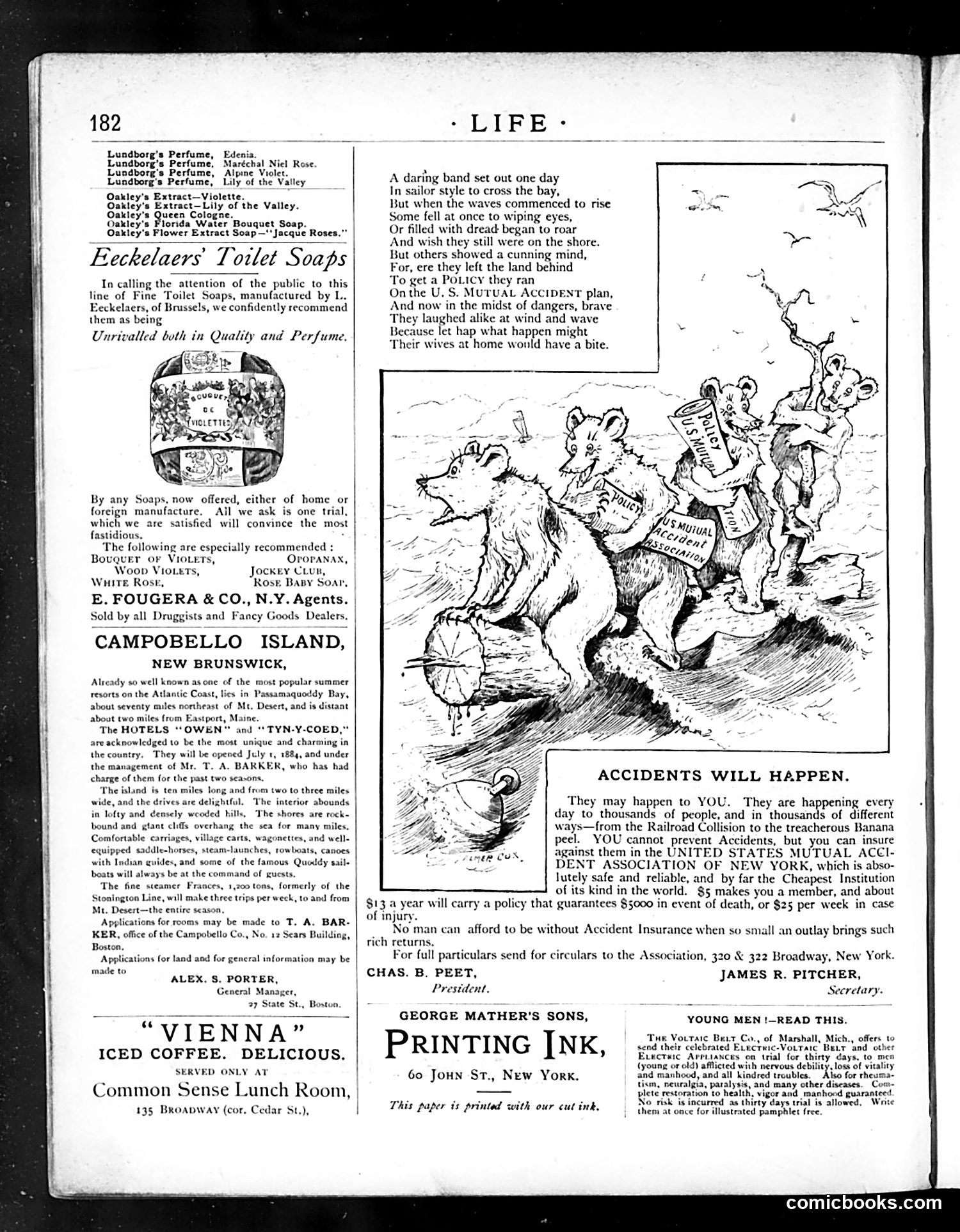
This page features a satirical cartoon advertising accident insurance. The illustration depicts anthropomorphized bears in a boat crossing rough waters—some covering their eyes in fear while others appear brave after purchasing U.S. Mutual Accident Insurance policies. The satire mocks both reckless adventurers and the insurance industry itself. The cartoon suggests that courage isn't innate but purchasable: only those with insurance laugh at danger, implying the policy is less about genuine protection and more about false confidence. The bears' exaggerated reactions—some terrified, others artificially bold—ridicule how people convince themselves that buying insurance somehow prevents or protects against accidents. The accompanying text reinforces this by listing common accidents (railroad collisions, banana peels) and arguing no one can "afford" to be uninsured. The humor lies in the absurdity: insurance doesn't prevent accidents, yet the advertisement promises peace of mind through what amounts to a financial gamble.
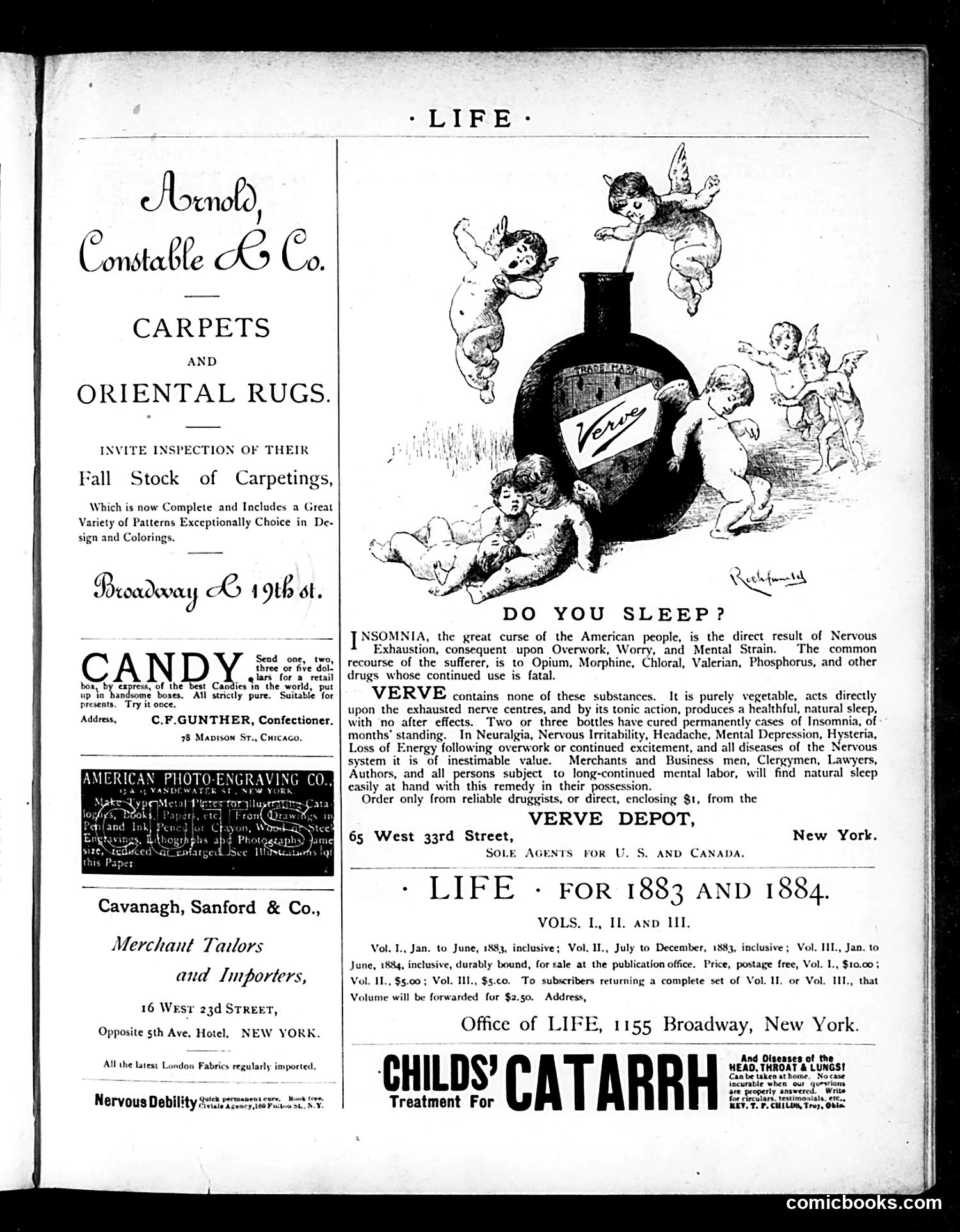
This is primarily an **advertising page** rather than a satirical cartoon page. The main visual element is a single illustration labeled "Do You Sleep?" featuring **cherubs surrounding a large bottle of "Verve"** tonic—a patent medicine claiming to cure insomnia and nervous conditions. The satire is subtle but present: the advertisement ironically uses innocent, cheerful angels to promote a "purely vegetable" remedy for the exhaustion of modern industrial life. The text reveals the actual problem it addresses—overwork, worry, and mental strain affecting merchants, lawyers, and clergymen—while promising relief without the "fatal" side effects of opium, morphine, and chloral (contemporary addiction-prone drugs). This reflects **genuine 1880s anxieties** about nervous exhaustion from rapid urbanization and work culture, though modern readers would recognize Verve as a dubious patent medicine relying on marketing rather than efficacy. The cherubs provide visual irony: suggesting innocent wellness while promoting a commercial product of questionable merit.
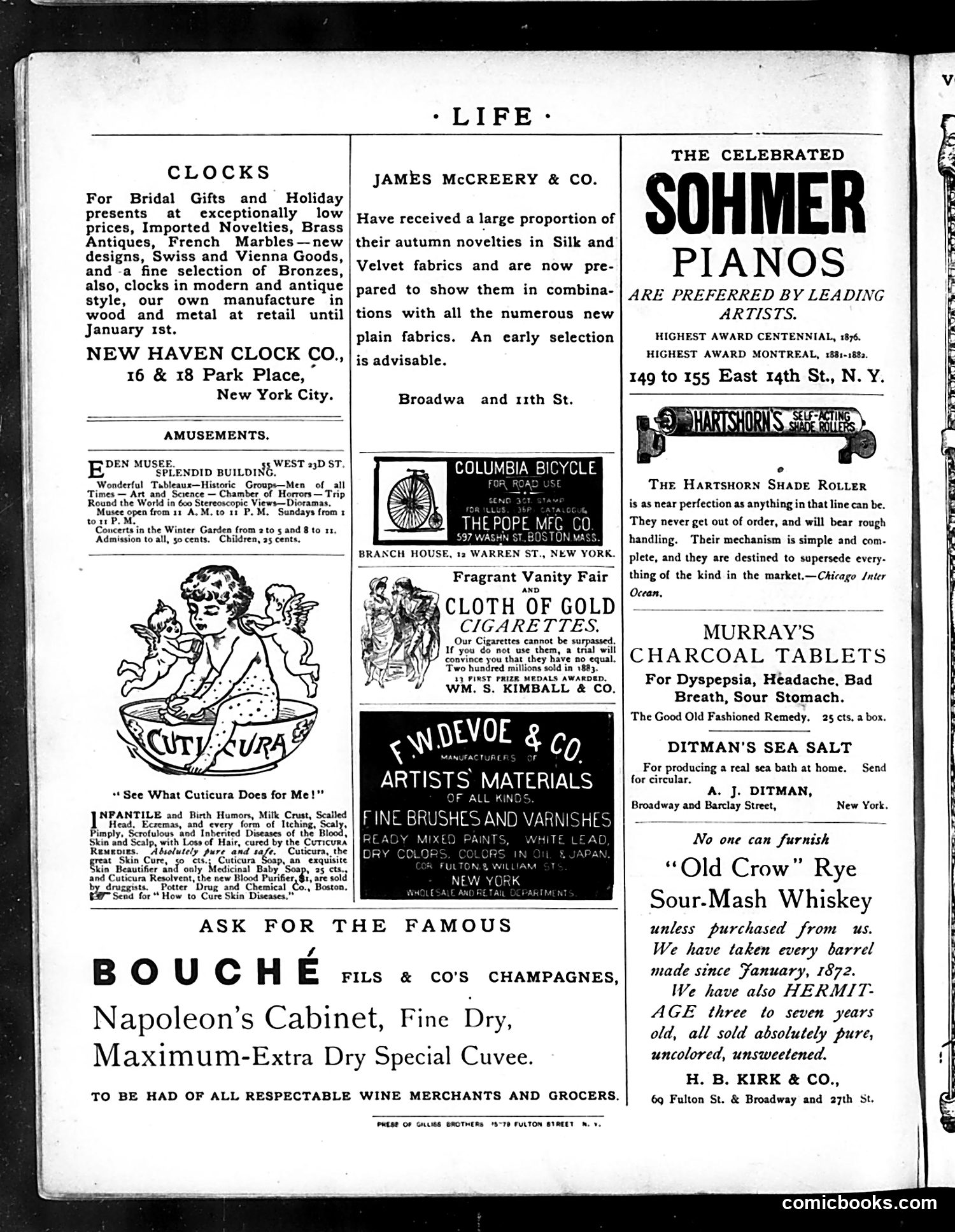
This is primarily an **advertising page** from Life magazine's late 19th century run, with one notable illustration. The main visual element is **"Cuticura"** — a satirical cartoon showing a cherubic infant in a basin labeled "CUTICURA," with the caption "See What Cuticura Does for Me!" This is an advertisement for Cuticura patent medicine, which promised to cure skin diseases, eczema, psoriasis, and hair loss. The cartoon's appeal to sentimentality (depicting a healthy, happy baby) was typical of patent medicine marketing of the era, which often made exaggerated health claims. The page is otherwise filled with period advertisements for luxury goods (Sohmer pianos, Bouché champagne), medical products (charcoal tablets for digestion), home goods, and spirits. The "Old Crow" whiskey ad notably emphasizes authenticity and purity—suggesting counterfeit whiskey was a problem. **Context for modern readers**: This reflects the largely unregulated patent medicine industry of the 1880s, when such products made dubious claims without FDA oversight.