
Life, 1884-09-25 · page 2 of 16
Life — September 25, 1884 — page 2: what you’re looking at
What you’re looking at
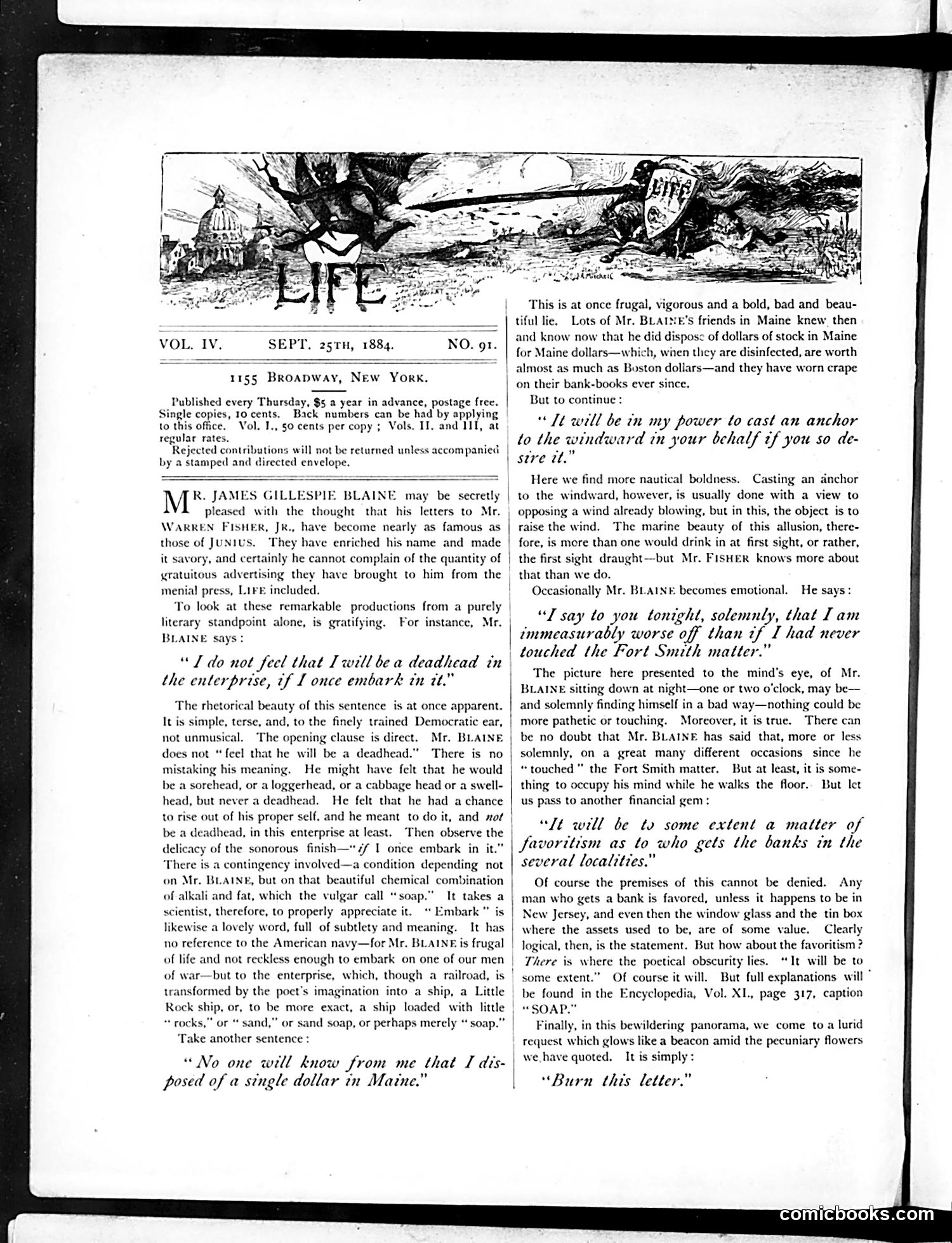
This page primarily contains **editorial text** mocking James Gillespie Blaine, a prominent political figure. The article satirizes Blaine's letters to Warren Fisher Jr., which became famous like those of the Roman statesman Junius. The satire focuses on Blaine's **suspicious financial dealings in Maine**, particularly stock disposals that enriched him while harming investors. The piece ridicules his grandiose language—especially his claim about "casting an anchor to the windward"—as pretentious obfuscation masking fraud. The final request to "Burn this letter" suggests Blaine is desperate to hide incriminating correspondence about the Fort Smith matter and Maine banking favoritism. This represents **hard-hitting political journalism** exposing alleged corruption during the 1884 election year.
📄 Transcribed text from this page (OCR, searchable)
Machine-transcribed from the original scan — historical spelling and the odd misread are preserved.
VOL, IV. SEPT. 257TH, 1884. NO. 91. 1155 Broapway, New York. Published every Thursday, $5 a year in advance, postage free. Single copies, 10 cents, Back numbers can be had by applying to this office. Vol. 1., 50 cents per copy ; Vols. II, and II, at regular rates. Rejected contributions will not be returned unless accompanied by a stamped and directed envelope. R. JAMES GILLESPIE BLAINE may be secretly pleased with the thought that his letters to Mr. WARREN FISHER, JR., have become nearly as famous as those of JUNIUS, it savory, and certainly he cannot complain of the quantity of gratuitous advertising they have brought to him from the menial press, Lire included. To look at these remarkable productions from a purely literary standpoint alone, is gratifying. For instance, Mr. BLAINE says: “Ldonot feel that Iwill bea deadhead in the enterprise, tf I once embark tn tt.” The rhetorical beauty of this sentence is at once apparent. It is simple, tet not unmusi The opening claus does not “feel that he will be mistaking his meaning. is direct. deadhead.” Mr. BLAINE be a sorehead, or a loggerhead, or a cabbage head or a swell- head, but never a deadhead. He felt that he had a chance to rise out of his proper self. and he meant to do it, and not | be a deadhead, in this enterprise at least. Then observe the delicacy of the sonorous finish—*¢/ 1 once embark in it.” ‘There is a contingency involved—a condition depending not on Mr. BLAINE, but on that beautiful chemical combination of alkali and fat, which the vulgar call “soap.” It takes a scientist, therefore, to properly appreciate it.‘ Embark likewise a lovely word, full of subtlety and meaning. It has no reference to the American navy—for Mr. BLAIN of life and not reckless enough to embark on one of our men of war. transformed by the poet’s imagination into a ship, a Little Rock ship, or, to be more exact, a ship loaded with little * rocks,” or “ sand,” or sand soap, or perhaps merely “ soap. ‘Take another sentence : “No one will know from me that I dis- posed of a single dollar in Maine.” They have enriched his name and made | se, and, to the finely trained Democratic ear, | There is no | He might have felt that he would | is frugal | but to the enterprise, which, though a railroad, is | This is at once frugal, vigorous and a bold, bad and beau- tiful lie, Lots of Mr. BLAINE's friends in Maine knew, then and know now that he did dispose of dollars of stock in Maine for Maine dollars—which, when they are disinfected, are worth almost as much as Boston dollars—and they have worn crape | on their bank-books ever since. But to continue : “Tt will be in my power to cast an anchor to the windward tn your behalf tf you so de- sere tt.” Here we find more nautical boldness. Casting an anchor to the windward, however, is usually done with a view to opposing a wind already blowing, but in this, the object is to | raise the wind. The marine beauty of this allusion, there- fore, is more than one would drink in at first sight, or rather, | the first sight draught—but Mr. FISHER knows more about that than we do. Occasionally Mr. BLAINE becomes emotional. He says: “say to you tonight, solemnly, that Iam immeasurably worse off than tf I had never touched the Fort Smith matter.” The picture here presented to the mind's eye, of Mr. | BLAINE sitting down at night—one or two o'clock, may be— and solemnly finding himself in a bad way—nothing could be more pathetic or touching. Moreover, it is true. There can be no doubt that Mr. BLAINE has said that, more or less solemnly, on a great many different occasions since he “touched " the Fort Smith matter, But at least, it is some- thing to occupy his mind while he walks the floor. But let us pass to another financial gem : “Tt will be to some extent a matter of Savoritism as to who gets the banks in the several localities.” Of course the premises of this cannot be denied. Any man who gets a bank is favored, unless it happens to be in | New Jersey, and even then the window glass and the tin box where the assets used to be, are of some value. Clearly logical, then, is the statement. But how about the favoritism ? There is where the poetical obscurity lies. “It will be to some extent.” Of course it will. But full explanations will * be found in the Encyclopedia, Vol. XI, page 317, caption “SOAP.” Finally, in this bewildering panorama, we come to a lurid request which glows like a beacon amid the pecuniary flowers | we have quoted, It is simply: | “Burn this letter.”