
Life, 1884-09-25 · page 6 of 16
Life — September 25, 1884 — page 6: what you’re looking at
What you’re looking at
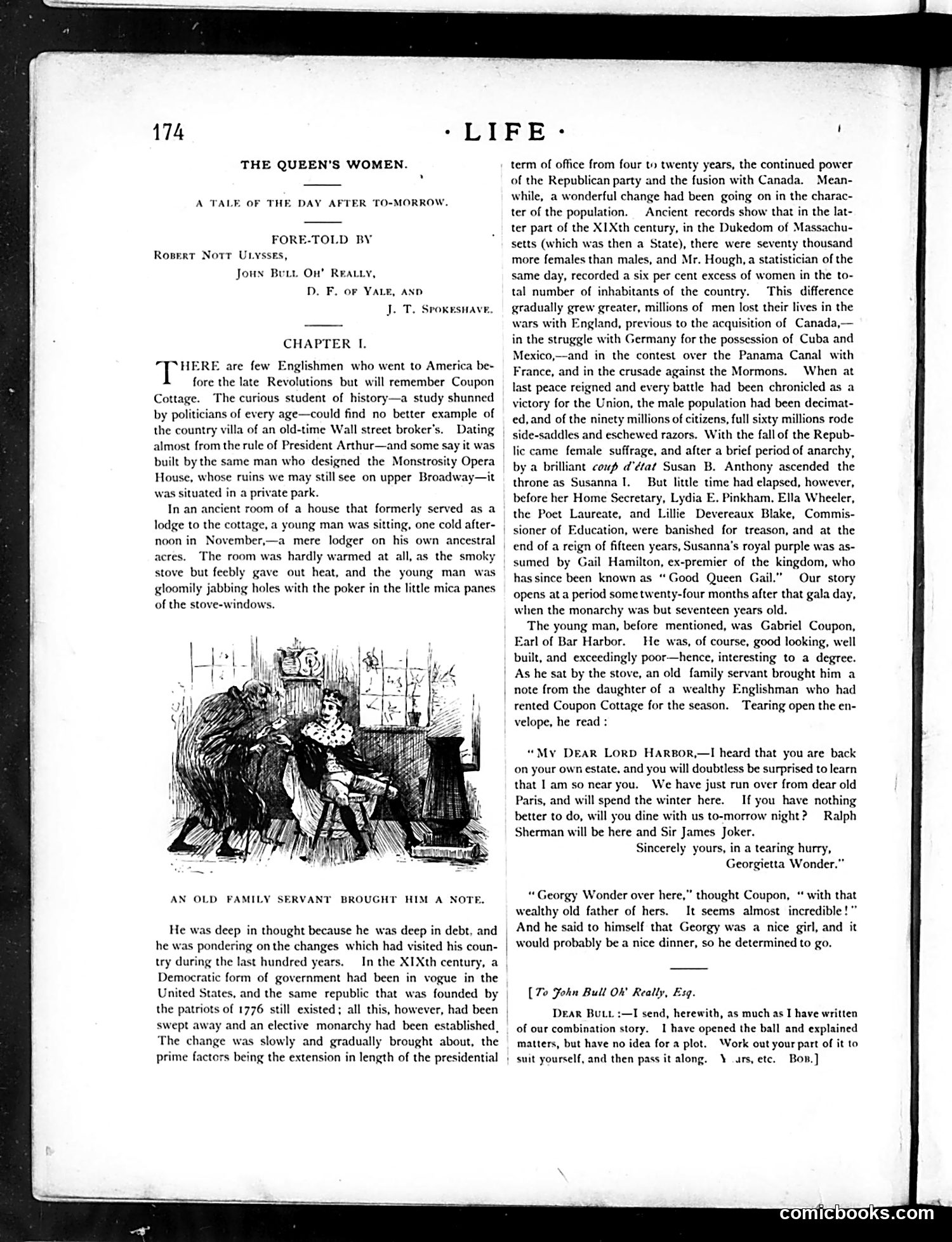
This page presents "The Queen's Women," a serialized story by Robert Nott Ulysses and others. The accompanying illustration shows an old family servant delivering a note to a young man by a fireplace—a Victorian domestic scene typical of 19th-century serialized fiction. The story itself, set in post-Civil War America, appears to be romantic fiction rather than political satire. It concerns Gabriel Coupon, an impoverished English gentleman renting a cottage, receiving an invitation from a wealthy acquaintance named Georgietta Wonder. The magazine text discusses American demographic shifts following the Civil War, noting increased female population due to male casualties. This contextual material frames the serial fiction within broader social commentary rather than containing satirical cartoons per se.
📄 Transcribed text from this page (OCR, searchable)
Machine-transcribed from the original scan — historical spelling and the odd misread are preserved.
THE QUEEN'S WOMEN. A TALE OF THE DAY AFTER TO-MORROW. FORE-TOLD BY Rosert Nott Utysses, Joun Butt On’ ReALty, D. F. oF YALE, AND J. T. Srokesnave. CHAPTER I. HERE are few Englishmen who went to America be- fore the late Revolutions but will remember Coupon Cottage. The curious student of history—a study shunned by politicians of every age—could find no better example of the country villa of an old-time Wall street broker's. Dating almost from the rule of President Arthur—and some say it was built by the same man who designed the Monstrosity Opera House, whose ruins we may still see on upper Broadway—it was situated in a private park. In an ancient room of a house that formerly served as a lodge to the cottage, a young man was sitting, one cold after- noon in November,—a mere lodger on his own ancestral acres. The room was hardly warmed at all, as the smoky stove but feebly gave out heat, and the young man was gloomily jabbing holes with the poker in the little mica panes of the stove-windows. AN OLD FAMILY SERVANT BROUGHT HIM A NOTE. He was deep in thought because he was deep in debt, and he was pondering onthe changes which had visited his coun- try during the last hundred years. In the XIXth century, a Democratic form of government had been in vogue in the United States, and the same republic that was founded by the patriots of 1776 still existed; all this, however, had been | swept away and an elective monarchy had been established, The change was slowly and gradually brought about, the prime factors being the extension in length of the presidential | suit yourself, and then pass it along. term of office from four to twenty years, the continued power of the Republican party and the fusion with Canada. Mean- while, a wonderful change had been going on in the charac- ter of the population. Ancient records show that in the lat- ter part of the XIXth century, in the Dukedom of Massachu- setts (which was then a State), there were seventy thousand more females than males, and Mr. Hough, a statistician of the same day, recorded a six per cent excess of women in the to- tal number of inhabitants of the country. This difference gradually grew greater, millions of men lost their lives in the wars with England, previous to the acquisition of Canada,— in the struggle with Germany for the possession of Cuba and Mexico,—and in the contest over the Panama Canal with France, and in the crusade against the Mormons. When at last peace reigned and every battle had been chronicled as a victory for the Union, the male population had been decimat- ed, and of the ninety millions of citizens, full sixty millions rode side-saddles and eschewed razors. With the fall of the Repub- lic came female suffrage, and after a brief period of anarchy, by a brilliant coup d'état Susan B. Anthony ascended the throne as Susanna I. But little time had elapsed, however, before her Home Secretary, Lydia E, Pinkham, Ella Wheeler, the Poet Laureate, and Lillie Devereaux Blake, Commis- sioner of Education, were banished for treason, and at the end of a reign of fifteen years, Susanna’s royal purple was as- sumed by Gail Hamilton, ex-premier of the kingdom, who has since been known as “Good Queen Gail.” Our story opens ata period some twenty-four months after that gala day, when the monarchy was but seventeen years old. The young man, before mentioned, was Gabriel Coupon, Earl of Bar Harbor. He was, of course, good looking, well built, and exceedingly poor—hence, interesting to a degree. As he sat by the stove, an old family servant brought him a note from the daughter of a wealthy Englishman who had rented Coupon Cottage for the season. Tearing open the en- velope, he read : “My DeaR Lorp Hargor,—lI heard that you are back on your own estate, and you will doubtless be surprised to learn that I am so near you. We have just run over from dear old Paris, and will spend the winter here. If you have nothing better to do, will you dine with us to-morrow night? Ralph Sherman will be here and Sir James Joker. Sincerely yours, in a tearing hurry, Georgietta Wonder.” “Georgy Wonder over here,” thought Coupon, “ with that wealthy old father of hers. It seems almost incredible!” And he said to himself that Georgy was a nice girl, and it would probably be a nice dinner, so he determined to go. [7 John Bull Oh’ Really, Esq. Dear Butt :—I send, herewith, as much as I have written of our combination story. 1 have opened the ball and explained matters, but have no idea fora plot. Work out your part of it to Y ars, ete. Bon.) Ccomicbooks.com