
A complete issue · 16 pages · 1884
Life — September 18, 1884
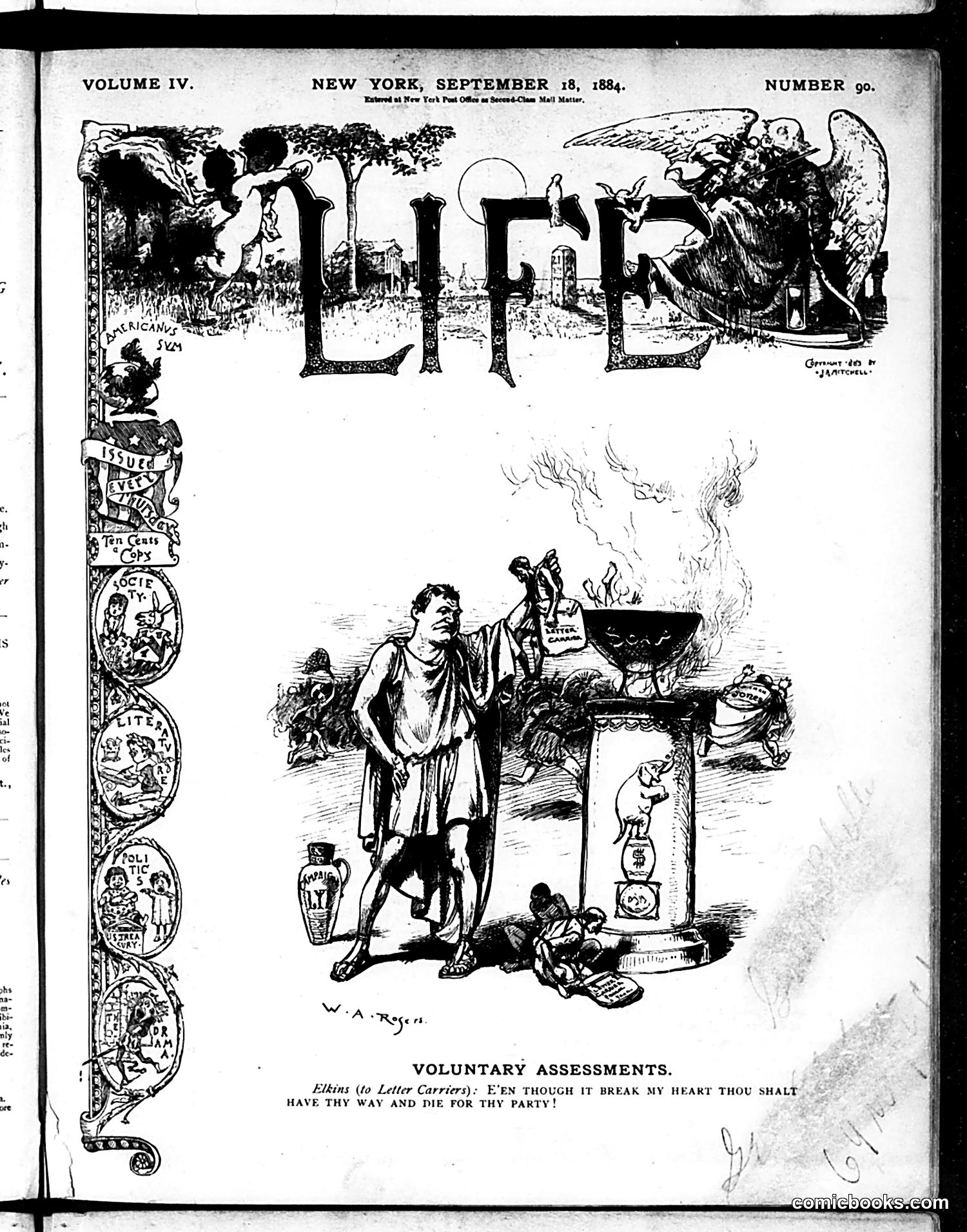
This satirical cartoon titled "Voluntary Assessments" depicts a distressed man at a furnace, throwing money into flames while exclaiming "E'en though it break my heart thou shalt thy way and die for they party!" The subtitle clarifies this targets **letter carriers** being pressured to make "voluntary" political contributions. The cartoon critiques the corrupt Gilded Age practice of forcing government employees—particularly postal workers—to donate portions of their salaries to the party in power, despite the donations being theoretically "voluntary." The man's anguish illustrates how these coercive demands financially harmed workers while enriching party machines. This was a genuine scandal of the 1880s, eventually leading to civil service reform limiting such exploitation of federal employees.
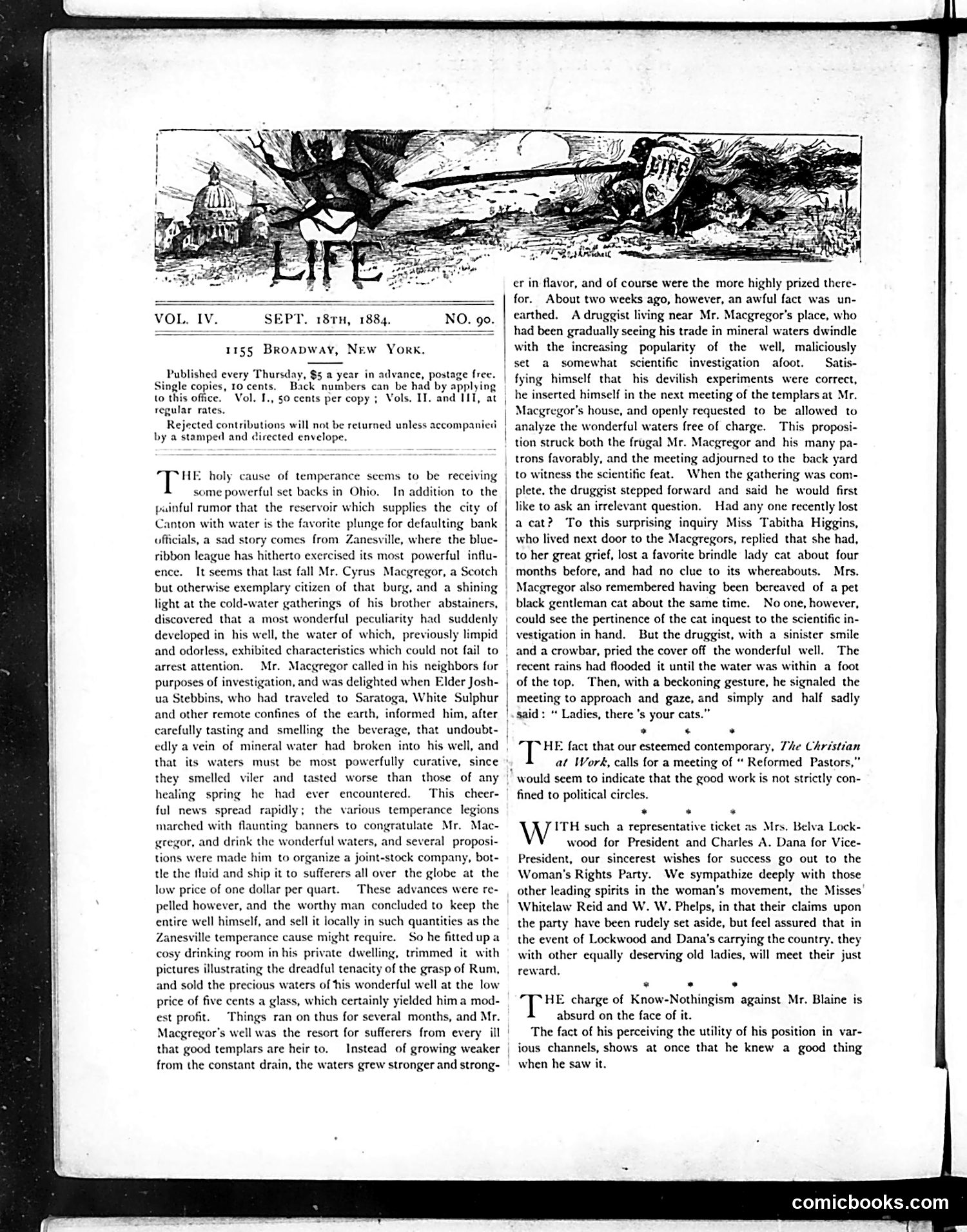
The masthead illustration depicts "LIFE" as a classical figure overlooking a landscape with a building (likely representing government or institutions) and a gravestone marked "RIP." The page's political content addresses temperance reform and women's suffrage. A substantial article mocks Mr. Macgregor's miraculous well water, which gained popularity as a cure-all tonic. The satire criticizes both the gullibility of the public embracing pseudoscientific remedies and the commercialization of dubious health claims. A separate item supports a "Reformed Pastors" meeting and women's voting rights, endorsing candidates Mrs. Belva Lockwood and Charles A. Dana for the Woman's Rights Party—indicating this 1884 election involved active suffrage advocacy. The final note dismisses criticism of Mr. Blaine (likely James G. Blaine, 1884 presidential candidate) as absurd "Know-Nothingism."
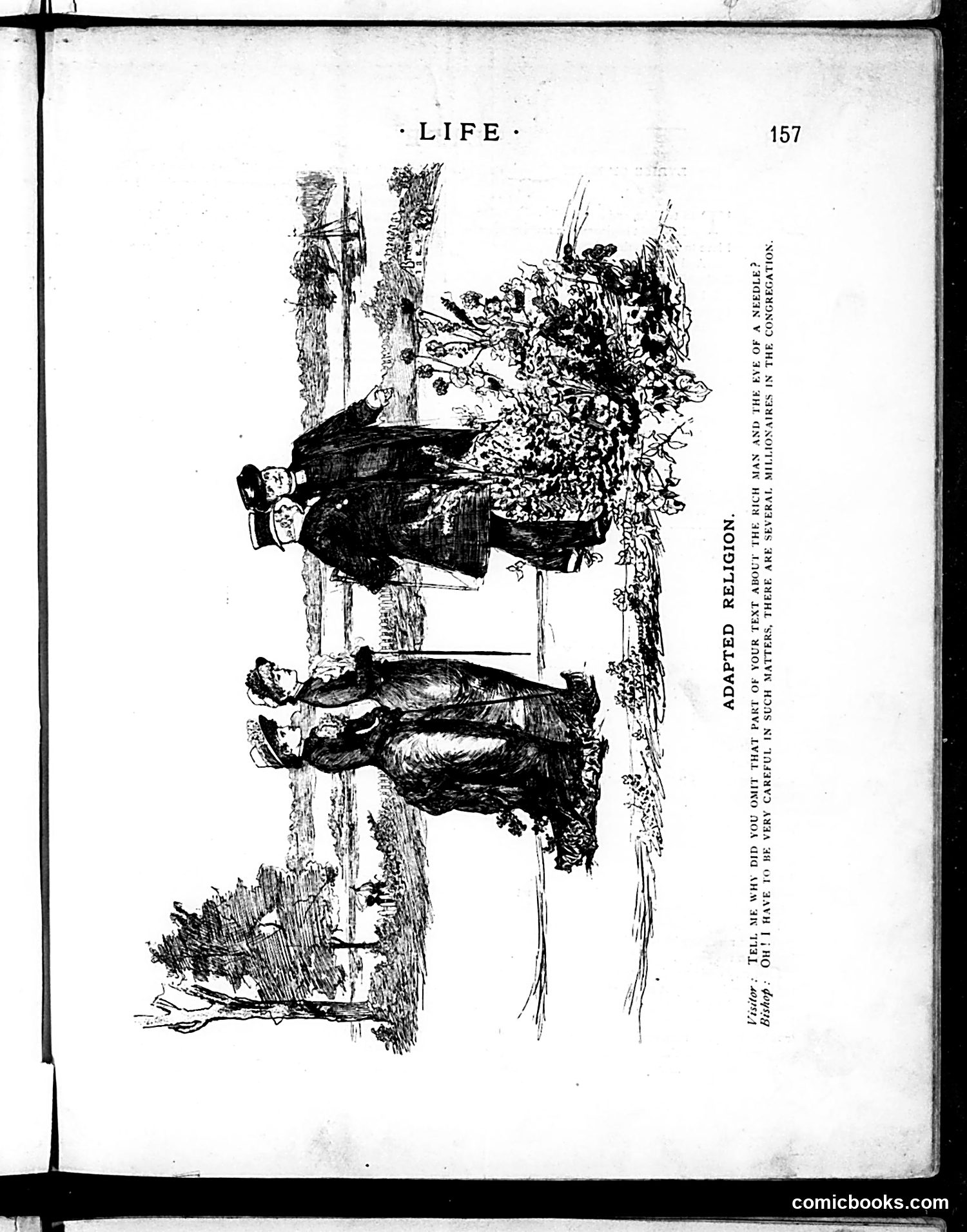
This cartoon satirizes religious hypocrisy, specifically criticizing those who claim religious devotion while ignoring its moral demands. The image shows two figures in what appears to be a rural setting, with the caption indicating they are "very careful in [their] religion" but only pay "lip-service" to religious "matters" while being "very careless in such matters" of actual moral conduct. The satire suggests a gap between professed faith and actual behavior—people who are scrupulous about ritual observance but indifferent to genuine moral obligations like charity, justice, or fair treatment of others. This was a common critique in early 20th-century American satire, targeting selective religiosity among the middle and upper classes.
This page contains **"Lyrics of Erie,"** a satirical poem mocking the Erie Railroad and its operators. The verses ridicule the train's poor conditions—the dim lighting, uncomfortable seating, and particularly **the brutal behavior of the driver**, whose harsh language and reckless driving endanger passengers ("A sickening thud! A splash!"). Below the poem is **"A Model for Presidential Candidates,"** a mock nomination letter from someone positioning himself as a model candidate. The satire targets both political ambition and self-aggrandizement—the writer ironically claims humility while extensively boasting about his qualifications and accomplishments. The page primarily contains political and institutional satire typical of *Life* magazine's approach: mocking incompetence in both transportation and politics through humor and irony.
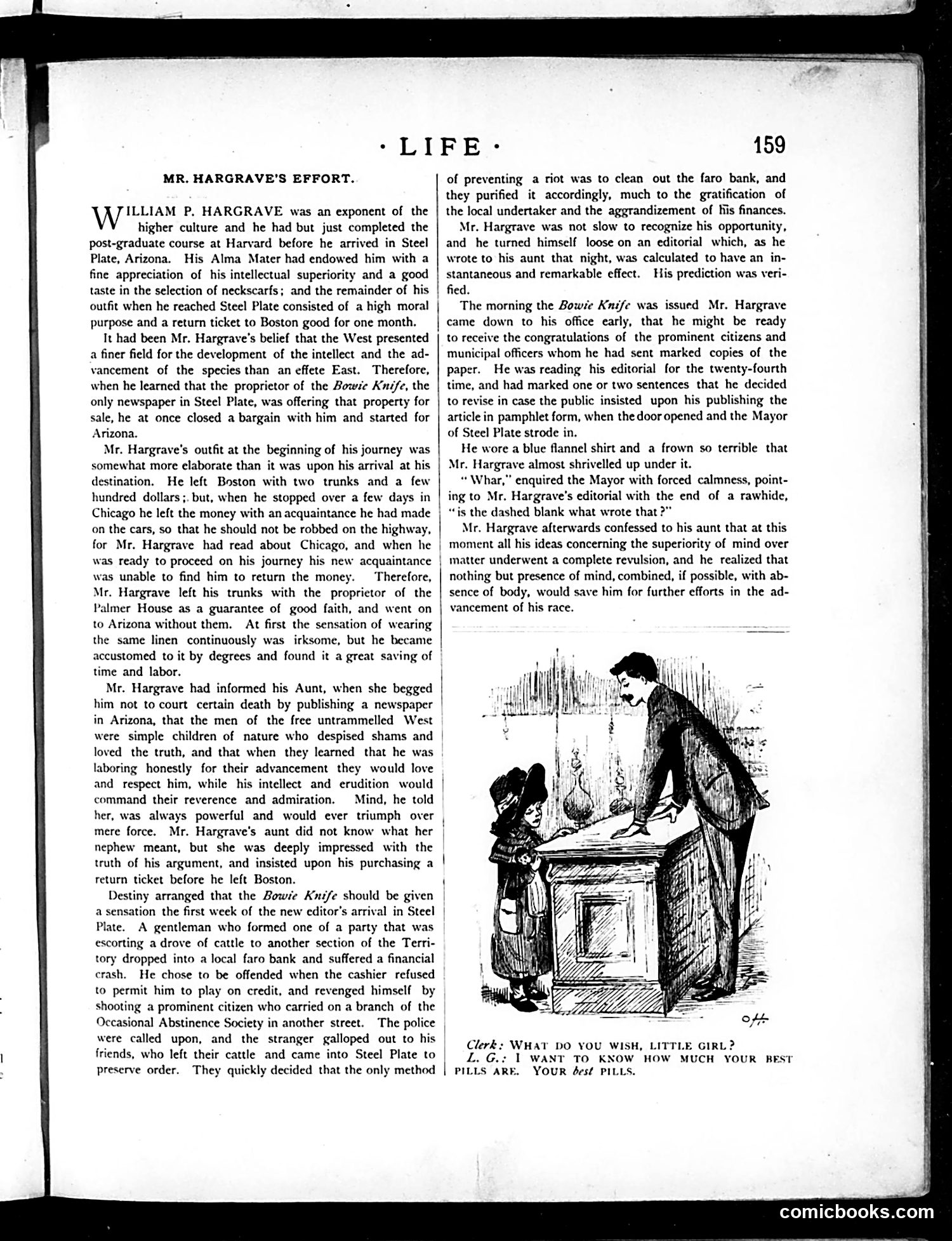
This page contains a serialized story about William P. Hargrave, a cultured Easterner who moves to Steel Plate, Arizona to start a newspaper called the *Bowie Knife*. The narrative describes his idealistic ambitions to bring intellectual advancement to the frontier town. The illustration shows a clerk speaking to a young girl, asking what she wishes for. She responds that she wants to know how much her "best pills" are—likely a humorous reference to patent medicines, which were heavily advertised and sold in this era. The satire targets the clash between Eastern refinement and rough frontier realities, and obliquely mocks the era's prevalent quack medicinal products marketed to common people.
This page is primarily **text content** rather than political cartoons. The main article, by F. Marshall White, appears to be a satirical **short story or sketch** about a newspaper editor's encounter with a stranger who reports that an entire village (Steel Plate) has been burned by Indians. The humor seems to derive from the editor's dismissive, bureaucratic response to what should be alarming news—he's more concerned with office protocol than the crisis itself. The page also includes **book reviews** and a "Found: A Letter" section containing a humorous **mock letter** from the Ohio Republican Committee to George Washington, asking him to endorse J.G. Blaine for President—anachronistic satire of 1884 election politics. No specific caricatured figures are visible in the text portions shown.
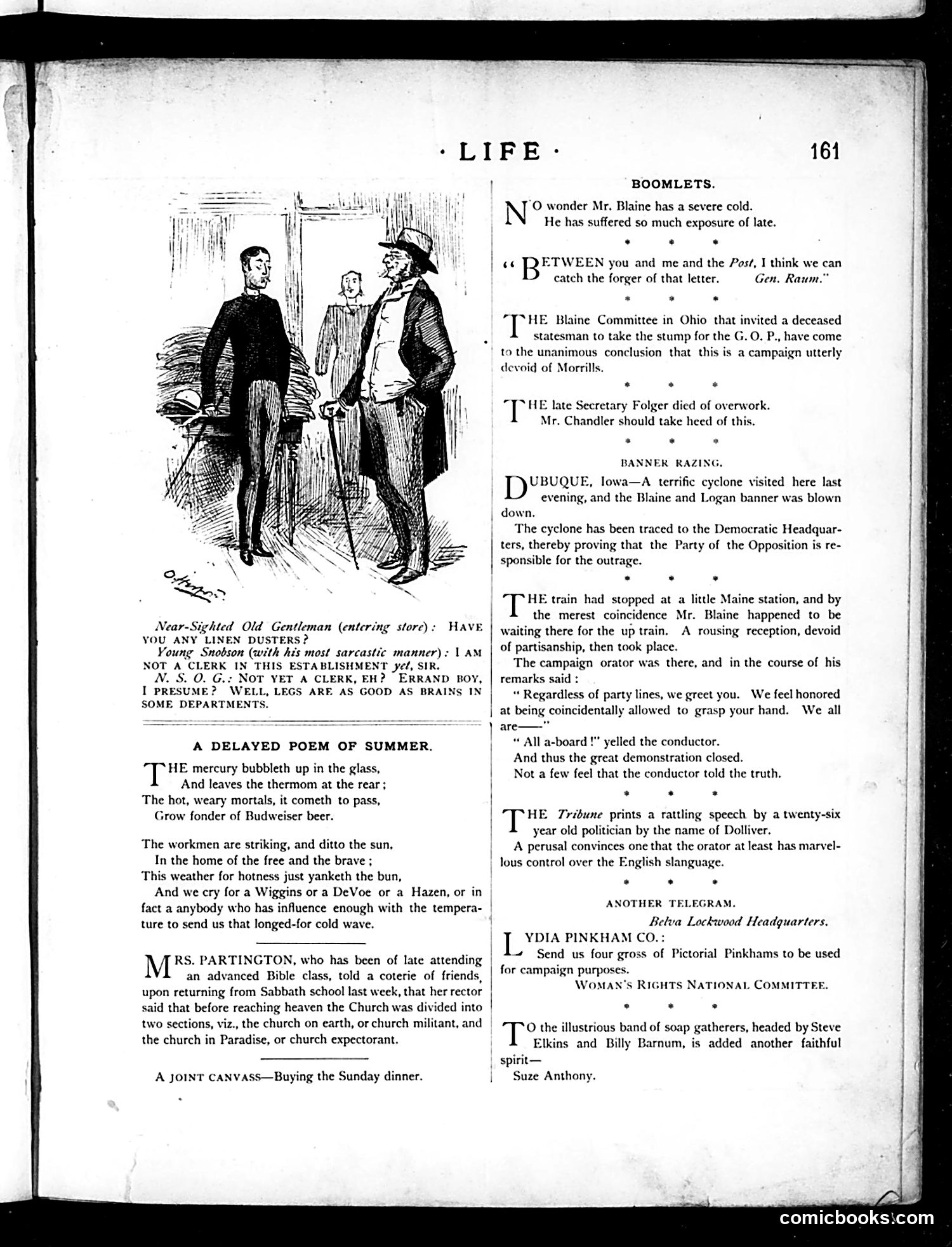
The main cartoon depicts three men in conversation outside a store, captioned with a dialogue about seniority and rank. The humor appears to target bureaucratic pretension—a young man sarcastically addresses an older gentleman, suggesting that despite appearances, office hierarchy doesn't determine actual competence or authority. The "Boomlets" section contains political gossip, including references to Mr. Blaine's health, the Blaine Committee in Ohio, and Secretary Folger's death from overwork. These items satirize contemporary political figures and campaign activities. "A Delayed Poem of Summer" mocks the contrast between summer's promise and working-class reality, while other brief items target religious hypocrisy and political opportunism. The page reflects 1880s-era American politics and social commentary without requiring specific date identification to understand its satirical intent.
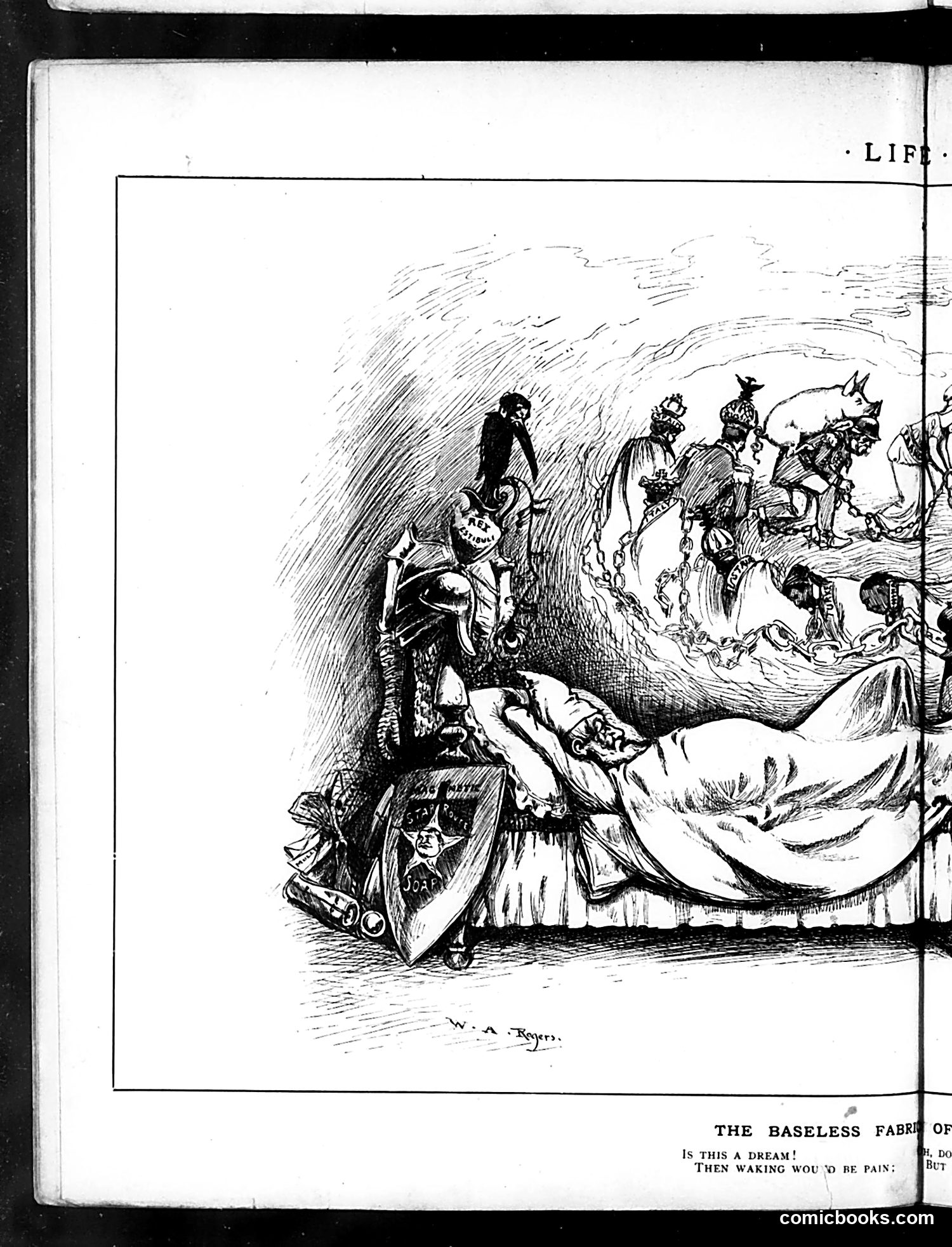
This is a satirical illustration from Life magazine titled "The Baseless Fabre," with the caption "Is this a dream! Then waking wou'd be pain." The cartoon depicts a woman in an elaborate dress appearing to faint or recline, attended by a military or decorated figure standing over her. Additional figures appear in the background. The style and composition suggest a parody of melodramatic theatrical scenes. Without additional context about what "The Baseless Fabre" specifically references, it's unclear whether this satirizes a particular play, literary work, or contemporary social phenomenon. The ornate costumes and theatrical nature suggest mockery of exaggerated sentimentality or artificial behavior in high society or performance. The artist is credited as "W.A. Rynn" or similar.
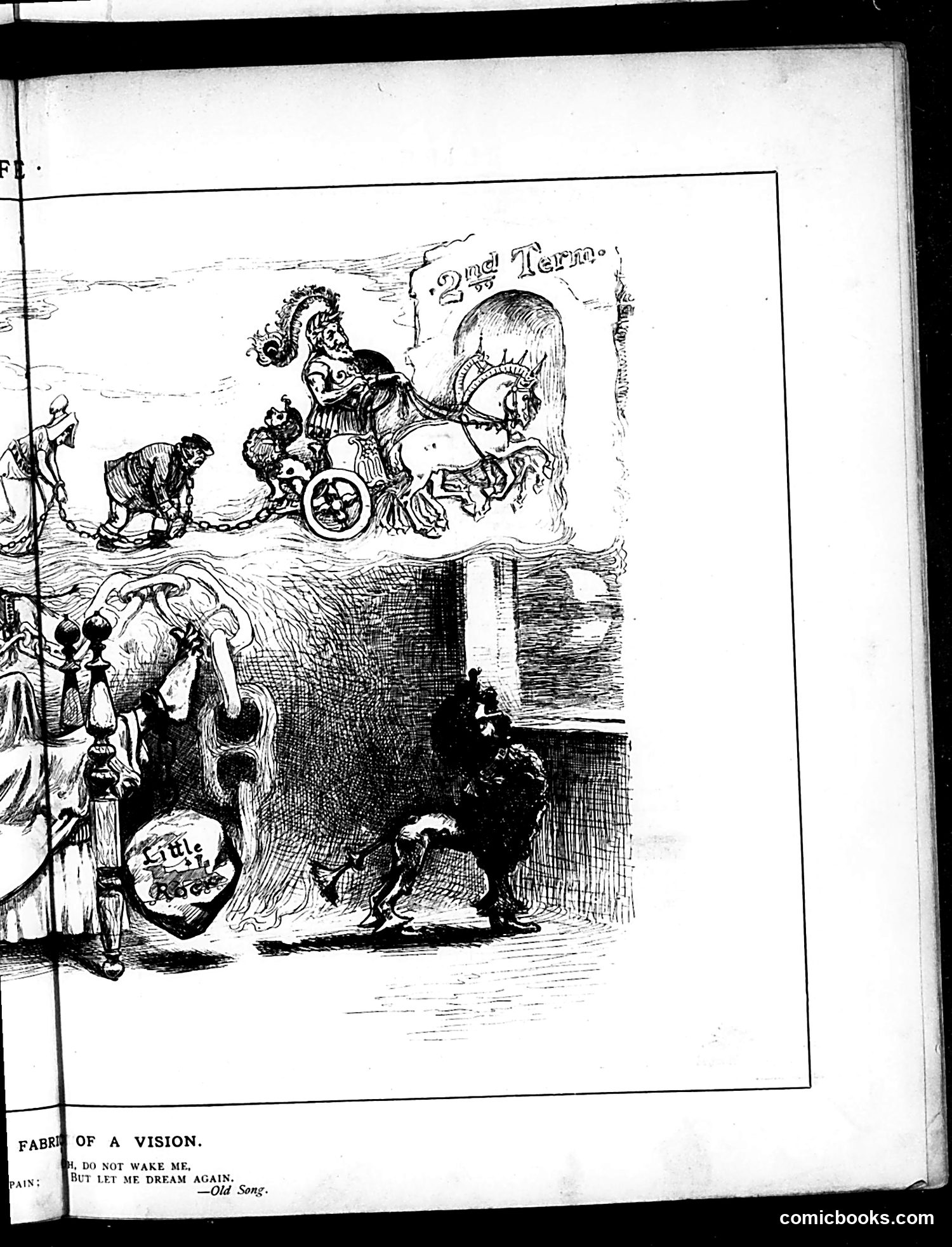
This political cartoon satirizes a grandiose military or political figure—likely a general or leader—depicted in classical Roman armor on a chariot labeled "2nd Term," suggesting ambitions for reelection or extended power. The figure appears inflated with self-importance. Below, a figure in modern dress (possibly representing the public, press, or a political opponent) looks on skeptically or mockingly. The caption references an old song: "Do not wake me, / But let me dream again"—suggesting the leader is operating in delusion rather than reality. The satire critiques overambitious political aspirations and the gap between self-perception and actual circumstances. Without identifying the specific historical moment, the cartoon targets pompous leadership and unrealistic political dreams.
This page contains two satirical pieces mocking American political and social figures through "electrical exhibition" metaphors. **"The Electrical Exhibition"** uses a Philadelphia Electrical Exhibition as a framework to lampoon politicians. The "Dynamic Individual from Maine" and "Bunting Monopolist of Lowell" appear to reference real political figures (likely Republican politicians of the era), satirized as malfunctioning machines. The "Streak Lightning Statesman" has rods labeled with contradictory political positions ("Monopoly," "Anti-Monopoly," "Protectionist," "Free Trader") that all activate simultaneously—mocking politicians for holding inconsistent positions. Additional "exhibits" satirize corruption: a congressman living beyond his $5,000 salary on $15,000 income, and a machine distinguishing bank cashiers from common thieves. **"The Thompson Street Poker Club"** begins a humorous account of a card game featuring characters with comically exaggerated names (Tooter Williams, Cyanide Whiffles, Thankful Smith), depicting working-class gambling culture with gentle mockery. Both pieces use absurdist humor to critique Gilded Age political hypocrisy and social pretension.
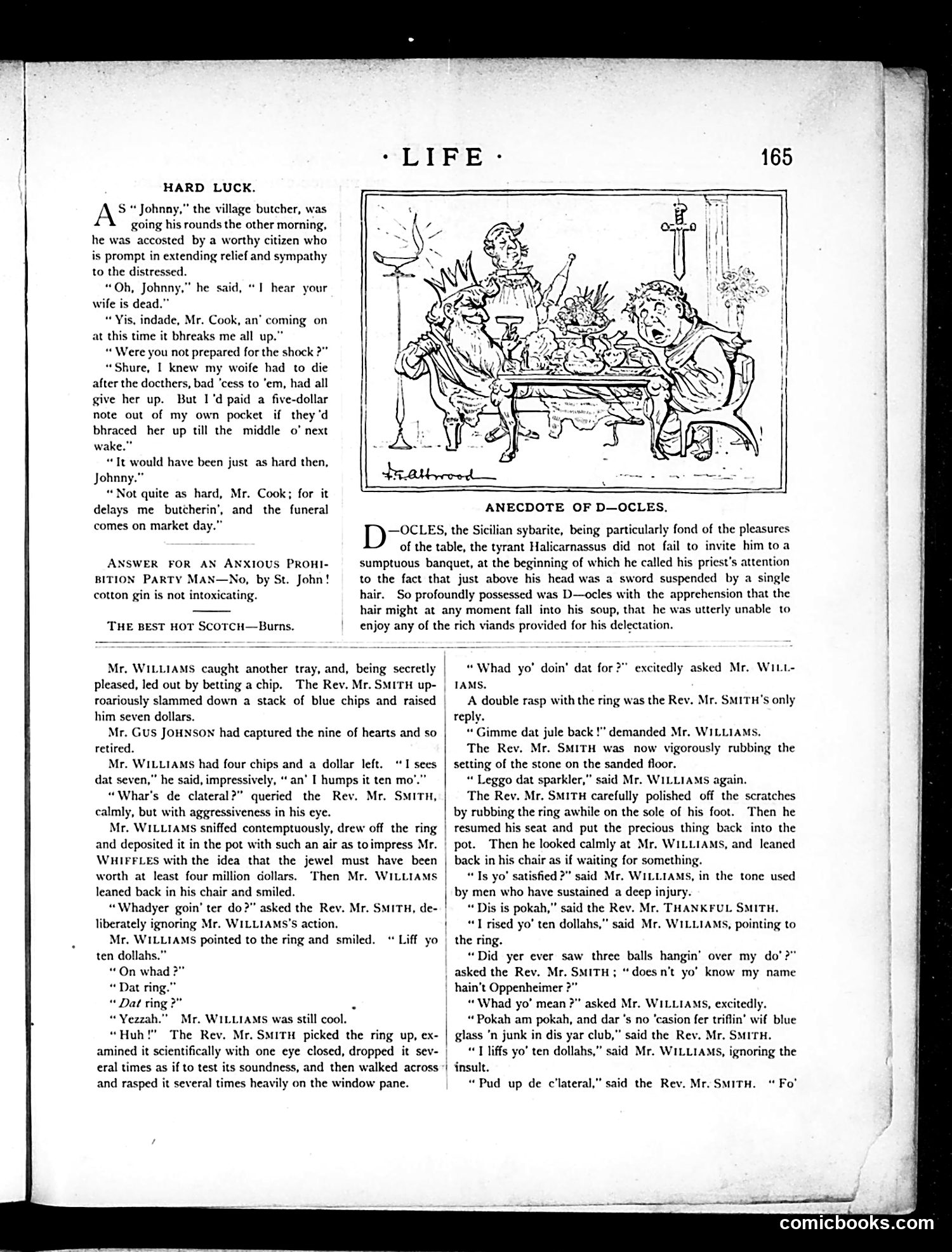
This page contains two distinct pieces of turn-of-the-century American humor: **"Hard Luck"** presents Irish-accented working-class dialect comedy. A butcher, having lost his wife, laments not that she died, but that her death delays his butcher business and coincides with market day—prioritizing profit over grief. The satire mocks both the character's callousness and working-class speech patterns common in period humor. **"Anecdote of D—ocles"** references the classical "Sword of Damocles" story, repositioning it as social commentary about anxiety and excess. The larger narrative involves a poker game among characters with names suggesting their types: Mr. Williams (African American, indicated by dialect), Rev. Mr. Smith, and others. When Williams bets a ring as collateral, Smith deliberately tests and scratches it—a humiliating power play. Smith's reference to "three balls" (pawnshop symbol) and "Oppenheimer" suggests ethnic mockery. The satire likely critiques racial dynamics and gambling culture through exaggerated dialect and stereotyped characterization typical of 1890s-era Life magazine.
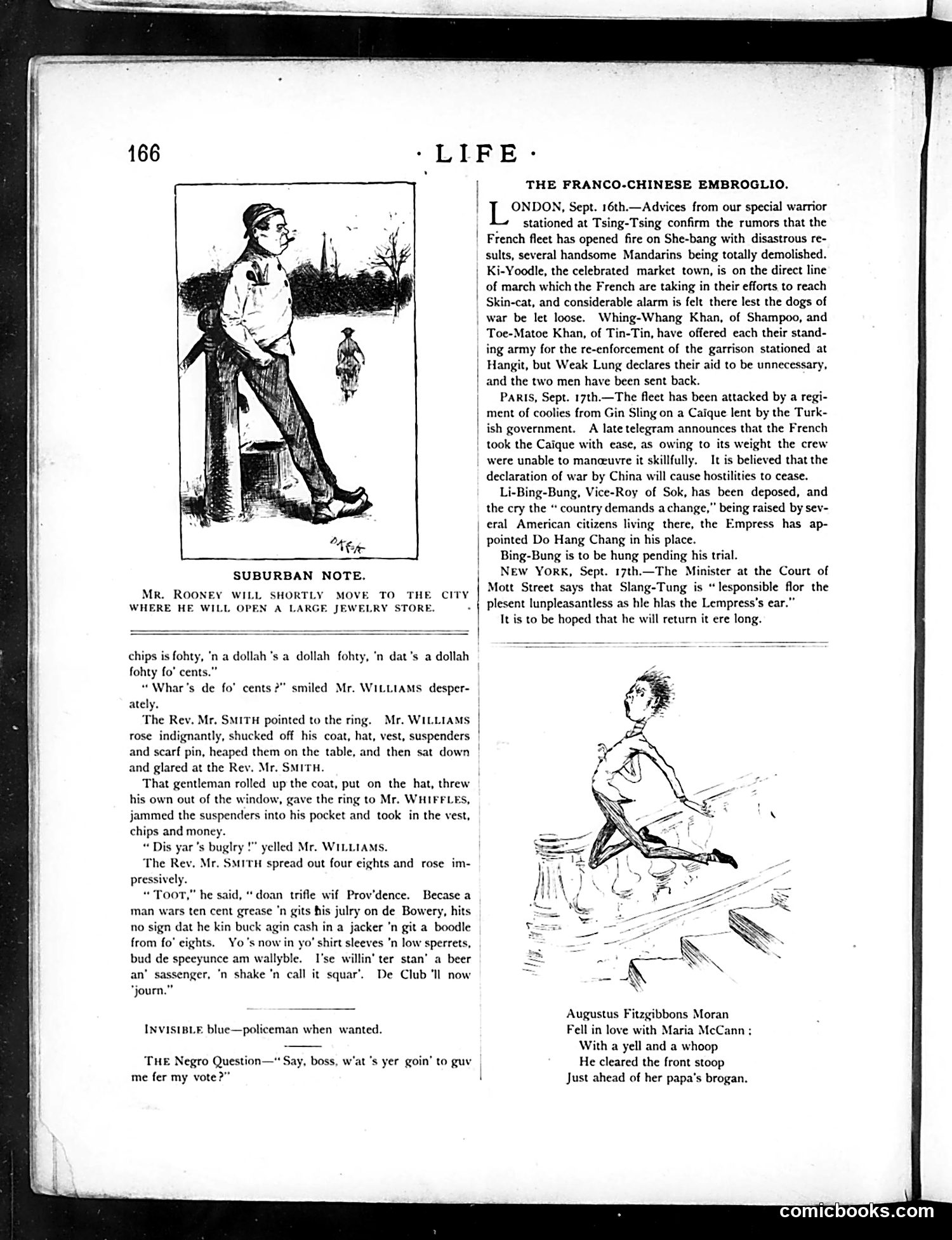
This page from *Life* contains two distinct pieces of satirical content: ## "Suburban Note" (Top Left) A crude racial caricature depicting a card game between white characters (Rev. Mr. Smith, Mr. Williams, Mr. Whiffles) and an unnamed Black man. The satire mocks both the card cheating occurring and uses stereotypical dialect to ridicule the Black participant, who loses his clothing and money. This reflects the period's casual racist humor. ## "The Franco-Chinese Embroiglio" (Main Text) A mock-serious news report satirizing the Franco-Chinese War (likely referencing 1884-1885 tensions). The humor relies on absurd, mispronounced Chinese place names ("She-bang," "Ki-Yoodle," "Gin Sling") and ridiculous characters ("Weak Lung," "Toe-Matoe Khan"). It parodies overly dramatic war reporting by presenting incompetent military operations as serious dispatches, mocking both sensationalist journalism and Western attitudes toward Asian conflicts. The bottom illustration and verse are unrelated comic vignettes about romance and voting, typical of the magazine's miscellaneous content.
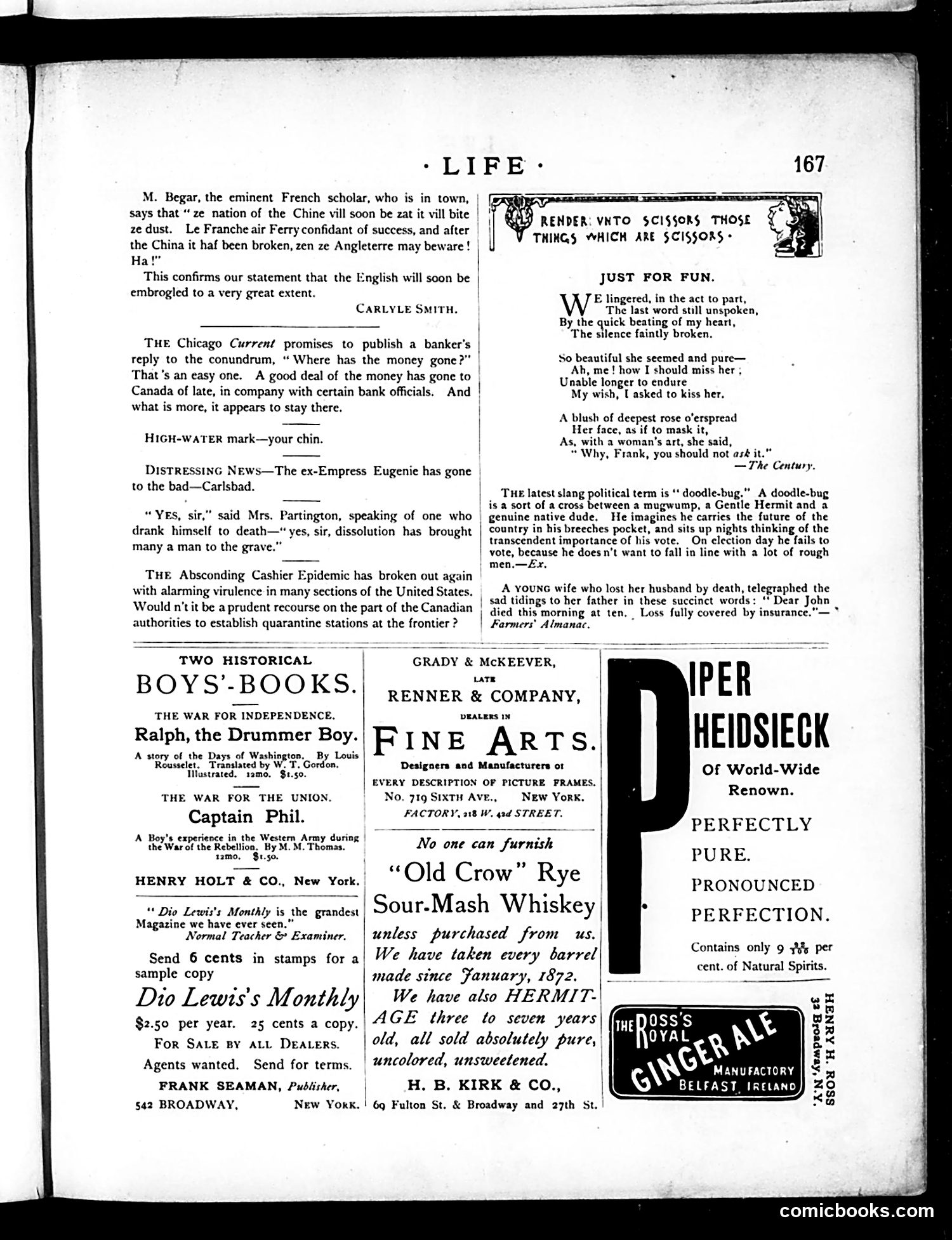
This page is primarily **advertising and humor content** rather than political cartoons. The small illustrated header "Render unto scissors those things which are scissors" appears to be a decorative masthead rather than substantive commentary. The text includes **satirical social commentary**: - A French scholar's prediction that China will "bite ze dust" and England should "beware" (likely referencing 19th-century imperial anxieties about Asian markets) - A quip about bankers' money disappearing to Canada with bank officials—**satirizing embezzlement**, a recurring theme mentioned ("Absconding Cashier Epidemic") - A joke about ex-Empress Eugenie going "to the bad—Carlsbad" (a spa town, playing on "bad" as a moral judgment) - "Doodle-bug" defined as a political type who talks about voting importance but doesn't actually vote—**mocking civic pretenders** The page is mostly filled with **advertisements** for whiskey, fine arts dealers, children's books, and magazines, typical of Life's revenue model. No major political figures are identified or caricatured.
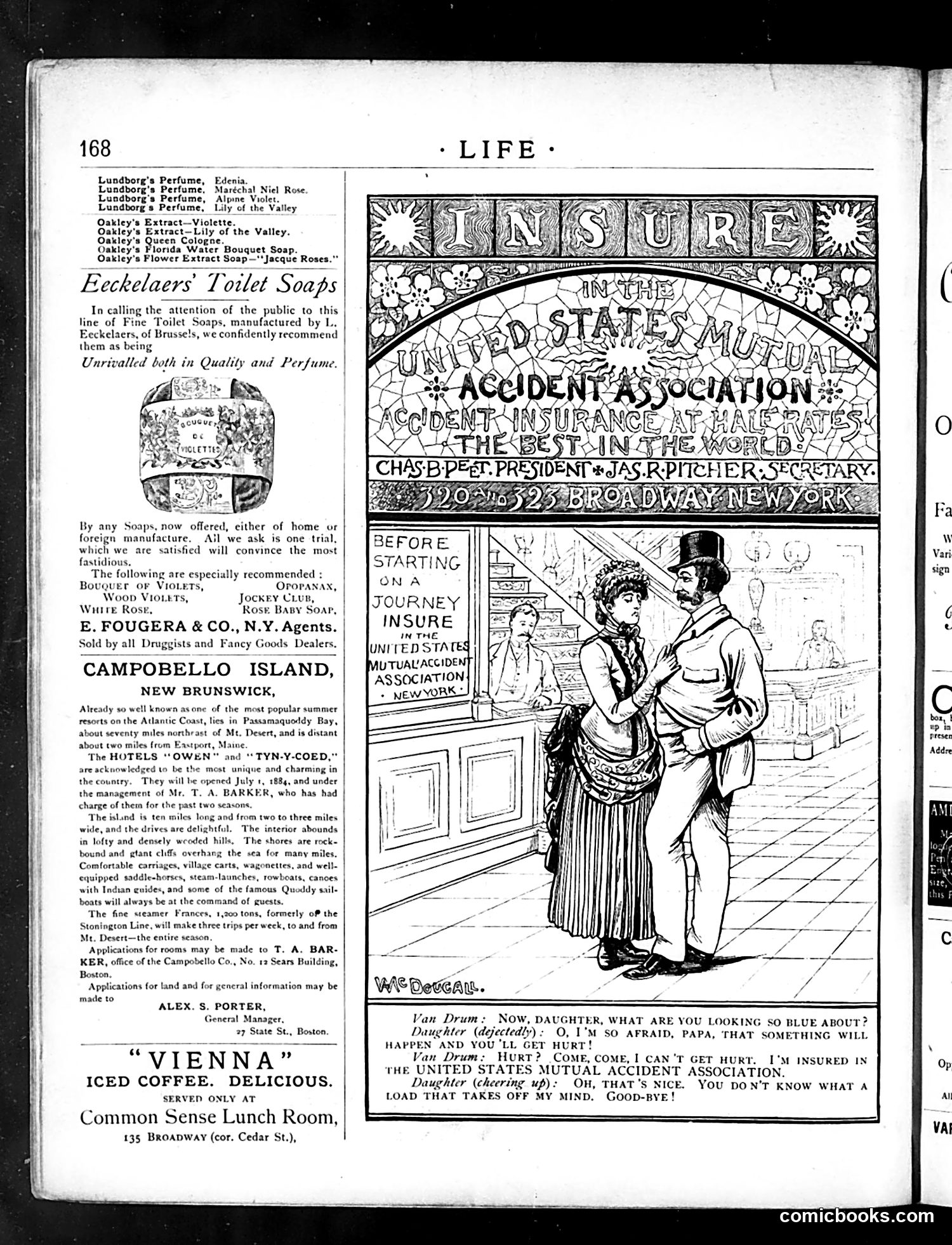
This page is primarily **advertisements** interspersed with one small cartoon. The cartoon depicts a father (Van Drum) reassuring his worried daughter before a journey. She fears he'll be injured; he allays her concerns by revealing he's insured with the United States Mutual Accident Association. She's instantly relieved and cheerful. **The satire**: The joke mocks how insurance companies marketed accident policies by playing on family anxiety. The daughter's dramatic mood shift—from despair to happiness upon hearing "insurance"—exaggerates the period's belief that insurance was a magical solution to life's dangers. It's gentle social commentary on late-19th-century consumer culture and commercialized reassurance. The remainder of the page advertises perfumes, toilet soaps, a resort hotel in Campobello Island, and "Vienna" iced coffee—typical luxury goods marketed to Life's affluent readership.
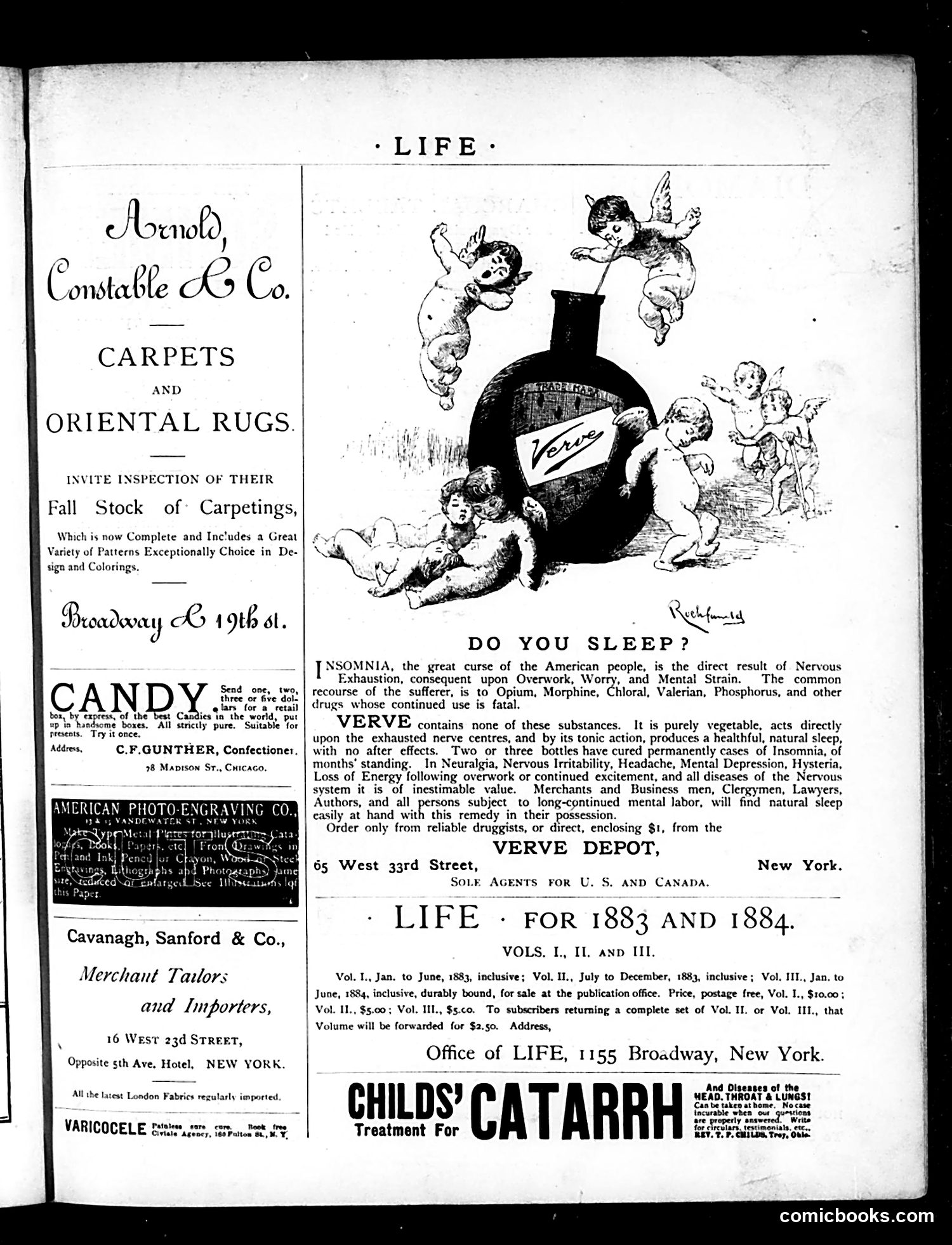
This page is primarily **advertising and promotional content** rather than satirical cartoons. The central image shows cherubs surrounding a large bottle labeled "Verve," a patent medicine marketed as a cure for insomnia. The cartoon satirizes the desperation of exhausted Americans—overworked businessmen, lawyers, and clergy suffering from "Nervous Exhaustion"—by depicting them as infantilized, needing comfort like babies. The irony is that "Verve" claims to be a purely vegetable remedy with "no after effects," yet contemporary readers would have recognized this as typical snake-oil advertising for a product likely containing opiates or other addictive substances (the text acknowledges many remedies used opium and morphine). The surrounding ads for carpets, candy, tailoring, and catarrh treatment are typical 1880s magazine advertisements. The page demonstrates how patent medicines exploited widespread anxiety about modern industrial life's psychological toll—a major satirical target for Life magazine during this era.
This page is primarily **advertisements**, not editorial content or cartoons. It's a typical turn-of-the-century Life magazine page featuring paid advertising for luxury goods and patent medicines—diamonds, pianos, printing ink, bicycles, and various remedies for ailments like dyspepsia, rheumatism, and skin conditions (Cuticura products are heavily featured). Notable is "Cloth of Gold Cigarettes," which advertised with claims of "Two hundred millions sold in 1883"—typical of an era before tobacco health warnings. The page reflects late 19th-century consumer culture: spa waters ("Genuine Vichy"), musical instruments, sporting goods, and **quack medicines**. The large "Beware of Imitations" warning about genuine Vichy water indicates prevalent counterfeiting. No satire or political cartoons appear on this page—it's purely commercial.