
A complete issue · 16 pages · 1884
Life — July 3, 1884
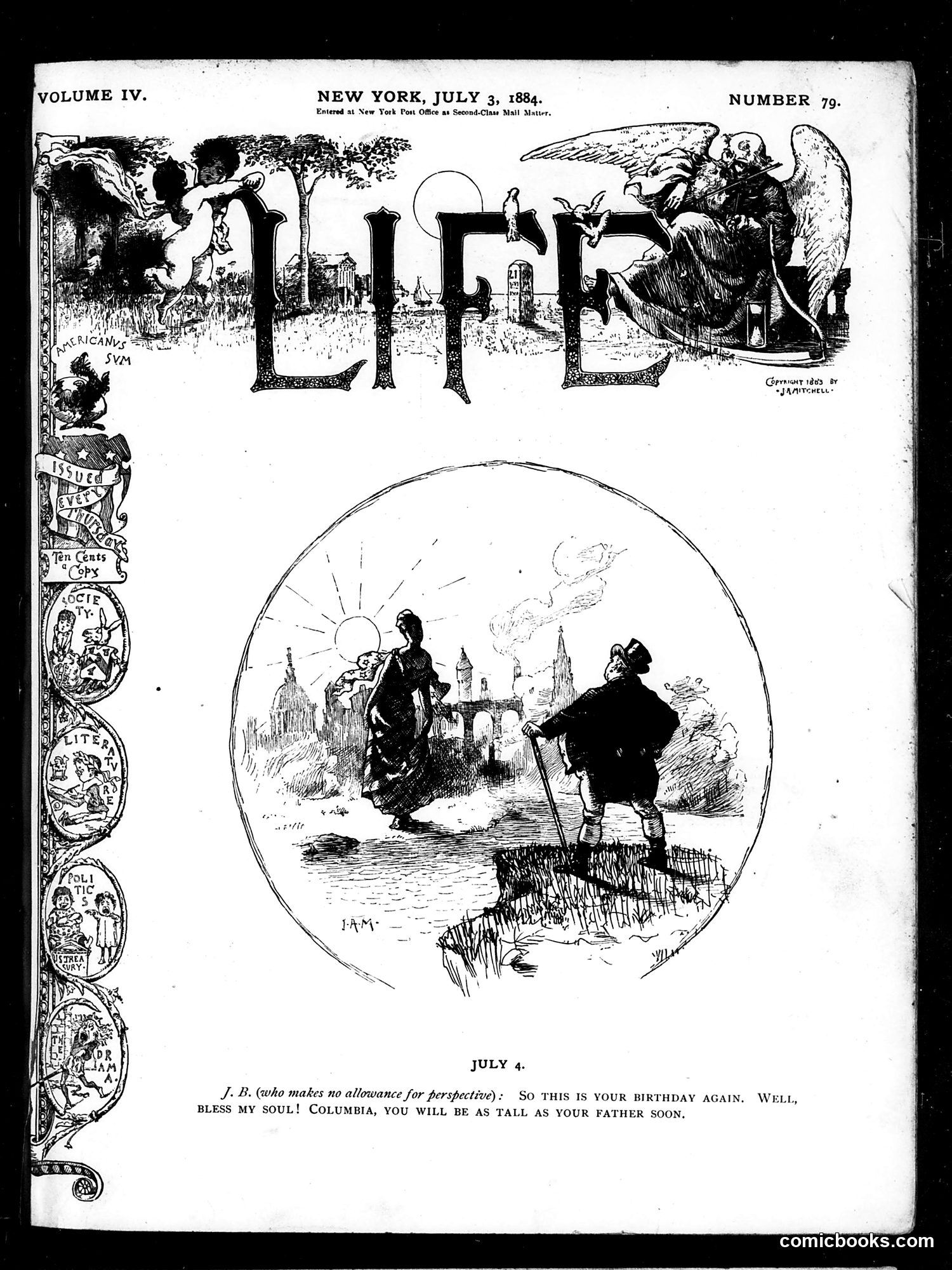
This page contains a satirical cartoon titled "JULY 4" depicting two figures by a river with a European cityscape (likely representing Britain or Europe) in the background. The caption reads: "J.B. (who makes no allowance for perspective): 'So this is your birthday again. Well, bless my soul! Columbia, you will be as tall as your father soon.'" The joke appears to be about America's (Columbia personified) growth and independence relative to Britain ("your father"). The figure on the left (labeled "J.B.") seems to be a British observer commenting on America's rapid development as a nation—nearly 100 years after independence. The "perspective" reference suggests ironic commentary on Britain's diminishing relative power compared to the expanding American nation, published strategically around Independence Day.
The masthead illustration depicts a figure playing guitar while seated amid a chaotic landscape. Based on the surrounding text mentioning Mr. Magruder's periodic "outbursts" and references to presidential nominations and "chronic ill-fortune," this appears to be political satire about a public figure experiencing repeated misfortunes. The text discusses Mr. Magruder's bad luck occurring "every four years"—coinciding with presidential election cycles—suggesting the cartoon satirizes someone whose personal disasters align suspiciously with election seasons. The specific reference to whether he'll "keep up his grip on chronic ill-fortune" implies commentary on a real political figure's recurring scandals or failures during campaign periods. The context suggests satirical commentary on nineteenth-century electoral politics and personal reputation.
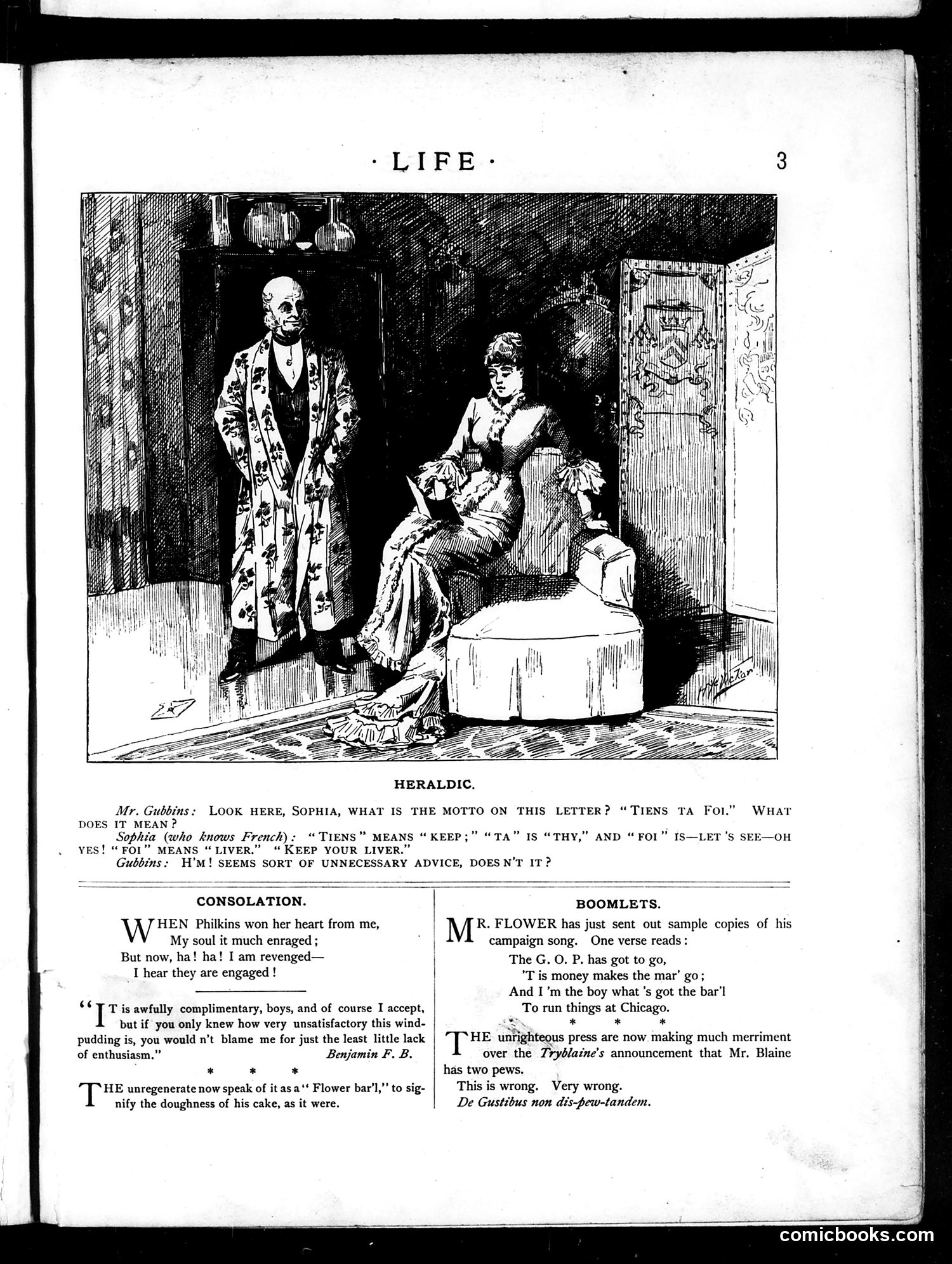
**"Heraldic" Cartoon:** The illustration depicts a gentleman asking a woman named Sophia about a letter's motto "Tiens ta Foi" (French: "Keep your faith"). The joke plays on homophone confusion: "Foi" sounds like "Foie" (liver in French), so Mr. Gubbins humorously interprets the advice as "Keep your liver"—suggesting unnecessary health preoccupation. **Lower Section Content:** Below are three brief satirical pieces: "Consolation" (likely about romantic disappointment), "Boomlets" (mocking Mr. Flower's campaign song and G.O.P. politics in Chicago), and a jab at the *Trybune's* announcement about Mr. Blaine having "two pews." The page reflects early American satirical humor mixing wordplay, political mockery, and social commentary typical of Life's era.
This page consists primarily of **text commentary and editorial notes** rather than cartoons. The content includes several satirical vignettes: 1. **Tilden mystery**: Commentary on a newspaper correspondent's mysterious name "Tilden," appearing only on the sixth day of the sixth month—apparently a running joke about Samuel J. Tilden. 2. **Political jabs**: Brief, witty remarks about contemporary figures including references to Blaine, Roosevelt, Cleveland, and Gov. Robinson declining Harvard's offer. 3. **"A Morality Conundrum"**: A substantial piece analyzing Henry Vane's novel "The Crime," discussing moral philosophy and social instruction through fiction. 4. **"The De Kay of the Hudson"**: A lengthy review of Mr. De Kay's "Choral Ode to the North River," celebrating New York's natural features. The page represents Life's characteristic style: **political commentary, literary criticism, and social satire delivered through dense text rather than illustrations**.
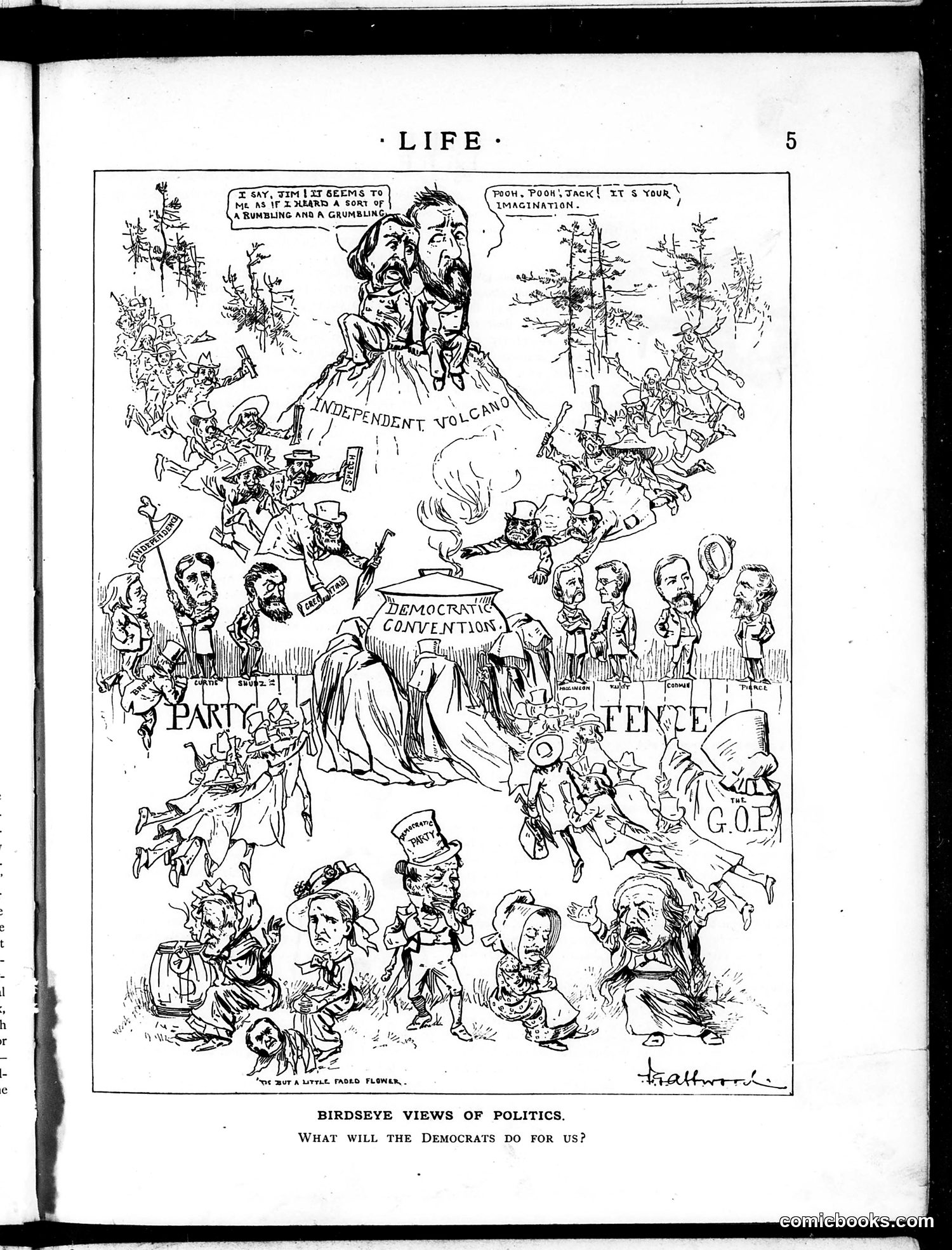
This satirical cartoon mocks the Democratic Party and its 1890s convention. At the center sits a "Democratic Convention" where party leaders gather beneath an "Independent Volcano" — suggesting internal instability and factional conflict. The volcano erupts chaos, with figures labeled "Party" and "Tent" fragmenting. Above, two bearded men (likely representing competing Democratic factions) argue about poor Jack and imagination. Below, various political figures scramble chaotically. Labels visible include "G.O.P." (Republican Party), suggesting Republicans watching Democratic disorder with amusement. The overall message: Democrats are disorganized and fractious, unable to deliver meaningful policies — hence the sarcastic title questioning what they'll actually accomplish for voters.
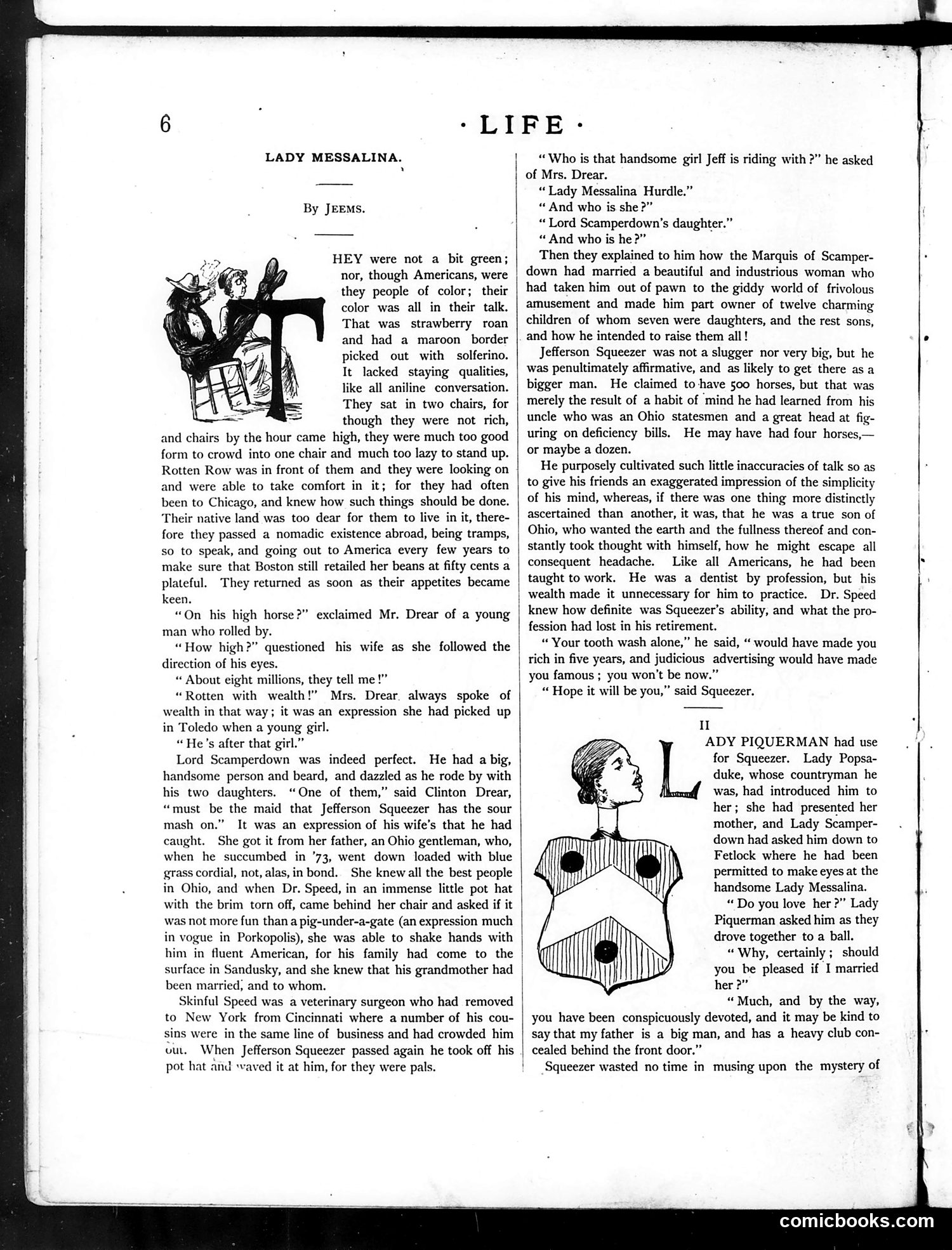
This page satirizes American social climbing and pretension through the story of Jefferson Squeezer, a self-made businessman from Ohio who cultivates an exaggerated persona of wealth and sophistication. The cartoon depicts two figures in a carriage, likely illustrating Squeezer's affected behavior. The satire mocks Americans who adopted European mannerisms and aristocratic pretensions—a common Life magazine theme circa early 1900s. The text ridicules Squeezer's "cultivated inaccuracies" and false claims of four horses and a dozen servants. The humor centers on exposing the gap between genuine wealth (like the Marquis of Scamperdown) and American nouveaux riches who merely perform sophistication without true breeding or substance.
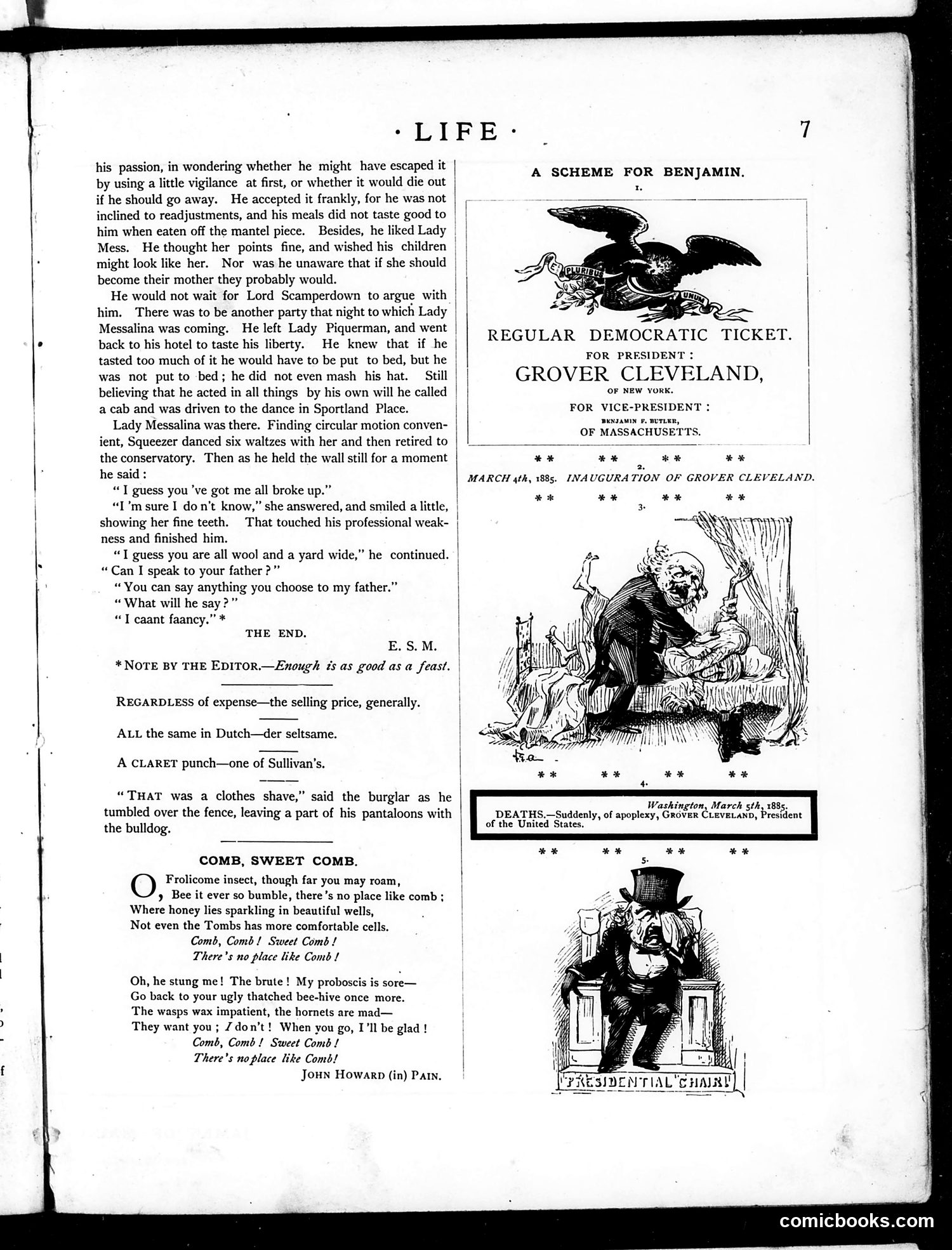
This page commemorates **Grover Cleveland's 1885 presidential inauguration**. The top section shows the official Democratic ticket featuring Cleveland for president and Benjamin Butler of Massachusetts for vice-president. The three cartoons appear to be satirical commentary on Cleveland's death (noted in the boxed announcement: "DEATHS.—Suddenly, of apoplexy, GROVER CLEVELAND, President of the United States"). The images use dark humor—the first shows a skeletal figure, the second depicts what appears to be Cleveland in a coffin or "Presidential Chair." Below is a poem "Comb, Sweet Comb" by John Howard (in Pain), likely a humorous piece unrelated to the political content above. The page blends news, satire, and light verse typical of 19th-century Life magazine's format.
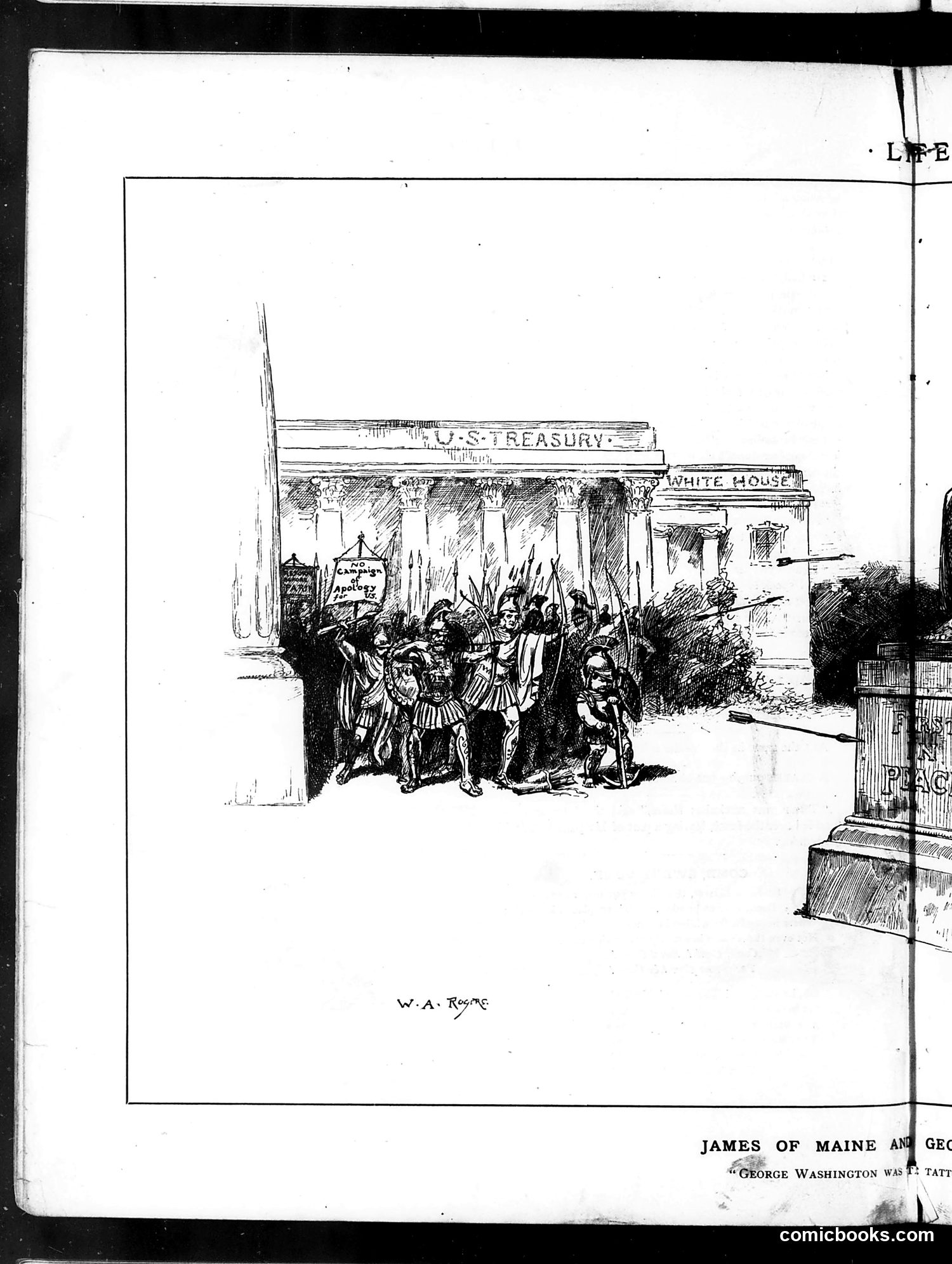
This cartoon by W.A. Rogers depicts a crowd of figures with raised weapons and flags gathered outside the U.S. Treasury and White House buildings. The caption references "James of Maine" and "George Washington," though the full context is cut off. The image appears to be satirizing a political protest or demonstration at federal buildings. The armed, aggressive crowd suggests either civil unrest or a commentary on threatening political activism. Without the complete caption visible, the specific historical event or political figure being critiqued remains unclear, though the placement at Treasury and White House indicates commentary on federal government actions or policies that provoked public anger or violence. The style suggests this is from the late 19th or early 20th century.
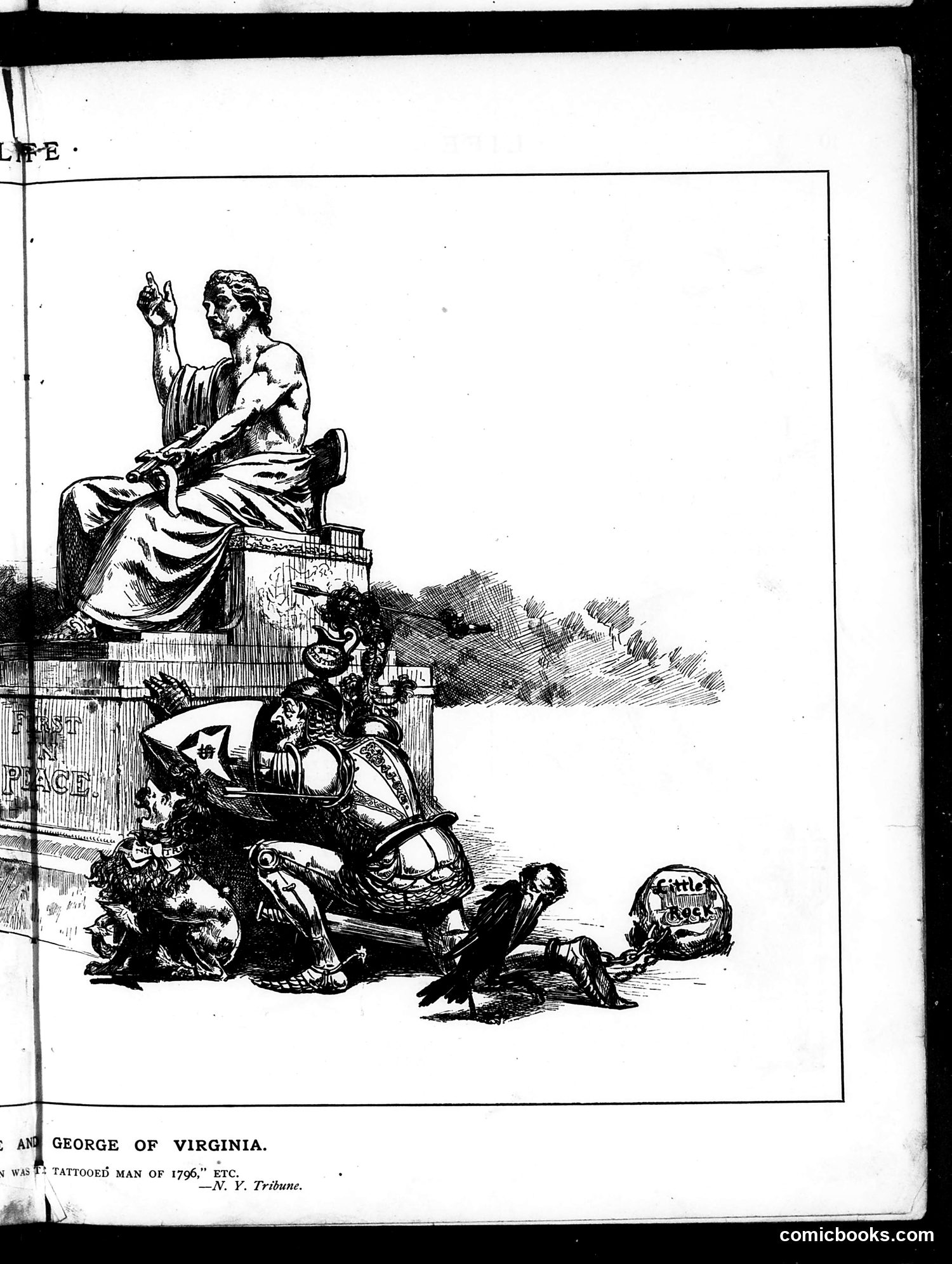
This cartoon satirizes George Washington through the caption "George of Virginia" and a subtitle reference to "a tattooed man of 1796." The image shows a classical female figure (likely representing Liberty or America) seated on a pedestal, pointing upward. Below her sit disheveled, defeated figures that appear to represent political opponents or enemies. The satire appears to mock Washington's authority and power during his presidency around 1796. By calling him "George of Virginia" rather than using his formal title, the artist employs mockery. The "tattooed man" reference is unclear but suggests derision. The trampled, submissive figures below suggest Washington's political dominance, though whether this is celebratory or critical of his power remains ambiguous from the image alone.
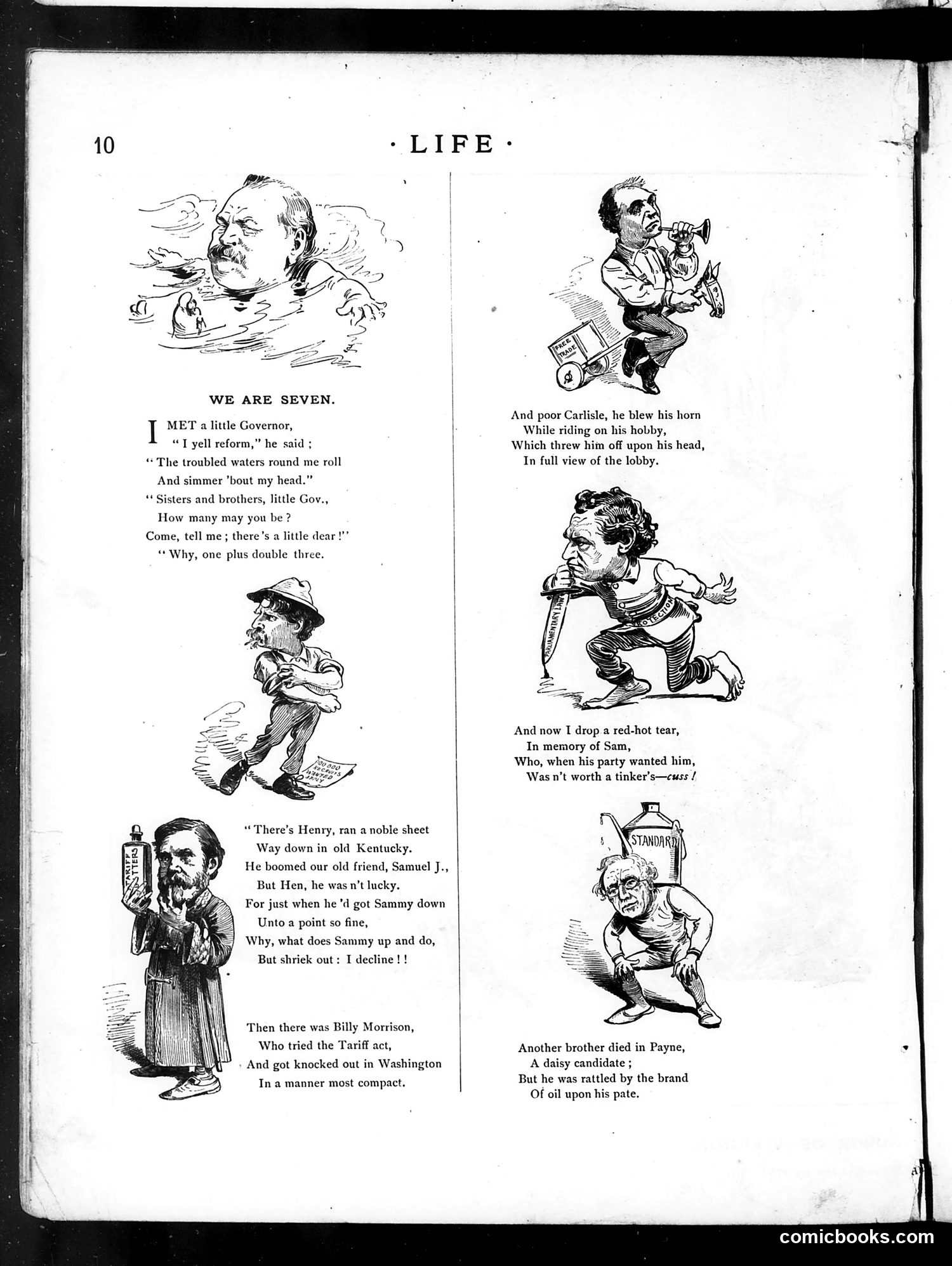
This satirical poem mocks a Democratic governor listing his party's recent electoral and political disasters. The "seven brothers" represent failed Democratic candidates or initiatives: - **Henry** (Kentucky): A newspaper editor who backed Samuel J. Tilden but failed when Tilden withdrew from candidacy ("I decline") - **Billy Morrison**: Lost on tariff legislation in Washington - **Carlisle**: Appears to be John G. Carlisle, a Kentucky politician who fell from his "hobby horse" (political position) publicly - **Sam**: Likely Tilden again, unavailable when needed - **Payne**: A failed candidate damaged by association with oil interests The poem's title references Wordsworth's "We Are Seven," suggesting the governor counts failures as if they were achievements. The caricatures emphasize the Democratic Party's string of embarrassing losses and broken promises during this period. Without specific dating, the references suggest late 19th-century American politics, likely the 1880s-90s.
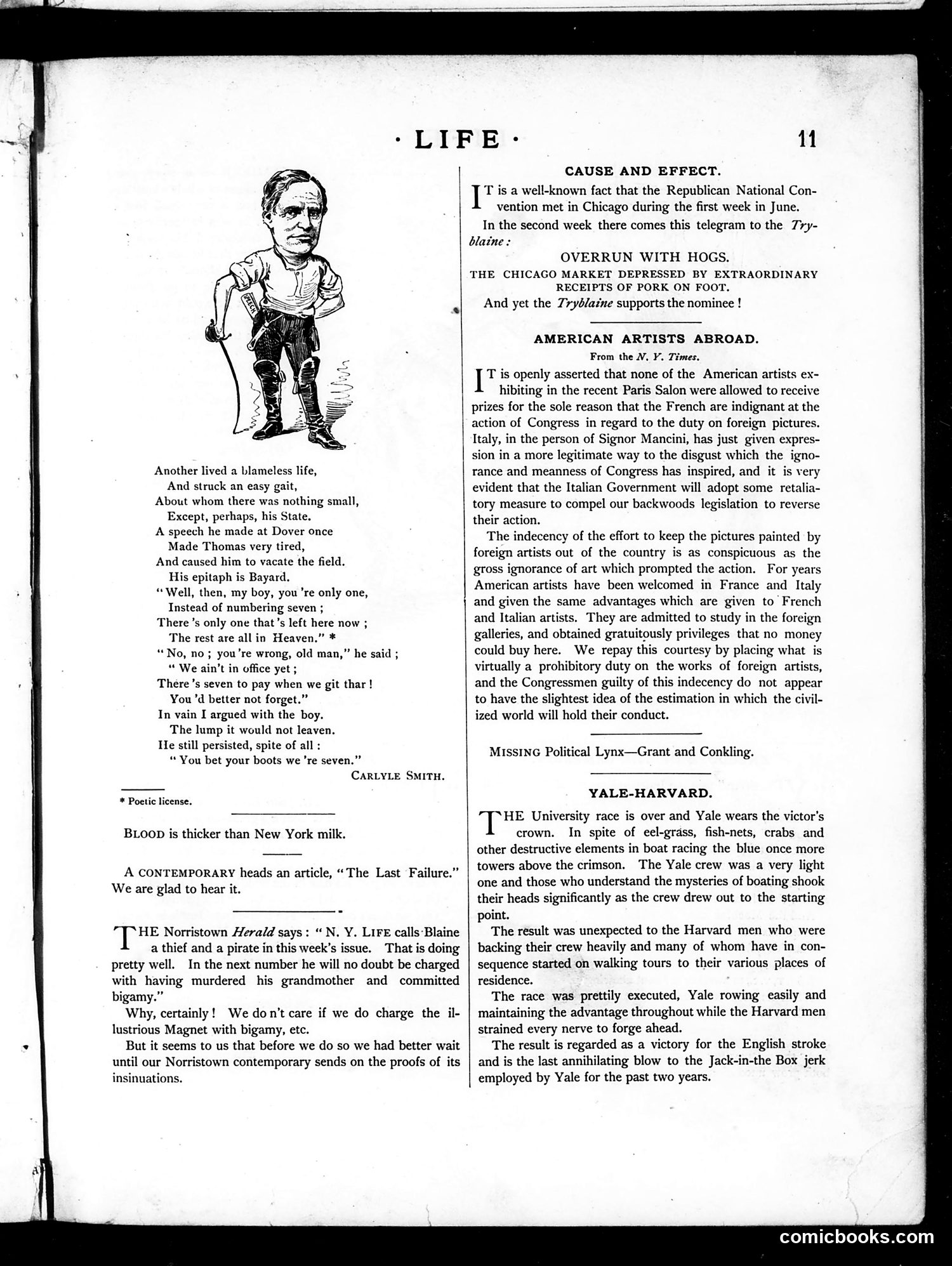
This page from *Life* contains several satirical pieces targeting political and cultural figures of the era. **The cartoon** (left) depicts a caricatured figure in an exaggerated stance, likely representing James G. Blaine, a prominent Republican politician. The accompanying poem by Carlyle Smith mocks him obliquely through references to "Dover" speeches and "Bayard" as his epitaph—political allusions unclear without more context. **"Cause and Effect"** makes a crude joke: the Republican Convention nominated Blaine, then Chicago's hog market was flooded with pork. The satire suggests the nominee himself is "pork"—a term of contempt for corrupt politicians. **"American Artists Abroad"** criticizes Congress for imposing tariffs on foreign artwork, calling it ignorant and insulting to France and Italy, who had welcomed American artists. The page also attacks Blaine directly, defending *Life*'s calling him a "thief and pirate" and sarcastically suggesting future accusations. The Yale-Harvard boat race item concludes the page.
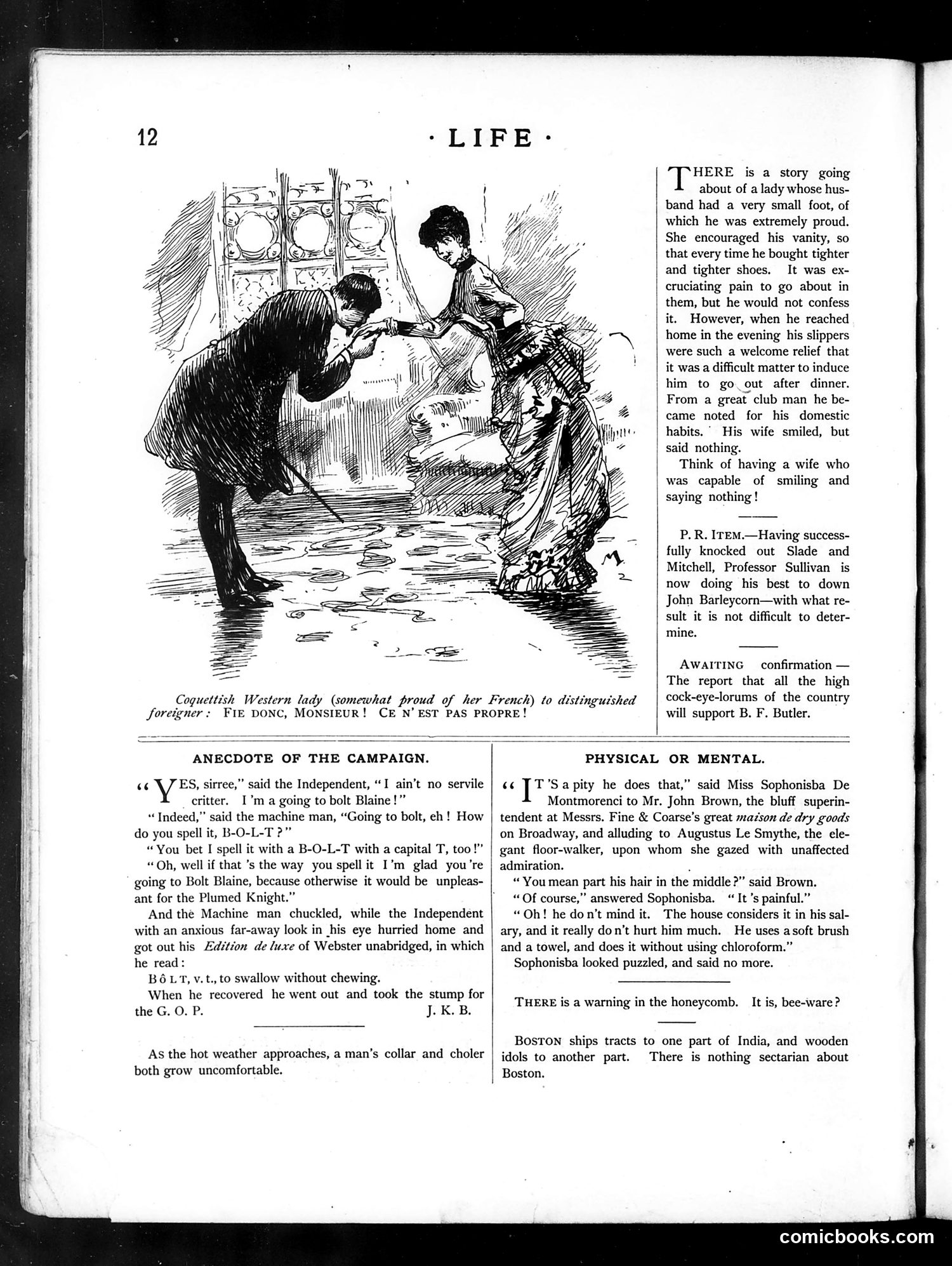
This page contains three satirical pieces typical of 1880s American humor: **Main Cartoon**: A "Coquettish Western lady" speaks French to a foreign gentleman, saying "Fie donc, monsieur! Ce n'est pas propre!" (roughly "That's not proper!"). The satire mocks American women who affected French sophistication and moral prudishness while often behaving hypocritically. **"Anecdote of the Campaign"**: Political satire about an Independent voter threatening to "bolt" (abandon) James G. Blaine. A Republican operative tricks him by exploiting the double meaning: "bolt" also means "swallow without chewing." The joke satirizes independent voters as easily manipulated dupes. **Other Items**: Brief jokes about vanity (tight shoes), Professor Sullivan's temperance work against "John Barleycorn" (alcohol), and social pretension (a floor-walker's painful hairstyle). The humor assumes readers understood 1884 election references, French affectations among the wealthy, and working-class social climbing—all now-obscure contexts.
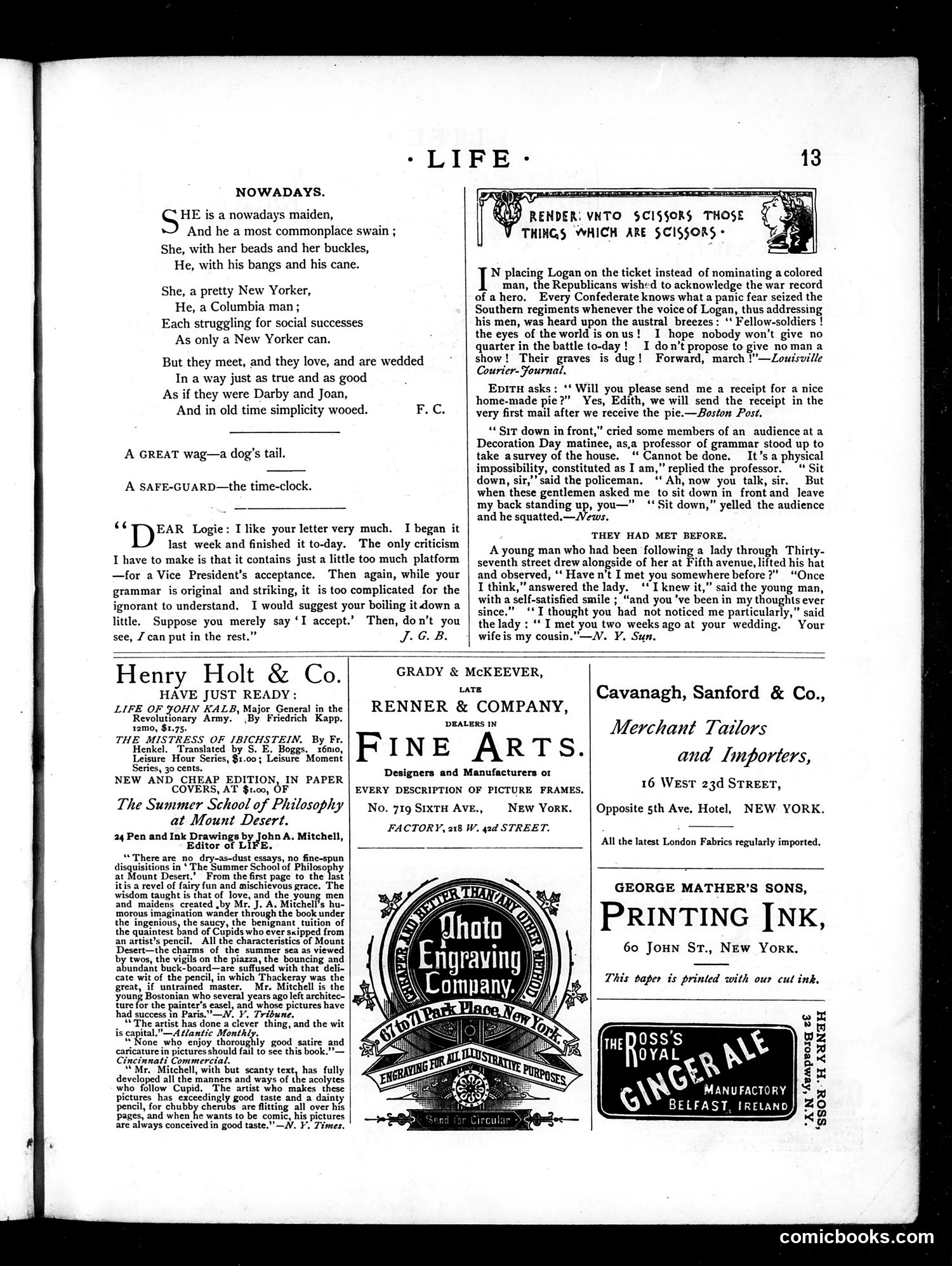
This page is primarily **advertisements and literary content** with minimal satirical cartoons. The main items are: **The "Nowadays" Poem**: A light social satire contrasting modern courting with traditional romance. It mocks contemporary New York society—a "pretty New Yorker" and "Columbia man" obsessed with "social successes," yet their love is genuine despite their superficial modern trappings (beads, buckles, bangs, canes). **The "Logan" Editorial**: A political jab at Republican VP candidate **John A. Logan**. The piece mocks his rough, ungrammatical battlefield speech patterns, suggesting Republicans chose him to highlight Civil War credentials rather than select a Black candidate. The Louisville *Courier-Journal* quote ridicules Logan's crude military vernacular ("Their graves is dug!"). **Minor Quips**: Humorous reader submissions about everyday absurdities (grammar professors at matinees, coincidental encounters). The page is dominated by **advertisements** for art frames, printing ink, and merchant tailors—typical for Life's commercial model. The satirical content is gentle social humor rather than hard-hitting political commentary.
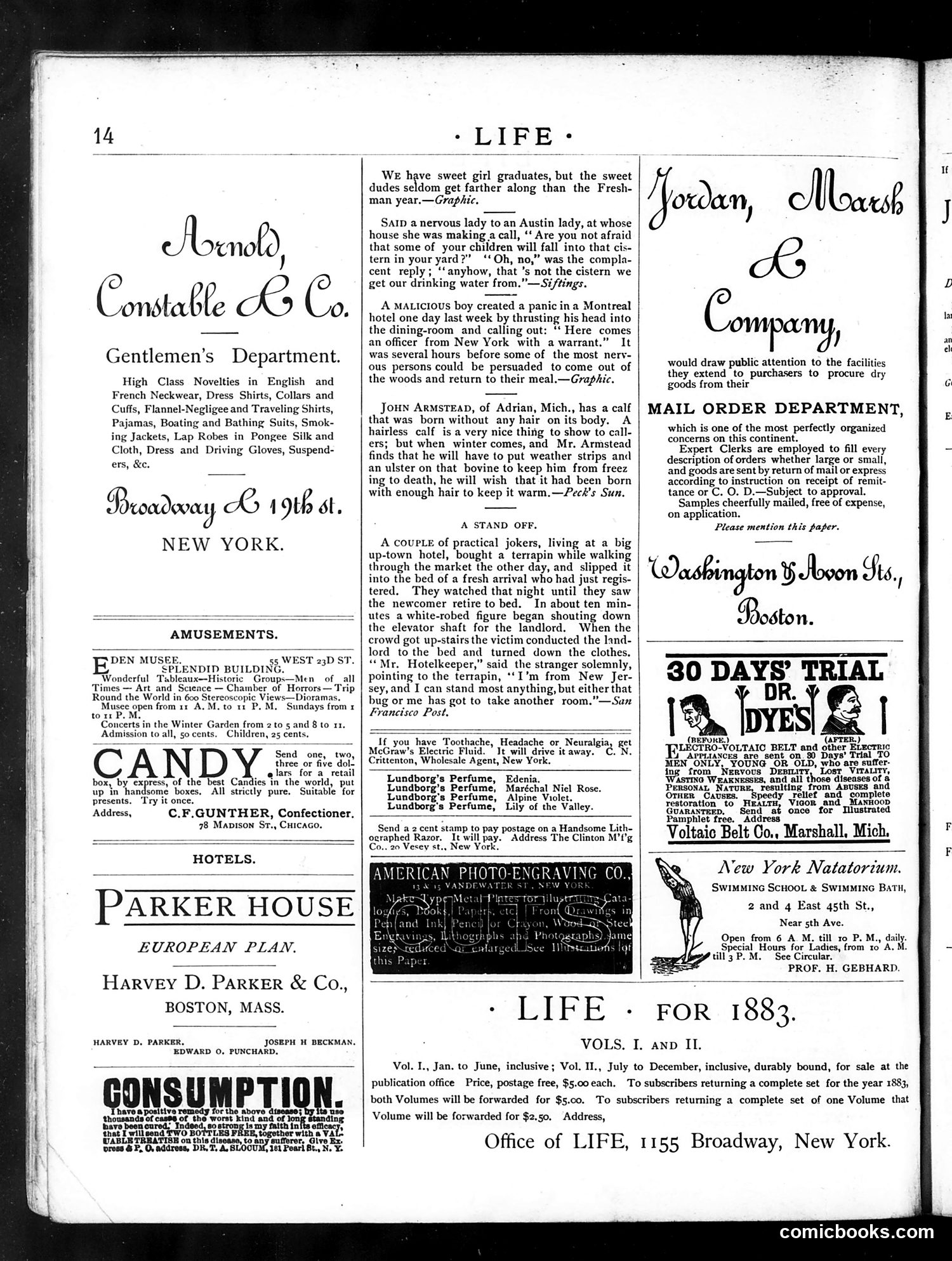
This is primarily an **advertising and humor page** from Life magazine's early years, not a political cartoon page. The page contains several **humorous anecdotes** typical of the era's satirical journalism: - A joke about "sweet girl graduates" who don't advance beyond freshman year - A nervous lady worried about children falling into a cistern (punchline: that's not where they get drinking water) - A prank at a Montreal hotel where someone shouts "officer from New York with a warrant," causing panic - A hairless calf born in Michigan - A practical joke involving a terrapin placed in a hotel guest's bed These brief, often absurdist humor pieces reflect **late 19th-century American attitudes**: mockery of social pretension, practical joking culture, regional stereotypes (nervous Canadians, practical Jersey men), and casual animal anecdotes. The remainder of the page consists of **period advertisements** for gentlemen's clothing, hotels, candy, and patent medicines—typical commercial content filling satirical magazines of this era. No identifiable political figures or specific events are referenced.
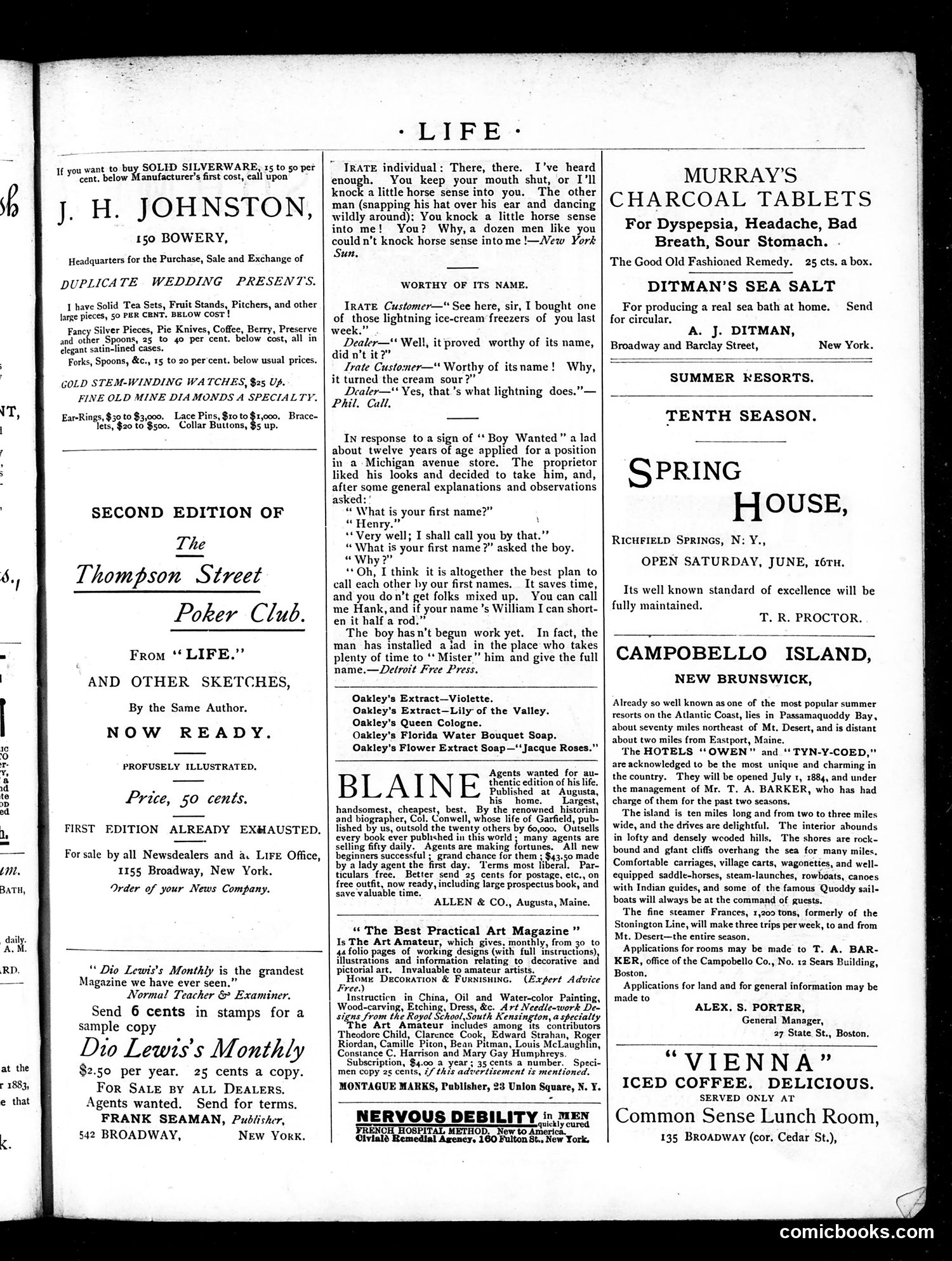
This is primarily an **advertising page** from an early issue of *Life* magazine, with two brief satirical jokes embedded. The jokes mock **working-class misunderstandings and class dynamics**: 1. **The "Horse Sense" joke**: Two men argue about who could knock sense into whom—a commentary on masculine bravado and pointless physical altercations. 2. **The "Ice Cream Freezer" joke**: A customer complains that a "lightning" ice-cream freezer ruined his cream. The dealer's pun—that "lightning" (meaning speed) naturally causes souring—is absurdist humor playing on the customer's naive expectation. 3. **The "Boy Wanted" story**: A young employee presumptuously suggests calling his boss by his first name ("Hank") to save time and avoid formality. The boss finds this so inappropriate he replaces the boy with someone who properly uses "Mister"—reflecting rigid **class consciousness and workplace hierarchy** of the era. The advertisements promote silverware, jewelry, and self-help publications—typical of *Life*'s commercial content alongside humor.
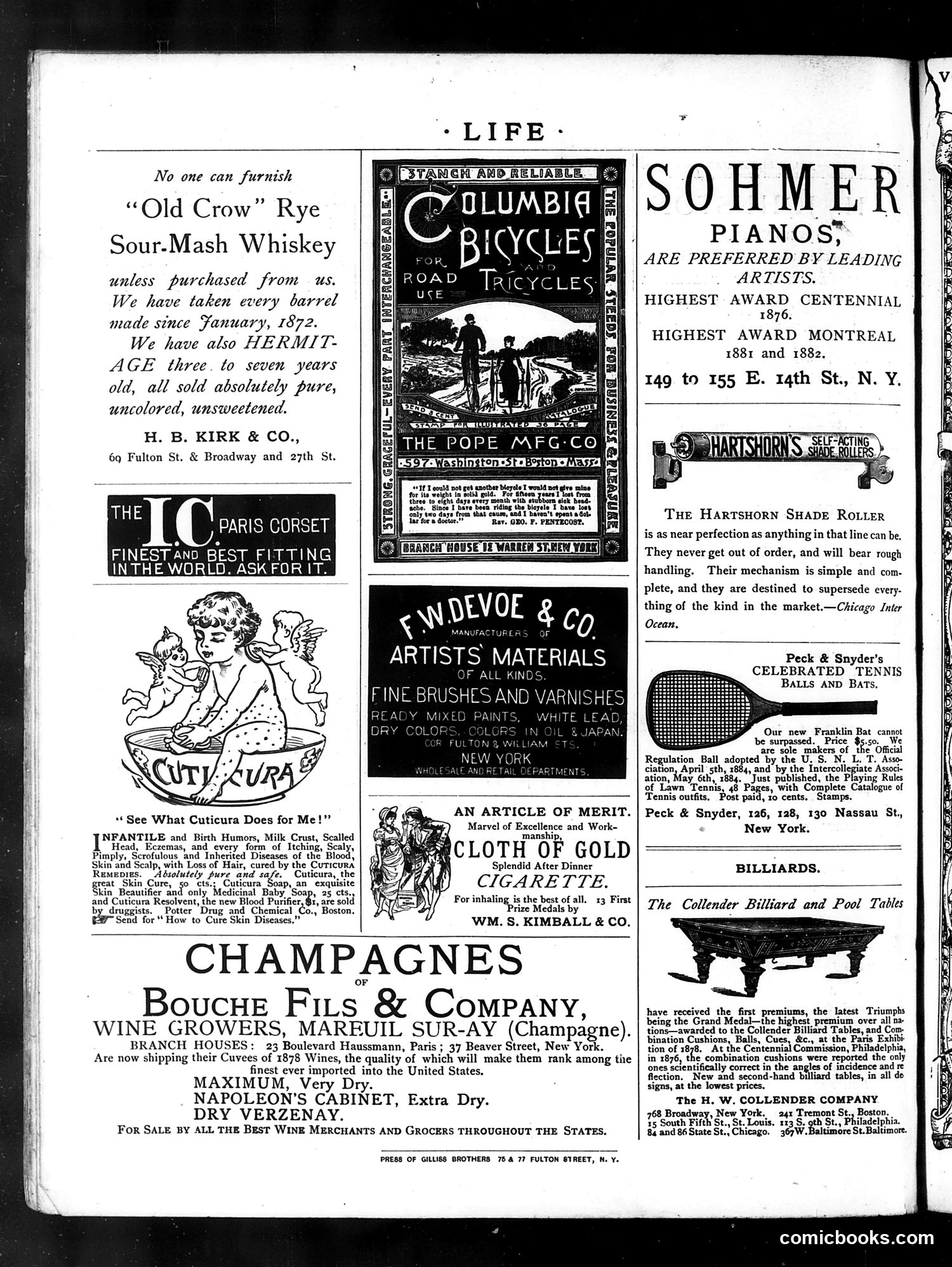
This is primarily a **advertisements page** from Life magazine, containing no political cartoons or satire in the traditional sense. The content consists entirely of commercial advertisements for late 19th-century products. Notable ads include: - **H.B. Kirk whiskey** claiming authenticity since 1872 - **Columbia Bicycles** (center), promoting tricycles and road bikes - **Sohmer Pianos**, emphasizing awards and artist endorsement - **Cuticura** (skin care product) with testimonial format - **IC Paris Corset** and various sporting goods (tennis, billiards equipment) - **Champagne by Bouche Fils & Company** at bottom The only illustration with any narrative quality is the **Cuticura advertisement** featuring cherubs in a bathtub, designed to suggest purity and cleansing. This page reflects **Gilded Age consumer culture**: products marketed through claims of European origins, prestigious awards, and celebrity/professional endorsement—strategies still recognizable today.