
Life, 1884-07-03 · page 2 of 16
Life — July 3, 1884 — page 2: what you’re looking at
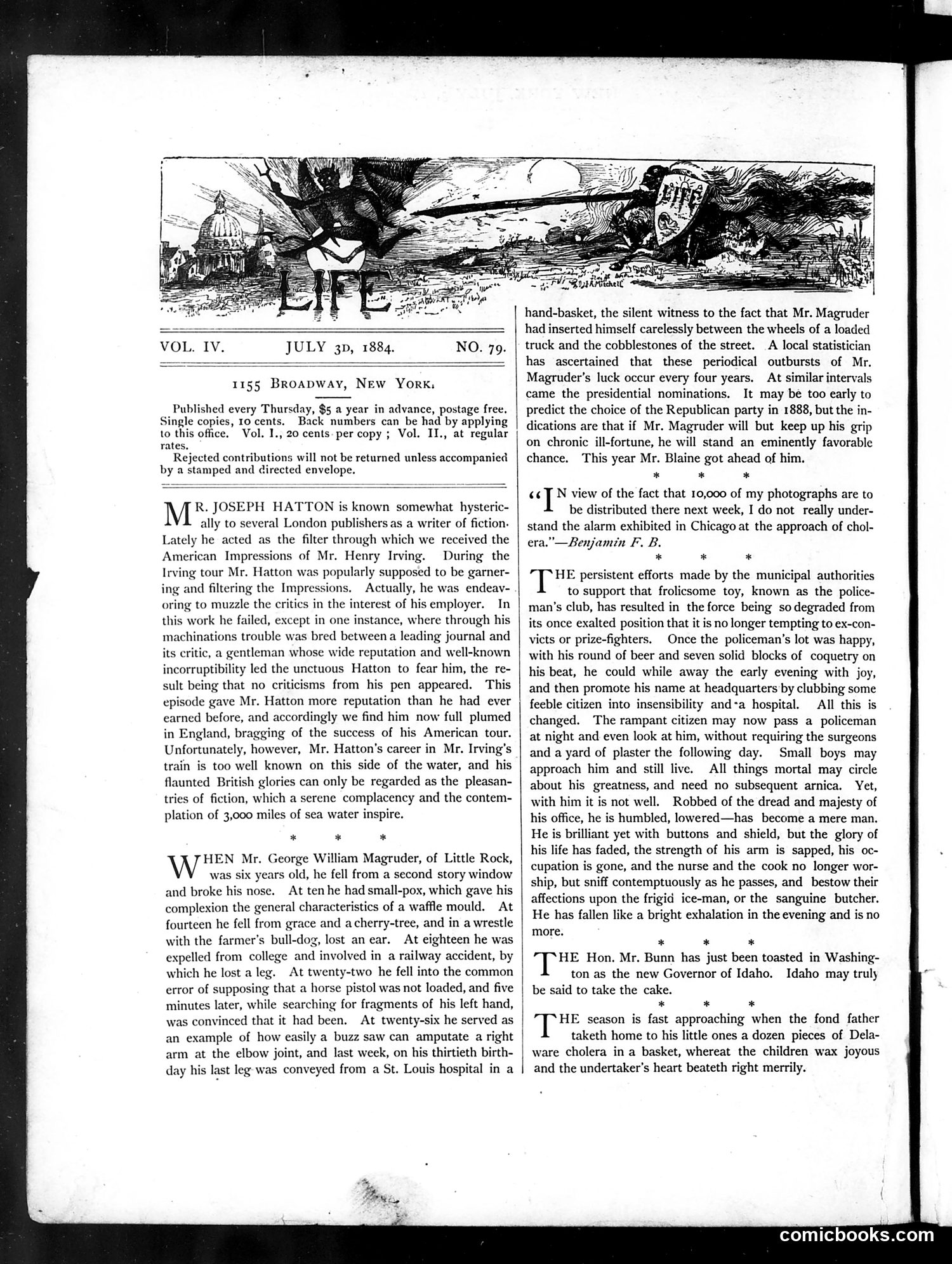
What you’re looking at
The masthead illustration depicts a figure playing guitar while seated amid a chaotic landscape. Based on the surrounding text mentioning Mr. Magruder's periodic "outbursts" and references to presidential nominations and "chronic ill-fortune," this appears to be political satire about a public figure experiencing repeated misfortunes. The text discusses Mr. Magruder's bad luck occurring "every four years"—coinciding with presidential election cycles—suggesting the cartoon satirizes someone whose personal disasters align suspiciously with election seasons. The specific reference to whether he'll "keep up his grip on chronic ill-fortune" implies commentary on a real political figure's recurring scandals or failures during campaign periods. The context suggests satirical commentary on nineteenth-century electoral politics and personal reputation.
📄 Transcribed text from this page (OCR, searchable)
Machine-transcribed from the original scan — historical spelling and the odd misread are preserved.
1155 Broapway, New York: Published every Thursday, $5 a year in advance, postage free. Single copies, 10 cents. Back numbers can be had by applying to this office. Vol. I., 20 cents. per copy ; Vol. II., at regular rates. Rejected contributions will not be returned unless accompanied by a stamped and directed envelope. R. JOSEPH HATTON is known somewhat hysteric- ally to several London publishers as a writer of fiction. Lately he acted as the filter through which we received the American Impressions of Mr. Henry Irving. During the Irving tour Mr. Hatton was popularly supposed to be garner- ing and filtering the Impressions. Actually, he was endeav- oring to muzzle the critics in the interest of his employer. In this work he failed, except in one instance, where through his machinations trouble was bred between a leading journal and its critic, a gentleman whose wide reputation and well-known incorruptibility led the unctuous Hatton to fear him, the re- sult being that no criticisms from his pen appeared. This episode gave Mr. Hatton more reputation than he had ever earned before, and accordingly we find him now full plumed in England, bragging of the success of his American tour. Unfortunately, however, Mr. Hatton's career in Mr. Irving’s train is too well known on this side of the water, and his flaunted British glories can only be regarded as the pleasan- tries of fiction, which a serene complacency and the contem- plation of 3,000 miles of sea water inspire. * * * HEN Mr. George William Magruder, of Little Rock, was six years old, he fell from a second story window and broke his nose. At ten he had small-pox, which gave his complexion the general characteristics of a waffle mould. At fourteen he fell from grace and acherry-tree, and in a wrestle with the farmer's bull-dog, lost an ear. expelled from college and involved in a railway accident, by which he lost a leg. At twenty-two he fell into the common error of supposing that a horse pistol was not loaded, and five minutes later, while searching for fragments of his left hand, was convinced that it had been. At twenty-six he served as an example of how easily a buzz saw can amputate a right arm at the elbow joint, and last week, on his thirtieth birth- day his last leg-was conveyed from a St. Louis hospital in a At eighteen he was | ara ey Ss hand-basket, the silent witness to the fact that Mr. Magruder had inserted himself carelessly between the wheels of a loaded truck and the cobblestones of the street. A local statistician has ascertained that these periodical outbursts of Mr. Magruder’s luck occur every four years. At similar intervals came the presidential nominations. It may be too early to predict the choice of the Republican party in 1888, but the in- dications are that if Mr. Magruder will but keep up his grip on chronic ill-fortune, he will stand an eminently favorable chance. This year Mr. Blaine got ahead of him. * * * «6 N view of the fact that 10,000 of my photographs are to be distributed there next week, I do not really under- stand the alarm exhibited in Chicago at the approach of chol- era.” —Benjamin F. B. * * * HE persistent efforts made by the municipal authorities to support that frolicsome toy, known as the police- man’s club, has resulted in the force being so degraded from its once exalted position that it is no longer tempting to ex-con- victs or prize-fighters. Once the policeman’s lot was happy, with his round of beer and seven solid blocks of coquetry on his beat, he could while away the early evening with joy, and then promote his name at headquarters by clubbing some feeble citizen into insensibility and-a hospital. All this is changed. The rampant citizen may now pass a policeman at night and even look at him, without requiring the surgeons and a yard of plaster the following day. Small boys may approach him and still live. All things mortal may circle about his greatness, and need no subsequent arnica. Yet, with him it is not well. Robbed of the dread and majesty of his office, he is humbled, lowered—has become a mere man. He is brilliant yet with buttons and shield, but the glory of his life has faded, the strength of his arm is sapped, his oc- cupation is gone, and the nurse and the cook no longer wor- ship, but sniff contemptuously as he passes, and bestow their affections upon the frigid ice-man, or the sanguine butcher. He has fallen like a bright exhalation in the evening and is no more, * * * HE Hon. Mr. Bunn has just been toasted in Washing- ton as the new Governor of Idaho. Idaho may truly be said to take the cake. * * * HE season is fast approaching when the fond father taketh home to his little ones a dozen pieces of Dela- ware cholera in a basket, whereat the children wax joyous and the undertaker's heart beateth right merrily. comicbooks.com