
A complete issue · 16 pages · 1884
Life — May 15, 1884
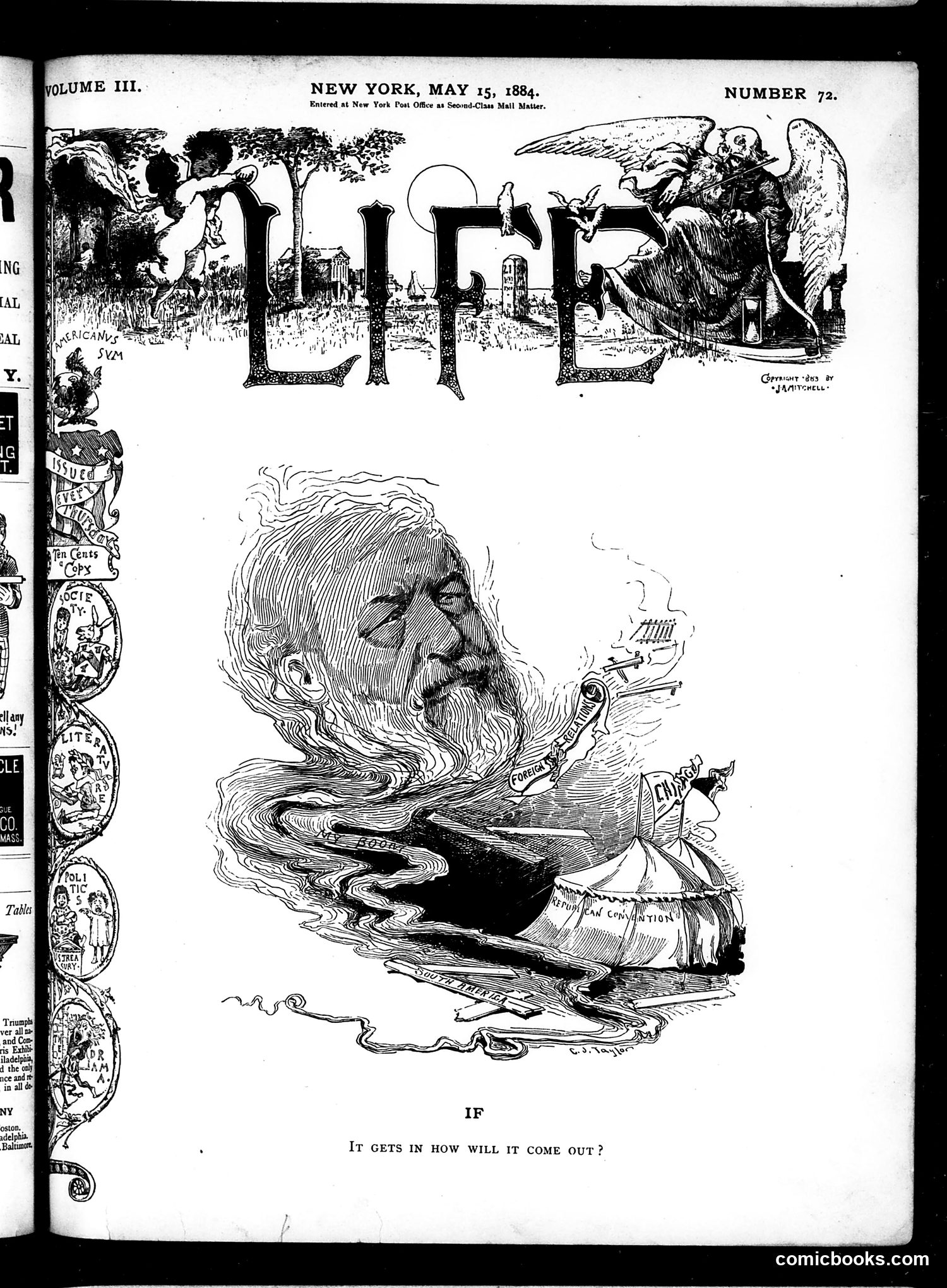
This page features a political cartoon titled "IF / It gets in how will it come out?" The image depicts a bearded man's head being inserted into what appears to be a mechanical device or press, with various labeled components suggesting political machinery or processes. The caption's wordplay suggests anxiety about something entering a system and the uncertain consequences of its emergence. Without clearer identification of the specific figure or the particular political event of May 1884, the exact target remains unclear—though the cartoon likely comments on a controversial political figure or proposal of that era and satirizes concerns about unpredictable political outcomes. The elaborate mechanical imagery emphasizes the mechanical, dehumanizing nature of politics itself.
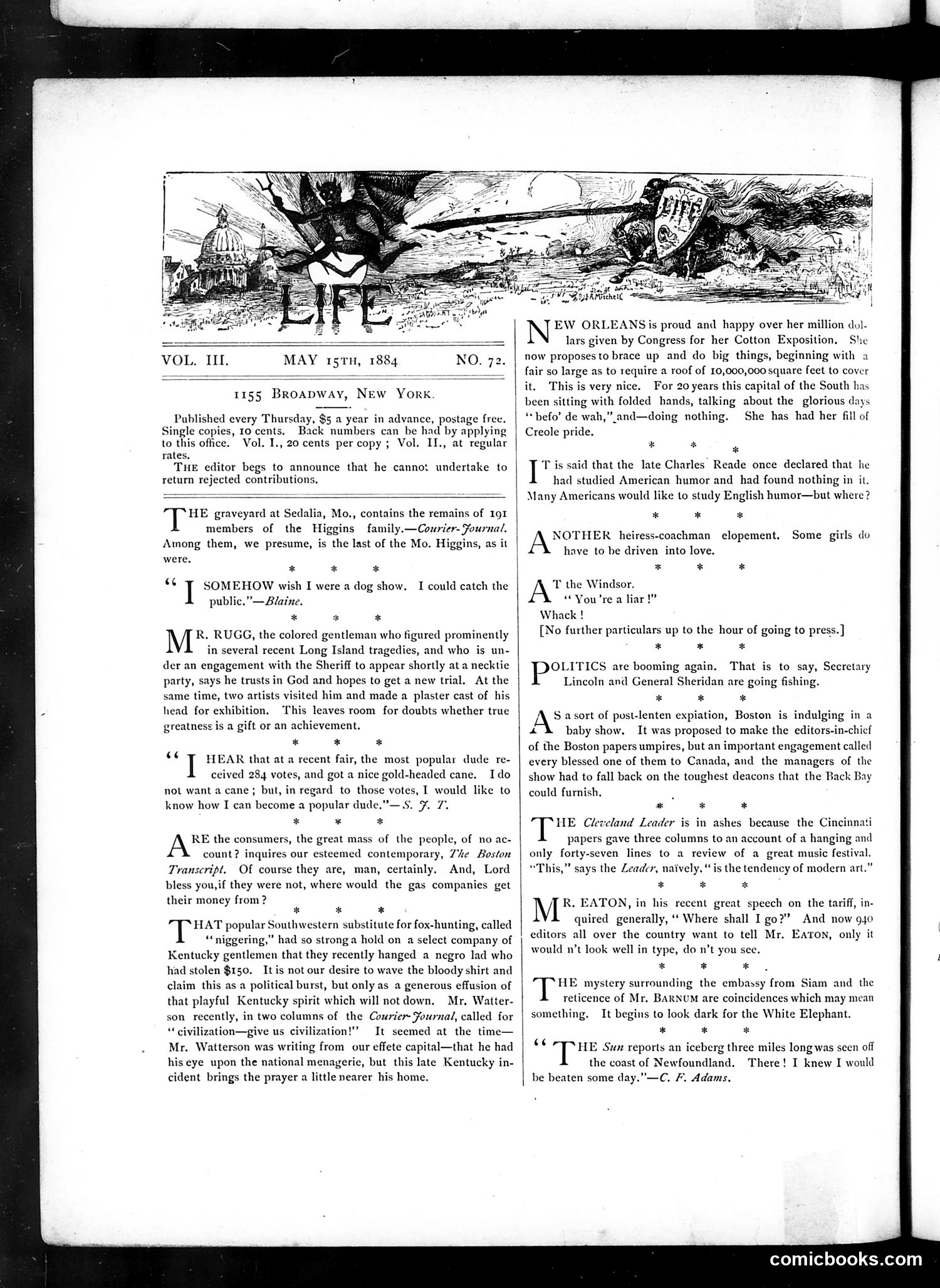
The masthead illustration depicts **Death as a skeletal figure wielding a scythe**, appearing to harvest or destroy various elements—possibly referencing mortality, destruction, or societal decline. The word "LIFE" contrasts darkly with this imagery. The page contains brief satirical notes rather than developed cartoons. Items include: - A joke about wanting to be a "dog show" to catch public attention - Commentary on **Mr. Rugg**, a colored gentleman involved in Long Island tragedies, questioning whether his prominence stems from genuine achievement or gift - Political gossip about **Secretary Lincoln and General Sheridan going fishing** - Mockery of Boston's "baby show" and editors being called to Canada - A jab at the **Cleveland Leader's** reporting on a hanging The content is typical 1880s-era gossip-column satire targeting politicians, public figures, and social pretensions.
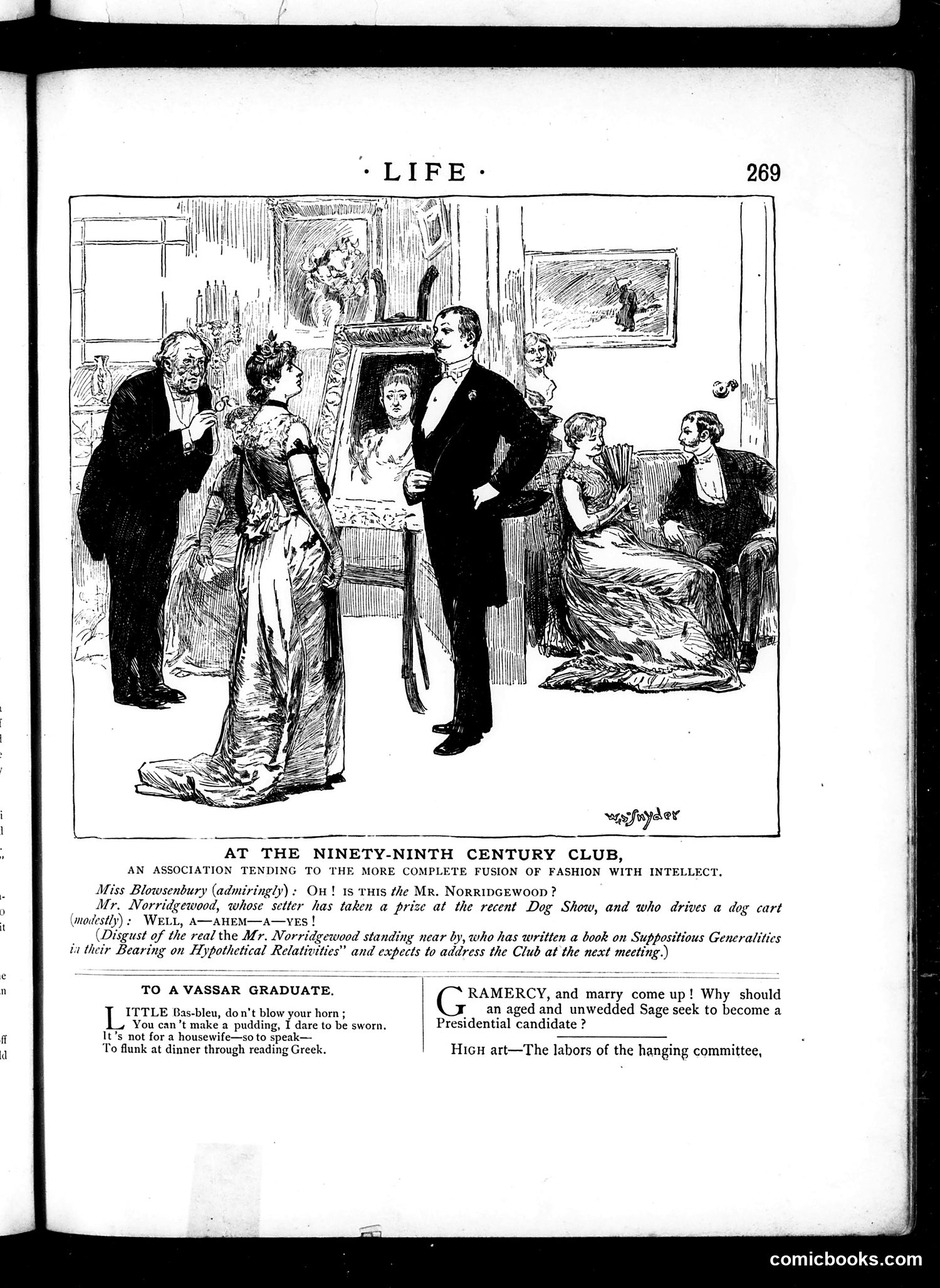
This satirical cartoon depicts an upper-class social gathering mocking the "Ninety-Ninth Century Club," described as promoting "fusion of fashion with intellect." The scene ridicules pretentious intellectualism among the wealthy. The caption introduces Mr. Norridgewood, whose "seller has taken a prize at the recent Dog Show" and who "drives a dog cart"—absurd qualifications for intellectual society. Another figure has written a book on "Suppositious Generalities" and their "Bearing on Hypothetical Relativities," lampooning academic pseudointellectualism and jargon. The satire targets the contradiction between claimed intellectual pursuits and actual shallow social climbing, suggesting that wealthy individuals use pseudo-intellectual pretense to justify exclusive club membership while their credentials are trivial or nonsensical.
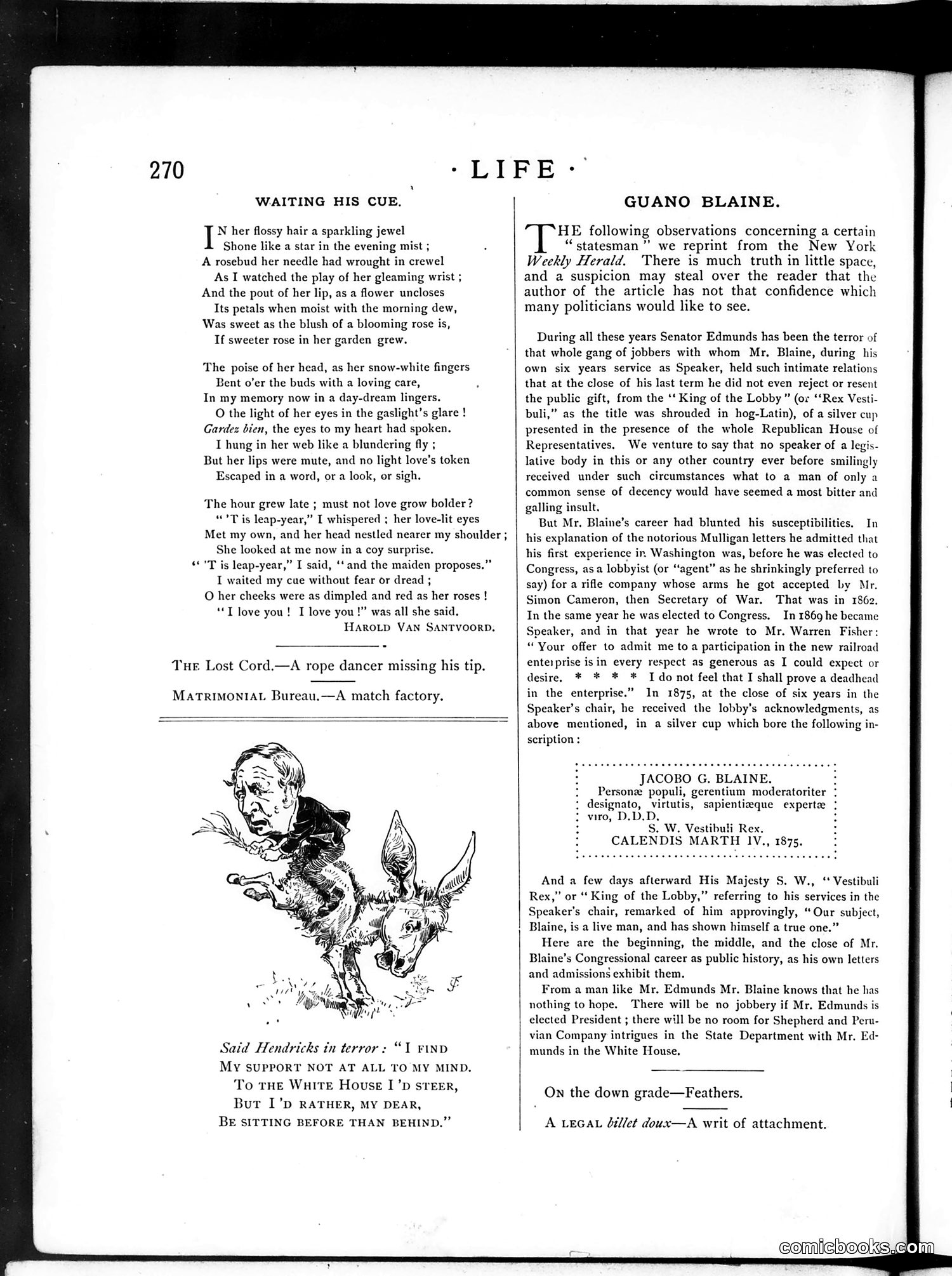
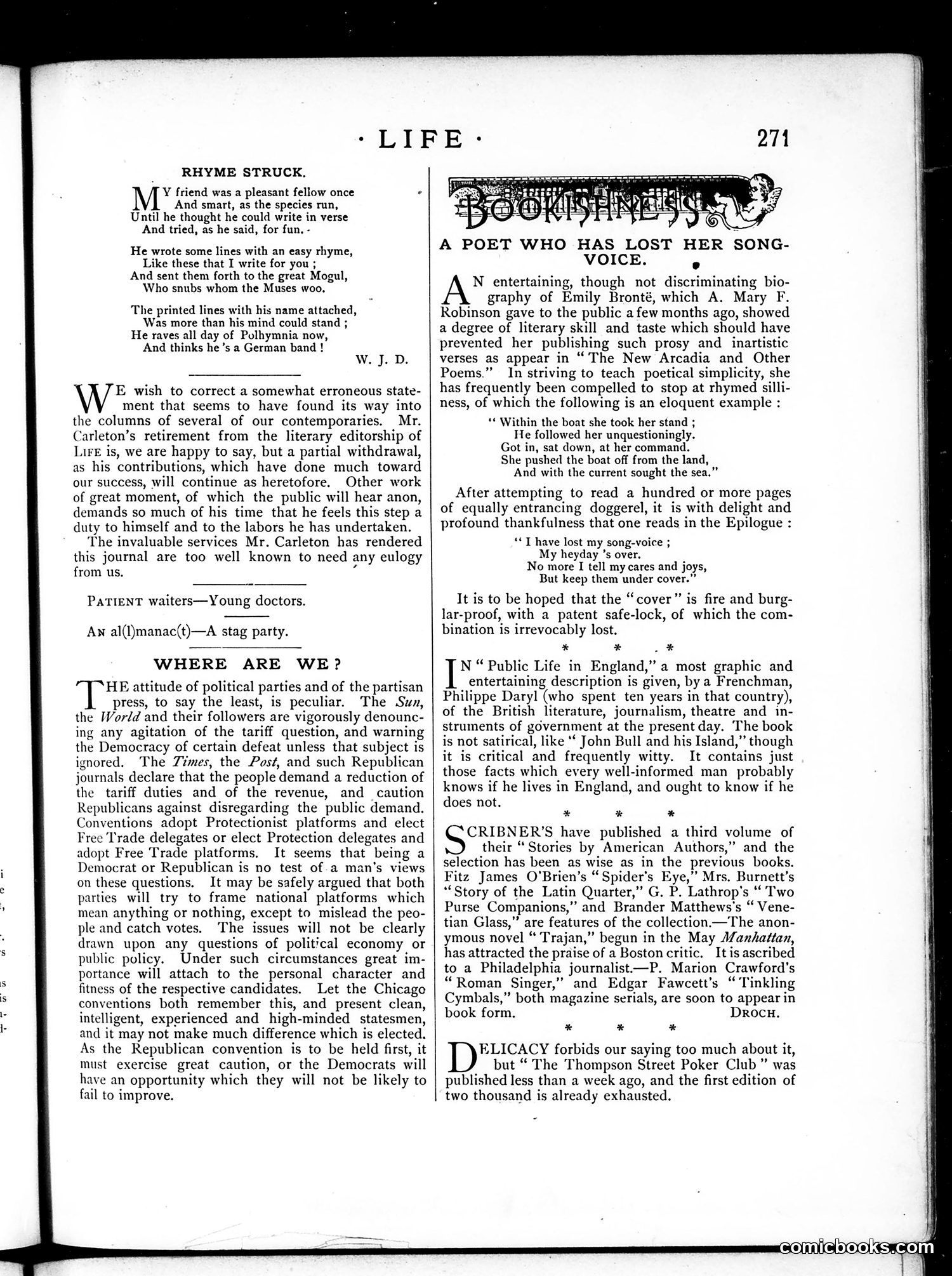
This page contains literary criticism and book reviews rather than political cartoons. The main content includes: **"Rhyme Struck"** - A poem criticizing rhymed verse in contemporary publications, suggesting inferior poetic quality. **"A Poet Who Has Lost Her Song-Voice"** - A review of Emily Brontë biography by A. Mary F. Robinson, criticizing her for preventing publication of "inartistic" verses. The review quotes examples of her deliberately simple poetry. **"Where Are We?"** - Political commentary on partisan press coverage of tariff debates, noting that both Democratic and Republican newspapers ignore facts inconvenient to their platforms. The author argues this prevents voters from making informed decisions. **Book notices** covering Scribner's story collections and "The Thompson Street Poker Club." The page reflects 19th-century concerns about journalistic integrity and literary standards.
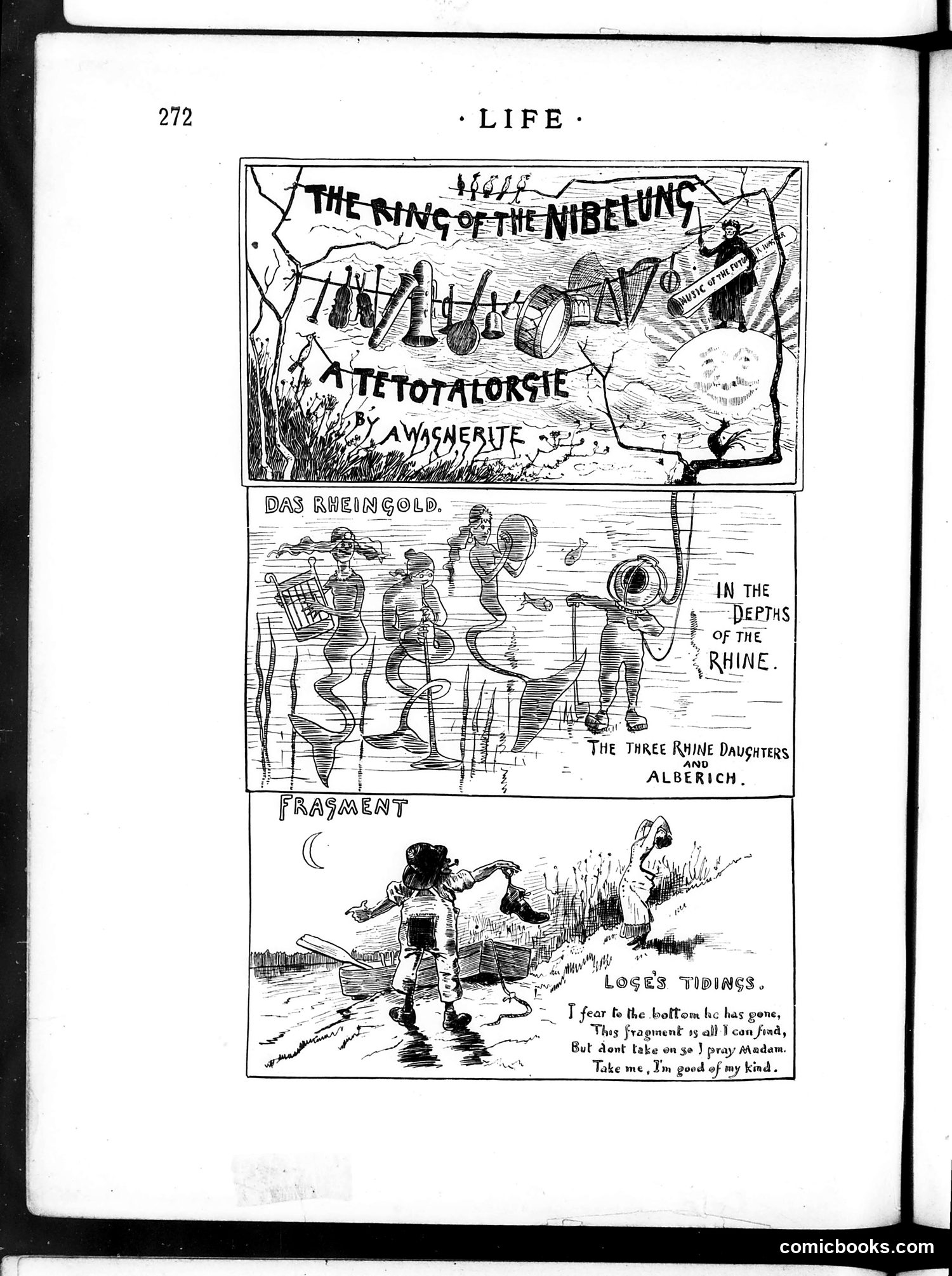
This page parodies Richard Wagner's monumental opera series "The Ring of the Nibelung," a German cultural touchstone. The top panel mocks the opera's complexity and length through absurdist imagery—musical instruments and mythological references rendered chaotic. The middle panel titled "Das Rheingold" (The Rhinegold) shows figures in water struggling with serpents, satirizing the opera's notoriously complicated plot involving Rhine maidens and magical gold. The bottom "Fragment" depicts a character lamenting lost "tidings" by moonlight, mocking the opera's melodramatic conventions. The satire targets both Wagner's legendarily difficult, lengthy compositions and American audiences' struggle to comprehend German high culture—a common source of humor in *Life* magazine's satirical commentary on elite artistic pretensions.
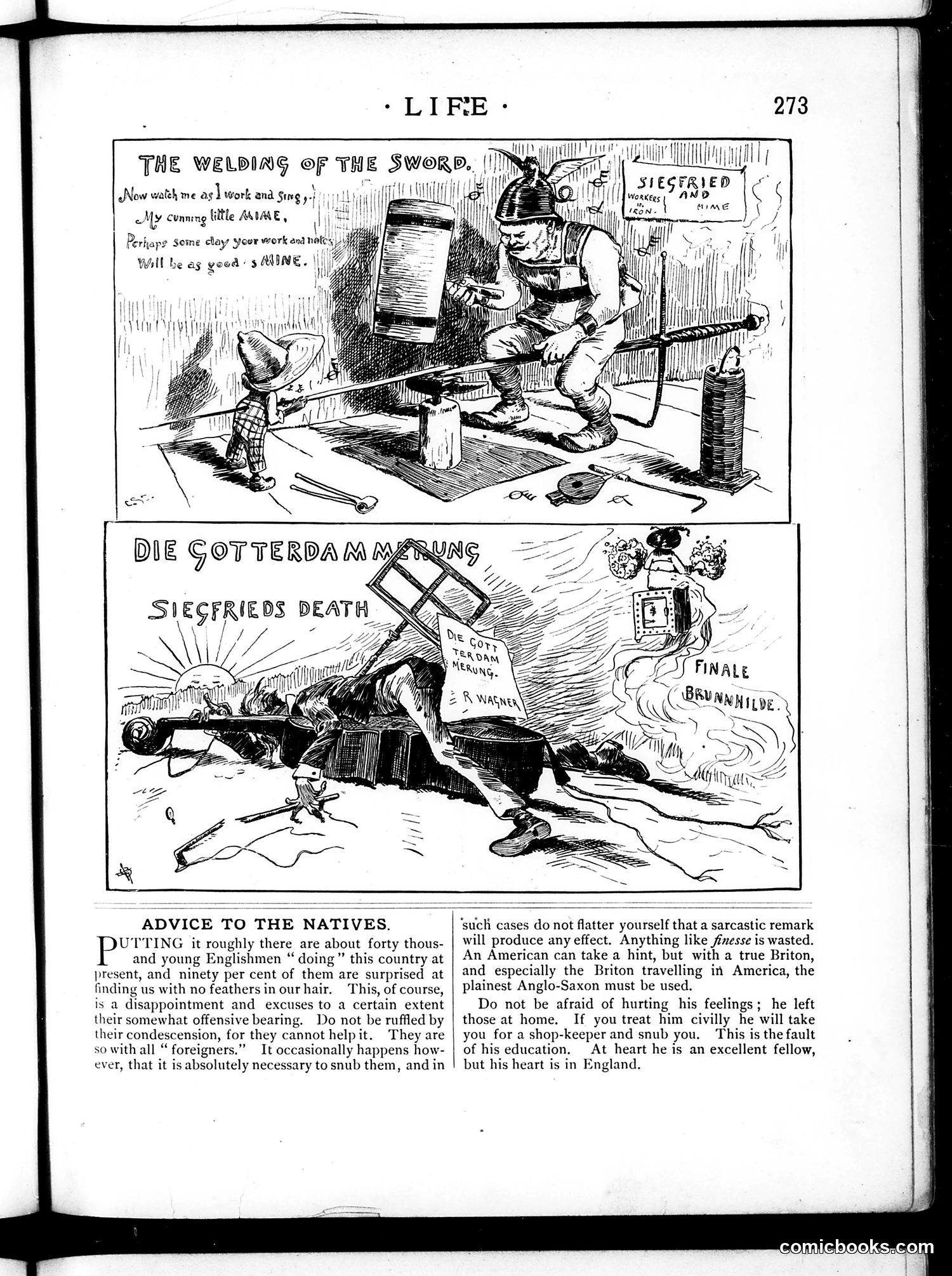
**Top cartoon ("The Welding of the Sword"):** Shows a dwarf-like figure and Siegfried (labeled) at a forge, working on a sword. The text references German mythology—likely satirizing German militarism through the legend of Siegfried forging Nothung. The joke appears to mock German war preparation or national identity tied to martial mythology. **Bottom cartoon ("Die Götterdämmerung / Siegfried's Death"):** Depicts Siegfried's death scene, with a cross and text referencing Richard Wagner's opera. This invokes the mythological cycle's conclusion—the "Twilight of the Gods"—likely satirizing German defeat or the collapse of German power, using Wagner's tragic narrative as metaphor. **"Advice to the Natives":** Text criticizing English colonizers' condescending treatment of native peoples, advocating for civil treatment while paradoxically defending cultural superiority.
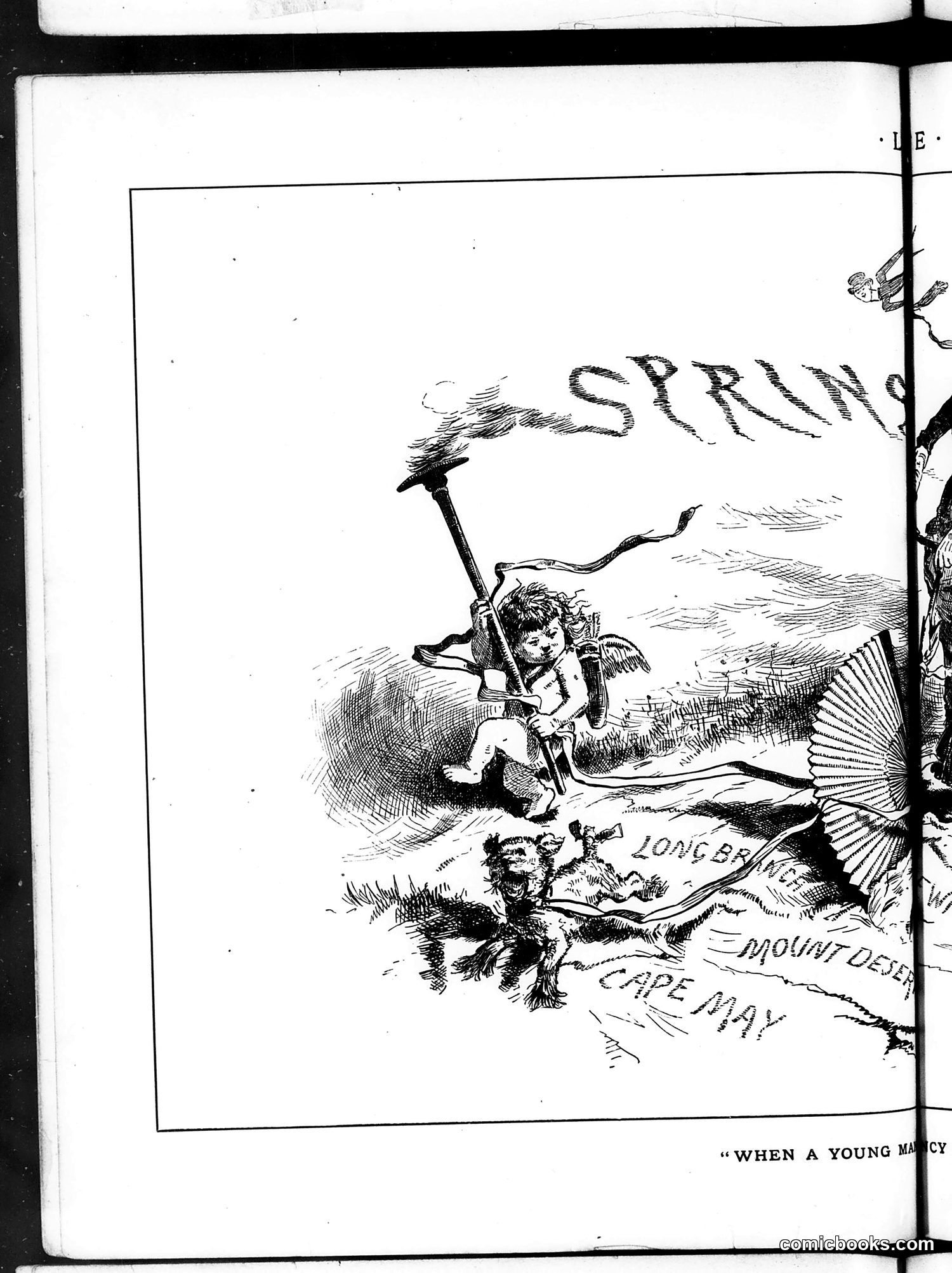
This appears to be a satirical illustration from Life magazine titled "When a Young Man..." (caption partially visible). The image depicts a cherub or Cupid figure wielding an axe above a landscape labeled with geographic references including "Long Branch," "Mount Desert," and "Cape May"—all prominent American seaside resort destinations of the 19th/early 20th century. The satire likely comments on romance and courtship at fashionable vacation spots, with Cupid aggressively "cutting down" or destroying something (possibly idealized romance or innocent relationships) at these popular destinations. The cherub's violent stance with the axe creates dark humor, inverting Cupid's traditional gentle role as a symbol of love. Without the complete caption, the exact target remains unclear.
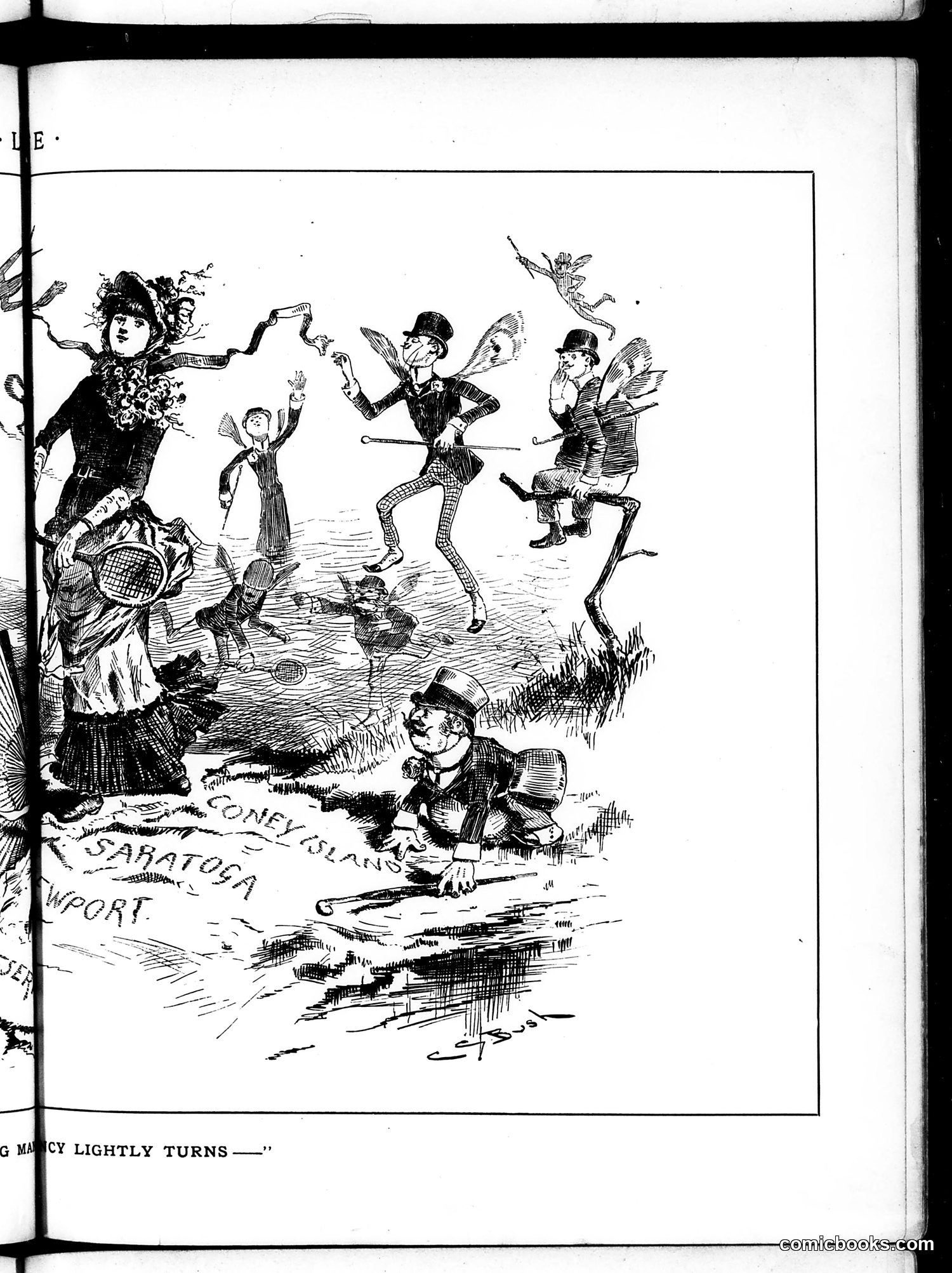
This satirical cartoon depicts a chaotic seaside scene at what appears to be Coney Island and Saratoga (visible in the text). A well-dressed woman on the left watches as fashionable figures—men and women in contemporary dress with exaggerated features—dance wildly and irresponsibly in the shallow water. A portly man sits partially submerged in the foreground, seemingly bemused or exhausted by the spectacle. The satire likely mocks the frivolous behavior of wealthy leisure-class vacationers at popular resort destinations. The "dancing madly" suggests reckless abandon and loss of decorum among the fashionable set. The cartoon appears to critique the extravagant social scene and moral looseness of gilded-age recreation, a common target of Life magazine's satirical commentary on American society.
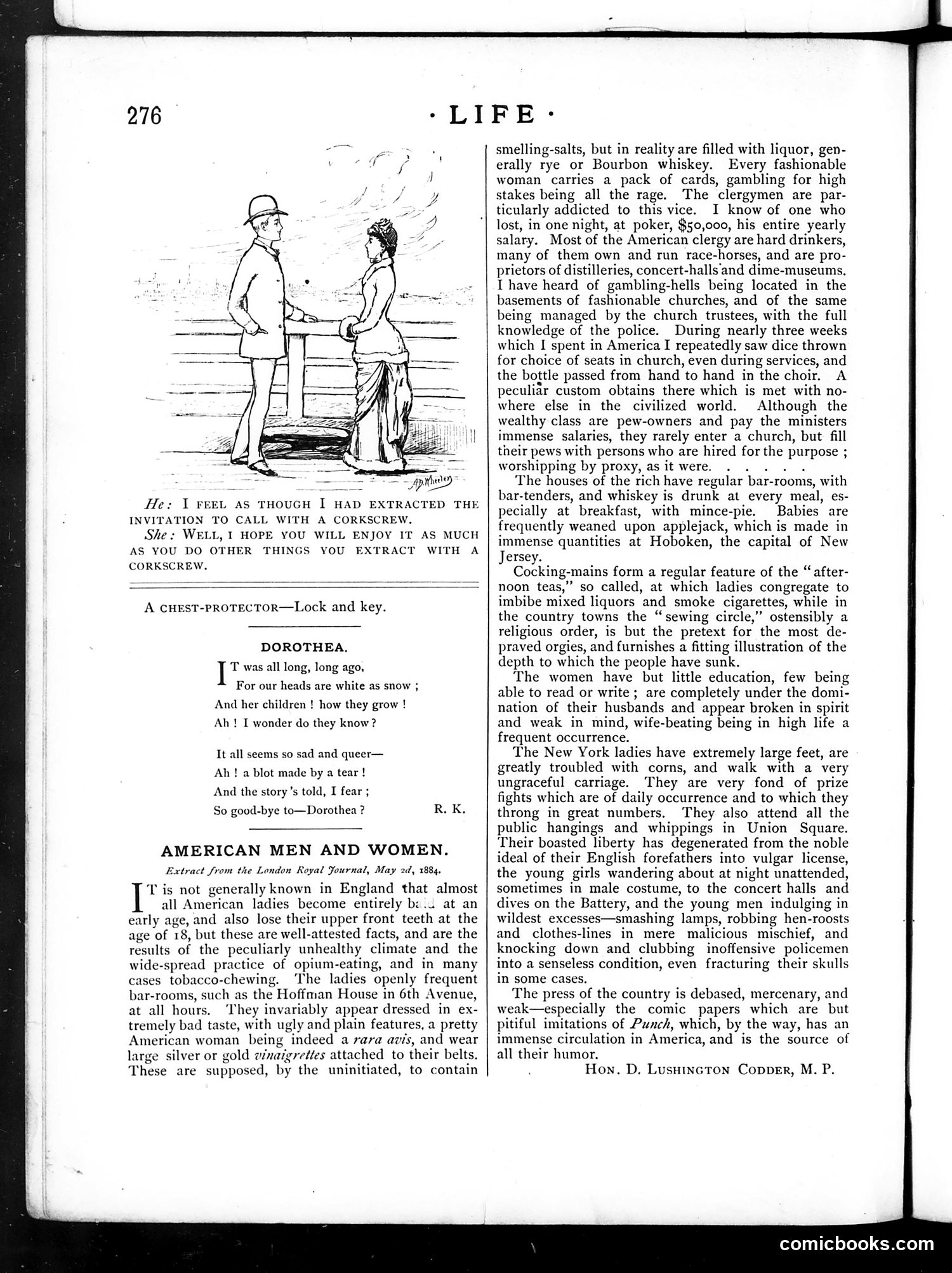
The main article "American Men and Women" is a scathing satire of exaggerated British stereotypes about Americans. Presented as an extract from a fictional "London Royal Journal," it ridicules unfounded claims: that American women lose their front teeth at 18, drink constantly, gamble obsessively, smoke cigarettes, and are uneducated and abused by husbands. It mocks specific accusations—that clergymen run distilleries and gambling operations in church basements, that wealthy families hire proxies to occupy their church pews, and that women attend cockfights and public executions. The accompanying cartoon (top) satirizes forced social invitations: a woman extracts a reluctant man's promise to attend her party "with a corkscrew" (forcibly), and he quips he hopes to enjoy it "as much as you do other things you extract with a corkscrew"—implying excessive drinking. Life magazine uses absurdist exaggeration to expose British prejudice and hypocrisy toward American society.
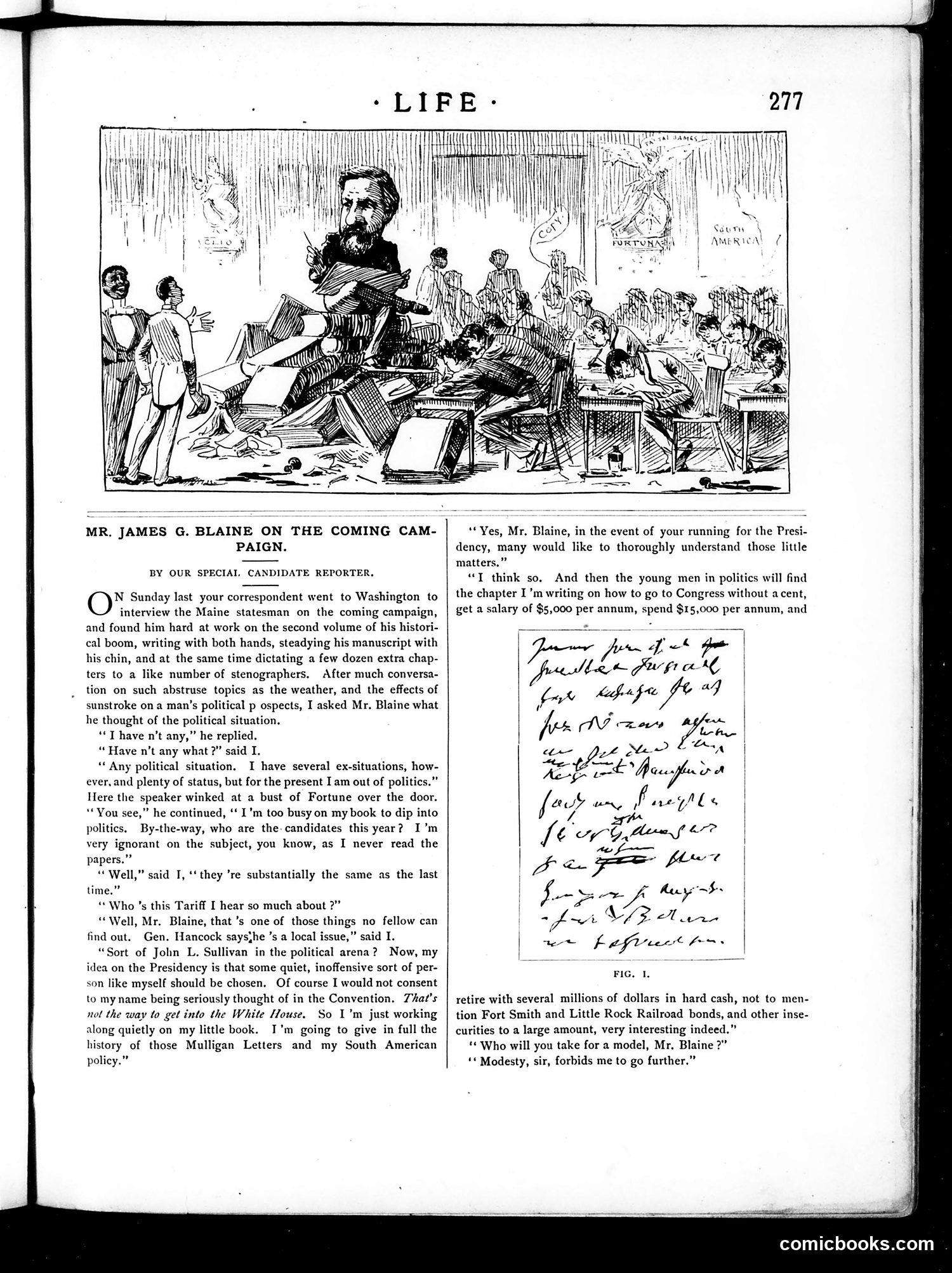
This is a satirical interview with **James G. Blaine**, a prominent Maine politician of the 1880s. The cartoon depicts him as absurdly self-aggrandizing while claiming false modesty about presidential ambitions. The satire targets Blaine's notorious corruption. He references the **"Mulligan Letters"**—a real scandal involving evidence he'd used political influence for personal financial gain. His boast about teaching congressmen "how to go to Congress without a cent" and "retire with several millions of dollars in hard cash" mocks his actual wealth accumulation through questionable means, including railroad bonds. The interview's humor comes from Blaine's transparent hypocrisy: he claims to avoid politics while obviously positioning himself for the presidency, and feigns ignorance about current issues while promoting his own historical narrative. The elaborate illustration shows him dictating to multiple stenographers, satirizing his self-mythologizing through his historical writings.
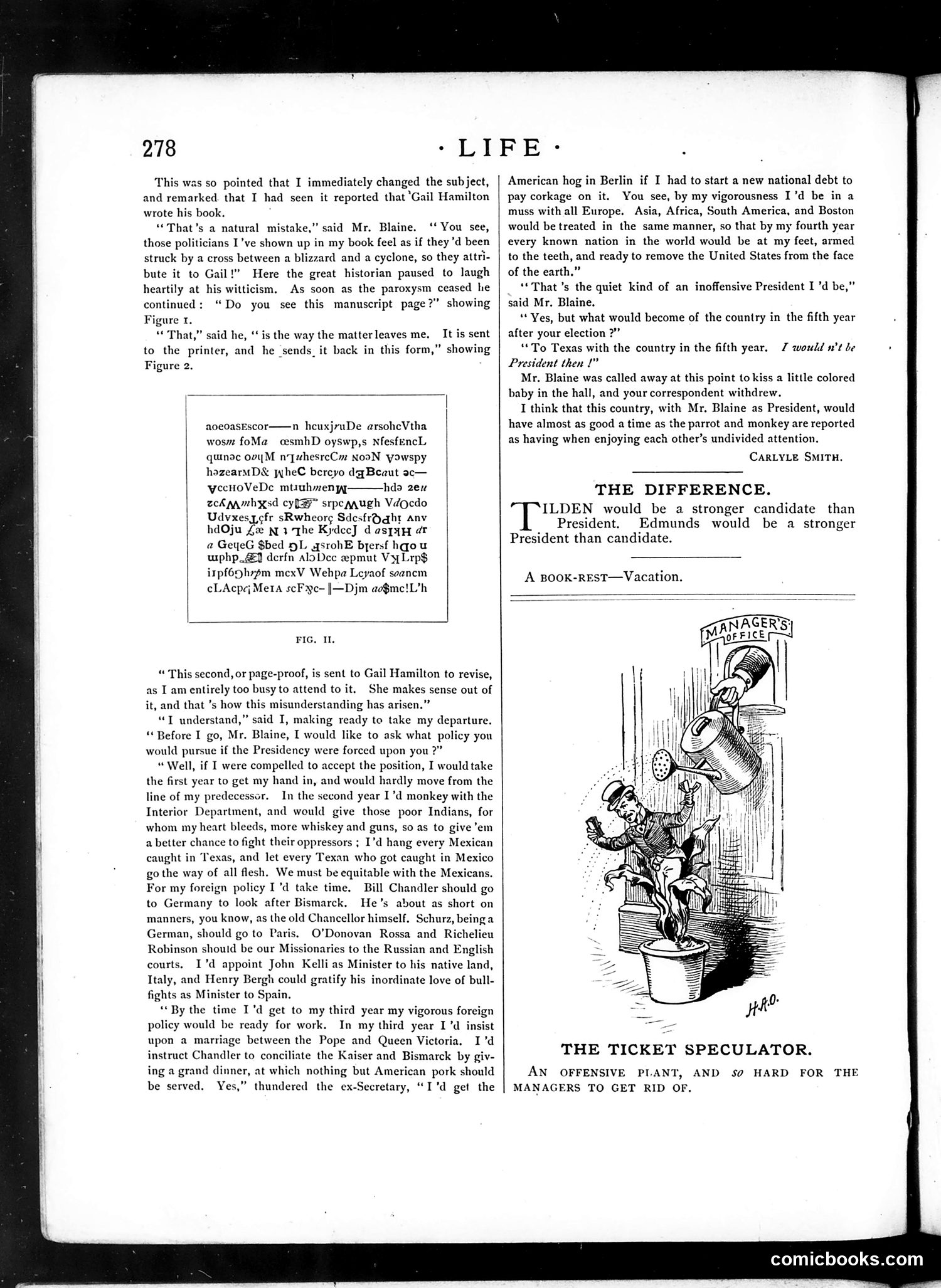
This is a satirical interview with **James G. Blaine**, a prominent 1880s politician (likely presidential aspirant), conducted by the magazine's correspondent. The humor relies on Blaine's absurdly grandiose and contradictory policy proposals. **The satire targets:** - Blaine's pretentious self-importance (he attributes sharp political criticism to his writing, not opponents' actual grievances) - His reckless foreign policy ideas: arranging a papal marriage to Queen Victoria, forcing American pork on Germany, and generally antagonizing every nation on Earth - His dismissive treatment of Native Americans ("more whiskey and guns") and Mexicans (execution) - His chaotic approach to governance, casually delegating major diplomatic posts to unsuitable men **The cartoon** (bottom right) shows "The Ticket Speculator"—an unrelated satirical image of someone profiting from theater ticket sales, labeled an "offensive plant" managers want eliminated. The entire piece mocks Blaine's unfitness for high office through his own increasingly outrageous statements, which escalate until he casually abandons the country in year five.
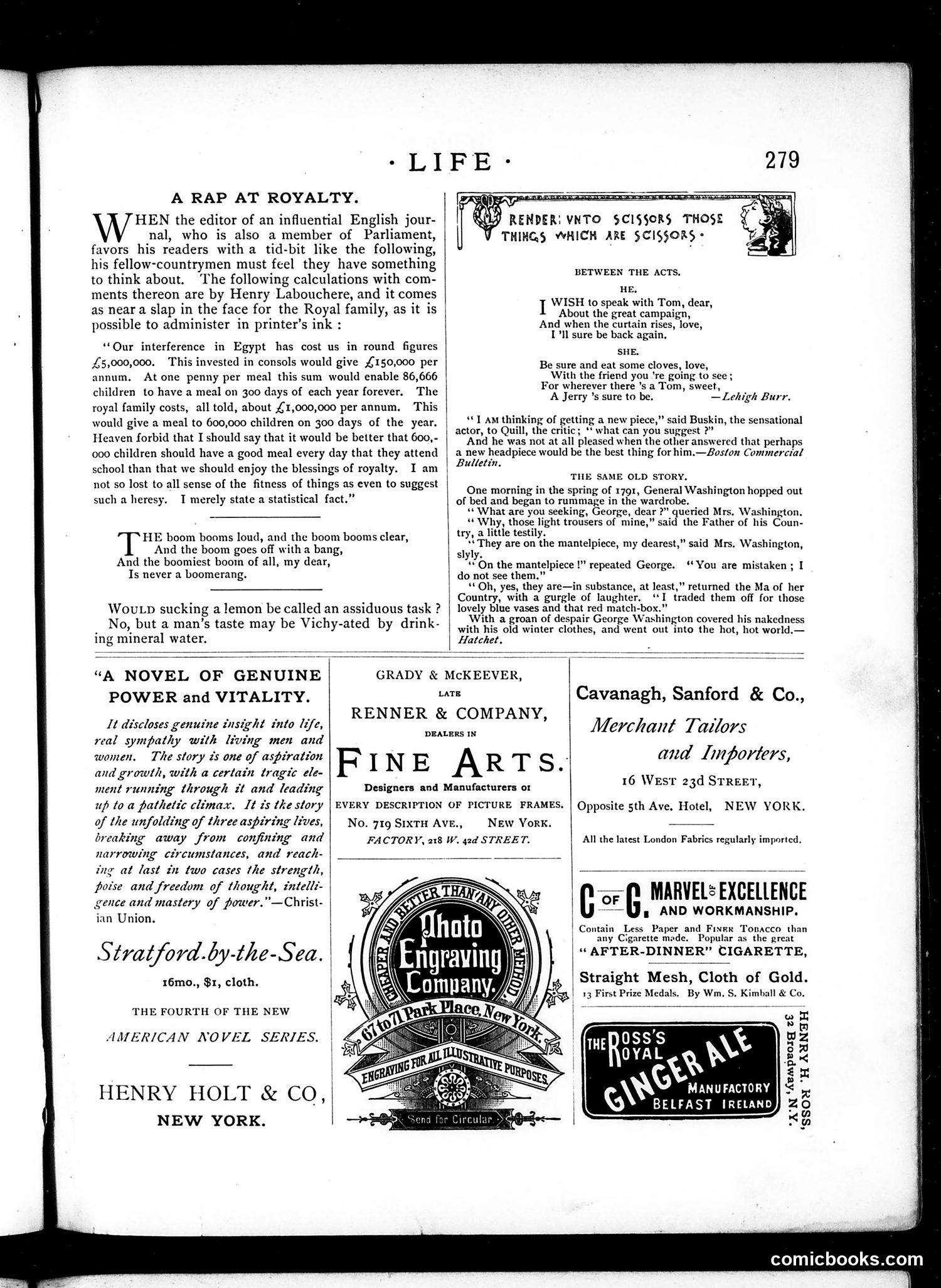
This page contains primarily **advertisements and light satirical commentary** rather than political cartoons. The main editorial content is "A Rap at Royalty," featuring **Henry Labouchere's** (an influential English MP and editor) critique of British royal spending. Labouchere performs a devastating statistical calculation: Egypt's military costs (£45 million) could feed 600,000 children daily, yet the Royal Family costs £1 million annually—implying the monarchy's expense is unjustifiable compared to public welfare needs. His mock-apologetic closing ("I am not so lost...to even suggest such a heresy") uses irony to amplify his actual criticism that royalty is a luxury Britain cannot afford. The remaining content includes light humor pieces ("Between the Acts," "The Same Old Story") and advertisements for art frames, tailors, and consumer goods. The satire's point: **royal privilege is indefensible when children lack basic meals.**
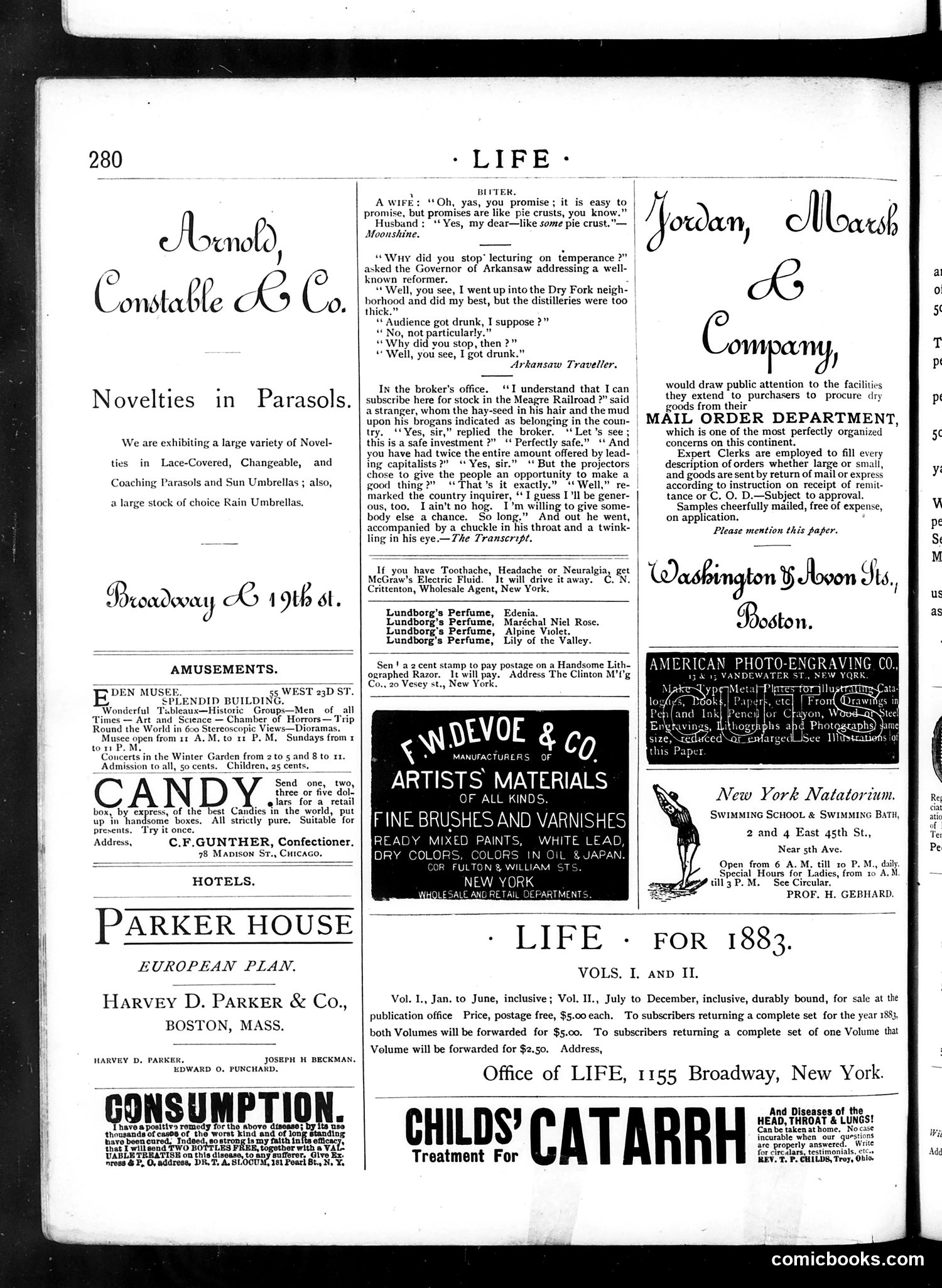
This page is primarily an **advertisement section** of Life magazine from 1883, with minimal cartoon or satirical content. The visible text includes several brief **humorous anecdotes** rather than illustrated cartoons: 1. A joke about wives and broken promises ("promises are like pie crusts") 2. A story about a temperance lecturer who gave up because he got drunk himself in Arkansas 3. A satirical sketch about a naive country investor being fooled by a railroad broker's sales pitch These anecdotes poke fun at common social types—henpecked husbands, failed reformers, and gullible rural people taken advantage of by city operators. The humor reflects 1880s attitudes about rural simplicity versus urban sophistication. The bulk of the page contains legitimate business advertisements for department stores (Jordan, Marsh & Co.), confectionery, hotels, and artists' materials—typical magazine advertising of the era.
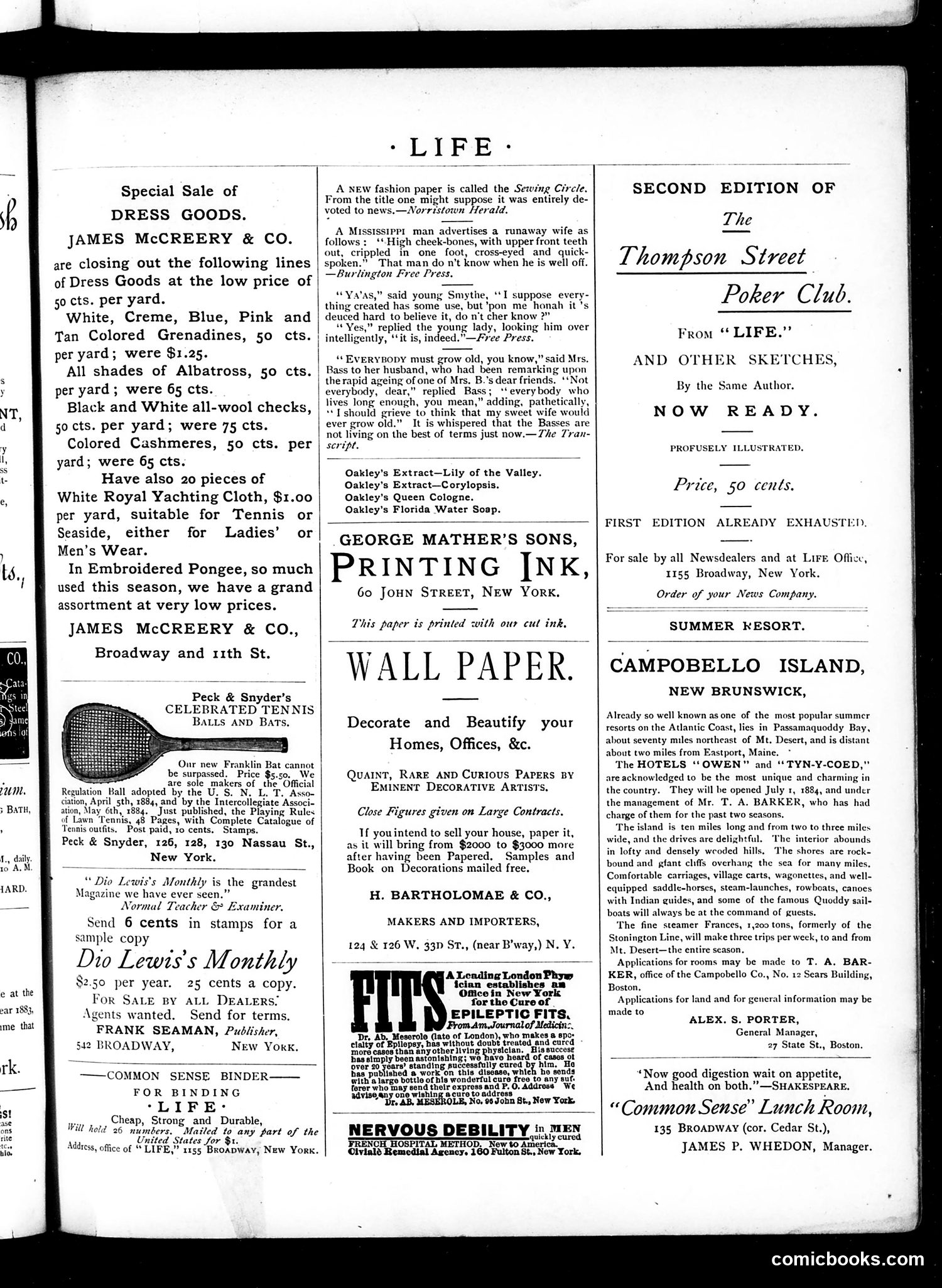
This page is primarily **advertising and announcements**, not political satire or comics. It contains: 1. **Dress goods sales** from James McCreery & Co. 2. **Sporting goods** (tennis equipment from Peck & Snyder) 3. **Magazine advertisements** (Dio Lewis's Monthly) 4. **Various product ads** (printing ink, wallpaper, extracts/colognes) 5. **Book announcement** for "The Thompson Street Poker Club" (a second edition of sketches from *Life* magazine) The **only satirical content** comprises brief, mild jokes in the middle column—small humor pieces about a fashion paper, a Mississippi man's wife advertisement, and social observations about aging. These are gentle domestic humor, not political commentary. The page functions primarily as a sales/advertising vehicle typical of late 19th-century magazines, where editorial and commercial content intermingled.
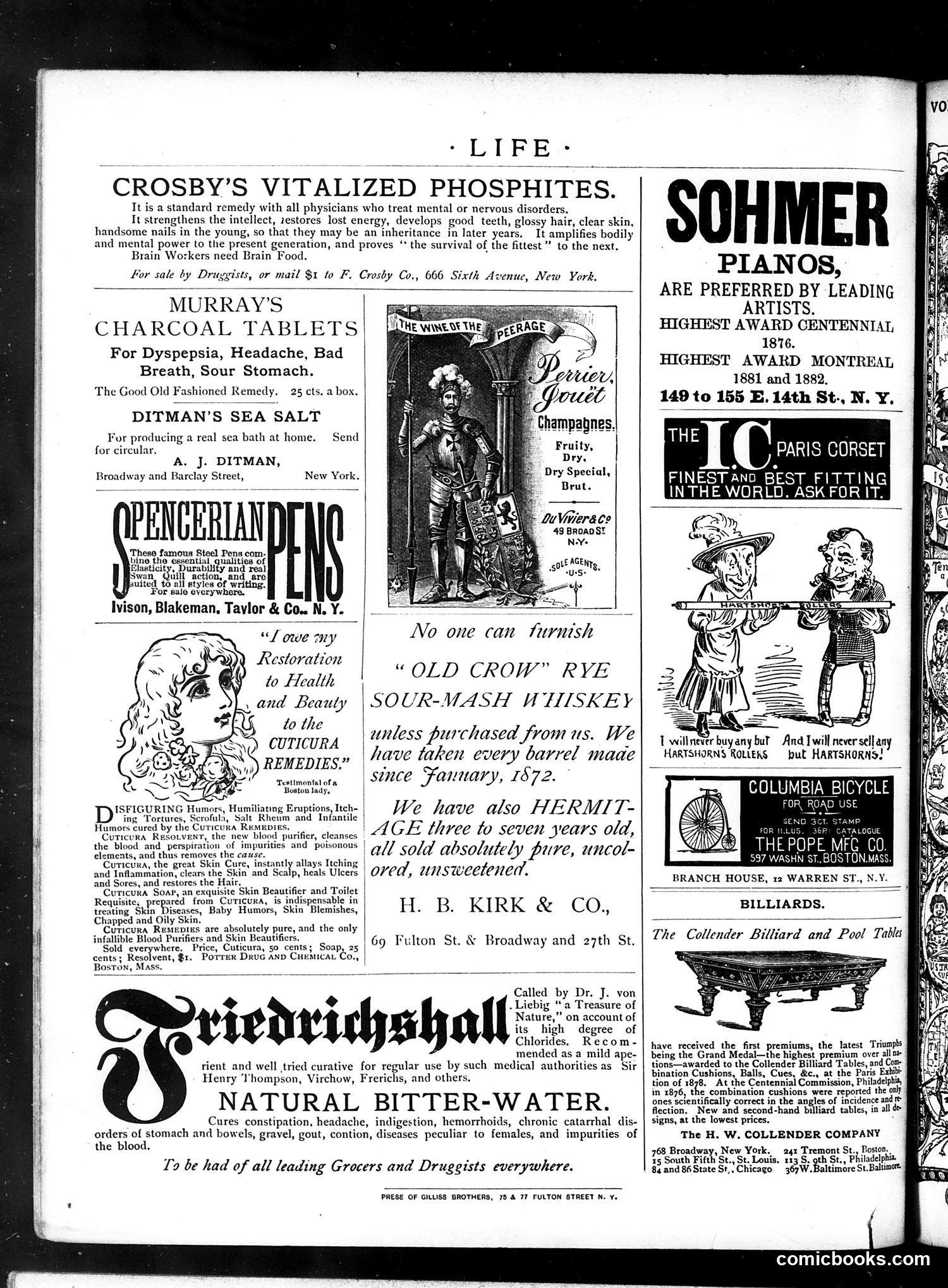
This page is **primarily advertisements** with one cartoon-like illustration (the "Old Crow" whiskey ad showing two men on a seesaw labeled with brand names). **The main visual humor** appears in that whiskey advertisement: two caricatured figures—likely representing competing whiskey brands—are depicted in a playful struggle on a seesaw or lever, with text claiming "I will never buy any but HARTSHORNS ROLLERS" and the response "And I will never sell any but HARTSHORNS!" This appears to be an inside joke or rivalry between brands, though the specific context is unclear today. **The rest is medical/consumer advertising** typical of the 1870s-80s era: patent medicines claiming to cure everything from dyspepsia to skin conditions, along with pianos, corsets, and bicycles. These ads reflect Victorian-era faith in dubious medicinal products and the absence of modern FDA regulation. The page itself contains **no political satire**—Life's satirical content appears elsewhere in the magazine.