
Life, 1884-05-15 · page 5 of 16
Life — May 15, 1884 — page 5: what you’re looking at
What you’re looking at
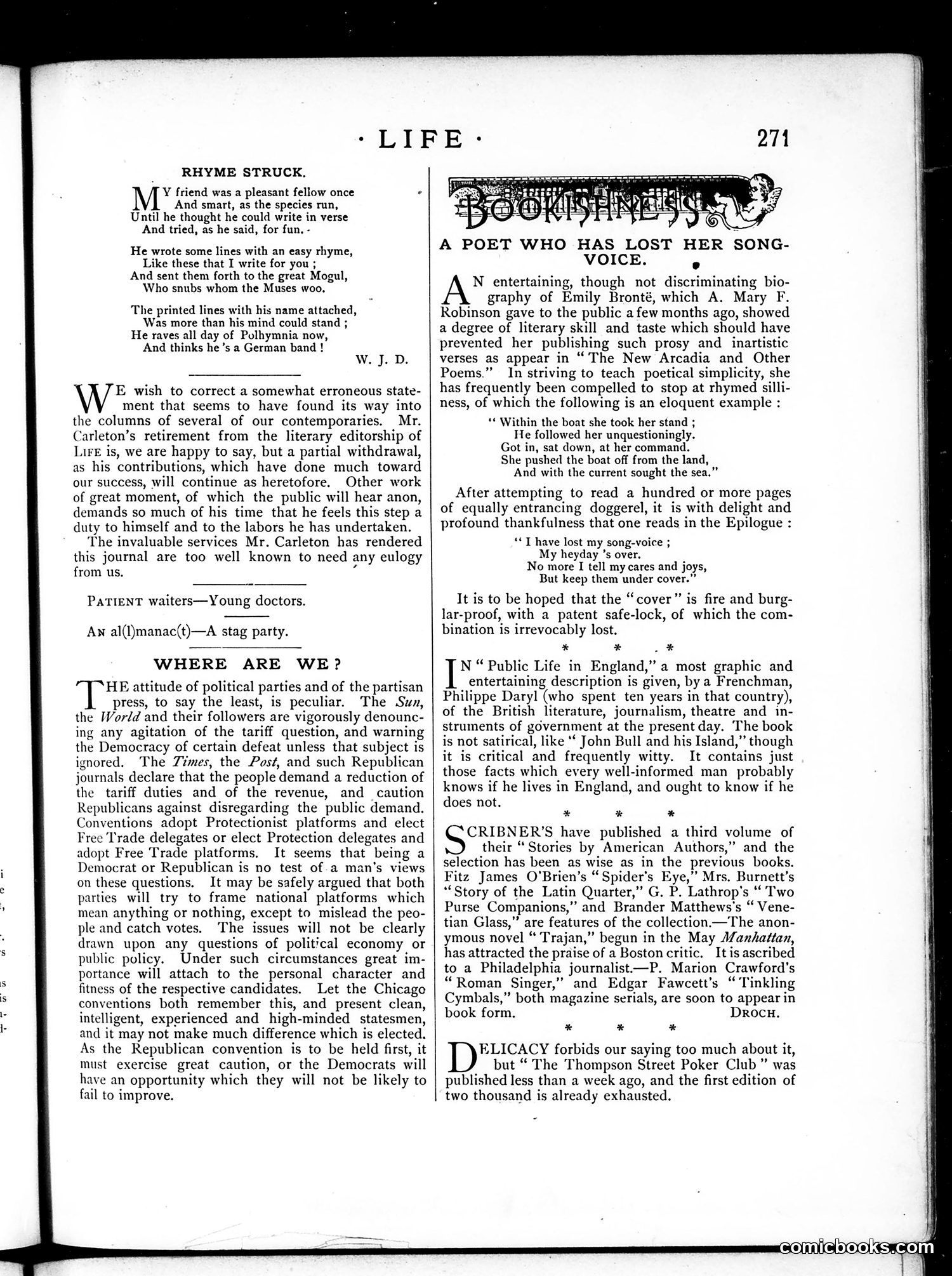
This page contains literary criticism and book reviews rather than political cartoons. The main content includes: **"Rhyme Struck"** - A poem criticizing rhymed verse in contemporary publications, suggesting inferior poetic quality. **"A Poet Who Has Lost Her Song-Voice"** - A review of Emily Brontë biography by A. Mary F. Robinson, criticizing her for preventing publication of "inartistic" verses. The review quotes examples of her deliberately simple poetry. **"Where Are We?"** - Political commentary on partisan press coverage of tariff debates, noting that both Democratic and Republican newspapers ignore facts inconvenient to their platforms. The author argues this prevents voters from making informed decisions. **Book notices** covering Scribner's story collections and "The Thompson Street Poker Club." The page reflects 19th-century concerns about journalistic integrity and literary standards.
📄 Transcribed text from this page (OCR, searchable)
Machine-transcribed from the original scan — historical spelling and the odd misread are preserved.
RHYME STRUCK. Y friend was a pleasant fellow once And smart, as the species run, Until he thought he could write in verse And tried, as he said, for fun. - He wrote some lines with an easy rhyme, Like these that I write for you ; And sent them forth to the great Mogul, Who snubs whom the Muses woo, The printed lines with his name attached, Was more than his mind could stand ; He raves all day of Polhymnia now, And thinks he’s a German band ! w. J. D. E wish to correct a somewhat erroneous state- ment that seems to have found its way into the columns of several of our contemporaries. Mr. Carleton’s retirement from the literary editorship of Lire is, we are happy to say, but a partial withdrawal, as his contributions, which have done much toward our success, will continue as heretofore. Other work of great moment, of which the public will hear anon, demands so much of his time that he feels this step a duty to himself and to the labors he has undertaken. The invaluable services Mr. Carleton has rendered this journal are too well known to need any eulogy from us. . PATIENT waiters—Young doctors. Aw al(I)manac(t)—A stag party. WHERE ARE WE? HE attitude of political parties and of the partisan press, to say the least, is peculiar. The Sun, the World and their followers are vigorously denounc- ing any agitation of the tariff question, and warning the Democracy of certain defeat unless that subject is ignored. The Zimes, the Post, and such Republican journals declare that the people demand a reduction of the tariff duties and of the revenue, and caution Republicans against disregarding the public demand. Conventions adopt Protectionist platforms and elect Free Trade delegates or elect Protection delegates and adopt Free Trade platforms. It seems that being a Democrat or Republican is no test of.a man’s views on these questions, It may be safely argued that both parties will try to frame national platforms which mean anything or nothing, except to mislead the peo- ple and catch votes. The issues will not be clearly drawn upon any questions of political economy or public policy. Under such circumstances great im- portance will attach to the personal character and fitness of the respective candidates. Let the Chicago conventions both remember this, and present clean, intelligent, experienced and high-minded statesmen, and it may not make much difference which is elected. As the Republican convention is to be held first, it must exercise great caution, or the Democrats will have an opportunity which they will not be likely to fail to improve. A POET WHO HAS LOST HER SONG- VOICE. . N entertaining, though not discriminating bio- graphy of Emily Bronté, which A. Mary F. Robinson gave to the public a few months ago, showed a degree of literary skill and taste which should have prevented her publishing such prosy and _ inartistic verses as appear in “The New Arcadia and Other Poems.” In striving to teach poetical simplicity, she has frequently been compelled to stop at rhymed silli- ness, of which the following is an eloquent example : “* Within the boat she took her stand ; He followed her unquestioningly. Got in, sat down, at her command. She pushed the boat off from the land, And with the current sought the sea.” After attempting to read a hundred or more pages of equally entrancing doggerel, it is with delight and profound thankfulness that one reads in the Epilogue : “T have lost my song-voice ; My heyday ’s over. No more I tell my cares and joys, But keep them under cover.” It is to be hoped that the “cover” is fire and burg- lar-proof, with a patent safe-lock, of which the com- bination is irrevocably lost. * * _* N “ Public Life in England,” a most graphic and entertaining description is given, by a Frenchman, Philippe Daryl (who spent ten years in that country), of the British literature, journalism, theatre and in- struments of government at the present day. The book is not satirical, like “ John Bull and his Island,” though it is critical and frequently witty. It contains just those facts which every well-informed man probably knows if he lives in England, and ought to know if he does not. * * * CRIBNER’S have published a third volume of their “ Stories by American Authors,” and the selection has been as wise as in the previous books. Fitz James O'Brien’s “Spider's Eye,” Mrs. Burnett’s “Story of the Latin Quarter,” G. P. Lathrop’s ‘‘ Two Purse Companions,” and Brander Matthews's “ Vene- tian Glass,” are features of the collection—The anon- ymous novel “ Trajan,” begun in the May Aanhattan, has attracted the praise of a Bostoncritic. It is ascribed to a Philadelphia journalist—P. Marion Crawford's “Roman Singer,” and Edgar Fawcett’s “ Tinkling Cymbals,” both magazine serials, are soon to appear in book form. Drocu. * * * [Bre forbids our saying too much about it, but “ The Thompson Street Poker Club ” was published less than a week ago, and the first edition of two thousand is already exhausted.