
A complete issue · 16 pages · 1883
Life — November 29, 1883
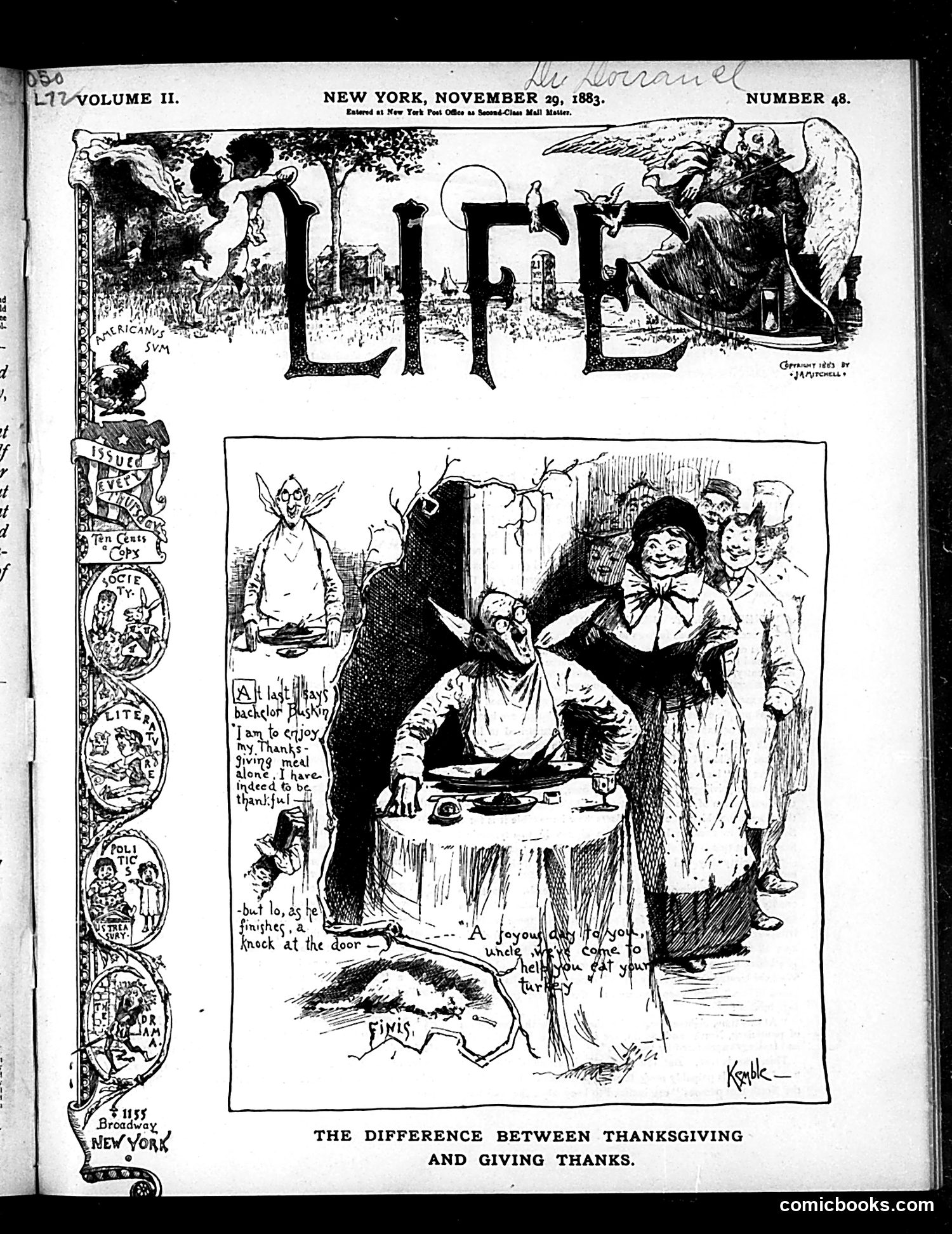
**The Cartoon**: "The Difference Between Thanksgiving and Giving Thanks" This satirical illustration contrasts two scenarios. On the left, a bachelor enjoys a modest meal alone. On the right, a married man sits surrounded by family members—wife, children, and servants—all expecting to be fed and entertained at a table laden with food and drink. **The Satire**: The cartoon mocks the burden of matrimony and family obligation. "Thanksgiving" (the holiday) supposedly means "giving thanks," but for the married man, it means literally *giving*—providing food, hospitality, and entertainment to numerous dependents. The bachelor's solitary contentment versus the family man's apparent obligation suggests marriage transforms the holiday from gratitude into exhausting provision. This reflects Victorian-era masculine anxieties about domestic responsibility.
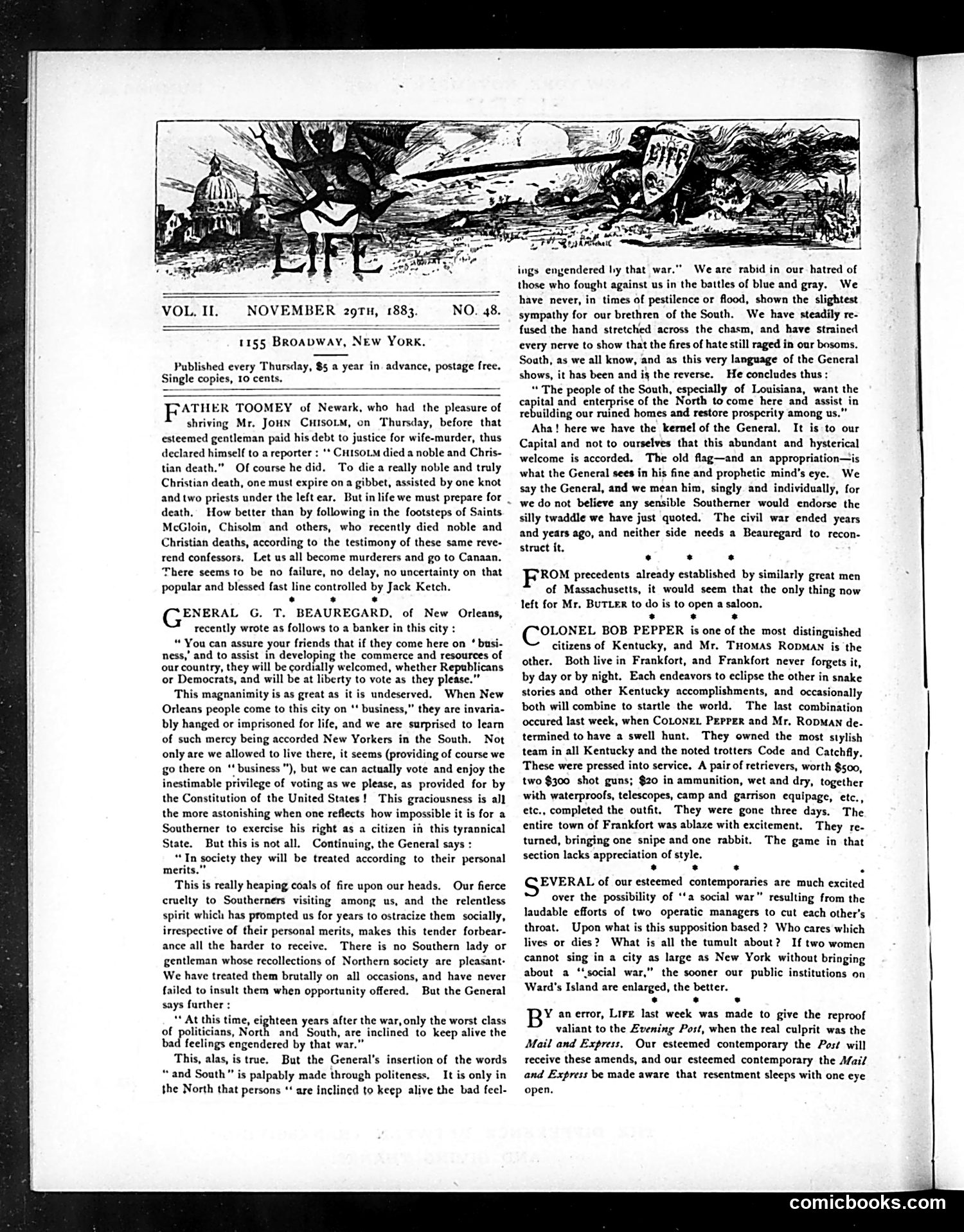
The page consists primarily of political commentary rather than illustrated cartoons. The masthead shows "LIFE" with decorative imagery of a classical dome (likely Capitol building) and a tree. The text discusses General Beauregard of New Orleans and political reconciliation between North and South following the Civil War (ended 1865). The passage criticizes Northern Republicans who visit the South and vote there despite not residing there. It mocks Beauregard's claim that politics should transcend sectional hatred, arguing this is naive hypocrisy—the North actually benefits from Southern division. The article also briefly mentions Colonel Bob Pepper and Thomas Rodman of Kentucky engaging in competitive hunting. A minor correction note addresses an error in the previous week's *Evening Post*.
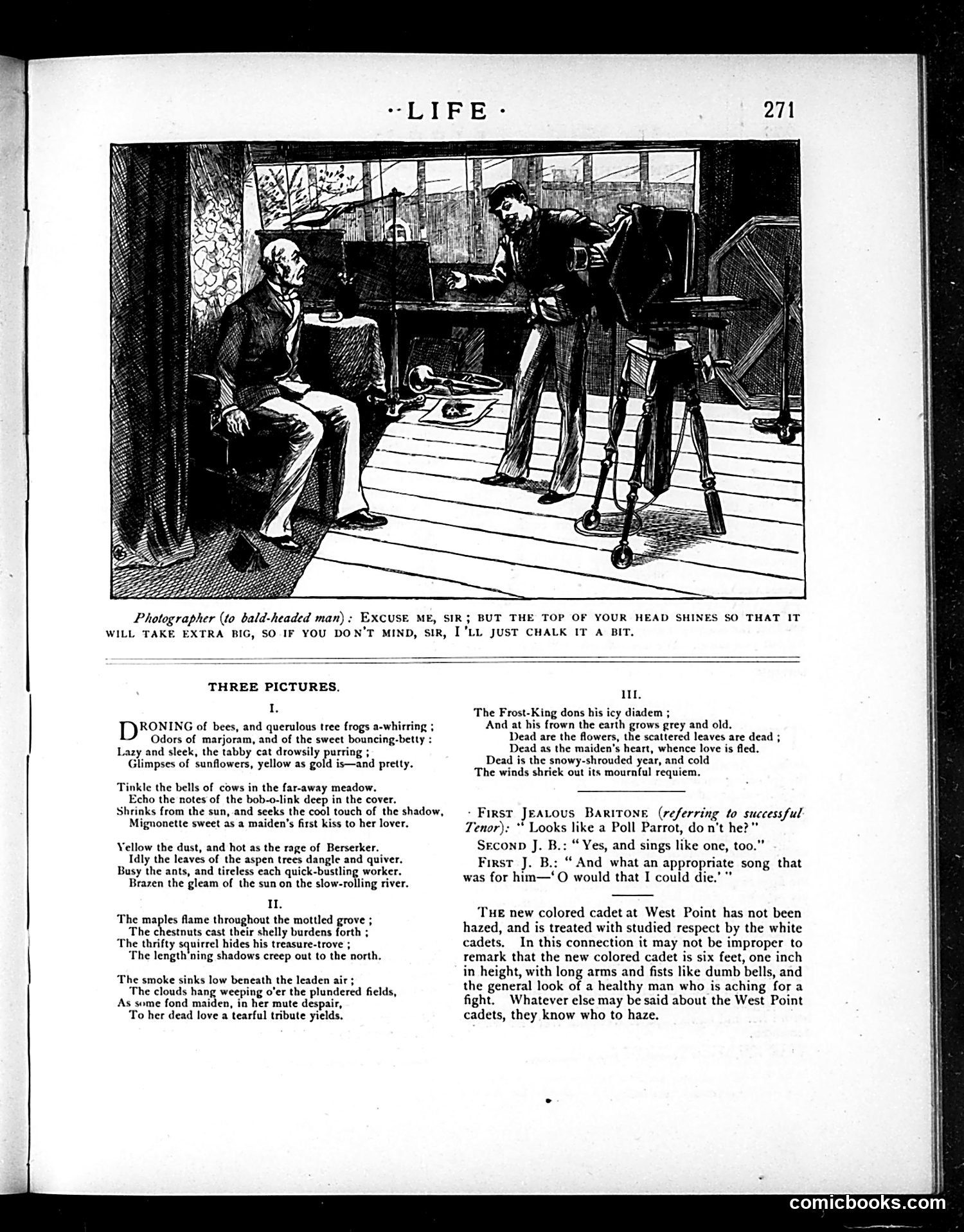
The main cartoon depicts a photographer with a bald client. The photographer's joke relies on a physical appearance gag: he suggests chalking the man's shiny bald head to reduce glare during photography, since "the top of your head shines so that it will take extra big." This is straightforward visual humor about baldness and studio photography techniques from the early 20th century. The satire targets vanity and the challenges photographers faced with reflective surfaces—a practical problem before modern lighting equipment. Below are three poems titled "Three Pictures," appearing unrelated to the cartoon. On the right are brief dramatic dialogue exchanges, including a reference to "West Point" cadets and hazing practices. The page primarily contains light humor and verse rather than political satire.
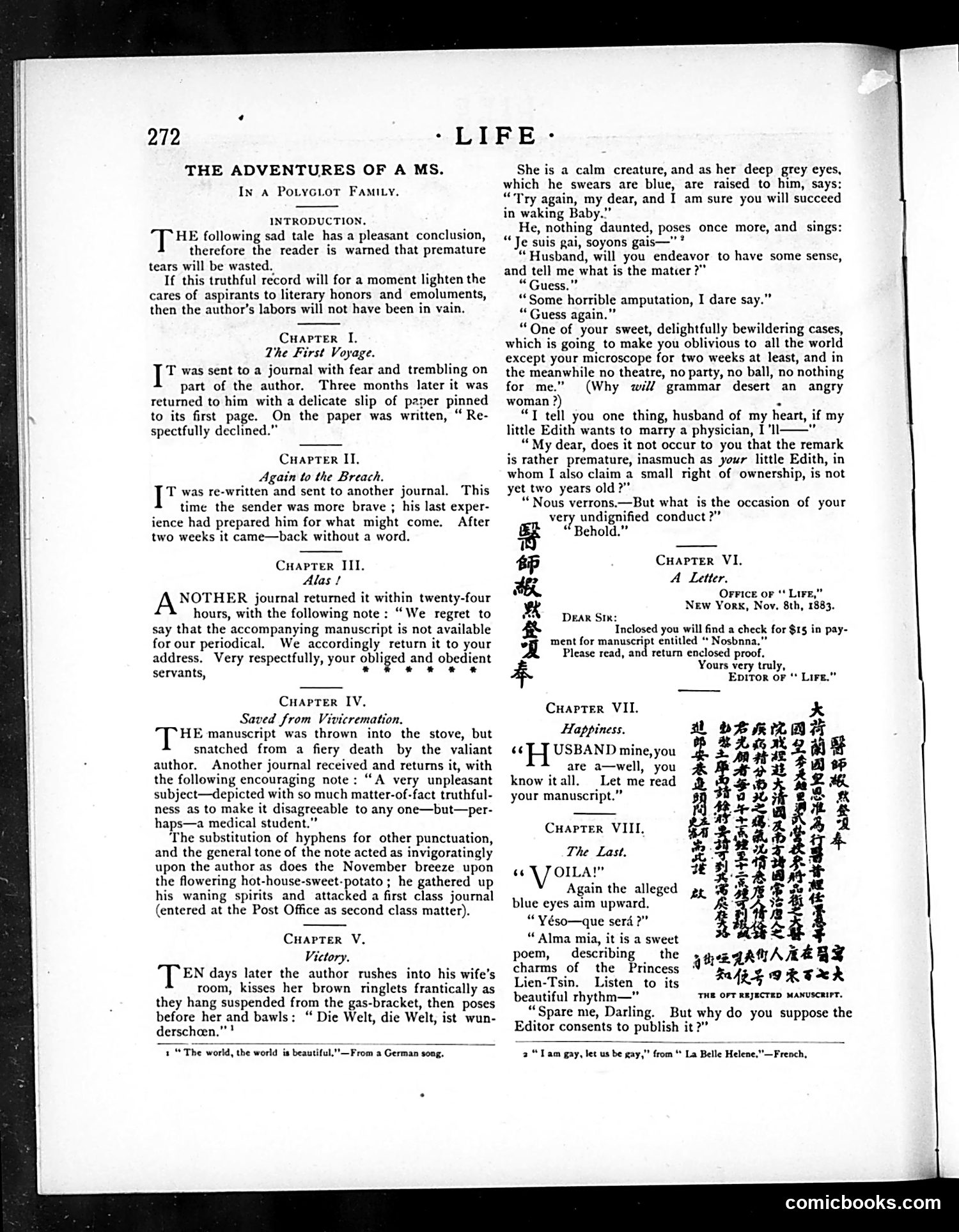
This appears to be a serialized satirical story about the rejections of a manuscript submitted to various publications. The narrative follows a rejected piece of writing ("MS" = manuscript) as it's returned with increasingly dismissive notes from different journals and editors. The satire mocks the publishing industry's treatment of aspiring authors—particularly women writers, given the reference to a female author with a husband and daughter. Each chapter chronicles another rejection: one journal returns it unread, another dismisses it within 24 hours, a third throws it in a stove. The humor targets both the brutality of editorial gatekeeping and the persistence required of writers seeking publication in the late 19th century.
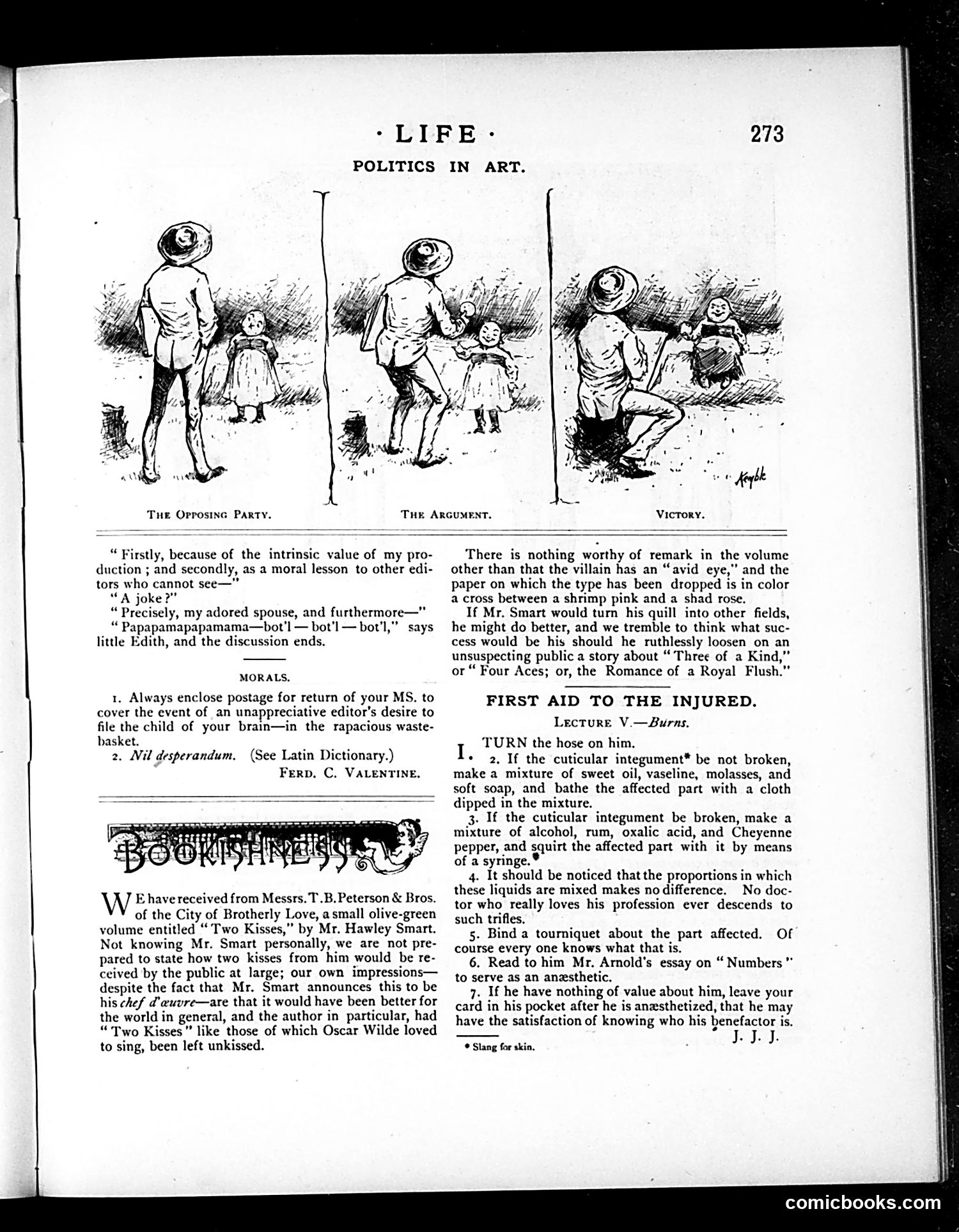
This three-panel satirical cartoon titled "Politics in Art" depicts a man and child in three scenarios: "The Opposing Party," "The Argument," and "Victory." The joke appears to be a commentary on political discourse and power dynamics. The progression suggests how political opponents interact—first presenting opposing views, then arguing, and finally one side "winning" (shown by the man appearing triumphant or dominant over the child figure). The satire likely mocks how adults conduct politics, comparing serious political conflict to a parent-child dynamic. By showing an adult arguing with a small child across three panels, Life ridicules the nature of political debate itself—suggesting politicians behave childishly or that political "victory" is as meaningless as winning an argument with a child. The specific political context remains unclear without additional historical information.
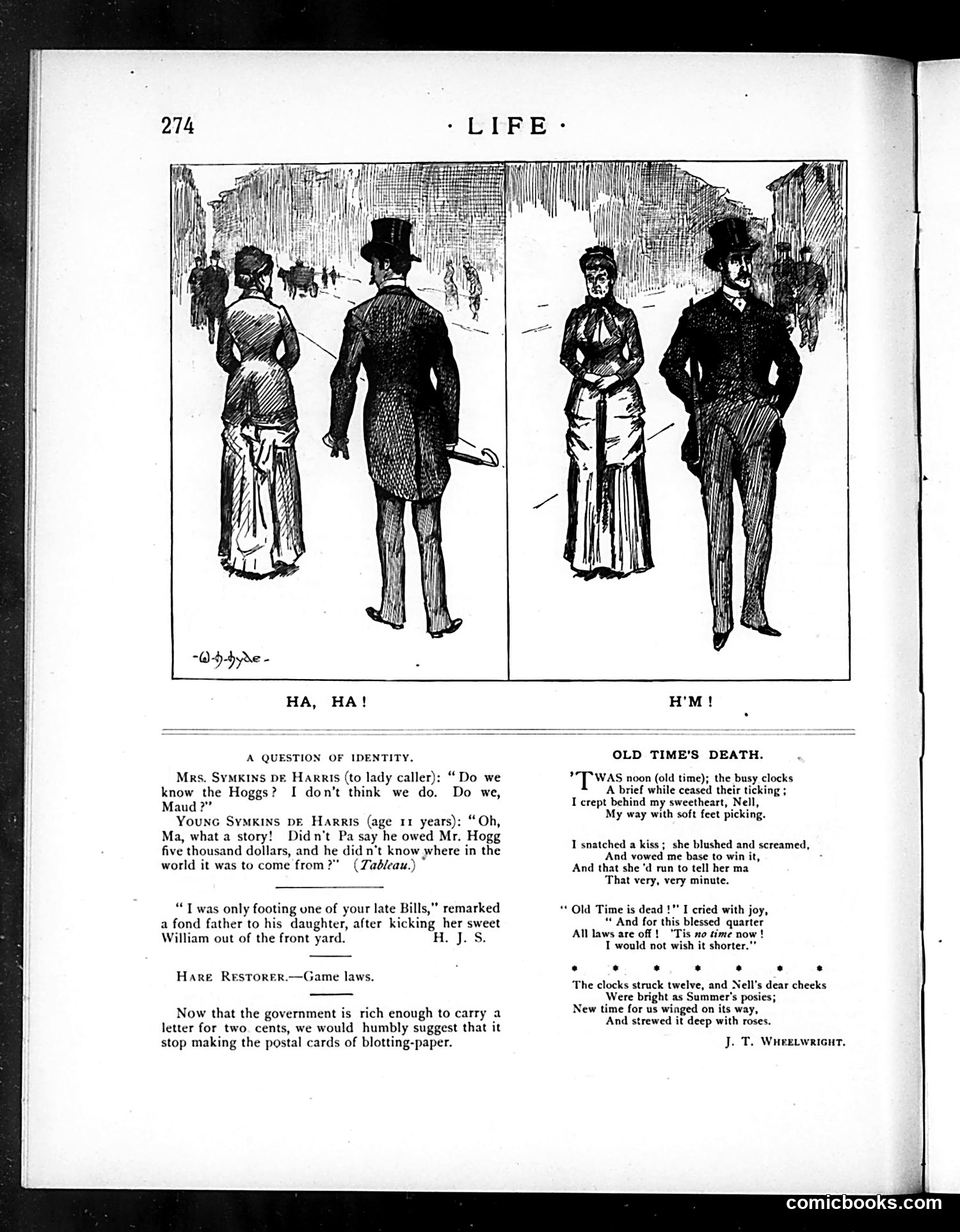
The cartoon depicts two pairs of Victorian-era figures (men in top hats with women) labeled "HA, HA!" and "H'M!" The accompanying text mocks class pretension: Mrs. Symkins claims not to know "the Hoggs," while her son notes the Hoggs have "five thousand dollars" but mysteriously unknown origins—implying nouveau riche (newly wealthy) embarrassment. The humor targets snobbish social climbing: the wealthy Hoggs are wealthy enough to associate with but too socially suspect to acknowledge. A secondary joke mentions kicking out a servant named "William" for impropriety. The satire reflects Victorian anxieties about distinguishing "old money" respectability from "new money" vulgarity—a common Life magazine theme ridiculing social pretense and hypocrisy.
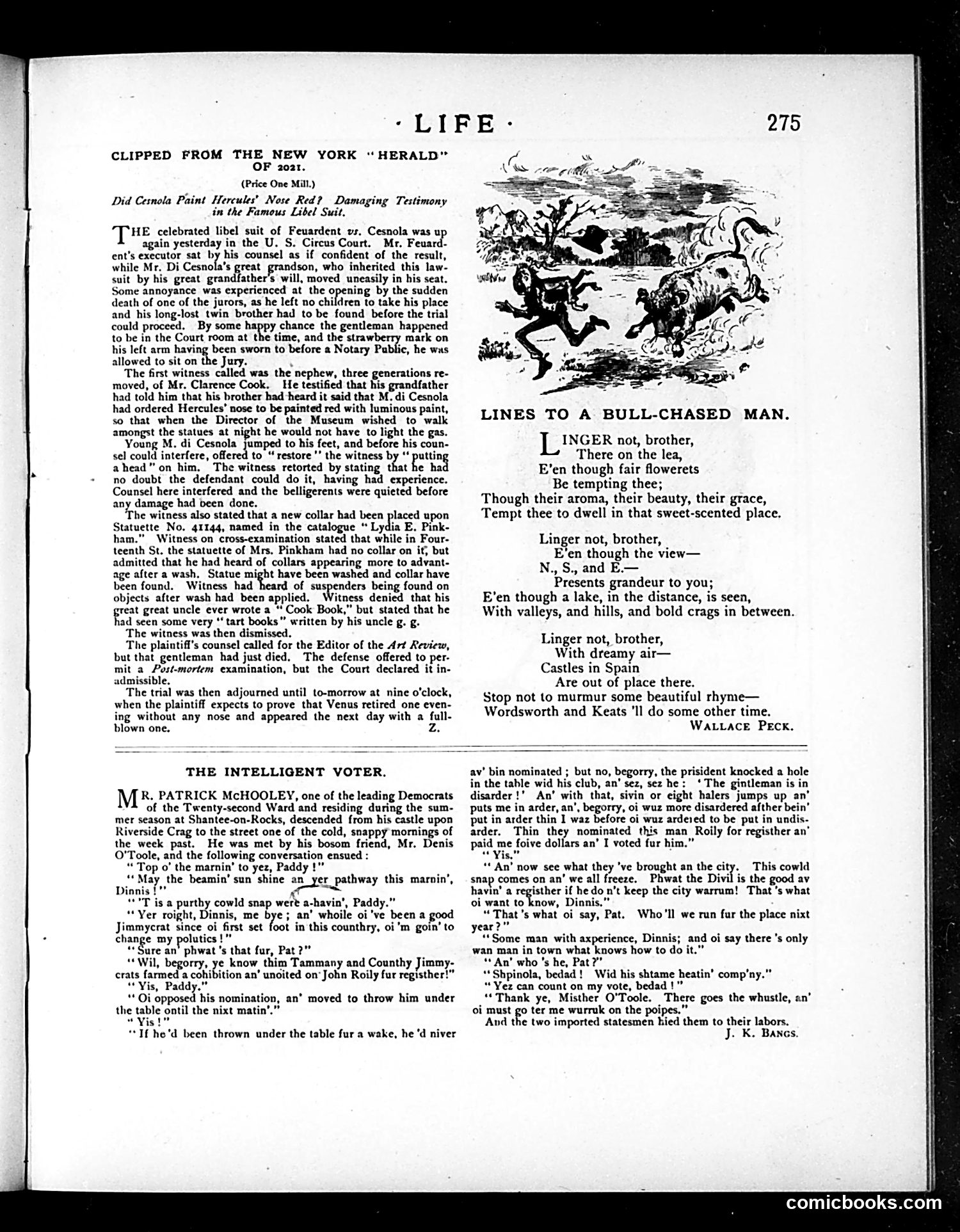
The page contains three distinct pieces: **"Lines to a Bull-Chased Man"** (poem by Wallace Peck): A humorous verse addressed to someone being chased by a bull, offering encouragement to flee toward flowers and scenic landscapes rather than face the animal. **The Bull-Chase Illustration**: An engraving depicting a man being pursued by a bull—a visual gag supporting the poem's theme. **"The Intelligent Voter"** (by J.K. Bangs): A satirical Irish dialect dialogue between two men discussing Democratic politics and voter manipulation. One character boasts of controlling votes through nomination tactics, while the other describes voters being treated as disposable political assets. The satire critiques machine politics and the cynical treatment of the electorate during this period.
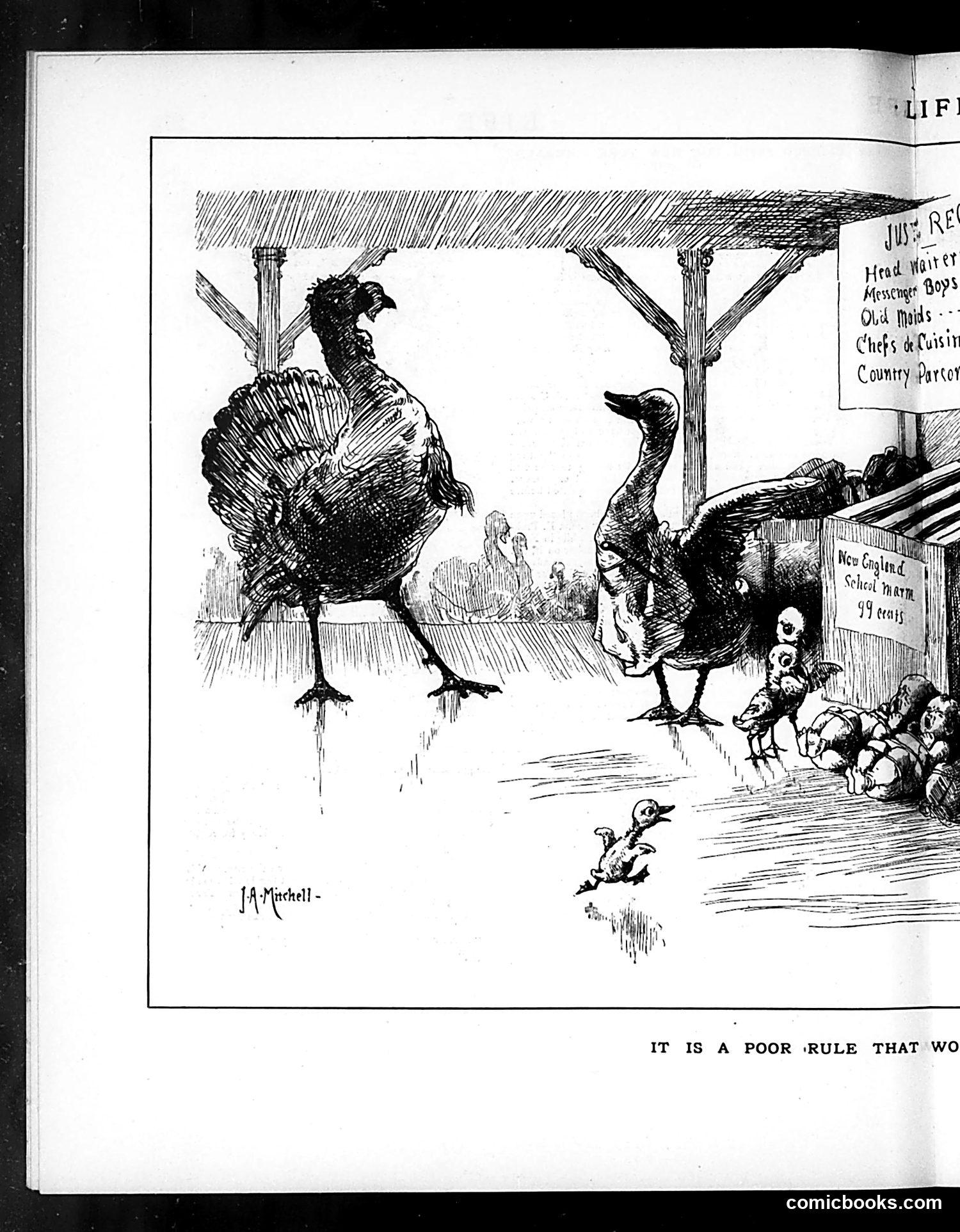
This cartoon by Mitchell depicts anthropomorphized turkeys in what appears to be a domestic service scenario. The larger turkey on the left displays an elaborate tail, while another turkey on the right appears to be serving or attending to human figures. A sign visible on the right lists job positions: "Head Waiter," "Messenger Boys," "Old Maids," "Chefs de Cuisine," and "Country Parlor," suggesting this satirizes servant hierarchies or domestic labor classifications. Another sign advertises "New England School MATTH 99 cents," though its relevance is unclear. The cartoon likely mocks either class distinctions in service work or—given the turkey imagery—makes a seasonal (Thanksgiving) joke about the irony of turkeys serving humans. The specific satirical target remains somewhat ambiguous without additional context.
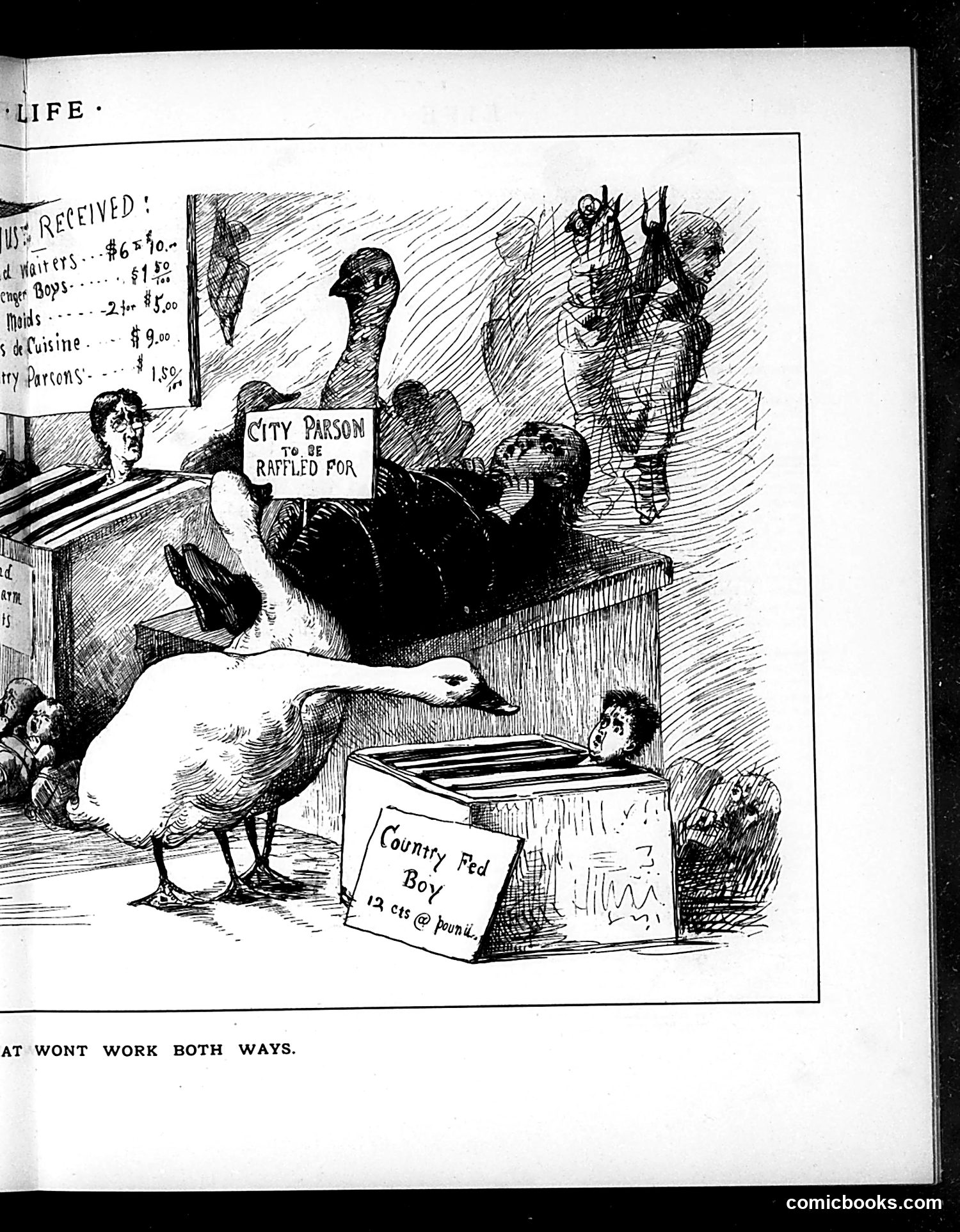
This satirical cartoon depicts a poultry market where animals are being sold for consumption. The visible labels include "City Parson to be raffled for" (on a turkey) and "Country Red Boy" (on what appears to be a duck or goose in a box marked "12 cts @ pound"). The cartoon's title, "Eat Won't Work Both Ways," suggests ironic commentary on food systems or class dynamics—likely satirizing urban versus rural food production or consumption patterns. The "City Parson" label humorously suggests even clergy are commodified. The visible price list on the left (showing wages and kitchen costs) reinforces themes of economic value and class distinction that would have resonated with *Life* magazine's readership in the early 20th century.
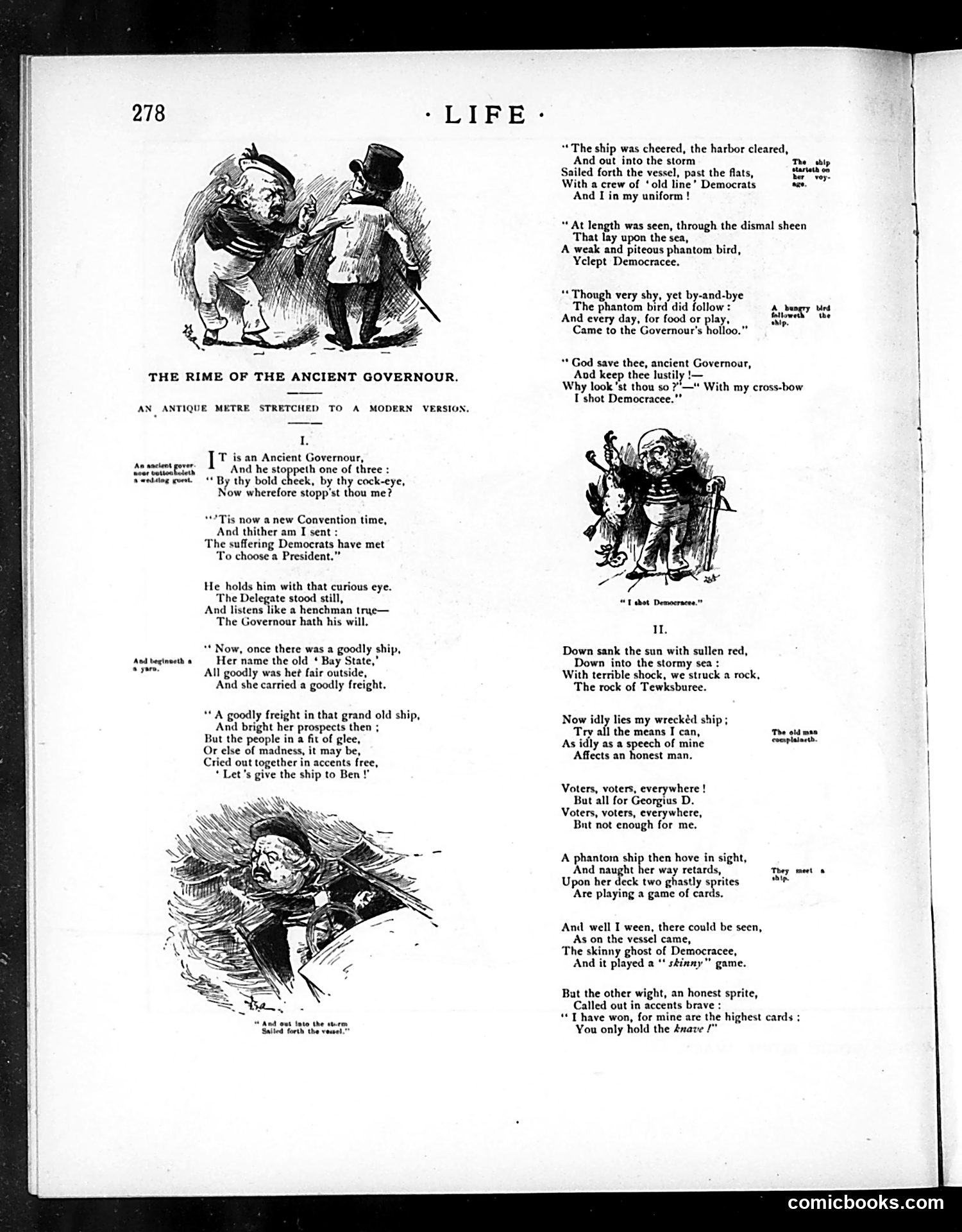
This is a political parody modeled on Coleridge's "The Rime of the Ancient Mariner," mocking a Massachusetts governor (likely referring to a real historical figure, though unclear which from the image alone) during a Democratic Party convention. The satire's key point: the governor, like the Mariner, has destroyed something precious—here, the Democratic Party itself (represented as a weak "phantom bird" called "Democracee"). The repeated references to "Georgius D." and "voters, voters, everywhere" suggest the party is fractured and unable to unite around a candidate. The shipwreck and card-playing ghosts represent political chaos and corruption. The "rock of Tewksburee" likely references a specific scandal or factional split. The overall message: the governor's political maneuvering has crippled Democratic fortunes, leaving only hollow phantoms and dishonest dealings in its wake.
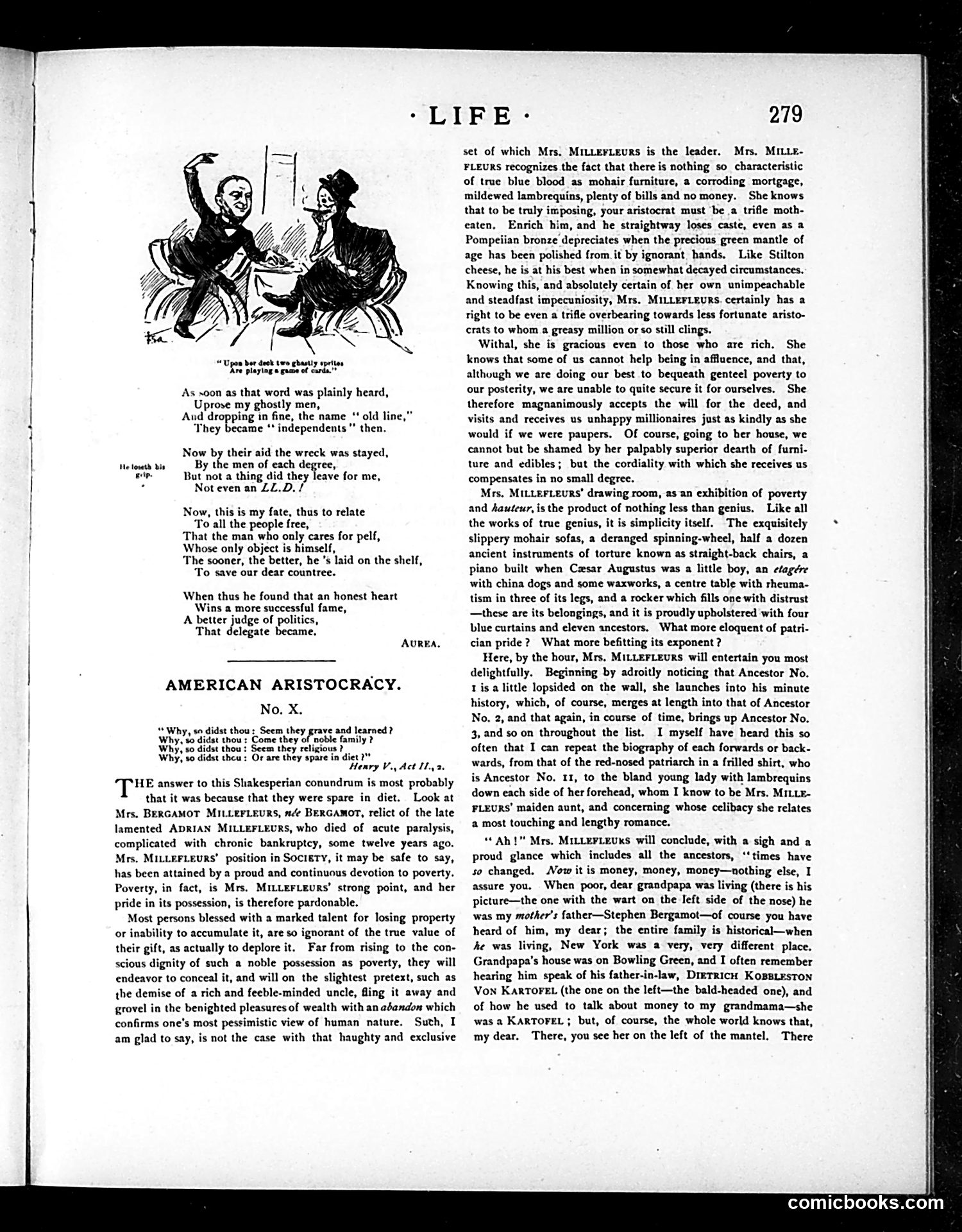
This page satirizes American social pretension, specifically mocking the "aristocracy" of the poor who claim superiority through poverty itself. **The Main Target:** Mrs. Bergamot Millefleurs, a widow who has achieved social status through *continuous devotion to poverty*—she lost her late husband's wealth through bankruptcy and now wears this destitution as a badge of honor, treating it as evidence of "true blue blood." **The Joke:** Life inverts typical class values. Millefleurs and her circle believe poverty, shabby furniture, unpaid bills, and decay are markers of genuine aristocracy, while actual wealth is vulgar. She condescends to rich people as inferior for their "greasy millions," despite accepting their charity visits. **The Satire's Point:** This ridicules Americans who, unable to achieve genuine inherited aristocracy (absent in democratic America), invented fake gentility through *performed poverty*—a transparent status claim that fooled no one but themselves. The cartoon (top-left, unclear subject) appears to illustrate this hypocrisy visually.
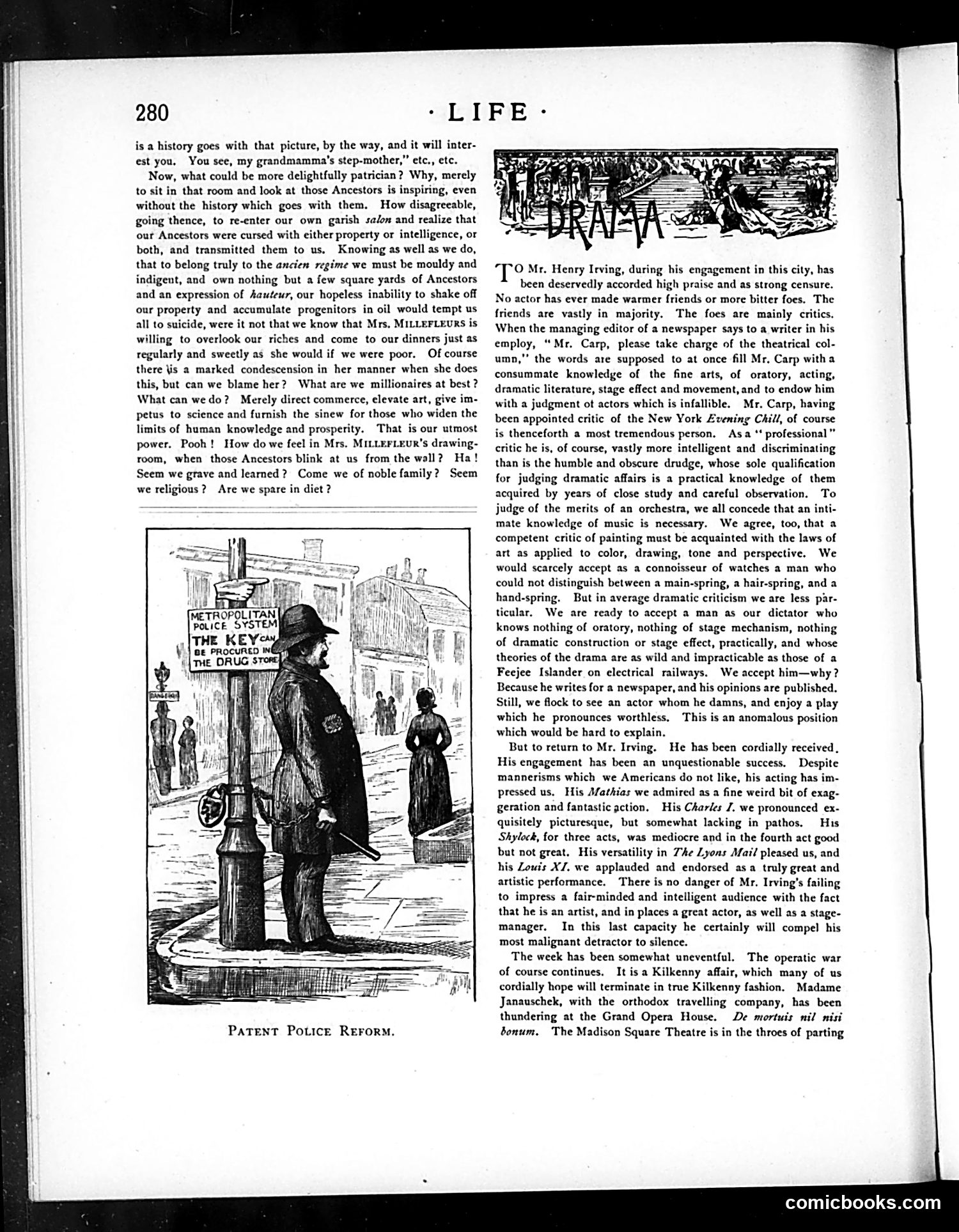
This cartoon satirizes proposed reforms to police systems, likely in New York City. The illustration shows a uniformed police officer operating what appears to be a mechanical or bureaucratic system, with the caption "PATENT POLICE SYSTEM" visible. The satire critiques the idea that policing can be mechanized or systematized like a patent—suggesting that reducing police work to rigid, formulaic procedures ignores the judgment and discretion required for effective law enforcement. The accompanying text discusses theatrical criticism, but the cartoon's point is clear: reformers proposing to "patent" or standardize police procedures are oversimplifying complex human work, much like accepting newspaper critics with no actual expertise in drama.
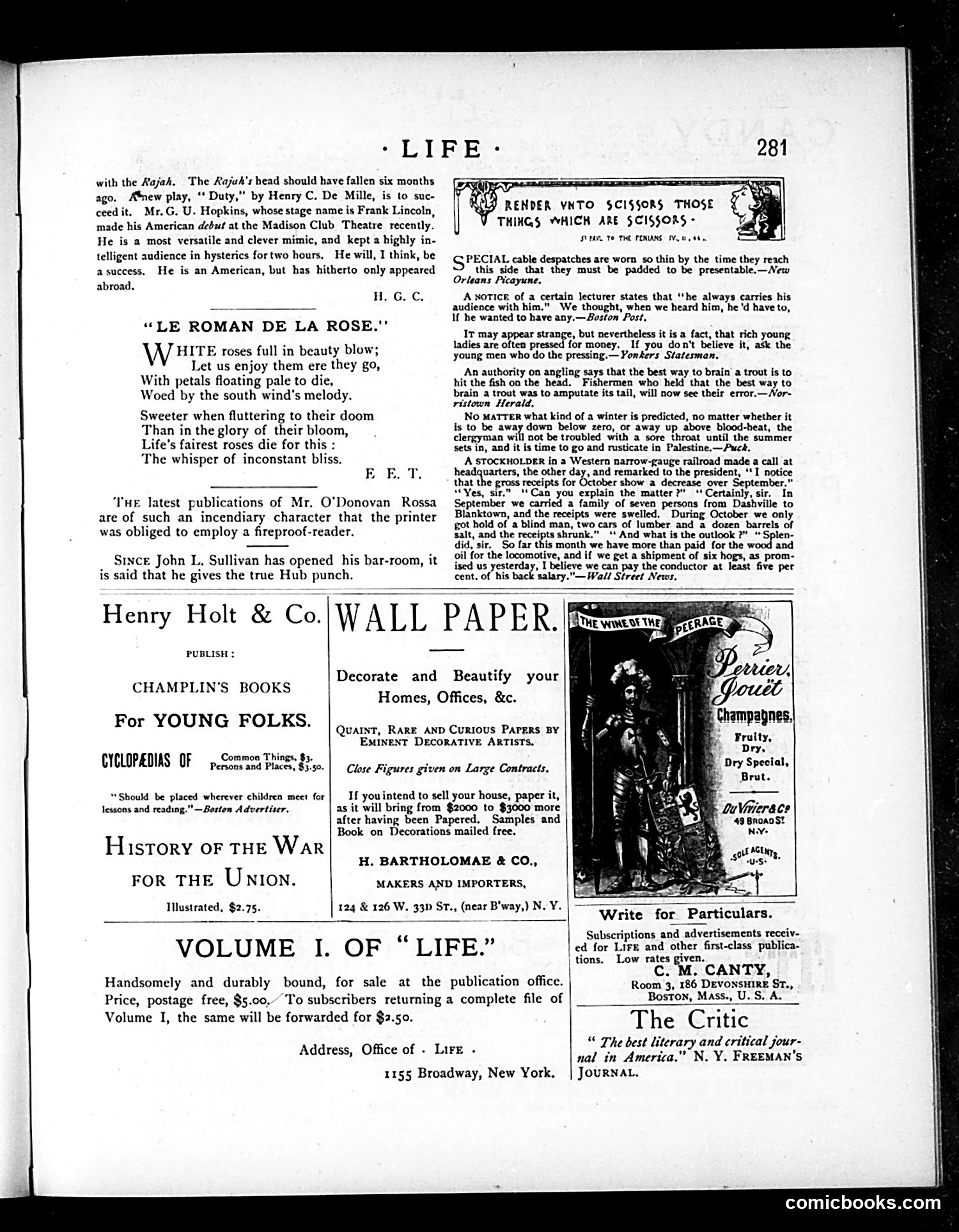
This page is primarily **advertisements and literary content** rather than political cartoons. The small illustrated header "Render unto Scissors Those Things Which Are Scissors" appears to be a visual pun referencing the Biblical phrase "Render unto Caesar," likely mocking the Fenians (Irish-American nationalist activists) through wordplay—the specific reference is unclear without fuller context. The page contains brief satirical **quips** rather than developed cartoons: jokes about theatrical performers, wealthy young women being "pressed for money" (pun on financial need), railroad economics, and clerical behavior. These are light social commentary typical of Life's humor. The bulk consists of book and wallpaper advertisements, including Henry Holt & Co.'s educational encyclopedias and H. Bartholomae & Co.'s decorative papers. The page reflects late 19th-century American advertising and publishing culture.
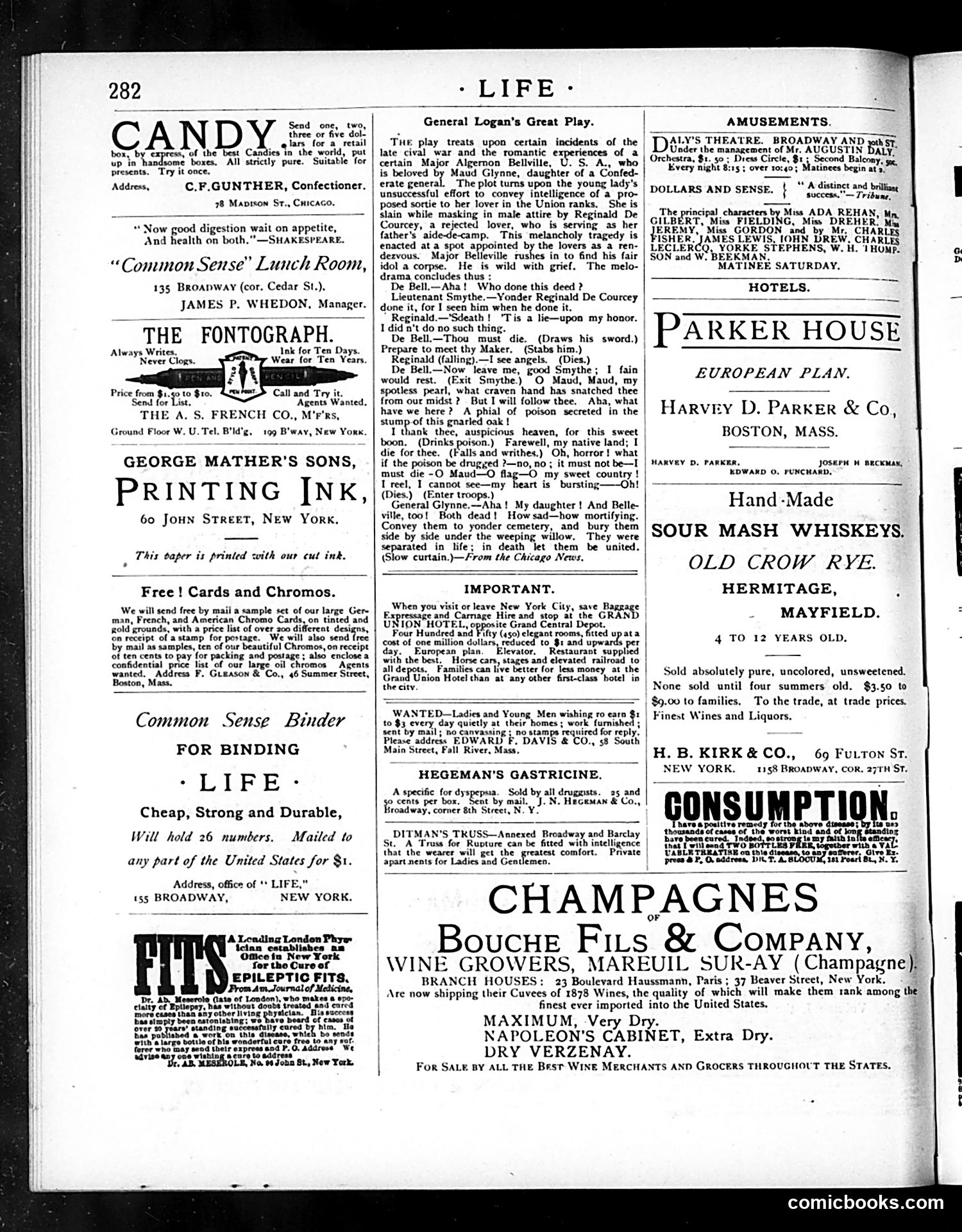
This page satirizes a melodramatic Civil War play, likely by or featuring General John A. Logan (a prominent Union general turned politician). The text mocks the overwrought theatrical conventions of the era through absurdly stilted dialogue and plot. The satire targets the play's clumsy handling of Civil War romance—a young woman dies while disguised as a soldier to reach her Union lover; her rejected suitor accidentally kills her; complications ensue. The humor lies in the wooden dialogue ("'Sdeath! 'Tis a lie—upon my honor"), the improbable staging, and the cascading deaths resolved through convenient plot devices (poison in a tree, mistaken identity). For modern readers: this mocks both overwrought Victorian melodrama *and* the tendency to romanticize the Civil War as theatrical spectacle rather than genuine tragedy. The exaggerated earnestness of the dialogue—especially the comic non-sequiturs—highlights how disconnected popular entertainment was from war's actual horror.
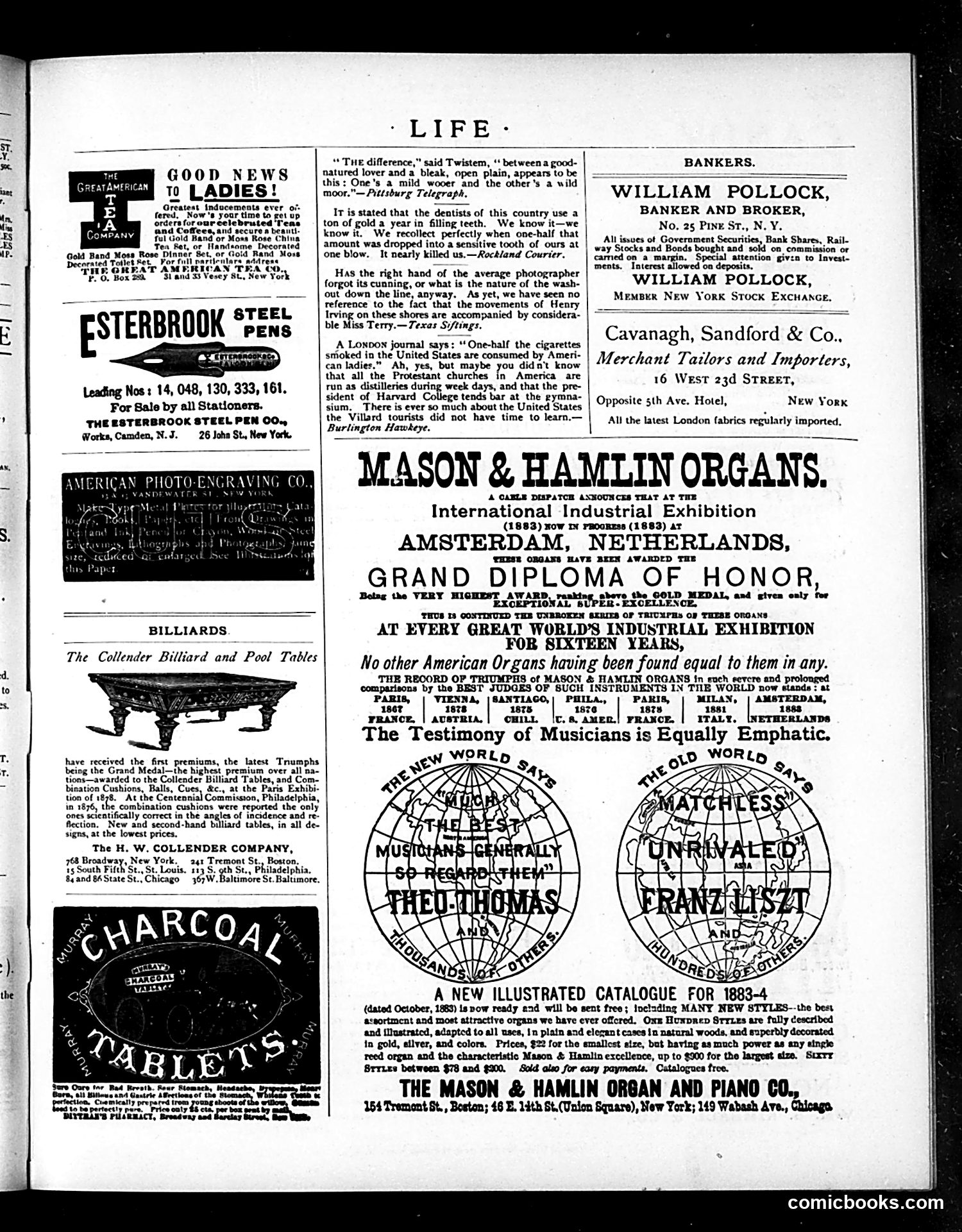
This page is primarily advertising, with a section of humorous short items at the top-center. The short jokes reference contemporary topics: one mocks London journalists for spreading false claims about America (that dentists use tons of gold annually, that churches run as distilleries, that Harvard's president tends bar); another jokes about photographers' technical failures; another contains a mild pun about "wooing" versus moorland. These satirize both American self-importance and foreign misunderstanding of American life. The bulk of the page comprises advertisements for financial services (Pollock's banking), tailoring (Cavanagh, Sandford), pens (Esterbrook), billiard tables (Collender), tea/coffee premiums (Great American), and prominently, Mason & Hamlin organs—boasting international awards and medals from exhibitions in Vienna, Amsterdam, and elsewhere. No political cartoons appear on this page. It functions as a typical 1880s *Life* magazine page mixing light satirical commentary with revenue-generating advertisements.
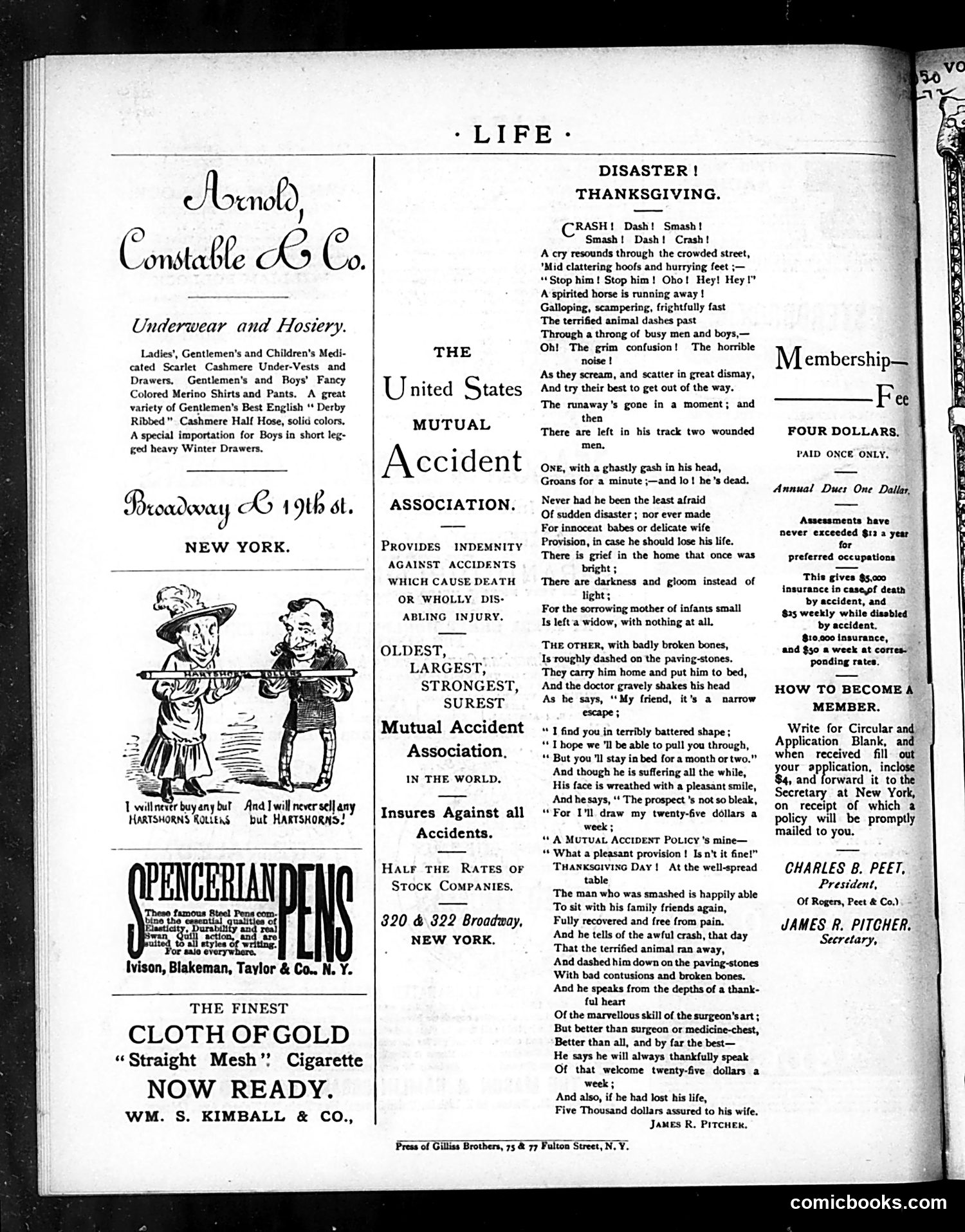
This page is primarily **advertising**, dominated by promotions for the United States Mutual Accident Association. The main content is a narrative poem titled "Disaster! Thanksgiving" by James R. Pitcher, which serves as marketing copy. The poem describes a runaway horse accident in the street that injures two men differently: one dies, leaving his family destitute because he had no insurance; the other survives with broken bones but recovers well because he holds a Mutual Accident policy paying him $25 weekly. **The satire's point:** The contrast between the two outcomes functions as implicit social commentary—showing that industrial accidents were common urban hazards, but financial protection separated the responsible worker from the desperate widow. The poem uses melodrama and thanksgiving sentiment to argue that accident insurance is morally necessary, not frivolous. The cartoon at bottom-left appears unrelated—two men discussing "Hartshorn's" cough drops with a humorous bargaining exchange. The page reflects late-19th-century anxieties about workplace safety and financial insecurity before government safety regulations or social insurance existed.