
Life, 1883-11-29 · page 2 of 16
Life — November 29, 1883 — page 2: what you’re looking at
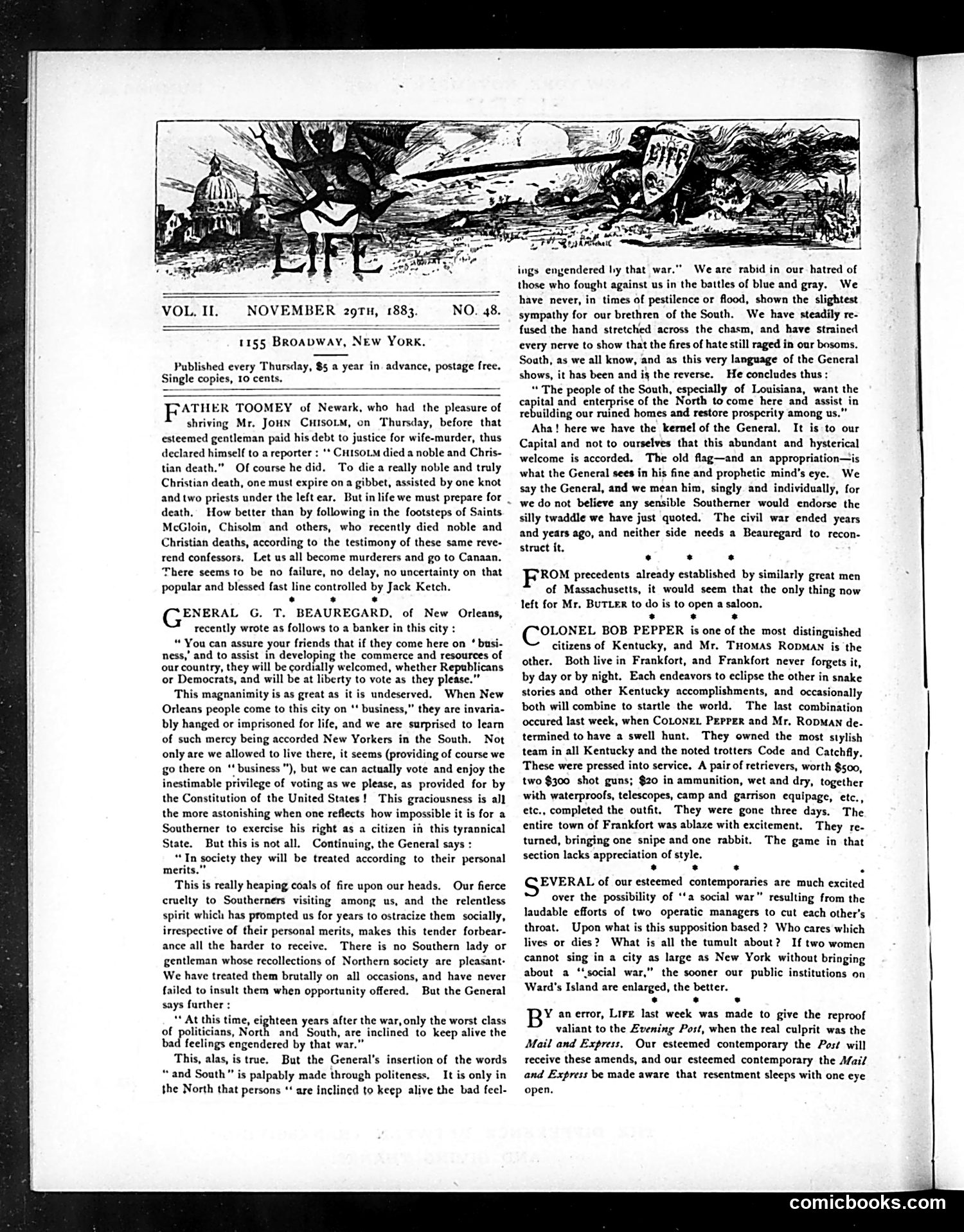
What you’re looking at
The page consists primarily of political commentary rather than illustrated cartoons. The masthead shows "LIFE" with decorative imagery of a classical dome (likely Capitol building) and a tree. The text discusses General Beauregard of New Orleans and political reconciliation between North and South following the Civil War (ended 1865). The passage criticizes Northern Republicans who visit the South and vote there despite not residing there. It mocks Beauregard's claim that politics should transcend sectional hatred, arguing this is naive hypocrisy—the North actually benefits from Southern division. The article also briefly mentions Colonel Bob Pepper and Thomas Rodman of Kentucky engaging in competitive hunting. A minor correction note addresses an error in the previous week's *Evening Post*.
📄 Transcribed text from this page (OCR, searchable)
Machine-transcribed from the original scan — historical spelling and the odd misread are preserved.
VOL, II. NOVEMBER 29TH, NO. 48. 1155 BROADWAY, NEw YorK. Published every Thursday, $5 a year in. advance, postage free. Single copies, 10 cents. ATHER TOOMEY of Newark, who had the pleasure of shriving Mr. JouN CrtsoLM, on Thursday, before that esteemed gentleman paid his debt to justice for wife-murder, thus declared himself to a reporter : ‘* CHISOLM died a noble and Chris- tian death.” Of course he did. To die a really noble and truly Christian death, one must expire on a gibbet, assisted by one knot and two priests under the left ear. But in life we must prepare for death, How better than by following in the footsteps of Saints. McGloin, Chisolm and others, who recently died noble and Christian deaths, according to the testimony of these same reve- rend confessors. Let us all become murderers and go to Canaan. There seems to be no failure, no delay, no uncertainty on that popular and blessed fast line controlled by Jack Ketch. * * * ENERAL G. T. BEAUREGARD, of New Orleans, recently wrote as follows to a banker in this city : uu can assure your friends that if they come here on ‘ busi- ness,’ and to assist in developing the commerce and resources of our country, they will be cordially welcomed, whether Republicans or Democrats, and will be at liberty to vote as they please.” This magnanimity is as great as it is undeserved, When New Orleans people come to this city on ‘* business,” they are invaria- bly hanged or imprisoned for life, and we are surprised to learn of such mercy being accorded New Yorkers in the South. Not only are we allowed to live there, it seems (providing of course we go there on “‘ business"), but we can actually vote and enjoy the inestimable privilege of voting as we please, as provided for by the Constitution of the United States! This graciousness is all the more astonishing when one reflects how impossible it is for a Southerner to exercise his right as a citizen if this tyrannical State. But this is not all. Continuing, the General says : “In society they will be treated according to their personal merits.” This is really heaping coals of fire upon our heads. Our fierce cruelty to Southerners visiting among us, and the relentless spirit which has prompted us for years to ostracize them socially, irrespective of their personal merits, makes this tender forbear- ance all the harder to receive. There is no Southern lady or gentleman whose recollections of Northern society are pleasant- We have treated them brutally on all occasions, and have never failed to insult them when opportunity offered. But the General says further: was this e, eighteen years after the war, only the worst class of politicians, North and South, are inclined to keep alive the bad feelings engendered by that war.” This, alas, is true, But the General's insertion of the words “and South” is palpably made through politeness, It is only in the North that persons ‘* are inclined to keep alive the bad feel- ings engendered ly that war.” We are rabid in our hatred of those who fought against us in the battles of blue and gray, We have never, in times of pestilence or flood, shown the slightest sympathy for our brethren of the South. We have steadily re- fused the hand stretched across the chasm, and have strained every nerve to show that the fires of hate still raged in our bosoms. Soath, as we all know, and as this very language of the General shows, it has been and ig the reverse. He concludes thus: “ The people of the South, especially of Louisiana, want the capital and enterprise of the North tocome here and assist in rebuilding our ruined homes and restore prospcrity among us.” Aha! here we have the kernel of the General. It is to our Capital and not to ourselves that this abundant and hysterical welcome is accorded. The old flag—and an appropriation—is what the General sees in his fine and prophetic mind’s eye. We say the General, and we mean him, singly and individually, for ~ we do not believe any sensible Southerner would endorse the silly twaddle we have just quoted. The civil war ended years and years ago, and neither side needs a Beauregard to recon- struct it, . * * FFROM precedents already established by similarly great men of Massachusetts, it would seem that the only thing now left for Mr. BUTLER to do is to open a saloon. * . * GObONED BOB PEPPER is one of the most distinguished citizens of Kentucky, and Mr. Tuomas RopMan is the other. Both live in Frankfort, and Frankfort never forgets it, by day or by night. Each endeavors to eclipse the other in snake stories and other Kentucky accomplishments, and occasionally both will combine to startle the world. The last combination occured last week, when CoLoneL Peprer and Mr, RODMAN de- termined to have a swell hunt. They owned the most stylish team in all Kentucky and the noted trotters Code and Catchfly. These were pressed into service. A pair of retrievers, worth $500, two $300 shot guns; $20 in ammunition, wet and dry, together with waterproofs, telescopes, camp and garrison equipage, etc., etc., completed the outfit, They were gone three days. The entire town of Frankfort was ablaze with excitement. They re- turned, bringing one snipe and one rabbit. The game in that section lacks appreciation of style. * * . GEVERAL of our esteemed contemporaries are much excited over the possibility of ‘‘a social war” resulting from the laudable efforts of two operatic managers to cut each other's throat. Upon what is this supposition based ?- Who cares which lives or dies? What is all the tumult about? If two women cannot sing in a city as large as New York without bringing about a ‘‘social war,” the sooner our public institutions on Ward's Island are enlarged, the better. ° . . Y an error, Lire last week was made to give the reproof valiant to the Evening Post, when the real culprit was the Mail and Express, Our esteemed contemporary the Post will receive these amends, and our esteemed contemporary the Mail and Express be made aware that resentment sleeps with one eye open. comicbooks.com