
Life, 1883-11-29 · page 12 of 16
Life — November 29, 1883 — page 12: what you’re looking at
What you’re looking at
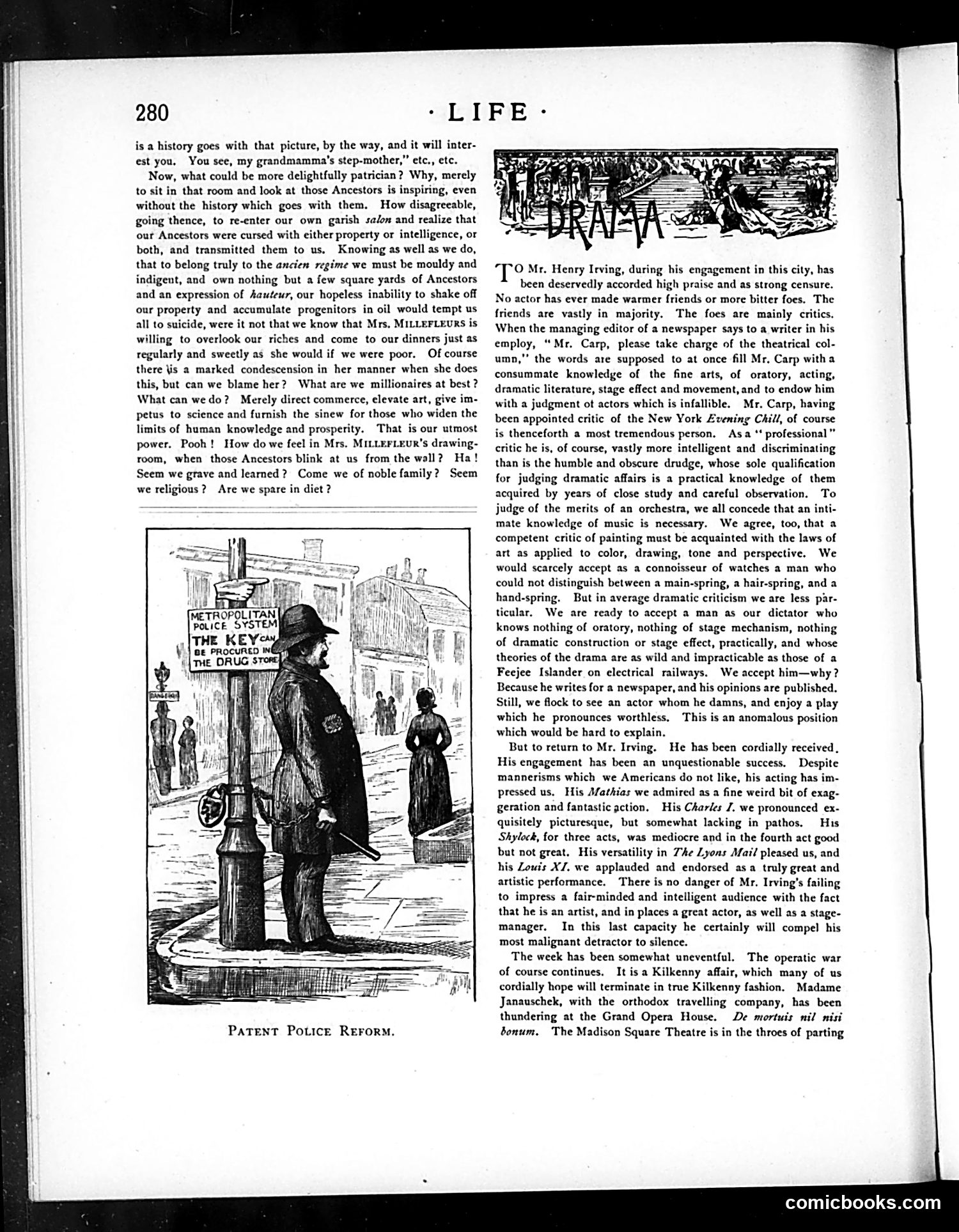
This cartoon satirizes proposed reforms to police systems, likely in New York City. The illustration shows a uniformed police officer operating what appears to be a mechanical or bureaucratic system, with the caption "PATENT POLICE SYSTEM" visible. The satire critiques the idea that policing can be mechanized or systematized like a patent—suggesting that reducing police work to rigid, formulaic procedures ignores the judgment and discretion required for effective law enforcement. The accompanying text discusses theatrical criticism, but the cartoon's point is clear: reformers proposing to "patent" or standardize police procedures are oversimplifying complex human work, much like accepting newspaper critics with no actual expertise in drama.
📄 Transcribed text from this page (OCR, searchable)
Machine-transcribed from the original scan — historical spelling and the odd misread are preserved.
280 is a history goes with that picture, by the way, and it will inter- est you. You see, my grandmamma’s step-mother,” etc,, etc. Now, what could be more delightfully patrician? Why, merely to sit in that room and look at those Ancestors is inspiring, even without the history which goes with them. How disagreeable, going thence, to re-enter our own garish sa/on and realize that our Ancestors were cursed with either property or intelligence, or both, and transmitted them to us. Knowing as well as we do, that to belong truly to the ancien regime we must be mouldy and indigent, and own nothing but a few square yards of Ancestors and an expression of Aauteur, our hopeless inability to shake off our property and accumulate progenitors in oil would tempt us all to suicide, were it not that we know that Mrs, MILLEFLEURS is willing to overlook our riches and come to our dinners just as regularly and sweetly as she would if we were poor. Of course there \is a marked condescension in her manner when she does this, but can we blame her? What are we millionaires at best ? What can wedo? Merely direct commerce, elevate art, give im- petus to science and furnish the sinew for those who widen the limits of human knowledge and prosperity. That is our utmost power. Pooh! How do we feel in Mrs. MILLEFLEUR’s drawing- room, when those Ancestors blink at us from the wall? Ha! Seem we grave and learned? Come we of noble family? Seem we religious? Are we spare in diet ? TT ROPOLITAN METRO eM POLICE SYST! Patent Potice REFORM. - LIFE: “TO Mr. Henry Ieving, during his engagement in this city, has been deservedly accorded high praise and as strong censure. No actor has ever made warmer friends or more bitter foes. The friends are vastly in majority. The foes are mainly critics. When the managing editor of a newspaper says to a writer in his employ, “Mr. Carp, please take charge of the theatrical col- umn,"’ the words are supposed to at once fill Mr, Carp witha consummate knowledge of the fine arts, of oratory, acting, dramatic literature, stage effect and movement, and to endow him with a judgment ot actors which is infallible. Mr. Carp, having been appointed critic of the New York Evening Chill, of course is thenceforth a most tremendous person, Asa ‘‘ professional” critic he is, of course, vastly more intelligent and discriminating than is the humble and obscure drudge, whose sole qualification for judging dramatic affairs is a practical knowledge of them acquired by years of close study and careful observation. To judge of the merits of an orchestra, we all concede that an inti- mate knowledge of music is necessary. We agree, too, that a competent critic of painting must be acquainted with the laws of art as applied to color, drawing, tone and perspective. We would scarcely accept as a connoisseur of watches a man who could not distinguish between a main-spring, a hair-spring, and a hand-spring. But in average dramatic criticism we are less par- ticular, We are ready to accept a man as our dictator who knows nothing of oratory, nothing of stage mechanism, nothing of dramatic construction or stage effect, practically, and whose theories of the drama are as wild and impracticable as those of a Feejee Islander on electrical railways. We accept him—why ? Because he writes for a newspaper, and his opinions are published. Still, we flock to see an actor whom he damns, and enjoy a play which he pronounces worthless, which would be hard to explain. But to return to Mr. Irving. He has been cordially received, His engagement has been an unquestionable success. Despite mannerisms which we Americans do not like, his acting has im- pressed us. His Mathias we admired asa fine weird bit of exag- geration and fantastic action. His Charles J. we pronounced ex- quisitely picturesque, but somewhat lacking in pathos. His Shylock, for three acts, was mediocre and in the fourth act good but not great, His versatility in Zhe Lyons Mail pleased us, and his Louis XZ. we applauded and endorsed asa truly great and artistic performance. There is no danger of Mr. Irving's failing to impress a fair-minded and intelligent audience with the fact that he is an artist, and in places a great actor, as well as a stage- manager. In this last capacity he certainly will compel his most malignant detractor to silence. The week has been somewhat uneventful. The operatic war of course continues, It is a Kilkenny affair, which many of us cordially hope will terminate in true Kilkenny fashion. Madame Janauschek, with the orthodox travelling company, has been thundering at the Grand Opera House. bonum. This is an anomalous position De mortuis nil nisi The Madison Square Theatre is in the throes of parting comicbooks.com