
A complete issue · 16 pages · 1883
Life — July 12, 1883
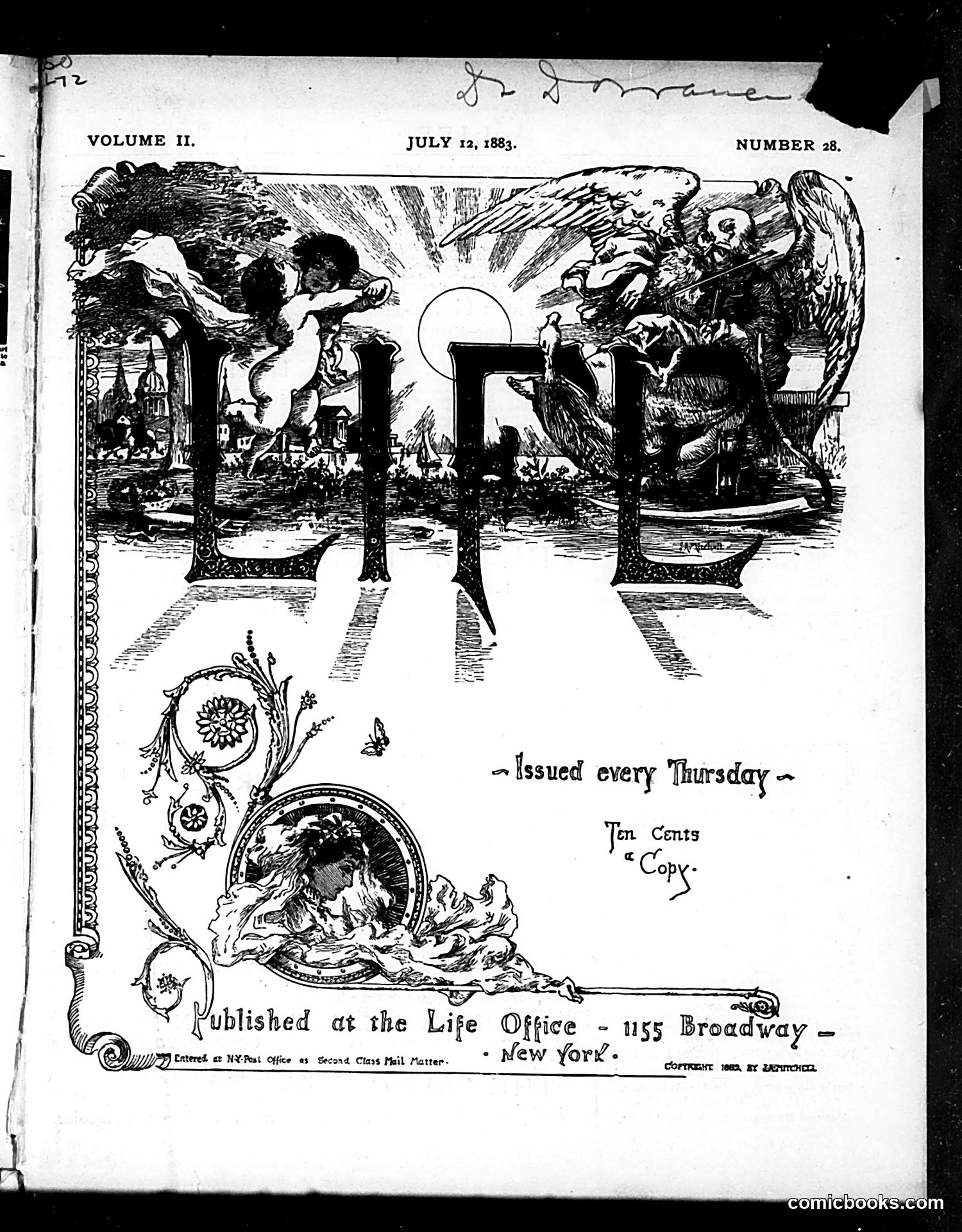
This is the cover page of Life magazine's second volume, number 28. The large decorative letters "LIFE" dominate the center, with an ornate allegorical engraving above featuring cherubs, classical figures, and celestial imagery—typical Victorian aesthetic styling for a publication's masthead. The specific satirical content or political cartoon referenced in this particular issue is unclear from this cover alone. The ornamental design suggests this is primarily a title/publication page rather than displaying editorial commentary. The masthead indicates Life was published weekly at 1155 Broadway in New York, costing ten cents per copy. Without additional text or clearer details, the intended satire or social commentary of this specific issue cannot be definitively identified.
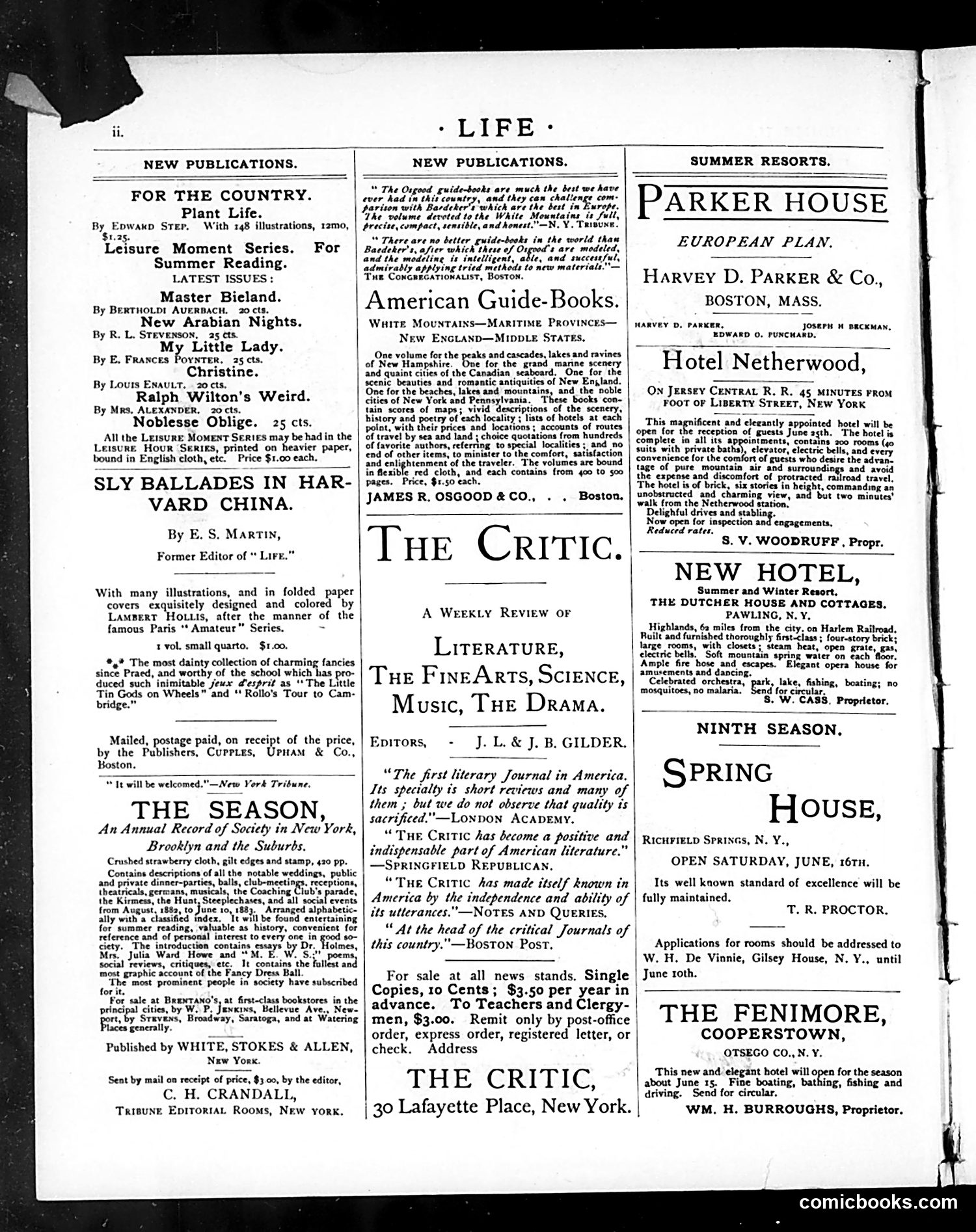
This page from *Life* magazine is **primarily advertising and editorial content** rather than political cartoons or satire. The left column advertises books for summer reading, including titles by Edward Stef and E.S. Martin. The center features advertisements for *American Guide-Books* and *The Critic*, a weekly literary review edited by J.L. & J.B. Gilder. The right side advertises summer resorts: Parker House (Boston), Hotel Netherwood (New Jersey), a new hotel near Darling, N.Y., and Spring House in Richfield Springs. **No political cartoons or satirical imagery are visible** on this page. The content reflects late 19th-century American publishing and leisure culture, with emphasis on literary journals and vacation destinations for the educated classes.
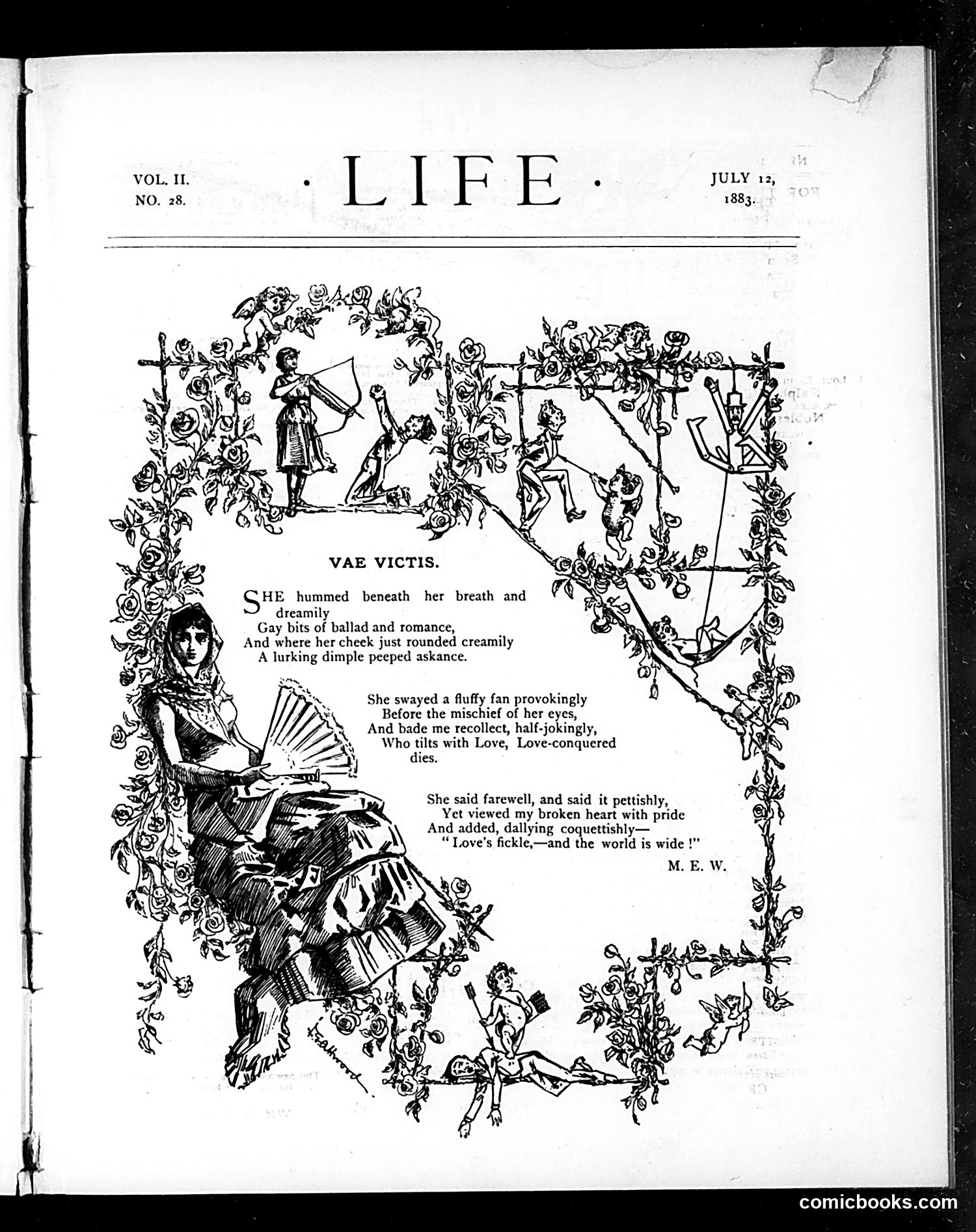
This page presents a poem titled "Vae Victis" (Latin: "Woe to the Vanquished") depicting a woman in an elaborate dress holding a fan, surrounded by decorative cherubs and floral borders. The ornamental frame contains romantic imagery—cupids, crosses, and classical figures engaged in various activities. The poem describes a flirtatious woman who dismisses her suitor's romantic devotion with lighthearted cruelty, ending with her parting words: "Love's fickle,—and the world is wide!" This appears to be social satire targeting 1880s courtship customs and female autonomy. The elaborate, ornate presentation mocks the romanticized idealization of women while simultaneously portraying female independence—the woman casually rejecting love's constraints. The satire likely comments on changing gender dynamics of the period.
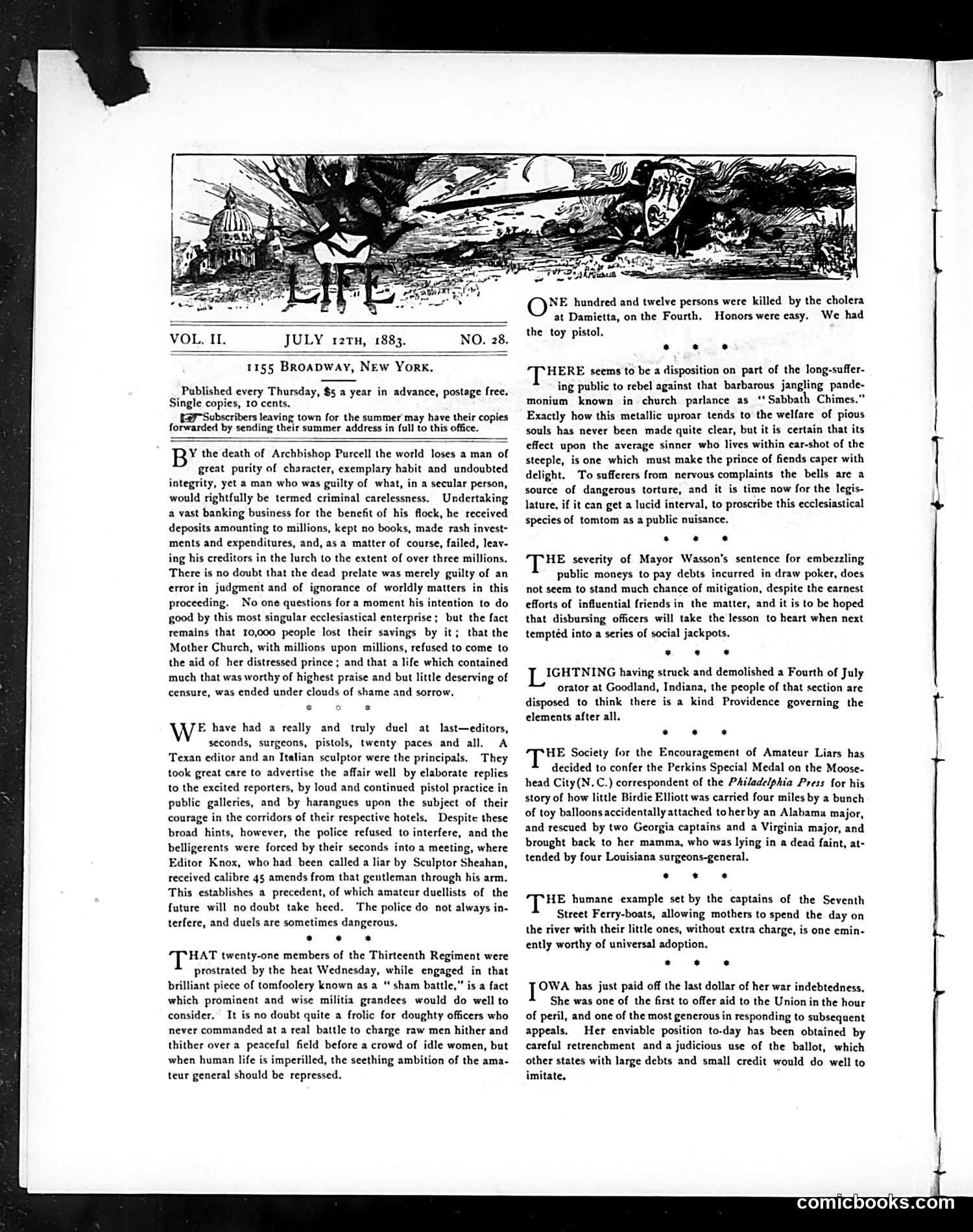
The woodcut illustration at the top depicts a nighttime scene with a skeletal Death figure sitting in a chair, overlooking a landscape with a domed building (likely St. Paul's Cathedral in London). This appears to be political satire about Archbishop Purcell's death, discussed in the left column text. The article describes Purcell as a man of "great piety" who was nonetheless "guilty of what, in a secular person, would rightfully be termed criminal carelessness." He apparently lost massive deposits for his church through banking mismanagement—over three million dollars. The satire criticizes both his poor financial judgment and the Church's refusal to aid distressed creditors, despite holding millions in assets. The Death imagery suggests the moral reckoning accompanying the scandal.
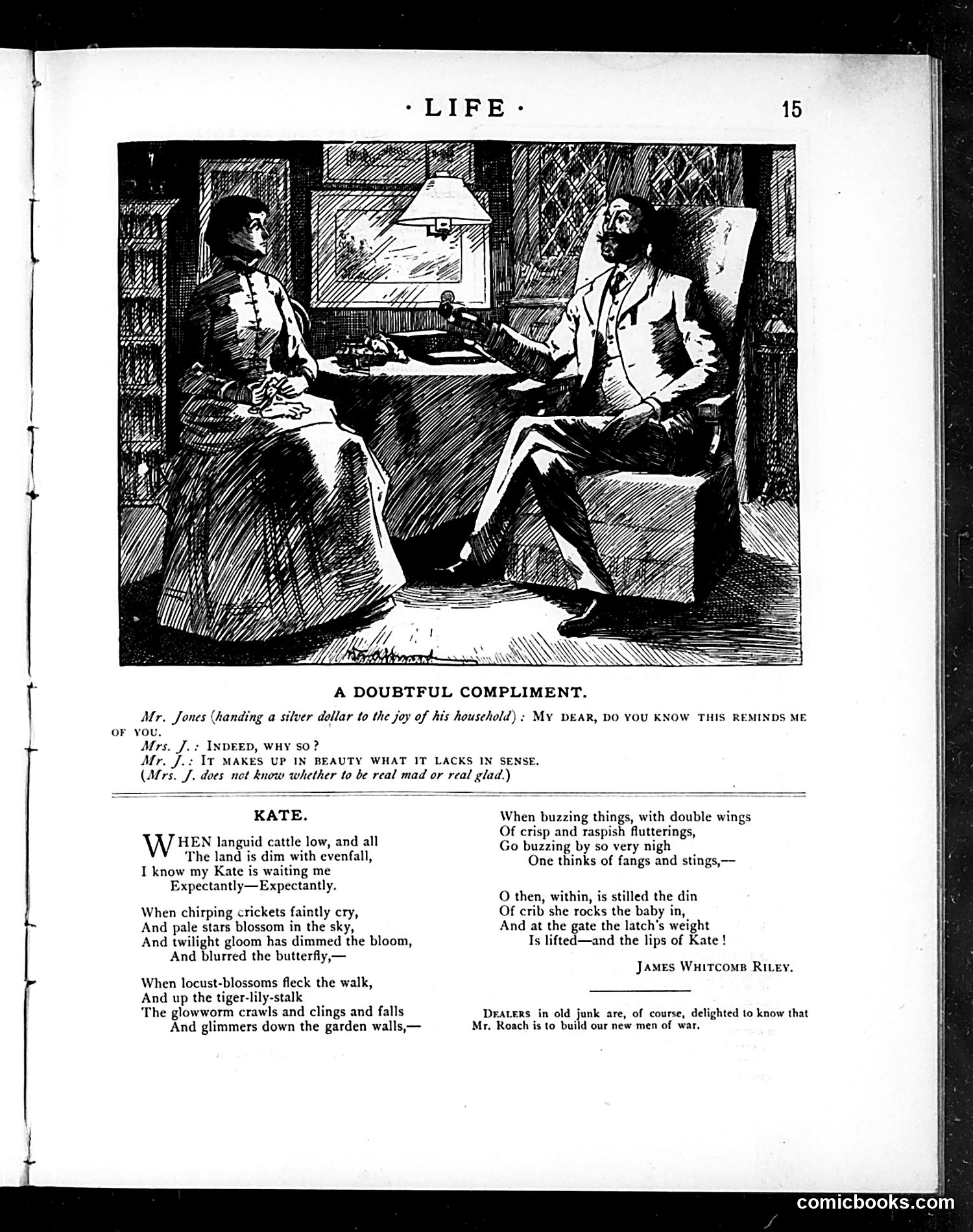
**The Cartoon:** A man (Mr. Jones) hands a silver dollar to a woman while making a compliment. She responds that it "reminds me of you" because it "makes up in beauty what it lacks in sense." The humor relies on the woman's backhanded insult—she's calling the man beautiful but stupid, disguised as flattery. The note clarifies Mrs. Jones doesn't know if she's genuinely angry or joking, adding to the satire of domestic interactions and unclear feminine intent—a common theme in early 20th-century humor about marriage dynamics. **The Poetry Section:** Below is a sentimental poem titled "Kate" by James Whitcomb Riley, and a brief note about wartime manufacturing, likely from WWI era based on the reference to "new men of war."
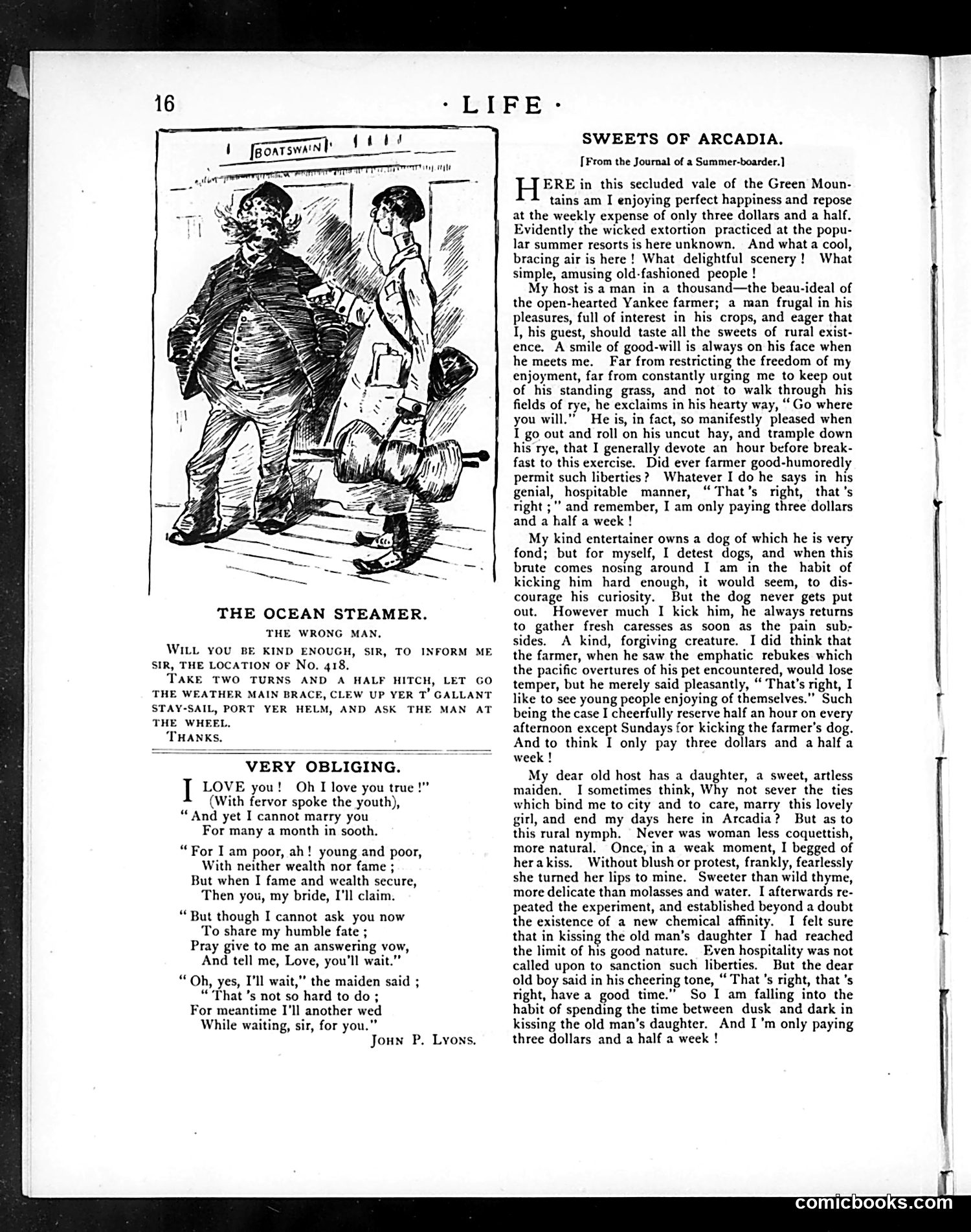
**"The Ocean Steamer"** cartoon depicts a passenger asking a ship's officer for directions, using nautical humor. The joke relies on the passenger's verbose politeness ("Will you be kind enough, sir, to inform me...") contrasted with the officer's terse response about taking "two turns and a half hitch" to reach the wheel—treating navigation instructions like rope-tying. This is gentle wordplay mocking overly formal Victorian manners and nautical jargon rather than political satire. **"Sweets of Arcadia"** is a prose piece satirizing rural farm life, presented ironically. A city visitor claims to enjoy "perfect happiness" at a farmer's modest home, but the humor emerges from his contradictions: he pays only $3.50 weekly while romanticizing rustic simplicity, yet admits kicking the farmer's dog and kissing his daughter without permission—revealing the visitor's actual entitlement despite professed respect for rural life.
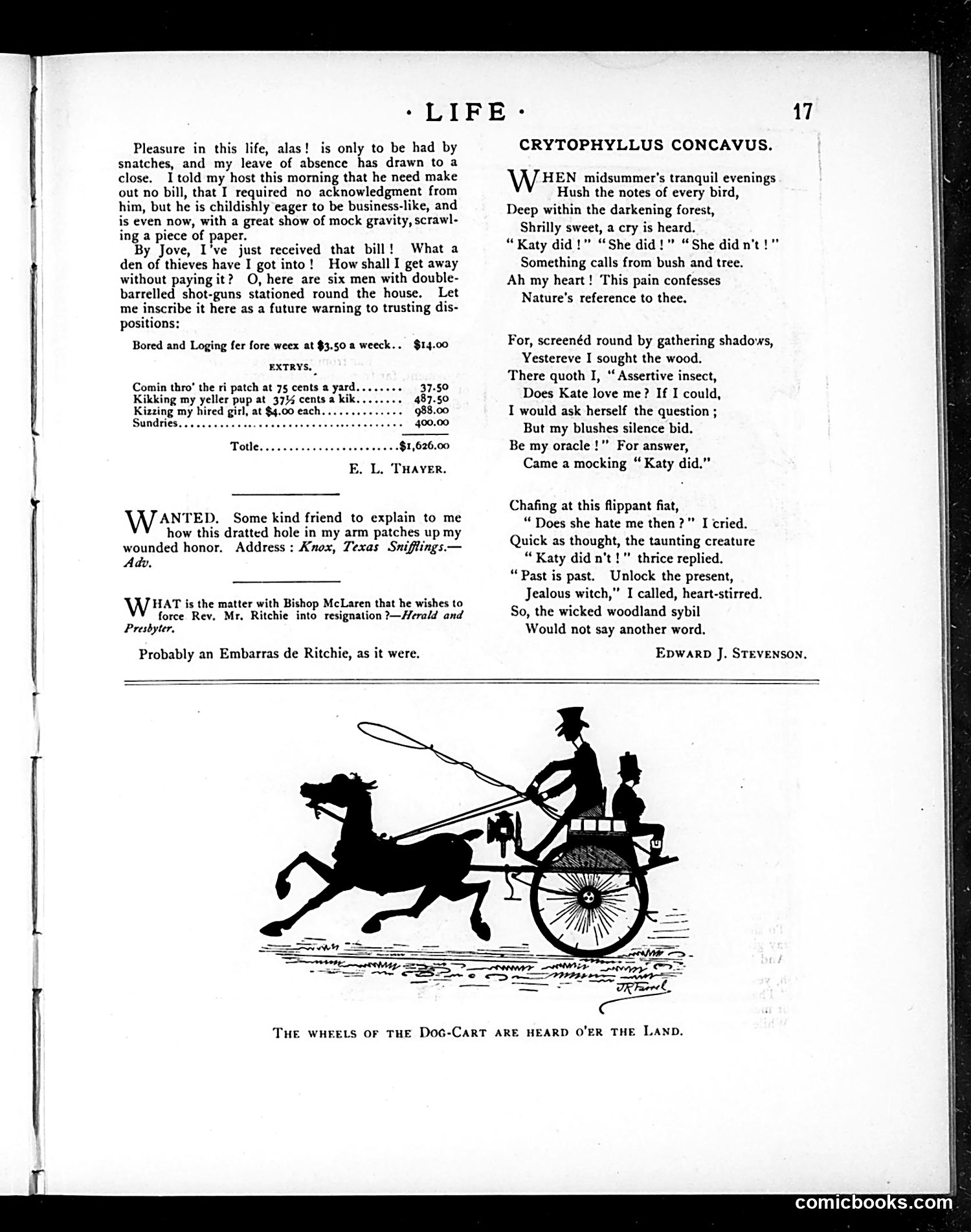
This page contains a poem titled "Crytophyllus Concavus" by Edward J. Stevenson about unrequited love in nature—a man listening to bird calls, interpreting them as a mocking "Katy did" comment about his beloved Kate rejecting him. The illustration below depicts a dog-cart (a light carriage pulled by a horse rather than dogs, despite the name) with two well-dressed figures. The caption "The wheels of the dog-cart are heard o'er the land" appears to be a humorous aside, possibly a brief satirical comment, though its specific reference is unclear from context alone. The upper section contains miscellaneous short items including personal ads and brief social commentary typical of Life's satirical format.
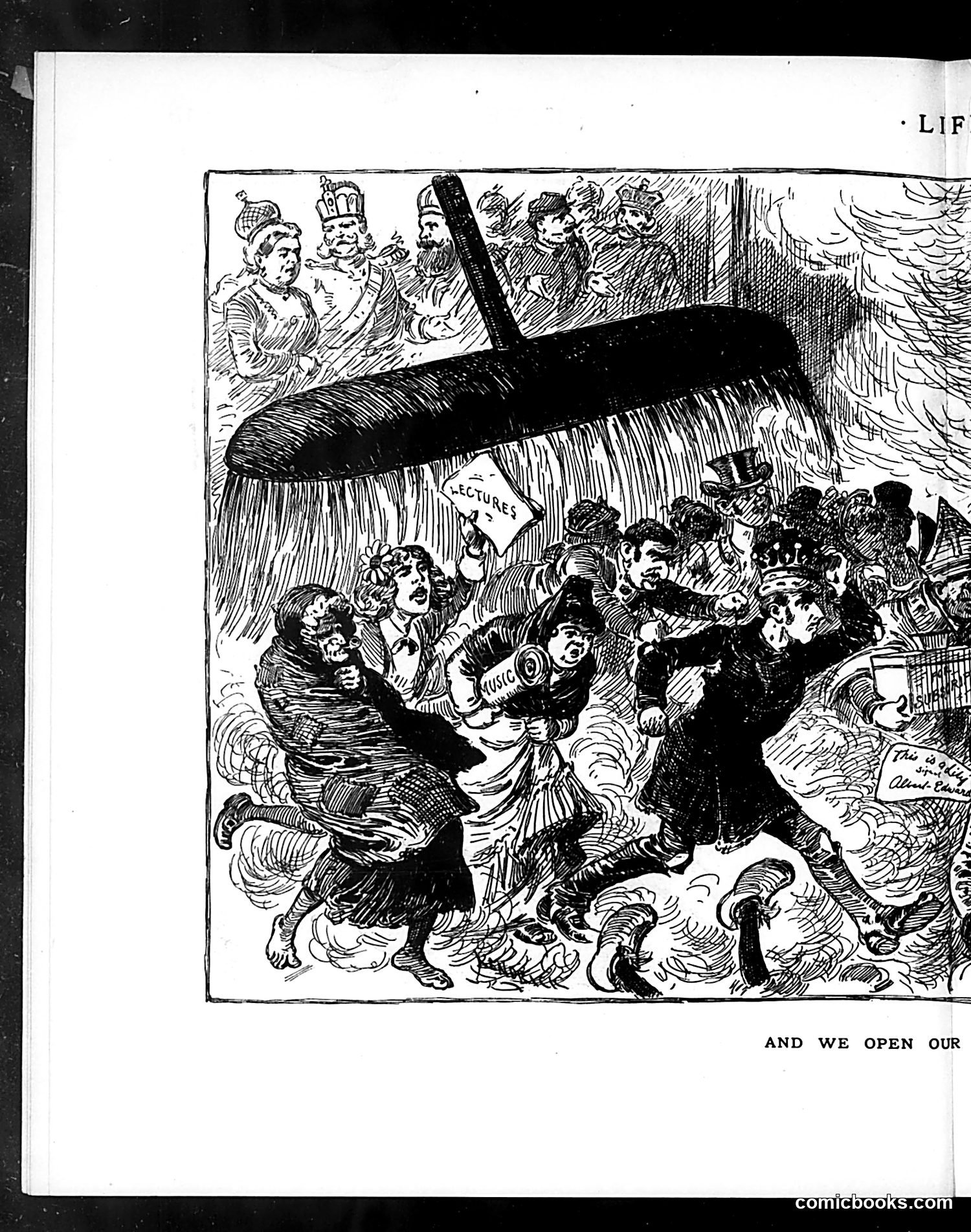
This satirical illustration depicts a massive submarine labeled "LECTURES" descending upon a crowd of people in apparent panic or distress. The crowd scatters in chaos below, while figures in formal dress observe from above. The cartoon appears to satirize the anxiety surrounding submarine warfare, likely from the World War I era when German U-boat attacks caused public fear. However, the "LECTURES" label suggests the satire targets something else: possibly the tedium or overwhelming nature of mandatory public lectures or educational campaigns—using submarine warfare imagery to exaggerate their perceived threat to social life. The caption reads "AND WE OPEN OUR" (text cut off), but without the complete text, the precise intended critique remains unclear.
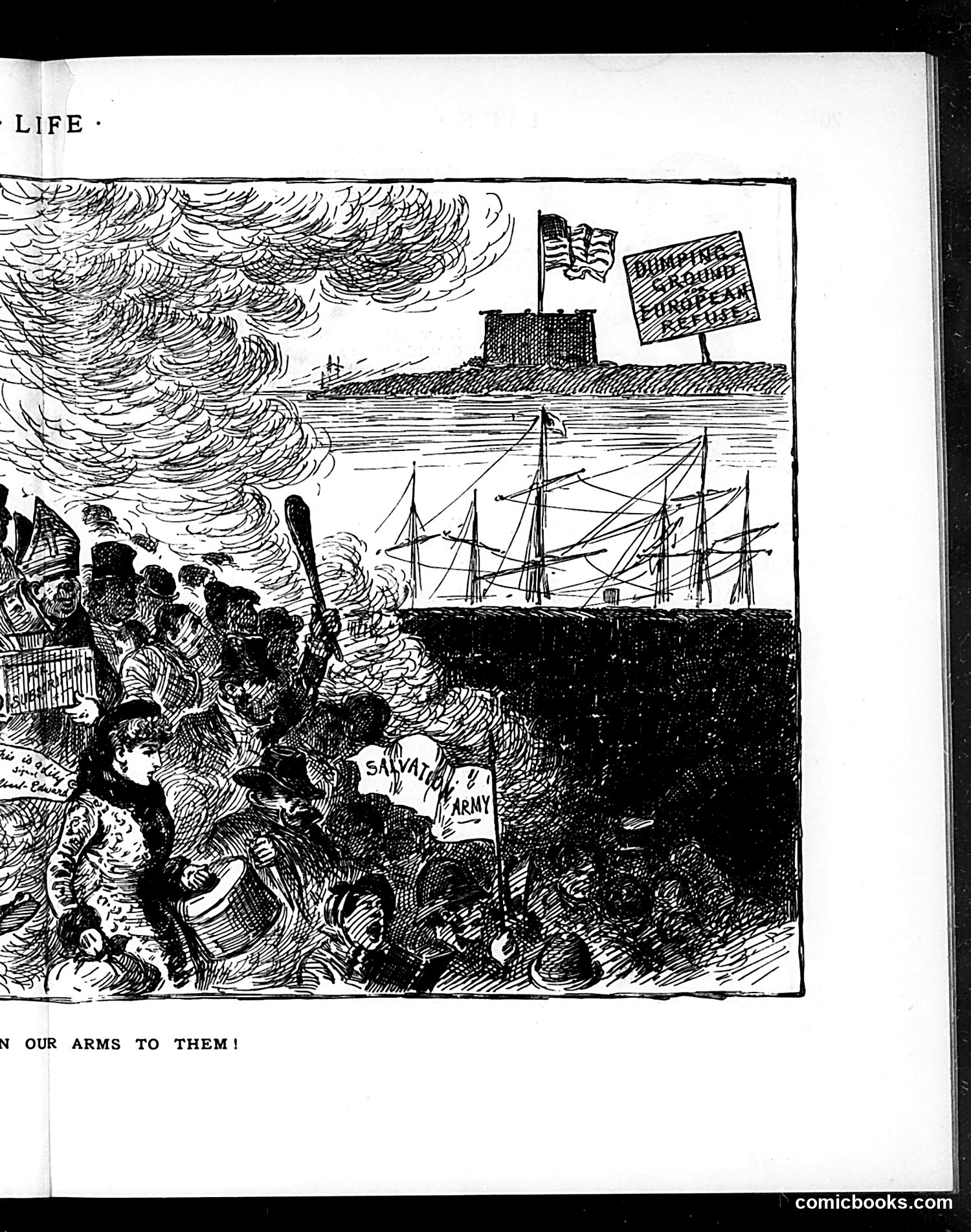
This is a World War I-era satirical cartoon from *Life* magazine. The image depicts a large crowd of people on the left shore watching ships in harbor, with a fort flying flags in the background. A flag labeled "SALVATION ARMY" is visible among the crowd. The caption reads "...ON OUR ARMS TO THEM!" (partially visible). The cartoon appears to satirize either the Salvation Army's war relief efforts or public enthusiasm for supporting troops. The dense crowd and dramatic smoke/fire imagery suggest commentary on civilian mobilization or charitable giving during wartime. The specific point of satire—whether praising or mocking the Salvation Army's involvement—is unclear from the visible text alone, though the crowded, energetic scene suggests public sentiment around military support organizations.
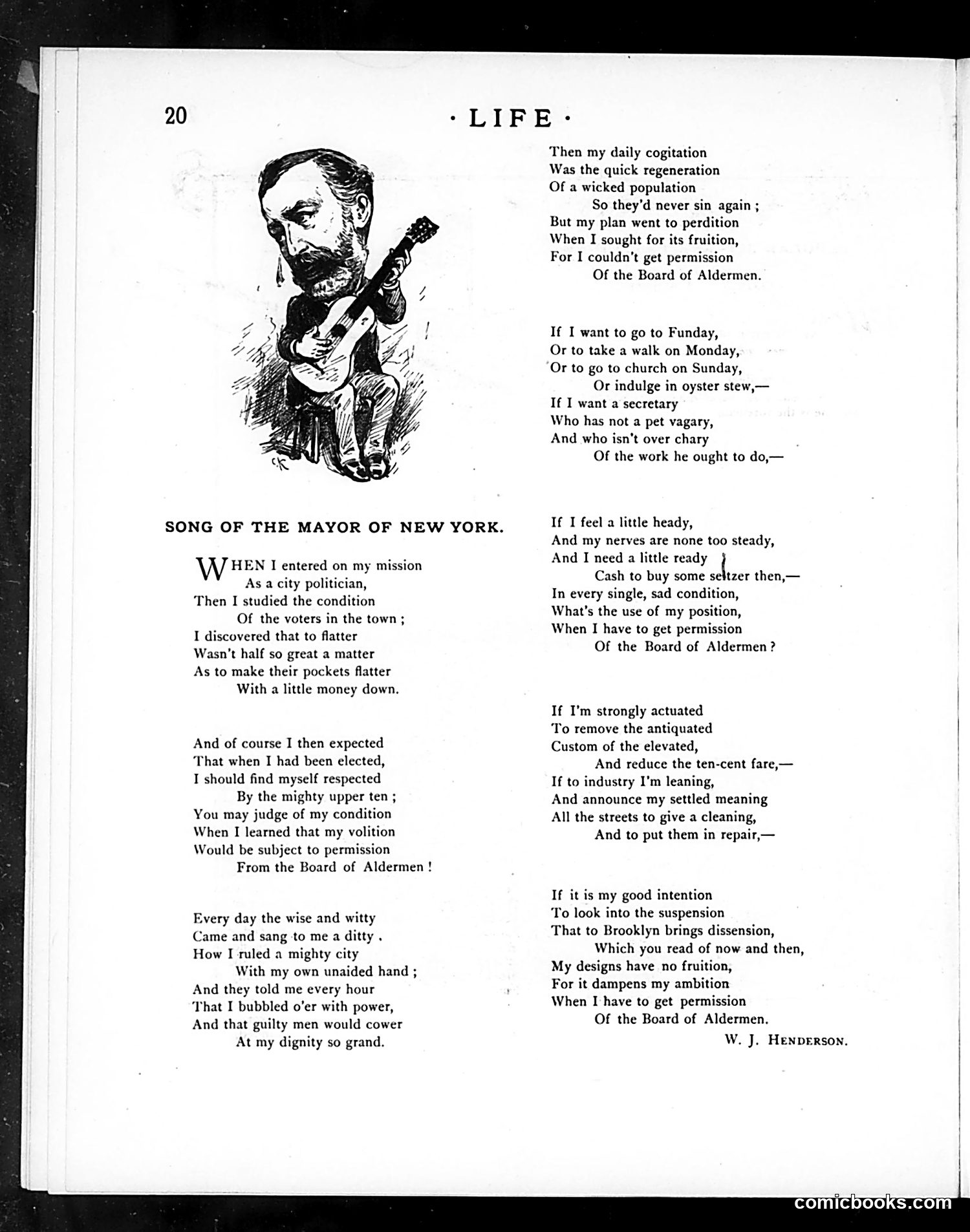
This satirical poem lampoons the **Mayor of New York's** powerlessness despite his office. The cartoon depicts a bearded man (the mayor) holding a guitar, illustrating his impotence: he's reduced to singing complaints rather than governing. The satire's target is the **Board of Aldermen**, who hold actual power over the mayor's decisions—from personal activities (going to church, buying seltzer) to major municipal reforms (elevated train fares, street cleaning, Brooklyn infrastructure). The recurring refrain "I have to get permission / Of the Board of Aldermen" underscores his frustration. The joke critiques **municipal government structure**: despite being elected mayor, he's subordinate to an appointed board, making his position ceremonial rather than executive. His grand ambitions for reform—moral regeneration of the population, modernizing transit—are blocked by bureaucratic obstruction. This reflects real tensions in **Gilded Age New York politics**, where aldermen often controlled city resources and resisted reform efforts, leaving mayors as figureheads. The satire exposes how formal authority doesn't guarantee actual power to implement change.
This page contains a mock educational dialogue ("Popular Science Catechism") satirizing the jury system's failures. The cartoon at the top depicts jurors as dim-witted "loafers," with the foreman characterized as the most ignorant among them—selected precisely because he knows the least. The satire exposes systematic corruption: lawyers distract with tobacco and witness abuse while judges and jurors nap; jurors hear neither evidence nor law; they pass verdict time playing poker; and "fixed" juries deliver verdicts satisfactory only to whoever bribed them. The dialogue ends by directing readers seeking jury information to Robert Ingersoll, a famous agnostic orator known for criticizing corruption. The piece mocks not just juror incompetence but the entire legal apparatus's complicity in perverting justice through bribery and indifference.
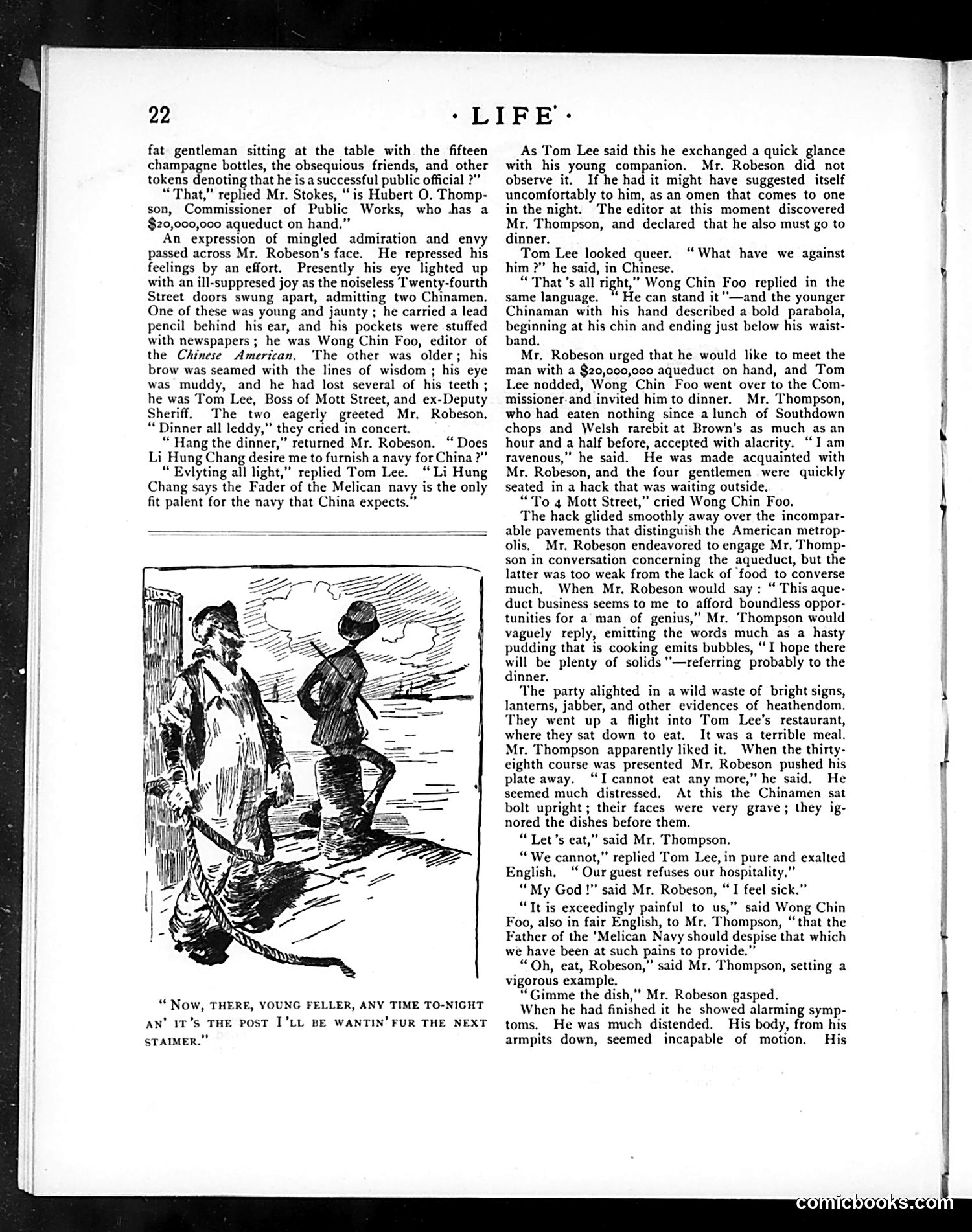
This page satirizes late-19th-century American political corruption and anti-Chinese sentiment. Mr. Robeson (likely Secretary of the Navy) seeks favor from Commissioner Thompson, who oversees a massive $20 million aqueduct project—suggesting graft and patronage networks among public officials. The introduction of Wong Chin Foo (a real Chinese-American editor) and Tom Lee (a Chinatown boss) signals the story's satirical pivot. Their exchange in Chinese and knowing glance implies a scheme: they're setting up Thompson for something sinister. The "parabola" gesture suggests violence or elimination. The subsequent terrible dinner at a Chinatown restaurant appears designed to humiliate or harm Thompson. The satire mocks both corrupt American politicians and plays on period xenophobic fears about Chinese immigrants as dangerous "others" capable of conspiracies against white authority figures. The illustration reinforces this: two menacing Chinese men confronting a Caucasian figure in shadow, evoking contemporary "Yellow Peril" anxieties.
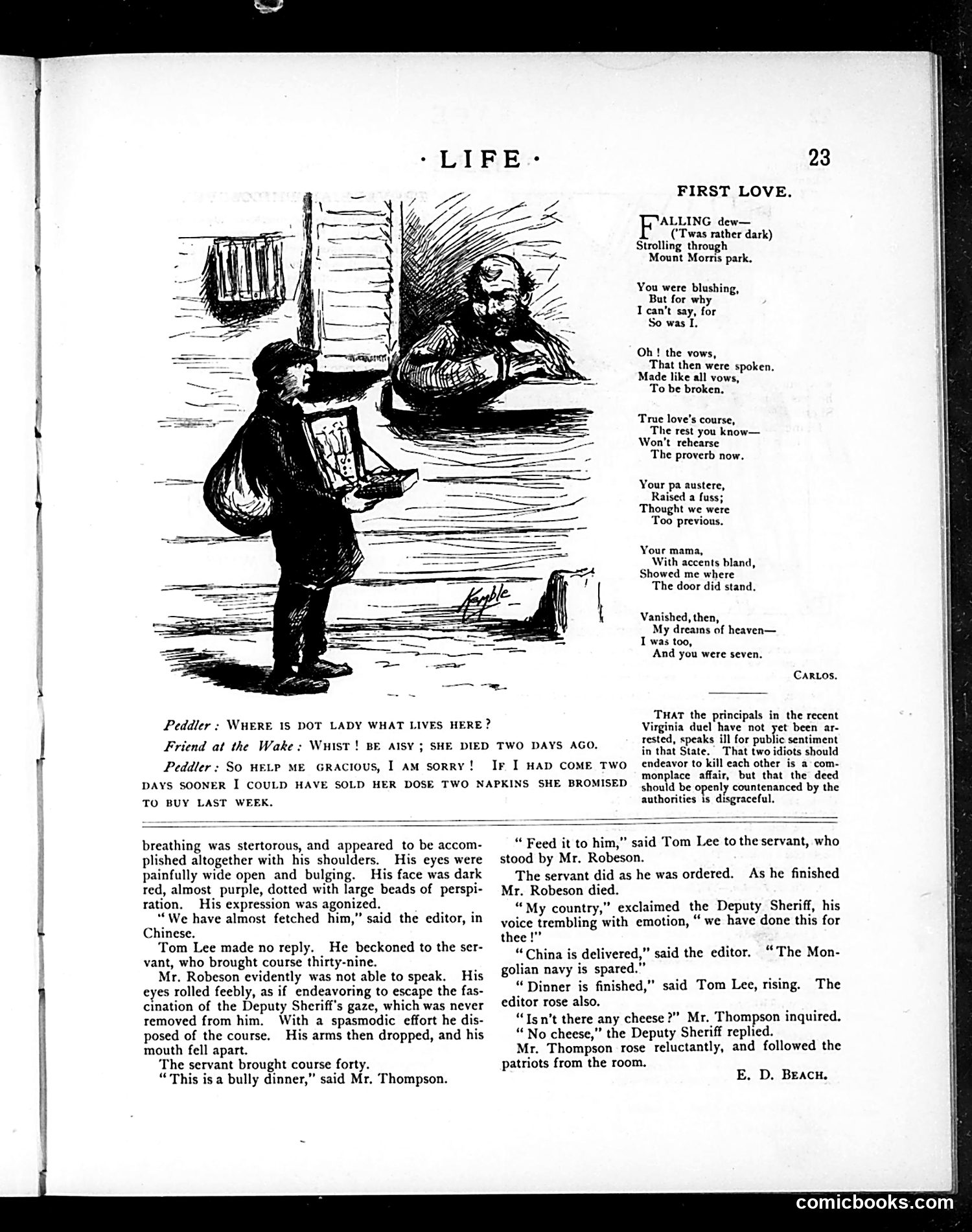
This page contains two satirical pieces: **The Peddler Cartoon** (top): A dark joke about an Irish peddler arriving at a wake two days too late. He's frustrated because the deceased woman had promised to buy napkins from him the previous week—he missed his sale. The humor relies on callous indifference to death and ethnic stereotyping (the peddler's dialect marks him as Irish immigrant). **"First Love" Poem** (right): A sentimental verse about childhood romance in Mount Morris Park (Harlem), where the narrator and his love interest were both children—he old enough to blush, she only seven years old. While presented romantically, this normalizes what modern readers recognize as deeply inappropriate. **The Longer Story** (bottom): A satirical account of a competitive dinner where men force-feed a character named Robeson until he dies, framed as patriotic service to "China" and "Mongolia." It's absurdist political satire, likely mocking contemporary events or figures (unclear without more context). All pieces reflect the magazine's irreverent, often tasteless humor conventions of the era.
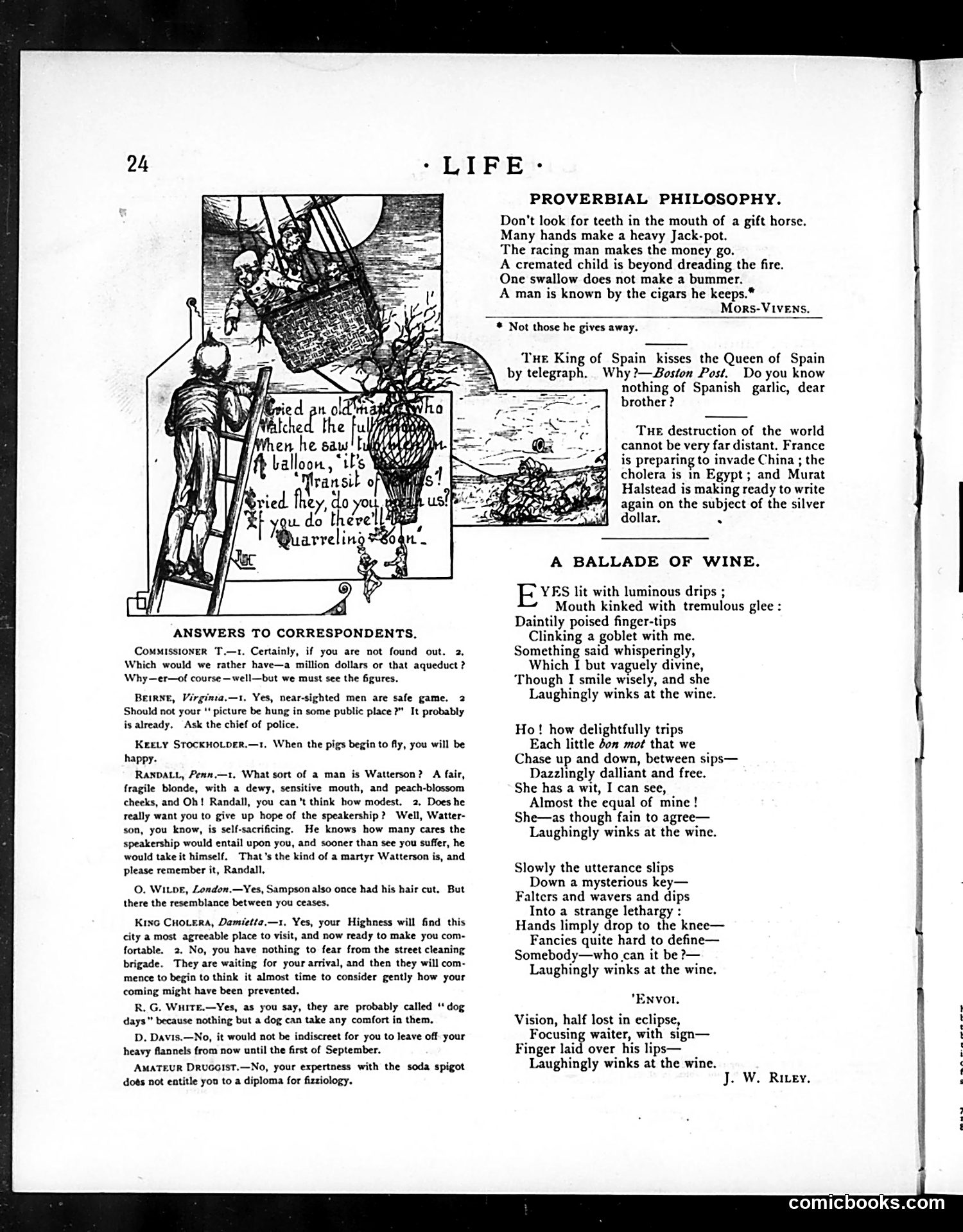
This page from *Life* magazine contains satirical "Answers to Correspondents"—humorous fake advice columns mocking contemporary figures and issues. The cartoon depicts an old man suspended in a basket, apparently referencing the Keely Motor—a notorious perpetual motion machine scam of the era. The "Keely Stockholder" question jokes that investors will be happy "when the pigs begin to fly," mocking the device's fraudulent promises. The correspondents section lampoons named individuals: "Watterson" (likely Henry Watterson, Kentucky editor) is sarcastically described as self-sacrificing; "King Cholera" in Egypt references actual cholera outbreaks; and "Murat Halstead" was a real journalist frequently mocked for his silver-dollar advocacy. The "Proverbial Philosophy" section offers dark-humored parodies of proverbs (e.g., "A cremated child is beyond dreading the fire"), while a brief gag about the Spanish king and queen kissing by telegraph plays on new telegraph technology. The page also includes a poem about wine and flirtation, typical of *Life's* lighter content.
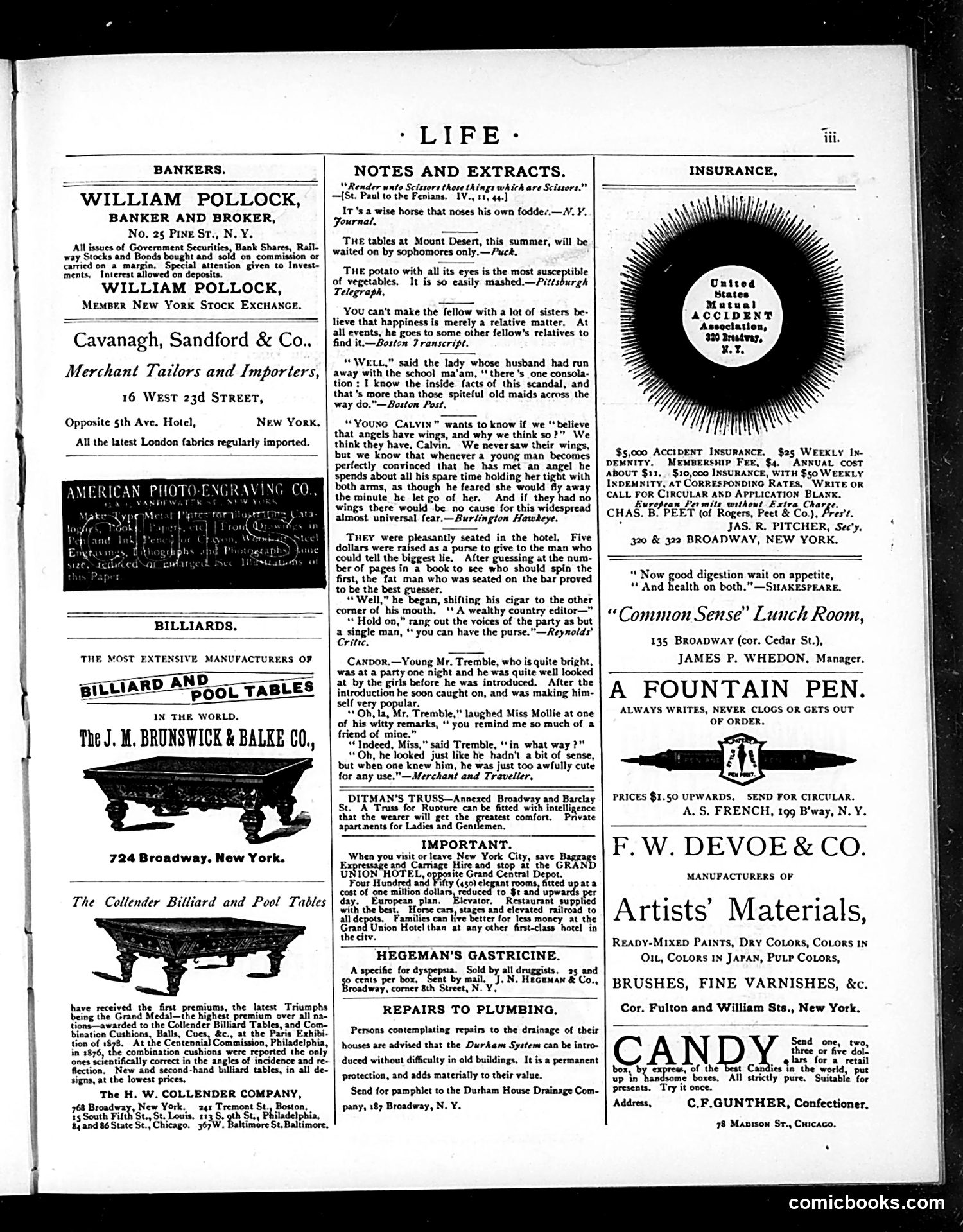
This page is primarily **advertising and satirical humor**, not political cartooning. The advertisements occupy most of the space (billiard tables, banking services, tailors, insurance). The "Notes and Extracts" section contains brief satirical jokes and observations typical of 19th-century humor magazines: - Jokes about potatoes being "mashed," horses eating fodder, and siblings' relationships play on wordplay and puns - A humorous anecdote mocks a woman whose husband eloped with a schoolteacher, finding dark comfort in knowing scandal details - A piece about young men becoming convinced they've met "angels" (attractive women) and holding them tightly, joking that angels must have wings or men wouldn't fear them flying away - A tall-tale contest where a country editor wins by simply beginning his story—implying editors are inherently untrustworthy liars These represent genteel Victorian-era humor: domestic situations, mild social criticism, and wordplay rather than sharp political satire.
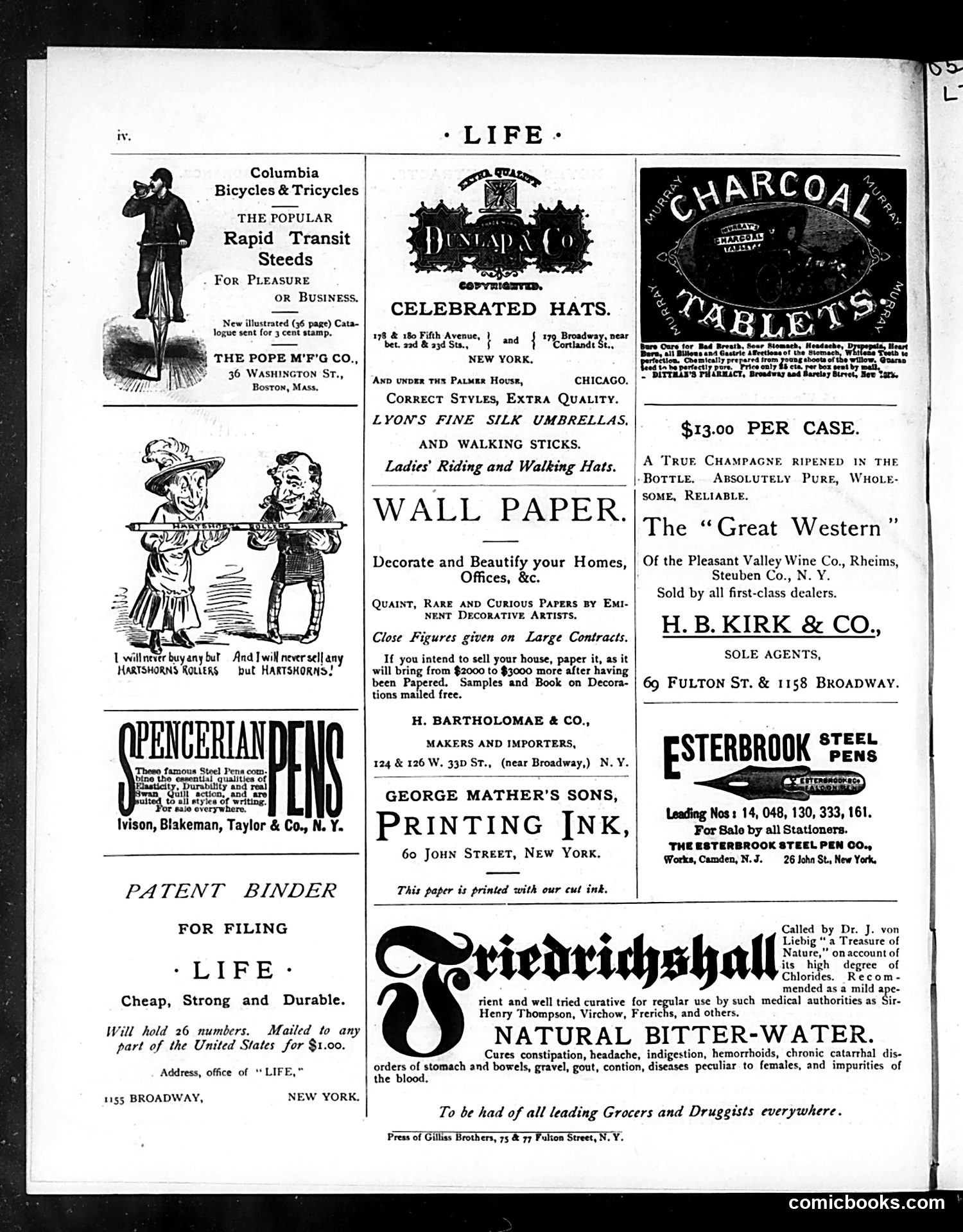
This is primarily an **advertising page** with one notable political cartoon. The main satirical content is the small cartoon showing two figures arguing over rollers, captioned "I will never buy any but Hartshorns Rollers" and "And I will never sell any but Hartshorns!" This appears to be **mock advertising satire**—Life is ridiculing Hartshorns Rollers through exaggerated testimonial claims. The cartoon suggests both buyer and seller are absurdly fanatical about the product, implying the brand's marketing rhetoric is overwrought and unconvincing. The rest of the page consists of genuine period advertisements for bicycles, hats, wallpaper, pens, champagne, printing ink, and patent medicine ("Friedrichshall Natural Bitter-Water"), typical of 1880s-90s Life magazine. These ads reflect contemporary consumer culture and product positioning, with claims about quality and efficacy that would raise modern eyebrows (particularly the medical remedy). The page is primarily **commercial content rather than political satire**.