
A complete issue · 16 pages · 1883
Life — July 5, 1883
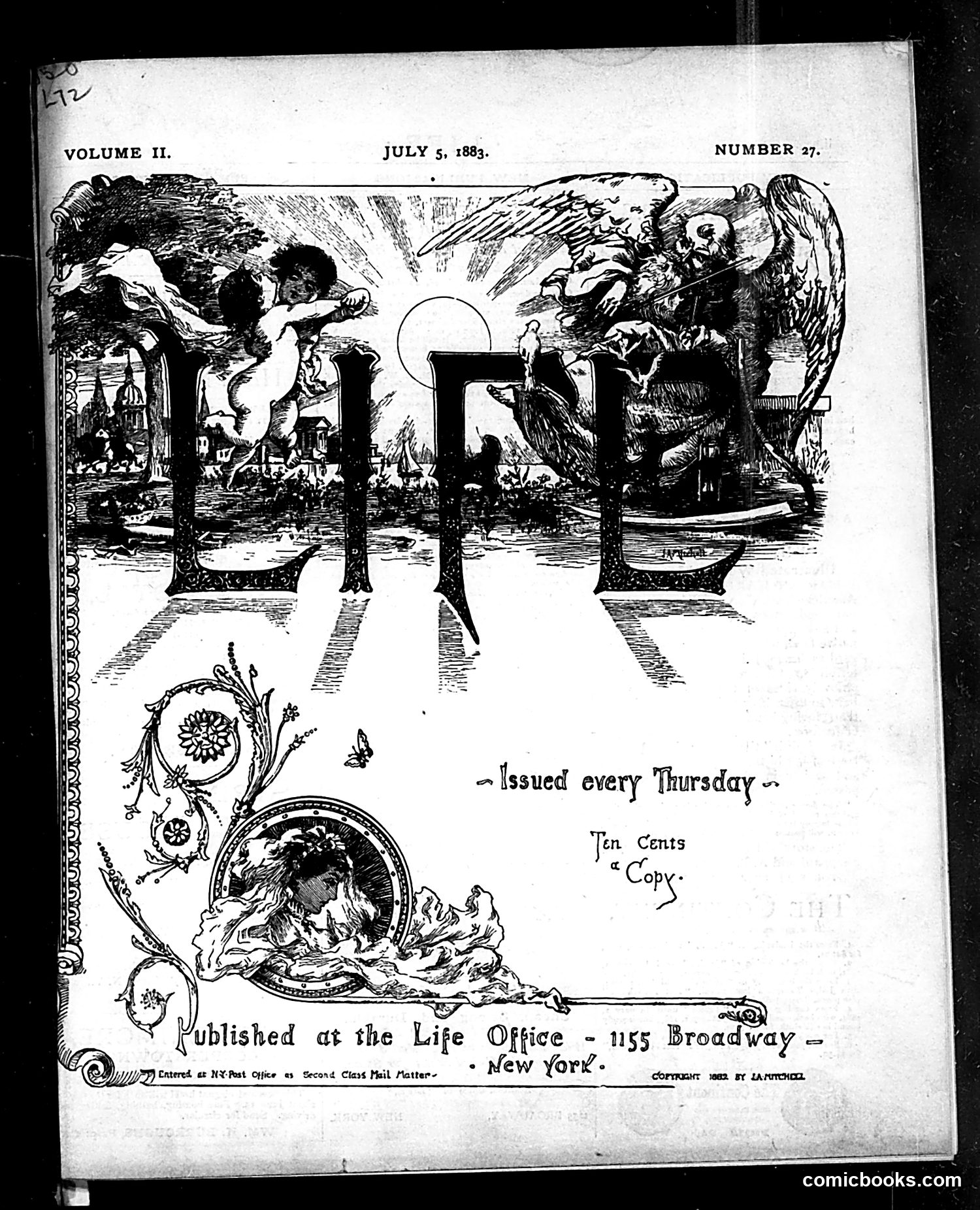
This is the cover of Life magazine's second volume, number 27. The central illustration depicts classical or mythological figures (appearing to be allegorical demons or devils) overlooking a hellish landscape with fire and destruction. Large letters spelling "LIFE" dominate the foreground, rendered as architectural columns or barriers. The specific political or social satire is unclear without additional context about July 1883 events. The infernal imagery suggests commentary on contemporary social turmoil or moral decay, but the exact target—whether political figures, social movements, or institutions—cannot be definitively identified from the image alone. The ornate art nouveau styling and ten-cent price reflect the magazine's status as a premium illustrated publication of that era.
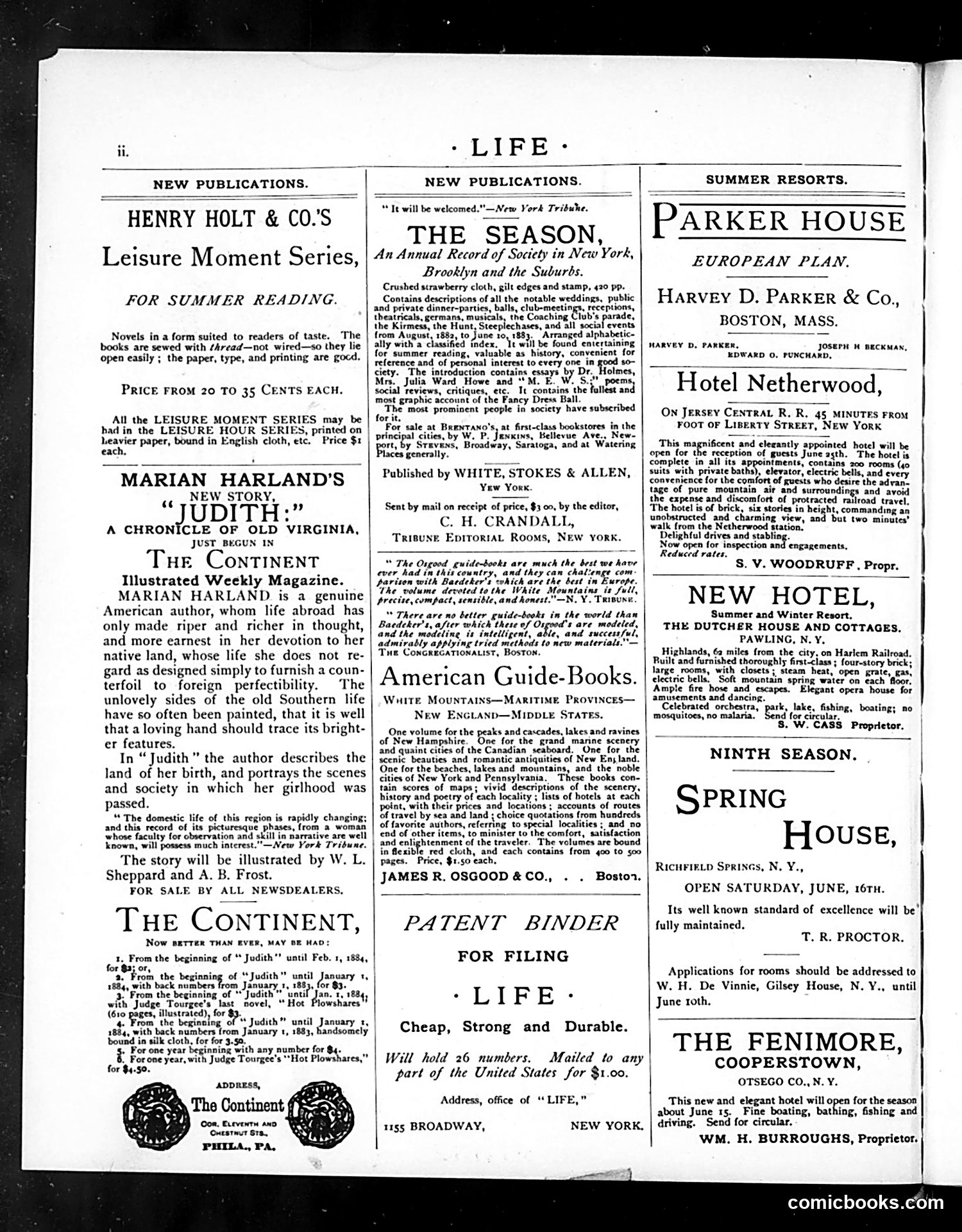
This page is **primarily advertising**, not satirical content. It shows three columns of commercial announcements from what appears to be a late 19th-century issue of *Life* magazine. The ads promote: - **Left**: Henry Holt & Co.'s "Leisure Moment Series" books and Marian Harland's novel *Judith* (illustrated by Sheppard and Frost) - **Center**: *The Season*, a social record of New York society, and American Guide-Books for tourists - **Right**: Summer resort hotels including Parker House (Boston), Hotel Netherwood (New Jersey), Spring House (Richfield Springs), and The Fenimore (Cooperstown) There are **no political cartoons** visible. The page reflects the magazine's dual function as both satirical publication and advertising medium for upscale readers interested in literature, travel, and leisure activities.
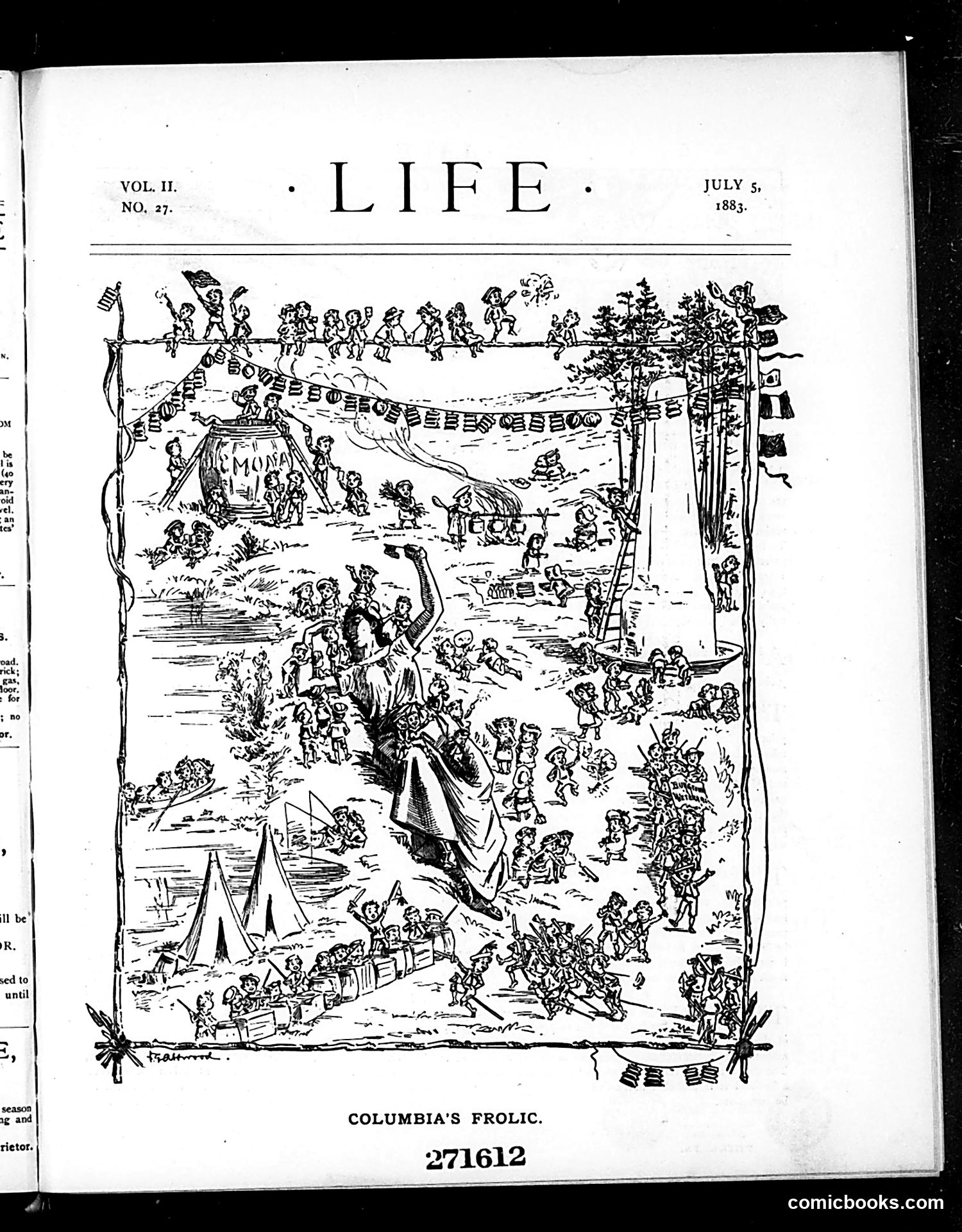
This satirical illustration depicts Columbia (the female personification of America) as a massive central figure presiding over a chaotic outdoor celebration or fair. Hundreds of smaller figures swarm around her, engaged in various activities—eating, drinking, playing, and socializing. The scene includes tents, flags, boats on water, and trees. The satire likely comments on American national character or social behavior during this period. The "frolic" suggests frivolous excess or undisciplined revelry. Without additional context from the magazine's text or contemporary events of July 1883, the specific target of criticism remains unclear—whether it addresses class behavior, commercialism, or broader national conduct. The scale disparity between Columbia and the crowds emphasizes her dominance over American society.
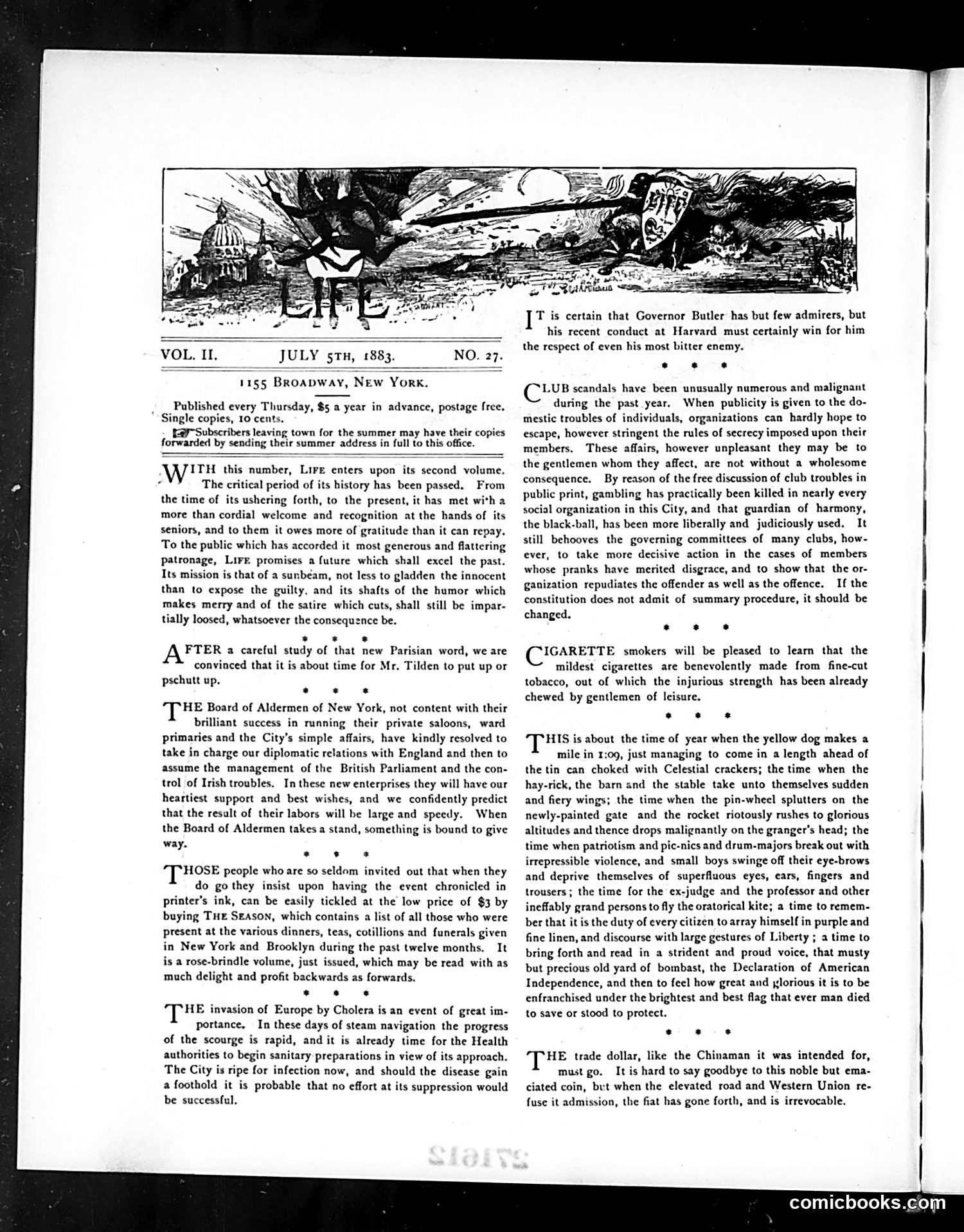
The masthead illustration depicts allegorical figures in a dramatic landscape scene, though specific identities are unclear from the image alone. The text consists of editorial commentary on contemporary issues: Governor Butler's conduct at Harvard, club scandals affecting social organizations, and a satirical reference to "that new Parisian word" (likely "chutist" or similar, now obscured). The piece mocks the Board of Aldermen for overreaching into international diplomacy and Irish affairs. There's sharp satire about social pretension—people buying expensive printed invitations to appear well-connected while actually being "choked in printer's ink." The final sections reference cholera preparedness and criticism of the trade dollar's viability as currency. The tone is consistently sarcastic toward New York's civic institutions and social climbers.
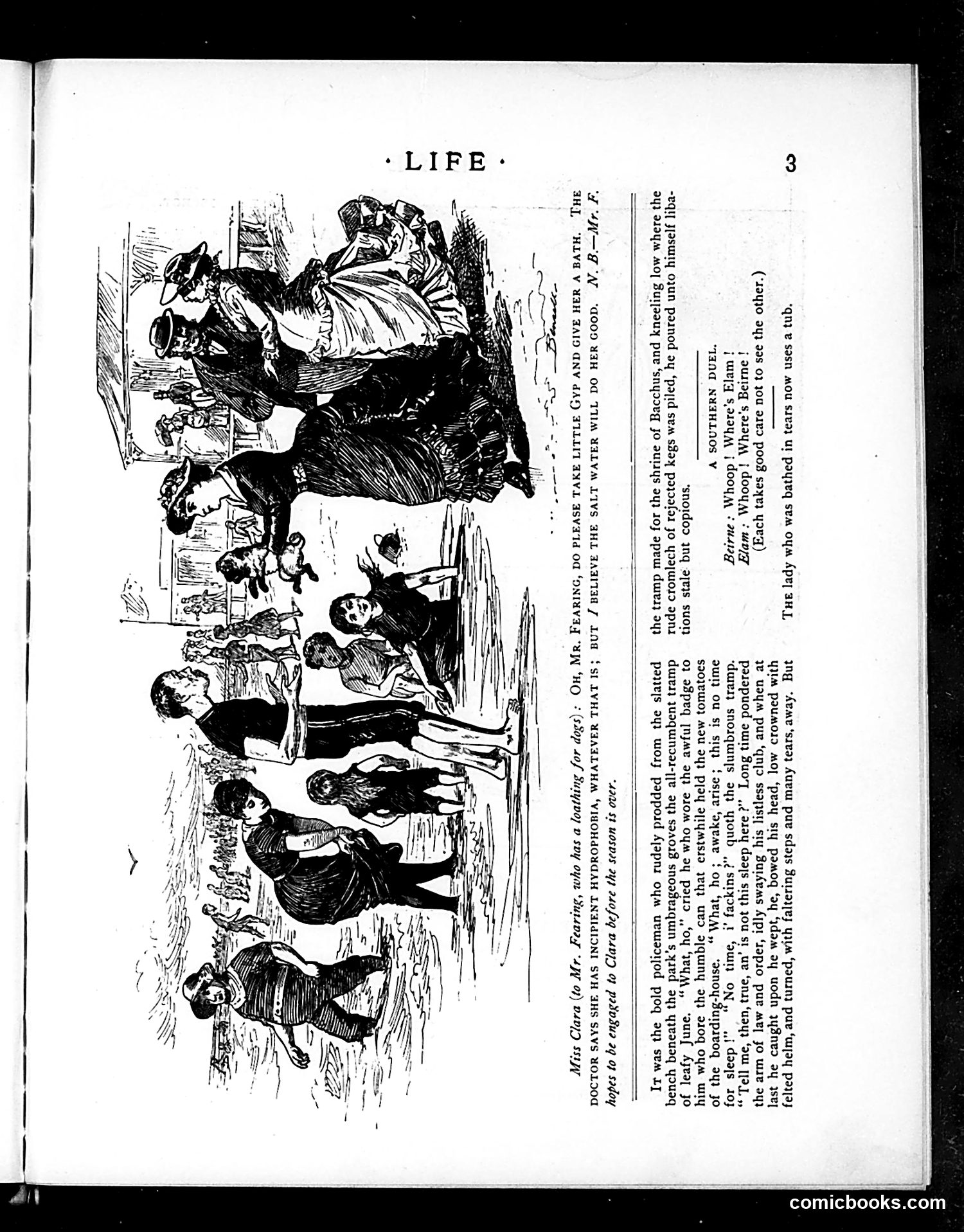
This page from *Life* magazine contains a satirical illustration about a "Southern Belle" and features accompanying text. The cartoon depicts multiple figures in what appears to be a social scene, likely critiquing attitudes or behaviors associated with the American South during the late 19th or early 20th century. The text references "Mrs. Clare" and discusses "a worthy housewife" who "modestly provided from the pantry" for guests, suggesting social pretension or hypocrisy. The narrative mentions "battered" items and references to "two use a tub," implying commentary on Southern domesticity or wealth disparity. However, without clearer image resolution and additional historical context, I cannot definitively identify specific political figures or pinpoint the exact event being satirized. The piece appears to mock Southern social conventions and possibly class distinctions of the era.
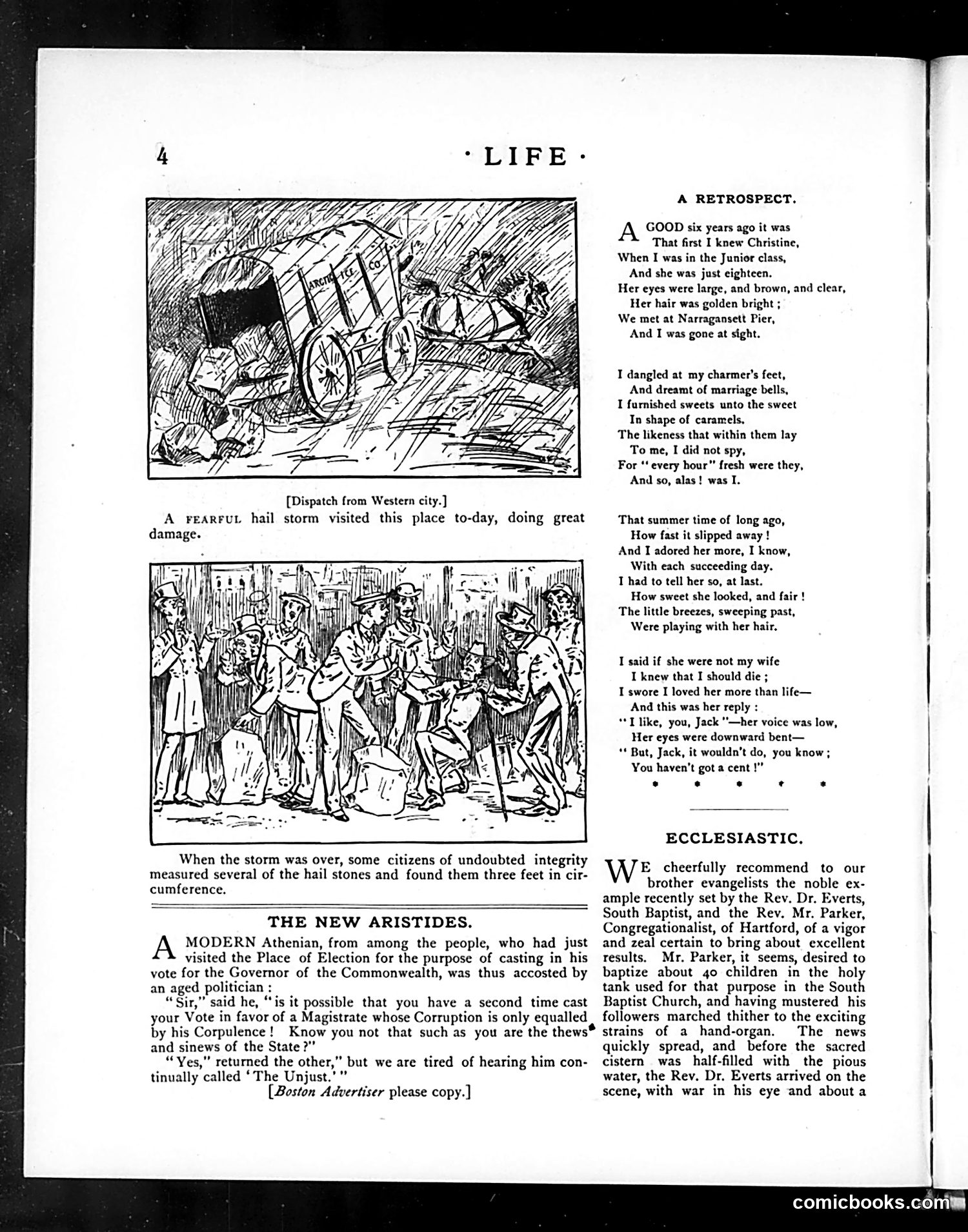
**Top Cartoon:** Depicts a severe hailstorm damaging a covered wagon, illustrating the caption "A fearful hail storm visited this place to-day, doing great damage." This is a straightforward naturalistic illustration rather than political satire. **Middle Cartoon:** Shows citizens measuring enormous hailstones after the storm passes. The caption notes they found stones "three feet in circumference"—clearly exaggerated for humorous effect, typical of 19th-century tall-tale humor. **"The New Aristides" Section:** Satirizes political corruption through dialogue between a citizen and politician. References "The Unjust" (a classical reference to Aristides the Just), mocking politicians who repeatedly win reelection despite acknowledged corruption. The joke: voters knowingly accept corrupt leaders. The page mixes weather humor with political commentary on voter complicity in governmental corruption.
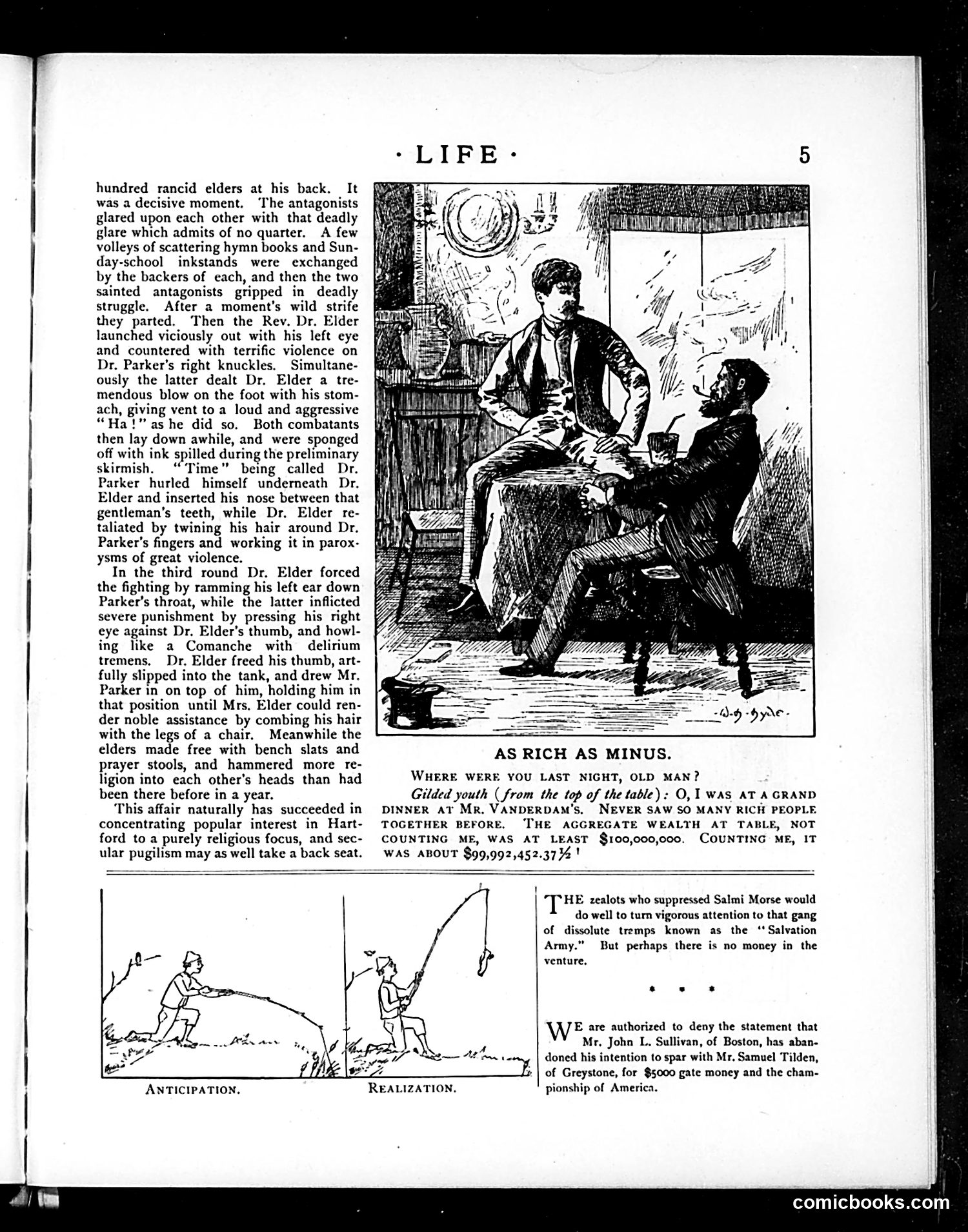
The main narrative describes a violent altercation between "Rev. Dr. Elder" and "Dr. Parker" involving rancid elders—apparently a satirical account of a religious or institutional dispute that escalated into physical fighting, with detailed descriptions of punching, ear-biting, and eye-gouging. The titled cartoon "AS RICH AS MINUS" mocks wealthy pretension through dialogue where a gilded youth boasts of attending a dinner where guests were worth $100,000,000 combined, yet his own worth was negative ($99,992,452-37½), suggesting he's a financially ruined heir spending inherited wealth. Below are two small fishing cartoons titled "ANTICIPATION" and "REALIZATION," contrasting optimistic expectation against disappointing reality. The page appears to be general satirical commentary on social hypocrisy and human folly rather than specific contemporary political events.
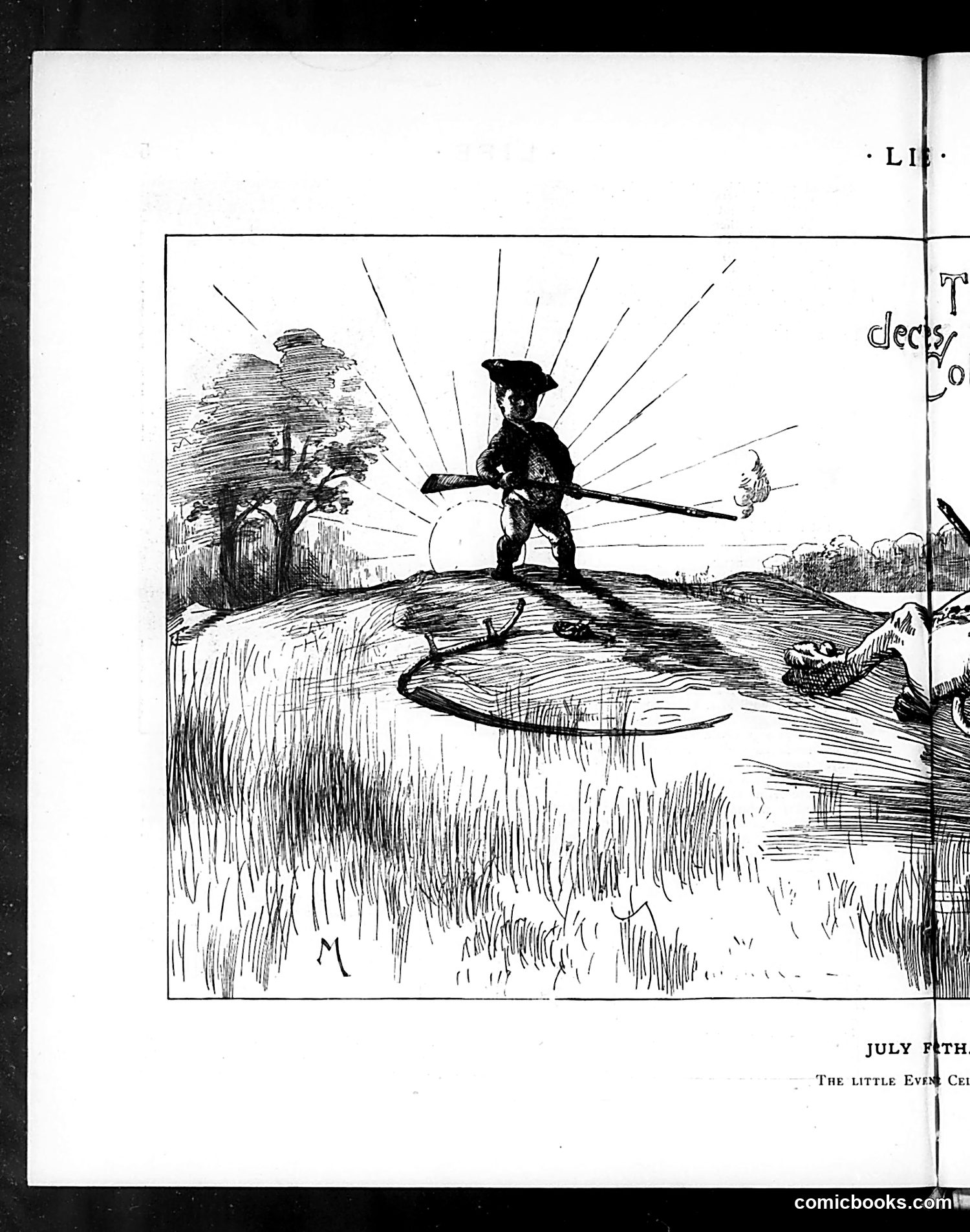
This appears to be a satirical illustration from *Life* magazine depicting a figure with an exaggerated, caricatured face standing triumphantly on a landscape. The character holds what looks like a sword or saber extended outward, with radiating lines suggesting importance or power. The figure wears formal attire and a distinctive hat. The exact identity of the caricatured figure and the specific political event referenced are unclear from the visible text alone—the caption appears incomplete ("The Little Even Cel"). The "July Fth" date reference is partially obscured. Without clearer text or additional context, I cannot definitively identify which political figure or event this satire targets, though the triumphant pose suggests commentary on a contemporary political moment or public figure.
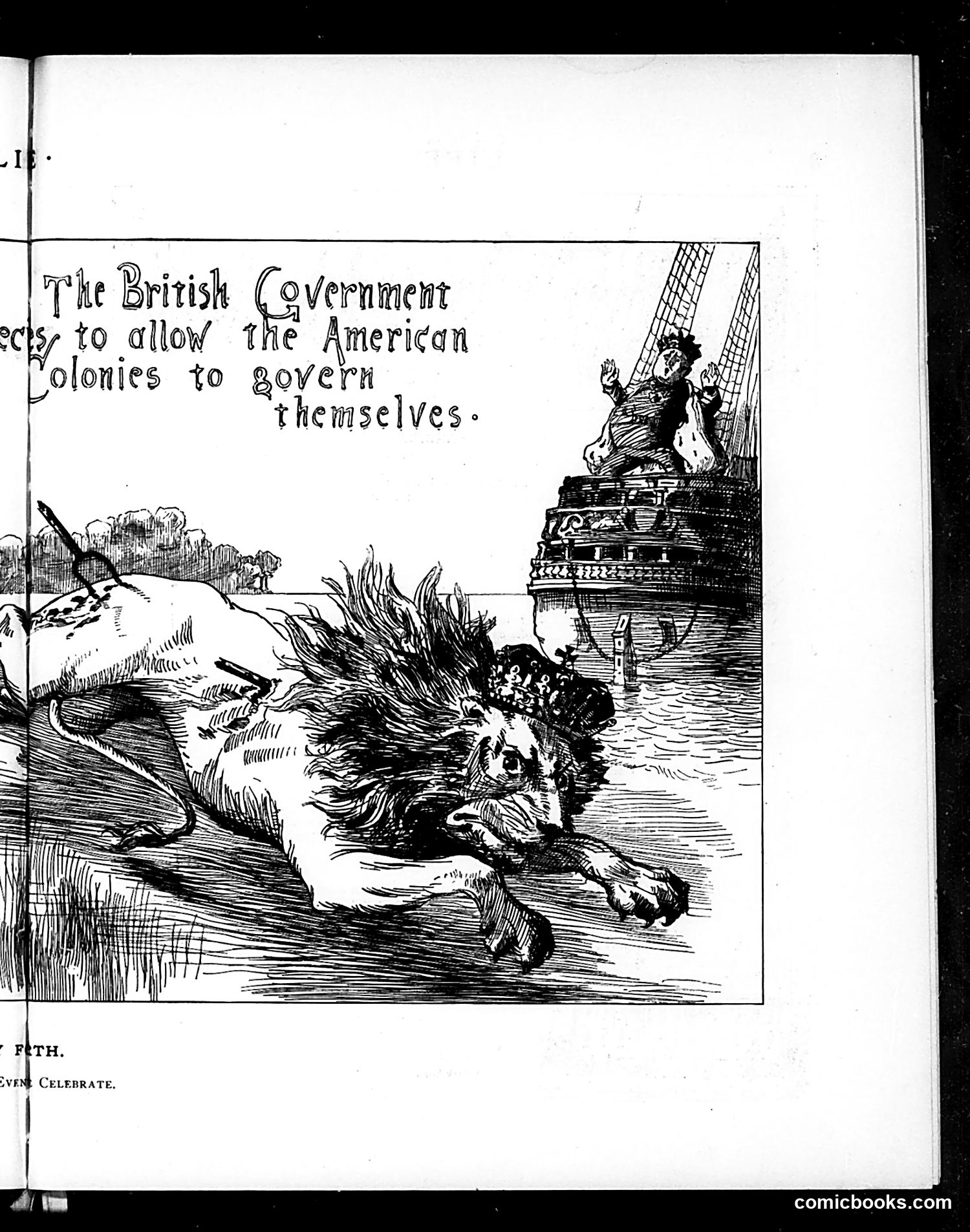
This is a political cartoon satirizing British colonial policy toward America. The text states: "The British Government seeks to allow the American Colonies to govern themselves." The image shows a lion (representing Britain) collapsed or defeated on the ground, while a ship (representing British power/navy) sails away in the background. The lion appears weakened or dying. The satire is ironic: the caption claims Britain is *generously* allowing colonial self-governance, but the visual shows Britain as defeated and powerless—suggesting the colonies have already wrested control from Britain by force, not through permission. The cartoon mocks the British government's framing of what was actually colonial rebellion and independence as a voluntary grant of freedom. This likely relates to American Revolutionary War tensions or the immediate post-independence period.
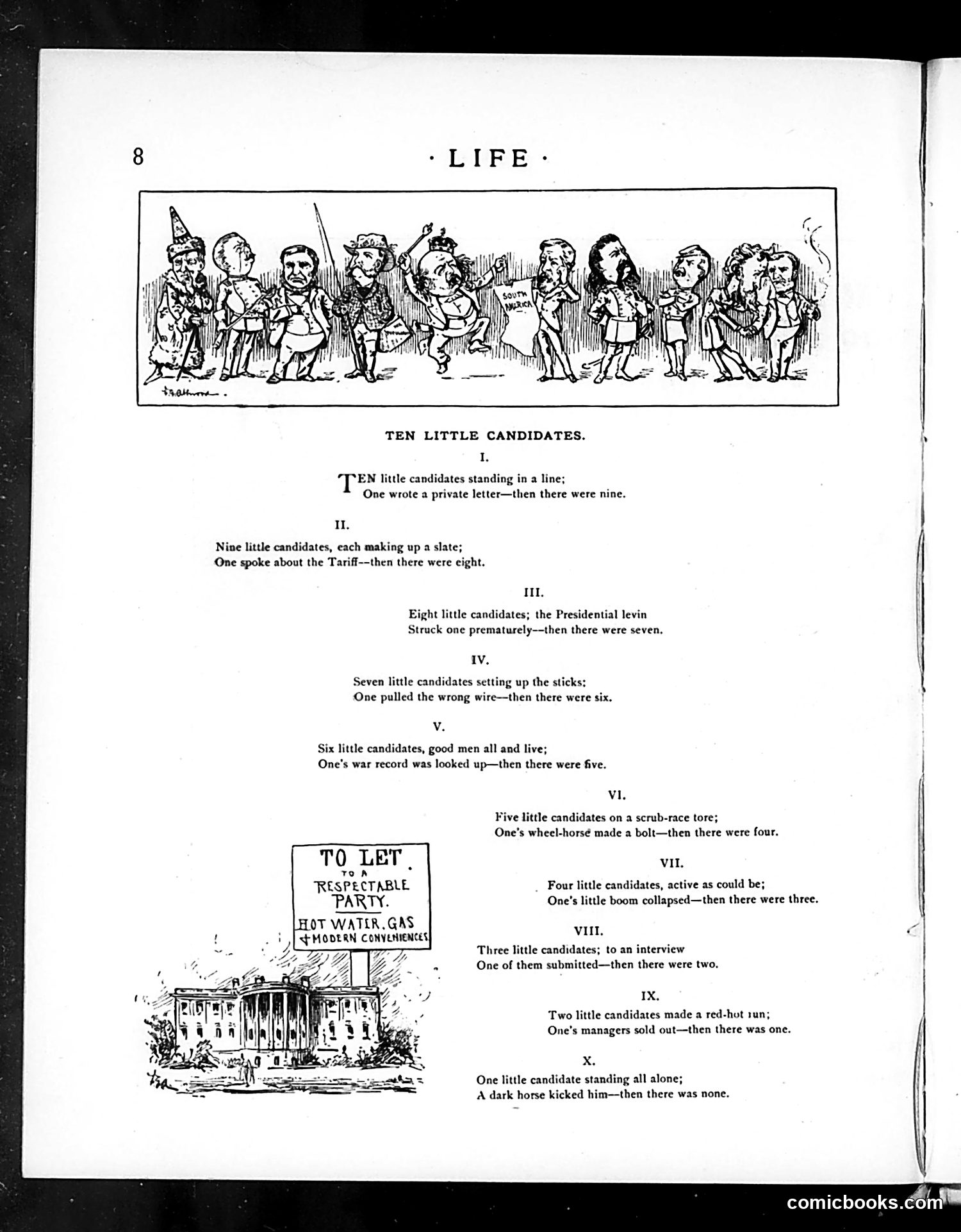
This page parodies the children's rhyme "Ten Little Indians," applying it to American political candidates eliminating each other from contention. Each verse humorously describes how a candidate drops out of the race through various scandals or mishaps: - **Private letters** and **tariff controversies** reference actual campaign vulnerabilities - **"Presidential levin" (lightning) struck one prematurely**—likely references a candidate's sudden, unexpected withdrawal or death - **War records looked up**—candidates faced scrutiny of military service - **Wheel-horse made a bolt**—a candidate's support collapsed - **Boom collapsed, submitted to interview, managers sold out**—typical political failures and betrayals The advertisement below for "a Respectable Party" with "Hot Water, Gas & Modern Conveniences" is an ironic jab at the political establishment itself—suggesting the political system is as artificial and constructed as party infrastructure. The cartoon mocks how candidates systematically self-destruct through their own missteps and compromises, leaving none viable by the end.
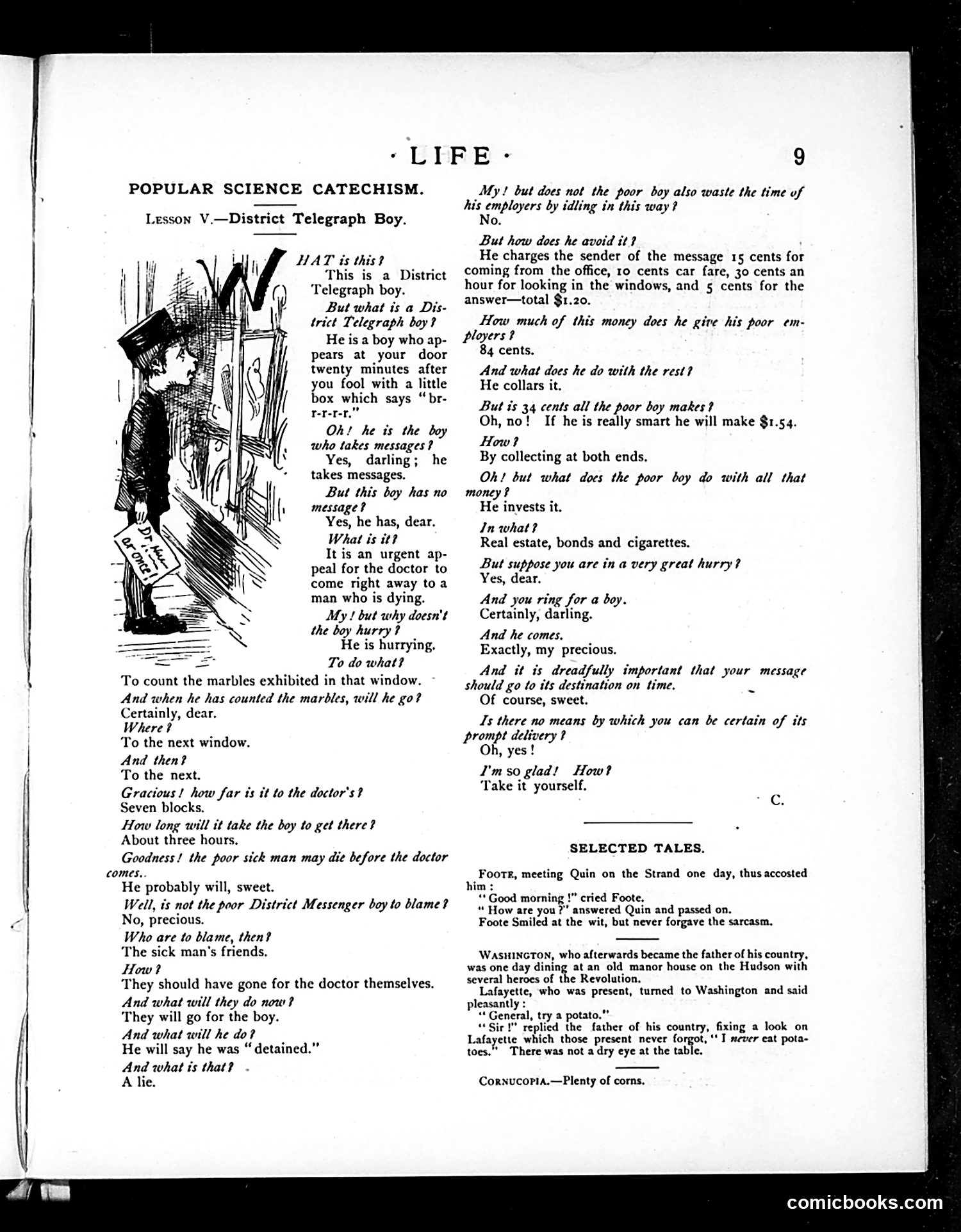
This is a satirical "Popular Science Catechism"—a mock-educational dialogue mocking the District Telegraph messenger service, a real Victorian-era delivery system where boys delivered urgent messages. The satire exposes the boy's laziness and dishonesty: summoned for an emergency (a dying man needing a doctor), he dawdles window-shopping for hours instead of hurrying. The joke escalates absurdly—he charges excessive fees (15 cents arrival, 30 cents per hour "looking in windows," etc.) totaling $1.20, keeps 36 cents profit, and invests it in real estate and cigarettes rather than helping his employer. The final punchline mocks the service's unreliability: the only way to guarantee prompt delivery is to take the message yourself. This satirizes both the messenger service's inefficiency and broader Victorian anxieties about untrustworthy working-class labor—the boy is portrayed as dishonest and negligent despite earning decent money.
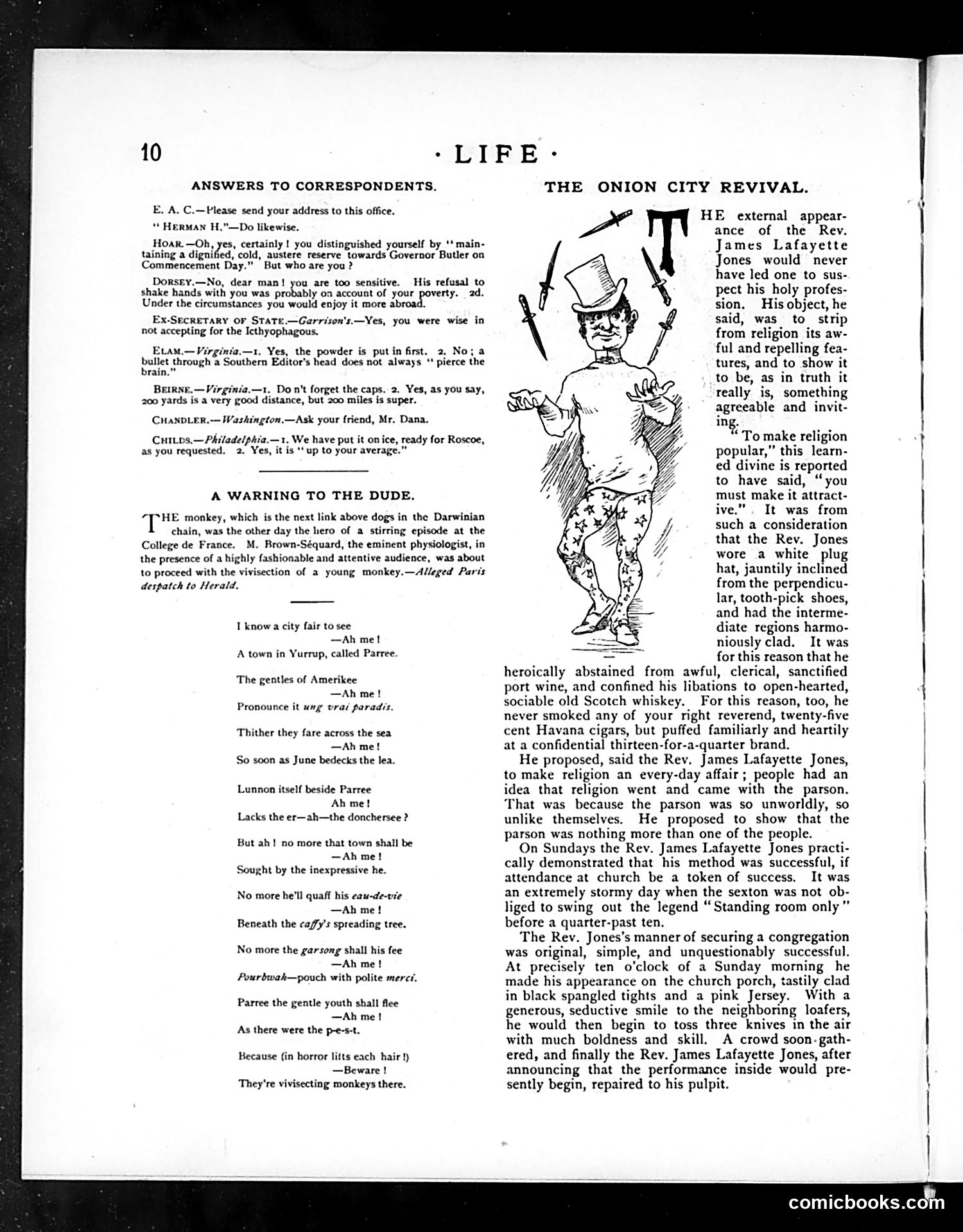
This page satirizes **Rev. James Lafayette Jones**, who attempted to make religion "popular" by adopting worldly affectations. The accompanying caricature shows him dressed in absurdly fashionable attire—a white plug hat, tooth-pick shoes, and flashy clothing—while juggling religious symbols (a cross, Bible) like carnival props. The satire's point: Jones believed stripping religion of its "awful and repelling features" would attract congregants. Instead of traditional clerical gravity, he drank Scotch whiskey, smoked cheap cigars, and dressed like a "dude" to appear relatable to ordinary people. The article mockingly chronicles his Sunday "performances"—tossing knives on the church porch before services to draw crowds, treating attendance as mere entertainment success. The broader satirical target is the commercialization and trivialization of religion through showmanship, suggesting that making faith "attractive" through fashion and theatricality fundamentally corrupts its spiritual purpose. The "Onion City" likely references Cincinnati.
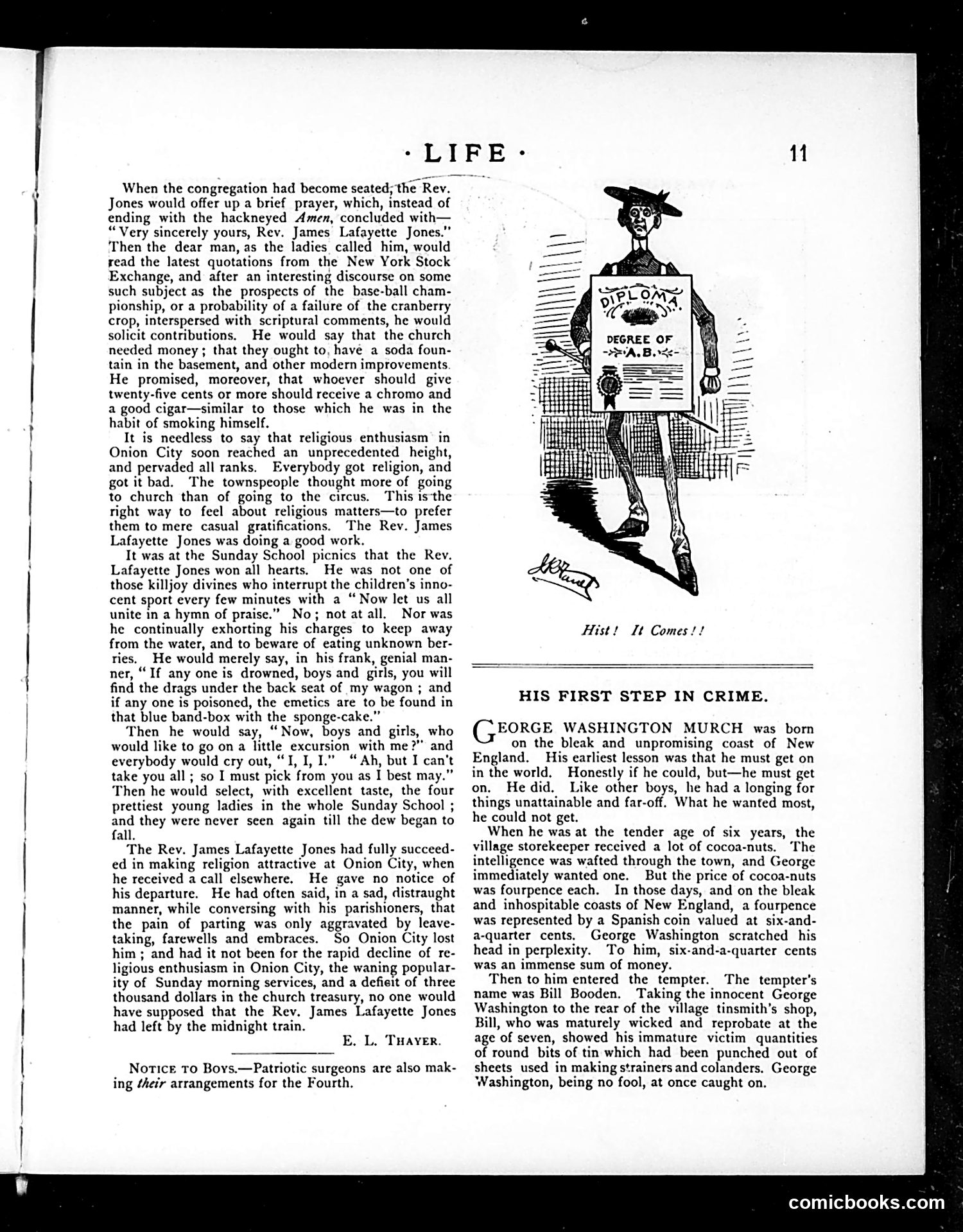
This 1890s satirical page contains two separate stories mocking American society. **"Rev. James Lafayette Jones"** (by E.L. Thayer) satirizes corrupt clergy and gullible congregations. The reverend exploits his parishioners by mixing stock-market tips with scripture, offering chromos and cigars as donation incentives, and soliciting funds for church "improvements" (a soda fountain). The darkest satire: he selects the four prettiest young ladies for Sunday School outings from which they "were never seen again till the dew began to fall"—suggesting predatory behavior. He abandons the parish without notice when religious enthusiasm wanes and church funds disappear. **The cartoon** shows a diploma-holding figure labeled "Hiss! It Comes!!" — likely representing a fraudulent "degree" or credential, reinforcing themes of fakery. **"His First Step in Crime"** (George Washington Murch) begins a story about a boy's moral corruption, starting with childhood theft of cocoa-nuts, establishing Life's moralistic yet ironic social commentary on American character. Both pieces satirize hypocrisy, greed, and moral decay in Gilded Age America.
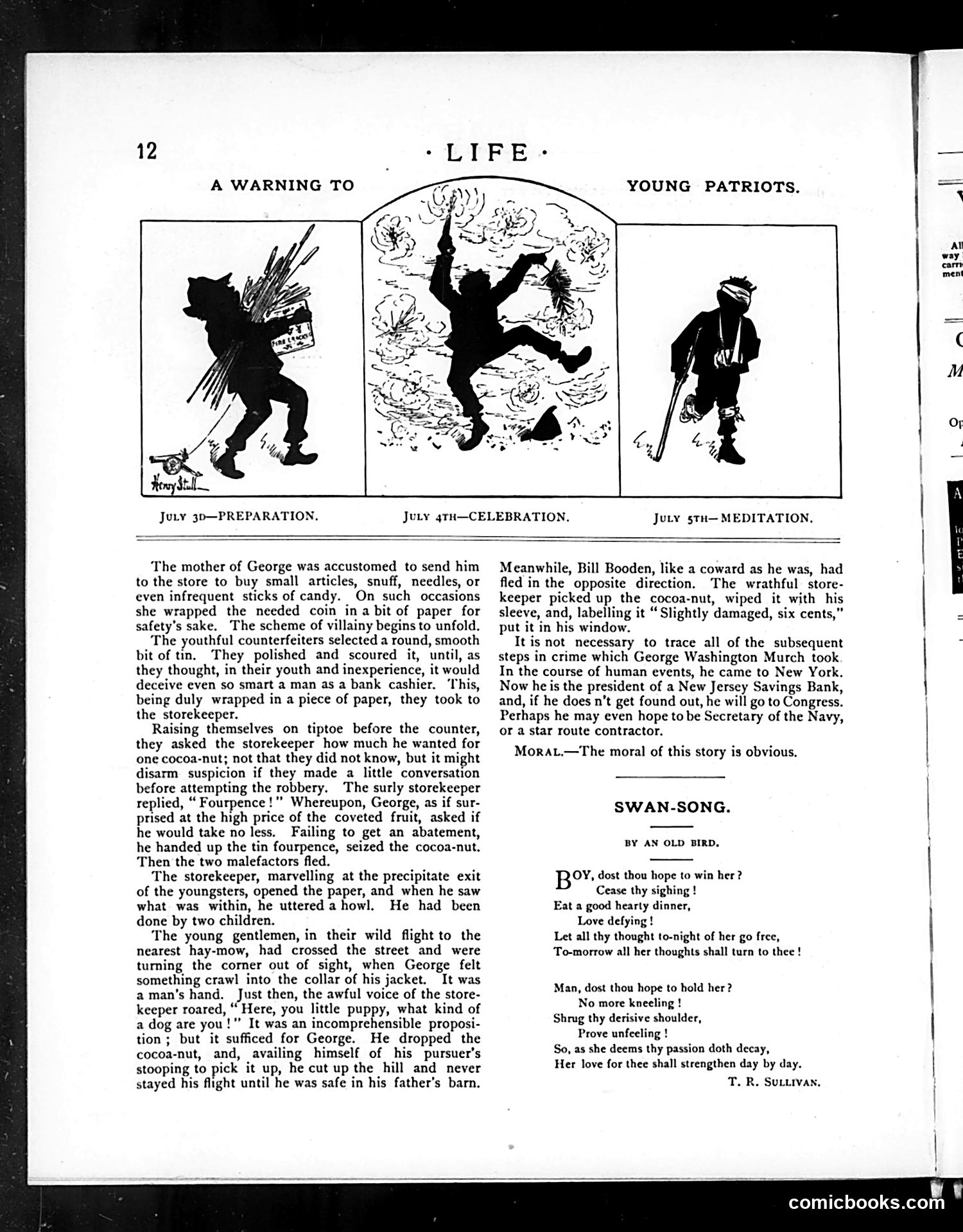
This three-panel cartoon satirizes American hypocrisy about morality and success. The narrative follows young George Washington Murch's counterfeiting scheme: he creates a fake tin coin, defrauds a storekeeper of a coconut, and escapes. The satire's punch lies in the "moral": despite this crime, George prospers, becoming a New Jersey bank president and potential congressman—suggesting that corruption and dishonesty are actually pathways to American success and respectability. The storekeeper, meanwhile, simply relabels and resells the damaged coconut, implying widespread petty fraud. The three stages (Preparation, Celebration, Meditation) mock the notion that such youthful transgressions carry consequences. By positioning this as a "warning to young patriots," Life ironically suggests American institutions reward rather than punish such behavior, critiquing both youth delinquency and systemic corruption.
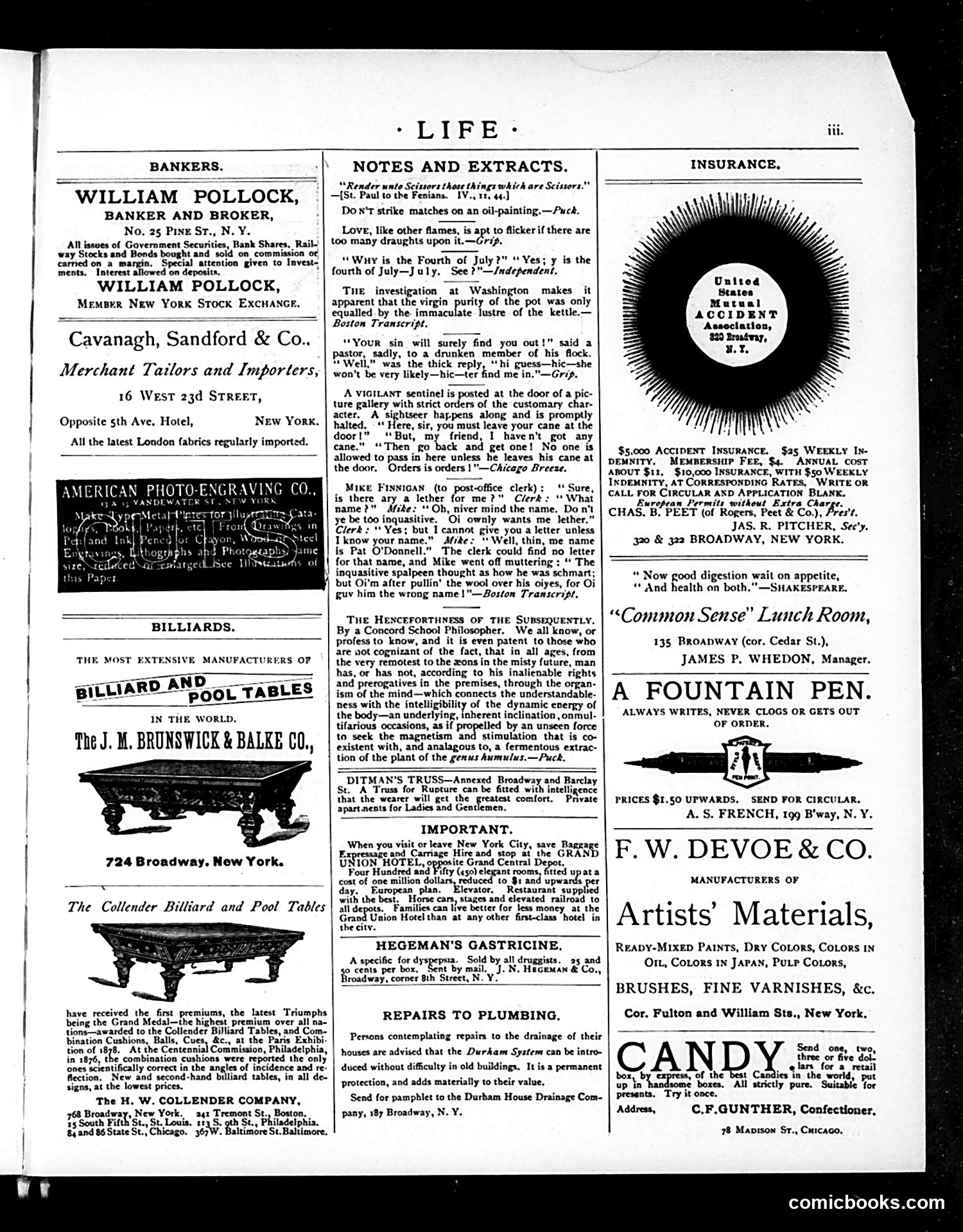
This page is primarily advertising and brief comedic notes rather than political cartoons. The "NOTES AND EXTRACTS" section contains satirical one-liners from various publications (Puck, Grip, the Boston Transcript, etc.). These short jokes mock contemporary social types: a drunken parishioner evading moral judgment, Irish immigrants with poor English (Mike Finnigan), and pompous pseudo-intellectual philosophy ("The Henceforthness of the Subsequently"). The humor is gentle, class-based satire typical of 1870s-80s American magazines—poking fun at working-class Irish immigrants, drunkenness, and pretentious intellectualism. There are no specific political figures or events referenced. The page is dominated by advertisements for bankers, billiard tables, tailors, and art supplies, with the satirical content relegated to small print.
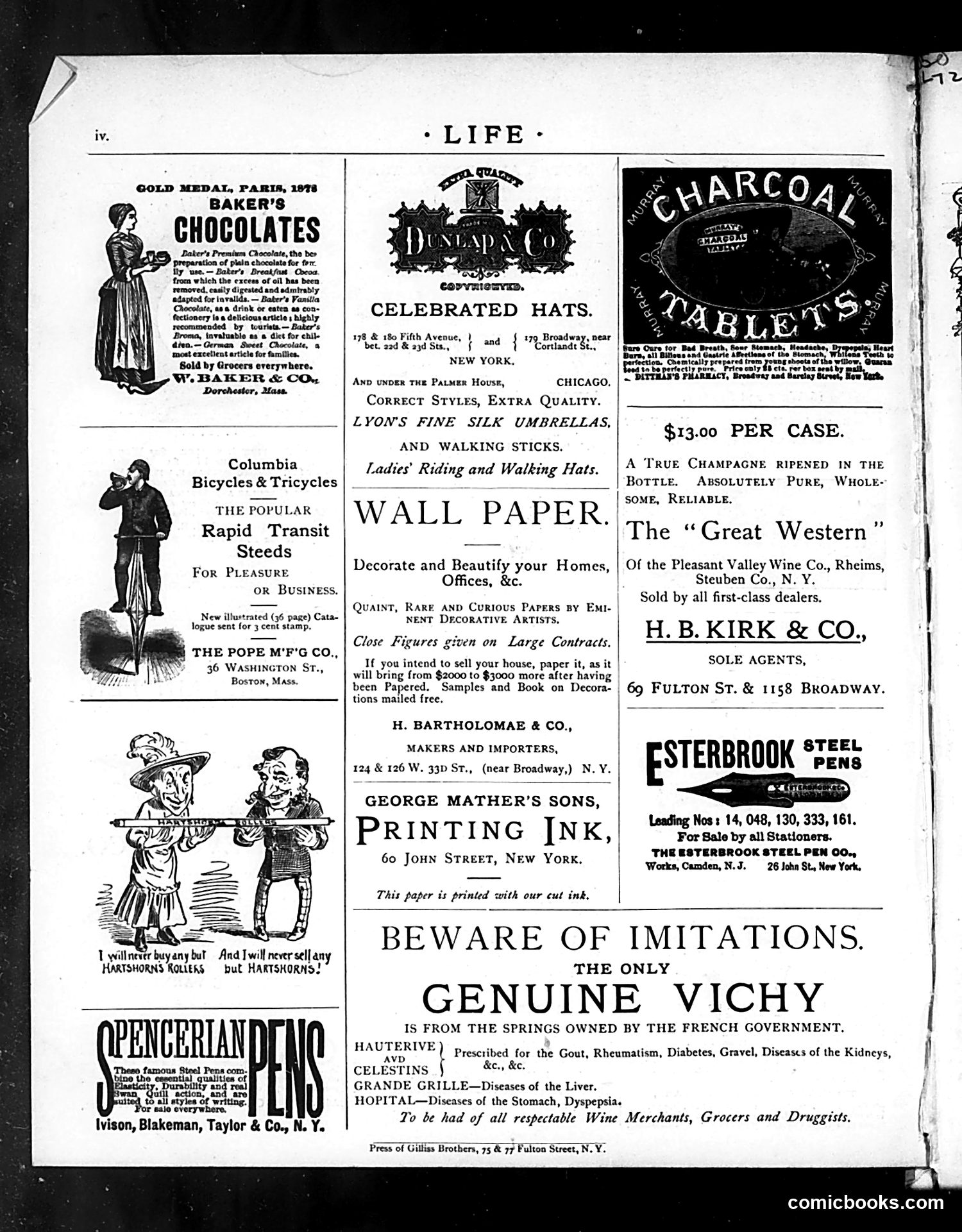
This is primarily an **advertising page** with one small cartoon. The page contains late-19th-century product ads for chocolates, bicycles, hats, wallpaper, wine, pens, and patent medicines. The sole cartoon appears in the lower left: two figures (appearing to be a woman and man) hold a large roller, with dialogue stating "I will never buy any but HARTSHORNS Rollers" and "And I will never sell any but HARTSHORNS!" This is a **product endorsement joke**—the figures represent satisfied customer and vendor, humorously emphasizing brand loyalty for Hartshorns window roller shades. It's gentle advertising humor rather than political satire. The page otherwise reflects consumer goods marketed to middle/upper-class Americans: imported French mineral water (Vichy), champagne, silk umbrellas, and decorative wallpaper. The repetition of "beware of imitations" suggests counterfeit products were common concerns of the era.